Design Thinking

Your constantly-updated definition of Design Thinking and collection of videos and articles.
Be a conversation starter: Share this page and inspire others!

5,029 Shares

What is Design Thinking?

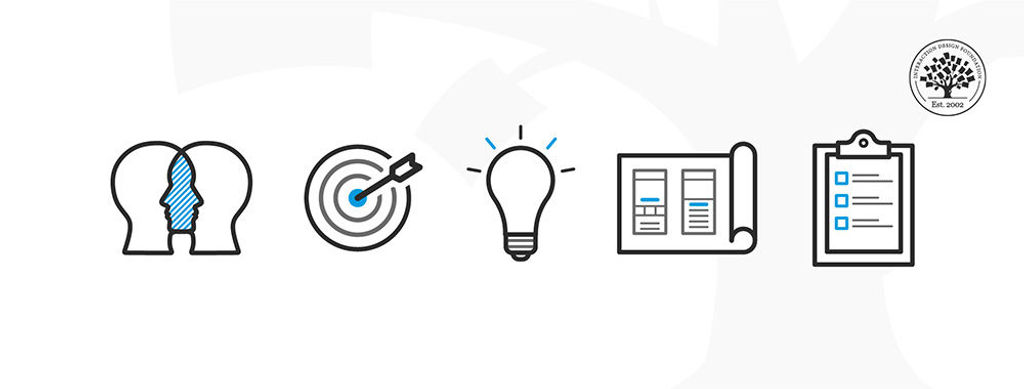
Design thinking is a non-linear, iterative process that teams use to understand users, challenge assumptions, redefine problems and create innovative solutions to prototype and test. It is most useful to tackle ill-defined or unknown problems and involves five phases: Empathize, Define, Ideate, Prototype and Test.

Transcript

Why Is Design Thinking so Important?

“Design thinking is a human-centered approach to innovation that draws from the designer's toolkit to integrate the needs of people, the possibilities of technology, and the requirements for business success.”

— Tim Brown, CEO of IDEO

Design thinking fosters innovation. Companies must innovate to survive and remain competitive in a rapidly changing environment. In design thinking, cross-functional teams work together to understand user needs and create solutions that address those needs. Moreover, the design thinking process helps unearth creative solutions.

Design teams use design thinking to tackle ill-defined/unknown problems (aka wicked problems). Alan Dix, Professor of Human-Computer Interaction, explains what wicked problems are in this video.

Transcript

Wicked problems demand teams to think outside the box, take action immediately, and constantly iterate—all hallmarks of design thinking.

Don Norman: Father of User Experience design, author of the legendary book The Design of Everyday Things, co-founder of the Nielsen Norman Group, and former VP of the Advanced Technology Group at Apple, explains why the designer’s way of thinking is so powerful when it comes to such complex problems.

Transcript

Design thinking offers practical methods and tools that major companies like Google, Apple and Airbnb use to drive innovation. From architecture and engineering to technology and services, companies across industries have embraced the methodology to drive innovation and address complex problems. 

The End Goal of Design Thinking: Be Desirable, Feasible and Viable
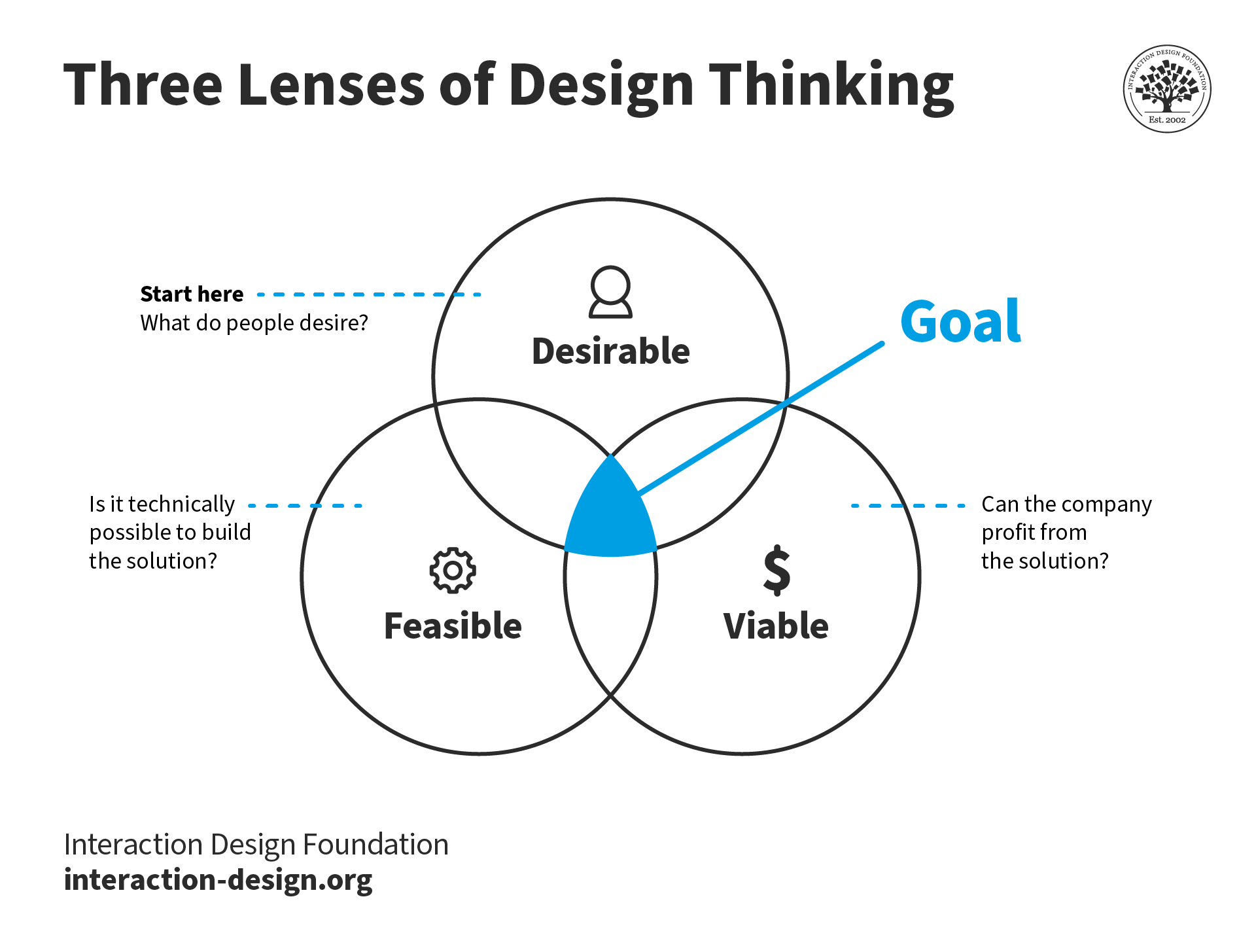
Three Lenses of Design Thinking.

The design thinking process aims to satisfy three criteria: desirability (what do people desire?), feasibility (is it technically possible to build the solution?) and viability (can the company profit from the solution?). Teams begin with desirability and then bring in the other two lenses.

© Interaction Design Foundation, CC BY-SA 4.0

Desirability: Meet People’s Needs

The design thinking process starts by looking at the needs, dreams and behaviors of people—the end users. The team listens with empathy to understand what people want, not what the organization thinks they want or need. The team then thinks about solutions to satisfy these needs from the end user’s point of view.

Feasibility: Be Technologically Possible

Once the team identifies one or more solutions, they determine whether the organization can implement them. In theory, any solution is feasible if the organization has infinite resources and time to develop the solution. However, given the team’s current (or future resources), the team evaluates if the solution is worth pursuing. The team may iterate on the solution to make it more feasible or plan to increase its resources (say, hire more people or acquire specialized machinery).

At the beginning of the design thinking process, teams should not get too caught up in the technical implementation. If teams begin with technical constraints, they might restrict innovation.

Viability: Generate Profits

A desirable and technically feasible product isn’t enough. The organization must be able to generate revenues and profits from the solution. The viability lens is essential not only for commercial organizations but also for non-profits. 

Traditionally, companies begin with feasibility or viability and then try to find a problem to fit the solution and push it to the market. Design thinking reverses this process and advocates that teams begin with desirability and bring in the other two lenses later.

The Five Stages of Design Thinking

Stanford University’s Hasso Plattner Institute of Design, commonly known as the d.school, is renowned for its pioneering approach to design thinking. Their design process has five phases: Empathize, Define, Ideate, Prototype, and Test. These stages are not always sequential. Teams often run them in parallel, out of order, and repeat them as needed.

Transcript

Stage 1: Empathize—Research Users' Needs

The team aims to understand the problem, typically through user research. Empathy is crucial to design thinking because it allows designers to set aside your assumptions about the world and gain insight into users and their needs.

Stage 2: Define—State Users' Needs and Problems

Once the team accumulates the information, they analyze the observations and synthesize them to define the core problems. These definitions are called problem statements. The team may create personas to help keep efforts human-centered.

Stage 3: Ideate—Challenge Assumptions and Create Ideas

With the foundation ready, teams gear up to “think outside the box.” They brainstorm alternative ways to view the problem and identify innovative solutions to the problem statement.

Stage 4: Prototype—Start to Create Solutions

This is an experimental phase. The aim is to identify the best possible solution for each problem. The team produces inexpensive, scaled-down versions of the product (or specific features found within the product) to investigate the ideas. This may be as simple as paper prototypes.

Stage 5: Test—Try the Solutions Out

The team tests these prototypes with real users to evaluate if they solve the problem. The test might throw up new insights, based on which the team might refine the prototype or even go back to the Define stage to revisit the problem.

These stages are different modes that contribute to the entire design project rather than sequential steps. The goal is to gain a deep understanding of the users and their ideal solution/product.
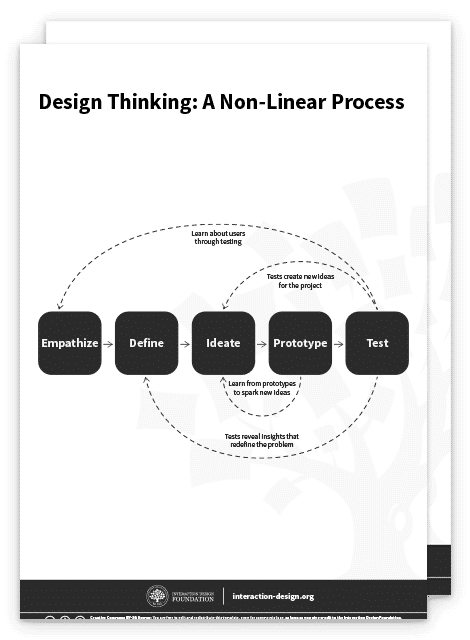
Advance Your Career With This Free Template for “Design Thinking: A Non-Linear Process”
Design Thinking: A Non-Linear Process
We respect your privacy
Get 1 powerful email each week: Design a life you love!

Design Thinking Frameworks

There is no single definition or process for design thinking. The five-stage design thinking methodology described above is just one of several frameworks.

Copyright
Transcript

Innovation doesn’t follow a linear path or have a clear-cut formula. Global design leaders and consultants have interpreted the abstract design process in different ways and have proposed other frameworks of design thinking.

Head, Heart and Hand by the American Institution of Graphic Arts (AIGA)

The Head, Heart, and Hand approach by AIGA (American Institute of Graphic Arts) is a holistic perspective on design. It integrates the intellectual, emotional, and practical aspects of the creative process.
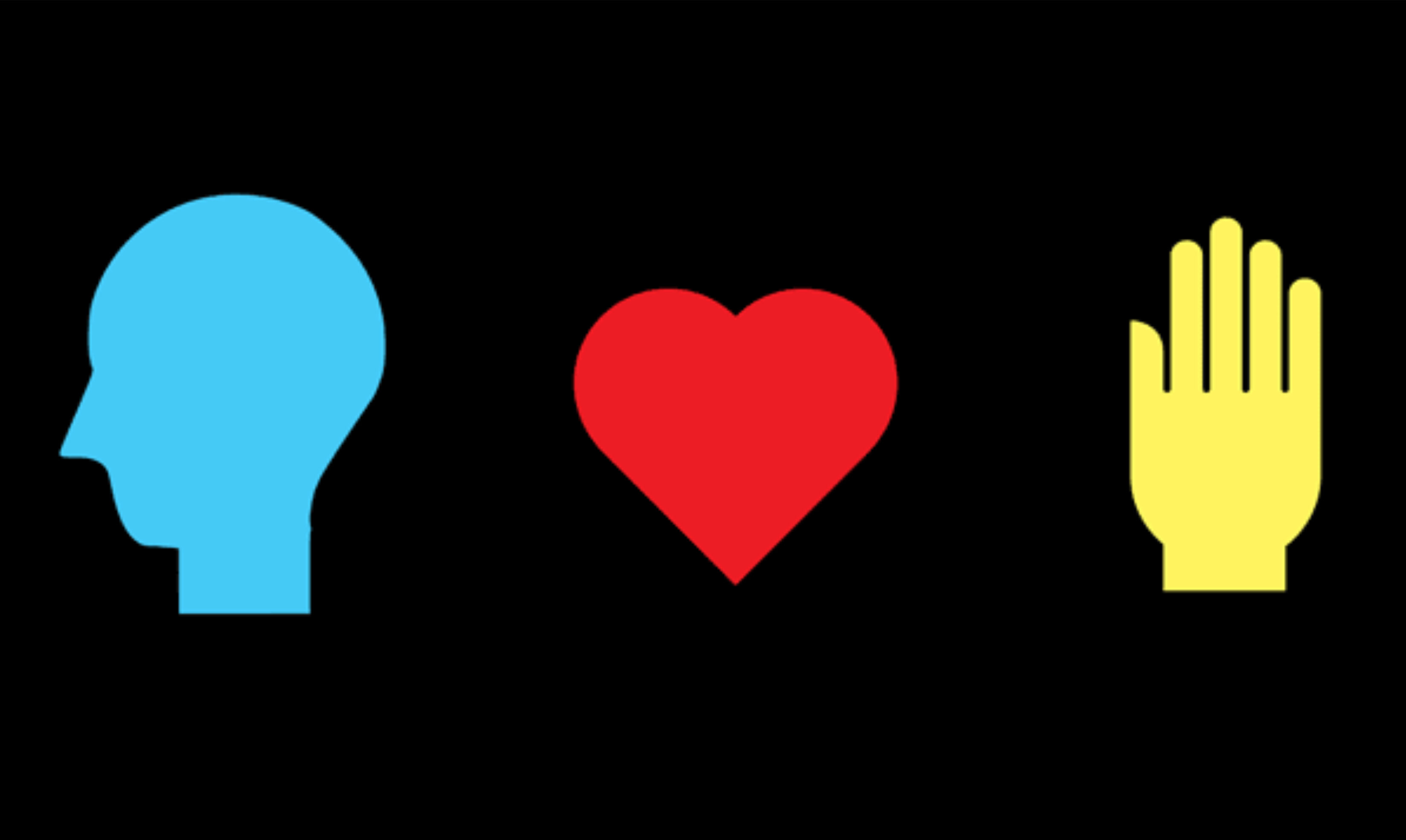
More than a process, the Head, Heart and Hand framework outlines the different roles that designers must perform to create great results.

© American Institute of Graphic Arts, Fair Use

Head” symbolizes the intellectual component. The team focuses on strategic thinking, problem-solving and the cognitive aspects of design. It involves research and analytical thinking to ensure that design decisions are purposeful.

Heart” represents the emotional dimension. It emphasizes empathy, passion, and human-centeredness. This aspect is crucial in understanding the users’ needs, desires, and experiences to ensure that designs resonate on a deeper, more personal level.

Hand” signifies the practical execution of ideas, the craftsmanship, and the skills necessary to turn concepts into tangible solutions. This includes the mastery of tools, techniques, and materials, as well as the ability to implement and execute design ideas effectively.

Inspire, Ideate, Implement by IDEO

IDEO is a leading design consultancy and has developed its own version of the design thinking framework.
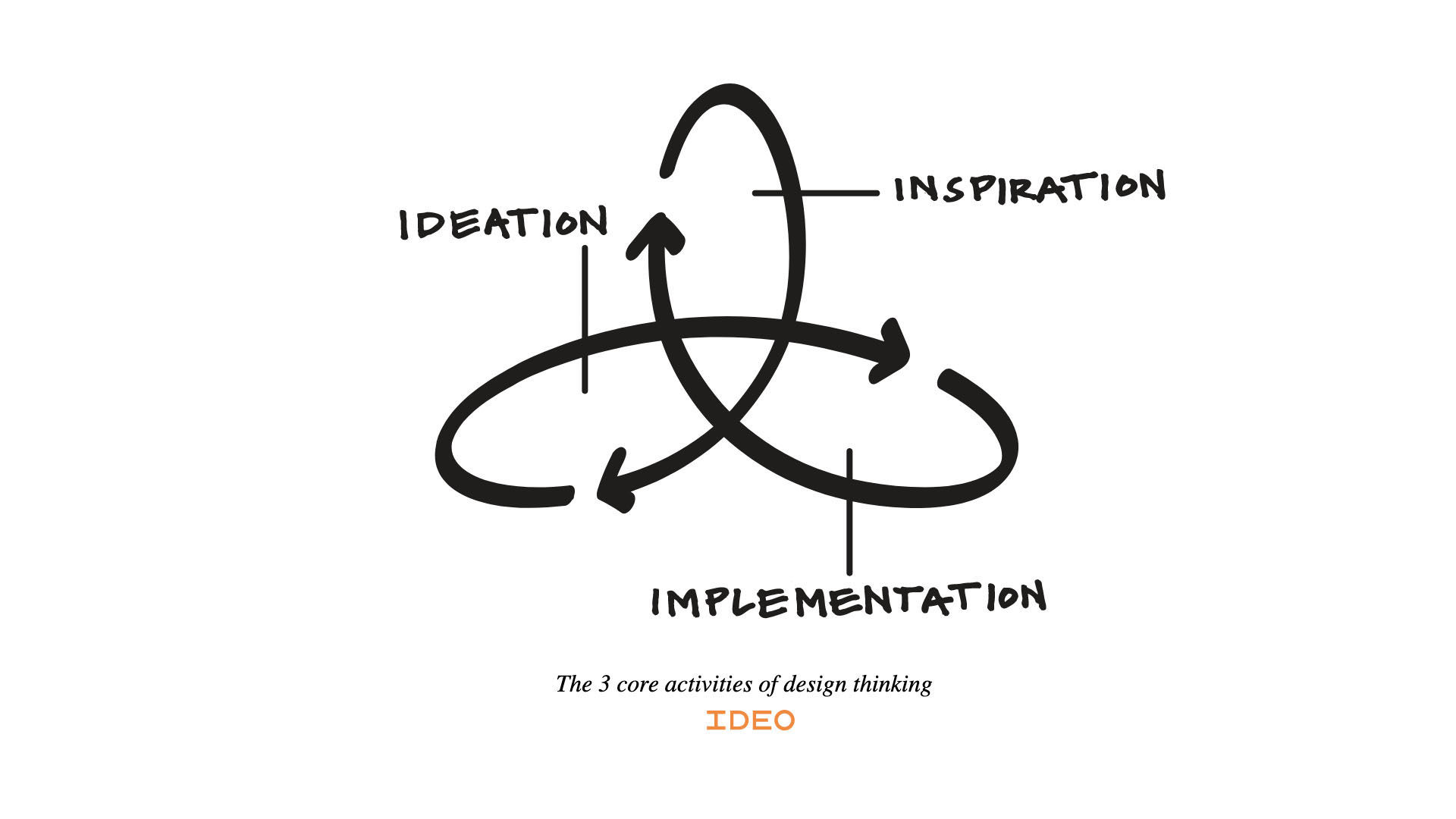
The 3 core activities of deisgn thinking, by IDEO.

IDEO’s design thinking process is a cyclical three-step process that involves Inspiration, Ideation and Implementation.

© IDEO, Public License

In the “Inspire” phase, the team focuses on understanding users’ needs, behaviors, and motivations. The team empathizes with people through observation and user interviews to gather deep insights.

In the “Ideate” phase, the team synthesizes the insights gained to brainstorm a wide array of creative solutions. This stage encourages divergent thinking, where teams focus on quantity and variety of ideas over immediate practicality. The goal is to explore as many possibilities as possible without constraints.

In the “Implement” phase, the team brings these ideas to life through prototypes. The team tests, iterates and refines these ideas based on user feedback. This stage is crucial for translating abstract concepts into tangible, viable products, services, or experiences.

The methodology emphasizes collaboration and a multidisciplinary approach throughout each phase to ensure solutions are innovative and deeply rooted in real human needs and contexts.

The Double Diamond by the Design Council

In the book Designing Social Systems in a Changing World, Béla Heinrich Bánáthy, Professor at San Jose State University and UC Berkeley, created a “divergence-convergence model” diagram. The British Design Council interpreted this diagram to create the Double Diamond design process model.
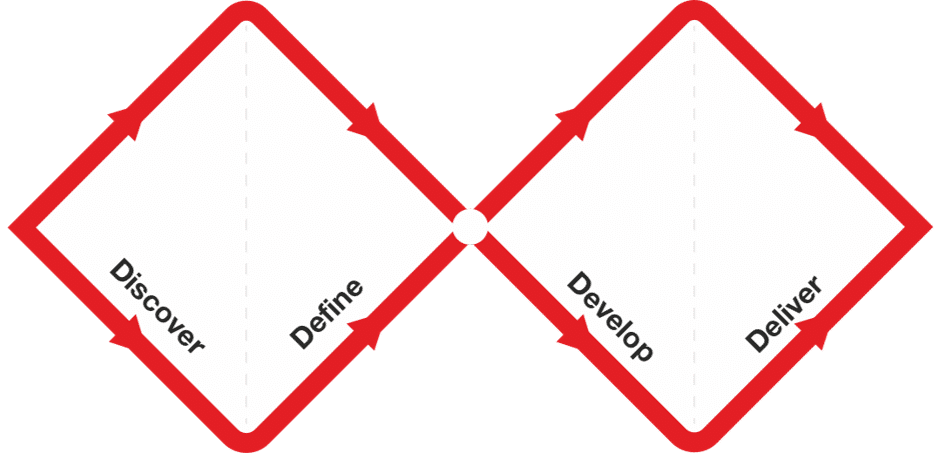
Design Council's Double Diamond

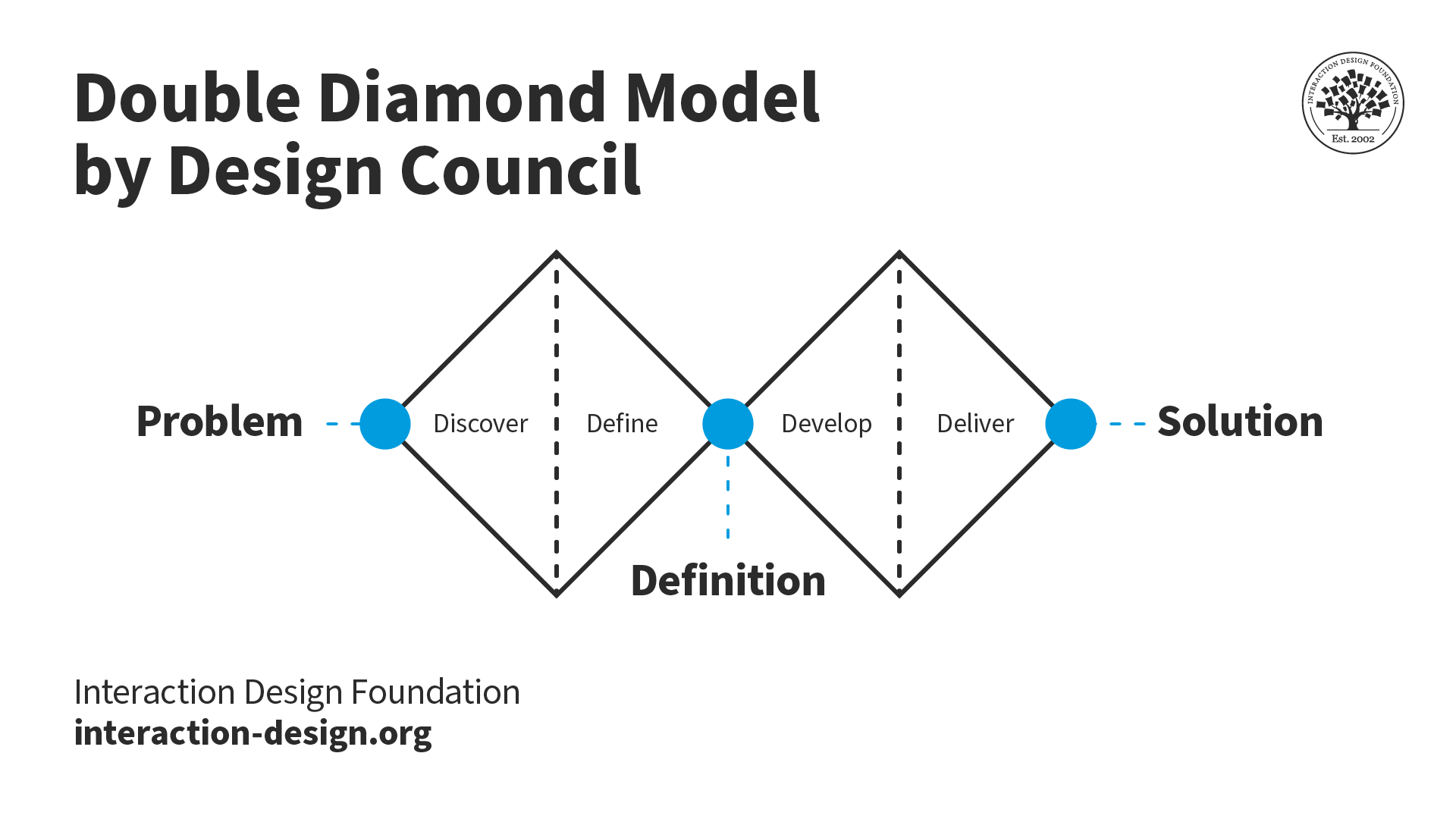
As the name suggests, the double diamond model consists of two diamonds—one for the problem space and the other for the solution space. The model uses diamonds to represent the alternating diverging and converging activities.

© Design Council, CC BY 4.0

In the diverging “Discover” phase, designers gather insights and empathize with users’ needs. The team then converges in the “Define” phase to identify the problem.

The second, solution-related diamond, begins with “Develop,” where the team brainstorms ideas. The final stage is “Deliver,” where the team tests the concepts and implements the most viable solution.

This model balances expansive thinking with focused execution to ensure that design solutions are both creative and practical. It underscores the importance of understanding the problem thoroughly and carefully crafting the solution, making it a staple in many design and innovation processes.
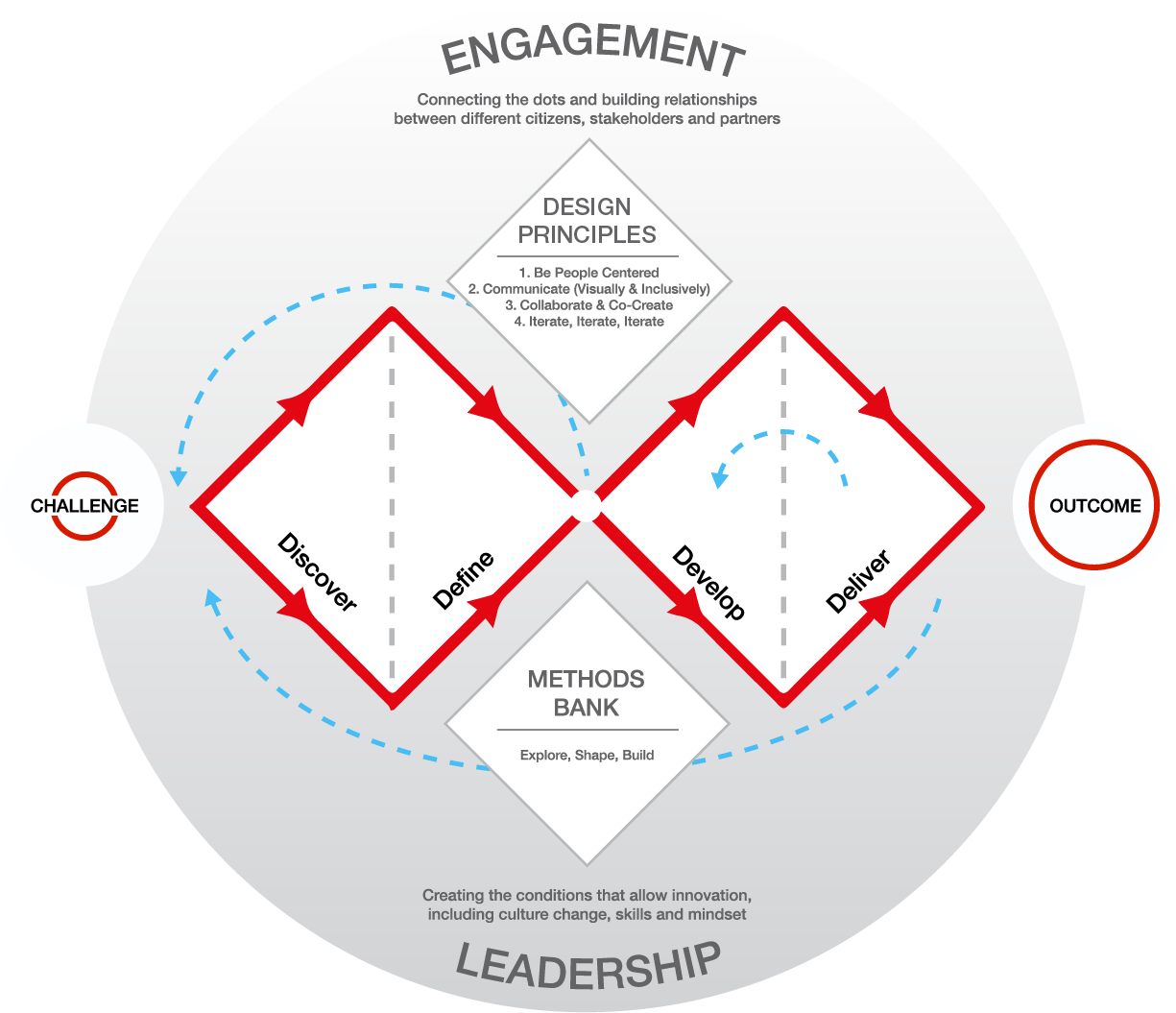
With the widespread adoption of the double diamond framework, Design Council’s simple visual evolved.

© Design Council, CC BY 4.0

In this expanded and annotated version, the framework emphasizes four design principles:

  1. Be people-centered.

  2. Communicate (visually and inclusively).

  3. Collaborate and co-create.

  4. Iterate, iterate, iterate!

The updated version also highlights the importance of leadership (to create an environment that allows innovation) and engagement (to connect with different stakeholders and involve them in the design process).

Common Elements of Design Thinking Frameworks

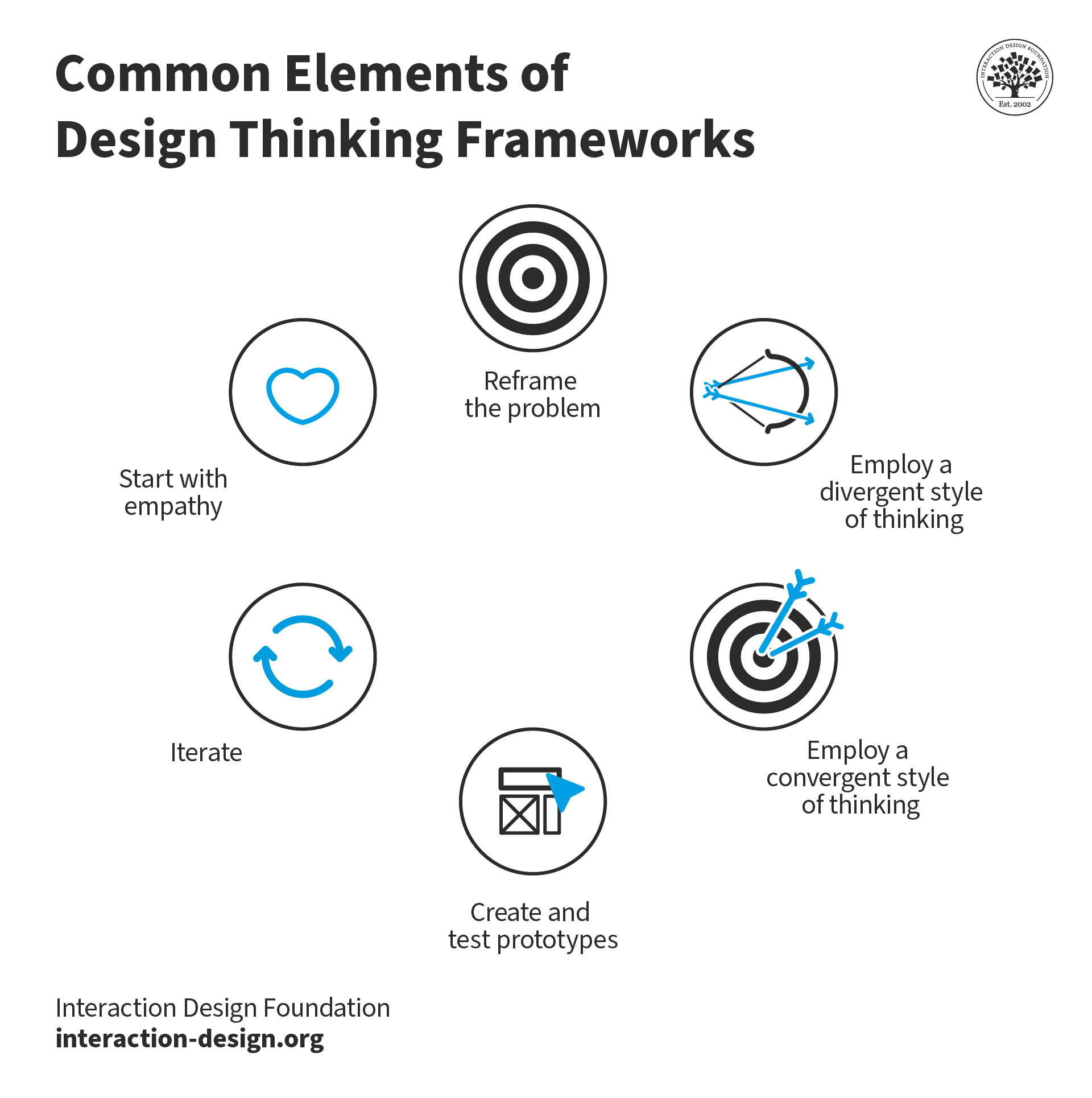
On the surface, design thinking frameworks look very different—they use alternative names and have different numbers of steps. However, at a fundamental level, they share several common traits.
© Interaction Design Foundation, CC BY-SA 4.0

  1. Start with empathy. Focus on the people to come up with solutions that work best for individuals, business, and society.

  2. Reframe the problem or challenge at hand. Don’t rush into a solution. Explore the problem space and look at the issue through multiple perspectives to gain a more holistic, nuanced understanding.

  3. Initially, employ a divergent style of thinking (analyze). In the problem space, gather as many insights as possible. In the solution space, encourage team members to generate and explore as many solutions as possible in an open, judgment-free ideation space.

  4. Later, employ a convergent style of thinking (synthesize). In the problem space, synthesize all data points to define the problem. In the solution space, whittle down all the ideas—isolate, combine and refine potential solutions to create more mature ideas.

  5. Create and test prototypes. Solutions that make it through the previous stages get tested further to remove potential issues.

  6. Iterate. As the team progresses through the various stages, they revisit different stages and may redefine the challenge based on new insights.
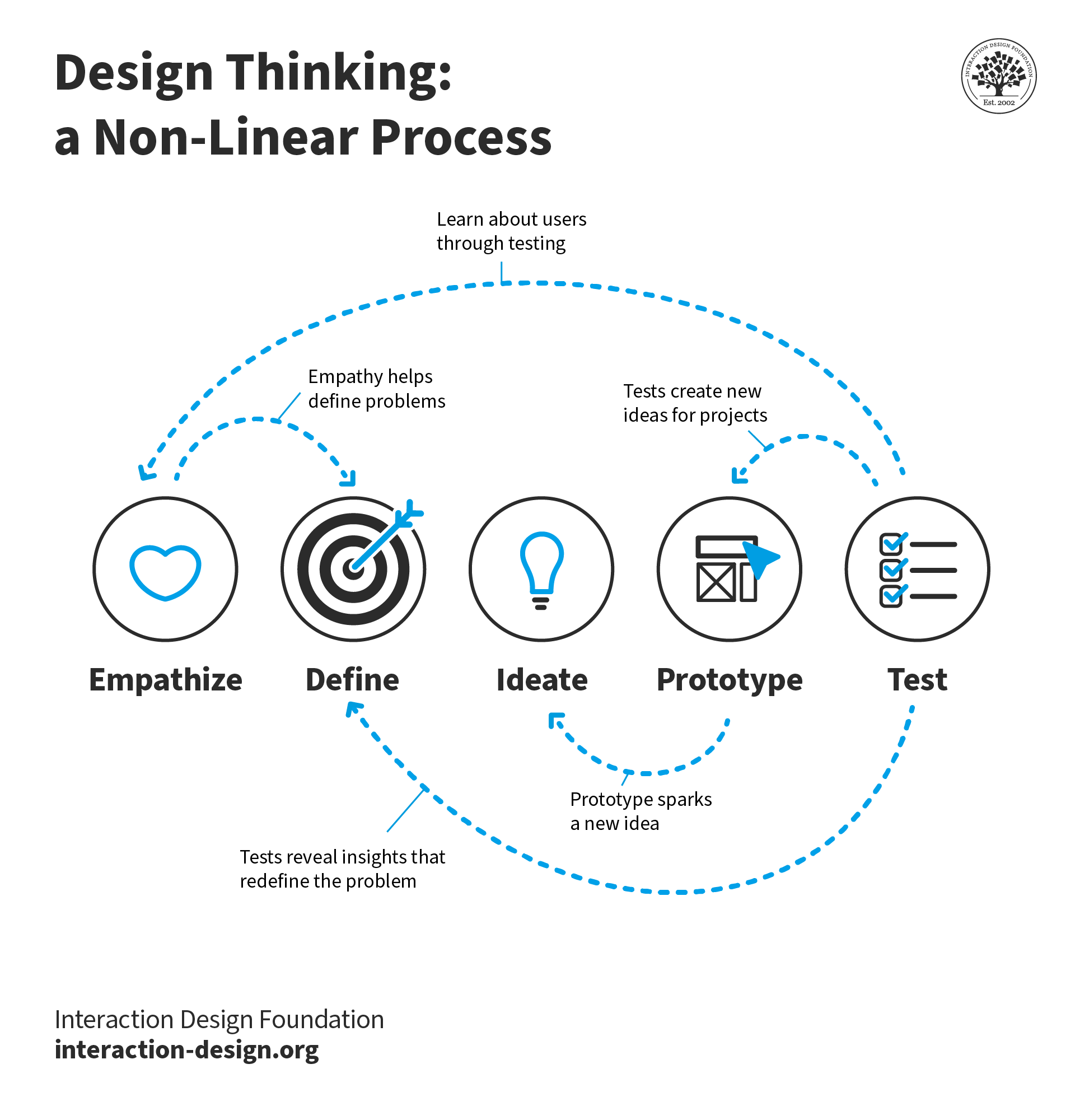
Five stages in the design thinking process.

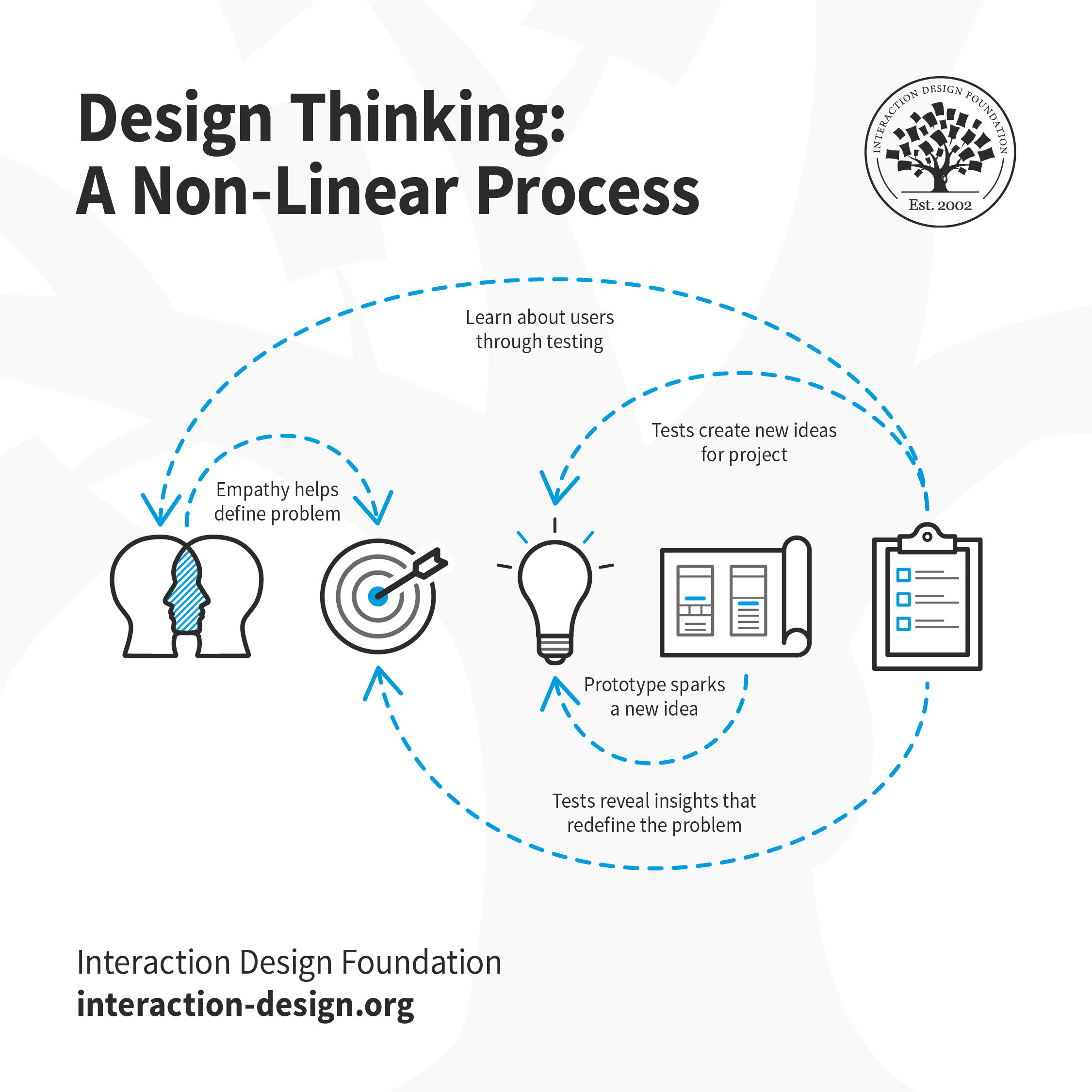
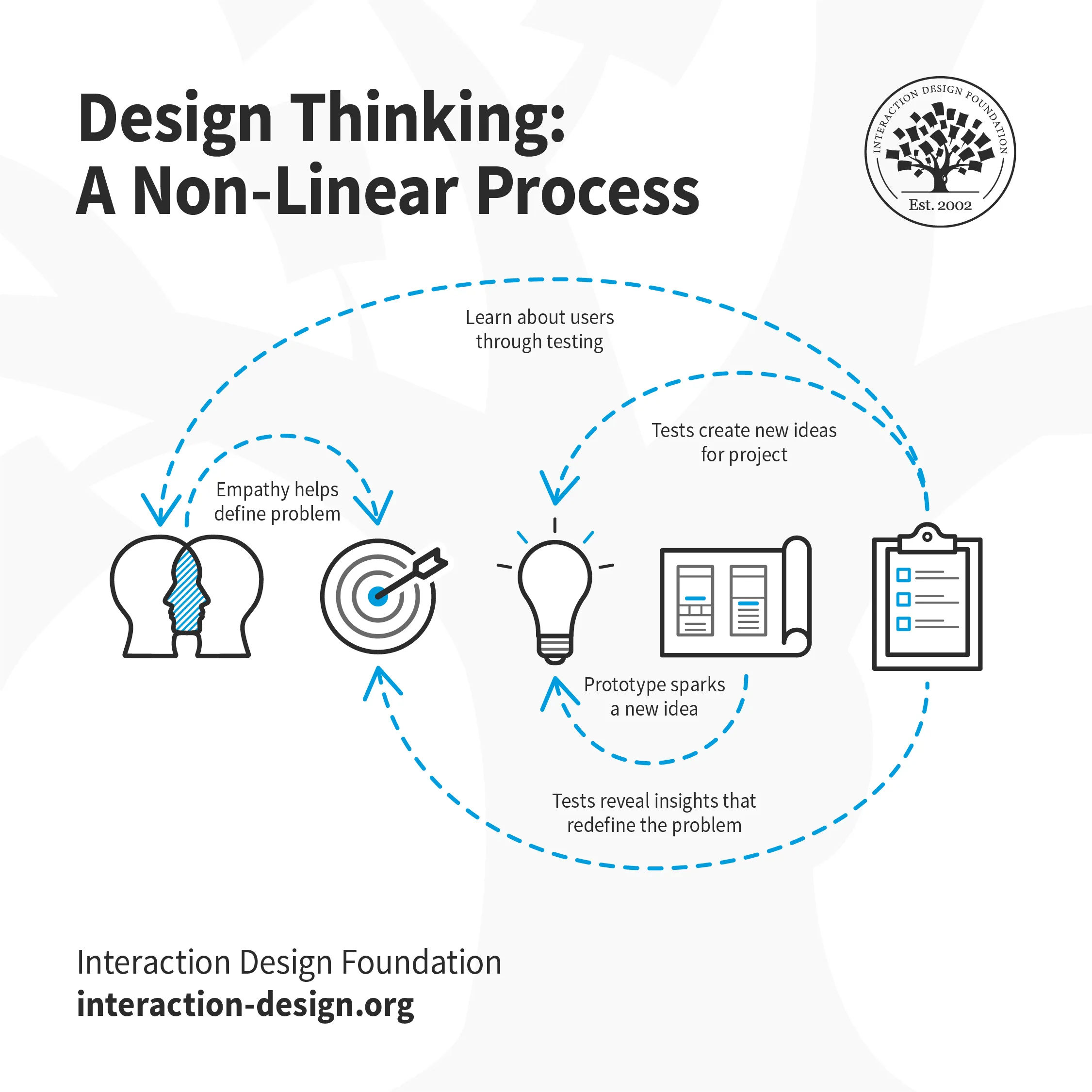
Design thinking is a non-linear process. For example, teams may jump from the test stage to the define stage if the tests reveal insights that redefine the problem. Or, a prototype might spark a new idea, prompting the team to step back into the ideate stage. Tests may also create new ideas for projects or reveal insights about users.

© Interaction Design Foundation, CC BY-SA 4.0

Design Thinking Mindsets: More than a Process

A mindset is a characteristic mental attitude that determines how one interprets and responds to situations. Design thinking mindsets are how individuals think, feel and express themselves during design thinking activities. It includes people’s expectations and orientations during a design project.

Without the right mindset, it can be very challenging to change how we work and think.

The key mindsets that ensure a team can successfully implement design thinking are.

  1. Be empathetic: Empathy is the ability to place yourself, your thinking and feelings in another person’s shoes. Design thinking begins from a deep understanding of the needs and motivations of people—the parents, neighbors, children, colleagues, and strangers who make up a community. 

  2. Be collaborative: No one person is responsible for the outcome when you work in a team. Several great minds are always stronger than just one. Design thinking benefits from the views of multiple perspectives and lets others’ creativity bolster your own.

  3. Be optimistic: Be confident about achieving favorable outcomes. Design thinking is the fundamental belief that we can all create change—no matter how big a problem, how little time, or how small a budget. Designing can be a powerful process no matter what constraints exist around you.

  4. Embrace ambiguity: Get comfortable with ambiguous and complex situations. If you expect perfection, it is difficult to take risks, which limits your ability to create radical change. Design thinking is all about experimenting and learning by doing. It gives you the confidence to believe that new, better things are possible and that you can help make them a reality. 

  5. Be curious: Be open to different ideas. Recognize that you are not the user.

  6. Reframe: Challenge and reframe assumptions associated with a given situation or problem. Don’t take problems at face value. Humans are primed to look for patterns. The unfortunate side effect of these patterns is that we form (often false and sometimes dangerous) stereotypes and assumptions. Design thinking aims to help you break through any preconceived notions and biases and reframe challenges.

  7. Embrace diversity: Work with and engage people with different cultural backgrounds, experiences, and ways of thinking and working. Everyone brings a unique perspective to the team. When you include diverse voices in a team, you learn from each other’s experiences, further helping you break through your assumptions.

  8. Make tangible: When you make ideas tangible, it is faster and easier for everyone on the team to be on the same page. For example, sketching an idea or enacting a scenario is far more convenient and easy to interpret than an elaborate presentation or document.

  9. Take action: Run experiments and learn from them.

Design Thinking vs Agile Methodology

Teams often use design thinking and agile methodologies in project management, product development, and software development. These methodologies have distinct approaches but share some common principles.

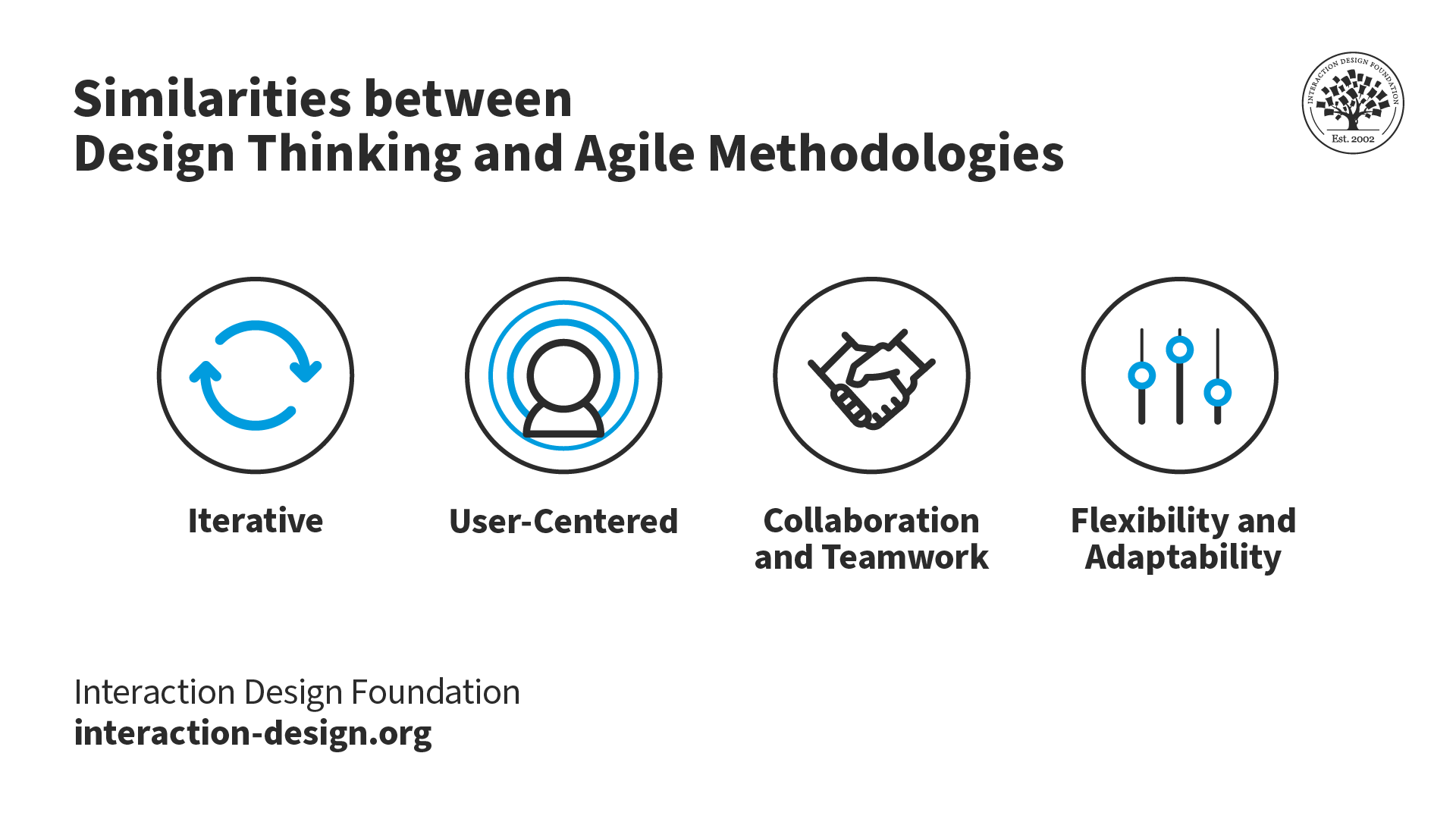
Similarities between Design Thinking and Agile

Iterative Process

Both methodologies emphasize iterative development. In design thinking, teams may jump from one phase to another, not necessarily in a set cyclical or linear order. For example, on testing a prototype, teams may discover something new about their users and realize that they must redefine the problem. Agile teams iterate through development sprints.

User-Centered

The agile and design thinking methodologies focus on the end user. All design thinking activities—from empathizing to prototyping and testing—keep the end users front and center. Agile teams continually integrate user feedback into development cycles.

Collaboration and Teamwork

Both methodologies rely heavily on collaboration among cross-functional teams and encourage diverse perspectives and expertise.

Flexibility and Adaptability

With its focus on user research, prototyping and testing, design thinking ensures teams remain in touch with users and get continuous feedback. Similarly, agile teams monitor user feedback and refine the product in a reasonably quick time.
© Interaction Design Foundation, CC BY-SA 4.0

In this video, Laura Klein, author of Build Better Products, describes a typical challenge designers face on agile teams. She encourages designers to get comfortable with the idea of a design not being perfect. Notice the many parallels between Laura’s advice for designers on agile teams and the mindsets of design thinking.

Transcript

Differences between Design Thinking and Agile

While design thinking and agile teams share principles like iteration, user focus, and collaboration, they are neither interchangeable nor mutually exclusive. A team can apply both methodologies without any conflict.

From a user experience design perspective, design thinking applies to the more abstract elements of strategy and scope. At the same time, agile is more relevant to the more concrete elements of UX: structure, skeleton and surface. For quick reference, here’s an overview of the five elements of user experience.

Transcript

Design thinking is more about exploring and defining the right problem and solution, whereas agile is about efficiently executing and delivering a product.

Here are the key differences between design thinking and agile.


Design Thinking

Agile

Origins

It primarily originates in design and borrows from multiple disciplines, including psychology, systems thinking, and business strategy.

It primarily originates from software development and borrows from disciplines such as manufacturing and project management.

Primary Focus

Problem-solving and innovative solutions.

Efficient product delivery.

Phase of Application

Usually, toward the beginning of a project. Aims to define the problem and test and pick a solution.

Usually, after teams have a clear solution. Aims to deliver that solution and continuously iterate on the live product.

Structure and Documentation

Fluid process, less formal and relatively lesser documentation.

Structured and formal process with extensive documentation.

End Product

An idea or solution, usually with a prototype, may not be tangible.

Tangible, working product (usually software) shipped to end users.

Design Sprint: A Condensed Version of Design Thinking

A design sprint is a 5-day intensive workshop where cross-functional teams aim to develop innovative solutions.

The design sprint is a very structured version of design thinking that fits into the timeline of a sprint (a sprint is a short timeframe in which agile teams work to produce deliverables). Developed by Google Ventures, the design sprint seeks to fast-track innovation.

In this video, user researcher Ditte Hvas Mortensen explains the design sprint in detail.
Transcript

Questions About Design Thinking?
We've Got Answers!

Do you need certification to practice design thinking?

You don’t need any certification to practice design thinking. However, learning about the nuances of the methodology can help you:

  • Pick the appropriate methods and tailor the process to suit the unique needs of your project.

  • Avoid common pitfalls when you apply the methods.

  • Better lead a team and facilitate workshops.

  • Increase the chances of coming up with innovative solutions.

IxDF has a comprehensive course to help you gain the most from the methodology: Design Thinking: The Ultimate Guide.

Who can use design thinking?

Anyone can apply design thinking to solve problems. Despite what the name suggests, non-designers can use the methodology in non-design-related scenarios. The methodology helps you think about problems from the end user’s perspective. Some areas where you can apply this process:

  • Develop new products with greater chances of success.

  • Address community-related issues (such as education, healthcare and environment) to improve society and living standards.

  • Innovate/enhance existing products to gain an advantage over the competition.

  • Achieve greater efficiencies in operations and reduce costs.

Use the Design Thinking: The Ultimate Guide course to apply design thinking to your context today.

What is a design thinking framework?

A framework is the basic structure underlying a system, concept, or text. There are several design thinking frameworks with slight differences. However, all the frameworks share some traits. Each framework: 

  • Begins with empathy.

  • Reframes the problem or challenge at hand.

  • Initially employs divergent styles of thinking to generate ideas.

  • Later, it employs convergent styles of thinking to narrow down the best ideas,

  • Creates and tests prototypes.

  • Iterates based on the tests.

Some of the design thinking frameworks are:

  • 5-stage design process by d.school

  • 7-step early traditional design process by Herbert Simon

  • Head, Heart and Hand by the American Institution of Graphic Arts (AIGA)

  • The 5-Stage DeepDive™ by IDEO

  • The “Double Diamond” Design Process Model by the Design Council

  • Collective Action Toolkit (CAT) by Frog Design

  • The LUMA System of Innovation by LUMA Institute

For details about each of these frameworks, see 10 Insightful Design Thinking Frameworks: A Quick Overview.

What is the IDEO model of design thinking?

IDEO’s 3-Stage Design Thinking Process consists of inspiration, ideation and implementation:

  • Inspire: The problem or opportunity inspires and motivates the search for a solution.

  • Ideate: A process of synthesis distills insights which can lead to solutions or opportunities for change.

  • Implement: The best ideas are turned into a concrete, fully conceived action plan.

IDEO is a leader in applying design thinking and has developed many frameworks. Find out more in10 Insightful Design Thinking Frameworks: A Quick Overview.

What is the Double Diamond?

Design Council's Double Diamond diagram depicts the divergent and convergent stages of the design process.

© Design Council, CC BY 4.0

Béla H. Bánáthy, founder of the White Stag Leadership Development Program, created the “divergence-convergence” model in 1996. In the mid-2000s, the British Design Council made this famous as the Double Diamond model.

The Double Diamond diagram graphically represents a design thinking process. It highlights the divergent and convergent styles of thinking in the design process. It has four distinct phases:

  1. Discover: Initial idea or inspiration based on user needs.

  2. Define: Interpret user needs and align them with business objectives.

  3. Develop: Develop, iterate and test design-led solutions.

  4. Deliver: Finalize and launch the end product into the market.

Double Diamond is one of several design thinking frameworks. Find out more in 10 Insightful Design Thinking Frameworks: A Quick Overview.

What are the design thinking methods?

There are several design thinking methods that you can choose from, depending on what stage of the process you’re in. Here are a few common design thinking methods:

  1. User Interviews: to understand user needs, pain points, attitudes and behaviors.

  2. 5 Whys Method: to dig deeper into problems to diagnose the root cause.

  3. User Observations: to understand how users behave in real life (as opposed to what they say they do).

  4. Affinity Diagramming: to organize research findings.

  5. Empathy Mapping: to empathize with users based on research insights.

  6. Journey Mapping: to visualize a user’s experience as they solve a problem.

  7. 6 Thinking Hats: to encourage a group to think about a problem or solution from multiple perspectives.

  8. Brainstorming: to generate ideas.

  9. Prototyping: to make abstract ideas more tangible and test them.

  10. Dot Voting: to select ideas.

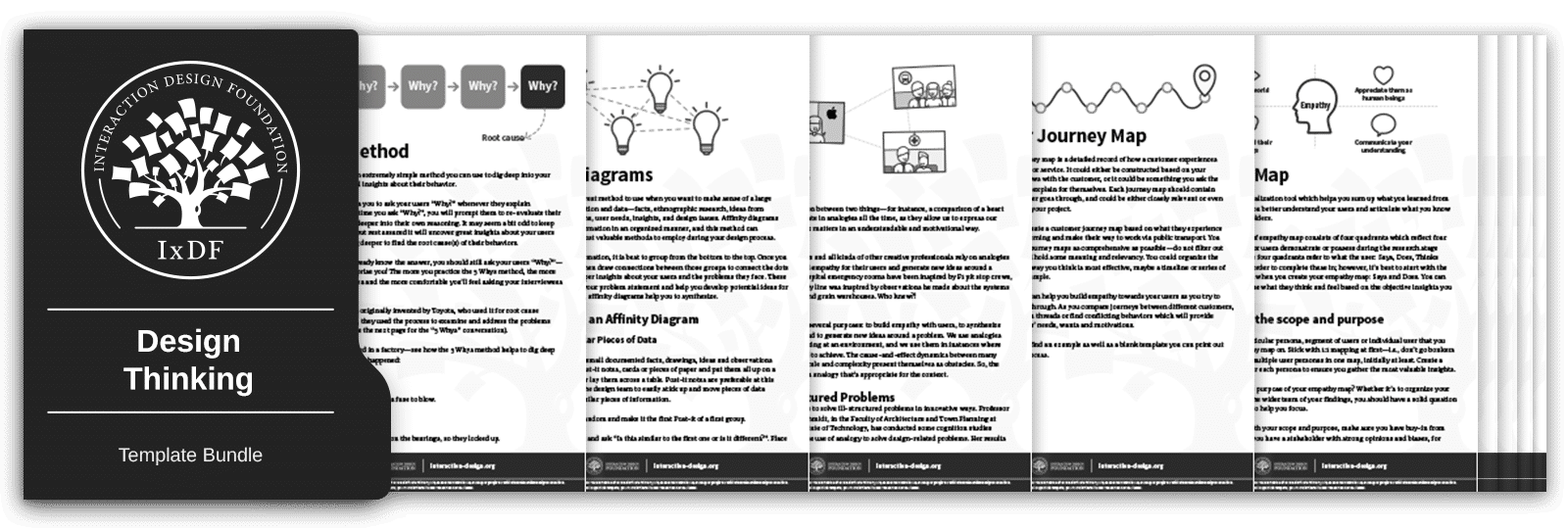
Start applying these methods to your work today with the Design Thinking template bundle.

Fast-Track Your Promotion With This Master Bundle of 41 “Design Thinking” Templates
Design Thinking

What are the design thinking tools?

For most of the design thinking process, you will need basic office stationery:

  • Pen and paper

  • Sticky notes

  • Whiteboard and markers

  • Print-outs of templates and canvases as needed (such as empathy maps, journey maps, feedback capture grid etc.) You can also draw these out manually.

  • Prototyping materials such as UI stencils, string, clay, Lego bricks, sticky tapes, scissors and glue.

  • A space to work in.

You can conduct design thinking workshops remotely by:

  • Using collaborative software to simulate the whiteboard and sticky notes.

  • Using digital templates instead of printed canvases.

Download print-ready templates you can share with your team to practice design thinking today.

Fast-Track Your Promotion With This Master Bundle of 41 “Design Thinking” Templates
Design Thinking

Why is design thinking important for business?

Design thinking is a problem-solving methodology that helps teams better identify, understand, and solve business and customer problems.

  1. When businesses prioritize and empathize with customers, they can create solutions catering to their needs. Happier customers are more likely to be loyal and organically advocate for the product.

  2. Design thinking helps businesses develop innovative solutions that give them a competitive advantage.

Gain a competitive advantage in your business with Design Thinking: The Ultimate Guide.

Who invented design thinking?
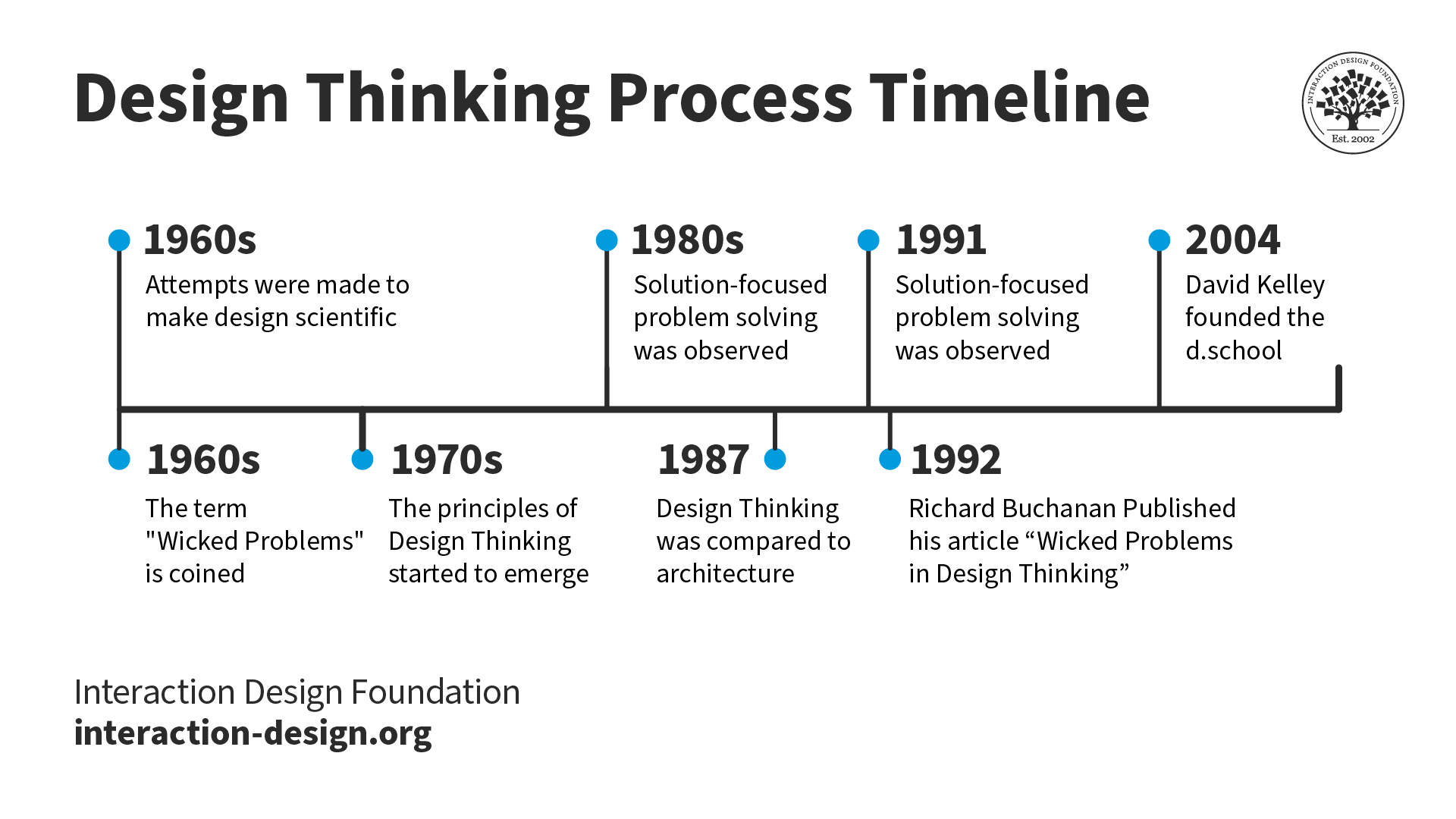
Design Thinking Process Timeline

The evolution of Design Thinking can be summarised in 8 key events from the 1960s to 2004.

© Interaction Design Foundation, CC BY-SA 4.0.

Herbert Simon’s 1969 book, "The Sciences of the Artificial," has one of the earliest references to design thinking. David Kelley, founder of the design consultancy IDEO, coined the term “design thinking” and helped make it popular.

For a more comprehensive discussion on the origins of design thinking, see The History of Design Thinking.

What are some examples of design thinking?

Some organizations that have employed design thinking successfully are:

  1. Airbnb: Airbnb used design thinking to create a platform for people to rent out their homes to travelers. The company focused on the needs of both hosts and guests. The result was a user-friendly platform to help people find and book accommodations.

  2. PillPack: PillPack is a prescription home-delivery system. The company focused on the needs of people who take multiple medications and created a system that organizes pills by date and time. Amazon bought PillPack in 2018 for $1 billion.

  3. Google Creative Lab: Google Creative Lab collaborated with IDEO to discover how kids physically play and learn. The team used design thinking to create Project Bloks. The project helps children develop foundational problem-solving skills "through coding experiences that are playful, tactile and collaborative.”

See more examples of design thinking and learn practical methods in Design Thinking: The Ultimate Guide.

Design thinking vs innovation: What’s the difference?

Innovation essentially means a new idea. Design thinking is a problem-solving methodology that helps teams develop new ideas. In other words, design thinking can lead to innovation.

Design thinking vs systems thinking vs HCD vs UCD vs design sprint: Are they all the same?

Copyright
Transcript

  1. Human-Centered Design is a newer term for User-Centered Design

“Human-centred design is an approach to interactive systems development that aims to make systems usable and useful by focusing on the users, their needs and requirements, and by applying human factors/ergonomics, and usability knowledge and techniques. This approach enhances effectiveness and efficiency, improves human well-being, user satisfaction, accessibility and sustainability; and counteracts possible adverse effects of use on human health, safety and performance.”

ISO 9241-210:2019(en), ISO (the International Organization for Standardization) 

User experience expert Don Norman describes human-centered design (HCD) as a more evolved form of user-centered design (UCD). The word "users" removes their importance and treats them more like objects than people. By replacing “user” with “human,” designers can empathize better with the people for whom they are designing. Don Norman takes HCD a step further and prefers the term People-Centered Design.

  1. Design thinking has a broader scope and takes HCD beyond the design discipline to drive innovation.

People sometimes use design thinking and human-centered design to mean the same thing. However, they are not the same. HCD is a formal discipline with a specific process used only by designers and usability engineers to design products. Design thinking borrows the design methods and applies them to problems in general.

  1. Design Sprint condenses design thinking into a 1-week structured workshop

Google Ventures condensed the design thinking framework into a time-constrained 5-day workshop format called the Design Sprint. The sprint follows one step per day of the week:

  • Monday: Unpack

  • Tuesday: Sketch

  • Wednesday: Decide

  • Thursday: Prototype

  • Friday: Test

Learn more about the design sprint in Make Your UX Design Process Agile Using Google’s Methodology.

  1. Systems Thinking is a distinct discipline with a broader approach to problem-solving

“Systems thinking is a way of exploring and developing effective action by looking at connected wholes rather than separate parts.”

— Introduction to Systems thinking, Report of GSE and GORS seminar, Civil Service Live

Both HCD and Systems Thinking are formal disciplines. Designers and usability engineers primarily use HCD. Systems thinking has applications in various fields, such as medical, environmental, political, economic, human resources, and educational systems.

HCD has a much narrower focus and aims to create and improve products. Systems thinking looks at the larger picture and aims to change entire systems.

Don Norman encourages designers to incorporate systems thinking in their work. Instead of looking at people and problems in isolation, designers must look at them from a systems point of view.

In summary, UCD and HCD refer to the same field, with the latter being a preferred phrase.

Design thinking is a broader framework that borrows methods from human-centered design to approach problems beyond the design discipline. It encourages people with different backgrounds and expertise to work together and apply the designer’s way of thinking to generate innovative solutions to problems.

Systems thinking is another approach to problem-solving that looks at the big picture instead of specific problems in isolation.

The design sprint is Google Ventures’ version of the design thinking process, structured to fit the design process in 1 week.

What is the design thinking process?

There are multiple design thinking frameworks, each with a different number of steps and phase names. One of the most popular frameworks is the Stanford d.School 5-stage process.

Design Thinking: A Non-Linear process. Empathy helps define problem, Prototype sparks a new idea, tests reveal insights that redefine the problem, tests create new ideas for project, learn about users (empathize) through testing.

Design thinking is an iterative and non-linear process. It contains five phases: 1. Empathize, 2. Define, 3. Ideate, 4. Prototype and 5. Test. It is important to note the five stages of design thinking are not always sequential. They do not have to follow a specific order, and they can often occur in parallel or be repeated iteratively. The stages should be understood as different modes which contribute to the entire design project, rather than sequential steps.

© Interaction Design Foundation, CC BY-SA 4.0.

For more details, see The 5 Stages in the Design Thinking Process.

What is the DeepDive™ Methodology?

IDEO is a leading design consultancy and has developed its own version of the design thinking framework and adds the dimension of implementation in the process.

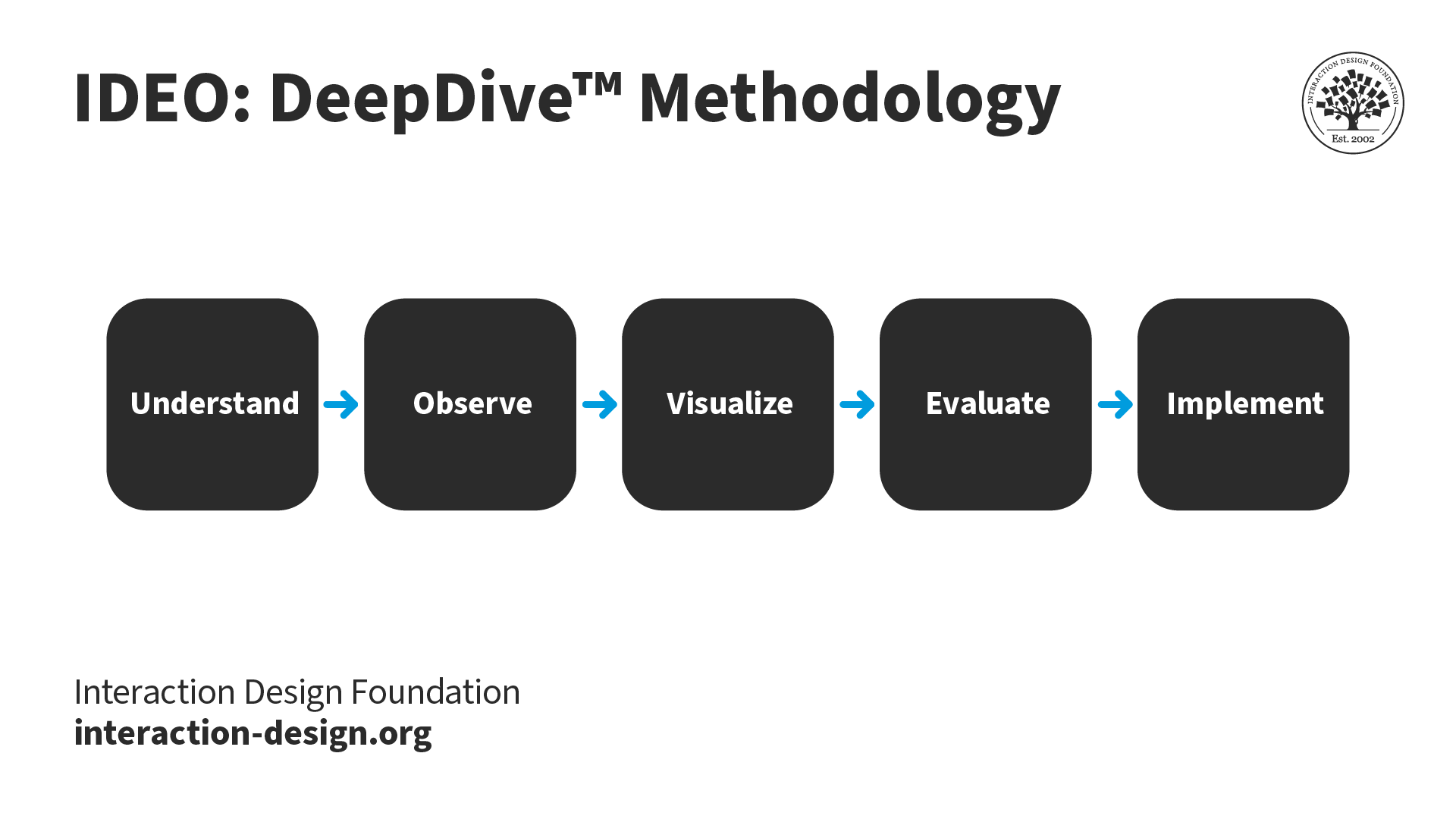
IDEO’s framework uses slightly different terms than d.school’s design thinking process and adds an extra dimension of implementation. The steps in the DeepDive™ Methodology are: Understand, Observe, Visualize, Evaluate and Implement.

© Interaction Design Foundation, CC BY-SA 4.0

IDEO’s DeepDive™ Methodology includes the following steps:

  1. Understand: Conduct research and identify what the client needs and the market landscape

  2. Observe: Similar to the Empathize step, teams observe people in live scenarios and conduct user research to identify their needs and pain points.

  3. Visualize: In this step, the team visualizes new concepts. Similar to the Ideate phase, teams focus on creative, out-of-the-box and novel ideas.

  4. Evaluate: The team prototypes ideas and evaluates them. After refining the prototypes, the team picks the most suitable one.

  5. Implement: The team then sets about to develop the new concept for commercial use.

IDEO’s DeepDive™ is one of several design thinking frameworks. Find out more in 10 Insightful Design Thinking Frameworks: A Quick Overview.

Earn a Gift Earn a Gift, Answer a Short Quiz!

1
2
3
4
1
2
3
4
Question 1
Question 2
Question 3
Get Your Gift
Interaction Design Foundation logo

Question 1

What are the stages in the design thinking process?

1 point towards your gift

  • Brainstorm, Prototype, Design, Launch, Test
  • Define, Ideate, Research, Design, Test
  • Empathize, Define, Ideate, Prototype, Test
Interaction Design Foundation logo

Question 2

Why is empathy critical in the design thinking process?

1 point towards your gift

  • It allows designers to understand and address the real needs of users.
  • It helps designers maintain control over the creative process.
  • It makes sure the solution is inexpensive and easy to create.
Interaction Design Foundation logo

Question 3

What is the primary purpose of the prototyping phase in design thinking?

1 point towards your gift

  • To explore potential solutions and how they might work in real-world situations
  • To finalize the product design for mass production
  • To sell the idea to stakeholders with a high-fidelity (hi-fi) demonstration

Learn More About Design Thinking

Make learning as easy as watching Netflix: Learn more about Design Thinking by taking the online IxDF Course Design Thinking: The Ultimate Guide.

Why? Because design skills make you valuable. In any job. Any industry.

In This Course, You'll

  • Get excited when you discover that you don't need to start from scratch to use the secret recipes that empower companies like Apple and Google to shape the future. You just need a structure and proven methods to optimize what you already do. As AI becomes part of your day-to-day workflows, your ability to guide it with timeless human-centered skills such as strategic thinking, creativity, and empathy for real users is what turns AI into your superpower and delivers meaningful results.

  • Build on your existing creativity, problem-solving, and people skills to learn the powerful 5-stage method called Design Thinking. It's one of the key drivers behind Apple and Google's continuous innovation and provides a clear, structured way to solve real-world problems. You've already got the instincts, so it's easy to learn the method. 

  • Make yourself invaluable with hands-on skills in Design Thinking. Design Thinking can help you break into User Experience Design, product design, and tech. It's widely applicable, impactful, and fun! Use your skills to improve customer support processes, create new products, and even tackle big challenges like climate change. This human-centered approach is a key driver of business success because it guides you to systematically understand and address what your users really need and want. That's why Design Thinking skills can help you increase sales, keep customers loyal, and turn them into powerful advocates for your company.

  • Gain confidence and credibility as you effortlessly apply methods from all five stages of the Design Thinking process. You'll be guided to build empathy and gather insights into people's habits through user interviews. 

  • Use our downloadable templates to create affinity diagrams, empathy maps, and actionable "How Might We" questions. Develop solutions as you apply ideation and innovation methods. Create a paper prototype early and fast, then test and optimize your prototype to ensure that your users love it. More love, more impact, greater salary potential. 

  • Apply your new skills in an optional project where you'll design and test a user-centered experience that's perfect for your portfolio and career growth. Master Design Thinking to amplify your uniquely human strengths like empathy, intuition, and creativity, and confidently stay in demand as AI reshapes how teams work.

It's Easy to Fast-Track Your Career with the World's Best Experts

Master complex skills effortlessly with proven best practices and toolkits directly from the world's top design experts. Meet your experts for this course:

  • Don Norman: Father of User Experience (UX) Design, author of the legendary book “The Design of Everyday Things,” and co-founder of the Nielsen Norman Group.

  • Alan Dix: Author of the bestselling book “Human-Computer Interaction” and Director of the Computational Foundry at Swansea University.

  • Mike Rohde: Experience and Interface Designer, author of the bestselling “The Sketchnote Handbook.”

Get an Industry-Recognized IxDF Course Certificate

Increase your credibility, salary potential and job opportunities by showing credible evidence of your skills.

IxDF Course Certificates set the industry gold standard. Add them to your LinkedIn profile, resumé, and job applications.

Course Certificate Example

Be in distinguished company, alongside industry leaders who train their teams with the IxDF and trust IxDF Course Certificates.

Our clients: IBM, HP, Adobe, GE, Accenture, Allianz, Phillips, Deezer, Capgemin, Mcafee, SAP, Telenor, Cigna, British Parliament, State of New York

All Free IxDF Articles on Design Thinking

Read full article
Product Thinking is Problem Solving - Article hero image
Interaction Design Foundation logo

Product Thinking is Problem Solving

It can be easy to get bogged down in developing features when we get into user experience design. It’s not that features aren’t important but that they are often secondary to the reason a customer or user buys our product. That reason is simple; the user buys the product to solve a real world proble

Social shares
954
Published
Read Article
Read full article
Design Thinking, Essential Problem Solving 101- It’s More Than Scientific - Article hero image
Interaction Design Foundation logo

Design Thinking, Essential Problem Solving 101- It’s More Than Scientific

The term “Design Thinking” dates back to the 1987 book by Peter Rowe; “Design Thinking.” In that book he describes the way that architects and urban planners would approach design problems. However, the idea that there was a specific pattern of problem solving in “design thought” came much earlier i

Social shares
1k
Published
Read Article
Read full article
Ideation for Design  - Preparing for the Design Race - Article hero image
Interaction Design Foundation logo

Ideation for Design - Preparing for the Design Race

Ideation is easy to define. It’s the process by which you generate, develop and then communicate new ideas. Ideas can take many forms such as verbal, visual, concrete or abstract. The principle is simple to create a process by which you can innovate, develop and actualize new products. Ideation is c

Social shares
870
Published
Read Article
Read full article
What Are Wicked Problems and How Might We Solve Them? - Article hero image
Interaction Design Foundation logo

What Are Wicked Problems and How Might We Solve Them?

Have you ever come across a problem so complex that you struggled to know where to start? Then you might have stumbled upon a wicked problem. While wicked problems may not have a definite solution, there are certainly things you can do to mitigate any negative effects. When you learn how to tackle w

Social shares
1.2k
Published
Read Article
Read full article
Probes for Context Mapping – How to Design and Use Them - Article hero image
Interaction Design Foundation logo

Probes for Context Mapping – How to Design and Use Them

Whether you are designing a mobile app, a professional online platform or an interactive museum exhibition, it is essential to understand users and the context in which they will use your design. Traditional methods such as interviews and observations will help you to touch the surface of their live

Social shares
863
Published
Read Article
Read full article
Empathy – How to Improve Your Designs by Developing Empathy for Your Target Group - Article hero image
Interaction Design Foundation logo

Empathy – How to Improve Your Designs by Developing Empathy for Your Target Group

Empathy is the ability to understand and identify with another person’s context, emotions, goals and motivations. In order to design great experiences, successful design firms actively search for empathic insights into their target group. In a design context, empathy serves a distinct purpose: to in

Social shares
780
Published
Read Article

The 5 Stages in the Design Thinking Process

The 5 Stages in the Design Thinking Process

Design thinking is a methodology that provides a solution-based approach to solving problems. It’s extremely useful when used to tackle complex problems that are ill-defined or unknown—because it serves to understand the human needs involved, reframe the problem in human-centric ways, create numerous ideas in brainstorming sessions and adopt a hands-on approach to prototyping and testing. When you know how to apply the five stages of design thinking, you will be empowered because you can apply the methodology to solve complex problems that occur in our companies, our countries, and across the world.

Design thinking is a non-linear, iterative process that can have anywhere from three to seven phases, depending on whom you talk to. We focus on the five-stage design thinking model proposed by the Hasso Plattner Institute of Design at Stanford (the d.school) because they are world-renowned for the way they teach and apply design thinking.

What are the 5 Stages of the Design Thinking Process

The five stages of design thinking, according to the d.school, are:

Let’s dive into each stage of the design thinking process.

Copyright
Transcript

Stage 1: Empathize—Research Your Users' Needs

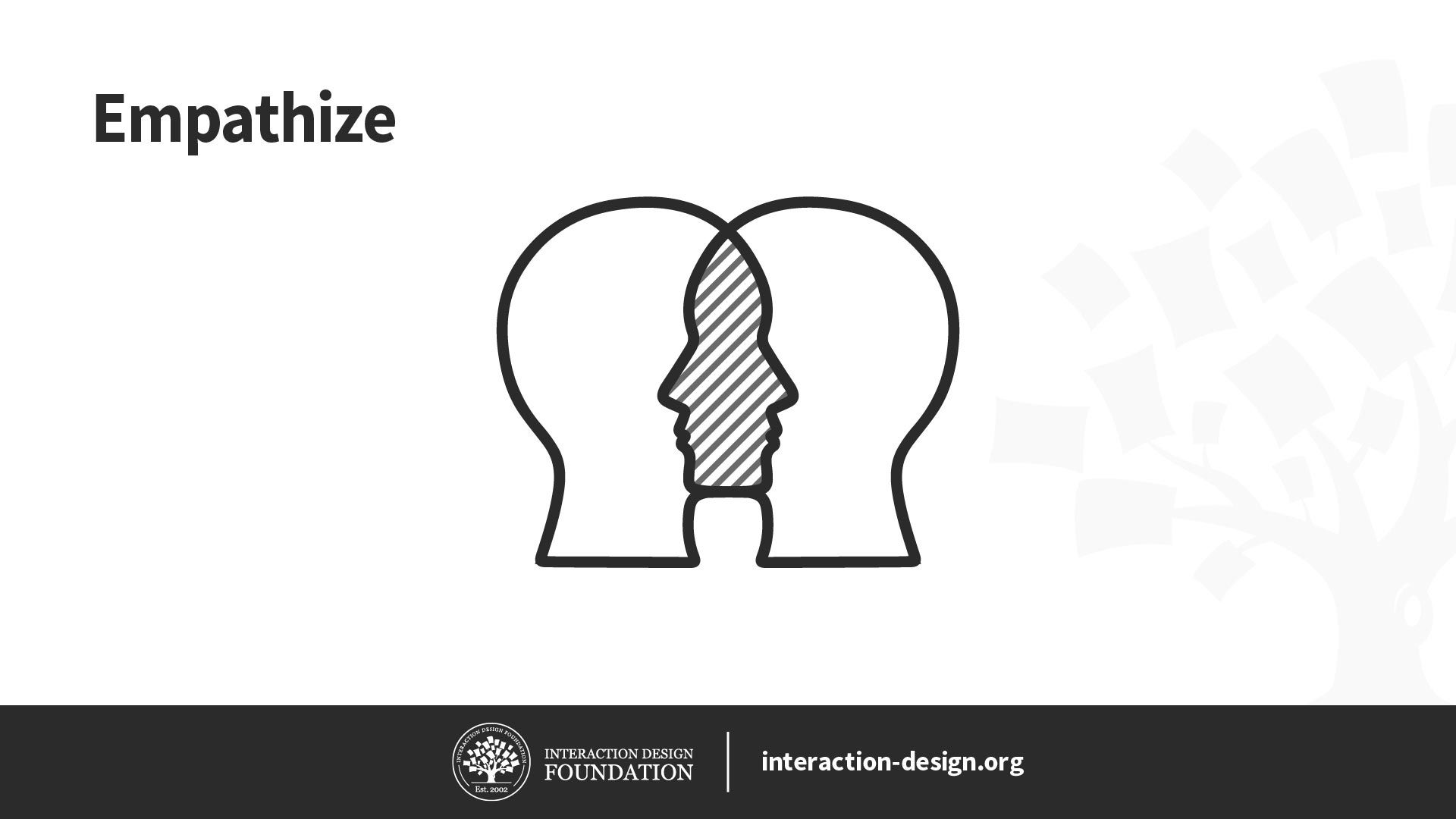
Illustration of Empathize showing two profile heads looking at each other and overlapping about 25%.

Empathize: the first phase of design thinking, where you gain real insight into users and their needs.

© Teo Yu Siang and the Interaction Design Foundation, CC BY-NC-SA 3.0.

The first stage of the design thinking process focuses on user-centric research. You want to gain an empathic understanding of the problem you are trying to solve. Consult experts to find out more about the area of concern and conduct observations to engage and empathize with your users. You may also want to immerse yourself in your users’ physical environment to gain a deeper, personal understanding of the issues involved—as well as their experiences and motivations. Empathy is crucial to problem-solving and a human-centered design process as it allows design thinkers to set aside their own assumptions about the world and gain real insight into users and their needs.

Depending on time constraints, you will gather a substantial amount of information to use during the next stage. The main aim of the Empathize stage is to develop the best possible understanding of your users, their needs and the problems that underlie the development of the product or service you want to create.

Stage 2: Define—State Your Users' Needs and Problems

Illustration of a target with an arrow in the center to represent the Define stage of the Design Thinking process.

Define: the second phase of design thinking, where you define the problem statement in a human-centered manner.

© Teo Yu Siang and the Interaction Design Foundation, CC BY-NC-SA 3.0.

In the Define stage, you will organize the information you have gathered during the Empathize stage. You’ll analyze your observations to define the core problems you and your team have identified up to this point. Defining the problem and problem statement must be done in a human-centered manner.

For example, you should not define the problem as your own wish or need of the company: “We need to increase our food-product market share among young teenage girls by 5%.”

You should pitch the problem statement from your perception of the users’ needs: “Teenage girls need to eat nutritious food in order to thrive, be healthy and grow.”

The Define stage will help the design team collect great ideas to establish features, functions and other elements to solve the problem at hand—or, at the very least, allow real users to resolve issues themselves with minimal difficulty. In this stage, you will start to progress to the third stage, the ideation phase, where you ask questions to help you look for solutions: “How might we encourage teenage girls to perform an action that benefits them and also involves your company’s food-related product or service?” for instance.

Stage 3: Ideate—Challenge Assumptions and Create Ideas

Illustration of three light bulbs going off as a representation of the Ideate part of the design process.

Ideate: the third phase of design thinking, where you identify innovative solutions to the problem statement you’ve created.

© Teo Yu Siang and the Interaction Design Foundation, CC BY-NC-SA 3.0.

During the third stage of the design thinking process, designers are ready to generate ideas. You’ve grown to understand your users and their needs in the Empathize stage, and you’ve analyzed your observations in the Define stage to create a user-centric problem statement. With this solid background, you and your team members can start to look at the problem from different perspectives and ideate innovative solutions to your problem statement.

There are hundreds of ideation techniques you can use—such as Brainstorm, Brainwrite, Worst Possible Idea and SCAMPER. Brainstorm and Worst Possible Idea techniques are typically used at the start of the ideation stage to stimulate free thinking and expand the problem space. This allows you to generate as many ideas as possible at the start of ideation. You should pick other ideation techniques towards the end of this stage to help you investigate and test your ideas and choose the best ones to move forward with—either because they seem to solve the problem or provide the elements required to circumvent it.

Stage 4: Prototype—Start to Create Solutions

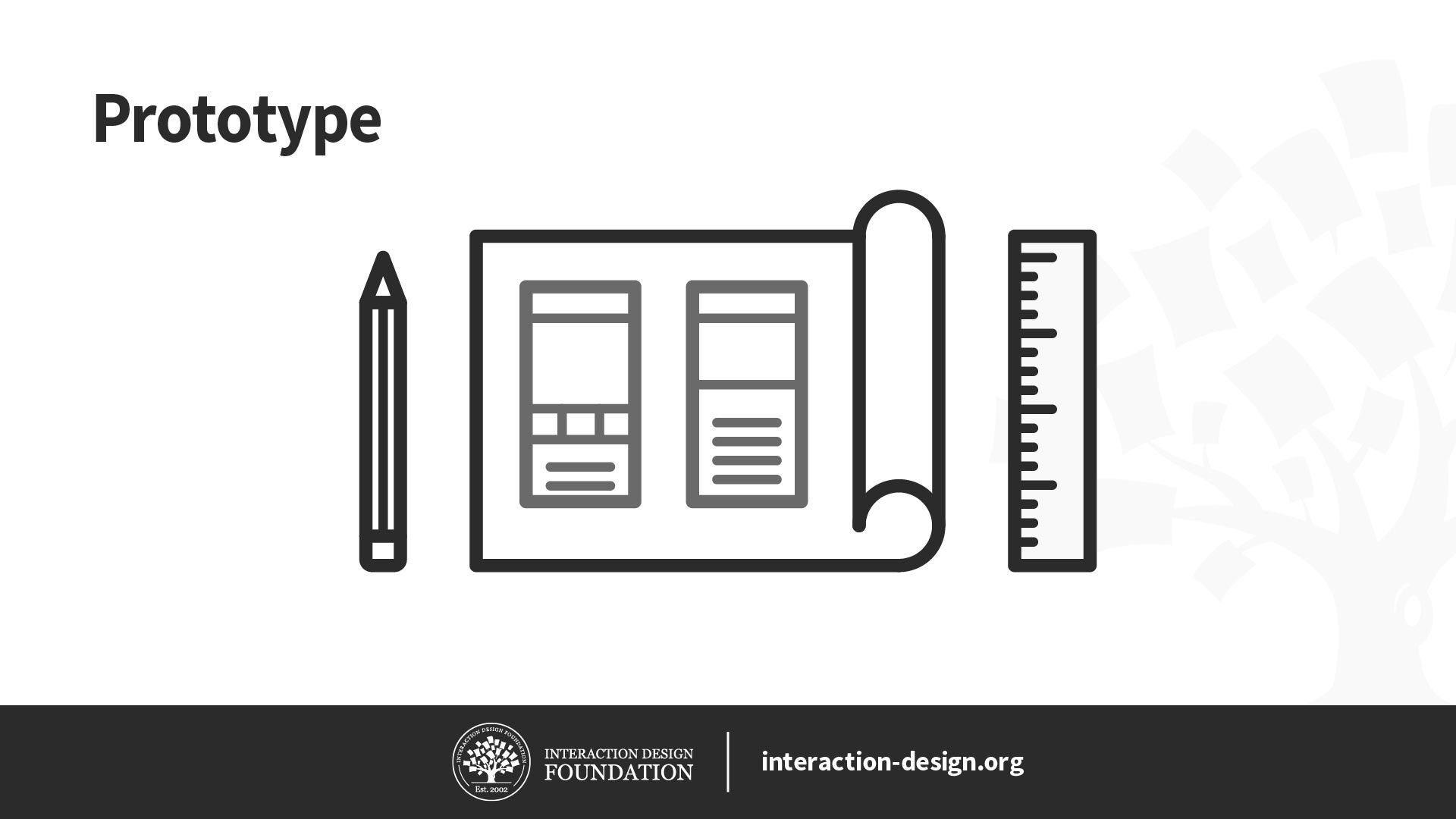
Illustration of the Prototype phase of the design process showing a pencil, wireframes on paper, and a ruler.

Prototype: the fourth phase of design thinking, where you identify the best possible solution.

© Teo Yu Siang and the Interaction Design Foundation, CC BY-NC-SA 3.0.

The design team will now produce a number of inexpensive, scaled down versions of the product (or specific features found within the product) to investigate the key solutions generated in the ideation phase. These prototypes can be shared and tested within the team itself, in other departments or on a small group of people outside the design team.

This is an experimental phase, and the aim is to identify the best possible solution for each of the problems identified during the first three stages. The solutions are implemented within the prototypes, and, one by one, they are investigated and then accepted, improved or rejected based on the users’ experiences.

By the end of the Prototype stage, the design team will have a better idea of the product’s limitations and the problems it faces. They’ll also have a clearer view of how real users would behave, think and feel when they interact with the end product.

Stage 5: Test—Try Your Solutions Out

Illustration of the Test phase of the design process showing a checklist on a clipboard.

Test: the fifth and final phase of the design thinking process, where you test solutions to derive a deep understanding of the product and its users.

© Teo Yu Siang and the Interaction Design Foundation, CC BY-NC-SA 3.0.

Designers or evaluators rigorously test the complete product using the best solutions identified in the Prototype stage. This is the final stage of the five-stage model; however, in an iterative process such as design thinking, the results generated are often used to redefine one or more further problems. This increased level of understanding may help you investigate the conditions of use and how people think, behave and feel towards the product, and even lead you to loop back to a previous stage in the design thinking process. You can then proceed with further iterations and make alterations and refinements to rule out alternative solutions. The ultimate goal is to get as deep an understanding of the product and its users as possible.

Did You Know Design Thinking is a Non-Linear Process?

We’ve outlined a direct and linear design thinking process here, in which one stage seemingly leads to the next with a logical conclusion at user testing. However, in practice, the process is carried out in a more flexible and non-linear fashion. For example, different groups within the design team may conduct more than one stage concurrently, or designers may collect information and prototype throughout each stage of the project to bring their ideas to life and visualize the problem solutions as they go. What’s more, results from the Test stage may reveal new insights about users which lead to another brainstorming session (Ideate) or the development of new prototypes (Prototype).

Design Thinking: A Non-Linear process. Empathy helps define problem, Prototype sparks a new idea, tests reveal insights that redefine the problem, tests create new ideas for project, learn about users (empathize) through testing.

It is important to note the five stages of design thinking are not always sequential. They do not have to follow a specific order, and they can often occur in parallel or be repeated iteratively. The stages should be understood as different modes which contribute to the entire design project, rather than sequential steps.

© Teo Yu Siang and the Interaction Design Foundation, CC BY-NC-SA 3.0.

The design thinking process should not be seen as a concrete and inflexible approach to design; the component stages identified should serve as a guide to the activities you carry out. The stages might be switched, conducted concurrently or repeated several times to gain the most informative insights about your users, expand the solution space and hone in on innovative solutions.

This is one of the main benefits of the five-stage model. Knowledge acquired in the latter stages of the process can inform repeats of earlier stages. Information is continually used to inform the understanding of the problem and solution spaces and to redefine the problem itself. This creates a perpetual loop in which the designers continue to gain new insights, develop new ways to view the product (or service) and its possible uses and develop a far more profound understanding of their real users and the problems they face.

Advance Your Career With This Free Template for “Design Thinking: A Non-Linear Process”
Design Thinking: A Non-Linear Process
We respect your privacy
Get 1 powerful email each week: Design a life you love!

The Take Away

Design thinking is an iterative, non-linear process that focuses on a collaboration between designers and users. It brings innovative solutions to life based on how real users think, feel and behave.

This human-centered design process consists of five core stages: Empathize, Define, Ideate, Prototype and Test.

It’s important to note that these stages are a guide. The iterative, non-linear nature of design thinking means you and your design team can carry these stages out simultaneously, repeat them and even circle back to previous stages at any point in the design thinking process.

References & Where to Learn More

Take our Design Thinking course which is the ultimate guide when you want to learn how to you can apply design thinking methods throughout a design thinking process.

Herbert Simon, The Sciences of the Artificial (3rd Edition), 1996.

d.school, An Introduction to Design Thinking PROCESS GUIDE, 2010.

Images

Hero Image: © the Interaction Design Foundation, CC BY-NC-SA 3.0.

Feel Stuck?
Want Better Job Options?

AI is replacing jobs everywhere, yet design jobs are booming with a projected 45% job growth. With design skills, you can create products and services people love. More love means more impact and greater salary potential.

At IxDF, we help you from your first course to your next job, all in one place.

See How Design Skills Turn Into Job Options
Privacy Settings
By using this site, you accept our Cookie Policy and Terms of Use.
Customize
Accept all

Be the One Who Inspires

People remember who shares great ideas.

Share on:

Academic Credibility — On Autopilot

Don't waste time googling citation formats. Just copy, paste and look legit in seconds.