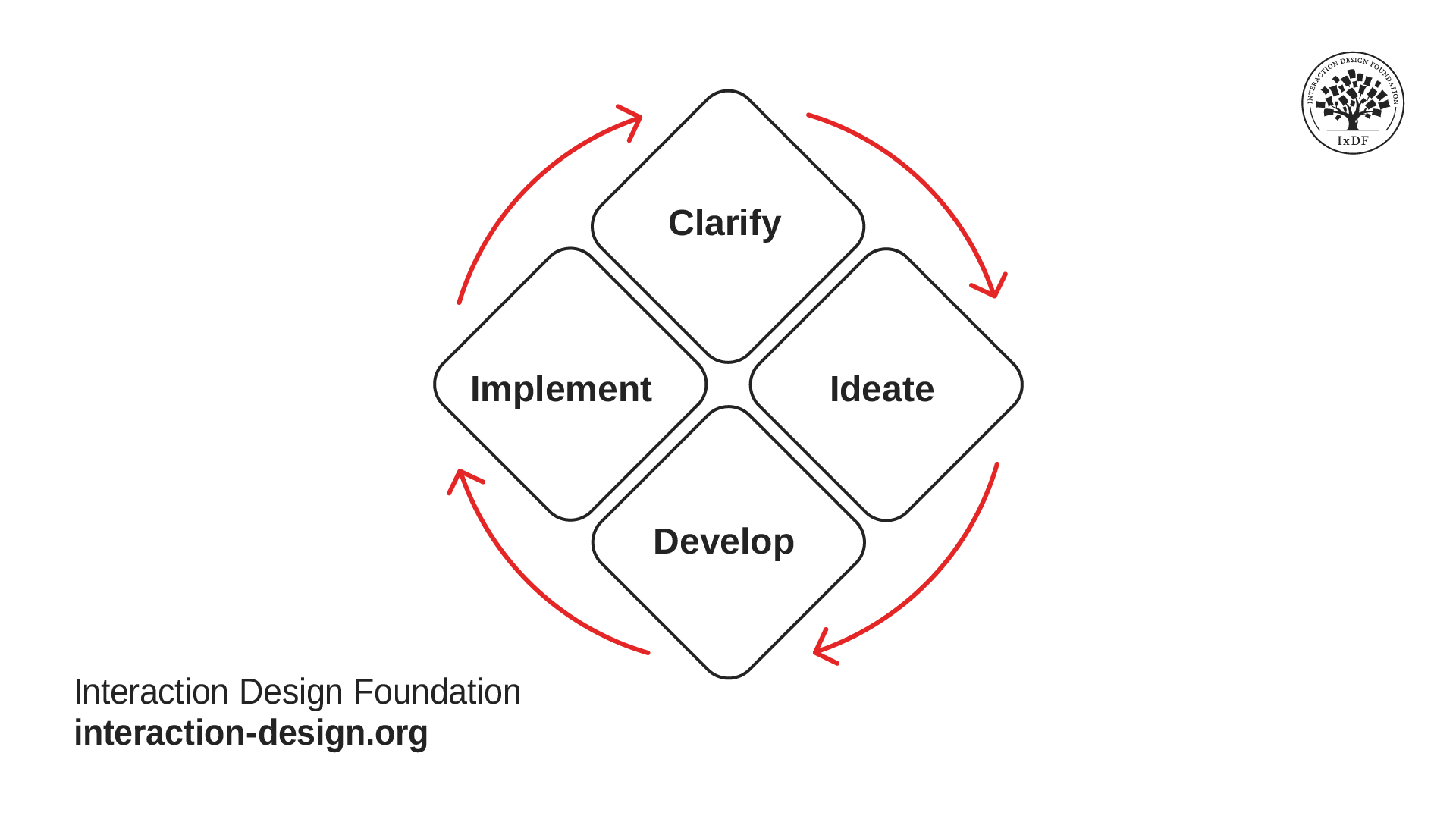
Creative problem solving (CPS) is a process that design teams use to generate ideas and solutions in their work. Designers and design teams apply an approach where they clarify a problem to understand it, ideate to generate good solutions, develop the most promising one, and implement it to create a successful solution for their brand’s users.
© Creative Education Foundation, Fair Use
Why is Creative Problem Solving in UX Design Important?
Creative thinking and problem solving are core parts of user experience (UX) design. Note: the abbreviation “CPS” can also refer to cyber-physical systems. Creative problem solving might sound somewhat generic or broad. However, it’s an ideation approach that’s extremely useful across many industries.
Not strictly a UX design-related approach, creative problem solving has its roots in psychology and education. Alex Osborn—who founded the Creative Education Foundation and devised brainstorming techniques—produced this approach to creative thinking in the 1940s. Along with Sid Parnes, he developed the Osborn-Parnes Creative Problem Solving Process. It was a new, systematic approach to problem solving and creativity fostering.
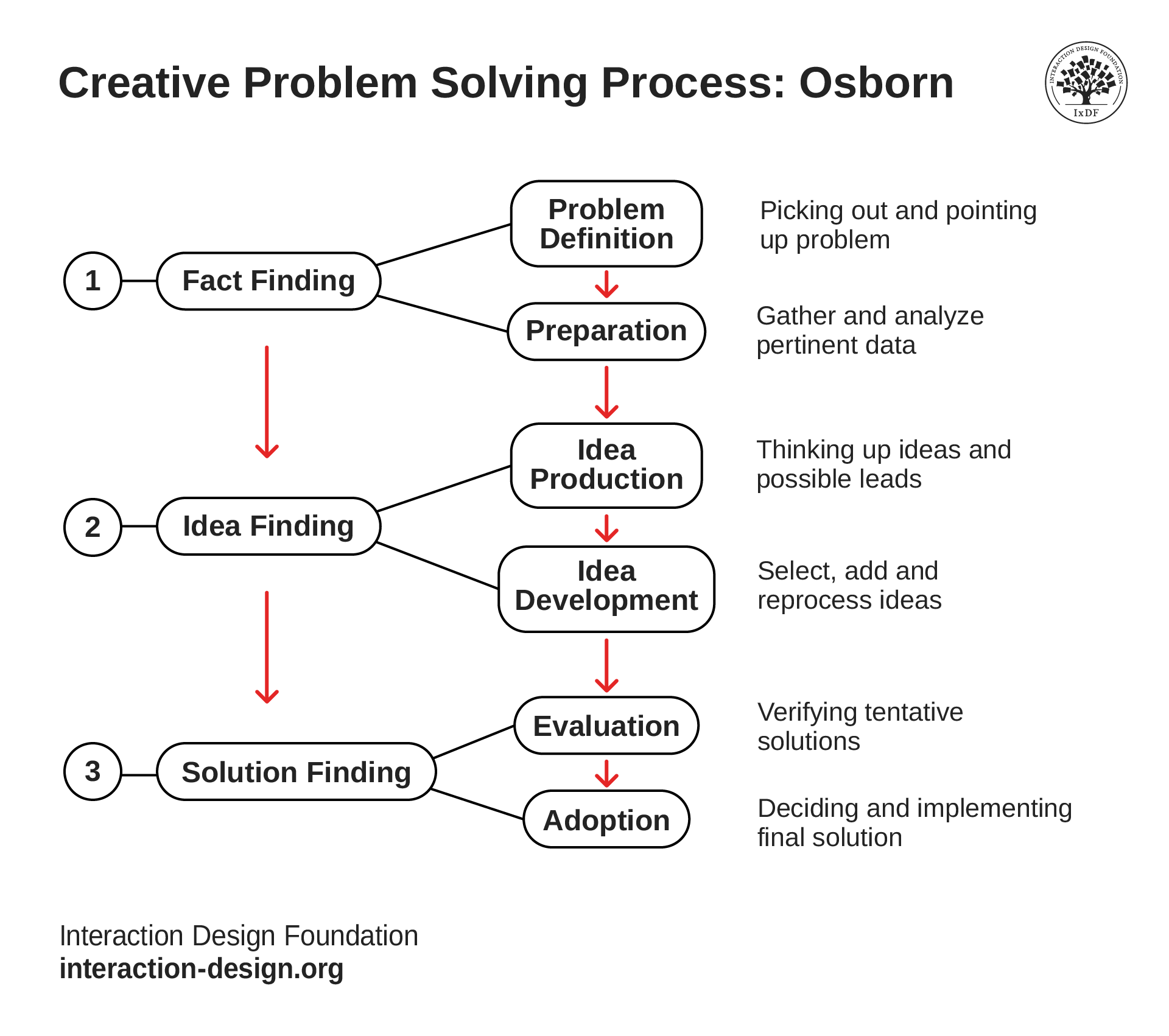
Osborn’s CPS Process.
© IdeaSandbox.com, Fair Use
The main focus of the creative problem solving model is to improve creative thinking and generate novel solutions to problems. An important distinction exists between it and a UX design process such as design thinking. It’s that designers consider user needs in creative problem solving techniques, but they don’t necessarily have to make their users’ needs the primary focus. For example, a design team might trigger totally novel ideas from random stimuli—as opposed to working systematically from the initial stages of empathizing with their users. Even so, creative problem solving methods still tend to follow a process with structured stages.
What are 4 Stages of Creative Problem Solving?
The model, adapted from Osborn’s original, typically features these steps:
Clarify: Design teams first explore the area they want to find a solution within. They work to spot the challenge, problem or even goal they want to identify. They also start to collect data or information about it. It’s vital to understand the exact nature of the problem at this stage. So, design teams must build a clear picture of the issue they seek to tackle creatively. When they define the problem like this, they can start to question it with potential solutions.
Ideate: Now that the team has a grasp of the problem that faces them, they can start to work to come up with potential solutions. They think divergently in brainstorming sessions and other ways to solve problems creatively, and approach the problem from as many angles as they can.
Develop: Once the team has explored the potential solutions, they evaluate these and find the strongest and weakest qualities in each. Then, they commit to the one they decide is the best option for the problem at hand.
Implement: Once the team has decided on the best fit for what they want to use, they discuss how to put this solution into action. They gauge its acceptability for stakeholders. Plus, they develop an accurate understanding of the activities and resources necessary to see it become a real, bankable solution.
What Else does CPS Involve?
© Interaction Design Foundation, CC BY-SA 4.0
Two keys to the enterprise of creative problem solving are:
Divergent Thinking
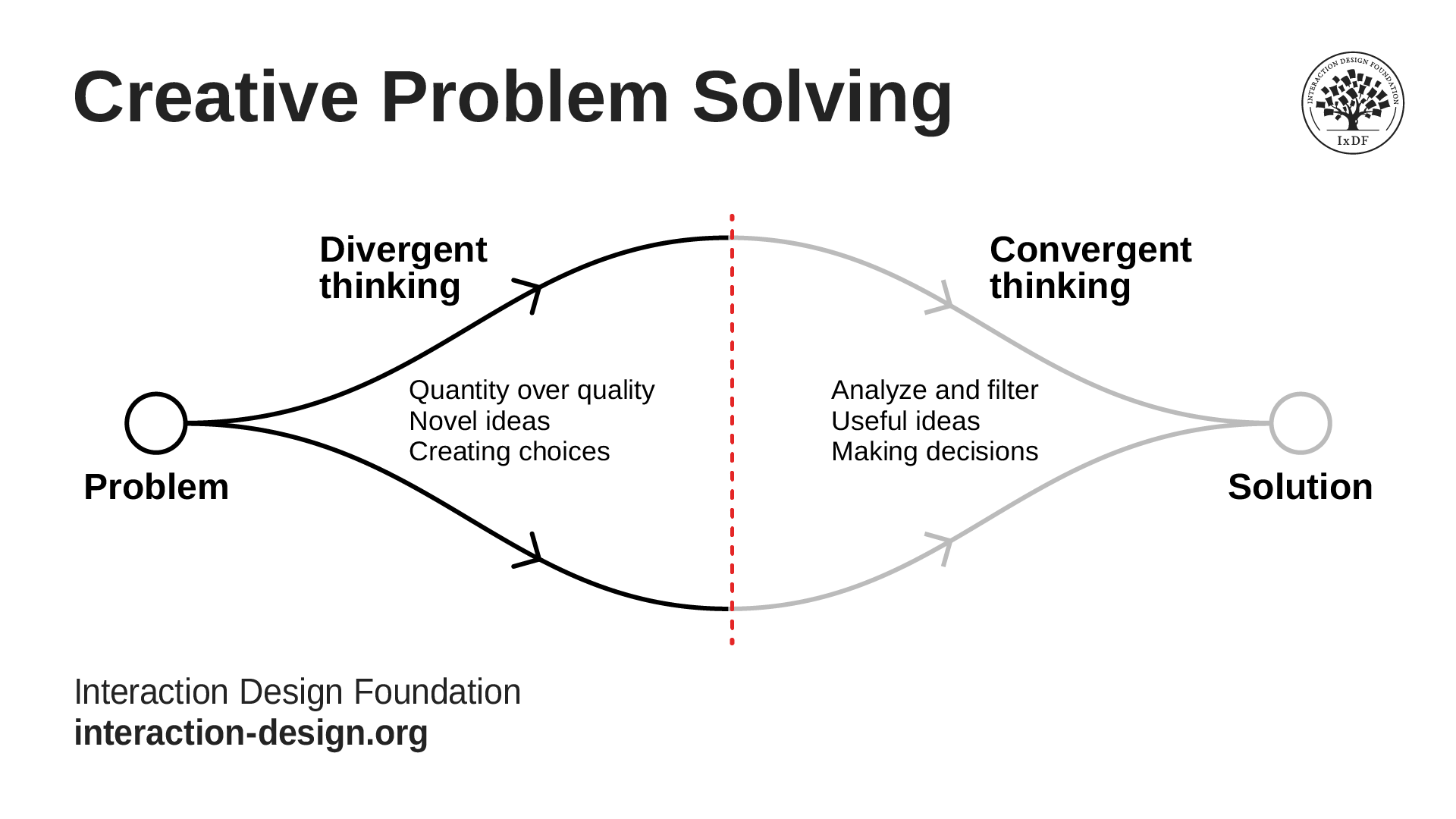
This is an ideation mode which designers leverage to widen their design space when they start to search for potential solutions. They generate as many new ideas as possible using various methods. For example, team members might use brainstorming or bad ideas to explore the vast area of possibilities. To think divergently means to go for:
Quantity over quality: Teams generate ideas without fear of judgment (critically evaluating these ideas comes later).
Novel ideas: Teams use disruptive and lateral thinking to break away from linear thinking and strive for truly original and extraordinary ideas.
Choice creation: The freedom to explore the design space helps teams maximize their options, not only regarding potential solutions but also about how they understand the problem itself.
Author and Human-Computer Interactivity Expert, Professor Alan Dix explains some techniques that are helpful for divergent thinking:
Convergent Thinking
This is the complementary half of the equation. In this ideation mode, designers analyze, filter, evaluate, clarify and modify the ideas they generated during divergent thinking. They use analytical, vertical and linear thinking to isolate novel and useful ideas, understand the design space possibilities and get nearer to potential solutions that will work best. The purpose with convergent thinking is to carefully and creatively:
Look past logical norms (which people use in everyday critical thinking).
Examine how an idea stands in relation to the problem.
Understand the real dimensions of that problem.
Professor Alan Dix explains convergent thinking in this video:
What are the Benefits of Creative Problem Solving?
Design teams especially can benefit from this creative approach to problem solving because it:
Empowers teams to arrive at a fine-grained definition of the problem they need to ideate over in a given situation.
Gives a structured, learnable way to conduct problem-solving activities and direct them towards the most fruitful outcomes.
Involves numerous techniques such as brainstorming and SCAMPER, so teams have more chances to explore the problem space more thoroughly.
Can lead to large numbers of possible solutions thanks to a dedicated balance of divergent and convergent thinking.
Values and nurtures designers and teams to create innovative design solutions in an accepting, respectful atmosphere.
Is a collaborative approach that enables multiple participants to contribute—which makes for a positive environment with buy-in from those who participate.
Enables teams to work out the most optimal solution available and examine all angles carefully before they put it into action.
Is applicable in various contexts—such as business, arts and education—as well as in many areas of life in general.
It’s especially crucial to see the value of creative problem solving in how it promotes out-of-the-box thinking as one of the valuable ingredients for teams to leverage.
Watch as Professor Alan Dix explains how to think outside the box:
How to Conduct Creative Problem Solving Best?
It’s important to point out that designers should consider—and stick to—some best practices when it comes to applying creative problem solving techniques. They should also adhere to some “house rules,” which the facilitator should define in no uncertain terms at the start of each session. So, designers and design teams should:
Define the chief goal of the problem-solving activity: Everyone involved should be on the same page regarding their objective and what they want to achieve, why it’s essential to do it and how it aligns with the values of the brand. For example, SWOT analysis can help with this. Clarity is vital in this early stage. Before team members can hope to work on ideating for potential solutions, they must recognize and clearly identify what the problem to tackle is.
Have access to accurate information: A design team must be up to date with the realities that their brand faces, realities that their users and customers face, as well as what’s going on in the industry and facts about their competitors. A team must work to determine what the desired outcome is, as well as what the stakeholders’ needs and wants are. Another factor to consider in detail is what the benefits and risks of addressing a scenario or problem are—including the pros and cons that stakeholders and users would face if team members direct their attention on a particular area or problem.
Suspend judgment: This is particularly important for two main reasons. For one, participants can challenge assumptions that might be blocking healthy ideation when they suggest ideas or elements of ideas that would otherwise seem of little value through a “traditional” lens. Second, if everyone’s free to suggest ideas without constraints, it promotes a calmer environment of acceptance—and so team members will be more likely to ideate better. Judgment will come later, in convergent thinking when the team works to tighten the net around the most effective solution. So, everyone should keep to positive language and encourage improvisational tactics—such as “yes…and”—so ideas can develop well.
Balance divergent and convergent thinking: It’s important to know the difference between the two styles of thinking and when to practice them. This is why in a session like brainstorming, a facilitator must take control of proceedings and ensure the team engages in distinct divergent and convergent thinking sessions.
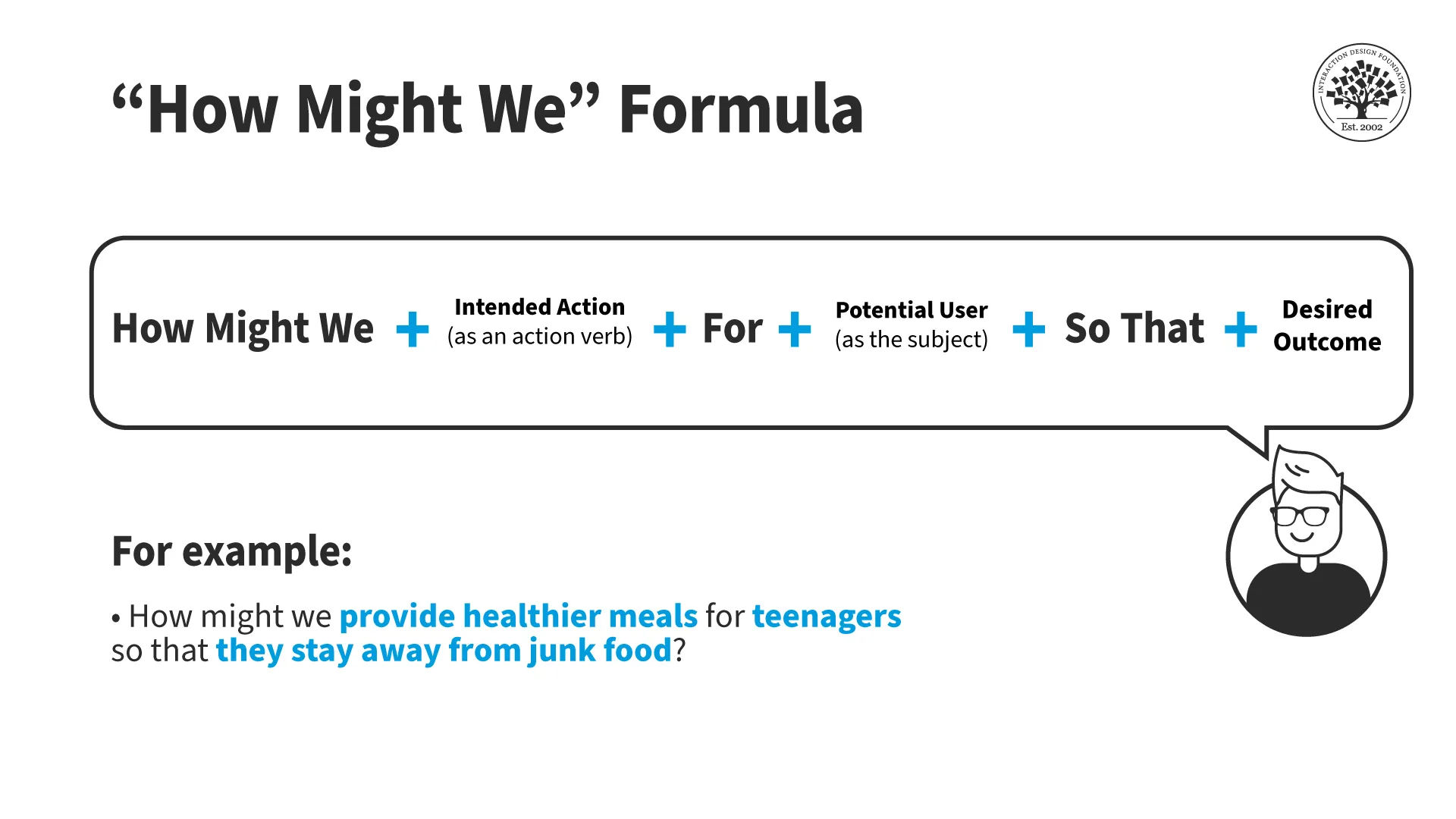
Approach problems as questions: For example, “How Might We” questions can prompt team members to generate a great deal of ideas. That’s because they’re open-ended—as opposed to questions with “yes” or “no” answers. When a team frames a problem so freely, it permits them to explore far into the problem space so they can find the edges of the real matter at hand.
© Interaction Design Foundation, CC BY-SA 4.0
UX Strategist and Consultant, William Hudson explains “How Might We” questions in this video:
Use a variety of ideation methods: For example, in the divergent stage, teams can apply methods such as random metaphors or bad ideas to venture into a vast expanse of uncharted territory. With random metaphors, a team prompts innovation by drawing creative associations. With bad ideas, the point is to come up with ideas that are weird, wild and outrageous, as team members can then determine if valuable points exist in the idea—or a “bad” idea might even expose flaws in conventional ways of seeing problems and situations.
Professor Alan Dix explains important points about bad ideas:
What Special Considerations Should Designers Have for CPS?
Creative problem solving isn’t the only process design teams consider when thinking of potential risks. Teams that involve themselves in ideation sessions can run into problems, especially if they aren’t aware of them. Here are the main areas to watch:
Bias
Bias is natural and human. Unfortunately, it can get in the way of user research and prevent a team from being truly creative and innovative. What’s more, it can utterly hinder the iterative process that should drive creative ideas to the best destinations. Bias takes many forms. It can rear its head without a design team member even realizing it. So, it’s vital to remember this and check it. One team member may examine an angle of the problem at hand and unconsciously view it through a lens. Then, they might voice a suggestion without realizing how they might have framed it for team members to hear. Another risk is that other team members might, for example, apply confirmation bias and overlook important points about potential solutions because they’re not in line with what they’re looking for.
Professor Alan Dix explains bias and fixation as obstacles in creative problem solving examples, and how to overcome them:
Conventionalism
Even in the most hopeful ideation sessions, there’s the risk that some team members may slide back to conventional ways to address a problem. They might climb back inside “the box” and not even realize it. That’s why it’s important to mindfully explore new idea territories around the situation under scrutiny and not merely toy with the notion while clinging to a default “traditional” approach, just because it’s the way the brand or others have “always done things.”
Dominant Personalities and Rank Pulling
As with any group discussion, it’s vital for the facilitator to ensure that everyone has the chance to contribute. Team members with “louder” personalities can dominate the discussions and keep quieter members from offering their thoughts. Plus, without a level playing field, it can be hard for more junior members to join in without feeling a sense of talking out of place or even a fear of reprisal for disagreeing with senior members.
Another point is that ideation sessions naturally involve asking many questions, which can bring on two issues. First, some individuals may over-defend their ideas as they’re protective of them. Second, team members may feel self-conscious as they might think if they ask many questions that it makes them appear frivolous or unintelligent. So, it’s vital for facilitators to ensure that all team members can speak up and ask away, both in divergent thinking sessions when they can offer ideas and convergent thinking sessions when they analyze others’ ideas.
Premature Commitment
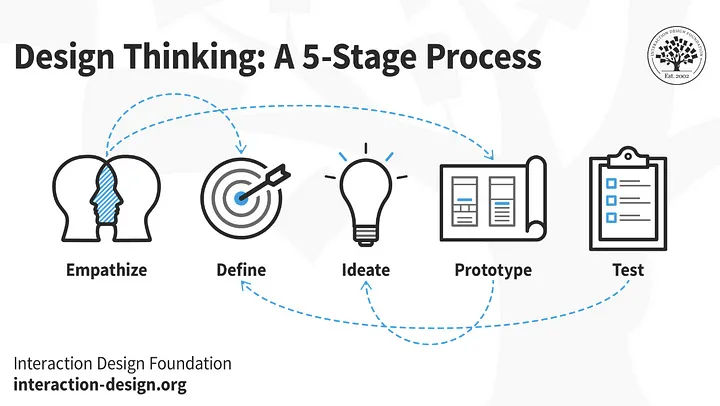
Another potential risk to any creativity exercise is that once a team senses a solution is the “best” one, everyone can start to shut off and overlook the chance that an alternative may still arise. This could be a symptom of ideation fatigue or a false consensus that a proposed solution is infallible. So, it’s vital that team members keep open minds and try to catch potential issues with the best-looking solution as early as possible. The key is an understanding of the need for iteration—something that’s integral to the design thinking process, for example.
© Interaction Design Foundation, CC BY-SA 4.0
Overall, creative problem solving can help give a design team the altitude—and attitude—they need to explore the problem and solution spaces thoroughly. Team members can leverage a range of techniques to trawl through the hordes of possibilities that exist for virtually any design scenario. As with any method or tool, though, it takes mindful application and awareness of potential hazards to wield it properly. The most effective creative problem-solving sessions will be ones that keep “creative,” “problem” and “solving” in sharp focus until what emerges for the target audience proves to be more than the sum of these parts.