Your constantly-updated definition of Outside the Box Thinking and collection of videos and articles. Be a conversation starter: Share this page and inspire others!
Outside-the-box thinking is an ideation form where designers freely discard common problem-solving methods to find the true nature of users’ problems, falsify old assumptions and be innovative. Vital to the design thinking process, out-of-the-box thinking means reframing problems with a wider grasp of the design space.
“Thinking outside of the box allows you to get rewards outside of your reach.”
See where—and what—thinking outside the box can get you:
Transcript
Transcript loading ...
Autoscroll
Break Out of the Box to Find Spectacular Solutions
Traditional approaches to problem-solving can distort design teams’ views of problems. The most innovative solutions—both in product design and service design—usually come from designers who dared to step off the path of linear thinking to ask “Why?”. Design problems are usually complex, with many hard-to-see factors at play between users, the diverse realities they face and solutions they would find most effective, helpful and desirable. To follow a vertical, linear train of thought when addressing these would likely soon cause some big obstacles. With outside-the-box thinking, you can challenge assumptions that would otherwise constrain you, therefore freeing you to sidestep the dangers of meeting a design problem head-on.
Thinking outside the box can save you and your team the headaches of pursuing a perceived problem and ending up developing uninventive, semi-effectual solutions. So, instead of chasing shadows, you can work your way around the boundaries and explore the bigger picture. Moreover, it's a great way to discover other resources that might be available to you, spot market gaps and, indeed, inspire your design team in the ideation stage of any project. That’s why thinking out of the box is synonymous with, and integral to design thinking.
“The box” is the apparent constraints of the design space and our restrictions in perspective from habitually meeting problems as everyday “if x, then do y to get z” tasks. That clinical, critical line of reasoning we’re used to outside the design space will easily impose its limitations in design ideation. You can’t get a holistic view of the problem unless you start to explore horizontally and find its edges. To get outside the box, it’s important to:
Focus on overlooked aspects of a situation/problem.
Challenge assumptions – about any aspect of the problem or users.
Seek alternatives – not just alternative potential solutions, but alternative ways of thinking about problems.
Lateral thinkinganddivergent thinking methods can lead to the best results. Early in the ideation stage is the time to get disruptive and reconnect with a similar sense of wonder to how children challenge the norms which adults grow to accept without question. A persistence with “Why?” is the key, as is a judgement-free atmosphere in your ideation session. You want to ask significant questions that may seem outlandish – the idea being to scrutinize the assumptions everyone else would go along with because they’re “the done thing” and see if they’re actually valid.
Essentially, you want to reframe the problem and:
Understand what’s constraining you and why.
Find new strategies to solutions and places/angles to start exploring.
Find the apparent edges of your design space and push beyond them – to reveal the bigger picture.
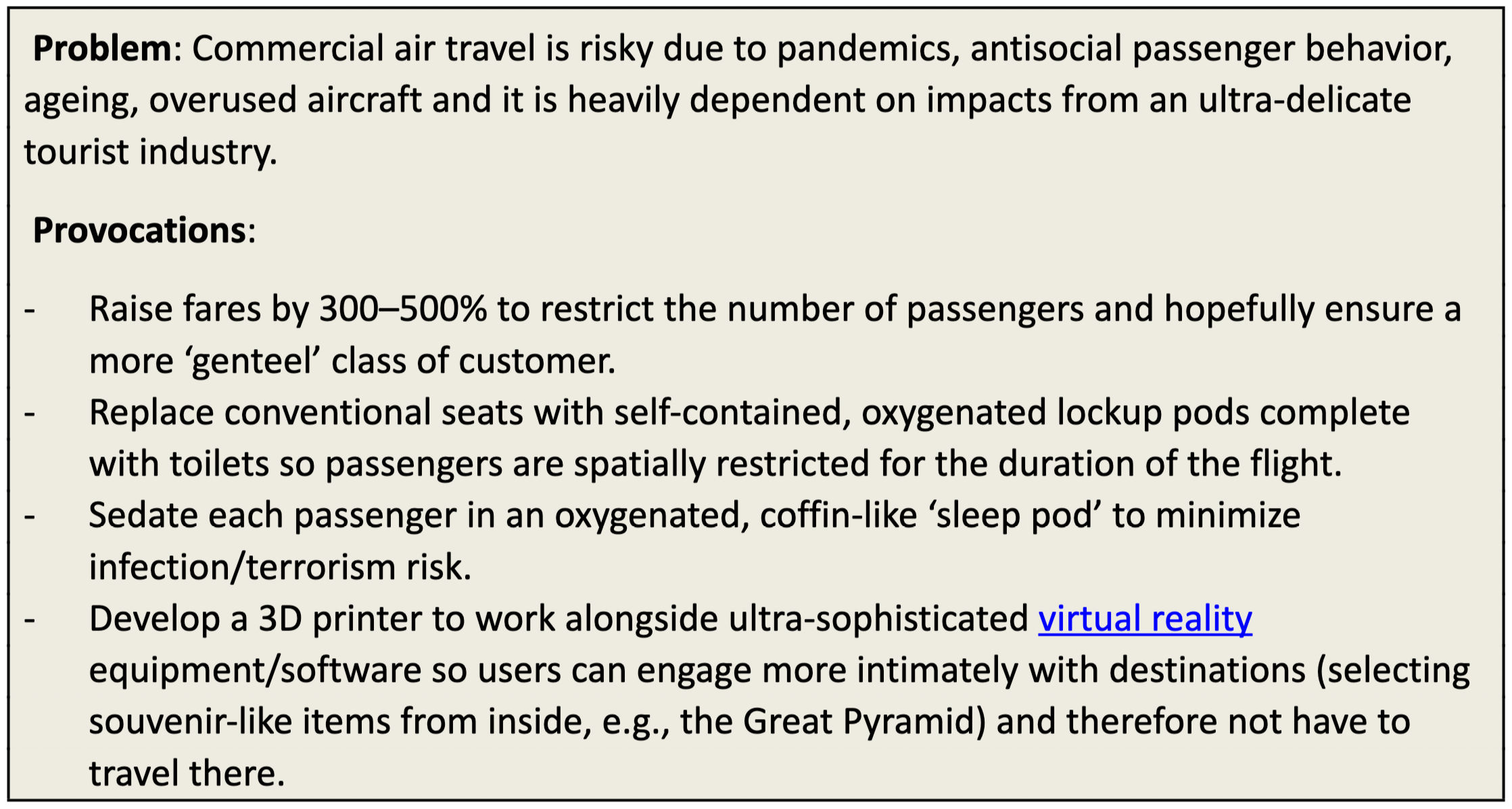
Of the various methods you can use, a chief one is provocations, where you make deliberately false statements about an aspect of the problem/situation. This could be to question the norms through contradiction, distortion, reversal (i.e., of assumptions), wishful thinking or escapism, for example:
Here, we see some norms of conventional air travel challenged and some unpredictable (and even socially unacceptable) notions to trigger our thinking. Our example showcases this method:
Bad Ideas – You think up as many bad or crazy ideas as possible, but these might have potentially good aspects (e.g., having self-contained compartments with toilets for passengers traveling together). You also establish why bad aspects are bad (e.g., raising prices so exorbitantly would A) foster social exclusion and B) not guarantee safety, anyway).
Design thinking is ideal for outside-the-box thinking, especially since its fluidity as a process lets you iteratively research, ideate, prototype and more as you fine-tune your way to the best solution. Ultimately, you should be able to investigate your problem—including factors affecting it—and harvest insights from its many dimensions by brainstorming or other means. From there, you use convergent thinking to zero in on the best solutions.
Questions About Outside the Box Thinking? We've Got Answers!
How to think outside the box?
This video aptly answers the question of how to think outside the box.
Transcript
Transcript loading ...
Autoscroll
Thinking outside the box means thinking freely and creatively—off the beaten path. It encourages a departure from standard or predictable thinking. It implies adopting unconventional and innovative approaches to problem-solving. Here is what you can do to get started:
Dive into the corners others might miss. Look beyond the obvious and focus on elements often overlooked in a situation.
Question the assumptions entrenched in the problem or regarding the users. Challenge the "given" and ask whether those assumptions are valid.
Don't settle for the expected. Seek not only solutions but also how to frame and approach the problem.
Is thinking outside the box a skill?
Yes, thinking outside the box is a valuable skill in problem-solving. It goes beyond regular solutions by exploring overlooked aspects, challenging norms, and looking past apparent boundaries. The skill involves questioning the usual ways of doing things and finding innovative solutions. The essence lies in addressing the edges and pushing beyond them to develop a dynamic and creative mindset.
How do I think outside the box?
Thinking outside the box involves lateral and divergent thinking methods.
During the ideation stage, be disruptive, persistently ask "Why?" and create a judgment-free atmosphere.
Reframe the problem by understanding constraints, finding new strategies, exploring different angles, and pushing beyond apparent boundaries to reveal the bigger picture.
Use provocations, such as deliberately false statements, to question norms and challenge assumptions.
What is an example of thinking outside of the box?
Here are a few innovative ideas from the home to the workplace:
At Home - Imagine you have a small, unused space under your staircase at home. Comfortable seating, soft lighting, and bookshelves can turn an overlooked area into an inviting space. It demonstrates a creative use of space beyond its "supposed" purpose.
At Work - A common challenge in an eCommerce app is a high rate of product returns. It mainly happens because customers need more certainty about how items will look on them. So, you incorporate augmented reality (AR) for virtual product try-ons to enhance user satisfaction.
What is creativity in thinking outside the box?
Creativity in thinking outside the box means introducing fresh and different ideas and breaking away from the norm. It is like analyzing other paths. The process involves exploring alternative options, questioning the "done thing," and finding clever solutions to problems. This video on Edward de Bono's "thinking hats" framework shows the connection between creative thinking and outside-the-box thinking. The "thinking hats" framework disrupts routine thinking, sparks creativity, and helps find new ideas and answers that change how to tackle challenges.
Transcript
Transcript loading ...
Autoscroll
An open and dynamic perspective provides a continuous flow of imaginative thinking. Creativity and outside-the-box thinking are about going beyond regular thinking to find possibilities. It paves the way for smart solutions and makes problem-solving more interesting.
Is thinking outside the box critical thinking?
Thinking outside the box is closely tied to critical thinking. While critical thinking is a part of the process, thinking outside the box goes a step further.
Critical thinking involves analyzing, evaluating, and reasoning through information to make judgments. It encourages exploring alternative perspectives and solutions.
Thinking outside the box focuses more on creative problem-solving and challenging assumptions. It involves questioning assumptions, challenging traditional norms, and reframing problems with a broader understanding.
Thinking outside the box shares similarities with critical thinking but is not synonymous. So, while complementing each other, they represent distinct aspects of cognitive processes.
Is thinking outside the box good or bad?
Thinking outside the box is a positive and valuable approach. It is about looking at things differently, not just sticking to the usual ideas. Such techniques make problem-solving more exciting and compelling.
While the initial introduction of unconventional ideas might seem impractical or risky, the long-term benefits are substantial. This approach has the potential to handle creative blocks, lead to breakthroughs, and overcome limitations imposed by traditional thinking.
Where to learn more about thinking outside the box?
You can sign up for our comprehensive course 'Creativity: Methods to Design Better Products and Services, to learn more about outside-the-box thinking. It equips you with skills and step-by-step methods to enhance your ability to generate innovative and valuable solutions. You will gain practical insights and tools to foster creativity in various workflows, programming algorithms, and professional settings.
Why? Because design skills make you valuable. In any job. Any industry.
In This Course, You'll
Get excited to innovate and get creative, even when you feel blocked. Learn a repeatable creative approach that'll help you generate strong concepts on demand, break through when you're stuck, and turn your best ideas into solutions users love. In this course, design legend and author of the bestselling book "Human-Computer Interaction (HCI)," Professor Alan Dix, shows you why the best ideas come from a structured process and gives you the toolkit to do it yourself.The World Economic Forum ranks creative thinking among the top skills employers want in any profession, today and through 2030. Whether you're starting out, switching careers, or in a senior role and want a process you can rely on, you'll turn creativity from something that happens to you into something you can switch on. No creative background needed.
Make yourself invaluable by mastering a wide range of ideation methods so you never get stuck in one approach. To generate and explore new ideas, you'll apply Bad Ideas, Random Metaphors, and Arbitrary Constraints, and to refine and develop them, you'll apply Embrace Opposites, Multiple Classifications, and Teasing Apart, Piecing Together (TAPT). With Edward de Bono's Six Thinking Hats, you'll learn to guide a team to see a problem from every angle. You'll also learn to build an environment that nurtures creativity and to remove the hidden barriers that hold people back. You won't just have better ideas, you'll help everyone around you have them too. As AI churns out endless options, it's your timeless, human-centered design skills, like understanding people and what they actually need, that ensure your solutions are genuinely new and useful.
Gain confidence and credibility with a creative process that helps you be productive even under pressure. You'll learn to plan and time-manage your work so good ideas arrive when you need them, and apply proven strategies to beat procrastination, bias, and fixation. You'll keep momentum going with busywork, recognize when stepping back to let an idea incubate is the smartest move, and tackle big, messy "wicked problems"without stalling. When you hit a wall, you'll know whether to push through, switch to something else, or step away, instead of forcing it. And because your best ideas often arrive in the shower or on a walk, not at your desk, you'll learn simple ways to capture them before they slip away. The result is a process you can rely on, so you deliver strong work whether the spark comes on schedule or not.
Craft your personal portfolio with a piecethat clearly captures your entire creative process. With optional, hands-on activities, you'll build a case study that shows how you ideate, from a ready-made persona and empathy map through to a fully developed concept. Downloadable templates let you apply your new skills immediately. You walk away able to show employers and clients what a polished mockup alone doesn't: how you actually approach and solve problems.
Learn From Industry Leaders
Master complex skills with proven best practices and toolkits directly from industry leaders. Meet your experts for this course:
Alan Dix: Author of the bestselling book "Human-Computer Interaction" and Director of the Computational Foundry at Swansea University.
Don Norman: Father of User Experience (UX) Design, author of the legendary book "The Design of Everyday Things," and co-founder of the Nielsen Norman Group.
Earn Industry-Recognized Certificates
Industry giants trust our courses to train their teams, and prestigious universities integrate our content into their curricula. Add your certificates to your LinkedIn profile, résumé, and job applications.
All Free IxDF Articles on Outside the Box Thinking
Design Thinking is not an exclusive property of designers—all great innovators in literature, art, music, science, engineering, and business have practiced it. So, why call it Design Thinking? What’s special about Design Thinking is that designers’ work processes can help us systematically extract,
Social shares
1.6k
Published
Read Article
What is Design Thinking and Why Is It So Popular?
Design Thinking is not an exclusive property of designers—all great innovators in literature, art, music, science, engineering, and business have practiced it. So, why call it Design Thinking? What’s special about Design Thinking is that designers’ work processes can help us systematically extract, teach, learn and apply these human-centered techniques to solve problems in a creative and innovative way—in our designs, in our businesses, in our countries, in our lives.
Some of the world’s leading brands, such as Apple, Google and Samsung, rapidly adopted the design thinking approach, and leading universities around the world teach the related methodology—including Stanford, Harvard, Imperial College London and the Srishti Institute in India. Before you incorporate design thinking into your own workflows, you need to know what it is and why it’s so popular. Here, we’ll cut to the chase and tell you what design thinking is all about and why it’s so in demand.
What is Design Thinking?
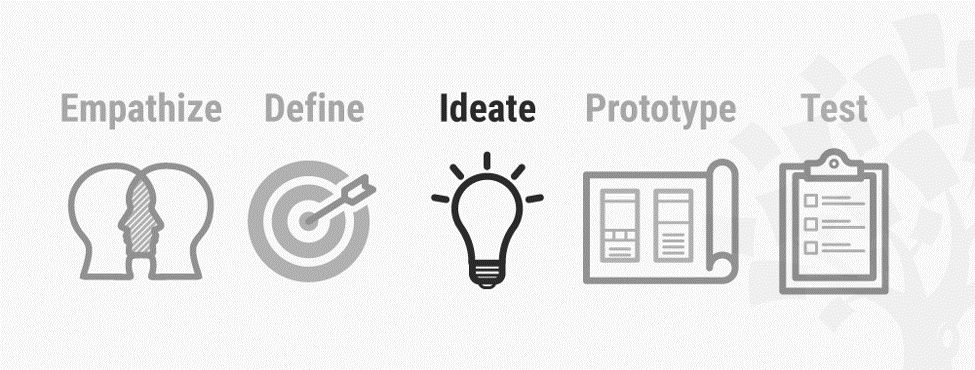
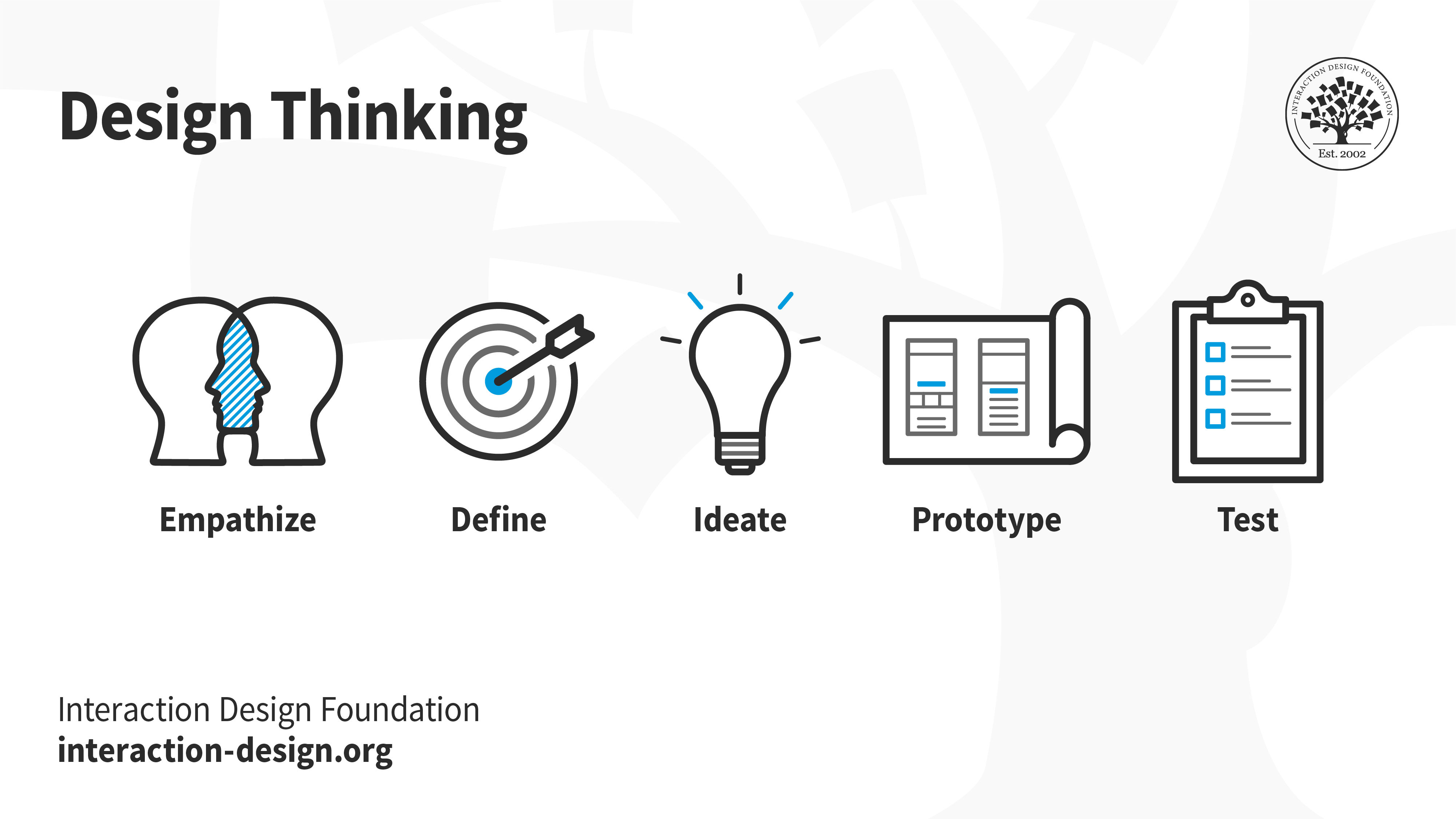
Design thinking is an iterative and non-linear process that contains five phases: 1. Empathize, 2. Define, 3. Ideate, 4. Prototype and 5. Test.
Design thinking is an iterative process in which you seek to understand your users, challenge assumptions, redefine problems and create innovative solutions which you can prototype and test. The overall goal is to identify alternative strategies and solutions that are not instantly apparent with your initial level of understanding.
Design thinking is more than just a process; it opens up an entirely new way to think, and it offers a collection of hands-on methods to help you apply this new mindset.
In essence, design thinking:
Revolves around a deep interest to understand the people for whom we design products and services.
Helps us observe and develop empathy with the target users.
Enhances our ability to question: in design thinking you question the problem, the assumptions and the implications.
Proves extremely useful when you tackle problems that are ill-defined or unknown.
Involves ongoing experimentation through sketches, prototypes, testing and trials of new concepts and ideas.
Transcript
Transcript loading ...
Autoscroll
In this video, Don Norman, the Grandfather of Human-Centered Design, explains how the approach and flexibility of design thinking can help us tackle major global challenges.
What Are the 5 Phases of Design Thinking?
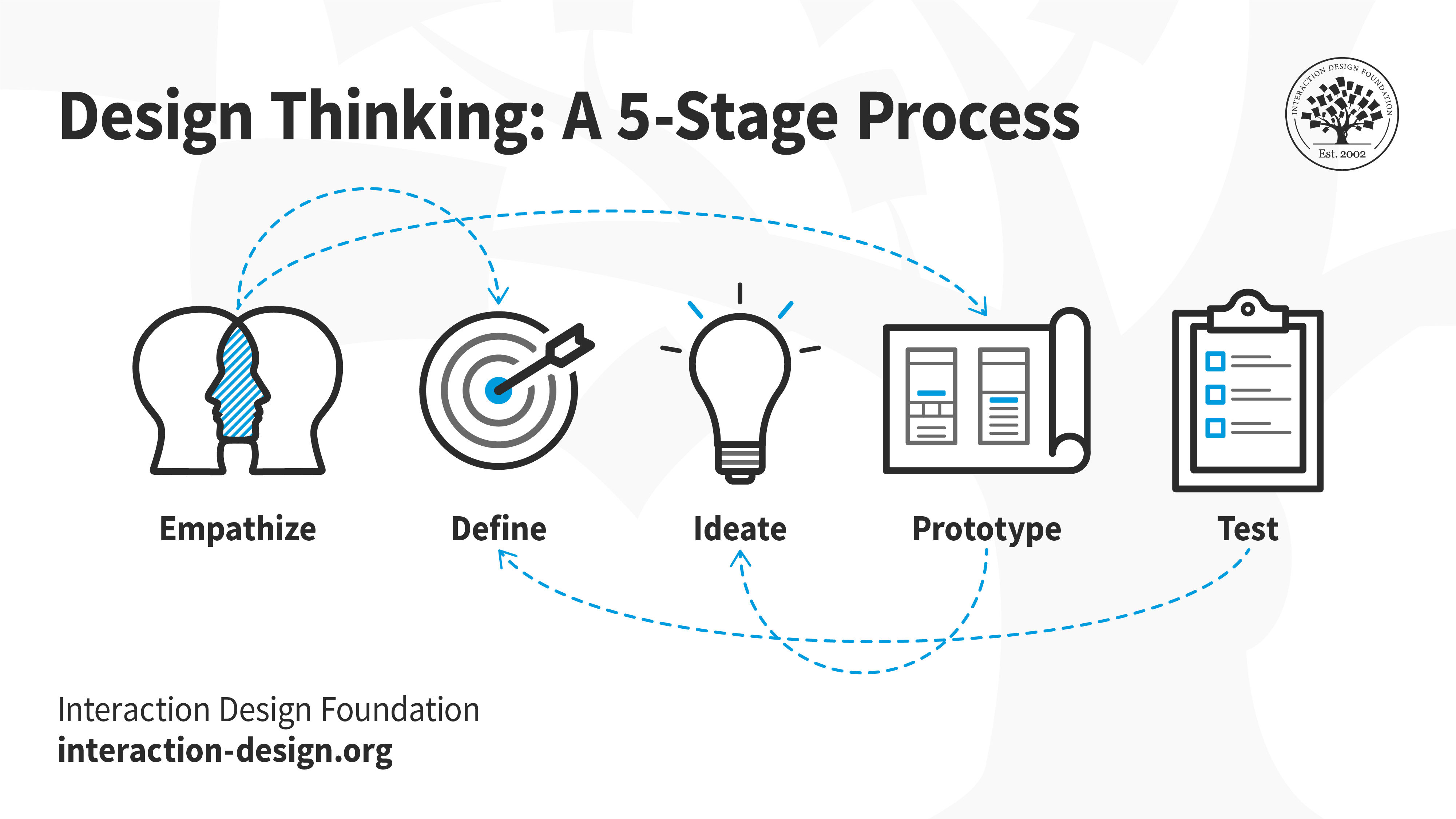
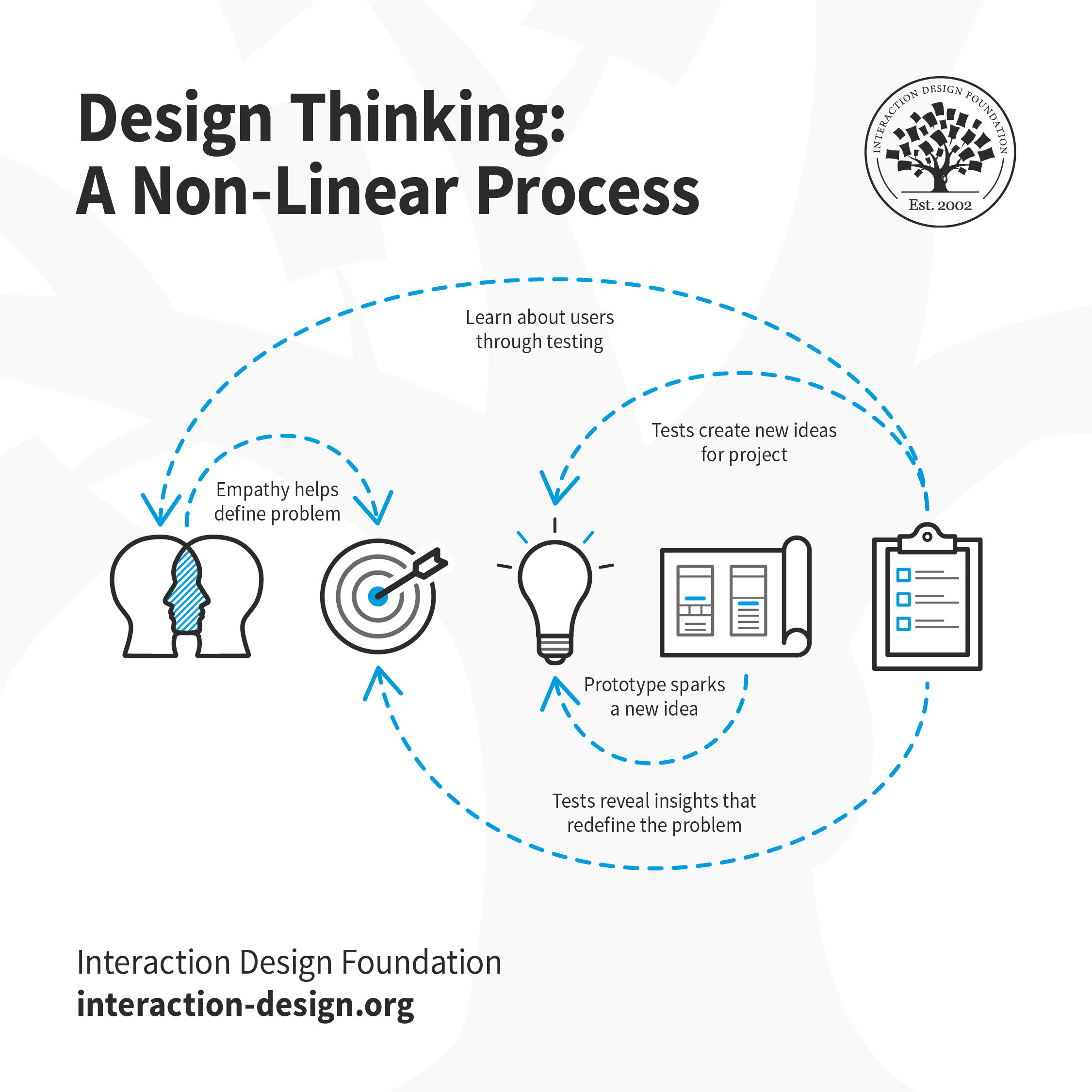
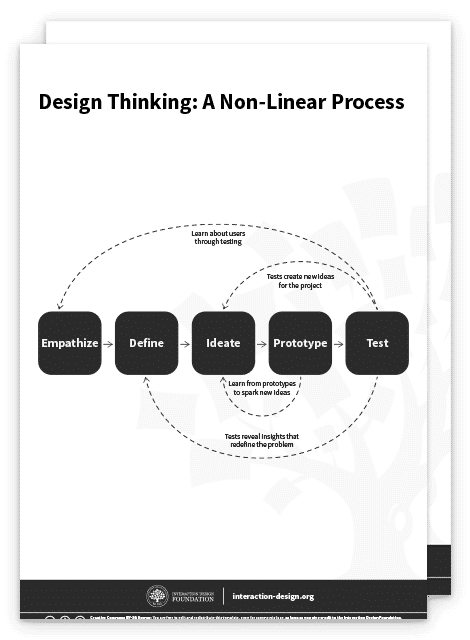
Design thinking is an iterative and non-linear process that contains five phases: 1. Empathize, 2. Define, 3. Ideate, 4. Prototype and 5. Test. You can carry these stages out in parallel, repeat them and circle back to a previous stage at any point in the process.
The core purpose of the process is to allow you to work in a dynamic way to develop and launch innovative ideas.
Design thinking is an iterative and non-linear process that contains five phases: 1. Empathize, 2. Define, 3. Ideate, 4. Prototype and 5. Test.
Design thinking can help people do out-of-the-box or outside-the-box thinking. People who use this methodology:
Attempt to develop new ways of thinking—ways that do not abide by the dominant or more common problem-solving methods.
Have the intention to improve products, services and processes. They seek to analyze and understand how users interact with products to investigate the conditions in which they operate.
Ask significant questions and challenge assumptions. One element of outside-the-box / out-of-the-box thinking is to to make previous assumptions falsifiable—i.e., make it possible to prove whether they’re valid or not.
As you can see, design thinking offers us a means to think outside the box and also dig that bit deeper into problem-solving. It helps us carry out the right kind of research, create prototypes and test our products and services to uncover new ways to meet our users’ needs.
The Grand Old Man of User Experience, Don Norman, who also coined the very term User Experience, explains what Design Thinking is and what’s so special about it:
“…the more I pondered the nature of design and reflected on my recent encounters with engineers, business people and others who blindly solved the problems they thought they were facing without question or further study, I realized that these people could benefit from a good dose of design thinking. Designers have developed a number of techniques to avoid being captured by too facile a solution. They take the original problem as a suggestion, not as a final statement, then think broadly about what the real issues underlying this problem statement might really be (for example by using the "Five Whys" approach to get at root causes). Most important of all, is that the process is iterative and expansive. Designers resist the temptation to jump immediately to a solution to the stated problem. Instead, they first spend time determining what the basic, fundamental (root) issue is that needs to be addressed. They don't try to search for a solution until they have determined the real problem, and even then, instead of solving that problem, they stop to consider a wide range of potential solutions. Only then will they finally converge upon their proposal. This process is called "Design Thinking."
— Don Norman, Rethinking Design Thinking
Design Thinking is for Everybody
How many people are involved in the design process when your organization decides to create a new product or service? Teams that build products are often composed of people from a variety of different departments. For this reason, it can be difficult to develop, categorize and organize ideas and solutions for the problems you try to solve. One way you can keep a project on track, and organize the core ideas, is to use a design thinking approach—and everybody can get involved in that!
Tim Brown, CEO of the celebrated innovation and design firm IDEO, emphasizes this in his successful book Change by Design when he says design thinking techniques and strategies belong at every level of a business.
Design thinking is not only for designers but also for creative employees, freelancers and leaders who seek to infuse it into every level of an organization. This widespread adoption of design thinking will drive the creation of alternative products and services for both business and society.
“Design thinking begins with skills designers have learned over many decades in their quest to match human needs with available technical resources within the practical constraints of business. By integrating what is desirable from a human point of view with what is technologically feasible and economically viable, designers have been able to create the products we enjoy today. Design thinking takes the next step, which is to put these tools into the hands of people who may have never thought of themselves as designers and apply them to a vastly greater range of problems.”
— Tim Brown, Change by Design, Introduction
Design thinking techniques and strategies belong at every level of a business. You should involve colleagues from a wide range of departments to create a cross-functional team that can utilize knowledge and experience from different specialisms.
Tim Brown also shows how design thinking is not just for everybody—it’s about everybody, too. The process is firmly based on how you can generate a holistic and empathic understanding of the problems people face. Design thinking involves ambiguous, and inherently subjective, concepts such as emotions, needs, motivations and drivers of behavior.
In a solely scientific approach (for example, analyzing data), people are reduced to representative numbers, devoid of emotions. Design thinking, on the other hand, considers both quantitative as well as qualitative dimensions to gain a more complete understanding of user needs. For example, you might observe people performing a task such as shopping for groceries, and you might talk to a few shoppers who feel frustrated with the checkout process at the store (qualitative data). You can also ask them how many times a week they go shopping or feel a certain way at the checkout counter (quantitative data). You can then combine these data points to paint a holistic picture of user pain points, needs and problems.
Tim Brown sums up that design thinking provides a third way to look at problems. It’s essentially a problem-solving approach that has crystallized in the field of design to combine a holistic user-centered perspective with rational and analytical research—all with the goal to create innovative solutions.
“Design thinking taps into capacities we all have but that are overlooked by more conventional problem-solving practices. It is not only human-centered; it is deeply human in and of itself. Design thinking relies on our ability to be intuitive, to recognize patterns, to construct ideas that have emotional meaning as well as functionality, to express ourselves in media other than words or symbols. Nobody wants to run a business based on feeling, intuition, and inspiration, but an overreliance on the rational and the analytical can be just as dangerous. The integrated approach at the core of the design process suggests a ‘third way.’”
— Tim Brown, Change by Design, Introduction
Design Thinking Has a Scientific Side
Design thinking is both an art and a science. It combines investigations into ambiguous elements of the problem with rational and analytical research—the scientific side in other words. This magical concoction reveals previously unknown parameters and helps to uncover alternative strategies which lead to truly innovative solutions.
The scientific activities analyze how users interact with products, and investigate the conditions in which they operate. They include tasks which:
Research users’ needs.
Pool experience from previous projects.
Consider present and future conditions specific to the product.
Test the parameters of the problem.
Test the practical application of alternative problem solutions.
Once you arrive at a number of potential solutions, the selection process is then underpinned by rationality. As a designer, you are encouraged to analyze and falsify these solutions to arrive at the best available option for each problem or obstacle identified during phases of the design process.
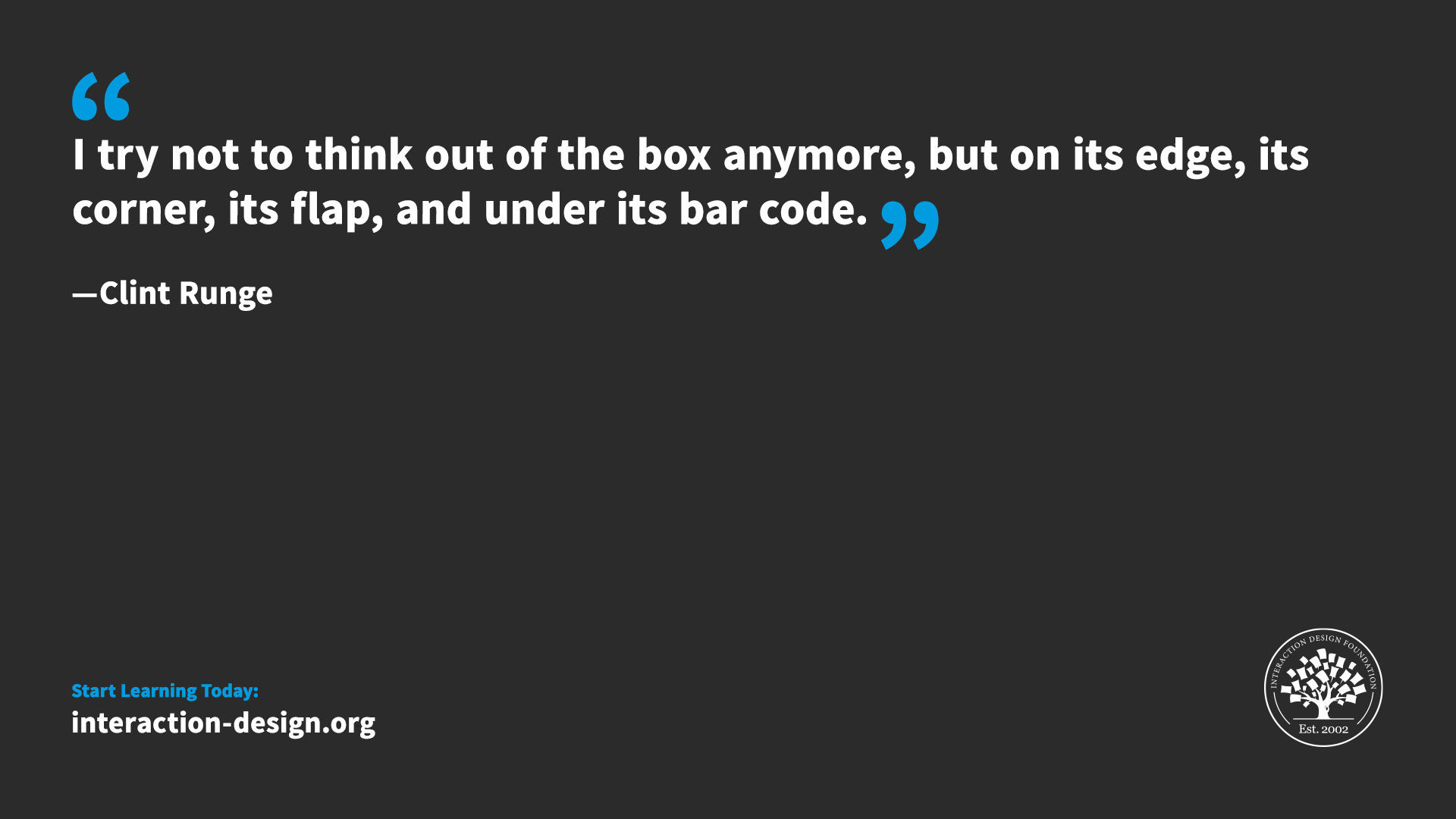
With this in mind, it may be more correct to say design thinking is not about thinking outside the box, but on its edge, its corner, its flap, and under its bar code—as Clint Runge put it.
Clint Runge is Founder and Managing Director of Archrival, a distinguished youth marketing agency, and adjunct Professor at the University of Nebraska-Lincoln.
Resetting Our Mental Boxes and Developing a Fresh Mindset
Thinking outside of the box can provide an innovative solution to a sticky problem. However, thinking outside of the box can be a real challenge as we naturally develop patterns of thinking that are modeled on the repetitive activities and commonly accessed knowledge we surround ourselves with.
Some years ago, an incident occurred where a truck driver tried to pass under a low bridge. But he failed, and the truck was lodged firmly under the bridge. The driver was unable to continue driving through or reverse out.
The story goes that as the truck became stuck, it caused massive traffic problems, which resulted in emergency personnel, engineers, firefighters and truck drivers gathering to devise and negotiate various solutions for dislodging the trapped vehicle.
Emergency workers were debating whether to dismantle parts of the truck or chip away at parts of the bridge. Each spoke of a solution that fitted within his or her respective level of expertise.
A boy walking by and witnessing the intense debate looked at the truck, at the bridge, then looked at the road and said nonchalantly, “Why not just let the air out of the tires?” to the absolute amazement of all the specialists and experts trying to unpick the problem.
When the solution was tested, the truck was able to drive free with ease, having suffered only the damage caused by its initial attempt to pass underneath the bridge. The story symbolizes the struggles we face where oftentimes the most obvious solutions are the ones hardest to come by because of the self-imposed constraints we work within.
It’s often difficult for us humans to challenge our assumptions and everyday knowledge because we rely on building patterns of thinking in order to not have to learn everything from scratch every time. We rely on doing everyday processes more or less unconsciously—for example, when we get up in the morning, eat, walk, and read—but also when we assess challenges at work and in our private lives. In particular, experts and specialists rely on their solid thought patterns, and it can be very challenging and difficult for experts to start questioning their knowledge.
Why did we tell you this story about the truck and the bridge? Well, it’s because stories can help us inspire opportunities, ideas and solutions. Stories are framed around real people and their lives and are important because they’re accounts of specific events, not general statements. They provide us with concrete details which help us imagine solutions to particular problems.
Stories also help you develop the eye of a designer. As you walk around the world, you should try to look for the design stories that are all around you. Say to yourself “that’s an example of great design” or “that's an example of really bad design” and try to figure out the reasons why.
When you come across something particularly significant, make sure you document it either through photos or video. This will prove beneficial not only to you and your design practice but also to others—your future clients, maybe.
The Take Away
Design Thinking is an iterative and non-linear process. This simply means that the design team continuously uses their results to review, question and improve their initial assumptions, understandings and results. Results from the final stage of the initial work process inform our understanding of the problem, help us determine the parameters of the problem, enable us to redefine the problem, and, perhaps most importantly, provide us with new insights so we can see any alternative solutions that might not have been available with our previous level of understanding.
Design thinking is a non-linear, iterative process that consists of 5 phases: 1. Empathize, 2. Define, 3. Ideate, 4. Prototype and 5. Test. You can carry out the stages in parallel, repeat them and circle back to a previous stage at any point in the process—you don’t have to follow them in order.
It’s a process that digs abit deeper into problem-solving as you seek to understand your users, challenge assumptions and redefine problems. The design thinking process has both a scientific and artistic side to it, as it asks us to understand and challenge our natural, restrictive patterns of thinking and generate innovative solutions to the problems our users face.
Design thinking is essentially a problem-solving approach that has the intention to improve products. It helps you assess and analyze known aspects of a problem and identify the more ambiguous or peripheral factors that contribute to the conditions of a problem. This contrasts with a more scientific approach where the concrete and known aspects are tested in order to arrive at a solution.
The iterative and ideation-oriented nature of design thinking means we constantly question and acquire knowledge throughout the process. This helps us redefine a problem so we can identify alternative strategies and solutions that aren’t instantly apparent with our initial level of understanding.
Design thinking is often referred to as outside-the-box thinking, as designers attempt to develop new ways of thinking that do not abide by the dominant or more common problem-solving methods—just like artists do.
The design thinking process has become increasingly popular over the last few decades because it was key to the success of many high-profile, global organizations. This outside-the-box thinking is now taught at leading universities across the world and is encouraged at every level of business.
“The ‘Design Thinking’ label is not a myth. It is a description of the application of well-tried design process to new challenges and opportunities, used by people from both design and non-design backgrounds. I welcome the recognition of the term and hope that its use continues to expand and be more universally understood, so that eventually every leader knows how to use design and design thinking for innovation and better results.”
— Bill Moggridge, co-founder of IDEO, in Design Thinking: Dear Don
Advance Your Career With This Free Template
for “Design Thinking: A Non-Linear Process”
References & Where to Learn More
Check out Tim Brown’s book Change by Design: How Design Thinking Transforms Organizations and Inspires Innovation Introduction, 2009.