5 Whys

Your constantly-updated definition of 5 Whys and collection of videos and articles.
Be a conversation starter: Share this page and inspire others!

493 Shares

What are 5 Whys?

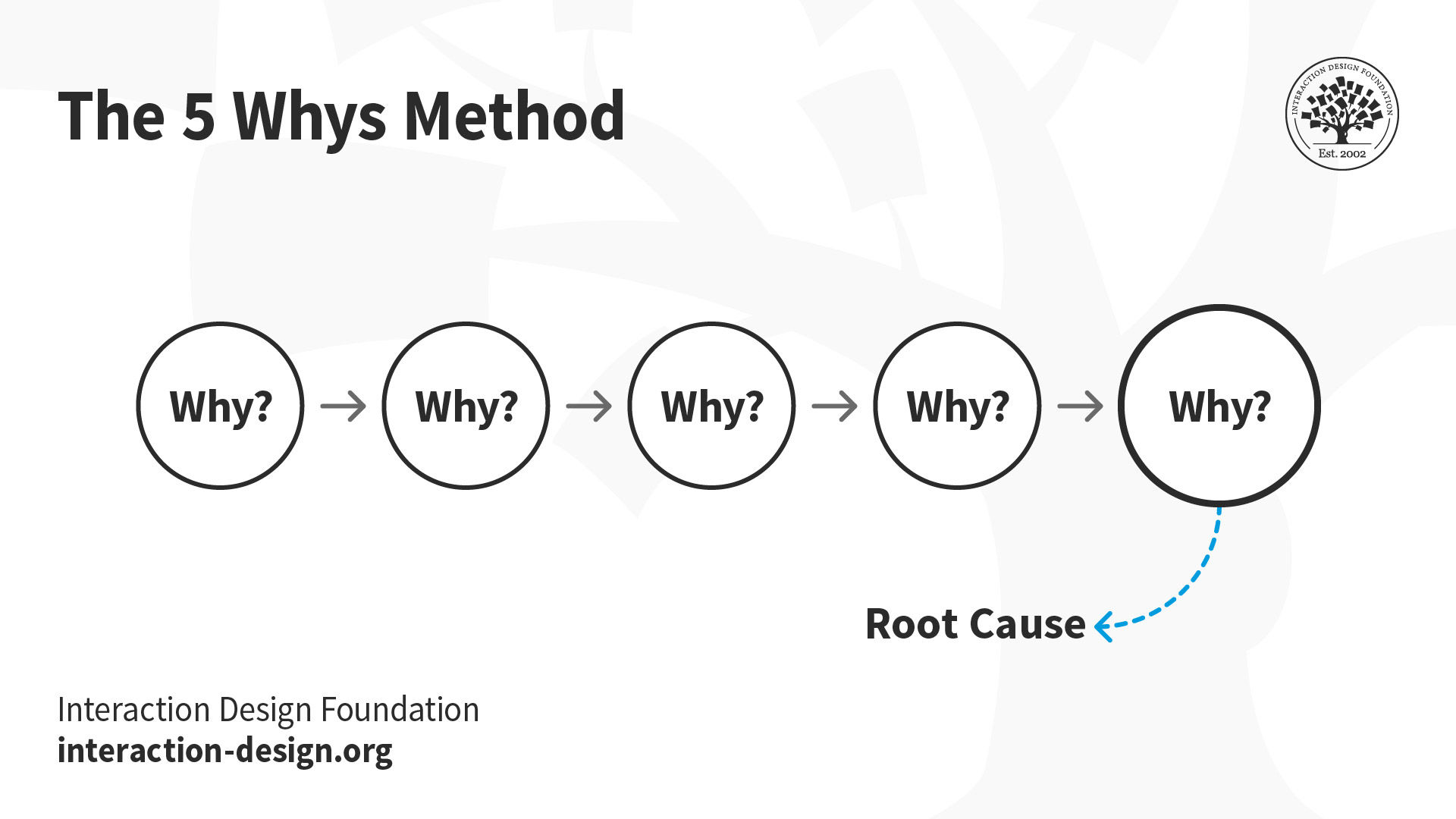
The 5 Whys method is an iterative interrogative technique pioneered at Toyota Motor Corporation in the 1930s to explore the cause-and-effect relationships underlying a specific problem. By working back from one effect to another up to five times, designers can expose root causes and explore effective solutions.

“Be ahead of the times through endless creativity, inquisitiveness and pursuit of improvement.”

— Sakichi Toyoda, Japanese industrialist and inventor who formulated the 5 Whys method

See why 5 Whys is such a valuable tool.

Transcript

Dig Deep to the Root Cause with 5 Whys

To ask why something happened is a natural, effective way to uncover a problem, be it a high bounce rate on a website, a marketplace failure or anything else you may want to know about users, etc. However, cause-and-effect chains can be long and complex. Whether they occur in the natural or human world, end-result events rarely happen in isolation with only one cause to trigger them. The effects of one action or condition can be so far-reaching that it’s easy to jump to conclusions when you look at the end result. The greater the number of removes—or steps in a cause-and-effect chain—the more effort and insight it will take to work your way back to what actually started the whole sequence of events that ultimately resulted in the problem at hand. If you overlook any factors involved, you might end up making assumptions—and it’s essential to discard assumptions in user experience (UX) design.

The 5 Whys method was developed to work back to a root cause of a mechanical problem by a total of five removes. Toyota’s famous example illustrates the simple nature but immense power of the technique:

  1. Why did the robot stop? The circuit overloaded, making a fuse blow.

  2. Why? There was insufficient lubrication on the bearings, so they locked up.

  3. Why? The oil pump on the robot wasn’t circulating enough oil.

  4. Why? The pump intake was clogged with metal shavings.

  5. Why? There was no filter on the pump.

In UX design—for example service design—system failures can be far more intricate than this. Users are humans who act in complex contexts, and their behaviors (and reasons for these) can be difficult to decipher, especially with so many channels and parts of their user journeys for you to examine. Most of what we first see when we look at an apparent problem (or, rather, its end result) is just on the surface. Symptoms can be misleading. On that note—and even more importantly for modern designers—the 5 Whys is an essential tool to dig down to root causes on a bigger scale. As cognitive science and user experience expert Don Norman advises in his 21st century design, human-centered design and humanity-centered design approaches, designers who want to effect real change in solving complex global-level problems need to get beneath the symptoms and apparent causes to discover and address what’s really going on. If you don’t solve the right problem—and work with the root cause—the symptoms will just come back.

You can use 5 Whys anytime in your design process, but it’s particularly helpful early on when you need to understand the problem facing your users, customers and/or stakeholders. As such, it’s a valuable aid in design thinking. When you conduct user research, the answers you can get by asking “why” repeatedly can arm your design team with many insights from users—insights which you can leverage to identify the real or underlying problem, and then iteratively gear your ideation efforts more accurately around it. You can use 5 Whys to:

  • Determine what’s important from the user’s/customer’s/stakeholder’s viewpoint.

  • Explore why users/customers/stakeholders think, feel and do what they do.

  • Analyze the information.

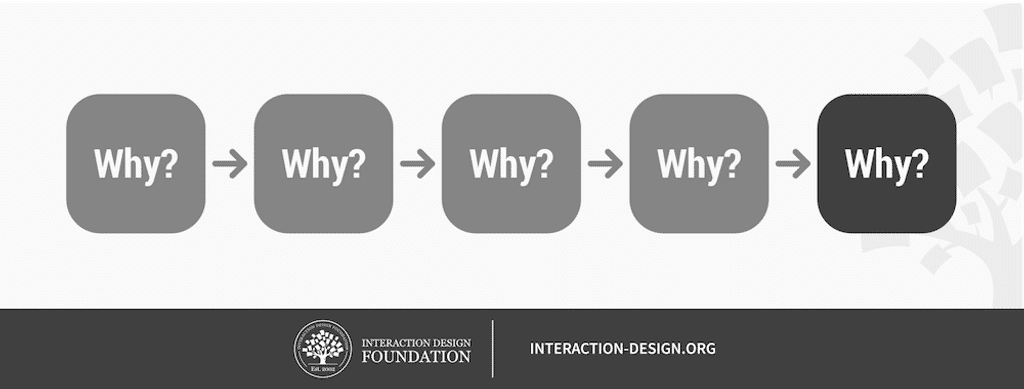
The 5 Whys Method illustrated to show 5 progressive Why questions leading towards uncovering the root cause of a problem.

© Daniel Skrok and Interaction Design Foundation, CC BY-SA 3.0

How to Use 5 Whys to Find the Root Cause

Five Whys is especially helpful to use in the empathize stage of design thinking, when you’re gathering the information you need so you can proceed to define the problem to address. It’s exactly as it sounds: you:

  1. Base the first question on the apparent end result.

  2. Form the second question on the answer to this.

  3. Form the third question on the answer to the second question.

  4. Form the fourth question on the answer to the third.

  5. Form the fifth question on the answer to the fourth.

For example: “Not as many customers are subscribing to the website’s newsletter after the design changed.”

  1. Why? Most of them click the subscription-related button within two seconds after it appears.

  2. Why? Because they’re used to seeing subscription-prompting pop-ups.

  3. Why? Because the internet is full of these.

  4. Why? Because organizations have grown used to deploying these with an automatic opt-in dark pattern for users to find it harder not to subscribe.

  5. Why? Because automatic opt-out buttons or allowing users to freely think about newsletter subscriptions (i.e., without guiding them with a design pattern) mean fewer subscriptions.

Here, it appears the designer failed to use the automatic opt-in design pattern.

Tips:

  • You can frame your “why” questions with different wording (e.g., “What do you think made that happen?”).

  • Keep asking until you get to the root cause of why your users feel or behave a certain way. For example, if they say, “Because I felt like doing that,” try to prompt them to evaluate their statement (without annoying them).

  • You can ask fewer (or more) questions, whatever works.

  • Ask “Why?” even if you think you already know the answer: you may be surprised what insights you can evoke.

Large question marks drawn on sheets of paper on a desk.

© Olya Kobruseva, CC0

Questions About 5 Whys?
We've Got Answers!

Why do designers use the 5 Whys?

Designers use the 5 Whys to uncover the root cause behind a problem, not just its symptoms. By asking “Why?” five times in a row, they can dig deeper with each answer. This method helps move past surface-level thinking and reveals the real issue users face, often invisible from the first symptom or effect.

For example, a user might abandon a signup form. Why? It takes too long. Why? There are too many fields. Why? The team wanted full profiles. Why? They wanted better personalization. Why? Users complained about irrelevant content. Now the focus shifts from form length to smarter personalization.

This technique keeps teams focused on solving the right problem, not just the visible one. It’s especially useful in UX design, product design, service design, and systems thinking. Everything is a system—or a part of one—and when you have an effect or a symptom on show, it often does take four or five removes to get to the real root cause.

Watch as UX Pioneer and the Godfather of UX Design, Don Norman explains the 5 Whys approach:

Transcript

Take our course Design for the 21st Century with Don Norman.

How is 5 Whys different from just asking follow-up questions?

The 5 Whys technique follows a structured path toward one goal: uncovering the root cause of a problem. Unlike general follow-up questions, which can branch in many directions, the 5 Whys drill straight down into a single issue by repeatedly asking “Why?” about the previous answer.

This linear method keeps your focus tight and keeps you from getting sidetracked. While follow-up questions might explore multiple angles, the 5 Whys aim to peel away layers of assumptions and get to the heart of the problem. It’s a disciplined tool, not a casual conversation thread.

Designers often use it to avoid jumping to solutions too early. Some effects or symptoms might suggest incorrect “causes”—wrong because either the designer is assuming things and misdiagnoses the cause or they stop at a cause that isn’t the root cause but is instead another symptom. By drilling down into the matter and identifying the real cause, teams can design fixes that address the real need—not just treat symptoms.

Watch as UX Pioneer and the Godfather of UX Design, Don Norman explains the 5 Whys approach:

Transcript

Take our course Design for the 21st Century with Don Norman.

How do I use 5 Whys in the define phase of design?

In the Define phase—the second phase of the design thinking process—use the 5 Whys to pinpoint the root cause of user problems before crafting a problem statement. Begin with a clear observation or user complaint—like “Users abandon the checkout page.” Ask “Why?” five times, and each time build on the previous answer to dig deeper.

This method helps you move from symptoms to causes. Instead of leaving the matter at “Users drop off at checkout,” you might drill down beneath that to discover “Users don’t trust the payment security.” That insight makes your problem statement more focused, actionable, and user-centered. Five is a good number of times to ask because everything is part of a system and the chances are slim that a single remove or cause is behind the symptom you’re trying to address. What’s the cause of that? And then, what’s the cause of that? Keep going:

  1. Problem → Why? → Cause

  2. Problem → Cause → Why? → Cause

  1. Problem → Cause → Cause → Why? → Cause

  2. Problem → Cause → Cause → Cause → Why? → Cause

  1. Problem → Cause → Cause → Cause → Cause → Why? → Root Cause

The 5 Whys also align your team around the real issue and prevent wasted effort solving the wrong problem. Use it in workshops or interviews, and document each step for clarity.

Watch as UX Pioneer and the Godfather of UX Design, Don Norman explains the 5 Whys approach:

Transcript

Take our course Design for the 21st Century with Don Norman.

What do I do if the answers are shallow or vague?

If your 5 Whys answers feel vague or shallow, return to the source. Talk to users directly or, better yet, observe them using the product or service. Real stories and behaviors give depth to your “Why” chain and help avoid guesswork that might otherwise render your research futile.

Get more details by rephrasing the “Why” questions if you need to. Instead of “Why did they stop?” ask “What made them stop right there?” Instead of general answers like “It’s confusing,” go for: “What part was confusing, and why?”. Be specific.

You can also bring in teammates to challenge assumptions. Group discussions often expose blind spots and force clearer thinking. If the path dries up, try starting from a different symptom or user action—it might lead you to a deeper insight. It’s like digging: the right place will have “soft soil” you can get through; “rockier” or “harder ground” may demand that you search for something else (i.e., a rephrased question).

Watch as UX Pioneer and the Godfather of UX Design, Don Norman explains the 5 Whys approach:

Transcript

Take our course Design for the 21st Century with Don Norman.

What are the common mistakes in using 5 Whys?

One big mistake is stopping too early—often after just one or two “whys.” That leaves you with surface-level causes and symptoms and, therefore, shallow solutions if you try to address just those. Another common error is jumping to conclusions or inserting assumptions instead of facts. Stick to what users say or do—look at the evidence.

Some teams also treat the 5 Whys like a checklist. However, it’s not about hitting a number—it’s about uncovering the root cause. Go deeper only if each answer builds meaningfully on the last; you’ll know when to stop when you hit “bedrock” and can’t dig beneath that “why.”

Also, avoid asking “why” in a way that sounds accusatory. That can put users or teammates on the defensive. Rephrase a finger-pointing question with one that has authentic curiosity: “What led to that?” or “Can you explain why that happened?”

Last, but not least, don’t do it alone. Use team input to challenge biases and validate each step.

Watch as UX Pioneer and the Godfather of UX Design, Don Norman explains the 5 Whys approach:

Transcript

Take our course Design for the 21st Century with Don Norman.

How do I stop my team from jumping to conclusions?

To stop your team from jumping to conclusions, slow the process down and anchor decisions in real user data. Let the evidence light the way. Start with a shared understanding: agree to explore the problem fully before considering solutions. Use tools like the 5 Whys to guide the team through deeper thinking and uncover root causes.

Facilitate sessions where everyone hears the same evidence, like user quotes, journey maps, or usability findings, before brainstorming. Encourage curiosity by asking open-ended questions like “What else could be causing this?” or “What don’t we know yet?”

Create space for reflection as well. Don’t rush from identifying a problem straight into ideation. Give your team time to sit with the findings.

This mindset shift helps teams stay focused on course to solving the right problem, not just the most obvious one.

Watch as UX Pioneer and the Godfather of UX Design, Don Norman explains the 5 Whys approach:

Transcript

Take our course Design for the 21st Century with Don Norman.

Can I go beyond the 5 whys if needed?

Yes, you indeed can go beyond five whys. The number five is just a guideline, not a rule. The goal is to uncover the root cause. Sometimes that takes three “whys,” but there may be more: six, seven, or even more.

Keep digging if the fifth “why” still leaves you with a surface-level answer or assumption. However, don’t just ask more for the sake of it—each step should bring you closer to a deeper understanding of the problem. When the answers start repeating or lose relevance, well done—you’ve likely reached the root.

Remember, flexibility matters more than the count. The purpose of the exercise is insight, not hitting a number.

Watch as UX Pioneer and the Godfather of UX Design, Don Norman explains the 5 Whys approach:

Transcript

Take our course Design for the 21st Century with Don Norman.

Can I combine 5 Whys with design tools like journey maps or affinity diagrams?

Yes, combining the 5 Whys with tools like journey maps or affinity diagrams makes your design process more robust. Use a journey map to spot moments where users struggle. Then, apply the 5 Whys to dig into why those pain points happen. This pairing reveals not just what’s going wrong and where (or when) in the user journey but also why it’s happening.

You can also use 5 Whys alongside affinity diagrams to group insights and cluster related root causes. Start by mapping out user feedback, and then dig into each theme using the 5 Whys to uncover deeper patterns.

When you use these tools together, they can help you power your way from scattered data to clear, focused problem statements that will help drive design decisions.

Watch as UX Pioneer and the Godfather of UX Design, Don Norman explains the 5 Whys approach:

Transcript

Take our course Design for the 21st Century with Don Norman.

What do I do if my team doesn’t agree on the root cause?

If your team doesn’t agree on the root cause, treat it as a sign to dig deeper, not a roadblock. Revisit the user data together. Walk through journey maps, user quotes, or session recordings to ground the discussion in facts instead of opinions.

Use the 5 Whys method as a team, writing out different possible cause chains. Compare them side by side to see where they diverge. Often, disagreement reveals multiple valid root causes, each worth exploring.

You can prototype simple tests for the competing causes, too. Collect feedback and let real user behavior settle the debate. Stay open, stay curious, and view the disagreement as fuel for better insights to gel together with, not something divisive or obstructive.

Watch as UX Pioneer and the Godfather of UX Design, Don Norman explains the 5 Whys approach:

Transcript

Take our course Design for the 21st Century with Don Norman.

Moule, J. (2012). Killer UX design: Create User Experiences to Wow Your Visitors. SitePoint.

Killer UX Design by Jodie Moule offers a comprehensive, accessible approach to user-centered design, integrating practical tools like the “5 Whys” method to uncover the root causes of user frustrations. By encouraging designers to dig deeper into user behavior and motivations, Moule shows how techniques like the 5 Whys can guide teams to more thoughtful, lasting solutions. Her background in psychology enriches the book, compellingly connecting theory with practice. With a focus on iterative prototyping and real-world application, this book is a key resource for UX professionals aiming to design more intuitive, effective digital experiences grounded in user insight.

Earn a Gift Earn a Gift, Answer a Short Quiz!

1
2
3
4
1
2
3
4
Question 1
Question 2
Question 3
Get Your Gift
Interaction Design Foundation logo

Question 1

When was the 5 Whys method developed?

1 point towards your gift

  • 1920s
  • 1930s
  • 1940s
Interaction Design Foundation logo

Question 2

What is the primary goal of the 5 Whys method?

1 point towards your gift

  • To determine user preferences
  • To explore cause-and-effect relationships
  • To increase sales and marketing effectiveness
Interaction Design Foundation logo

Question 3

In the context of UX design, why is it important to discard assumptions?

1 point towards your gift

  • To focus on aesthetic design
  • To ensure functionality
  • To avoid solving the wrong problem

Learn More About 5 Whys

Make learning as easy as watching Netflix: Learn more about 5 Whys by taking the online IxDF Course Design for the 21st Century with Don Norman.

Why? Because design skills make you valuable. In any job. Any industry.

In This Course, You'll

  • Get excited as you learn to design a better world. Whether you want to help families save money while reducing their carbon footprint, redesign how cities manage waste, or improve public health systems, this course will show you how. You don't need to be a designer. You just need the desire to make things better. Led by world-renowned designer Don Norman, you'll learn the powerful tools of human-centered design, systems thinking, and design thinking to tackle real-world challenges like climate change, inequality, public health, and more.

  • Make yourself invaluable when you build timeless human-centered design skills that are essential to make AI your superpower, so speed never comes at the cost of people's wellbeing. This course builds on and expands your deeply human skills like empathy, problem framing, and root-cause thinking that guide AI toward better, more responsible outcomes. You'll learn to apply these skills to drive innovation at work, lead meaningful projects, communicate your ideas clearly, and capture people's attention. This course helps you grow your impact, salary potential, and confidence—and feel deeply fulfilled. Did you know that design-driven companies are twice as likely to outperform their industry peers in revenue growth? The key is to go beyond traditional approaches and solve the real problems behind surface-level symptoms while integrating solutions seamlessly into real people's lives. You'll get the ability to design lasting change and learn how to work effectively with stakeholders to make it happen. You'll also discover how to move up in your company and take on bigger challenges.

  • Gain confidence and credibility as you apply your new skills from day one with ready-to-use templates such as the 5 Whys method. Create an optional case study aligned with the UN Sustainable Development Goals. By the end of this course, you'll have the skills and mindset to make a difference, whether that's in your job, your community, or the world. Let's co-create a better future starting now.

It's Easy to Fast-Track Your Career with the World's Best Experts

Master complex skills effortlessly with proven best practices and toolkits directly from the world's top design experts. Meet your expert for this course:

  • Don Norman: Father of User Experience (UX) Design, author of the legendary book “The Design of Everyday Things,” co-founder of the Nielsen Norman Group, and former VP of the Advanced Technology Group of Apple.

Get an Industry-Recognized IxDF Course Certificate

Increase your credibility, salary potential and job opportunities by showing credible evidence of your skills.

IxDF Course Certificates set the industry gold standard. Add them to your LinkedIn profile, resumé, and job applications.

Course Certificate Example

Be in distinguished company, alongside industry leaders who train their teams with the IxDF and trust IxDF Course Certificates.

Our clients: IBM, HP, Adobe, GE, Accenture, Allianz, Phillips, Deezer, Capgemin, Mcafee, SAP, Telenor, Cigna, British Parliament, State of New York

All Free IxDF Articles on 5 Whys

Read full article
Laddering Questions Drilling Down Deep and Moving Sideways in UX Research - Article hero image
Interaction Design Foundation logo

Laddering Questions Drilling Down Deep and Moving Sideways in UX Research

Laddering questions help you direct your research in order to get the most valuable information from interview subjects. This can help you expand the remit of the research or to focus it to where the roots of problems really lay.Laddering questions are a variant of the “5 Whys” principle. The idea i

Social shares
730
Published
Read Article
Read full article
7 Simple Ways to Get Better Results From Ethnographic Research - Article hero image
Interaction Design Foundation logo

7 Simple Ways to Get Better Results From Ethnographic Research

The first step in any user experience or design thinking process will involve you getting to know your users. The problem is, when you start a project from scratch or move into a new industry, it’s unlikely you’ll have either relevant experience or a deep understanding of your users!This is where et

Social shares
856
Published
Read Article
Read full article
Question Everything - Article hero image
Interaction Design Foundation logo

Question Everything

Research can be compared to interacting with the ocean. On the surface, we may see calm beauty or turbulence; however, we can only fully understand the bigger picture once we submerge ourselves and go much deeper. In order to gain a holistic, empathic understanding of our users and the problem we ar

Social shares
604
Published
Read Article
Read full article
Understand the “Why” of User Behavior to Design Better - Article hero image
Interaction Design Foundation logo

Understand the “Why” of User Behavior to Design Better

You know what products and services you offer, or intend to offer. You likely have certain types of users in mind; you may have some demographic data and you may also have drawn a few personas. But do you know why people will buy your products? Why would they choose your product over your competitor

Social shares
668
Published
Read Article
Read full article
Why Should Designers Become Leaders? - Article hero image
Interaction Design Foundation logo

Why Should Designers Become Leaders?

Are you excited to do good for humanity? Would you like to help solve the world’s biggest problems such as climate change, hunger and eliminate excess waste? If yes, that’s a good start. But what happens when you get ignored? Because you will most likely get ignored, because designers most often are

Social shares
414
Published
Read Article

Understand the “Why” of User Behavior to Design Better

Understand the “Why” of User Behavior to Design Better

You know what products and services you offer, or intend to offer. You likely have certain types of users in mind; you may have some demographic data and you may also have drawn a few personas. But do you know why people will buy your products? Why would they choose your product over your competitors’? If you understand your users’ underlying motivation to buy, you can improve your value propositions, communicate more effectively and thus increase user engagement and conversions.

Milkshakes for Breakfast

Business consultant and professor of business administration at Harvard Business School Clayton Christensen narrated a story that has since become popular the world over as “Milkshake Marketing”. Here’s how it goes.

A fast-food restaurant wanted to increase sales of their milkshakes. So, they asked their customers about their preferences. Would they like their milkshake chocolatier, creamier, chunkier, cheaper…?

Their customers gave them suggestions, and the fast-food restaurant tweaked the milkshake recipe. But no matter what they did to the milkshakes, it didn’t affect their sales.

Enter Rory McDonald — researcher and associate professor of business administration at Harvard Business School.

McDonald spent a day at the restaurant, to observe its customers. He noticed that milkshake sales were the highest between 6:30 am and 8:00 am. The customers who bought them were alone. They’d buy the milkshake, and nothing else. And immediately leave.

Curious, the researcher went back the next day and asked the customers why they bought the milkshake. As it turned out, the customers all had something in common — a long, boring commute, and they wanted something to do along the way. They left home early and weren’t quite hungry yet. But they knew that they would feel hungry by about 10 o’clock.

The milkshake gave customers something to do while they waited in traffic — the thick liquid took as long as 20 minutes to sip through a thin straw. And once they were done with it, they no longer felt hungry.

When McDonald probed further, he found that customers had experimented with other foods for the job. Donuts were greasy. Bagels were messy. And bananas weren’t filling enough. One customer who had tried a Snickers bar ended up feeling guilty. The milkshake was the most convenient breakfast. And the best part, it fit the car’s cup holder. Sure, coffee could fit, but it didn’t last as long.

The fast-food company’s milkshake wasn’t competing against other restaurants’ milkshakes. It was competing against other breakfast items. Armed with this insight, the company made their shakes thicker and added chunks of fruit so that it took commuters even longer to finish. And since commuters were on their way to work, the company tweaked their checkout process to let commuters get their milkshake faster. The thicker shakes and faster checkouts led to a 7-fold increase in sales of the milkshake.

What Can “Why” Do For You?

Improve Product Experience

When you understand why your users buy from you (or your competitors), you can tweak your product to better suit the users’ needs. Our fast-food restaurant went from “improve the milkshake” to “make breakfast for people on-the-move”.

While the commuters bought milkshakes for breakfast on-the-go, the restaurant discovered another group of customers who bought milkshakes for a different reason — parents who bought them as a treat for their children. In this case, the company made the milkshakes thinner, so parents didn’t have to wait for half an hour as the kids made their way to the bottom of the cup.

Improve Communication

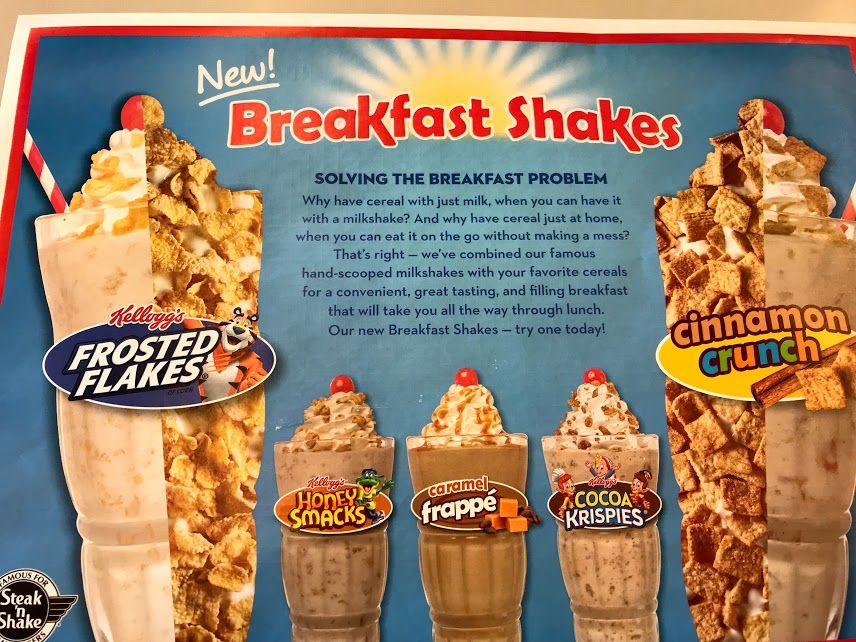
You can incorporate your users’ “why” directly into your communication strategy — on landing pages, product descriptions and advertisements. Here’s an advertisement from Steak ‘n’ Shake:

“Why have cereal with just milk, when you can have it with a milkshake? And why have cereal just at home, when you can eat it on the go without making a mess?

That’s right — we’ve combined our famous hand-scooped milkshakes with your favorite cereals for a convenient, great tasting, and filling breakfast that will take you all the way through lunch.”

Image of a print advertisement for 'Breakfast Shakes'.

This advertisement sounds very familiar.
© Nana Kris, Copyright unknown.

The 5 Whys

To unearth the true reasons behind people’s behavior, you can use the “5 Whys” method when you interview your (and your competitors’) users.

The “5 Whys” method is an iterative interrogative technique first developed at Toyota Motor Corporation in the 1930s to explore the cause-and-effect relationships underlying a particular problem.

“5 Whys” in Action

Let’s assume that you are in conversation with a customer of Mailchimp — an email delivery service. Here’s a hypothetical excerpt:

Q: Why did you choose this service?
A: I wanted to send professional-looking emails.

Q: What would you consider a professional-looking email?
A: Like emails which I can format nicely and I can send them out in bulk.

Q: Ah okay, so how do you use these professional emails? (or, why do you need to send these professional emails?)
A: I have this newsletter about money management that I send out to some people in my network.

Q: Oh that’s nice... So, why do you run this newsletter? I mean, what do you get out of it?
A: I want to position myself as an expert on tax laws.

Q: Why do you want to position yourself as an expert on tax laws?
A: I’d like to be able to get some leads for my accounting firm.

We found the ultimate goal for our user was to sell their financial services.

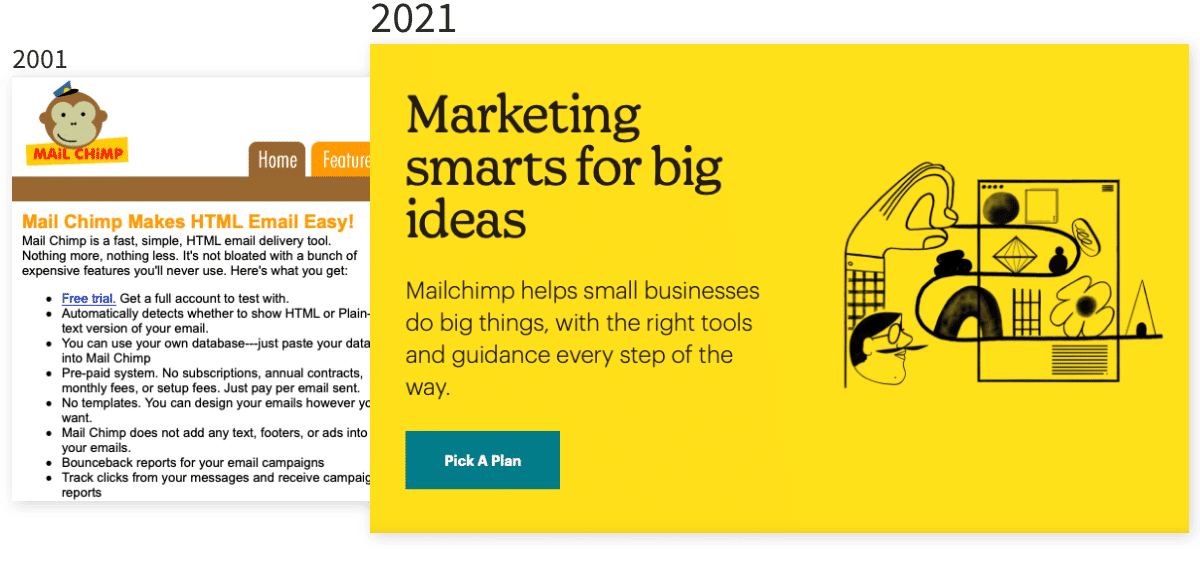
While this is an example that we made up, Mailchimp possibly had similar conversations with their users (or their competitors’ users). Armed with such insights, Mailchimp evolved — it added new features to its product and revised its communication to better serve its users’ requirements: users didn’t need HTML email; they wanted a way to market themselves.

Screeenshots of Mailchimp's website from 2001 and 2021.

Mailchimp in 2001 vs Mailchimp in 2021. From an HTML-email delivery tool to a complete marketing solution.
© Mailchimp, Fair Use.

Let’s look back at our fictitious conversation, Notice that both the “5” and the “why” in 5 Whys is only a guideline. You don’t have to force 5 questions and you don’t strictly have to start your questions with “why”. Just let the conversation flow naturally, and where there is scope to probe for the underlying reason for a statement, ask “why”.

How many “whys” you need will depend on the context of your product and the question you ask. The key is to ask as many “whys” as you need to reach the “source of truth”. Ask “why” even if you think you know the answer — their reason might surprise you.

At first, it might seem awkward to keep asking “why”. With practice, you will feel more comfortable and phrase your “whys” more tactfully. Take care not to share your opinions or sound judgmental in any way. If you are naturally curious and ask with an open mind, your users will feel at ease and be willing to share their reasons. This is especially important if the reasons are deeply personal or emotional (which is more common than we might realize).

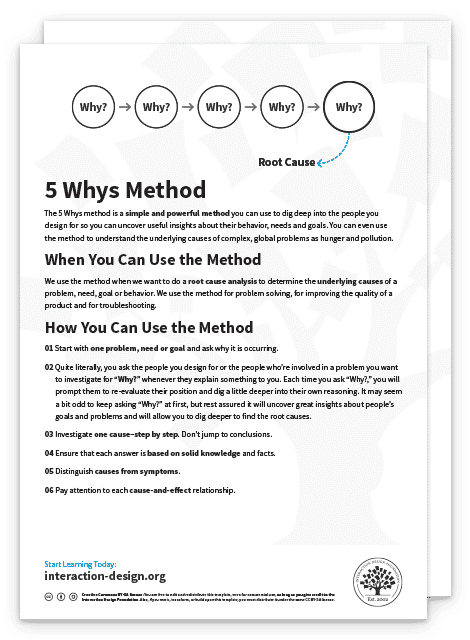
Advance Your Career With This Free Template for “5 Whys Method”
5 Whys Method
We respect your privacy
Get 1 powerful email each week: Design a life you love!

The Take Away

When you understand what motivates users to purchase a product or service, you can take steps to better serve their requirements.

The “5 Whys” method is an effective way to unearth insights from your users. When you conduct user interviews, you can begin with a question and then ask “why” successive times based on the participants’ responses. At first, it may seem awkward to repeatedly ask “why”. With practice, you will feel comfortable.

The underlying reasons why people act in certain ways can often be deeply personal and/or emotional. Make sure your interviewees are comfortable. If you are naturally curious and keep your opinions, assumptions and judgments away from the interview, your users will be more comfortable sharing what truly matters to them, giving you insights that you can plug into your work.

References & Where to Learn More

Carmen Nobel describes Clayton Christensen’s “Milkshake Marketing” in this article in Harvard Business School Working Knowledge:

Clayton Christensen, Rory McDonald, Laura E Day, and Shaye Roseman. "Integrating Around the Job to Be Done." Harvard Business School Module Note 611-004, August 2010. (Revised November 2020):

Starting with “Why” is a good practice in design and leadership. Watch Simon Sinek’s TED Talk: How great leaders inspire action (~18 min)

“5 Whys” is one of several techniques used to empathize with users. Learn more techniques in the course Design Thinking: The Ultimate Guide

Images

Hero image: © Interaction Design Foundation, CC BY-SA 3.0

Feel Stuck?
Want Better Job Options?

AI is replacing jobs everywhere, yet design jobs are booming with a projected 45% job growth. With design skills, you can create products and services people love. More love means more impact and greater salary potential.

At IxDF, we help you from your first course to your next job, all in one place.

See How Design Skills Turn Into Job Options
Privacy Settings
By using this site, you accept our Cookie Policy and Terms of Use.
Customize
Accept all

Be the One Who Inspires

People remember who shares great ideas.

Share on:

Academic Credibility — On Autopilot

Don't waste time googling citation formats. Just copy, paste and look legit in seconds.