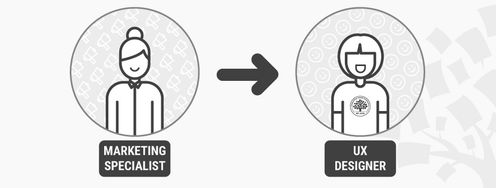
There are a few good reasons why you might want to change your career from marketing to UX design. First, there’s the pay—sources like UXDesignerSalaries(1) show that UX designers are paid a fairly handsome salary across the world (even as high as $97k in Switzerland). Furthermore, according to recuiting and HR company Brazen(2), UX design is the number one demand profession in the design field. Third, research by DMI(3) shows that companies that invest in UX design boost their bottom line by up to 228% over those which don’t. Then there’s also the sense of fulfilment of working under the hood to build a great product that users desire, rather than working to sell a product to the target consumer. Whatever your reasons for making the switch, the large overlap between marketing and UX design makes the transition that much easier—especially if you have an excellent resource to guide you (hint: like the one you’re reading right now). Let’s start off with a brief explainer of what exactly user experience entails.
What is User Experience and User Experience Design?
User experience, or UX, is a user’s experience of using a product. That sounds simple enough, doesn’t it? Well, UX design is the process by which we understand what users want and need, and incorporate that into product design to deliver greater user experiences—and that’s the complex part.
UX design begins with user research. User interviews, surveys, and focus groups are a few techniques a UX designer might use to get a clear picture of a user’s needs and desires. This research then feed into a design and development phase to create a product that satisfies a user’s needs. What happens next is more research: usability testing, user testing, etc. to see if user behaviours of using the product fall in line with expectations. Results of the research then feeds back into a new round of design—and the iterative process continues.
You can see from the image below that the UX of using a product can be broken down into 3 key areas: look, feel and usability.
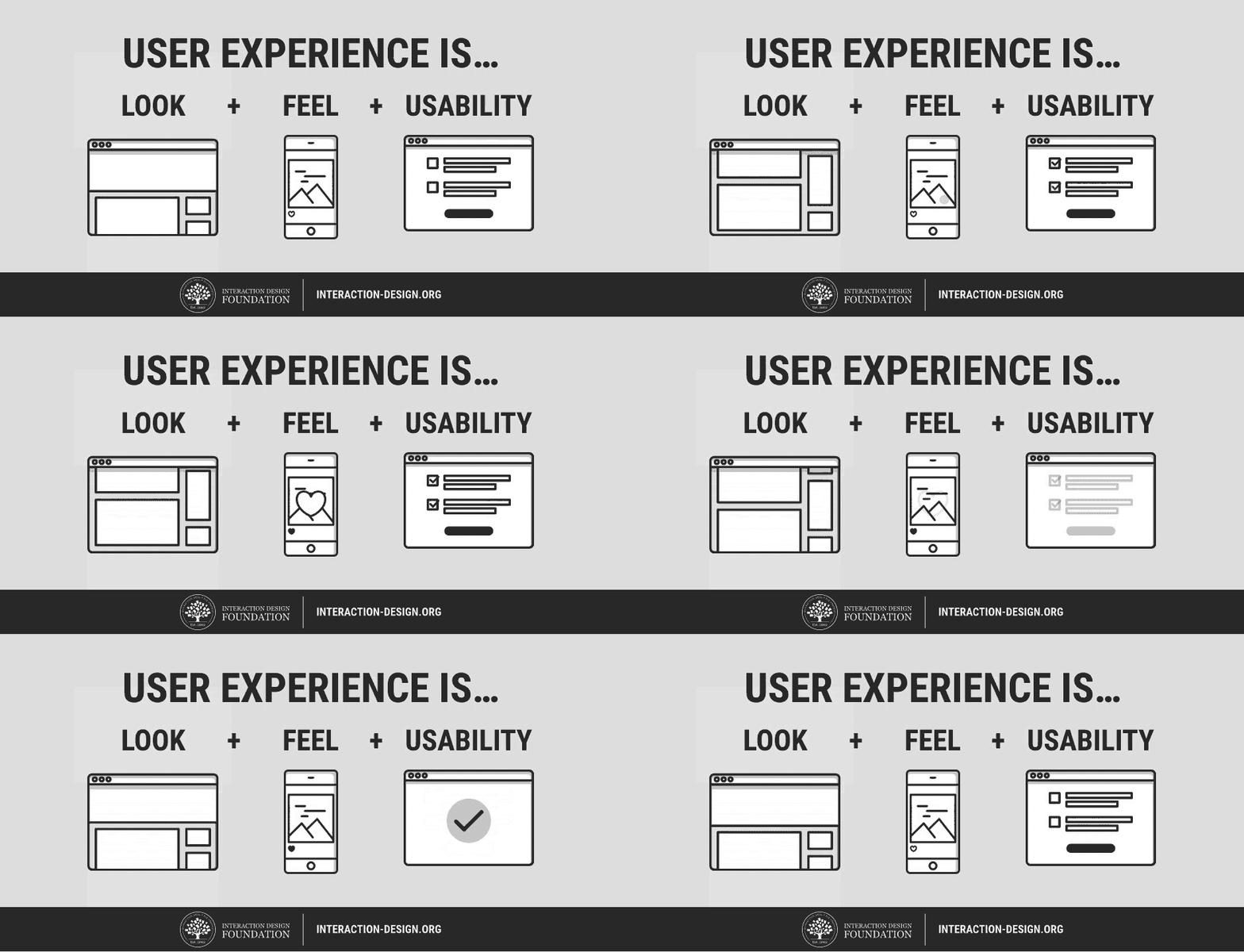
The look of a product is not only the aesthetic appeal, but also how it creates credibility and trust with users and captures the spirit of what the user expects.
The feel of a product is all about creating something that is a “joy to use”; that is, crafting positive, pleasant emotions in users as they interact with a product or react to the use of that product.
Finally, underpinning it all is the concept of usability—the idea that products have to be easy to understand and use. Bad usability breaks UX. To ensure proper usability, products should be individualised but still be functional and predictable in their use.
We have a series of short articles which help explain some of the core parts of UX design:
An Introduction to Usability
Usability vs Desirability
What is Interaction Design?
What Marketing and UX Design Have in Common
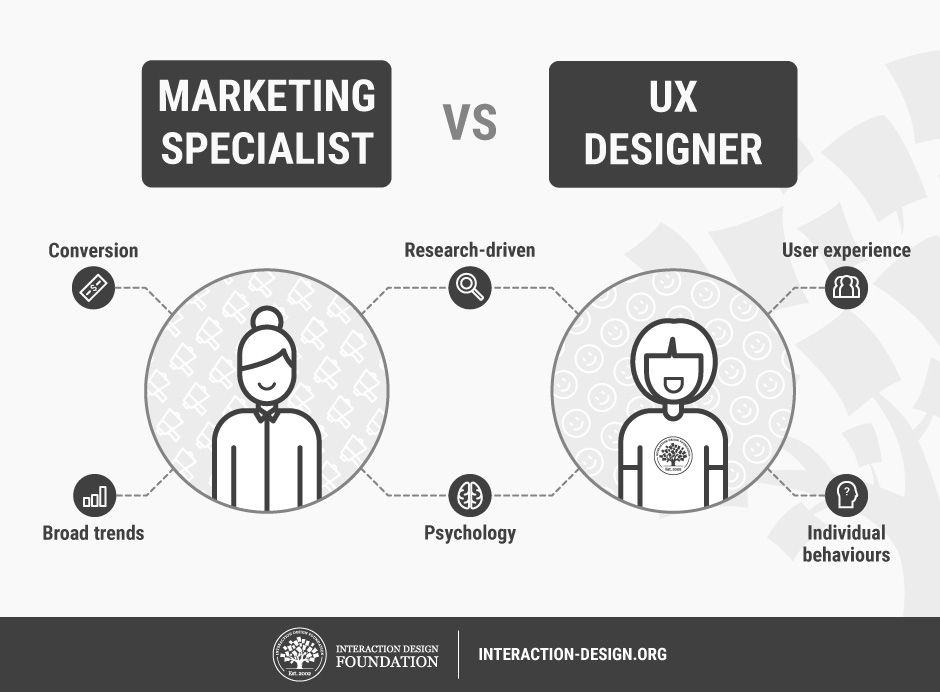
Research-driven
Marketing is informed by research on consumer behaviours, preferences and spending patterns. UX design is informed by research on user needs and behaviours. Both fields are heavily focused on research, and it is quite safe to say that both a marketing specialist and UX designer wouldn’t be able to perform their work properly without first doing a fair bit of research.
There’s also a significant overlap in research techniques you might have employed as a marketer and those used by a UX designer: interviews, focus group discussions, surveys, ethnographic research, formulation of user personas, and many more.
Psychology
Marketing and UX design are really both about making a product as desirable to the customer or user as possible. Marketing aims to make products desirable to customers, so they’ll spend money to purchase the product. UX design aims to make products desirable to users, so they’ll have a great experience while using it. In both fields, psychology plays a significant role.
A keen understanding of psychology is crucial to appeal to users by delivering value—be it social, economic, or otherwise—and using elements like typography, colours and imagery to invoke emotional responses. The difference is that marketing specialists like you apply psychology in designing the best marketing campaign for a product, while UX designers apply it to design the best product for a user.
The Differences between Marketing and UX Design
Despite the large overlap between marketing and UX design, there are a few key differences that make their end goals very different. Marketing specialists like you who want to switch to UX design should bear these in mind as you learn new skills to change your career.
Conversion vs user experience
Marketing is focused on ultimately increasing the sales of the product (i.e. conversion), and directly feeds into the bottomline of the company. UX design, on the other hand, is focused on building the best experience for the user, regardless of whether it ultimately adds to the company’s bottomline. There is thus a distinct difference in the end results of both professions. Fortunately, as research from DMI has shown, in most cases when care is put into building products with great UX, users purchase more of the product, hence contributing to the bottomline of the company.
In some cases, however, differences in the end point of marketing and UX design can lead to not-so-good outcomes. One popular example is the emergence of dark patterns, where user interfaces or interactions are designed specifically to trick users into buying products or otherwise drive up conversion, often at the expense of UX. Dark patterns, like the automatic addition of travel insurance when you book an air ticket and Facebook’s past attempt to prevent users from achieving full privacy(4), are often the result of marketing goals to ramp up conversion in any way possible.
Another less insidious example to illustrate the divergence of goals between marketing and UX design is branded apps. Companies love using branded apps to boost their engagement with their customers, but a research in 2011 by Deloitte found that a whopping 80% of branded apps had less than 1,000 downloads(5). The reason? Most likely, the apps were purely marketing campaigns disguised as apps, rather than products that actually solve users’ needs.
Broad trends vs individual behaviours
Marketing research is often concerned with big, statistically significant numbers: large demographic surveys that show broad consumer trends, that are used to predict what people want to buy. UX design, however, is concerned with the opposite: specific, individual users and their behaviours. Human Factors International explains this by saying that UX research is “not about markets, trends” but “what a person feels about using a product or service.”(6)In fact, a key concept in UX research is that there is a real difference between what people say in surveys and what they actually do; this is one reason why UX research focuses on the individual behaviours of small groups of people. As Steve Jobs once famously said: “It's really hard to design products by focus groups. A lot of times, people don't know what they want until you show it to them.”
The Big Benefit of Marketing Experience when Moving to UX Design
Despite the difference between marketing and UX design, your prior experience in marketing can be of great advantage when you switch into UX design.
A focus on business needs
Many times, it is important for UX designers to strike a fine balance between championing users and taking care of business needs. For instance, occassional pop-up windows—which are nasty in terms of user experience—are sometimes required if your website needs a method to reach its readers and convert them into regular subscribers of the company’s newsletter.
The bottom line is, if you’ll excuse the pun, that if users don’t spend money on products, companies can’t make money to pay UX designers. Coming from a marketing background would make it that much easier to always keep business objectives in mind while designing for the user.
Distilling insights from research
Marketing involves heavy research, and more often than not you’re required to distill the large sets of data and numbers into meaningful and actionable insights. Your knowledge of research techniques will be relevant to a job in UX design, but it’s this experience of distilling insights from research that will really give you the most advantage as you switch to a career in UX design.
UX research involves reading between the lines and figuring out the mixed motivations (the why) behind user behaviours. The thinking processes behind boiling down UX research into user needs and motivations are very much similar to that behind finding meaningful trends in marketing datasets.
How to Enhance Your Skills to Make the Jump from Marketing to UX Design
Moving from marketing to UX design should be relatively straightforward. Chances are, you’ve worked closely with a UX designer before in your past experience as a marketing specialist. To switch to UX design, you’d want to demonstrate on your CV that you understand many of the basic techniques employed in UX design and that you bring additional skills (such as bottomline focus) to the table.
But because there are differences between UX and marketing, it can’t hurt to get a little support through education, mentoring, coaching and networking. We’ve laid out some of the vast array of options available to you here.
Online Courses
Interaction Design Foundation
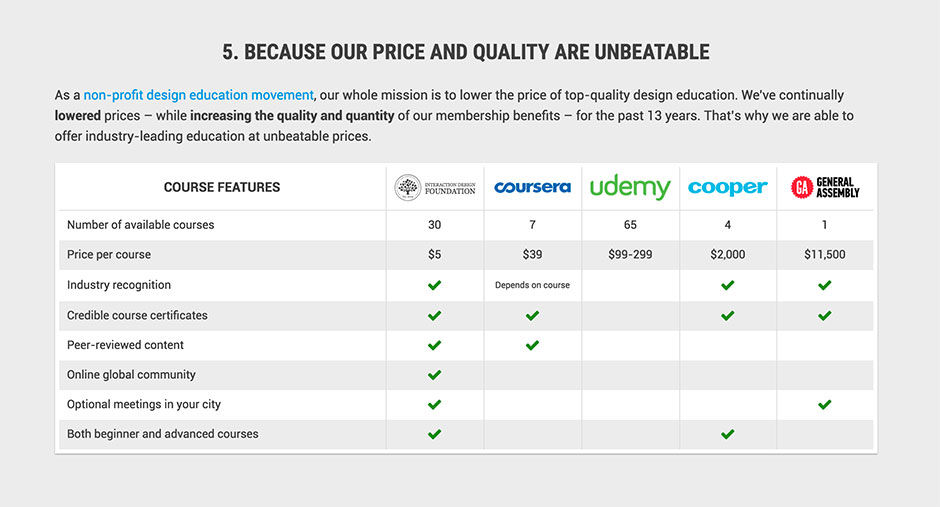
We’d like to think that our own online offering is a great way to get the learning you need under your belt. For a single annual fee, you can access all of our 32 courses whenever you like. We have three courses that will come in very handy for those looking for a career change.
You’ll learn all areas of UX work and basic skills to practice UX work in Become a UX Designer from Scratch. In Get Your First Job as a UX (or Interaction) Designer, you’ll be able to learn what kinds of experience in UX do employers seek the most, as well as craft a winning cover letter, CV and portfolio that will help you get an interview for a UX design job. Finally, in User Research – Methods and Best Practices, learn the industry best practices of how to conduct proper user research and turn the results of your research into useful action on your product.
And don’t take our word for it; Forbes magazine said that we offer “Ivy League level education in UX, Product Design or Human Computer Interaction”.
Check out all our UX courses here.
Coursera
Another good source of online UX learning is Coursera, where the courses are developed by universities around the world. Some courses are free but many are charged for, and while the education is good, the course schedule can leave a bit to be desired with many courses only on offer once or twice a year.
Udemy
A third source of online learning is Udemy. With Udemy, you’re tapping into the world’s largest training marketplace, and the site offers hundreds (if not thousands) of courses in every discipline imaginable. None of these courses are developed by Udemy; anyone can make a course and publish it and sell it on Udemy. That unfortunately means that while there are some excellent courses on the platform there are also a lot of poor ones too.
Classroom Courses
Nielsen Norman Group
One of the world’s leading providers of UX consultancy is the Nielsen Norman Group and they offer training courses all over the world for UX professionals. Their courses don’t come cheap but they may be a good alternative for those who can’t get on with online learning.
Check out their courses here.
General Assembly
General Assembly is another option. They offer relatively short and intense bootcamp-styled courses on campus. However, location may be a challenge as their presence is limited. And like other classroom-based specialized training, their courses are not cheap.
Check out their programs here.
University Courses
If you really want to spend some serious cash, you could consider a Bachelor’s degree or a Master’s degree at a University. These won’t be entirely UX-related, but they do include UX-related material. We’d only recommend this route if you have a very fixed picture of your career path—it’s a lot of work and a lot of money to invest early on in your UX career.
We’ve got two courses to give you an example of the kind of content available. Choosing a university course is an intensely personal decision and you’ll want to do more research before making a decision.
Carnegie Mellon – HCI Programs
University of York – MSc in HCI Technologies
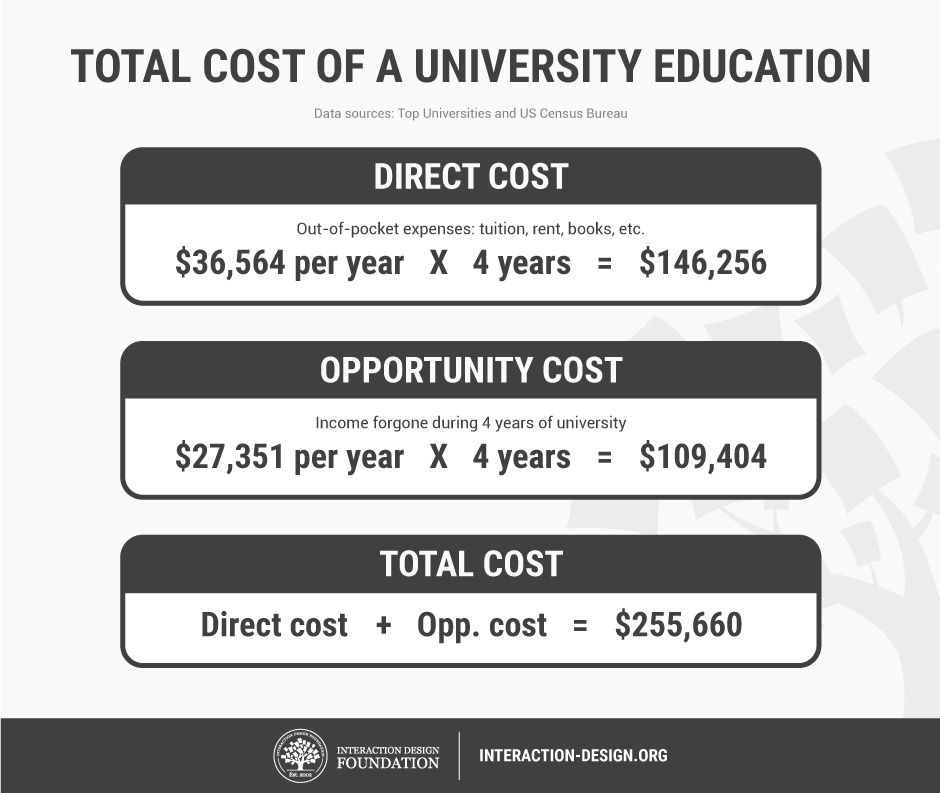
University may seem very appealing, but it comes with a pretty hefty price tag too. If you take the cost of a year’s university education in the US, as estimated by HSBC (and reported in Top Universities(7)), as being an average of $36,534 (including rent, bills, tuition, etc.), that means a 4-year degree is going to set you back $146,256 in cash (and more if you take a loan and pay interest on it). You’re also going to have to give up work for four years, which amounts to an opportunity cost of income forgone. According to the US Census Bureau(8), an average non-graduate earns $27,351 per year—that’s $109,404 for a 4-year degree. That adds up to a total cost of $255,660!
 If you are confused by all the educational options available to you, don’t worry, you’re not alone. We’ve put together a helpful article on the Return on Investment of different design education approaches here which may help you make a more informed decision.
Networking
The best opportunities in any field will come up from people already involved in that field. Perhaps the best known networking forum is LinkedIn, and it certainly can’t hurt to join some professional UX groups on that platform to expand your network.
The Interaction Design Foundation also offers networking both within the course environment (so you can work with others at your level to expand your network and opportunities) and also in the form of local networks which are groups which meet all over the world. You need to be an IxDF member to benefit from course networking, but our local network groups are free to attend whether or not you are a member. Find out more here.
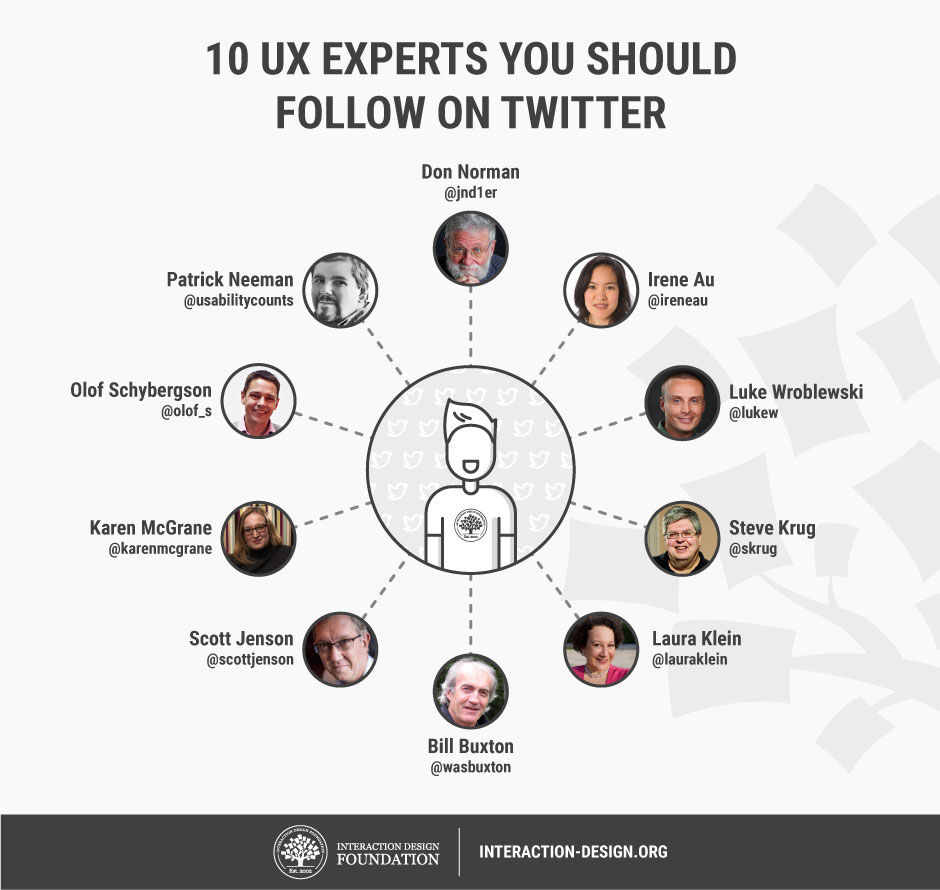
You might also want to follow some influential designers and interact with them on social media; we’ve got a nice list of twenty designers to get you started here.
Mentoring and Feedback
It can be very useful to seek out a professional mentor when looking to make a career change; you can do this through your personal network or you could use our own service which links would-be UX designers with mentors around the world. It’s free to members of the Interaction Design Foundation Design League—you can find out more about our Design League membership here.
The Take Away
Making the move from marketing to UX design isn’t that difficult. You already have many of the skills required to be a UX designer. The biggest change is that your focus will shift from “customers” to “users”.
If you want to boost your chances of success in transitioning, it can help to seek out some education to guide you through the differences in a bit more detail than this article can and help you learn to speak the language of the UX profession.
References & Where to Learn More
UX designer salaries across the world.
Brazen Design looks at In-Demand Careers here.
DMI’s analysis of design investment
The dark pattern of Facebook’s 2010 privacy UI.
Deloitte finds that most branded apps are a flop.
Human Factors International white paper on UX Research vs Market Research
How much does it cost to study in the US?
Earnings by education: US Bureau Of Labor Statistics