User Interviews

Your constantly-updated definition of User Interviews and collection of videos and articles.
Be a conversation starter: Share this page and inspire others!

887 Shares

What are User Interviews?

User interviews are a qualitative research method where researchers engage in a dialogue with participants to understand their mental models, motivations, pain points, and latent needs.

“To find ideas, find problems. To find problems, talk to people.”

Julie Zhou, former VP, Product Design at Facebook, author of The Making of a Manager

In this video, Ann Blandford, Professor of Human-Computer Interaction at University College London, explains the pros and cons of user interviews.

Transcript

Research is the initial step in the design process. It helps you understand what your user feels, wants, and appreciates. It also helps gain insights for future designs and identify the pain points in the current solution. User interviews will help you structure your design process and deliver optimized solutions that will resonate with the users.

User Interviews: What and How?

Design teams typically perform user interviews with the potential users of a design as part of the empathize phase of the design thinking process. User interviews follow a structured methodology whereby the interviewer prepares several topics to cover, records what is said, and systematically analyzes the conversation after the interview.

User interviews are one of the most commonly used methods in user research. They can cover almost all user-related topics and be used, for example, to gather information on users’ feelings, motivations, daily routines, or how they use various products.

The interviews often follow the same methodology as qualitative interviews in other fields but with the specific purpose of informing a design project. Because user interviews typically have to fit into a design or development process, practical concerns such as limited time or resources often play a role when deciding how to conduct such interviews. For instance, user interviews can be conducted over a video or voice call if time is restricted. On the other hand, in projects with sufficient time and resources, researchers can perform the interview in the user’s home, and designers might even be flown overseas if the users reside in another country.

While many interview methods used in design projects are borrowed from other fields, such as ethnography and psychology, some have been created specifically for use in design contexts. An example is contextual interviews in the participant’s everyday environment. Contextual interviews can provide more insights about the environment in which a design will be used. As such, a contextual interview might uncover flaws within a product’s design (e.g., the product is too heavy to be carried around the house by the user) that a typical user interview might not

User interviews can be used in different stages of product development, from discovery to usability testing. Conducting a user interview is simply a question of choosing the right user or users to interview, asking them pre-determined questions (or free-form questions if used following an observation), and then reporting on their answers to enable further decision-making.

Ann Blandford emphasizes the need to keep an open mind when approaching a user interview. 

Transcript

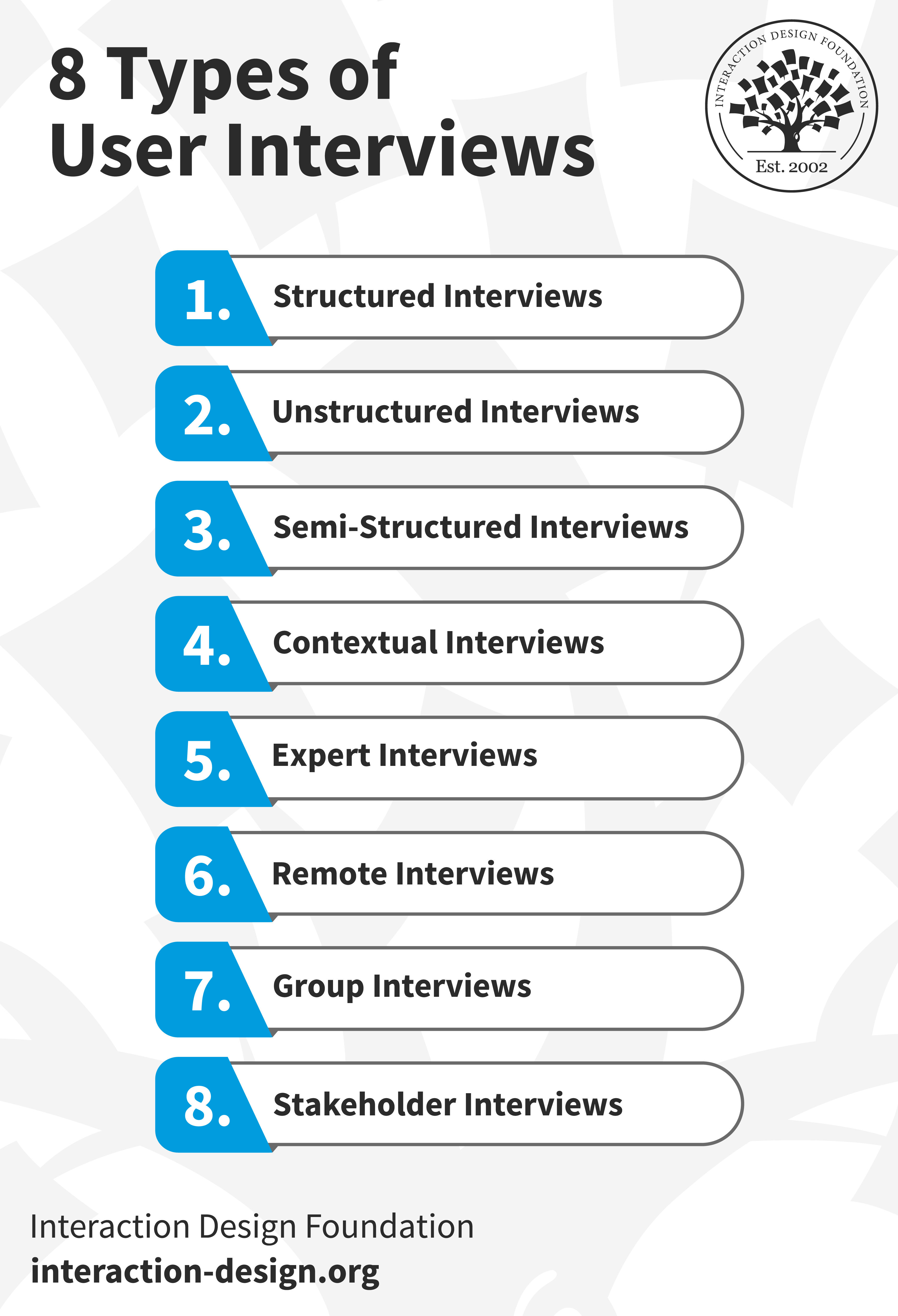
8 Types of User Interviews

List of 8 types of User Interviews

User Interviews are of 8 different types such as structured, unstructured, contextual, and group, to name a few.

© Interaction Design Foundation, CC BY-SA 4.0

User interviews are a versatile and indispensable design research tool, serving as a gateway to invaluable insights that shape user-centric solutions. Depending on your goals and who the interview participants are, we can classify user interviews into eight categories.

1. Structured Interviews

Structured interviews adhere to a meticulously planned set of questions, providing a systematic approach to information gathering.

This type is characterized by its rigidity, ensuring a standardized process that facilitates easy participant comparison. Designers opt for structured interviews when seeking specific, targeted information. These interviews require an organized means of collecting quantitative data.

2. Unstructured Interviews

In contrast, unstructured interviews embrace a more open-ended and flexible approach. Participants are encouraged to express themselves freely, leading to a qualitative exploration of their thoughts and experiences.

This type is favored when the goal is to uncover niche insights that may not emerge through predefined questions. This allows for a deeper understanding of user perspectives and motivations.

3. Semi-Structured Interviews

Semi-structured interviews balance the rigidity of structured interviews and the flexibility of unstructured ones.

Designers prepare a set of predetermined questions but allow room for participants to elaborate on their responses. This format combines the benefits of both worlds, offering depth and consistency while accommodating the richness of qualitative data.

Here’s Ann Blandford with more on semi-structured interviews and how they differ from structured and unstructured ones.

Transcript

4. Contextual Interviews

Contextual interviews unfold in the user’s natural environment, providing a unique perspective on how they interact with products in their day-to-day lives.

This type ventures beyond the controlled setting, uncovering insights that might be missed in a traditional interview setup. Observing users in their context allows designers to identify specific pain points, preferences, and behaviors that influence the user experience in a real-world scenario.

5. Expert Interviews

Expert interviews involve engaging with individuals possessing specialized knowledge or experience relevant to the design context.

These individuals could be industry experts or professionals with specific domain expertise. Their insights contribute a layer of knowledge to the design process. These interviews help refine solutions with experienced perspectives that are not apparent through user interviews alone.

6. Remote Interviews

In the era of digital connectivity, remote interviews overcome geographical constraints. They leverage technology to facilitate conversations between designers and participants.

This type is particularly convenient when engaging with users located in different regions. Remote interviews ensure accessibility and flexibility, allowing designers to gather insights without the limitations of physical proximity.

7. Group Interviews

Group interviews involve the simultaneous participation of multiple individuals, fostering dynamic interactions. This format encourages participants to build on each other's responses, unveiling shared experiences and diverse perspectives within the group.

Group interviews are beneficial when exploring collective opinions and group dynamics or seeking insights into how individuals influence each other's perspectives.

8. Stakeholder Interviews

Stakeholder interviews extend beyond end users to include individuals with a vested interest in the project's success. These could be internal stakeholders, decision-makers, or individuals representing different organizational departments.

Engaging with stakeholders ensures alignment between design goals and broader organizational objectives. This also helps foster a holistic approach that considers the overall impact of the design solution.

Understanding the applications of these eight types of user interviews empowers designers to strategically choose the most fitting approach based on project goals and the specific information sought. Each type brings a unique flavor to the user research process and contributes to creating designs that resonate with user needs and expectations.
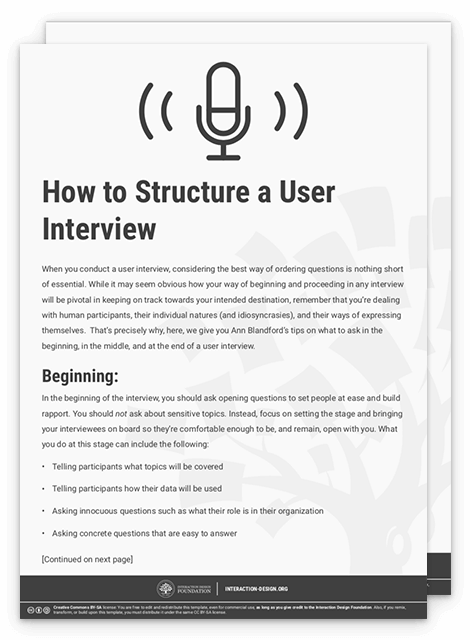
Advance Your Career With This Free Template for “How to Structure a User Interview”
How to Structure a User Interview
We respect your privacy
Get 1 powerful email each week: Design a life you love!

Common Mistakes to Avoid During a User Interview
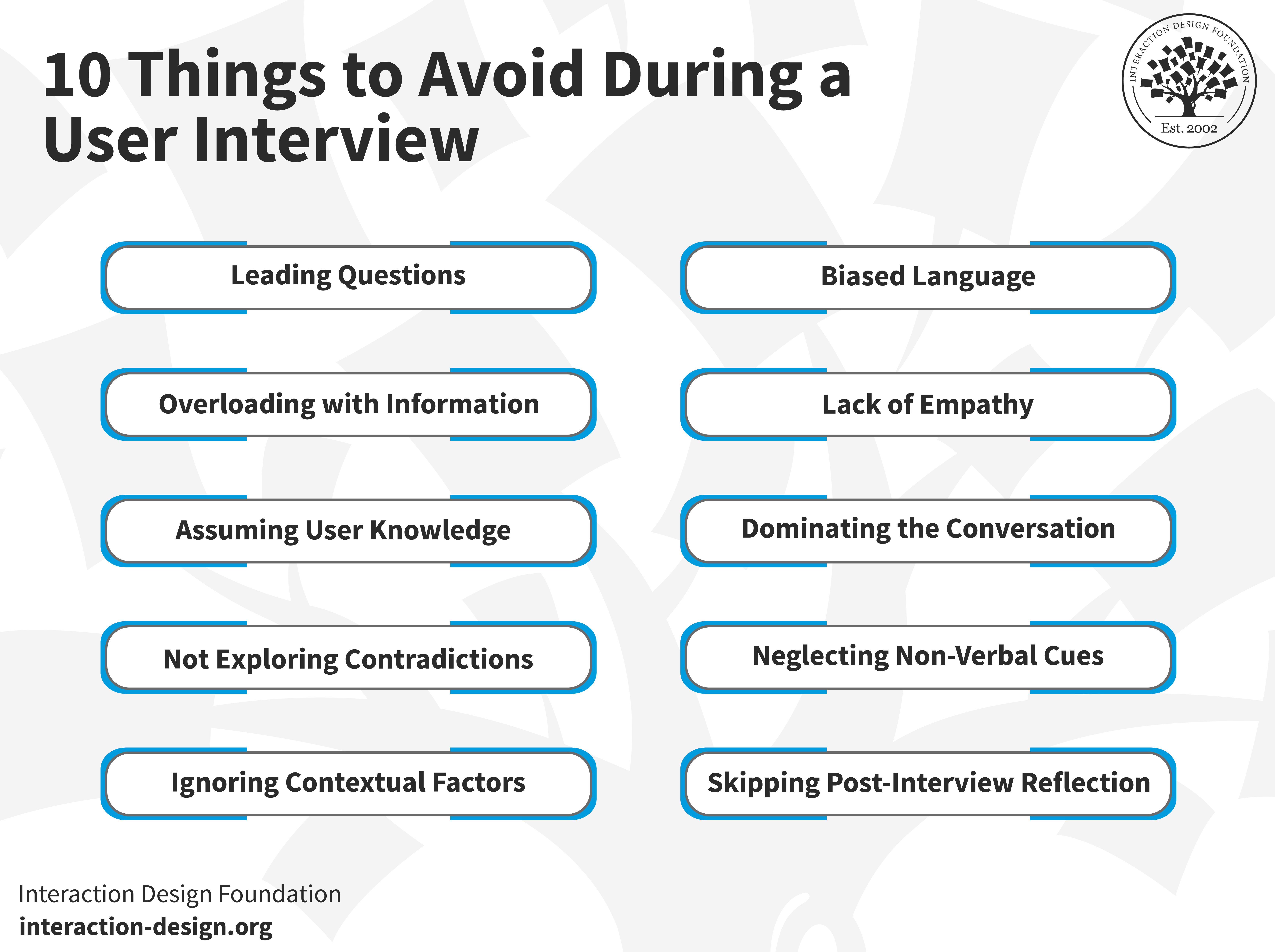
List of things to avoid during a User Interview

Practices like Leading Questions, Biased Language, Lack of Empathy, etc. should be avoided during a User Interview

© Interaction Design Foundation, CC BY-SA 4.0

User interviews are powerful for extracting meaningful insights, but their success depends on careful planning and execution. To ensure a fruitful user research process, designers must navigate potential hindrances that could compromise the authenticity and depth of the gathered information.

1. Leading Questions

Avoid steering participants toward specific responses with leading questions. Instead, try to craft questions that are neutral and open-ended. This encourages genuine and unbiased insights. Leading questions can unknowingly influence participants, compromising the integrity of the data collected.

One approach researchers use to reduce bias and let user insights, rather than themselves, lead the research is grounded theory. In grounded theory, you collect data from interviews, analyze it, identify gaps and research directions, and then conduct more interviews to understand real user needs. You repeat this process until all gaps are filled.

In this video, William Hudson, User Experience Strategist and Founder of Syntagm Ltd, explains grounded theory.

Transcript

2. Biased Language

Be vigilant about using language that may introduce bias into the interview. Phrasing questions in a way that favors a particular response can distort the authenticity of participants' answers. Designers should aim for neutrality and clarity to ensure participants feel comfortable expressing their thoughts.

3. Overloading with Information

Resist the temptation to overwhelm participants with excessive information before or during the interview. Providing too much context leads participants to tailor their responses based on what they think the interviewer wants to hear. In contrast, user interviews aim to make participants express their natural thoughts and experiences.

4. Lack of Empathy

Build rapport and create a comfortable environment in a user interview. Refrain from rushing through questions without allowing participants the space to share their thoughts. Acknowledge their experiences and be genuinely interested in their perspective to foster open communication.

Ann Blandford offers practical tips on how to build rapport with interviewees through the structure of questions.

Transcript

5. Assuming User Knowledge

Steer clear of assumptions regarding the user's knowledge or familiarity with the product or topic. Clarify terms, avoid industry jargon, and ensure that participants fully understand the context are some of the key pointers. This prevents misunderstandings that could impact the accuracy of their feedback.

6. Dominating the Conversation

It is vital to balance guiding the conversation and allowing participants to express themselves freely. Avoid dominating the dialogue or interrupting excessively. You should create an environment where participants feel valued, listened to, and are encouraged to share their experiences without interruption.

7. Not Exploring Contradictions

Explore contradictions or inconsistencies in participants' responses with appropriate sensitivity. There may be occasions where people contradict their statements. These variations can offer valuable insights into the complexity of user experiences. However, when you question them on such discrepancies, they might get defensive or uncomfortable. Approach these contradictions carefully and delve deeper to uncover the nuances that might not be immediately apparent.

8. Neglecting Non-Verbal Cues

User interviews extend beyond verbal communication. Pay attention to non-verbal cues such as body language, facial expressions, and tone of voice. Neglecting these cues may result in overlooking subtle yet significant indicators of a participant's sentiments or attitudes.

9. Ignoring Contextual Factors

Avoid separating user insights from their broader context. Consider external factors influencing participants' responses, such as cultural differences or situational circumstances. It is crucial to account for these factors to avoid misinterpretations and incomplete understandings of the user experience.

10. Skipping Post-Interview Reflection

After the interview, resist the urge to immediately move on to the next task. Take time for post-interview reflection to analyze the gathered data, identify patterns, and uncover more profound insights. Skipping this critical step may result in overlooking key findings and hinder the overall impact of the user interview process.

In this next video, Ann Blandford shares some precautions to consider during the analysis.

Transcript

By removing these pitfalls, designers can elevate the quality of user interviews. This will ensure the data collected is authentic, unbiased, and representative of the user's experiences.

User Interview Alternatives

While user interviews are a go-to method in user research, time or budgetary constraints may make it difficult to conduct interviews. Here are some other research methods to consider under such circumstances.

Alternatives to User Interview

Methods like Focus Groups, Usability Tests etc, can be tried as an alternative to User Interview.

© Interaction Design Foundation, CC BY-SA 4.0

1. Focus Groups

Focus groups offer a dynamic alternative to one-on-one interviews. Bringing together a small group of participants fosters group dynamics, allowing researchers to observe interactions and gather collective insights. This method is particularly effective for exploring diverse perspectives, uncovering shared experiences, and understanding group dynamics that might not surface in individual interviews. Remember that your designs will be used by multiple users different from one another.

2. Usability Testing and Prototypes

Usability testing involves evaluating the effectiveness of a product's interface through real-time user interaction. This alternative method employs prototypes or actual product versions, allowing researchers to observe users navigating the system. Usability testing provides insights into user interactions, pain points, and preferences in a controlled environment. By incorporating prototypes, designers can assess the functionality of specific features, ensuring a user-friendly design. This method is especially valuable for refining the user experience iteratively, based on direct user feedback, ultimately leading to more robust and user-centric design solutions.

3. In-Person Observation

In-person observation involves directly witnessing users' behaviors and actions in their natural environment. By immersing researchers in the users' context, this method unveils nuances that may be missed in a controlled setting. The in-person approach provides a holistic understanding of how users integrate products or services into their daily lives. Designers should conduct the observation without external influence on the subject user’s behavior.

4. Market Research

Market research extends the scope beyond individual user experiences to broader market trends and preferences. This alternative leverages quantitative data, surveys, and statistical analysis to uncover patterns at a larger scale. Market research complements user interviews by providing a macro-level understanding that informs strategic decisions and market positioning.

5. Discovery Research

Discovery research focuses on the initial exploration of a problem space or a new product idea. It involves gathering insights from various sources, including user interviews, surveys, and secondary research. By combining diverse methods, discovery research lays the foundation for understanding the landscape before diving into more targeted investigations.

Mixed Methods and Triangulation

Rather than relying solely on one method, researchers often integrate various user research methods to understand user needs comprehensively. They get insights from different angles by combining methods such as interviews, usability testing, and surveys. This is called mixed-method user research.

Researchers also use triangulation. This approach similarly uses multiple research methods, but the goal is to validate initial research findings. For example, in methodology triangulation, researchers conduct surveys to confirm whether their findings from user interviews match the needs and behaviors of a wider user group, as William Hudson explains in this video.

Transcript

These approaches result in more informed and user-centric design decisions.

Download our free template to learn about and easily implement triangulation in your research and design projects.
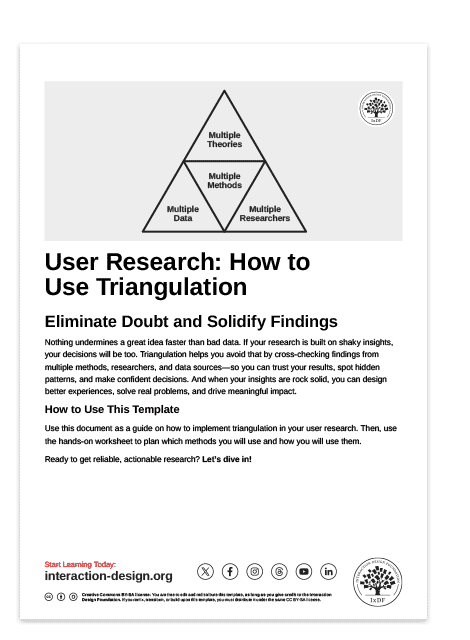
Advance Your Career With This Free Template for “User Research: How to Use Triangulation”
User Research: How to Use Triangulation
We respect your privacy
Get 1 powerful email each week: Design a life you love!

Questions About User Interviews?
We've Got Answers!

What are the basic steps that lead to a successful outcome from a research interview?

Successful research interviews hinge on a systematic approach. The basic steps include defining clear research objectives, selecting appropriate participants, crafting well-structured and open-ended questions, ensuring a comfortable environment, actively listening to participants, documenting findings accurately, and conducting thoughtful follow-up analysis. These steps collectively contribute to the success of a research interview. They foster genuine engagement, extract meaningful insights, and lay the groundwork for informed design decisions. Designers should also carefully consider selecting the research methodology that best suits their objectives. Selection of the sample groups to conduct the interviews is also vital to maintain the research context.


Watch this video to learn about the interview analysis process.

Transcript

What is a focus framework for user interviews?

A user interview focus framework is a practical plan that ensures we create things people genuinely need. It aligns with the idea that people don't just buy products; they buy solutions to their problems. This framework consists of five straightforward steps: find the right people looking for a solution, share your idea with them, check if they're willing to pay, make sure your solution works, and, if successful, grow and automate. It's a smart way to use user interviews to build things that truly solve real problems.

How do you conduct user interviews?

Conducting user interviews involves a systematic approach. Begin by defining clear research objectives and identifying the target audience. Craft open-ended questions to encourage participants to share their experiences openly. The next step is to choose a suitable interview format. Depending on the research goals, it could be structured, unstructured, or semi-structured. Ensure a comfortable environment for participants, whether in-person or remote. Listen to responses, ask follow-up questions for depth, and document findings meticulously. Post-interview, analyze the data, identify patterns and iterate the design process based on the insights gathered. By following this structured approach, you can conduct an insightful user interview.

How many user interviews do you need?

The number of user interviews needed depends on the research goals and the project’s complexity. While there's no one-size-fits-all answer, a common rule of thumb is to conduct at least five to eight interviews per user segment. This typically uncovers recurring patterns and provides a solid foundation for decision-making. However, the ideal number may vary based on the project's scope, the diversity of the user base, and the level of detail required. Iterative testing and continuous feedback loops may prompt additional interviews as the design evolves. If you continuously upgrade your designs based on your research insights, consider conducting another round of interviews after every significant update.

Are user interviews safe to use?

User interviews are generally safe when conducted ethically and with the well-being of participants in mind. Researchers should prioritize informed consent, clearly communicate the purpose of the interview, and ensure participants' anonymity when necessary. Protect sensitive information and adhere to data privacy regulations. Remote interviews should be conducted on secure platforms, and any incentives offered should be reasonable and ethical. By following ethical guidelines, user interviews can provide valuable insights while respecting participants' rights and privacy. Questions asked in the interviews should be carefully curated to avoid hurting any participant’s personal, emotional, or cultural sentiments. After considering the above factors, user interviews can be safely used for design research.

Why choose user interviews?

User interviews offer a personalized and in-depth understanding of user experiences, allowing designers to uncover insights beyond quantitative data. They facilitate empathy by connecting directly with users, leading to more human-centered designs. The qualitative nature of user interviews is invaluable for exploring motivations, pain points, and emotions. Additionally, the adaptability of user interviews, whether in-person or remote and their ability to uncover contextual insights make them a versatile tool for various stages of the design process. User interviews can be used in multiple types and areas of research design. Choosing user interviews empowers designers to create solutions that authentically resonate with user needs.


Transcript

Watch this video to learn about the pros and cons of user interviews.

Earn a Gift Earn a Gift, Answer a Short Quiz!

1
2
3
4
1
2
3
4
Question 1
Question 2
Question 3
Get Your Gift
Interaction Design Foundation logo

Question 1

What is the primary purpose of user interviews in UX design?

1 point towards your gift

  • To gather technical data from users.
  • To understand users' needs, pain points, and motivations.
  • To test design prototypes with users.
Interaction Design Foundation logo

Question 2

Why should interviewers avoid leading questions during user interviews?

1 point towards your gift

  • Leading questions produce shorter answers.
  • Leading questions can bias the participant’s responses.
  • Leading questions help users express their thoughts quickly.
Interaction Design Foundation logo

Question 3

How do contextual interviews differ from typical user interviews?

1 point towards your gift

  • They are conducted in the user's natural environment.
  • They focus only on usability testing.
  • They rely solely on predefined questions.

Learn More About User Interviews

Make learning as easy as watching Netflix: Learn more about User Interviews by taking the online IxDF Course Personas and User Research: Design Products and Services People Need and Want.

Why? Because design skills make you valuable. In any job. Any industry.

In This Course, You'll

  • Get excited to create products, services, and experiences people actually love, without the guesswork. Personas grounded in research will help you move beyond assumptions and craft experiences that truly delight. Expanding requirements cause 47% of projects to overspend, launch late, or fail altogether. One additional feature turns into five, and before you know it, the project is unrecognizable, packed with things no one asked for. When you design for a persona, you get to focus on what truly matters and solve the real problems people have. Fewer problems, more smiles. More smiles, more profit.

  • Make yourself invaluable when you can transform raw research into powerful personas that turn ideas into user-centered solutions that smash business goals and improve people's lives. As AI accelerates how fast we build and iterate, your timeless human-centered skills become even more powerful. You'll direct AI with deep human insight, and ensure outcomes remain meaningful, ethical, and genuinely resonate with people. This is how you stay in demand: Human-centered design skills transform AI from a tool into your new superpower. With design personas, you’ll make smarter decisions, keep everything and everyone on track, and drive your team and projects to success.

  • Gain confidence and credibility as you learn the simple step-by-step method to create effective personas, complete with templates that turn knowledge into real-world results. Get to grips with observations, triangulation, and grounded theory, distill your findings with affinity diagrams, and pour it all into personas that work. Access real user research in the optional course project, and bring your new skills to life with a portfolio piece that'll open up exciting and fulfilling career opportunities.

You'll Learn from the Best

In this course, you'll learn from one of the world's leading experts:

  • William Hudson: User Experience Strategist and Founder of Syntagm Ltd.

Get an Industry-Recognized IxDF Course Certificate

Increase your credibility, salary potential and job opportunities by showing credible evidence of your skills.

IxDF Course Certificates set the industry gold standard. Add them to your LinkedIn profile, resumé, and job applications.

Course Certificate Example

Be in distinguished company, alongside industry leaders who train their teams with the IxDF and trust IxDF Course Certificates.

Our clients: IBM, HP, Adobe, GE, Accenture, Allianz, Phillips, Deezer, Capgemin, Mcafee, SAP, Telenor, Cigna, British Parliament, State of New York

All Free IxDF Articles on User Interviews

Read full article
Laddering Questions Drilling Down Deep and Moving Sideways in UX Research - Article hero image
Interaction Design Foundation logo

Laddering Questions Drilling Down Deep and Moving Sideways in UX Research

Laddering questions help you direct your research in order to get the most valuable information from interview subjects. This can help you expand the remit of the research or to focus it to where the roots of problems really lay.Laddering questions are a variant of the “5 Whys” principle. The idea i

Social shares
730
Published
Read Article
Read full article
How to Conduct User Interviews - Article hero image
Interaction Design Foundation logo

How to Conduct User Interviews

You may have noticed in life that few (if any!) people think like you do. So there’s absolutely no reason for you to think your users think like you either! You need to go out and meet your users if you want to properly understand and design for them, and user interviews are a great way to achieve t

Social shares
1.3k
Published
Read Article
Read full article
Pros and Cons of Conducting User Interviews - Article hero image
Interaction Design Foundation logo

Pros and Cons of Conducting User Interviews

You have had a green light from your stakeholders to conduct some user research for your design project, and you think user interviews might be the way to go. After all, they seem straightforward, and interviews are one of the most widely used user research methods — so, they should be a safe choice

Social shares
781
Published
Read Article
Read full article
How to Prepare for a User Interview and Ask the Right Questions - Article hero image
Interaction Design Foundation logo

How to Prepare for a User Interview and Ask the Right Questions

Getting great interview results requires careful preparation. You need to be clear about the purpose of your research, decide whom to recruit, do all the practical preparations, and—finally—you need to design a great interview guide detailing the questions you want to ask. Here, you will learn how t

Social shares
801
Published
Read Article
Read full article
How to Moderate User Interviews - Article hero image
Interaction Design Foundation logo

How to Moderate User Interviews

Carrying out user interviews can be chaotic! You must handle a lot of things at once to ensure that your participants are comfortable and that you get valid results. You must listen to what your participant is saying while also keeping track of where to go next, which questions you haven’t asked yet

Social shares
649
Published
Read Article
Read full article
How to Do a Thematic Analysis of User Interviews - Article hero image
Interaction Design Foundation logo

How to Do a Thematic Analysis of User Interviews

You have been in the field talking to users and you now find yourself with a massive amount of audio, notes, video, pictures, and interesting impressions. All that information can be overwhelming, and it’s difficult to know where to start to make sense of all the data. Here, we will teach you how to

Social shares
1.3k
Published
Read Article

How to Conduct User Interviews

How to Conduct User Interviews

You may have noticed in life that few (if any!) people think like you do. So there’s absolutely no reason for you to think your users think like you either! You need to go out and meet your users if you want to properly understand and design for them, and user interviews are a great way to achieve this. They enable you to extract information about the user experience and usability of your product or service, and will also help you ideate for further solutions. All in all, user interviews are a great way to get to know your users... but is your company actually conducting them and, if so, in an effective way? Read on and learn not only how to prepare for and conduct user interviews but how to report on them too.

“Stories are where the richest insights lie, and your objective is to get to this point in every interview.”

—Steve Portigal

In this video, Joshua Seiden, Designer, Entrepreneur, Coach, and Author, explains how user interviews uncover the stories that lead to real insights, shows you how they support work from early discovery through post-launch, and walks you through a simple funnel-shaped discussion guide to structure them well.

Transcript

Designers experience a constant internal battle between the temptation to design for themselves and the knowledge they should design for their users instead. Experienced designers will tell you a good mantra to follow throughout your design work is to understand your audience and design with them in mind. Whatever you do, don’t make assumptions about your users—that will lead you down a dangerous path!

You need to understand what your users’ goals are, what their needs are, and how they think and feel—as well as how all that differs from your perception of the context at hand. This will enable you to make objective decisions about how to take the design process further so it is truly centered around your users, and what delights and engages them. What’s good to know is there are many research techniques you can employ to achieve a deep understanding of your users, and a key one of those is user interviews.

What is a User Interview?

User interviews are guided interviews where a researcher asks existing or potential users questions to gain an understanding of their preferences, thoughts and feelings. User interviews can be used to examine the user experience and usability of a product or service, as well as flesh out demographic or ethnographic data for input into user personas.

The ideal user interview involves two UX researchers and one user. The first UX researcher asks questions and guides the interviewee through the interview, and the second researcher takes notes. If you’ve ever tried to ask questions, listen to responses and take notes all at the same time, you’ll know how hard it is to do all three! There’s a good chance the interview will be derailed and become hard to manage. If a second researcher is, however, unavailable and you have to go it alone, make sure to video or audio record the interview to ensure you don’t lose any information.

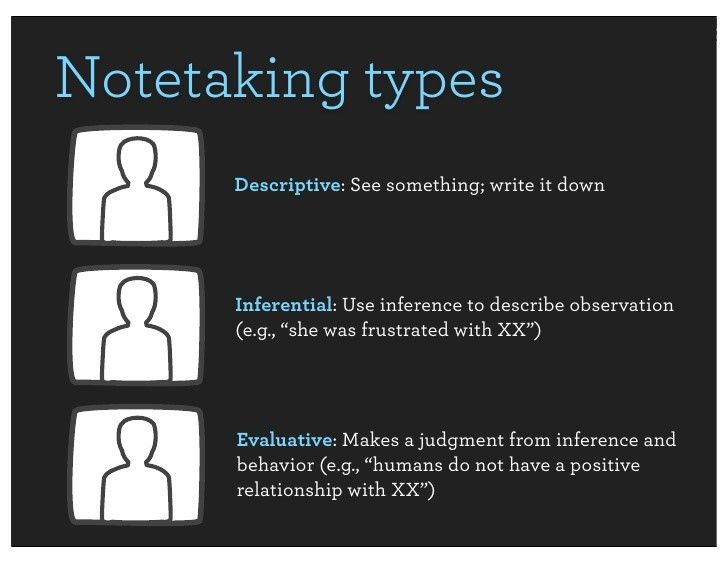
Three types of note taking - descriptive, inferential, and evaluative.

It’s important to have a second researcher when you conduct user interviews as they can then be the one to take notes. There are three types of notes you can take, however it is descriptive notes that are most important and relevant to user interviews.

© Danzico, Fair-Use.

Typical topics covered within user interviews include:

  • The background of the user (ethnographic data, for example)

  • The use of related technology

  • How the user uses the product

  • The user’s main objectives and motivations to use the product

  • The user’s pain points with the product

However, please don’t feel limited to these topics alone! If there’s something you need to know, and can find the answers by asking your users, make sure to include a few questions about it (as long as it’s not offensive or threatening of course!).

There is also a special type of user interview known as the contextual interview. This is an interview that is conducted after (or during) a user observation—it’s an interview “in context” with usage. You’ll find these are very common in usability testing, the assessment of products and even in information visualization.

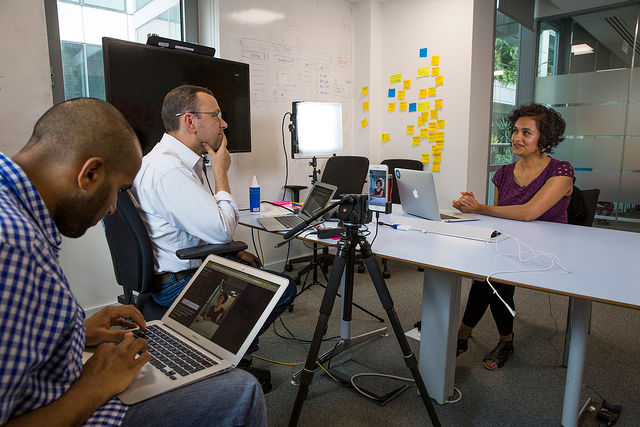
Interviewing session with notetaker in the background and video camera set up.

It’s important to have two interviewers when you conduct user interviews—one to focus on the questions and responses, and one to take notes. Regardless, you should also record the interview so you can look back over the footage to analyze it even further.

© gdsteam, CC BY 2.0.

When Should You Conduct User Interviews?

User interviews can be utilized at several points in the design process and, each time, they will provide key insights to ensure your project stays on track and remains user-centered. You should conduct user interviews:

  • At the beginning of a project, even before you’ve defined a clear concept. The information you collect during these initial user interviews will help you get a better understanding of your potential users, their wants and needs and what kind of solution you should aim for. The insights you gather will also help you develop your user personas and journey maps, as well as aspects of the product, such as features and workflows.

  • During the early stages of product development. Once you have an early prototype, you can conduct usability tests with your users to gain valuable feedback before the product gets properly implemented and mass produced. You should round up the observation part of the usability tests with user interviews. This will help you better understand users’ behaviors, how they perceive the product and any frustrations they face.

  • After the product has been put to market. Just because your product has been shipped, it doesn’t mean the user interviews have to stop! You should continue to conduct user observations and interviews (otherwise known as contextual inquiries) to give users even more of an opportunity to show you how they interact with your product.

3 Key Steps to Prepare for User Interviews

“Failing to prepare is preparing to fail.”

—John Wooden

Preparation is vital if you want your user interviews to generate useful and meaningful insights. There are three key steps you can follow to adequately prepare yourself, and they are as follows.

1. Set a Goal for Your Interviews

You need to form a concise, concrete goal for your user interviews—one that’s related to a specific aspect of your users’ behaviors or motivations is ideal. You should ask product stakeholders what they want to learn and base your goal on one of their realistic aspirations. Remember, don’t go too broad otherwise your interviews will generate too much irrelevant material. Keep your design needs in mind at all times!

2. Recruit the Right Participants

Once you’ve set a goal, you can move on to recruit participants for the interview. You’ll want to ensure you recruit a representative sample of users for your interviews, so you should start with your user personas and try to find interview participants that match them. If you have multiple user personas, now is the time to decide whether you want to focus on one particular group of users or several.

You can use various methods to source participants, including:

  • Personal connections

  • Former or current customers

  • Guerrilla or street interviews

  • Paid interviewees

You don’t need to go overboard when it comes to the number of people you recruit. There are no rules set in stone, but we recommend you start off with 5-7 participants and if by that point you’re not getting any new insights, you can leave it there.

When you schedule your interviews, pick a location that’s convenient and comfortable for both your participants and your team. Will a certain context help, for example? If the participants have certain items around them, would that help the interview? Also note that it’s a good idea to leave 30 minutes or so between each one. This will give you time to make additional notes and compile your thoughts before you move onto the next participant (you don’t want to get everything jumbled up in your mind!).

 Notes on possible interview participants.

Your user personas are a great place to start when you want to decide which participants to recruit for your user interviews. If you have identified multiple personas, you’ll need to decide whether to stick to one or try to cover them all.

© Travis Isaacs, CC BY 2.0.

3. Write a Set of Interview Questions

Now you’ve got your interviews in the diary, it’s time to create a set of questions to ask your participants. Some tips to help you do so include:

  • Before you even start with your questions, script an explanation of the purpose behind the interview—what are you trying to achieve? In this introduction, also explain how the participants’ data and insights will be used.

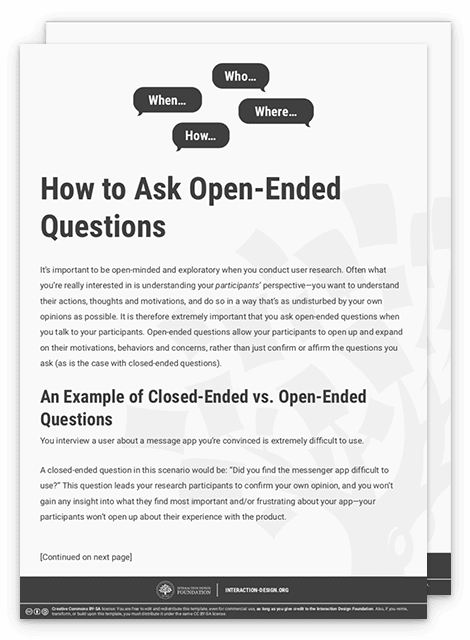
  • Keep leading questions to a minimum—focus on open-ended questions, and leave out the closed-ended questions wherever possible. It’s much better to ask “Can you describe to me how you use instant messaging?” than “How often do you use Snapchat?”, for example. The former lets you explore what the user actually does whereas the latter presupposes the user uses Snapchat, and that this is the extent of their instant messaging activity. For more information on how and why to use open-ended questions, please see our free template:

    Advance Your Career With This Free Template for “How to Ask Open-Ended Questions”
    How to Ask Open-Ended Questions
    We respect your privacy
    Get 1 powerful email each week: Design a life you love!
  • Prepare more questions than you think you’ll need. Make sure you include questions that allow you to approach the same issue from different angles yet also bear in mind the interviewee should be the person who talks for the majority of the interview (not you). It’s also good practice to start with the easy, less intrusive questions and build up to the more complex and thought-provoking ones—ease your participant into it in other words!

  • Anticipate different responses and create follow-up based questions based on your research goals.

  • Don’t forget your questions are a guide, not a script. If you find your interviewee says something particularly interesting in an interview and there are no relevant questions to explore that idea… explore it anyway. Amend your set of questions based on this in case something similar gets brought up in future interviews.

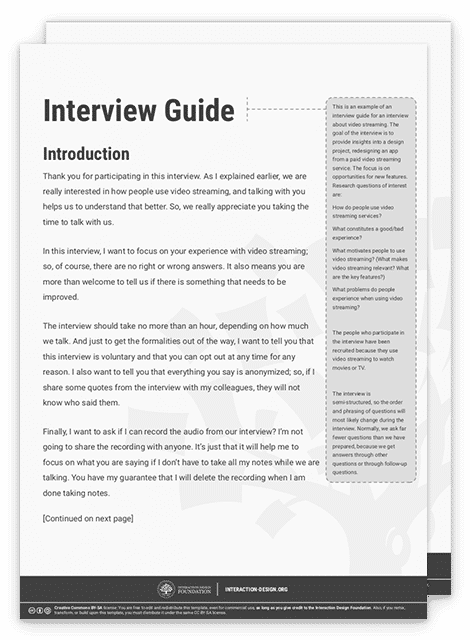
You can learn more about how best to create your interview questions in our Interview Guide templates:

Advance Your Career With This Free Template for “How to Structure a User Interview”
How to Structure a User Interview
We respect your privacy
Get 1 powerful email each week: Design a life you love!
Advance Your Career With This Free Template for “Interview Guide”
Interview Guide
We respect your privacy
Get 1 powerful email each week: Design a life you love!

How to Conduct a User Interview

Preparation gets you to the door. What happens inside the room is a different skill entirely.

However, a few key techniques will take you from nervous note-taker to confident interviewer faster than you'd expect.

Start by Making the Participant Comfortable

Open every interview the same way. Introduce yourself, explain the purpose of the session, and remind the participant that there are no wrong answers. You're studying the product, not them.

Say something like: "We're here to learn from your experience. There's nothing you can say that would be wrong or unhelpful. In fact, the more honest you are, the better."

This matters more than it sounds. People instinctively try to give "correct" answers. Your job in the opening two minutes is to undo that instinct.

Hunt for Stories, Not Opinions

Opinions tell you what people think. Stories show you what people actually do.

Instead of asking "Do you find this process frustrating?", ask "Tell me about the last time you used this feature. Walk me through exactly what happened." Concrete stories are where your most valuable insights live.

Master the Pause

Silence can feel uncomfortable, but you must resist the urge to fill it.

When a participant finishes answering, wait three to five seconds before you respond. More often than not, they'll keep talking, and what comes next could be more revealing than what came first.

Jumping in too quickly is one of the most common interviewer mistakes. The pause is your most underrated tool.

Use “Why” and “Tell Me More” As Your Defaults

When a participant says something interesting, don't move on. Dig in.

"That's interesting. Why did you do it that way?"

"Can you tell me more about that?"

"What did you mean when you said it felt confusing?"

These simple follow-ups consistently reveal the deeper insights your discussion guide alone won't reach.

Stay Flexible With Your Discussion Guide

Your questions are a compass, not a script.

If a participant takes the conversation in an unexpected and genuinely interesting direction, follow them. You can always return to your guide. The most valuable insight from an interview is often the one you didn't think to plan for.

Watch Your Body Language

Nod. Make eye contact. Keep your expression open and neutral, not visibly excited when they say something that confirms your hypothesis, and not visibly deflated when they don't.

Your reactions subtly shape how participants answer. Stay curious and even throughout.

Close With an Open Door

End every interview by asking: "Is there anything else you'd like to share that we haven't covered?"

You'll be surprised how often this question surfaces something important. Then thank the participant genuinely: Their time is a real gift to your design process.

The more interviews you conduct, the more natural all of this becomes. Your first few will feel awkward. That's normal. Push through it. Because the insights waiting on the other side are worth it.

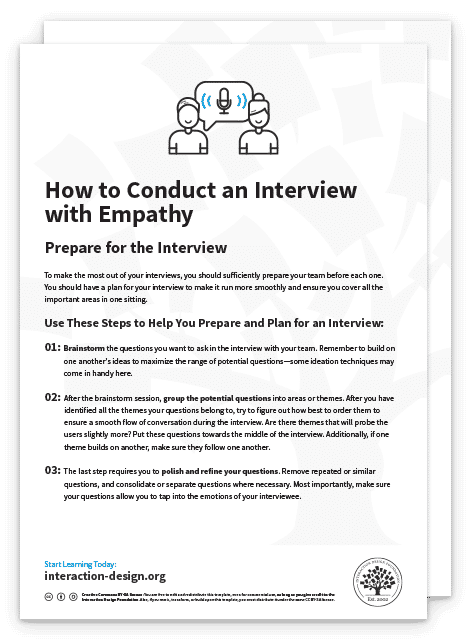
If you want to add even more empathy to your user interviews, check out the following template:

Advance Your Career With This Free Template for “How to Conduct an Interview with Empathy”
How to Conduct an Interview with Empathy
We respect your privacy
Get 1 powerful email each week: Design a life you love!

How to Report on a Series of User Interviews

Now your user interview is complete, it’s time to report on all the qualitative data you have collected. It can be a challenge to compile the results of several interviews, and techniques such as word clouds and mind maps are two good ways to present qualitative data in an interesting but easy-to-understand format.

To dig into your interview findings a little further, we recommend you follow the steps of a ‘thematic analysis’. This fancy sounding term means identifying, analyzing and interpreting patterns in data. What you heard in your user interviews is data, even though it may not seem like it!

  1. Familiarize yourself with your data. Listen to your recordings and either transcribe or take lots of notes.

  2. Generate initial codes. When you encounter a particularly interesting comment or section of the recording, create a descriptor code for it – e.g., “comparing products”. Apply the same code to other comments which you think belong in the same category, and create new codes for aspects that haven’t been discussed before. When you’ve coded all the key sections of your interviews, collate all the interview extracts so they fit into groups under each descriptor code.

  3. Search for patterns or themes in your codes across the different interviews. This is an iterative process where you can move codes around multiple times to form different themes. A good tip is to write your codes on sticky notes to make it easier to move them around and get a better overview.

  4. Review and refine the themes. Read through all the interview extracts in each theme and consider if there is clear coherence inside each one, and also a clear difference between themes. Combine themes you find too similar and split up themes that don’t cohere meaningfully. When you think all your themes work, take a step back and consider if your themes cover what’s most interesting in your data, or if anything is missing. Add and remove themes in an iterative fashion until you’re satisfied your themes suitably represent the insights from your interviews.

  5. Define and name themes. Look at each of your themes. Define what the theme is about and give it an appropriate name.

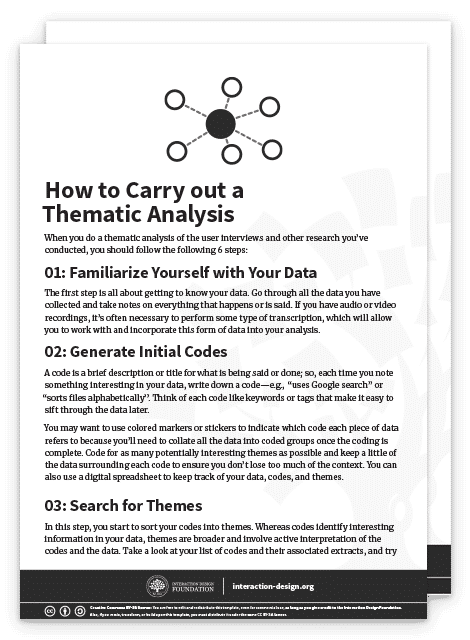
You can download more detailed advice about how to conduct thematic analysis in our template:

Advance Your Career With This Free Template for “Steps in a Thematic Analysis”
Steps in a Thematic Analysis
We respect your privacy
Get 1 powerful email each week: Design a life you love!

Once you’ve identified the themes in your data, you can translate the findings into a more formal written or visual report—something you’d be happy to show your manager or client.

The Drawbacks of User Interviews

Hopefully you now feel fully prepared to go and conduct some effective user interviews! Before you dive in however, you need to take a look at some of the drawbacks of user interviews to ensure you have a well-rounded mindset and approach to the process.

  • There’s a difference between what humans say and what they actually do. Even if they are contextual, interviews tend to give insights into what people say they will do and this is sometimes (often, even) not the same as what they actually do. This is why the 5 whys method is so crucial and can help you get more accurate insights.

  • Human memory is flawed and we can often struggle to recall details as clearly as we would like. Unfortunately, it’s a human tendency to try and create these details (this is not even a conscious process) to tell a story the way we think something happened, rather than how it happened. Ask the same questions in multiple ways to try and overcome this and help you spot discrepancies in the data.

  • Participants often leave out small details because they deem them insignificant. Make sure you repeat how important such details are for the purpose of your project and keep asking them “Why” to uncover more details about what they did and why.

It’s important to keep these drawbacks in mind when you design your interview questions and execute the user interview. You should also take them into account when you evaluate a set of user interviews—interview data gives you a starting point to examine problems but rarely provides a finishing point which delivers 100% certainty as to what to do next. As the designer, that decision will be up to you!

The Take Away

User interviews are guided interviews where a researcher asks existing or potential users questions to gain an understanding of their preferences, thoughts and feelings. They are a great opportunity to meet your users, understand and start to design for them.

As with most things in life, preparation is key! You need to set a goal for your interviews, recruit the right participants and write a set of interview questions if you want to have any chance of getting valuable insights from your participants.

When it comes to conducting the interview itself, it's important to build a rapport with your participants, explain the purpose of the interview, ask open-ended questions and make sure your body language keeps interviewees at ease throughout.

Thematic analysis is the best way to analyze your interview data and will help you discover the key insights that your manager and client will be interested in.

References & Where to Learn More

Course: User Research – Methods and Best Practices

Malte Windwehr, Know Thy User: The Seven Research Commandments, 2018

Kara Pernice, User Interviews: How, When, and Why to Conduct Them, 2018

AltexSoft, How to Conduct User Interviews for UX Research and Product Development, 2019

Chuck Liu, Never Ask What They Want — 3 Better Questions to Ask in User Interviews, 2014

Steve Portigal, Interviewing Users: How to Uncover Compelling Insights, 2013

Images

Hero Image: © David Davies, CC BY-SA 2.0.

Feel Stuck?
Want Better Job Options?

AI is replacing jobs everywhere, yet design jobs are booming with a projected 45% job growth. With design skills, you can create products and services people love. More love means more impact and greater salary potential.

At IxDF, we help you from your first course to your next job, all in one place.

See How Design Skills Turn Into Job Options
Privacy Settings
By using this site, you accept our Cookie Policy and Terms of Use.
Customize
Accept all

Be the One Who Inspires

People remember who shares great ideas.

Share on:

Academic Credibility — On Autopilot

Don't waste time googling citation formats. Just copy, paste and look legit in seconds.