Non-verbal communication is everything you express without words, your gestures, posture, facial expressions, tone, and even silence. In UX (user experience) design and product design, you use non-verbal cues to build trust, present ideas with impact, and understand how people truly react. Master non-verbal cues and you can help make your messages clearer, more credible, and more memorable and, as a good presenter of your work, grow your career into a blossoming one.
Strike the right poses and shine with the signals you emit, from what you find in this video with Morgane Peng, Managing Director, Global Head of Product Design and AI Transformation.
Without Words You Can Say a Great Deal
Consider this strange paradox: in most situations, your non-verbal signals may say more than your words. It’s almost like the adage “A picture is worth a thousand words.”
As the oldest and most instinctive way to get messages across, non-verbal communication is the transmission of information through body language, facial expressions, tone of voice, eye contact, gestures, and other physical cues instead of spoken or written words. Even today, in social contexts, non-verbal cues can outweigh spoken words. Non-verbal cues can carry more weight than the actual words spoken. People are more likely to believe the non-verbal message: what you say can “lose” to how you say it. While words are important, a smile, a frown, crossed arms, or a raised eyebrow can all instantly change how others receive your message, and whether or not they believe, trust, or even want to listen to you.
Listen With Your Eyes: How to Read the Room to Improve Your Presentations
Think about a presentation where someone avoided eye contact, read stiffly from slides, and stood rigidly, looking as though they were just going through the motions: maybe another rehearsal of a presentation they didn’t want to do in the first place. Even if their content was strong, chances are the audience tuned out.
Now picture another presenter who moved naturally, varied their tone, and showed genuine enthusiasm. You probably felt more connected and open to their ideas. That difference is non-verbal communication at work. Even if the two presenters had identical slides and used the same words, the one who injected life and interest into how they presented their words and themselves captured the audience.
When you apply good non-verbal communication in UX design, you can:
Make Better First Impressions
First impressions count. Within seconds, people form opinions based on your appearance, body language, and tone. And when you have the words and the non-verbal communication well chosen, well executed, and in sync, you set the stage for credibility.
Foster Trust in People
Trust depends on consistent, open non-verbal cues. They build reliability. Consider someone, however, who makes nervous gestures, avoids eye contact, or has a closed posture. That might come across as “shifty” behavior, to indicate something’s wrong, almost as if they know they’re lying or believe something bad is about to happen to the listener and don’t want to warn them directly. And, indeed, it can undermine confidence in their message.
Engage an Audience
When you vary your tone, use natural gestures, and maintain eye contact, you make the “magic” of engagement and keep people interested and responsive. You don’t just capture attention in presentations and meetings; you hold it, as if the audience feels spellbound by your presence.
Understand Others
This benefit means you need to use your eyes, but the rewards can prove immeasurable: observe non-verbal signals from your audience and you can gauge reactions, spot confusion, and adapt in real time.
Inspire Support
For UX professionals who advocate for users, pitch ideas, or lead workshops, non-verbal behavior shapes whether your work inspires support, or gets dismissed. The right “moves” and ways of accentuating your other messages are more than about just looking confident; they help you create impact, especially beneficial with business stakeholders and influential people watching you.
Advance in Your Career
Success breeds success. From an open demeanor or bearing and a confident way of holding yourself before an audience, you can achieve more success when you, for instance, lead teams more effectively through your presence and influence. You can differentiate yourself as someone who communicates with clarity and confidence.
Non-verbal communication amplifies your ideas, makes them land with power, and transforms routine interactions into moments of influence. For you, as someone who communicates ideas, non-verbal communication is the silent partner to the words you speak. It helps you engage audiences, reassure stakeholders, and build empathy with users during research or testing.
Speaking of empathy, another vital ingredient in successful design and digital products, explore how to apply it to a powerful advantage, in our video.
7 Non-Verbal Communication Types Your Audience Notice First
Non-verbal communication covers a wide range of behaviors, for good reason, given how it was a primary communication mode for so long in early human history. When you understand these categories, you can pinpoint how to become more intentional in how you send and receive messages.
1. Body Language (Kinesics)
Your posture, gestures, and movements communicate a great deal. For example, someone who stands upright with relaxed shoulders conveys confidence, while slouching may signal disinterest. Open gestures invite collaboration and trustworthiness; crossed arms may look defensive.
2. Facial Expressions
Your face is the most expressive channel of all. If you’ve ever entered a room to find someone with a facial expression that told you something wonderful had just happened, you’ll know it takes just a moment to “read” that look. A smile signals openness, a furrowed brow shows concern, raised eyebrows can signal curiosity or doubt, and a yawning mouth usually means the person is either ready for bed or extremely bored. These micro-expressions often happen unconsciously, but they strongly influence how people interpret you, and you know what to look for on their faces.
3. Eye Contact
Eye contact shows attention, respect, and interest. This element of non-verbal communication can be “tricky,” though, because the cultural norms in some parts of the world “frown” on sustained eye contact. In general, however, maintaining natural eye contact helps you connect with people, while avoiding it may suggest nervousness, lack of confidence, or even deceitfulness.
4. Tone of Voice (Paralanguage)
How you say something can matter far more than what you say. For example, if you’ve ever heard someone say, “Don’t take that tone of voice with me!” you’ll know how even positive words like “all right” or “fine” can sound hostile. For longer bits of speech than that, such as a UX design presentation, variations in pitch, pace, volume, and emphasis communicate enthusiasm, authority, or hesitation. A flat monotone loses people, while a varied tone keeps them engaged and, done effectively enough, can inspire them to collaborate and back you.
5. Proxemics (Personal Space)
The distance you keep between yourself and others carries meaning, and there’s a “sweet spot” depending on the audience. If you stand too close, it can feel intrusive (“Get out of my face!” may be the natural reaction); too far, however, can create distance or formality (as if to say, “I’m great, you’re not, so listen to me!”). Although some cultures differ on what “too close” looks like, strike the right balance and you help create comfort and trust with your audience.
6. Appearance
Clothing, grooming, and even the design of your environment send signals. While it’s not nice to judge, people still do it with their eyes whether they realize it or not. The “decorative” aspects of yourself that you bring to a presentation, or what’s on the wall behind you in the room you’re in for virtual meetings, influence perceptions of professionalism, creativity, or credibility. It’s not all about nose piercings, tattoos, and designer stubble potentially turning off suit-and-tie businesspeople; your comportment (outward bearing) can benefit greatly from complementary decoration like a decent dress shirt, whatever’s audience-appropriate.
7. Silence
Silence can be powerful and “speak” for itself. For example, if you pause before answering, you show thoughtfulness. Strategic pauses in presentations give weight to key points, like a “drumroll” effect to cue some great reveal or discovery. However, the trick is the difference between pausing and stopping. Too much silence can mean you’ve stopped, and signal discomfort or disengagement.

For in-person meetings, space is the “medium” for your body language to help carry your message and plant it in the minds of enthusiastic attendees.
© Interaction Design Foundation, CC BY-SA 4.0
How to Make Maximum Impact with Non-Verbal Communication
Improving non-verbal communication isn’t about learning a rigid script, even if the following “step-by-step approach” is helpful to take. So, as you follow this approach to effective non-verbal communication, consider the “bigger picture,” too. Become more aware of the signals you send, practice small adjustments, and make sure your body, voice, and presence support your words.
1. Align Your Words and Body Language
When your words and actions match, people will believe you. When they don’t, they’ll trust your non-verbal cues instead, whatever you’re saying. So:
Record yourself giving a short talk and then play it back with the sound off. Do your gestures and expressions look consistent with your message? Do they reinforce your points? Would you trust yourself if you were a stranger who came to your meeting?
Practice replacing nervous habits, like crossing your arms or turning your back to the audience, with open, purposeful gestures that match your points.
Use mirroring and subtly reflect the posture or energy of your audience to create a sense of connection. Even if the people who have gathered in the meeting look “half-dead,” seem to be wondering what to cook for dinner, have other faraway looks on their faces, or are sitting with their arms crossed and scowling as if someone just tried to set fire to their home, be their inspiration to come out of that mode and listen to you. Once you “ignite” them with interest and they perk up, you can then leverage mirroring to great effect.
2. Master Open and Confident Posture
Your posture is often the first thing people notice. A closed posture can make you look defensive, like you think they’re about to attack, which can put them on the defensive, too. Relax; the audience won’t, or shouldn’t, bite. So, take an open posture to look approachable and confident.
Stand with your feet shoulder-width apart, shoulders relaxed, and arms uncrossed: nice and easy, no tension.
If you’re sitting, lean slightly forward to show engagement; try the SOLER framework of Sit squarely, Open posture, Lean forward, Eye contact, Relax to project openness and build trust. In any case, don’t slouch or lean back too far.
Imagine a string gently pulling the crown of your head upward: this naturally improves alignment and presence and keeps you from talking into the tabletop or floor.
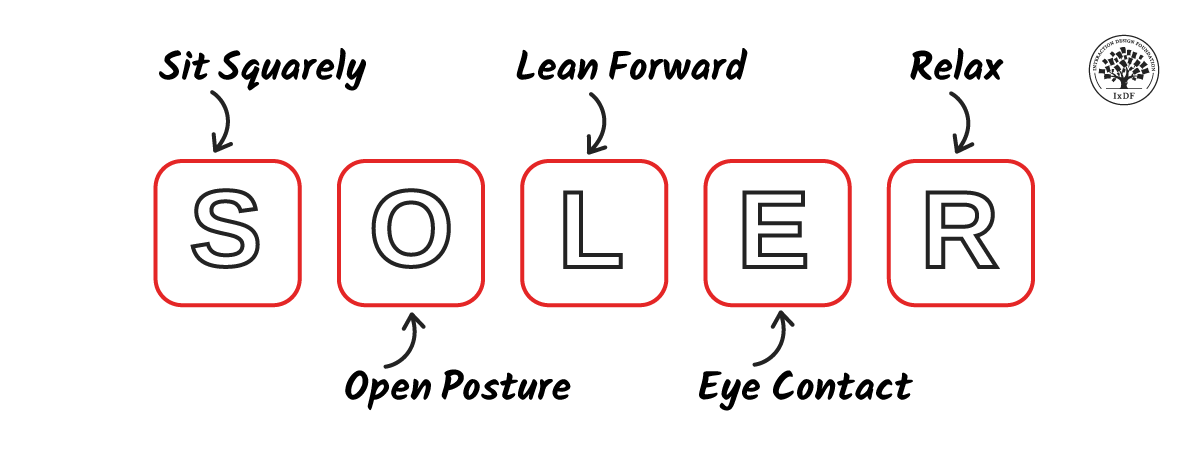
“SOLER power” can help your shine brighter messages.
© Interaction Design Foundation, CC BY-SA 4.0
3. Use Eye Contact to Connect
In general, eye contact helps people feel seen and included. Too little of it can look evasive or nervous. Too much of it can feel intense; and some cultures, such as in some parts of Asia, can take it as a sign of disrespect. So, in general:
In one-on-one talks, aim to maintain eye contact about 60–70% of the time.
In group settings, scan the room naturally and make eye contact with different people for a few seconds each.
Online, look directly into your camera periodically so participants feel you’re addressing them personally.
4. Bring Variety to Your Voice
Your voice is your built-in engagement tool, with features like pitch and pace to help you get messages across well. A monotone loses people, but varied tone and pace hold attention and keep things interesting. So:
Practice slowing down when you’re explaining complex points and speeding up slightly to show excitement.
Emphasize keywords by slightly raising your volume or lowering pitch to help them stand out.
Record yourself reading out loud. Play it back to notice patterns of monotony; spot personal habits like making “um” sounds or saying “you know” frequently (your audience probably won’t “know,” so try to minimize these); and practice adding variety.
Use pauses strategically; stop talking for two or three seconds after key points to let ideas sink in, or pause for a second or two for dramatic effect to let important keywords or concepts enter the room impressively.
5. Manage Nervous Energy and Gestures
Everyone gets nervous, one “price” of being human, but restless movements can distract from your message. So:
Identify your nervous habits (pacing, tapping, or fidgeting) and consciously replace them with calm gestures. You can look for these in playback of your videoed rehearsal or if you ask a colleague to be up-front and totally honest with you about your perceived nervous habits.
Practice anchoring: ground both feet firmly on the floor and take a deep breath before you speak.
Hold a pen or use purposeful hand gestures to keep your hands engaged without fidgeting. Find a comfortable balance so you don’t keep karate-chopping the air around you, scratching the back of your head, or twirling your hands and forearms as if you’ve had too much caffeine (and try to minimize your caffeine intake for UX presentations, anyway).
6. Pay Attention to Your Audience’s Signals
Remember, non-verbal communication is a two-way street, so keep your eyes open. You want to send clear signals to get your message across well, but you also need to read the ones you receive from those who have come to listen to you.
Watch for crossed arms, puzzled looks, or people avoiding eye contact; they’re often signals of confusion or disengagement.
If you do see those signs, pause and ask, “Would you like me to explain that part in more detail?”
If you’re in a virtual meeting, track chat comments, reactions, and faces on screen. Adjust your delivery if you see signs of distraction or ask if anybody needs you to clarify a point.
7. Respect Cultural Differences
This one, like paying attention to others, can be easy to overlook, especially when you’ve got a rehearsed presentation to get on with. Still, it’s vital to reinforce, as gestures, eye contact, and personal space don’t mean the same thing everywhere. And, indeed, it’s fair to suggest that your audience should also realize where you’re coming from. However, the onus is on the presenter to adjust the style and message to the target audience, just like a designer would a digital product like an app for an overseas market. So:
If you’re presenting to an international group, do some quick research on cultural norms. For instance, direct eye contact shows confidence in Western contexts but may feel disrespectful in parts of Asia.
When in doubt, aim for a neutral, open style: gentle gestures, moderate eye contact, and a professional distance.
Ask colleagues from different backgrounds for feedback on what works well.
8. Practice, Reflect, Improve
As with virtually any other activity, you can sharpen your non-verbal communication skills through practice and reflection. Soon, you may find yourself shining as one of the most welcoming, trustable, and successful presenters regardless of whether you’re an introvert or extrovert. So:
Rehearse with a trusted friend or record yourself. Ask specifically for feedback on body language, tone, and pacing. Ask them to be brutally honest in their critique. If you’re self-assessing, be compassionate with yourself but likewise be as objective as you can to weed out anything that could sabotage your message delivery.
After each presentation or meeting, take two minutes to reflect: “When did I feel most connected to the audience? When did I lose them?”
Focus on one element at a time: Handle eye contact this week, vocal variety next week. Small, consistent practice adds up.
If nerves are getting in the way, try breathing exercises like the 4-7-8 method (4 seconds for inhalation, 7 seconds for holding, 8 seconds for exhalation) for a minute. Rehearse, consider voice or theater lessons, and remember stage fright and glossophobia (the fear of public speaking) are common to millions of other people too.
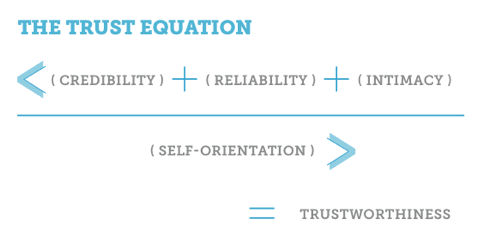
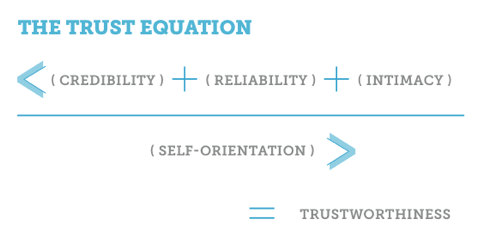
Explore another powerful way to help present UX design material and other ideas; present with a trust framework, in this video with Morgane Peng.
How to Master Non-Verbal Communication in Virtual Settings
It’s true that digital communication adds another layer of complexity; when you present or collaborate online, non-verbal cues can be harder to send and interpret. Still, you can use effective techniques to make the most of your message delivery, such as:
Camera framing: Keep your head and shoulders in frame with good lighting; this makes your expressions visible and builds connection. If you’re off-screen or lurking in the shadows, people won’t be able to build trust.
Gestures: Use hand movements sparingly but visibly within the camera frame to emphasize points.
Tone and pace: Since body language is limited to the top parts of your body, your vocal delivery becomes even more important. So, vary pitch and pace to keep people engaged.
Reactions and chat: Pay attention to emojis, reactions, and chat messages as substitutes for in-person cues. People won’t be, or shouldn’t be, rude enough to write bored emojis, for example, but watch for tell-tale signs of low engagement or confusion, anyway. For example, “?”, “??”, or even “???” might turn up in the chat. Swiftly respond to these with a “May I clarify a point?” for example.
Common Non-Verbal Communication Mistakes to Avoid
It can take some mental bandwidth to focus on the power of presence. Even seasoned communicators can send the wrong non-verbal signals, so watch out for these pitfalls:
Overusing slides: Don’t hide behind slides; it lessens your presence. A well-chosen slide set should feature a good balance of clear points and visuals. Don’t make slide text-heavy or let them make you redundant; your audience can read faster than you can talk, if they’re still interested or awake. You want your delivery to carry the message, not just your visuals.
Avoiding eye contact: This can make you look unprepared or untrustworthy, whoever’s watching you.
Speaking in monotone: Flat delivery drains energy from your message, no matter how strong the content. Words won’t save a message if you can’t voice them well.
Closed body language: Crossed arms, hunched posture, or turning away makes you seem defensive; appear open and you’ll nurture trust, credibility, and even good will from the audience.
Ignoring audience reactions: Don’t carry on regardless and just stick to the plan. Failing to adjust when people look confused or disengaged wastes opportunities to connect, and shows you don’t care what they think. Cater to your audience’s real-world concerns in real time; after all, they’ve invested their valuable time to come and listen to you.
Zero in on how to keep a roomful of people on board and not stumble on common presentation mistakes, in this video with Morgane Peng.
Overall, non-verbal communication is the silent force that shapes every interaction you have, from informal, “unguarded” moments at home to the most formal presentations in front of senior executives. In any case, whether you’re presenting a design, leading a meeting, or interviewing users, remember that the way you carry yourself speaks louder than your slides or script.
The good news is, you’re better off being yourself when you learn to manage your own non-verbal signals and read those of others. Far from the stiff, leaden delivery of a robot or the fast, jerky movements of someone who looks like they can’t wait to get their speech over with, you can secure presence with natural style and win the audience over. You can build trust, keep attention, and influence outcomes through a confident, competent, and caring posture, speech, and manner of responding to people in the meeting room.
In a world where attention is scarce, anxiety and suspicion are easily instilled, and credibility is everything, a mastery of non-verbal communication gives you an edge. It ensures your ideas don’t just get heard; rather, it becomes a chief reason the people you present to listen to you as you present them with ideas, ideas that then resonate, persuade, and inspire action.
The Science Behind Non-Verbal Communication
The impact of non-verbal cues has been at the center of many psychologists’ and communication scholars’ studies for a long time. Albert Mehrabian’s classic research highlights that people rely heavily on non-verbal signals when they interpret feelings and attitudes. Mehrabian’s Rule (1970s) comes from studies of emotional communication, where participants judged meaning to come 7% from words, 38% from tone of voice, and 55% from body language. It doesn’t apply universally, but it does underscore how powerful non-verbal signals are.
Neuroscience neatly grounds the reality of non-verbal communication in a physiological foundation. Some scientists suggest that mirror neurons may underlie our tendency to mimic others, which could support empathy and the human ability to feel things from another person’s perspective.
Society and culture factor into the “phenomenon” of communicating without words, too, namely through cultural variation. Anthropologist Edward T. Hall showed that personal space and gestures vary across cultures; so, what feels open in one culture may feel intrusive in another.
How Non-Verbal Communication Shapes UX Design
Your audience is constantly interpreting your non-verbal cues, often unconsciously, while you’re busy speaking. Here’s how those cues play out in everyday professional contexts:
In Presentations
Your body language, eye contact, and tone reinforce your message. When you lean forward slightly, you communicate interest; standing tall with open posture signals authority. Varying your vocal tone prevents monotony and keeps attention alive.
In Research Interviews or Usability Tests
One of the biggest risks of user research is to misread test participants’ or user behavior or take their words at face value. Often out of politeness because they don’t want to offend the designer, participants won’t always say exactly what they think, but their non-verbal signals often reveal the truth. A hesitation before answering, crossed arms, or a change in tone may signal discomfort or hidden concerns, even if what they say sounds positive. Read these non-verbal cues and you’ll find it helps you uncover deeper insights.
In Team Collaboration
Non-verbal signals influence group dynamics. It’s easy to think of good poise and posture and perhaps being “deliberately natural” as effective for formal presentations and public speaking, but non-verbal messaging carries through into even the smallest meetings like one-on-one interviews. When you nod to acknowledge input, lean in to listen, or mirror gestures, it fosters trust and shows you have sharp audience awareness and value your listeners. On the other hand, eye-rolling, sighing, or checking your phone can derail collaboration and signal you’d rather be elsewhere.
.png)
Flip things around to view your presentation and communication style from the audience members’ perspective, and make yourself open, available, and accommodating to what they, like you, want out of the meeting: an effective outcome.
© Interaction Design Foundation, CC BY-SA 4.0