Carrying out user interviews can be chaotic! You must handle a lot of things at once to ensure that your participants are comfortable and that you get valid results. You must listen to what your participant is saying while also keeping track of where to go next, which questions you haven’t asked yet, how much time you have spent, how to formulate your next question and so on. Equally important, you also have to consider the interpersonal aspects of the situation and build rapport with your participant. This means that the interview situation can seem quite chaotic at times and may be difficult to navigate, but never fear. Here, we will teach you how to approach the interview situation, create rapport and ask the right questions.
How to Approach the Interview Situation
Before you find yourself in the middle of an interview session, it’s crucial that you consider how to approach the interview situation. The foundation for conducting good interview research and getting great results is to keep an open mind and be truly curious about the participant’s perspective; otherwise, there’s no reason to conduct the interviews in the first place.
Here, professor of Human-Computer Interaction at University College London and expert in qualitative user studies Ann Blandford explains how to approach the interview situation in an open and respectful way that doesn’t lead the participant.
If possible, it can be an advantage to have two persons facilitating the interview together. That way, one person can ask questions while the other takes notes. After a while, you can switch roles. The person taking notes has more time to really listen to the answers. This person can also think about any questions that the first person forgot to ask about, or did not pick up on. Switching between who does what also enables the facilitators to be more relaxed, and it changes the dynamics between participant and facilitator. As maintaining a natural feel is important, the interviewee will be far more likely to feel on board this way, as waiting for a lone interviewer to catch up after taking down notes may create the atmosphere of, say, a police interview. If you are dealing with very sensitive topics, however, having one person facilitate the interview can be an advantage.
Building Rapport
When you conduct an interview, it’s crucial that you are able to build rapport with your participants. Having rapport with your participants means that you have a good connection—you feel as though you understand each other and communicate well. If your participants trust you and feel comfortable, they will be more open and forthcoming in their answers. With some participants, you will have a natural connection, making it almost effortless to build rapport. With other participants, you will have to work harder to establish a relaxed and trusting atmosphere. In all cases, it’s the responsibility of you as the interviewer to build rapport.
“Rapport equals trust plus comfort.”
— Neil Strauss, Author and transformational journalist
A lot of rapport building relates to factors that matter in most social situations. Make sure you dress appropriately, be friendly, and make natural eye contact. Try to maintain a relaxed and open body posture. As much as possible, you should follow along with common social customs, such as offering a cup of coffee or chatting briefly about the weather. That’s part of being polite and building rapport. At the same time, you shouldn’t spend too much of your valuable time with the participant on small talk or preambles to the issues at hand, and you should avoid talking too much about yourself and your own opinions (if at all). Firstly, you are interested in the participant and not yourself. Secondly, if you give too many of your own opinions or share too much of your own experience, you will risk influencing your participants’ answers. They will be less likely to be forthcoming and open if they think doing so may cause you to disagree with what they have to say. As such, this guardedness will cause many to distort their answers and thus work against the whole point of the exercise.
Although you follow common social customs, remembering that the interview is a professional context, not primarily a social one, is vital. You are the one responsible for framing the conversation, for ensuring that relevant topics are covered and for the well-being of your interview participants. If you find it difficult to listen and keep track of the interview at the same time (and it really can be), then taking notes of the follow-up questions that pop into your head as the participant is speaking might be a very sound idea. That way, you don’t have to interrupt your participants as they are speaking and you don’t risk forgetting good questions.
There are a lot of things you can do to build rapport, but as Ann Blandford explains in this video, there are also factors that are outside of your control.
Follow-up Questions
When you plan your interviews, you write an interview guide and you think a lot about how to ask questions and in what order. When you are actually conducting the interview, though, you will often find that how you intended to ask the questions and in what order changes completely depending on how the conversation evolves. In his book Interviewing Users: How to Uncover Compelling Insights, Steve Portigal even states that—ideally—you should only ask one kick-off question and allow the rest of the interview to flow naturally from there. Obviously, you steer the conversation and you sometimes consult your interview guide, but if you listen to your participant, most of your questions can/will be phrased as follow-up questions to something the participant has said. In that case, you mainly use your interview guide as a reference to see if you have forgotten anything, to get back on track if you draw a blank and can’t remember where the conversation was going, or if the interview strays too far off-topic and you need help to get back on track.
“Listening is the most effective way you can build rapport. It’s how you demonstrate tangibly to your participants that what they have to say is important to you.”
— Steve Portigal, Author of the book Interviewing Users: How to Uncover Compelling Insights
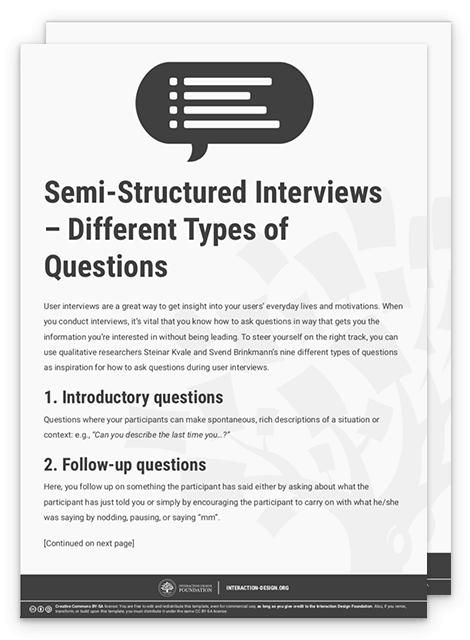
Since most of an interview can consist of follow-up questions, obviously follow-up questions can mean many different things. You can use qualitative researchers Steinar Kvale and Svend Brinkmann’s list of nine different types of questions as inspiration for how to follow up on questions. Most of the question types follow up on answers given by the participants or relate to managing the flow of the interview:
1. Introductory questions
Questions where your participants can make spontaneous, rich descriptions of a situation or context: e.g., “Can you describe the last time you…?”.
2. Follow-up questions
Here, you follow up on something the participant has said either by asking about what the participant has just told you or simply by encouraging the participant to carry on with what he/she was saying by nodding, pausing, or saying “mm”.
3. Probing questions
With probing questions, you ask participants directly to elaborate on what they were saying: e.g., “Can you give me an example of that...?” or “Can you explain in more detail…?”.
4. Specifying questions
If you feel like you are getting too generalized a description, you can try asking specifying questions: e.g., “What concretely did you do?” or “How did that make you feel?”.
5. Direct questions
With direct questions, you introduce topics directly, because you know they are either of interest to your project or based on something the participant has said earlier: e.g., “Do you have any experience with x-brand video streaming service?”. It is best to wait with direct questions until the last part of the interview, so that you give participants a chance to describe their perspective before you introduce your own interests.
6. Indirect questions
If there are questions where you don’t want to ask the participants directly about their experiences with something, you can ask them more indirectly: e.g., “Do you think other people sometimes find the user interface difficult?”. The answer can reflect both the participants’ own experiences and how they interpret the experiences of others, so you should be careful how you interpret their answers to any indirect questions.
7. Structuring questions
You use structuring questions when you want to change the topic of the conversation or to get back on track if the interview has gone too off-topic. In that case, you briefly acknowledge that you have understood what the participant is saying and then say—e.g.—“let’s move on to…”.
8. Silence
When you conduct an interview, try not to fear pauses in the conversation. Leaving a bit of quiet time after your participants answer allows them to think and follow up with additional information. How quiet you can be is a balancing act, and you shouldn’t be so quiet that it makes participants uncomfortable. For example, some interviewees may pipe up with off-topic or tangential points, just for the sake of filling such gaps.
9. Interpreting questions
You ask interpreting questions to ensure that you have understood a participant’s answer correctly or to prompt him/her to elaborate. An example of an interpreting question could be this: “Am I right in understanding that you feel that…?”
As you can see, many of these questions are not something you can put into your interview guide. Semi-structured interviews are organic things that evolve and grow around the structure you try to maintain within them. On that note, these sorts of questions are mainly something you can keep in the back of your mind when you do interviews—as is the case with most of the things you can do to build rapport. That also means that becoming a good interviewer is something that comes with practice. You will not be able to get everything right the first time. That doesn’t mean you will not get valuable results out of your first interviews, but it’s a good idea to start with simple interview projects that involve short and focused interviews, and then expand to more complex topics. For each interview you perform, try to reflect on how well you managed and what you would like to improve in your next interview.
You can download our template summarizing the nine different types of questions here:
In this video, researcher Graham R. Gibbs from the University of Huddersfield comments on a video recording of a semi-structured qualitative interview. It’s a relatively old interview, but it provides a good summary of many of the points as to how to build rapport and ask questions.
Data Collection
So far, we have focused on how to handle the interpersonal aspects of the interview and ensure that you ask the right questions. Nonetheless, another important aspect of handling the interview situation correctly is to ensure you collect the data you need—without having the data collection interfere too much with the interview. There are different ways to collect data from an interview, and which method is right for you will depend upon the purpose and context of the interview and on your personal preferences. The most common forms of data collection during interviews are note taking, photos, audio and video recordings, and a combination of all three. There are upsides and downsides to all methods, and which one you use is up to your personal judgment and what type of data you need. For instance, video recordings can be viewed as intrusive by some participants. That said, others are used to camera phones and are not disturbed if you use a small camera. This also depends on how sensitive your topic of interview is and how you are going to use the recordings afterwards. In some situations, you need to be able to see what the participant is doing while he or she is talking—e.g., if he/she is demonstrating something to you. In that case, you have to record a video. In other situations, an audio recording is just as good as a video recording, so you might as well just stick to audio recordings. Of course, any time you record your participants you need to ensure that your participants give consent to being recorded, that they know how you will use the recordings, and that they know that they can ask you to stop the recording at any time.
In this video, Ann Blandford discusses the pros and cons of different types of data collection.
The Take Away
The interview situation can be chaotic, and there are many things you need to consider at once. It’s important that you build rapport with your participants by behaving in a respectful and suitable manner, and by showing that you are indeed listening to what they are saying. One way to clearly show that you are listening is to base most of your interview on follow-up questions to something the participant has said. Here, we have shown you different ways of asking follow-up questions depending on the context and what you want to find out. With this variety of considerations, you can help an interview grow naturally over the “skeleton” you have assembled beforehand or the follow-up questions you get to grips with as you progress.
References & Where to Learn More
Ann Blandford, Dominic Furniss and Stephann Makri, Qualitative HCI Research: Going Behind the Scenes, Morgan & Claypool Publishers, 2016
Steinar Kvale and Svend Brinkmann, InterViews: Learning the Craft of Qualitative Research Interviewing. SAGE Publications, 2009
Steve Portigal, Interviewing Users. How to Uncover Compelling Insights, Rosenfeld Media, 2013
Image
Hero Image: © Samuel Mann, CC BY 2.0