Grounded theory is a qualitative research method that helps to discover patterns and insights from real user data. Instead of starting with assumptions, researchers collect and analyze data step by step, letting findings emerge naturally to build a deep, unbiased understanding of users' behaviors and needs.
In this video, William Hudson, User Experience Strategist and Founder of Syntagm Ltd, explains grounded theory.
Grounded Theory Reveals Hidden Insights
In grounded theory, researchers alternate data collection with analysis until they build a complete picture of user needs and behaviors. Researchers greatly benefit from grounded theory in novel problem domains or when they require a more in-depth understanding of user behavior.
The aim of grounded theory is to allow user insights to guide the research. This way, design teams can discover and solve the most important issues users face, regardless of their initial research or design goals. This contrasts with more traditional forms of research that set out to address a specific concept.
For example, a typical design goal might be:
Improve the user experience of an online supermarket to increase customer engagement.
This approach may exclude insights unrelated to the website's usability and features. For example, participants may have issues with delivery times and product substitutions that influence their decisions more than user experience (UX). However, grounded theory does not focus on finding answers to specific questions, allowing researchers to discover these important insights.
These issues fall outside the immediate scope of the website. However, if the organization ignores them, UX alone is unlikely to achieve the goal of increased engagement. The organization would benefit if the researchers included these findings in their research summary. They can then consider how best to improve customer experience as a whole, not just the website's UX.
Benefits of Grounded Theory in UX Design
Grounded theory is a powerful tool in user experience research, and it has several benefits to offer.
Improved Understanding
When researchers observe users in situ and interact with them directly, they are better able to explore users’ behaviors and needs in context.
Even when research is limited to interviews without observation, discussions are focused on scenarios in the problem domain rather than abstract lines of questioning. For example, a typical research question might be:
“How satisfied are you with the online checkout process?”
However, a researcher using grounded theory might ask:
“Can you walk me through your last experience checking out your groceries online, step by step? I'd like to understand what you did, how it felt, and if anything stood out to you.”
Centered on Users
The focus of grounded theory research is on users in the problem domain. Researchers usually do not address potential solutions in the domain unless they are part of the existing user experience. Therefore, most observations are about stories of use. With diverse participants, this ensures researchers get a better understanding of the user experience.
For example, in other types of research, a question for participants that addresses the problem domain might be:
“Would it be helpful if the supermarket app recommended substitute items when something is out of stock?”
A grounded theory question could be:
“Tell me about the last time you found out something you ordered online was out of stock. How did you handle it, and what did you do next?”
In this video, Don Norman, Father of User Experience design, author of the legendary book The Design of Everyday Things, and Co-Founder of the Nielsen Norman Group, explains the importance of user and human-centered design.
Wide-Ranging
Since grounded theory views usage as a tool of exploration, it’s not uncommon for results to cover a wide range of topics. Naturally, researchers will have established what area they’re interested in and may wish to deliberately exclude issues that are out of scope. However, this is something they should do carefully—if they ignore behaviors or concerns that arise in research; it may be counterproductive.
For example, grounded theory research might reveal that customers are frustrated with limited delivery times. Researchers can share this insight with the operations team, who may then adjust the delivery schedule. However, if they ignore such findings, this could result in a solution that technically meets users' stated needs yet fails to meaningfully improve their overall experience.
Insights into Behavior
When researchers observe or ask participants to walk through scenarios in their lives, they rapidly gain detailed knowledge of user goals, behaviors, and needs. How user goals are defined and prioritized may change throughout research and development until the final solution is complete. However, behaviors are often well-established early on, and grounded theory research is highly effective at discovering them compared to other methods.
Reduces Bias
Since grounded theory starts without assumptions or theories, it reduces bias by letting user data guide the research. Instead of testing a fixed idea, researchers ask open-ended questions, observe real behavior, and adjust their focus based on what they discover. This approach avoids common biases like:
Confirmation bias: This happens when researchers focus only on data that supports their beliefs and ignore anything that doesn’t. Grounded theory helps avoid this by not starting with a fixed idea. Insights come directly from the data, not from what the researcher expects to find.
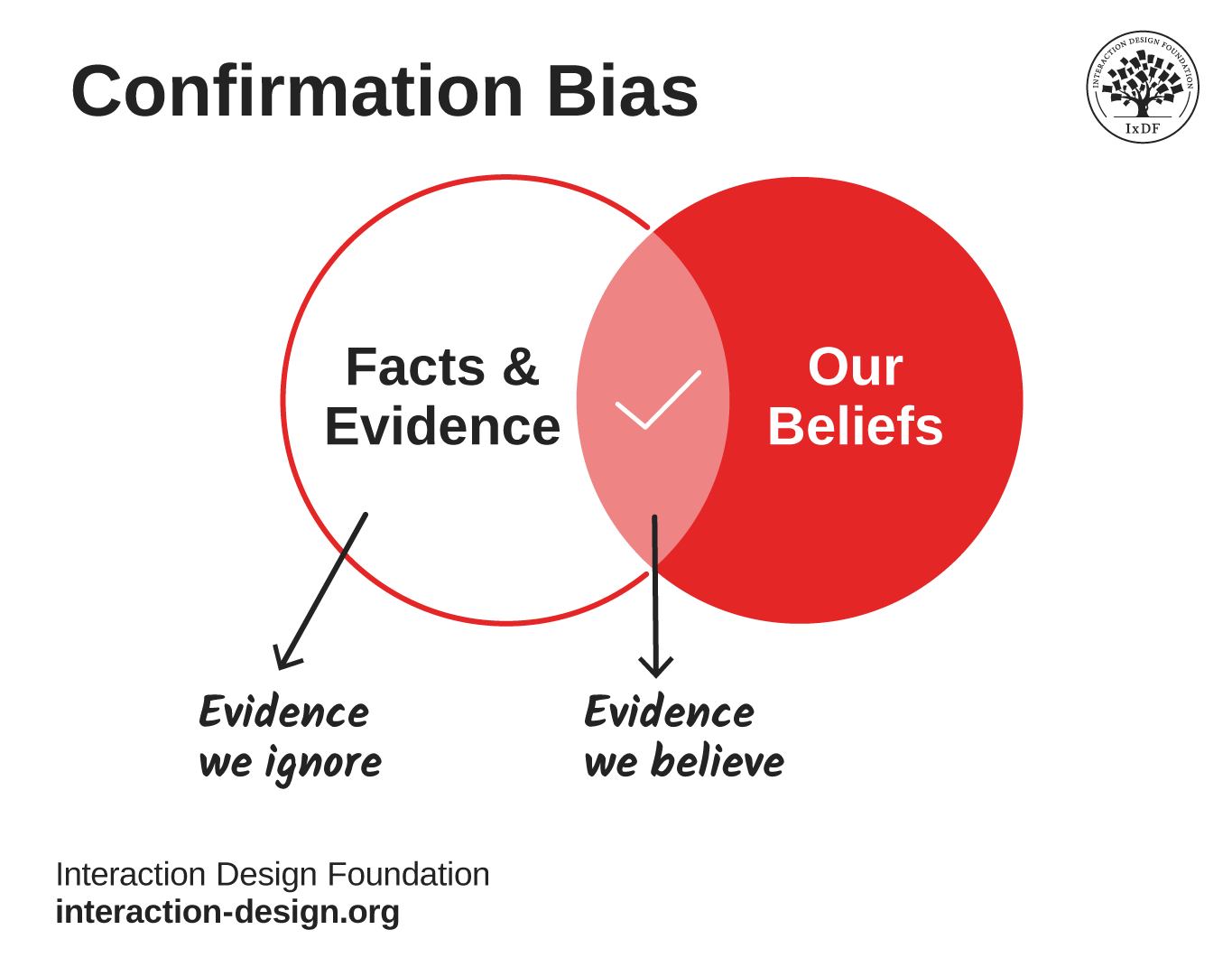
Research built with confirmation bias will directly affect the final product, service, or experience. This is why it is pivotal that researchers stay open-minded and explore avenues that contradict their beliefs.
© Interaction Design Foundation, CC BY-SA 4.0
Framing bias: This occurs when the way a question is worded leads people toward a certain answer. Grounded theory uses open-ended, neutral questions that allow users to speak freely, reducing the risk of steering their responses.
Cultural and personal biases: These appear when a researcher’s background or beliefs affect how they understand user behavior. Grounded theory emphasizes direct user quotes and observations, keeping the focus on what users actually say and do—not how the researcher interprets it.
Grounded Theory in User Research: A Step-by-Step Guide
Follow these steps to use grounded theory in user research.
1. Define Your Research Question
To apply grounded theory in user research, start with a broad, open-ended research question that explores user needs, behaviors, and challenges within the problem domain.
Grounded theory research questions should be:
Exploratory and designed to uncover new knowledge, not test hypotheses.
Flexible, so you can follow up on emerging areas of interest.
Specific enough to be practical but broad enough to capture complexity.
For example:
“What obstacles prevent in-store supermarket customers from making online delivery orders?”
This question explores a wide range of factors—such as ease of use of online platforms, concerns about product freshness, delivery fees, and preference for in-store shopping—without narrowing it down to a single hypothesis.
2. Collect Data
Begin your data collection using qualitative methods like observations and interviews.
User observation is often preferable to interviews because it reveals what users actually do rather than what they say they do. People often overlook or misreport their own behaviors. However, direct observation reveals real actions, habits, and workarounds. Observations often expose needs or pain points that users themselves aren’t consciously aware of. When you watch users in their natural environment, you gain deeper, more accurate insights into how products, services, and experiences fit into their lives.
3. Code and Explore
Coding is the process of organizing and making sense of your qualitative data. For example, your interview transcripts or observation notes. Here, you label selections of information with descriptive tags called codes. These codes capture key ideas, actions, or patterns in the data. There are three stages of coding:
Open coding: Begin by analyzing the data line by line and assigning initial codes without any predefined categories.
Axial coding: As patterns emerge, link related codes together around central themes. Develop connections between categories and subcategories to form a coherent framework.
Selective coding: Finally, integrate and refine your categories around a core category so you can develop a cohesive theory.
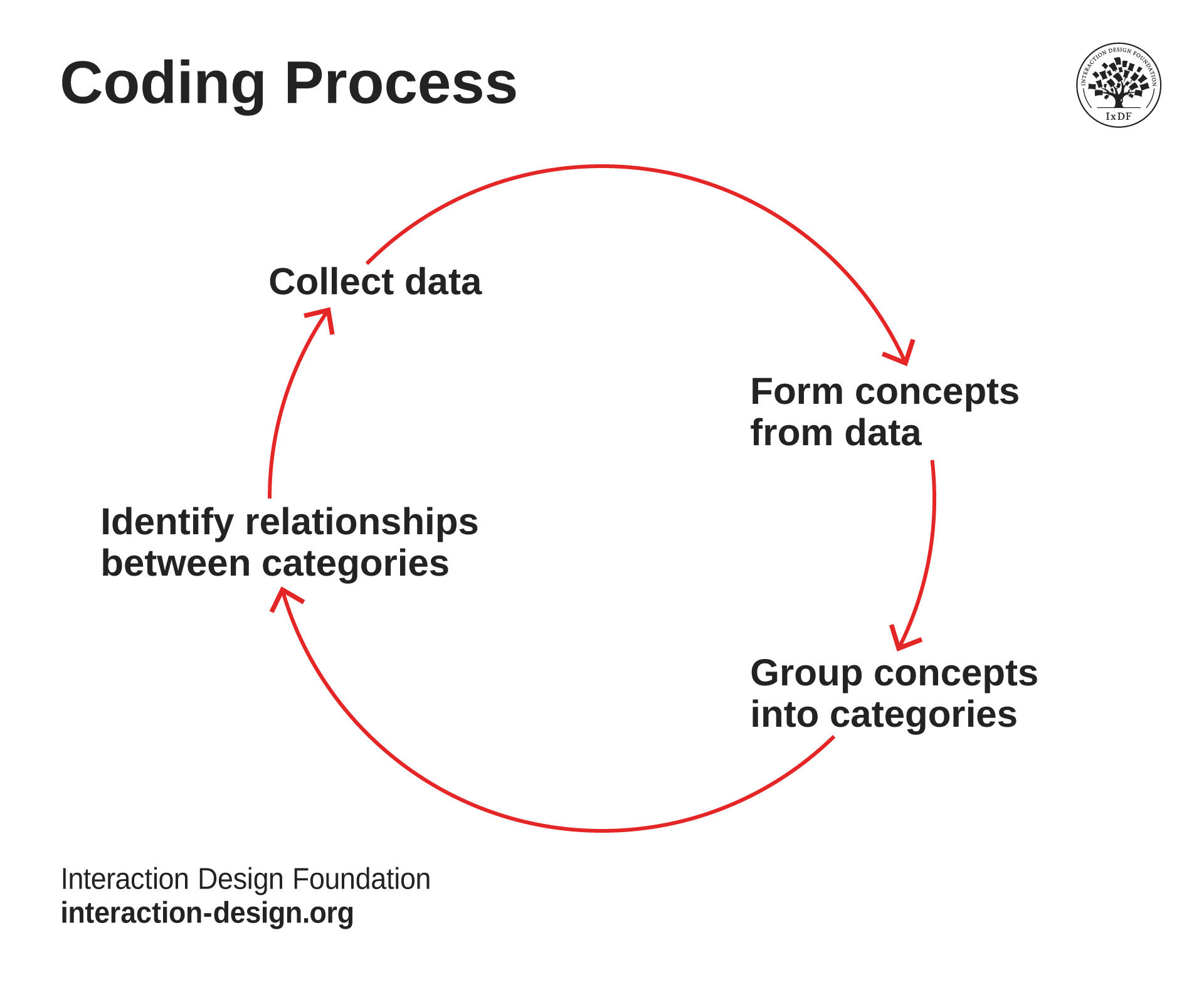
Coding is an iterative process that transforms raw data into a structured theory grounded in real user experiences.
© Interaction Design Foundation, CC BY-SA 4.0
A simple method for coding grounded theory research is with affinity diagrams. Affinity diagrams organize, link, and structure research data into a format upon which design teams can take action.
For a quick start guide to affinity diagramming, download the free template below and start coding your data easily.

4. Repeat
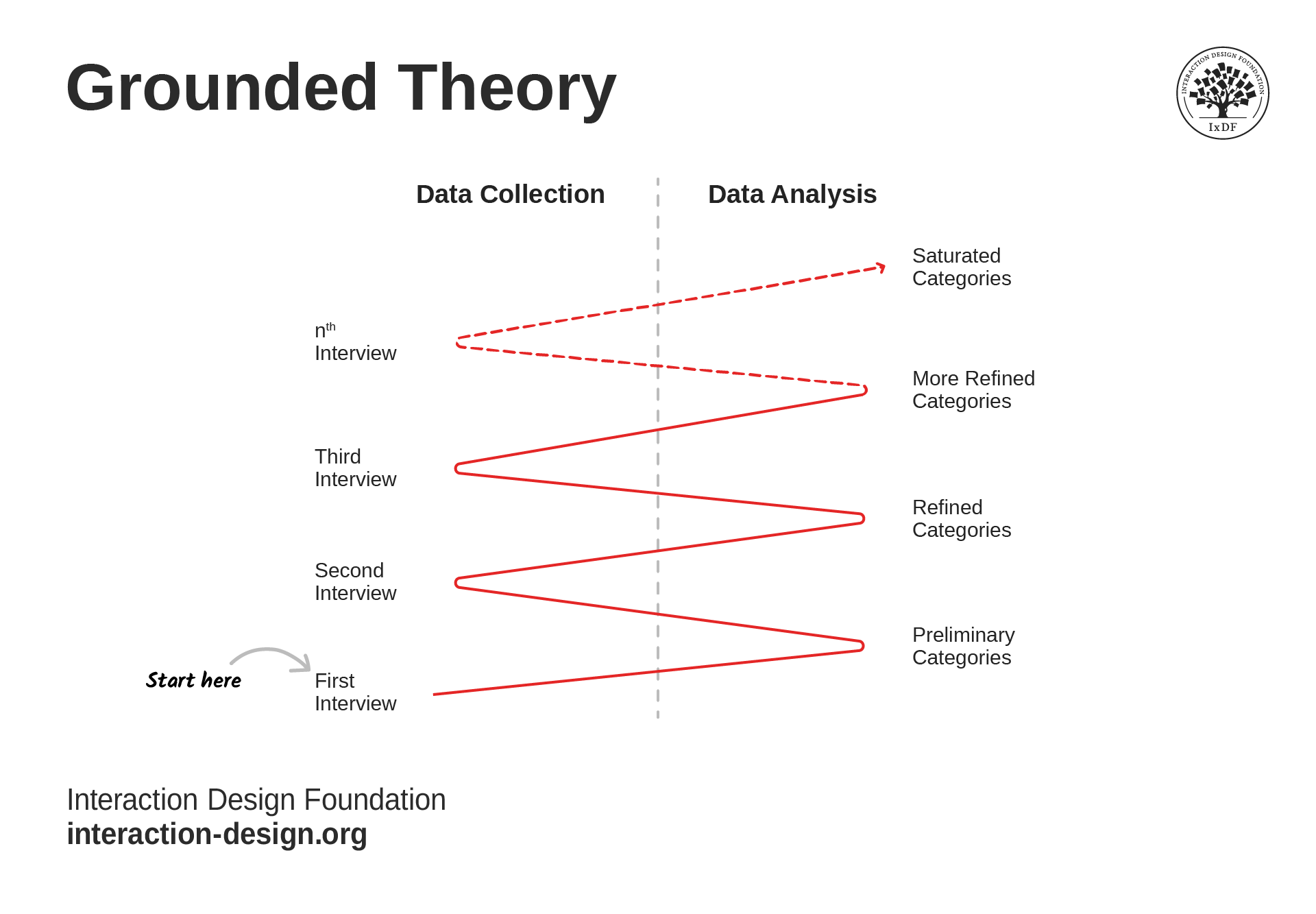
After each open and axial coding session, identify gaps in your data or new, relevant research directions. Conduct further observations or interviews with either the same or new participants if you think it will be more beneficial. Continue this research and analysis process until no new categories emerge in your axial coding.
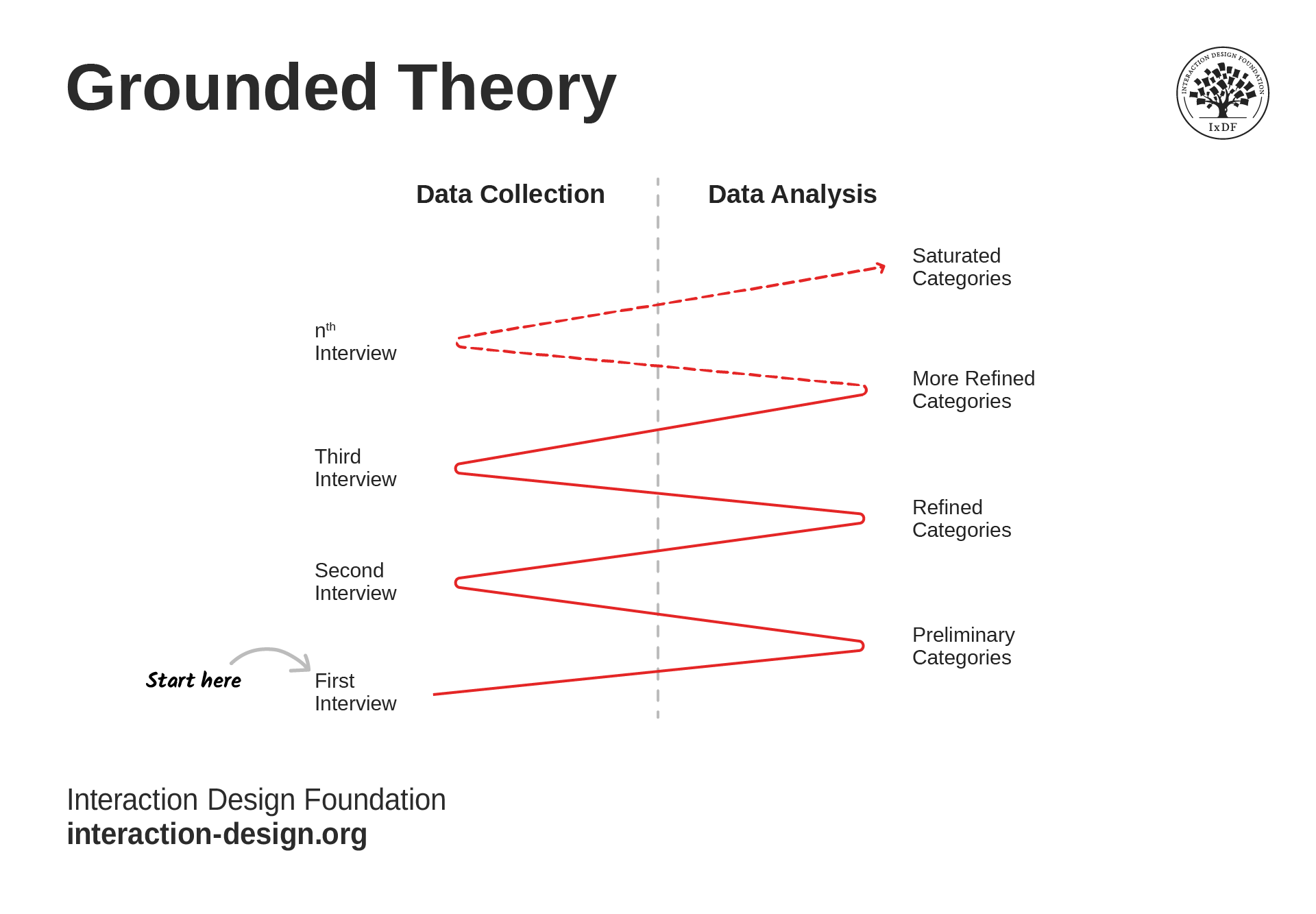
Grounded theory is an iterative process in which data collection and analysis continually inform each other, allowing new insights to guide the direction of the research. It is a cyclical method that identifies emerging patterns, deepens understanding, and adjusts research priorities accordingly. As a result, grounded theory helps produce user-focused solutions informed by genuine user behaviors, motivations, and challenges.
© Image redrawn by Interaction Design Foundation, based on original by John Creswell (Educational Research), Fair use
When no new categories emerge in axial coding, you have reached “saturation.” This is when it is unlikely that further research will reveal new insights.
At this stage, if you are working within a team or organization, you may wish to explore your data with your colleagues and stakeholders. Data exploration helps everyone build empathy and prepare them to build products, services, and experiences that users love.
In this video, William Hudson explains how to capture your research data in preparation for exploration with affinity diagrams.
5. Develop Your Theory
In grounded theory, you don’t start with a theory—you build one from the ground up using your research data. Theories begin to emerge naturally as you collect data and code it. These patterns become the building blocks of your theory.
Once you reach saturation, look at the concepts and relationships in your coding and ask:
“How do these explain the problem I’ve been researching?”
From here, connect the dots and create a theory. The theory will be a structured explanation of how users experience a particular issue, why it happens, and what influences it.
For example, a design team researches why people abandon online grocery orders. Through interviews and observations, they notice common themes:
Confusion about delivery slots.
Lack of trust in product quality.
Frustration with item substitutions.
As they code, conduct further research, and finally complete selective coding, they realize many users start excitedly but gradually lose confidence and control. This leads to their theory:
“A sense of lost control and uncertainty leads users to abandon online grocery orders.”
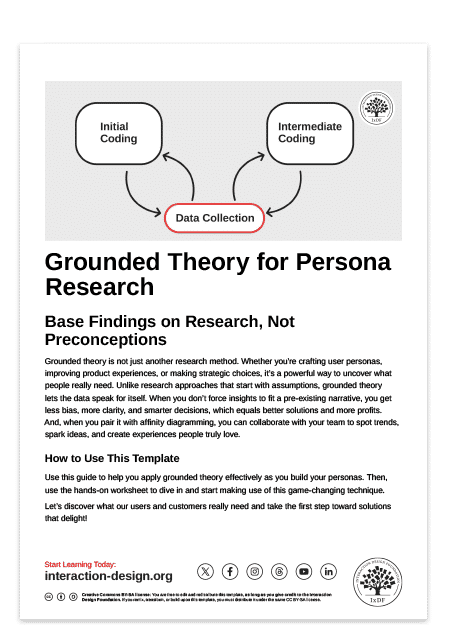
Free Grounded Theory Quick Start Worksheet
Download this template to start implementing grounded theory in your research straight away. It includes a quick guide on grounded theory, plus a worksheet to plan and record your research.
The History of Grounded Theory
Grounded Theory was developed in the mid-1960s by sociologists Barney G. Glaser and Anselm L. Strauss:
1967: The Discovery of Grounded Theory: Strategies for Qualitative Research by Glaser and Strauss. This book describes the motivation for grounded theory and focuses on how important it is to derive theories from research data.
1970s-1980s: Grounded theory finds increasing use in social research and related fields. What’s more, the theory was adapted to meet a wide range of needs.
Divergence: In the late ’70s and early ’80s, Glaser and Strauss's views on grounded theory began to diverge—namely in how:
Barney Glaser preferred a more flexible approach and was enthusiastic about minimal researcher interference when developing theories from collected data.
Anselm Strauss and Juliet Corbin developed a more systematic version of grounded theory, and their approach was far more detailed and prescriptive.
1990: Strauss and Corbin published Basics of Qualitative Research: Grounded Theory Procedures and Techniques. This became a step-by-step guide to grounded theory research, including coding techniques and the development of theoretical frameworks.
1990s-2000s: Multiple practitioners adapted and extended grounded theory, resulting in several new versions.
2010s-Present: Grounded theory is still used widely in qualitative research across a range of fields, including psychology, education and medicine.
Technological advancements: The more extensive use of computing has helped researchers manage data collection and analysis processes, and more sophisticated forms of data analysis have become available.










#/media/File:Ed_lines.jpg)