Confirmation bias is a psychological tendency to favor information or data that aligns with one’s preexisting beliefs, opinions or values. People disregard information that contradicts these characteristics. This cognitive bias can greatly influence designers’ thought processes, skew their interpretation of data and impair decision-making.
Author and Human-Computer Interaction Expert, Professor Alan Dix explains one form of bias and how to overcome it.
Why Do People See Only What They Want to See?
The roots of confirmation bias lie deep within the psychological makeup of individuals. Bias is the tendency to observe events and consider concepts through mental “filters.” Some biases, such as implicit bias, can color a person’s view of the world. Many people can make snap judgments which they base on preconceived notions and stereotypes—and not even be aware of it.
Confirmation bias is a product of the natural inclination to seek consistency and coherence in human belief systems. The desire for cognitive consistency can lead people to selectively gather and interpret information that supports their existing beliefs. To seek information with this attentional bias, they will focus on evidence that supports and dismiss proof to the contrary. This selective attention and interpretation of information form the crux of confirmation bias. It can affect information processing, problem solving and decision making—often for the worse.
Examples of this bias include when individuals:
Believe news sources that align with their political views and dismiss those that don't.
Dismiss medical advice that contradicts their beliefs about healthcare.
Engage mostly with content and groups of people that share similar viewpoints on social media platforms.
Remember instances that confirm their stereotypes and disregard those that contradict them.
Interpret scientific studies in a way that aligns with their existing beliefs, regardless of the actual findings.
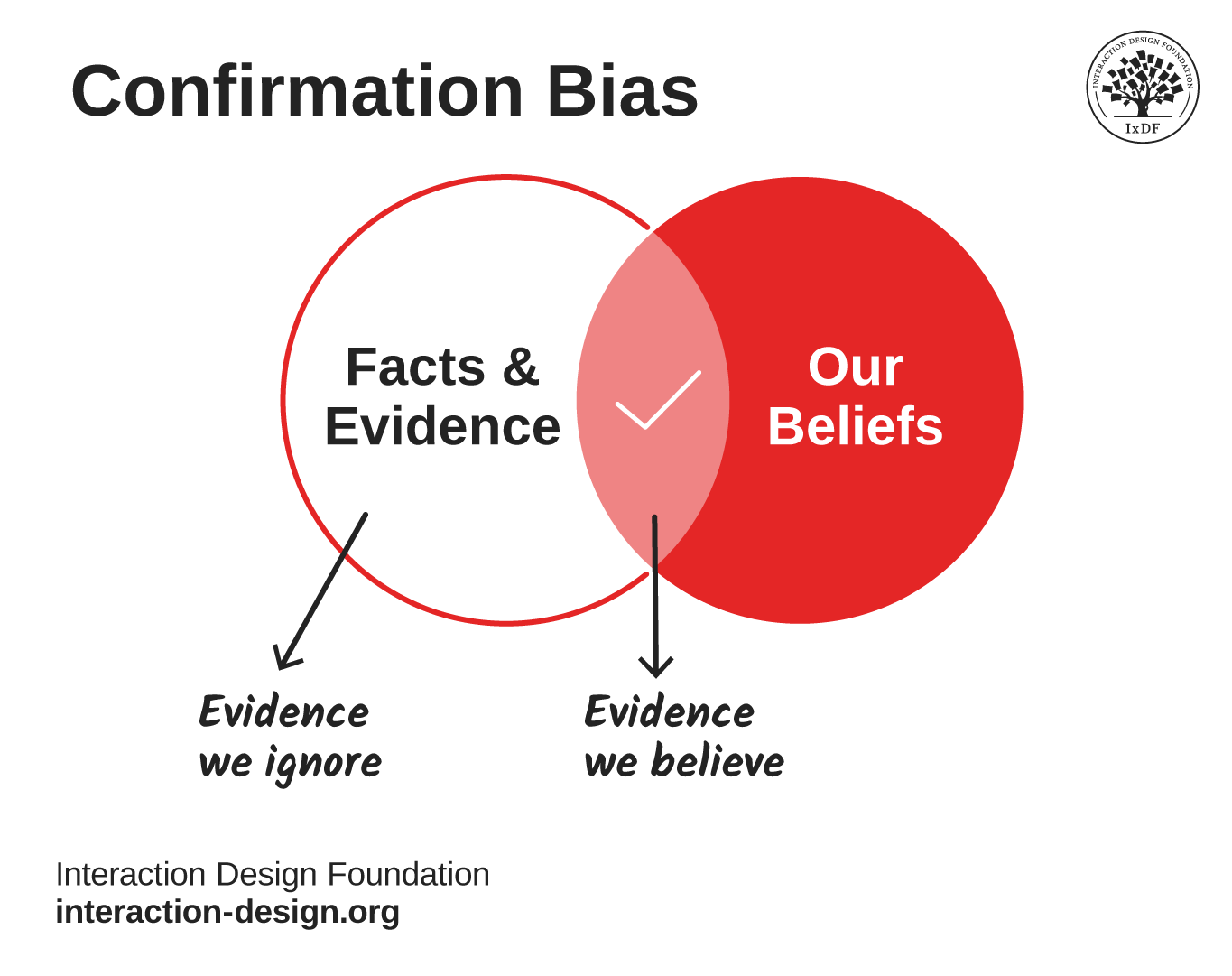
Seeing is believing—at least some of the way. Confirmation bias can decide what an individual observes and considers.
© Interaction Design Foundation, CC BY-SA 4.0
Like other types of biases—such as anchoring bias and the framing effect, as well as social desirability bias—confirmation bias comes from several psychological factors. These include human reliance on heuristics. Heuristics are cognitive or mental shortcuts that simplify decision-making processes. These heuristics—such as availability and representativeness—can lead people to favor pieces of information that conform to the beliefs they already have.
Moreover, the human tendency to seek social validation and avoid dissonance further reinforces confirmation bias. These cognitive processes, while helpful in certain situations, can be hazardous to good design. Because they’re so close to how a person processes the world around them, these processes can form blind spots. They can hinder the ability to objectively evaluate information and consider concrete evidence. As a result, even individuals who deem themselves open-minded might not be able to make properly informed decisions in many contexts of user experience (UX) design.
How Confirmation Bias Can Creep into UX Design
In UX design, this unconscious bias can subtly creep into various stages of the design process. Hard to detect, it can influence both design decisions and user research in many ways.
Confirmation Bias in User Research
Confirmation bias poses significant challenges to the validity and reliability of user research in UX design. When designers or researchers conduct user interviews, surveys or usability testing, they may unintentionally introduce biases. These can come up in their questioning, analysis and interpretation of data. For example, researchers may use wording bias, and ask leading questions that elicit responses that confirm their assumptions. Alternatively, they may selectively focus on data that supports their preconceived notions. This can lead to skewed findings and hinder or even prevent the discovery of valuable insights.
Such bias can compromise the validity of the user insights a designer gathers. For example, a designer or researcher may misguide a focus group so individuals’ responses come out only on one train of thought or track of perspective. Interpretations can obscure the real user needs and impair the effectiveness of UX research. Potentially, it can lead to costly design decisions that don't even align with the actual user needs. So, it can cause harm that results in anything from poor visual design to even worse problems in the final product designed.
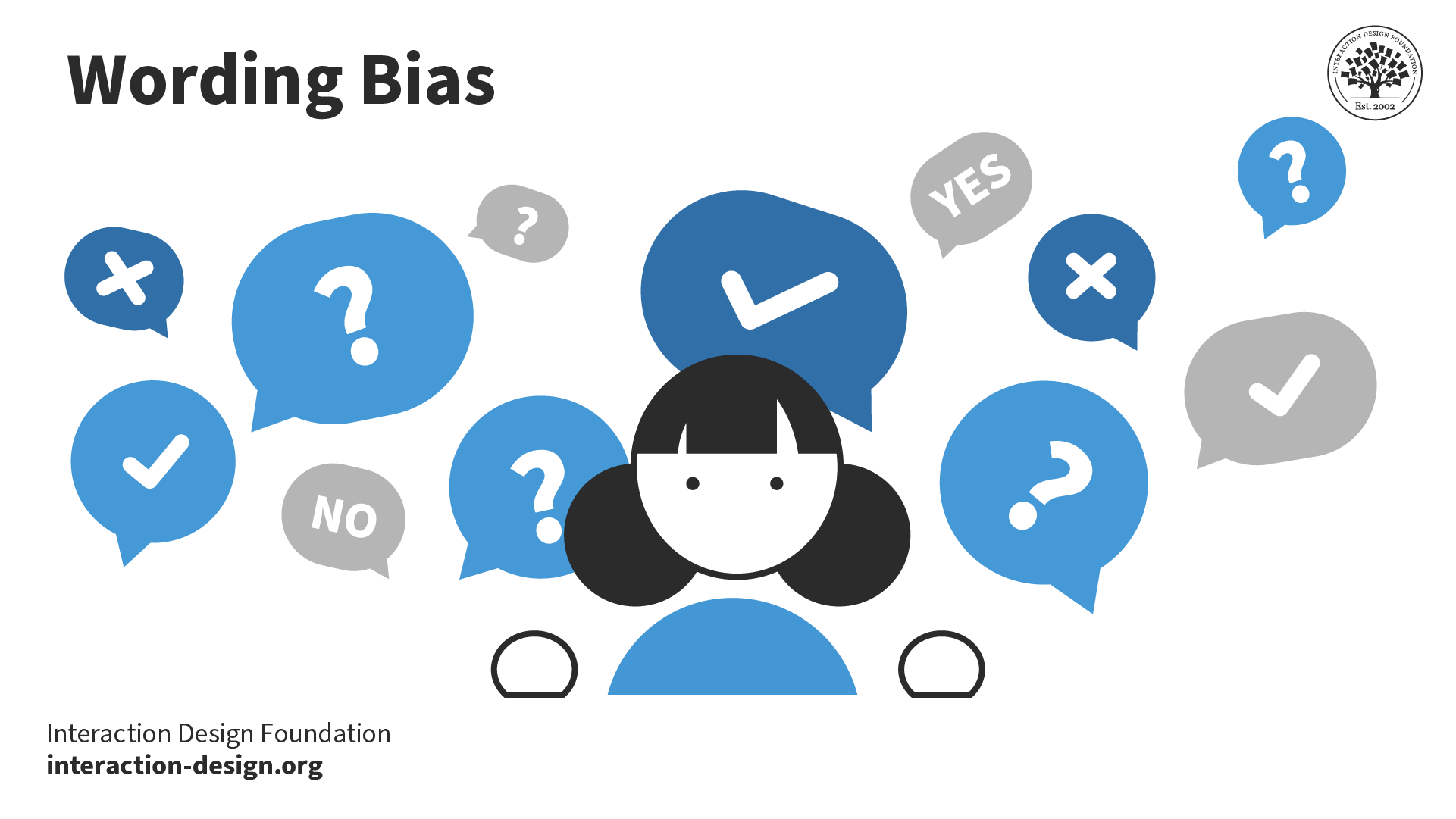
How UX researchers ask questions can lead respondents: for example, “Do you like the new, improved design or the old one?”
© Interaction Design Foundation, CC BY-SA 4.0
Confirmation Bias in Design Debates
In design debates, individuals can tend to favor and defend their own design choices while they dismiss alternative points of view. This can lead to a lack of critical evaluation and a limited understanding of the potential strengths and weaknesses of different design approaches. Teams who recognize and overcome confirmation bias in design discussions can foster a more collaborative and inclusive environment. In that atmosphere, they can find that diverse viewpoints and true innovation have a far greater chance of flourishing.
Confirmation Bias in User Feedback Analysis
Confirmation bias can also appear in user feedback analysis. Designers may selectively focus on positive feedback and reviews that confirm their design decisions. Meanwhile, they’ll ignore or downplay negative feedback. This can lead to a skewed understanding of user preferences and hinder the iterative design process. It’s therefore vital to actively seek out and consider diverse feedback. Then, designers can gain a more comprehensive understanding of user needs and make well-informed design decisions.
Some designers or researchers fall prey to confirmation bias, as well as other types of cognitive biases. A vital point to remember is that it can happen at any stage of the design process. Designers may exhibit a preference for data that aligns with their preconceived notions about the user or design requirements, and build on shaky foundations. For example, one of the most hazardous aspects of a designer’s bias is how it can overlook such vital concerns as accessibilty in design. While bias can affect decisions positively or negatively in the main, in design terms it can be a major menace when assumptions and design misfires cost brands in terms of money and reputation.
CEO of Experience Dynamics, Frank Spillers explains the bias designers can have in web design for accessibility:
Risks When Designers Do Not Address Confirmation Bias
If designers fail to address confirmation bias in their design work, particularly detrimental effects include:
Narrow Perspective
Design decisions may stand on limited or biased information. That narrow perspective doesn't consider alternative viewpoints or user needs. This may be the case in user feedback, for example. A researcher might be so convinced about the success of their design that they focus only on positive user feedback. Meanwhile, they dismiss any negative comments or declared pain points as outliers.
Impaired Decision-Making
Confirmation bias can also affect the overall decision-making process within the design team. It can lead to suboptimal choices and potentially hinder project success.
Ineffective Solutions
Confirmation bias can lead to the acceptance of solutions that aren’t truly effective or user-centered. If the designer only seeks out information that confirms their preconceived ideas, it can result in flaws that might even extend to precarious areas. For example, the brand might release a design with accessibility flaws in its user interface (UI) design. It might even run the risk of legal repercussions. Alternatively, it could address confirmation bias early on and prevent this.
Poor User Experience
If designers ignore contradictory evidence due to confirmation bias, their design solution may end up with a poor user experience. The design may not adequately address the diverse needs and perspectives of the users. Here again, the flaw in, for example, the UI design may go unheeded until much later and involve even deep-seated accessibility issues. Then, it will cost more to put right.
Lost Opportunities
If designers fail to address confirmation bias, they may miss out on innovative ideas and opportunities that contradict their initial assumptions. This will limit the potential of their designs.
Reputation Damage
Design solutions that confirmation bias influences may earn negative feedback from users and negative associations with the brand. This could damage the reputation of the designer, the design team or even the brand as a whole.
It’s crucial to address confirmation bias early on in the design process. Teams need to ensure that design decisions can stand on comprehensive and unbiased information. That will ultimately lead to more effective and user-centered outcomes.
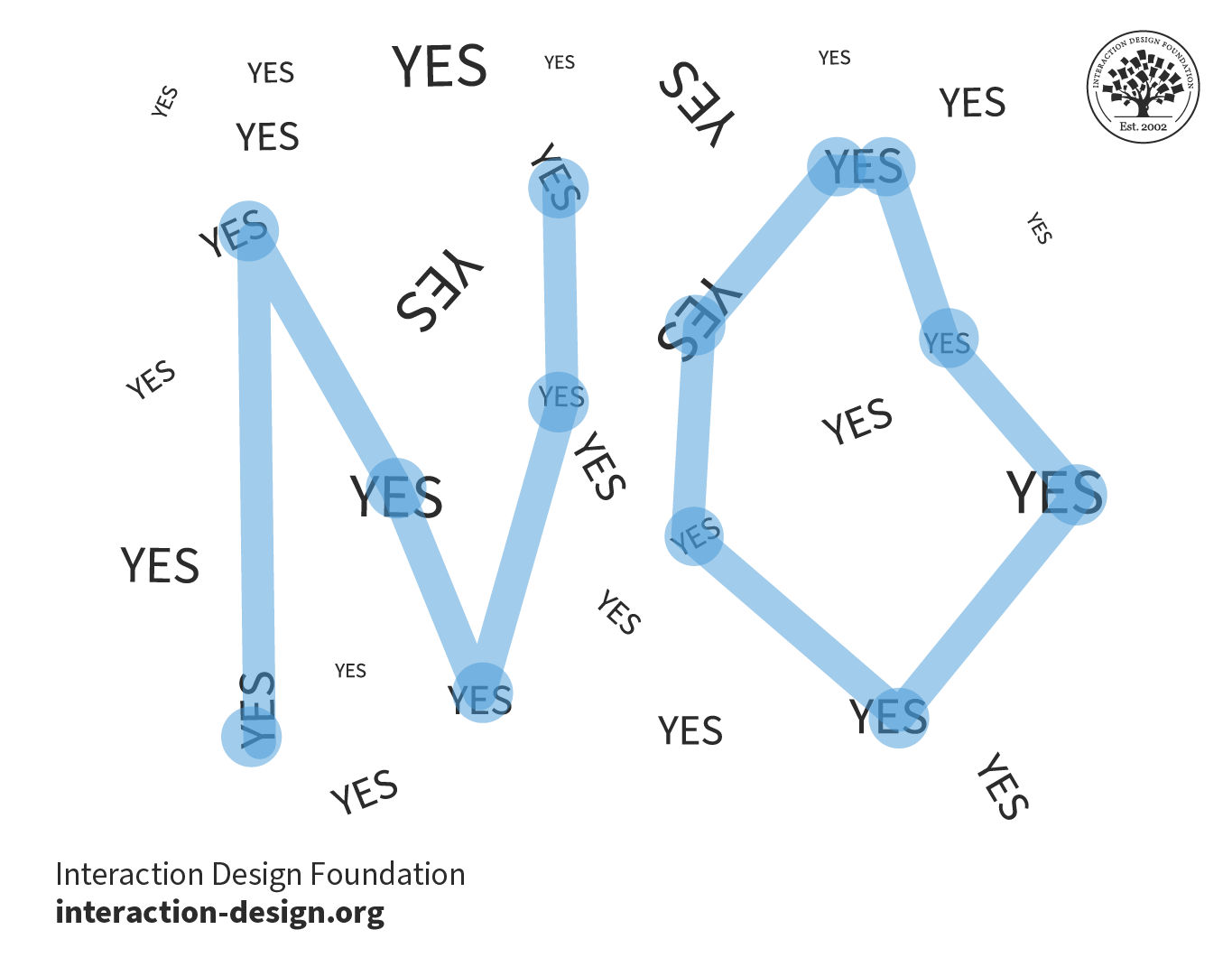
How many “Yes”s are in this “No”?
© Interaction Design Foundation, CC BY-SA 4.0
What Strategies Are Good to Avoid Confirmation Bias?
While confirmation bias can pose significant design challenges, designers can use several strategies to minimize its impact.
Recognize and Acknowledge Bias
The first step in overcoming confirmation bias is to acknowledge its existence and the potential impact it can have on our design process. A large part of open-mindedness is to recognize that bias is inherent in human cognition and that individuals are susceptible to it. With that in mind, designers can cultivate a mindset of openness and curiosity. This will help them challenge their assumptions and seek alternative perspectives.
Actively Seek Contradictory Evidence
To counter confirmation bias, it’s essential to actively look for contradictory evidence and diverse viewpoints. Designers can do this through rigorous user research methods. For example, they can conduct user testing with representative samples and seek feedback from a diverse range of users.
Design for Cognitive Diversity
To accommodate cognitive diversity well, designers must recognize that users have different needs, preferences and cognitive abilities. When designers embrace this diversity, they can create inclusive designs that cater to a wide range of users. So, it’s important to conduct user research with diverse user groups. It’s also essential to consider the needs of users with different cognitive profiles and provide multiple pathways for interaction and information access. Designers can then mitigate the effects of confirmation bias. They can go on to create more accessible and inclusive experiences.
UX Content Strategist Katrin Suetterlin explains the nature of inclusive design:
Leverage Quantitative Data
Quantitative data can provide objective evidence to challenge biased assumptions or interpretations. When designers or researchers use data analytics in the design process, they can identify certain trends and patterns in user behavior. These are ones that they may otherwise overlook due to confirmation bias.
Implement Rigorous User Testing
User testing can serve as a reality check. It can provide a platform for users to voice their thoughts and feedback about the design. When designers conduct rigorous user testing with a diverse group of users, they can uncover a wide range of user perspectives. This can help counteract confirmation bias.
UX Strategist and Consultant William Hudson explains how best to approach testing:
Implement Iterative Design Processes
Iterative design processes like user-centered design and agile methodologies can help lessen the impact of confirmation bias. This is because they emphasize continuous feedback and iteration. When designers incorporate regular feedback loops, they can validate their assumptions. They can also identify potential biases and make informed design decisions that have their basis in user insights. This iterative approach helps designers discover new opportunities. It also permits teams to identify design flaws and adapt to changing user needs.
Cultivate a Culture of Critical Thinking
A culture of critical thinking and open dialogue within design teams can overcome confirmation bias. Designers should encourage healthy skepticism, promote diverse perspectives and foster an environment that values evidence-based decision-making. They can challenge their own biases in that environment. They can also promote a more objective and inclusive design process. They can achieve this in several ways. These include design critiques, peer reviews and interdisciplinary collaboration, where team members can challenge assumptions and provide constructive feedback.
Encourage Devil’s Advocacy
Assign someone to play the role of devil's advocate. A team member who stays mindful to bring up opposing viewpoints can help challenge prevailing assumptions and points of view. Their presence can lead to a more balanced consideration of evidence.
Promote Psychological Safety
It’s vital to create an environment where individuals feel safe to express dissenting opinions without fear of retribution. Team members need to feel secure to speak their minds, free from the specter of managerial or group suppression. This is an essential way to encourage open discussion and help counteract groupthink.

Team members need a signal, some assurance they can feel safe to proceed with their responses.
Implement Blind Reviews
Conduct blind reviews of work or proposals. Such reviews can help reduce bias as they remove identifying information. That will allow a more impartial evaluation.
Encourage Cross-Functional Collaboration
Involve stakeholders with different perspectives. When designers actively seek diverse perspectives, such as from product developers and other brand or department personnel, they can uncover hidden insights and challenge their assumptions. From there, they can proceed to create more inclusive and user-centered designs.
UX Designer and Author of Build Better Products and UX for Lean Startups, Laura Klein explains the value of cross-functional teams.
Utilize “Red Teams”
Employ red teams—groups who pretend to be the “enemy”—to actively challenge existing strategies or plans. That can help identify weaknesses and potential biases in decision-making.
Apply the Premortem Technique
For a premortem analysis, a designer imagines a scenario where a project or decision has failed—and then works backward to identify potential causes. These causes include biases that may have contributed to the failure that they have imagined.
Document Decisions and Rationales
Keep a record of design decisions and the thought process behind them. Regularly review and reflect on these decisions to identify and address any biases that may have influenced the design direction.
When designers and their design teams incorporate these approaches, they can help ensure that they mitigate confirmation bias and make more informed, objective decisions. They can therefore produce more inclusive, thoughtful and effective designs, even when working alone.
Remember, it’s crucial to be aware of and understand confirmation bias in UX design. That mindfulness will help ensure designers create user-centric products and services. The ultimate goal is to design with the users’ needs and expectations at the forefront. Design teams who manage to strip as much bias away as possible can enjoy a more objective and user-centered design process throughout. That will help lead to products and services that truly meet the users' needs and expectations.