Your constantly-updated definition of Cognitive Biases and collection of videos and articles. Be a conversation starter: Share this page and inspire others!
Cognitive bias is an umbrella term that refers to the systematic ways in which the context and framing of information influence individuals’ judgment and decision-making. There are many kinds of cognitive biases that influence individuals differently, but their common characteristic is that—in step with human individuality—they lead to judgment and decision-making that deviates from rational objectivity.
In some cases, cognitive biases make our thinking and decision-making faster and more efficient. The reason is that we do not stop to consider all available information, as our thoughts proceed down some channels instead of others. In other cases, however, cognitive biases can lead to errors for exactly the same reason. An example is confirmation bias, where we tend to favor information that reinforces or confirms our pre-existing beliefs. For instance, if we believe that planes are dangerous, a handful of stories about plane crashes tend to be more memorable than millions of stories about safe, successful flights. Thus, the prospect of air travel equates to an avoidable risk of doom for a person inclined to think in this way, regardless of how much time has passed without news of an air catastrophe.
Researchers Amos Tversky and Daniel Kahneman conducted a number of studies on cognitive bias and found that framing identical information differently (i.e., presenting the same information differently) can lead to opposing decisions being made. This means that cognitive biases play an important role in information design, because they influence users’ or customers’ decision-making processes. How we present information on webpages and user interfaces can affect how likely users are to perform certain actions, such as purchasing a product.
Learn More About Cognitive Biases
Make learning as easy as watching Netflix: Learn more about Cognitive Biases by taking the
online IxDF Course Design Thinking: The Ultimate Guide.
Why? Because design skills make you valuable. In any job. Any industry.
In This Course, You'll
Get excited to learn one of the most powerful problem-solving methods in the world. Design thinking is how you turn messy, ill-defined problems into products and services people love. It's how Apple entered the crowded MP3 player market and redefined the industry with the iPod. It's how Airbnb went from near-bankruptcy to an $86.5B market debut. Whatever your role, design thinking gives you a clear, structured way to solve real-world problems, from everyday challenges like launching a product or improving a service to complex, societal problems like sustainability or healthcare access. And as AI handles more of the routine work, your ability to frame the right problem, understand people in context, and turn raw data into testable ideas will matter even more. Whether you want to land your first design role, raise the quality of the work you deliver every day, or step into leadership, this course gives you the toolkit to get there. No previous design experience required.
Make yourself invaluable when you learn the methods to empathize deeply with your users, ideate, prototype, test and iterate to solve complex problems. These are timeless, human-centered design skills you can use in any role across all industries. Research from Forrester found that 3 out of 4 design thinking projects at least double their investment, with a median ROI of 229% per project. In this course, you'll bring structure to your empathy, intuition, creativity, and problem-solving skills with the five stages of design thinking: Empathize, Define, Ideate, Prototype, and Test. You'll learn research andempathy techniques such as user interviews, the 5 Whys, and the What-How-Why method. Your team will stay focused and aligned with synthesis tools like affinity diagrams, personas, and empathy maps. And you'll apply ideation methods like brainstorming, SCAMPER, and Worst Possible Idea to generate solutions you can validate before you invest in building them. You'll know when to use each method and why, and apply them immediately to your daily work with downloadable templates, including interview guides and "How Might We" sessions, ready to use on your next big project.
Gain confidence and credibility as you run effective workshops, back your decisions with evidence, and get buy-in from stakeholders. You'll map influence and interest across your stakeholder group, write Point of View statements to frame the design challenge around real user needs, and use prototypes to test your ideas before committing to a full build. These are the same methods IBM, Google, and other major companies use to innovate and turn rough ideas into successful products. You'll learn that design thinking isn't just a set of techniques. It's a way of caring about people that puts empathy at the heart of every solution you design.
Craft a personal portfolio with optional hands-on activities. You'll interview real participants, design cultural probes, and map their behaviors. Then, with your problem defined, you'll ideate solutions, storyboard the user journey, and paper-prototype an app interface ready to test on users. You'll finish with a complete case study that shows how you approach a problem, what you learn from users, and how your ideas evolve through the design thinking process. By the end of this course, you'll have the design thinking skills you need to drive your long-term career growth and create solutions people genuinely need and want.
Learn From Industry Leaders
Master complex skills with proven best practices and toolkits directly from industry leaders. Meet your experts for this course:
Don Norman: Father of User Experience (UX) Design, author of the legendary book “The Design of Everyday Things,” and co-founder of the Nielsen Norman Group.
Alan Dix: Author of the bestselling book “Human-Computer Interaction” and Director of the Computational Foundry at Swansea University.
Mike Rohde: Experience and Interface Designer, author of the bestselling “The Sketchnote Handbook.”
Earn Industry-Recognized Certificates
Industry giants trust our courses to train their teams, and prestigious universities integrate our content into their curricula. Add your certificates to your LinkedIn profile, résumé, and job applications.
Would you like to facilitate successful ideation sessions? Or would you like to learn how to contribute to ideation processes in your team more effectively? In either case, you should know the ideation traps and how you can prevent yourself and your team from falling into them. You should give the f
Groupthink is dangerous to our objectivity. It prevents us from thinking for ourselves and making the best decisions. Designers need to be cautious about falling into the bandwagon bias trap but also be aware of how it can be exploited in their designs to improve user experiences and get users to ma
The Illusion of Control – You Are Your Worst Enemy
Not everything in life is within our control. Believing that it is can be a serious handicap to getting things done in design work and most of life. Learning how to handle the illusion of control will make it much easier to accept things that aren’t within your control and focus your efforts on area
The Bias Blind Spot and Unconscious Bias in Design
It’s useful for designers to understand bias both so that they combat their own biases when they work and so that they can tap into the biases of their users to provide better user experiences. But what happens when we can’t acknowledge our own biases? That’s when we need to understand the bias blin
Evaluating the outcomes of our actions makes sense. However, there is a cognitive bias where we place too much weight on the outcome and aren’t critical enough of the process by which we reached that outcome. Learning to avoid the outcome bias can help improve the quality of our decision making proc
Confirmation Bias – It’s Not What We Think We Know That Counts
Confirmation bias is a pernicious form of bias that can cause real problems in both UX research and our own lives. Learning to recognize and eliminate confirmation bias leads to better decision making, better research and ultimately better products and user experiences.One of the most famous, and fl
Social shares
663
Published
Read Article
The Bias Blind Spot and Unconscious Bias in Design
It’s useful for designers to understand bias both so that they combat their own biases when they work and so that they can tap into the biases of their users to provide better user experiences. But what happens when we can’t acknowledge our own biases? That’s when we need to understand the bias blind spot so that we can work more effectively despite the limitations of our natural tendencies.
We all have biases. The biases we hold reflect the fact that we only have a partial perspective on the world around us. You can be biased towards or against many things including ideas, cultures, individuals, race, gender, sexuality, political standpoints, social class, species, etc.
Understanding our own biases can help us overcome them. Understanding the biases of others can help us improve the user experience and help us develop the people around us.
Bias is not, by definition, always a bad thing. Our biases serve a purpose from an evolutionary standpoint. Our 5 senses supply us with incredible amounts of data constantly. It’s impossible for the human brain to process all this information – there’s simply too much of it.
Thus to make our lives easier, our brains are programmed to take short cuts when interpreting data. We develop a bunch of rules that we tap into unconsciously that allow us to make instant decisions and judgements.
There was a time when this was extremely useful. If you were to go back to the time when humanity was a hunter-gatherer society; it’s easy to see how this was useful. Imagine that you were walking through a rainforest and that you saw, out of the corner of your eye, a flash of orange and black in the trees. Your brain would kick in and say; “That could be a tiger!” and you could quickly implement a plan for dealing with tigers (running away, fighting, playing dead, etc.).
The idea is that your learned bias (orange + black = tiger) gave you a head start on preventing being eaten by a tiger. This was true even if the orange and black had a more prosaic reason for being (like being part of the colour of a plant).
In essence your brain works on the principle that it’s usually better to be safe than it is to be sorry. It doesn’t matter whether those colours are a tiger; it matters that we’re ready for one just in case.
Unfortunately, when bias comes into play in the modern world – things become a little more complicated. We develop our biases through genetics, through education, through the work that we do, through the people we interact with, the culture we grow up in, etc. and they don’t always serve a useful purpose.
Everyone is subject to unconscious bias. In fact, once we examine biases – it’s pretty obvious that this is true. Unfortunately, what we struggle to understand is how biased we are and how our biases can work against us and often how they can work against others too.
Everyone has some form of unconscious bias. It’s part of what makes us human. But when you examine our understanding of this – things get a little peculiar.
For example; what percentage of the population will be more biased than the average person? If you think about this; the answer is obvious. 50% of people are more biased than average and as you’d expect 50% are less biased than the average too.
But if you ask people; “Are you more biased than the average person?” you get a strange result. Out of every 661 people you ask, only one will say “yes”! To put that another way only approximately 0.15% of us believe that we’re more biased than average – even though, by definition, 50% of us are!
In fact, research carried out at Boston University found:
Most people have no idea of how biased they actually are
Most people believe the people around them are more biased than they themselves are
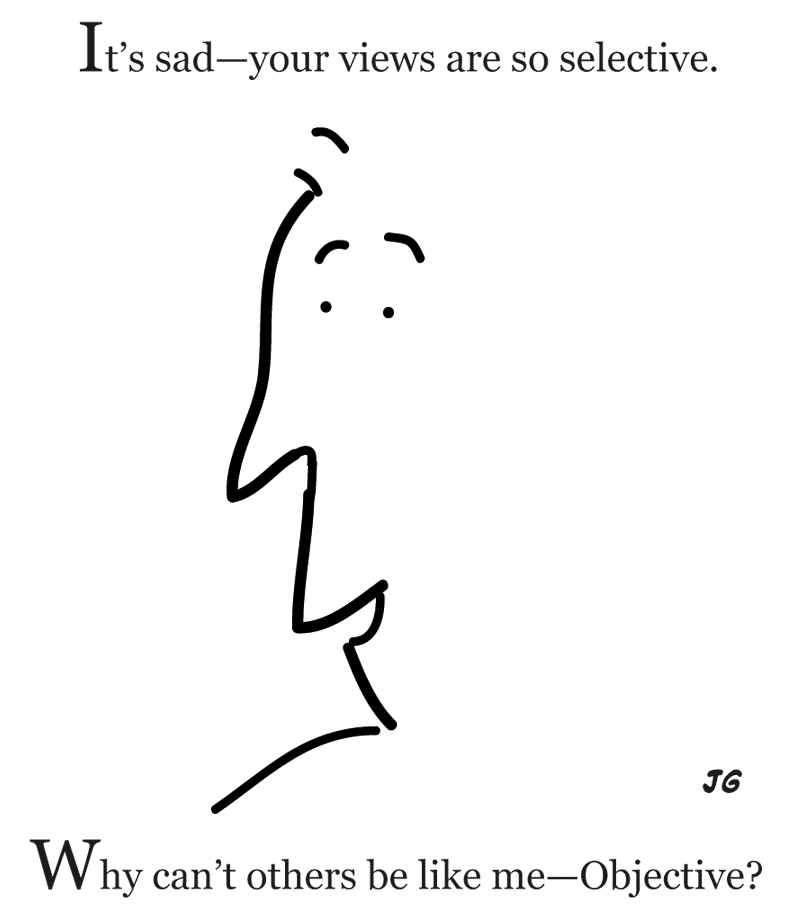
This is the bias blind spot. Our ability to perceive bias in others is actually pretty good. Our ability to perceive bias in ourselves is generally dreadful.
This leads to bias that can damage the way we work and an inability to tackle it – because we can’t see it.
It’s been shown, for example, that female managers are as likely to discriminate against female employees as male managers. Their unconscious bias (a product of many things) actually presents itself in direct contrast to their conscious beliefs (the correct understanding that women are every bit as capable as men).
How Can the Bias Blind Spot Cause Problems for Us?
The bias blind spot can be incredibly problematic. When we operate from within our blind spot; it’s been shown that we are more likely to reject the input of peers and/or experts in a subject and that we are also least likely to benefit from education and training concerning our particular bias.
This can be explained rationally too. Society teaches us that bias is a bad thing. The word has negative connotations. Most of us would prefer not to see ourselves as the kind of people who do bad things. In fact, we’re taught from an early age that that’s not who we are.
This leads us to believe that we must be rational. That our actions and judgments are accurate and therefore without bias. However, it doesn’t stop us from seeing the flaws in others because of their biases.
How Can We Tackle the Bias Blind Spot?
It’s very difficult to tackle the blind spot bias on your own. The first step is acknowledging that it may exist but challenging ourselves to take action is difficult. Once you have acknowledged the existence of the blind spot bias you can commit to tackling the biases it masks but it may be easier to enrol the services of a coach to help you with this.
The Take Away
We all have unconscious biases and that’s part of what makes us human. It’s how the brain is designed to work. Most of us also suffer from blind spot bias and that makes it difficult for us to tackle the underlying biases and the way they affect the way we work. It’s very helpful to do so – once we address our biases we can become much more effective in the way we relate to the world and other people.