Outcome Bias – Not All Outcomes are Created Equal

• 7 min read

716 Shares

Evaluating the outcomes of our actions makes sense. However, there is a cognitive bias where we place too much weight on the outcome and aren’t critical enough of the process by which we reached that outcome. Learning to avoid the outcome bias can help improve the quality of our decision making process.

Human beings tend to be self-evaluative. We look back at what we’ve done and try to measure ourselves against that in the future. This can be a very useful trait – it enables us to learn lessons from the past and recycle them for the future. Unfortunately, it can also be a problem.

Hindsight is not always 20-20. In fact, we have a tendency to place too much importance on the outcome of a decision than the process by which we made that decision. So when we make a bad decision that results in a poor outcome we are much more likely to be self-critical than we make a bad decision that results in either a neutral or a positive outcome.

In the extreme, if you took all your decisions based on the flip of a coin for a week and the vast majority of outcomes were positive because of that – you might decide that flipping a coin was a good way of making decisions. (When it clearly isn’t).

What is Outcome Bias

Outcome bias is a cognitive bias that enables us to judge our decision making based on the results of the process rather than the quality of the process itself.

You see this a lot with poor managers. A manager who makes a decision based on “gut instinct” - when his team are strongly advising him in one direction and the manager goes in the opposite direction - is going to consider their process to be a good one if they get a positive outcome from it. When in fact, if the team’s rationale was sound it would have been better to have listened to the team.
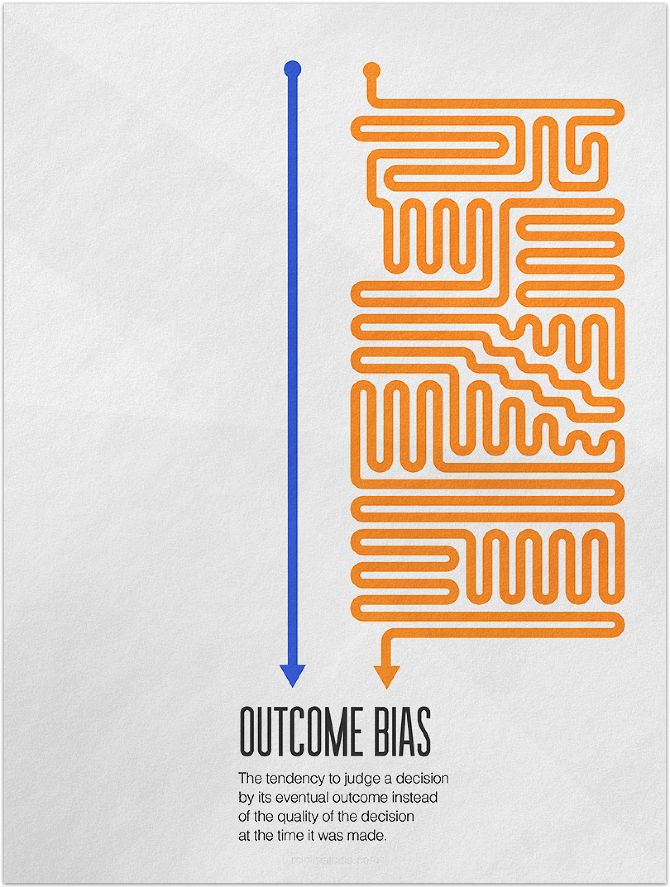

Author/Copyright holder: Jack Hagley. Copyright terms and licence: All rights reserved.

Whereas if their decision resulted in a poor outcome – they would be more likely to listen to their team in future.

The first mention of Outcome Bias was probably in Baron and Hershey’s paper in the Journal of Personality and Social Psychology in their paper; “Outcome bias in decision evaluation.”

Overcoming the Outcome Bias

It’s important for us to be truly critical in the way we evaluate our actions. Instead of focusing on outcomes, we need to focus on the process as a whole.

  • What led us to take the decision?

  • What information did we or didn’t we have at that point?

  • Was there a better process that we could have followed to make the decision?

  • Could we have consulted other people?

  • Could we have obtained more data?

  • Was there any need to make the decision when we made it?

By evaluating the process as well as the outcome – we can make better decisions in the future.

If you want another extreme example of the outcome bias working at its most negative – consider the drunk driver. When they leave the pub or bar with a skin-full of alcohol in them; they probably know it’s a bad idea to drive drunk – particularly the first time that they do so.

However, if their drunk driving does not result in an accident (and not all drunk drivers do have accidents) then they are more likely to drive drunk in the future. The outcome of their action had no negative consequences – so, to them, there’s nothing wrong with repeating the action.

Yet, as we all know; drunk driving is a bad idea. Any decision making process that leads to drunk driving outside of an extreme emergency is flawed. Critical evaluation of the decision making process is more likely to deter the drunk driver in the future than focusing on the outcome.


Author/Copyright holder: Dollar Photo Club. Copyright terms and licence: All rights reserved.

Like many other cognitive biases, it can be hard to tackle outcome bias by yourself. Asking the kinds of question to examine the decision process in enough detail can be challenging; we may have a tendency to stop too early or to ignore data that we don’t like. If you find that this is the case for you – you should consider working with a coach who can help you get to the bottom of the bias and address it in future.

What's the difference between the focusing effect and the outcome bias?

The outcome bias could be considered a particular type of focusing effect. Where the focus is all based on a previous succesful outcome (irrespective of the value of the process followed to reach that outcome). However, the piece of information that is focused on when the focusing effect comes into play could be any piece of information (usually the first recieved) rather than always relating to previous outcomes.

The Take Away

Outcome bias is a problem because it leads us to repeat poor decision making based on outcomes rather than on the process used to obtain the outcome. The consequences of this are not always severe (or the bias would not exist) but they can be. It is almost always better to make an informed decision than to make a decision based on gut feelings, in haste, etc. as this gives you a much higher chance of a successful outcome.

References

You can find Baron and Hershey’s paper here: Baron, Jonathan; Hershey, John C. (1988). "Outcome bias in decision evaluation"(PDF). Journal of Personality and Social Psychology 54

An interesting insight into how outcome bias can influence ethical decision-making from Harvard Business School.

A look at how outcome bias can affect clinical decision-making in health care, too.

For a look at biases in a UX context, try the Man with No Blog.

Hero Image: Author/Copyright holder: Unknown. Copyright terms and licence: Unknown.

Learn More in This Course:

AI for Designers

10 days
16 % booked
View Course

What You Should Read Next

  • Read full article
    7 Tips to Improve Your UX Design Practice - Article hero image
    Interaction Design Foundation logo

    7 Tips to Improve Your UX Design Practice

    Hey! But my UX design practice is perfect! Thankfully, we don’t hear that very much but the truth is – the longer we’re in a job, the better we consider ourselves to be at that job. Sometimes, it’s worth remembering that even the best professionals still have learning to be done. It’s also worth rem

    Social shares
    967
    Published
    Read Article
  • Read full article
    Do I Need a Degree to Work In User Experience? - Article hero image
    Interaction Design Foundation logo

    Do I Need a Degree to Work In User Experience?

    This is a question that, in slightly different forms, gets asked a lot by those considering a UX design career. The question is a simple one but the answer..? Well, that’s a bit more complicated. A lot depends on you and your approach to life and your career. So let’s take a look at the benefits of

    Social shares
    952
    Published
    Read Article
  • Read full article
    How to Build a UX/UI Design PDF Portfolio That Hiring Managers Will Love (Includes Examples) - Article hero image
    Interaction Design Foundation logo

    How to Build a UX/UI Design PDF Portfolio That Hiring Managers Will Love (Includes Examples)

    If you already have an online UX/UI design portfolio, do you need a PDF version? The answer is – yes; it is better to be safe than sorry! Some hiring managers like to see a more detailed PDF portfolio after reviewing your online portfolio, while some job applications may request an upload instead of

    Social shares
    943
    Published
    Read Article
  • Read full article
    14 Barriers to Ideation and How to Overcome Them - Article hero image
    Interaction Design Foundation logo

    14 Barriers to Ideation and How to Overcome Them

    Would you like to facilitate successful ideation sessions? Or would you like to learn how to contribute to ideation processes in your team more effectively? In either case, you should know the ideation traps and how you can prevent yourself and your team from falling into them. You should give the f

    Social shares
    920
    Published
    Read Article
  • Read full article
    What Tech Job is Right for Me? A Comprehensive Guide to Navigating Your Career Path - Article hero image
    Interaction Design Foundation logo

    What Tech Job is Right for Me? A Comprehensive Guide to Navigating Your Career Path

    Think about which tech career is right for you and you may well find that choosing a career is about getting work that offers fulfilling employment, personal growth opportunities, and—of course—good remuneration. If you’re finding yourself contemplating a change or exploring alternative paths on you

    Social shares
    817
    Published
    Read Article
  • Read full article
    The Bandwagon Bias – The Dangers of Groupthink - Article hero image
    Interaction Design Foundation logo

    The Bandwagon Bias – The Dangers of Groupthink

    Groupthink is dangerous to our objectivity. It prevents us from thinking for ourselves and making the best decisions. Designers need to be cautious about falling into the bandwagon bias trap but also be aware of how it can be exploited in their designs to improve user experiences and get users to ma

    Social shares
    817
    Published
    Read Article
  • Read full article
    The GROW model: Similarities between Coaching and UX - Article hero image
    Interaction Design Foundation logo

    The GROW model: Similarities between Coaching and UX

    The GROW model is used by coaches to enable individuals to reach their objectives. As you will see while reading about this model, there’s a large overlap with the skills already used by UX designers. As a designer, it can be helpful for you to see the parallels between the two professions – as it a

    Social shares
    752
    Published
    Read Article
  • Read full article
    The Illusion of Control – You Are Your Worst Enemy - Article hero image
    Interaction Design Foundation logo

    The Illusion of Control – You Are Your Worst Enemy

    Not everything in life is within our control. Believing that it is can be a serious handicap to getting things done in design work and most of life. Learning how to handle the illusion of control will make it much easier to accept things that aren’t within your control and focus your efforts on area

    Social shares
    751
    Published
    Read Article
  • Read full article
    The Bias Blind Spot and Unconscious Bias in Design - Article hero image
    Interaction Design Foundation logo

    The Bias Blind Spot and Unconscious Bias in Design

    It’s useful for designers to understand bias both so that they combat their own biases when they work and so that they can tap into the biases of their users to provide better user experiences. But what happens when we can’t acknowledge our own biases? That’s when we need to understand the bias blin

    Social shares
    742
    Published
    Read Article
  • Read full article
    How to Create the Perfect UX Resume and Cover Letter - Article hero image
    Interaction Design Foundation logo

    How to Create the Perfect UX Resume and Cover Letter

    Your cover letter helps sell you as a good fit for the company and serves to introduce your resume and portfolio. The cover letter plays a major role because this is your first chance to help the recruiter know that you’re the perfect fit for the company and job role. You need your UX design portfol

    Social shares
    725
    Published
    Read Article

Top Articles

Top Topic Definitions

Feel Stuck?
Want Better Job Options?

AI is replacing jobs everywhere, yet design jobs are booming with a projected 45% job growth. With design skills, you can create products and services people love. More love means more impact and greater salary potential.

At IxDF, we help you from your first course to your next job, all in one place.

See How Design Skills Turn Into Job Options
Privacy Settings
By using this site, you accept our Cookie Policy and Terms of Use.
Customize
Accept all

Be the One Who Inspires

People remember who shares great ideas.

Share on:

Academic Credibility — On Autopilot

Don't waste time googling citation formats. Just copy, paste and look legit in seconds.

Feel Stuck? Want Freedom?

Get one powerful email each week, like 326,076 others.

Learn to design a life you love.

Next email in
6
days
15
hrs
55
mins
18
secs