Bad Ideas

Your constantly-updated definition of Bad Ideas and collection of videos and articles.
Be a conversation starter: Share this page and inspire others!

197 Shares

What are Bad Ideas?

Bad ideas is a method design teams use for ideation and divergent thinking, to focus on the quantity—not quality—of their ideas and explore the design space. In a relaxed, judgment-free setting, designers think outside the box and imagine ideas that seem bad but which they can analyze to see the bad and good qualities.

Using Ideation to Build Castles in the Sky, then the Bridges

Transcript

Divergent Thinking is vital to Finding the Good in Bad Ideas

The term “ideation session” might suggest an image of design teams striving to produce “the best solution” to a design problem as quickly—and as rationally—as possible. However, this approach is often counterproductive since:

  1. People feel restrained by the logical, analytical linear thinking mode which they’ve learnt to practice elsewhere.

  2. The pressure to keep on this track as they search for “the right answer” creates an atmosphere of judgmentalism.

So, someone might have a “crazy-sounding” (but potentially useful) idea and hesitate to declare it, perhaps fearing it might make them look foolish, time-wasting or even anti-management. Pressured to think up “good” ideas, the team member silently considers that idea—without really assessing its value as a potential solution—then abandons or forgets it as the ideation session grinds onward. So, it becomes almost impossible for everyone to pool the best of their creative talents; unless they can channel their cognitive activity freely and explore the design space in all directions.

That’s where divergent thinking comes in, ideally early in the ideation stage of your design process. A “less than” sign (<) visually represents how the thinking starts at one focal point and expands outward as more novel and unique ideas and combinations get added. Similar to another brainstorming technique—worst possible idea—bad ideas is about being free to truly focus on ideating. It’s both a method and a tool that involves disruptive and lateral thinking. As the name suggests, you deliberately go for bad ideas. Everyone can explore fearlessly and think outside the box to generate as many ridiculous-sounding ideas as they can. Then, you analyze these to see what’s bad about them, but also what’s good and which aspects might work as part of a great idea.
© Yu Siang and Interaction Design Foundation, CC BY-SA 3.0

Take 4 Steps to Find the Good in Bad Ideas

Try these steps to come up with something good from bad ideas: 

  1. Set a timer for 5 or 10 minutes. Write down as many bad ideas for the topic you’re working on as possible.

  2. Analyze what’s bad about your ideas. For each idea, ask yourself:

    1. What’s bad about this idea?

    2. Why is this a bad thing?

    3. Are there any other things that share this feature which aren’t bad?

    4. If so, what’s the difference?

  3. Analyze what’s good about your ideas. For each idea, ask yourself:

    1. What’s good about this idea?

    2. Why is this a good thing?

    3. Are there any other things that share this feature which aren’t good?

    4. If so, what’s the difference?

  4. Make your ideas better. For each idea, ask yourself:

    1. Are there good aspects you want to keep?

    2. Are there bad aspects you want to change?

    3. What if the context were different?

    4. Describe the modified idea.

For example, if you imagined an app that automatically uploaded a user’s photos to all their social media sites at once and transcribed what the user said (while taking the picture) as the caption, you might begin analyzing it like this:

  1. Bad – The danger of showing every photo without considering consequences.

  2. Bad because – It’s too easy to record unflattering comments, accidentally tag people, violate privacy, maybe activate it unintentionally, etc.

Now you have some reasons for “I can’t create something like that!”. However, as you work through these steps and build up a vocabulary to understand your design space, you may find aspects that suggest you can create it. For instance, what if you substituted some parts of that bad idea with their opposite? You might end up considering a “safety-catch” to prevent accidental/alcohol-fueled uploads. Or how about a pre-set filter so customers could share only with family/friends while journalists could take advantage of the sheer power of conveniently capturing history as it happens?

Overall, with bad ideas you have immense freedom to explore, analyze and adjust. So, if an idea really is awful, you have maximum leeway to discover why and what bits of it you might just be able to turn into something helpful.
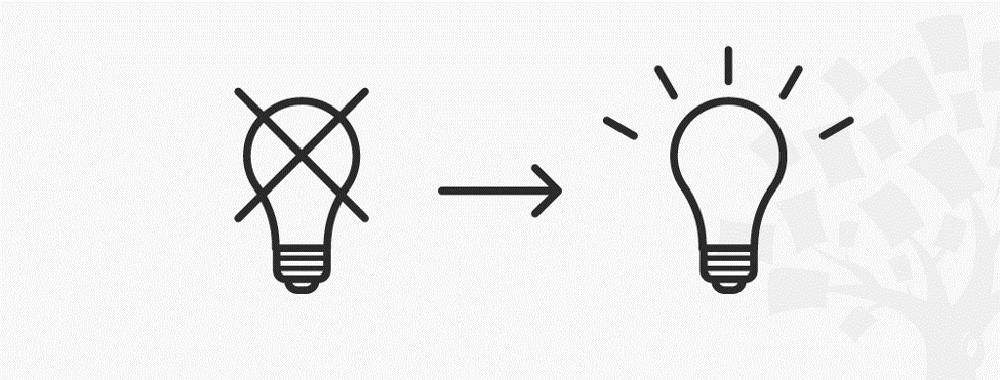
© Yu Siang and Interaction Design Foundation, CC BY-SA 3.0

“There are many reasons why we, as a society, abandon creative thinking as we enter adulthood. For one, creativity is messy and uncertain; it goes against everything we learn along the way in formal education and through socialization.”

— Yazin Akkawi, Founder & principal designer of MSTQ UX design studio

Questions About Bad Ideas?
We've Got Answers!

What problems does the “Bad Ideas” approach try to solve in brainstorming?

The “Bad Ideas” approach tackles two big problems in brainstorming: fear of judgment and creative blocks. When teams feel pressured to only share good or smart ideas, they often hold back because of performance anxiety. That fear kills creativity. By encouraging bad ideas, teams lower the stakes and open the floor to wild thinking.

This method also shakes up groupthink and helps individuals splinter off to find their own treasures. Teams often fall into familiar patterns or stick too close to what’s already known. Purposefully bad ideas challenge those norms and push people to explore unusual paths that can take them to valuable viewpoints and angles of the real problem. These “bad” ideas often reveal hidden assumptions or lead to surprisingly great insights.

IDEO and other innovation leaders swear by this method for loosening up minds and building a strong creative momentum.

Watch as Author and Human-Computer Interaction Expert, Professor Alan Dix explains bad ideas and what you can do with them:

Transcript

Take our course Creativity: Methods to Design Better Products and Services.

Why do silly or absurd ideas lead to original thinking?

Silly or absurd—or downright “bad”—ideas often lead to original thinking because they push the brain out of autopilot. When you step away from logic and expectations, you can unlock new mental pathways. Absurd or bad ideas challenge assumptions and force teams to look at problems in unexpected ways—and access ideas that conventional thinking would “forbid.”

This works because creativity thrives on surprise. Absurdity disrupts the usual thought patterns and encourages risk-taking, flying in the face of convention and its norms and rules about not being “silly.” Teams stop filtering themselves and start exploring “what if” questions without limits.

A classic example is Google’s “20% time,” which lets employees explore wild ideas—Gmail started as a “silly” side project.

Watch as Author and Human-Computer Interaction Expert, Professor Alan Dix explains bad ideas and what you can do with them:

Transcript

Enjoy our Master Class Harness Your Creativity to Design Better Products.

When should I use the “Bad Ideas” method in the design process?

Use the “Bad Ideas” method early in the design process, especially during ideation and when your team feels stuck. For example, in design thinking, design teams use it during the third phase of the process, when they ideate. Bad ideas as a technique work best when you want to loosen up thinking, break mental ruts, or kick-start creativity before refining concepts.

Right after research and problem framing, this is the moment to go wide and wild with ideas. Tossing out “bad” ones helps teams move past safe or obvious solutions. It sets the tone for experimentation and makes everyone feel safe to contribute. Judgments are left at the door for the time being.

This method also comes in handy when your brainstorming feels stale or dominated by the same voices. Absurd ideas shift energy and open surprising paths—and the fun factor can encourage even the quietest personalities to chime in with beautifully bold and ludicrous ideas that can carry the team towards a better destination, ideas-wise.

Watch as Author and Human-Computer Interaction Expert, Professor Alan Dix explains bad ideas and what you can do with them:

Transcript

Take our course Creativity: Methods to Design Better Products and Services.

How do I run a “Bad Ideas” session step-by-step?

Here’s a suggestion for how to run a “Bad Ideas” session step-by-step:

1. Set the tone—Start by telling the team the goal is to imagine the worst, most ridiculous ideas possible. Make it clear that this is about fun, not perfection.

2. Frame the challenge—Clearly define the design problem or question you want to explore. Keep it focused but open-ended.

3. Warm up—Use a silly prompt (e.g., “How would a toddler solve this?”) to get everyone laughing, relaxed, and into the spirit of the exercise.

4. Generate bad ideas—Set a timer for 10–15 minutes. Encourage wild, impractical, or outrageous ideas. Don’t stop to evaluate; go for quantity.

5. Share and build—Encourage each person to share their worst ideas. Then, remix or build on them together. Sometimes, absurd ideas spark something unexpectedly brilliant. The team will notice the value of what at first may have seemed laughably pointless.

6. Debrief—Wrap up by reflecting on which ideas have potential if reframed. Capture anything worth exploring further.

Watch as Author and Human-Computer Interaction Expert, Professor Alan Dix explains bad ideas and what you can do with them:

Transcript

Take our course Creativity: Methods to Design Better Products and Services.

What are some good examples of bad ideas?

Good bad ideas are so outrageous or impractical that they push creative boundaries and bulldoze walls of judgment that conventional wisdom or assumptions have built. That’s what makes them valuable. For example:

  • “Let’s solve traffic by putting cities on stilts.” It’s absurd and pointlessly impracticable (at least with current technological and resource constraints), but it opens thinking around vertical design, layered infrastructure, or flying transport.

  • “What if our app only worked on Tuesdays?” It sounds useless (who would love a brand that could only deliver one seventh of the time, after all), but it sparks ideas about exclusivity, scarcity, or user rituals.

  • “Make a chair that disintegrates after you sit too long.” It’s wild and—yes—dangerously irresponsible if someone were to actually design one. However, it still prompts thinking around ergonomics, movement, or preventing sedentary behavior.

These ideas seem ridiculous at first. Notions that would get the contributor laughed off the stage (or lectern, podium, or front table at a meeting), but they help teams let go of limitations and explore fresh angles. Often, a great solution hides behind a joke; many a true word is said in jest.

Watch as Author and Human-Computer Interaction Expert, Professor Alan Dix explains bad ideas and what you can do with them:

Transcript

Take our course Creativity: Methods to Design Better Products and Services.

How long should a bad ideas exercise last?

A “Bad Ideas” exercise should last around 10 to 20 minutes. That short window keeps energy high and stops overthinking. You want just enough time for wild ideas to flow and emerge nice and raw and absurd, but not so much that the team starts filtering themselves or losing momentum.

Start with a quick 5-minute warm-up. Then, dive into a 10-minute rapid-fire round of bad idea generation. If the team feels energized, extend it another 5 minutes or do a second round with a twist—like remixing the worst ideas into new ones and seeing where that goes.

This format works well in workshops, sprints, or team huddles. Think of it as a creative jolt where the energy comes in creative spurts. It shouldn’t be a marathon where ideas plod in many directions. In longer sessions, people might have time to accidentally edit the “badness” out of their otherwise useful bad ideas.

Watch as Author and Human-Computer Interaction Expert, Professor Alan Dix explains bad ideas and what you can do with them:

Transcript

Take our course Creativity: Methods to Design Better Products and Services.

How can I make this activity feel like fun and not a joke?

To make a “Bad Ideas” activity feel fun—but not like a joke (which is a risk with this kind of activity)—set the right tone from the start. Tell the team this is a serious creativity tool disguised as play but focus more on the fun factor and that there’s a method to the madness. Be careful not to make a bad ideas session sound like a trick or a conventional ideation approach in disguise. That might undo the trust and lowered barriers you want for the best results. Emphasize that absurd ideas help uncover surprising insights and unlock better thinking, so everyone can be as wild as they want.

Create a safe space by encouraging laughter and letting go of judgment, but keep focus. Set a clear challenge, use a timer, and treat the process with intention. When the time’s up, look back at the “bad” ideas together and ask, “What hidden gem can we build on?”

Use music, sticky notes, or sketching to keep energy high. Celebrate wild thinking with humor and light-heartedness, but always reconnect the ideas to the core problem.

Watch as Author and Human-Computer Interaction Expert, Professor Alan Dix explains bad ideas and what you can do with them:

Transcript

Take our course Creativity: Methods to Design Better Products and Services.

How do I turn a bad idea into a useful or feasible one?

Dig beneath the joke and find the insight to turn a bad idea into a useful one. Ask: What problem does this idea highlight? What’s the core need or twist hiding inside it? Then reframe it in a way that makes it practical.

Start by breaking down the absurd idea. For example, “What if we made shoes that scream when they get wet?” may sound useless, but it hints at a real need: keeping feet dry. That could lead to smart moisture-alert tech for shoes.

Next, use “Yes, and…” thinking. Don’t shoot ideas down—instead, build on them. Shift focus from what's wrong to what could work. A ridiculous idea often sparks an innovative feature, experience, or strategy—hence the purpose of the activity.

Watch as Author and Human-Computer Interaction Expert, Professor Alan Dix explains bad ideas and what you can do with them:

Transcript

Take our course Creativity: Methods to Design Better Products and Services.

Dunne, A., & Raby, F. (2013). Speculative Everything: Design, Fiction, and Social Dreaming. MIT Press.

Speculative Everything by Anthony Dunne and Fiona Raby is a seminal work that redefines the purpose of design beyond commercial and utilitarian objectives. The authors introduce speculative design to explore alternative futures, using fictional and sometimes intentionally “bad” or provocative ideas to challenge the status quo. This approach encourages designers to think critically and creatively, using design as a tool for asking questions rather than offering solutions. The book has been particularly influential in academia and future-focused design practices, providing a framework for using imagination and storytelling to address social, political, and environmental issues in design thinking.

What are some highly cited or recent scientific articles about bad ideas?

Dix, A., Ormerod, T., Twidale, M. B., Sas, C., Gomes da Silva, P. A., & McKnight, L. (2006). Why bad ideas are a good idea [Conference paper]. University of Illinois at Urbana-Champaign.

This conference paper introduces the "Bad Ideas" methodology, which leverages intentionally flawed or absurd ideas to stimulate creativity and critical thinking in interaction design. Using deliberately “bad” ideas, designers and students can challenge assumptions, explore unexpected avenues, and break free from design fixation. The paper outlines the technique’s rationale, practice, and pedagogical applications in fostering lateral thinking. The authors provide theoretical background and anecdotal evidence, making this a valuable contribution to creative design education. The approach stands out for its playful, subversive twist on traditional brainstorming and practical use in UX and HCI learning environments.

Silva, P. A., & Read, J. C. (2010). A methodology to evaluate creative design methods: A study with the Bad Ideas method. In Proceedings of the 22nd Conference of the Computer-Human Interaction Special Interest Group of Australia on Computer-Human Interaction (pp. 264–271). ACM.

This paper presents a methodology for evaluating creative design methods, focusing on the Bad Ideas method. The authors conducted a study to assess the effectiveness of this approach in fostering creativity during the design process. Findings indicate that the Bad Ideas method encourages divergent thinking and helps designers explore a broader range of solutions by intentionally considering flawed concepts. The study also examines the role of facilitation in the process, concluding that while facilitation can enhance participant engagement, the method remains effective even without it. This research is significant as it provides a structured framework for evaluating creative methods and highlights the value of embracing unconventional ideas in design.

Birsel, A. (2017, August 16). To come up with a good idea, start by imagining the worst idea possible. Harvard Business Review.

In this article, Ayse Birsel explores the concept of "wrong thinking,” a creative technique where designers begin by intentionally generating the worst ideas imaginable. This counterintuitive approach is rooted in reverse thinking, helping to bypass conventional assumptions and trigger novel insights. Birsel explains how reframing problems by considering absurd or unfeasible ideas can lead to genuine innovation, especially in high-stakes design environments. Drawing from her experience with leading global brands, she demonstrates the method’s practical use in unlocking creativity. The article is significant for its accessible yet strategic take on design ideation, offering a useful tactic for UX designers, educators, and innovation teams.

Earn a Gift Earn a Gift, Answer a Short Quiz!

1
2
3
4
1
2
3
4
Question 1
Question 2
Question 3
Get Your Gift
Interaction Design Foundation logo

Question 1

What is the main purpose of the "bad ideas" method in design thinking?

1 point towards your gift

  • To eliminate impractical ideas quickly
  • To explore unconventional solutions and improve creativity
  • To focus on quality over quantity of ideas
Interaction Design Foundation logo

Question 2

What should designers do after they generate bad ideas?

1 point towards your gift

  • Analyze both the bad and good aspects of each idea.
  • Discard them immediately.
  • Implement them without changes.
Interaction Design Foundation logo

Question 3

How does the "bad ideas" method use divergent thinking?

1 point towards your gift

  • It narrows down options quickly.
  • It expands the range of ideas and explores new possibilities.
  • It focuses only on logical and practical ideas.

Learn More About Bad Ideas

Make learning as easy as watching Netflix: Learn more about Bad Ideas by taking the online IxDF Course Creativity: Methods to Design Better Products and Services.

Why? Because design skills make you valuable. In any job. Any industry.

In This Course, You'll

  • Get excited as you learn to innovate and get creative, even when you feel blocked! Did you know that creative thinking is the second most important skill hiring managers look for, across all jobs and industries? This course will give you the skills to design innovative solutions and products that stand out. It's easier than you think! No matter your background, you can effortlessly learn to tap into creativity. You'll apply proven methods to break out of habitual thinking, spark new ideas anytime, and capture them before they disappear!

  • Make yourself invaluable with divergent and convergent ideation techniques that have real business impact. In a world where AI can generate endless ideas, you stay in demand when you know which ideas to explore, which to combine, and which to move forward. Timeless human-centered design skills help you focus creativity on real needs, and that’s how you can turn AI from a tool into your new creative superpower. Companies that prioritize creativity achieve 67% more organic revenue growth. Creativity is just as valuable in finance, engineering, and healthcare as it is in creative professions. Every industry thrives on innovative ideas. In this course, you'll use ideation methods like multiple classifications and three-way comparisons to see opportunities others miss and bring bold ideas to life.  

  • Gain confidence and credibility with 15+ downloadable templates to fast-track your creativity! You'll learn how to use busywork to enable your creativity in daily planning and foster a creative team environment. You'll apply step-by-step strategies to beat procrastination, bias, and fixation, and ensure your creative process remains productive—even under pressure. You'll get hands-on experience and walk away with a polished case study for your portfolio if you choose to complete the optional ideation project. If you want to solve big problems, improve lives, and build a better world with innovative solutions people love, then this course is the perfect place to start.

It's Easy to Fast-Track Your Career with the World's Best Experts

Master complex skills effortlessly with proven best practices and toolkits directly from the world's top design experts. Meet your experts for this course:

  • Alan Dix: Author of the bestselling book “Human-Computer Interaction” and Director of the Computational Foundry at Swansea University.

  • Don Norman: Father of User Experience (UX) Design, author of the legendary book “The Design of Everyday Things,” and co-founder of the Nielsen Norman Group.

Get an Industry-Recognized IxDF Course Certificate

Increase your credibility, salary potential and job opportunities by showing credible evidence of your skills.

IxDF Course Certificates set the industry gold standard. Add them to your LinkedIn profile, resumé, and job applications.

Course Certificate Example

Be in distinguished company, alongside industry leaders who train their teams with the IxDF and trust IxDF Course Certificates.

Our clients: IBM, HP, Adobe, GE, Accenture, Allianz, Phillips, Deezer, Capgemin, Mcafee, SAP, Telenor, Cigna, British Parliament, State of New York

All Free IxDF Articles on Bad Ideas

Read full article
Introduction to the Essential Ideation Techniques which are the Heart of Design Thinking - Article hero image
Interaction Design Foundation logo

Introduction to the Essential Ideation Techniques which are the Heart of Design Thinking

Ideation is at the heart of the Design Thinking process. There are literally hundreds of ideation techniques, for example brainstorming, sketching, SCAMPER, and prototyping. Some techniques are merely renamed or slightly adapted versions of more foundational techniques. Here you’ll get an overview o

Social shares
1.2k
Published
Read Article
Read full article
Ideation Methods: Bad Ideas - Article hero image
Interaction Design Foundation logo

Ideation Methods: Bad Ideas

[[video:80]]Sometimes, the pressure to come up with a good idea can make you completely stuck in your ideation. Your critical sense gets the better of you, and all your ideas seem like bad ones. What if instead of trying to think of a good idea you deliberately set out to think up a bad idea or a si

Social shares
481
Published
Read Article

Ideation Methods: Bad Ideas

Ideation Methods: Bad Ideas

Copyright
Transcript

Sometimes, the pressure to come up with a good idea can make you completely stuck in your ideation. Your critical sense gets the better of you, and all your ideas seem like bad ones. What if instead of trying to think of a good idea you deliberately set out to think up a bad idea or a silly one? In this video, you learn to use the ideation method “Bad Ideas” and see how thinking up, analyzing and tinkering with bad ideas can be a great way to gain new insights and even ultimately lead to new good ideas!

Bad Ideas is an ideation method you can use both for ideation and to train your divergent thinking skills.

Divergent Thinking

Divergent thinking occurs in the early stages of ideation and takes the form of generative cognitive activity, where the quantity of ideas is more important than the quality. Visually, you may imagine two lines opening up from a single point like a “less than” sign (<). This indicates how the thinking starts at a single point of focus and expands further and further as more novel and unique ideas and combinations get added over time. This divergent ideation phase is a time for disruptive, horizontal and lateral thinking.

You might still wonder why it’s a good idea to spend your valuable time thinking about bad ideas. When you ideate, there can be a lot of pressure to come up with good ideas, and you’ll often struggle to break the logical, analytical linear thinking mode which we practice in our daily lives and learn at school. However, when you try to come up with bad ideas, it’s easier to focus on the ideation without worrying about how your ideas will be judged.

Bad ideas are also a design tool which will help you explore a whole new part of the design space. Bad ideas help you tap into lateral thinking—where the purpose is to break out of rigid thought patterns and to generate unpredictable ideas that were previously unknown. Lateral thinking is thinking outside the box.

Bad ideas obviously start out as bad; however, if you follow the steps in the ideation method template below, it’s also an amazing method for coming up with good ideas!

Download our Bad Ideas Template and Start Ideating Now

We’ll guide you through the 4 steps in the Bad Ideas method.

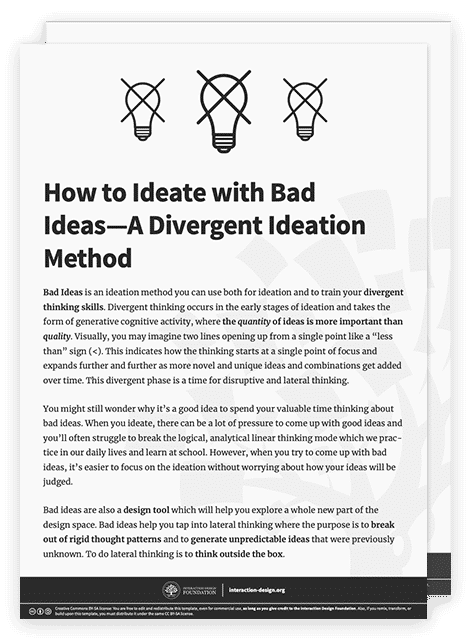
Advance Your Career With This Free Template for “How to Ideate with Bad Ideas—A Divergent Ideation Method”
How to Ideate with Bad Ideas—A Divergent Ideation Method
We respect your privacy
Get 1 powerful email each week: Design a life you love!

Feel Stuck?
Want Better Job Options?

AI is replacing jobs everywhere, yet design jobs are booming with a projected 45% job growth. With design skills, you can create products and services people love. More love means more impact and greater salary potential.

At IxDF, we help you from your first course to your next job, all in one place.

See How Design Skills Turn Into Job Options
Privacy Settings
By using this site, you accept our Cookie Policy and Terms of Use.
Customize
Accept all

Be the One Who Inspires

People remember who shares great ideas.

Share on:

Academic Credibility — On Autopilot

Don't waste time googling citation formats. Just copy, paste and look legit in seconds.