Lateral Thinking

Your constantly-updated definition of Lateral Thinking and collection of videos and articles.
Be a conversation starter: Share this page and inspire others!

197 Shares

What is Lateral Thinking?

Lateral thinking is a form of ideation in which designers approach problems by using disruptive or not immediately obvious reasoning. They use indirect and creative methods to think outside the box and see problems from radically new angles, gaining insights to help find innovative solutions.

“You cannot dig a hole in a different place by digging the same hole deeper.”

— Dr. Edward de Bono, Brain-training pioneer who devised lateral thinking 

See how lateral thinking can stretch towards powerful, “impossible” solutions:

Transcript

Lateral Thinking helps Break Out of the Box

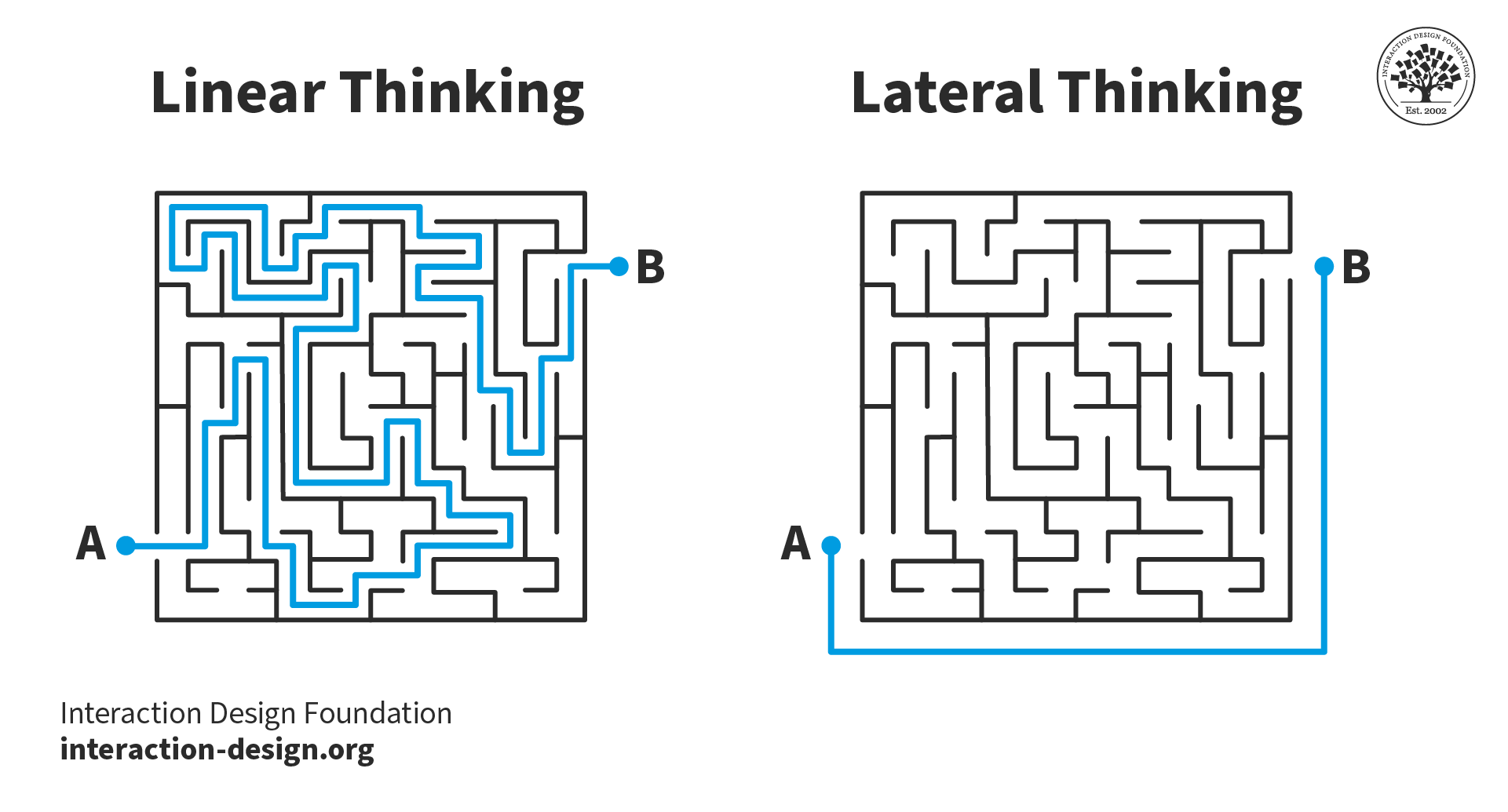
Many problems (e.g., mathematical ones) require the vertical, analytical, step-by-step approach we’re so familiar with. Called linear thinking, it’s based on logic, existing solutions and experience: You know where to start and what to do to reach a solution, like following a recipe. However, many design problems—particularly, wicked problems—are too complex for this critical path of reasoning. They may have several potential solutions. Also, they won’t offer clues; unless we realize our way of thinking is usually locked into a tight space and we need a completely different approach.

© Interaction Design Foundation, CC BY-SA 4.0

That’s where lateral thinking comes in – essentially thinking outside the box. “The box” refers to the apparent constraints of the design space and our limited perspective from habitually meeting problems head-on and linearly. Designers often don’t realize what their limitations are when considering problems – hence why lateral thinking is invaluable in (e.g.) the design thinking process. Rather than be trapped by logic and assumptions, you learn to stand back and use your imagination to see the big picture when you:

  • Focus on overlooked aspects of a situation/problem.

  • Challenge assumptions – to break free from traditional ways of understanding a problem/concept/solution.

  • Seek alternatives – not just alternative potential solutions, but alternative ways of thinking about problems.

When you do this, you tap into disruptive thinking and can turn an existing paradigm on its head. Notable examples include:

  • The mobile defibrillator and mobile coronary care – Instead of trying to resuscitate heart-attack victims once they’re in hospital, treat them at the scene.

  • Uber – Instead of investing in a fleet of taxicabs, have drivers use their own cars.

Rather than focus on channeling more resources into established solutions to improve them, these innovators assessed their problems creatively and uncovered game-changing (and life-changing) insights.

© Interaction Design Foundation, CC BY-SA 3.0

How to Get Fresh Perspectives with Lateral Thinking 

For optimal results, use lateral thinking early in the divergent stages of ideation. You want to reframe the problem and:

  1. Understand what’s constraining you and why.

  2. Find new strategies to solutions and places/angles to start exploring.

  3. Find the apparent edges of your design space and push beyond them – to reveal the bigger picture.

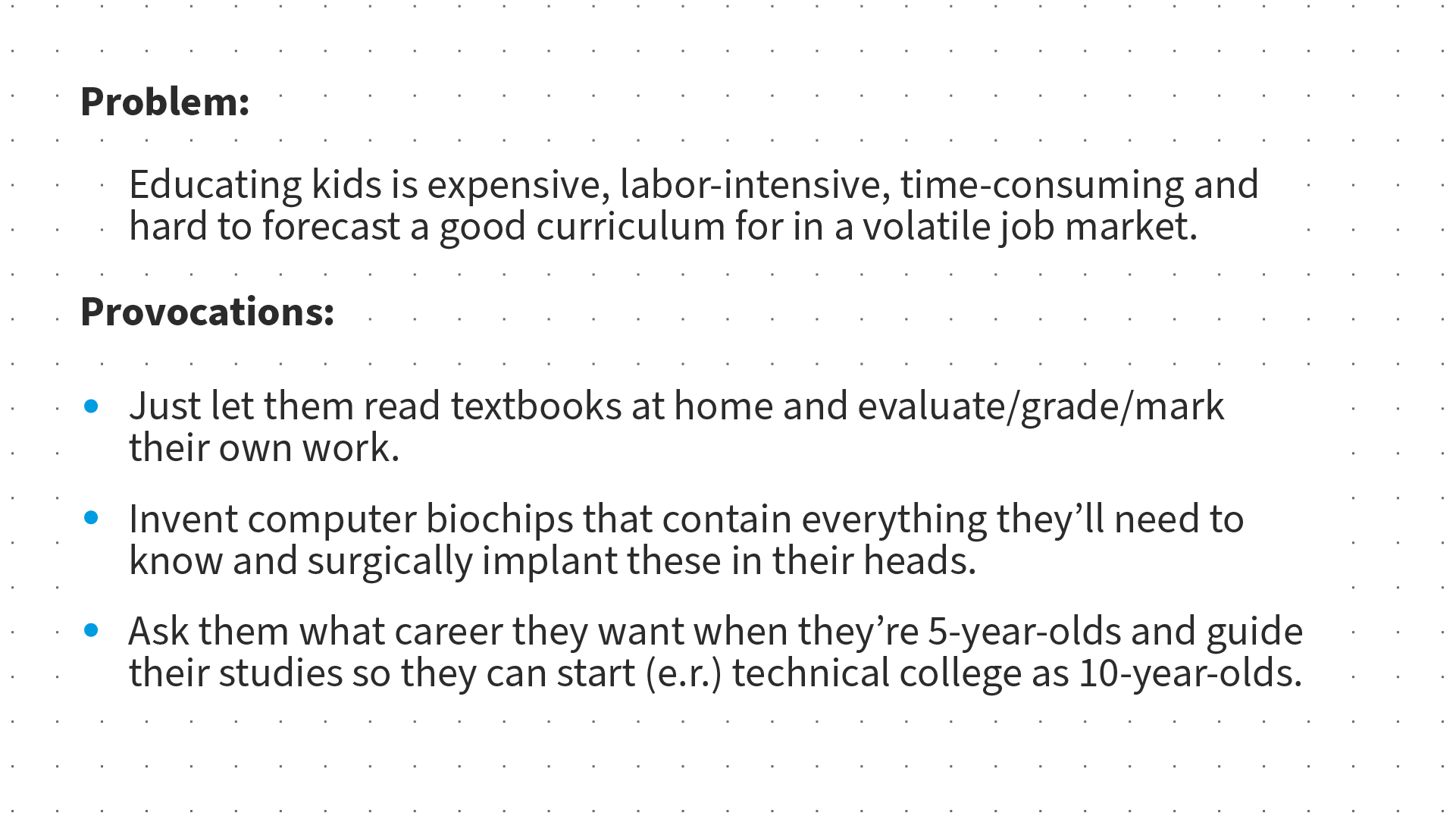
You can use various methods. A main approach is provocations: namely, to make deliberately false statements about an aspect of the problem/situation. This could be to question the norms through contradiction, distortion, reversal (i.e., of assumptions), wishful thinking or escapism, for example:

Here, we see the norm of conventional schooling challenged and some unpredictable (and even outrageous) notions to trigger our thinking. Our example showcases this method:

  • Bad Ideas – You think up as many bad or crazy ideas as possible, but these might have potentially good aspects (e.g., helping children specialize in desired subjects earlier). You also establish why bad aspects are bad (e.g., inserting biochips would be a gross violation of human rights).

Other helpful methods include:

  1. Random Metaphors

    • Randomly pick an item near you or word from a dictionary and write down as many aspects/associations about it as possible. E.g., “Exhibition” – “visitors walk around enjoying paintings”; “learn about cultures”; “pleasant environment”.

    • Pretend some genius in your field told you this item/word is a good metaphor for your project. E.g., you can organize information, tips and images for your travel-related app to also act like an art/museum exhibition, so anyone can enjoy an interesting tour of a given location.

    • Use the metaphors you think of to improve your design/product. E.g., you create a captivating app which virtual tourists can enjoy with (e.g.) virtual reality features.

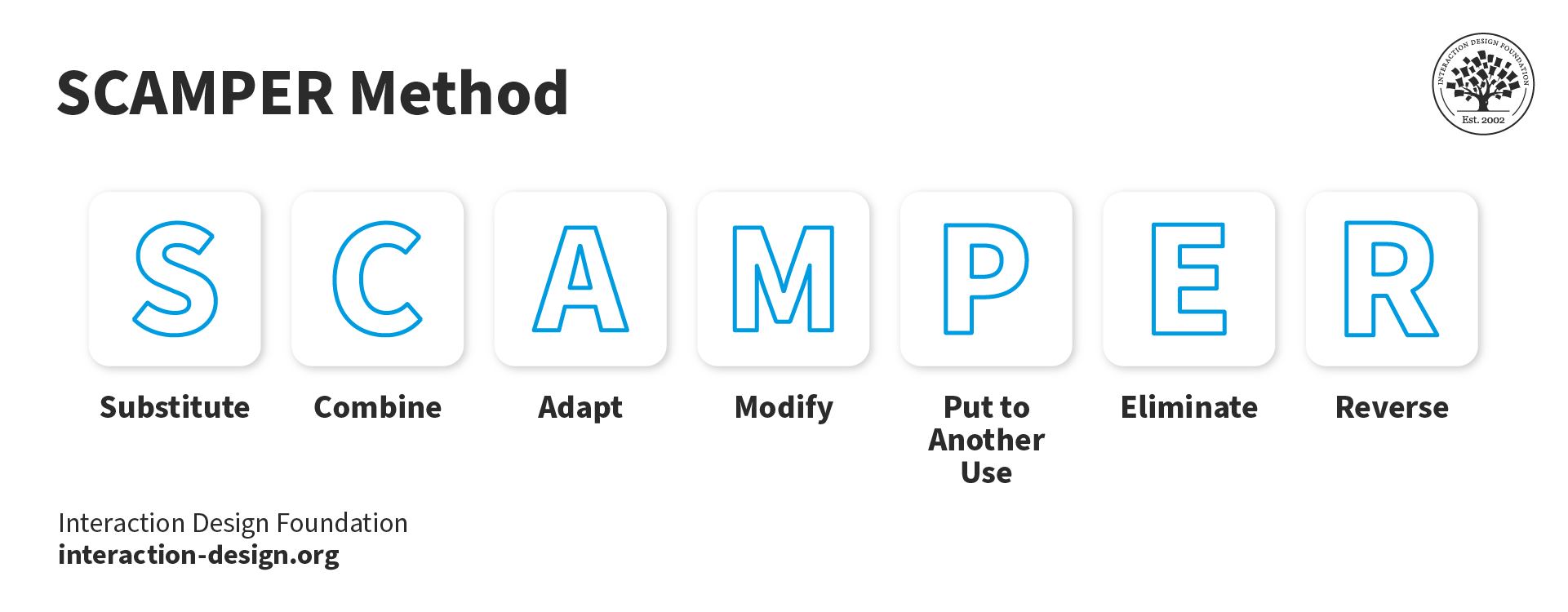
  2. SCAMPER – To help generate ideas for new solutions, ask 7 different types of questions to help understand how you might innovate and improve existing products, services, concepts, etc. SCAMPER is remarkably easy to learn and efficient in ideation sessions.

    © Interaction Design Foundation, CC BY-SA 4.0

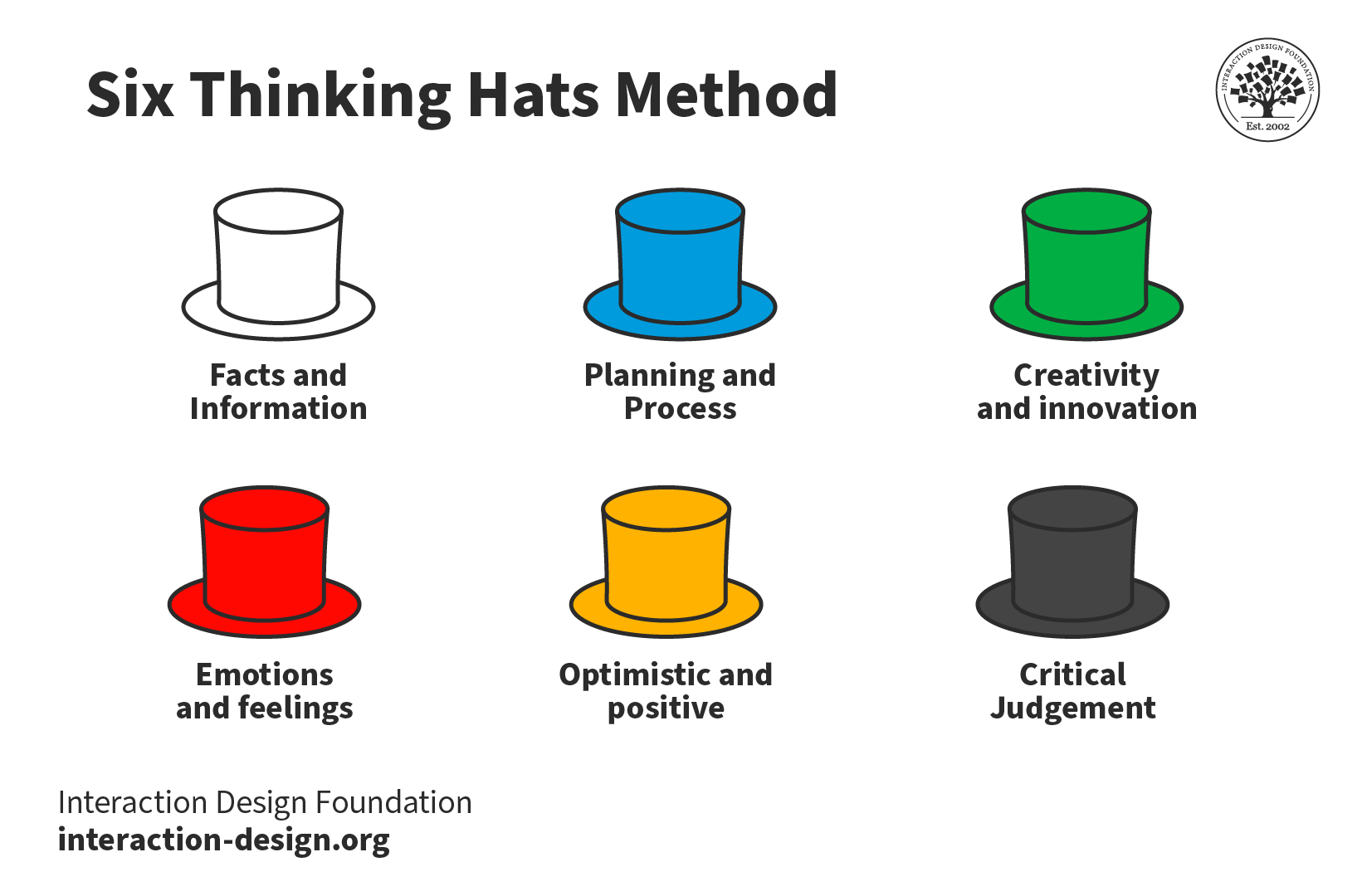
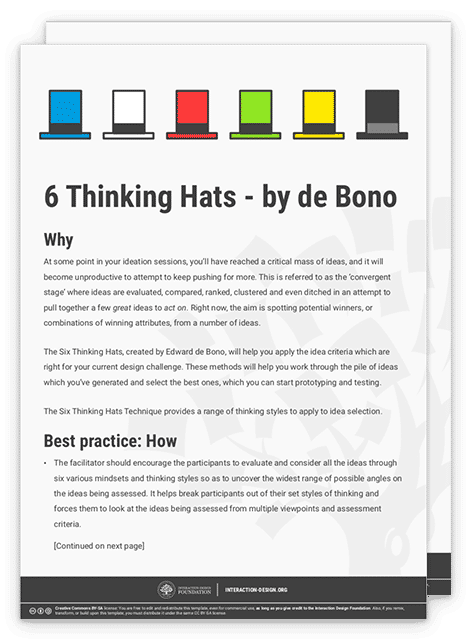
  3. Six Thinking Hats – To reach for alternative viewpoints, you examine problems from 6 perspectives, one at a time (e.g., white hat = focusing on available data; black hat = focusing on potentially negative outcomes). 

© Interaction Design Foundation, CC BY-SA 4.0

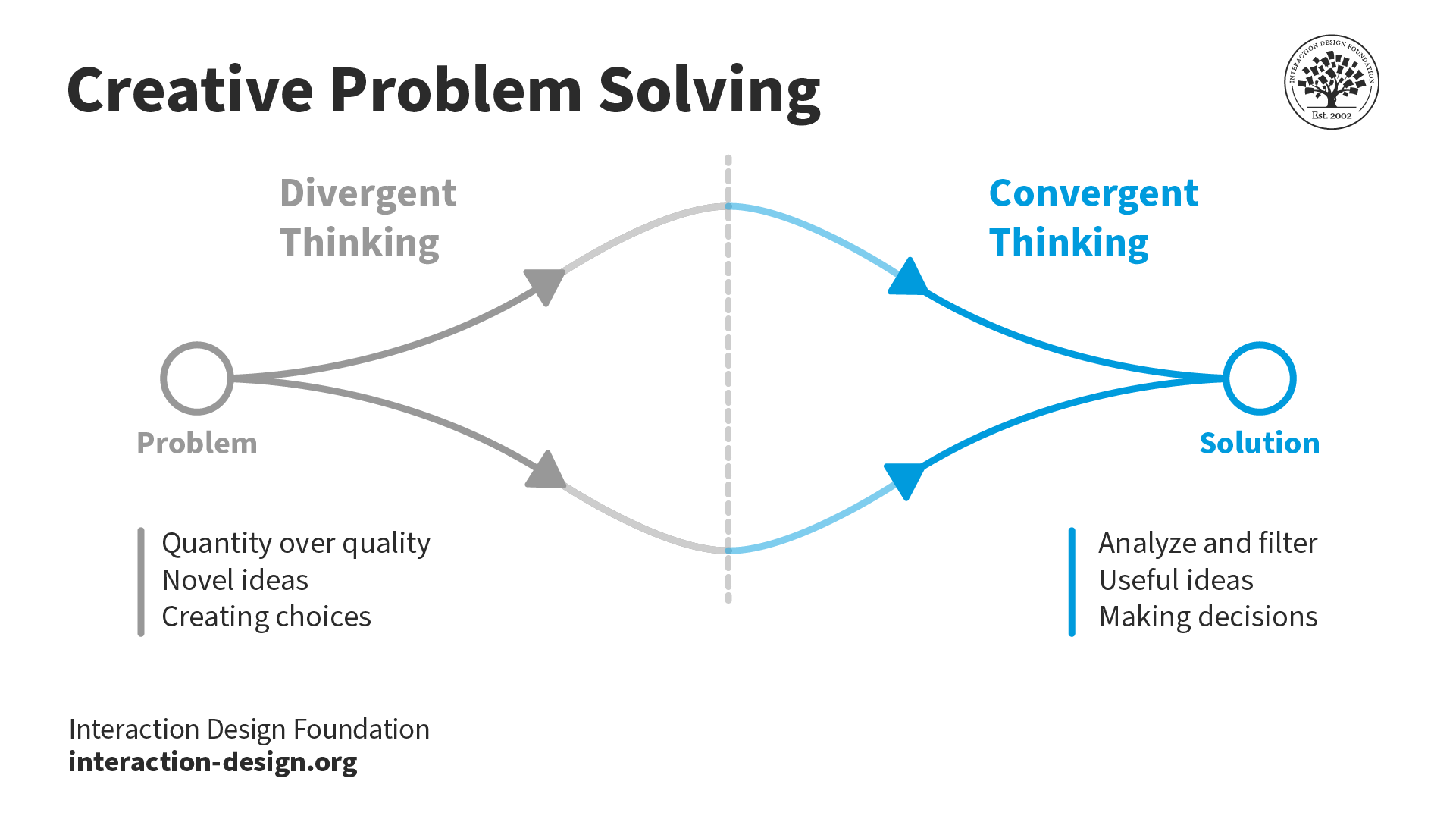
Overall, it’s important to stay aware of where ideation sessions are going. You may need to pause to redirect the group’s thinking or introduce a new trigger/provocation to help the creative process. Later, you use convergent thinking to isolate optimal solutions.

© Interaction Design Foundation, CC BY-SA 4.0

Questions About Lateral Thinking?
We've Got Answers!

What are the four techniques of lateral thinking?

The four lateral thinking techniques are:

Provocation: This involves disrupting conventional thinking patterns with unusual ideas.

Challenge: The challenge is about questioning the status quo. It’s about looking at things as if they might be wrong, even if they seem right. This approach encourages deeper analysis and alternative viewpoints.

Random entry: This technique generates new ideas using a random word or idea as a starting point. It creates connections that may not be immediately noticeable.

Alternatives: It focuses on shifting thinking patterns by exploring various directions and possibilities.

All these techniques encourage thinking outside the box and fostering creativity.

Watch as Professor Alan Dix discusses lateral thinking:

Transcript

Take our course Creativity: Methods to Design Better Products and Services.

What is lateral vs linear thinking?

Lateral thinking and linear thinking are two distinct approaches to problem-solving. Linear thinking is sequential and logical. It follows a straight, step-by-step path that relies on data and analysis. It focuses on following the standard path of reasoning going along, as Alan Dix describes it.

Lateral thinking is non-linear. It involves creativity and looking at problems from various angles. It’s about challenging assumptions and exploring unconventional solutions.

Linear thinking concentrates on details and processes. Whereas lateral thinking emphasizes brainstorming and producing innovative ideas. Both are valuable, but they approach problems from different perspectives.

Watch as Author and Human-Computer Interaction Expert, Professor Alan Dix discusses linear thinking:

Transcript

Take our course Creativity: Methods to Design Better Products and Services.

Is lateral thinking a skill?

Yes, lateral thinking is a valuable skill. It's a problem-solving approach that stresses creative thinking. Unlike traditional linear thinking, it's about exploring diverse ideas. You can hone this skill through practice, challenging assumptions, making unexpected connections, and approaching problems from fresh angles.

People skilled in lateral thinking are often adept at generating innovative solutions. Many fields, especially those requiring innovation and creativity, value this skill.

Watch as Author and Human-Computer Interaction Expert, Professor Alan Dix discusses lateral thinking:

Transcript

Take our course Creativity: Methods to Design Better Products and Services.

Are lateral thinkers intelligent?

Lateral thinking often aligns with intelligence distinct from traditional measures like IQ. Intelligence manifests in various forms, and lateral thinking showcases creative, problem-solving intelligence. Lateral thinkers view things from unique perspectives. They create innovative ideas and link unrelated concepts. This ability marks an essential aspect of creative intelligence.

This video discusses problem redefinition and negotiation in real-world scenarios. Traditional intelligence focuses on finding a single right solution using given information. But lateral thinking is like solving real-world problems. This approach holds significant value in fields that demand innovation and creative problem-solving.

Watch as Professor Alan Dix discusses lateral thinking:

Transcript

Take our course Creativity: Methods to Design Better Products and Services.

Is lateral thinking logical?

While different from traditional logical thinking, lateral thinking has its logic. It’s not illogical or random. Instead, it follows a distinct reasoning that prioritizes creativity and innovation. Traditional logic is linear and sequential. It focuses on reaching conclusions based on existing knowledge and facts.

Lateral thinking involves looking at problems from new angles and making unexpected connections. Lateral thinking is a creative way of problem-solving. It can help you find unique and practical solutions. Lateral thinking is a powerful tool when conventional logic doesn't work.

Watch as Professor Alan Dix explains different types of creativity and what can get in the way of being creative.

Copyright
Transcript

Take our course Creativity: Methods to Design Better Products and Services.

Is lateral thinking the same as brainstorming?

Lateral thinking and brainstorming are similar yet different. Lateral thinking helps solve problems using creative and unconventional approaches. It breaks away from traditional methods.

Brainstorming is a group activity where people contribute ideas without judgment to solve a problem. It generates creative solutions.

Lateral thinking can be a solitary or group activity and it focuses on thinking differently. It's a specific approach to problem-solving that emphasizes creativity.

Watch as Professor Alan Dix discusses lateral thinking:

Transcript

Take our course Creativity: Methods to Design Better Products and Services.

Why is lateral thinking important?

Lateral thinking is crucial because it fosters creativity and innovation. It allows you to explore new ideas and solutions that conventional, linear thinking might not reveal. Lateral thinking helps adapt to new challenges and situations. It encourages looking at problems from multiple perspectives. This leads to more comprehensive and sometimes unexpected solutions. This type of thinking is crucial in innovative fields like business, technology, and design.

Lateral thinking breaks from traditional thought patterns and contributes to advancements and breakthroughs. It enhances problem-solving skills and promotes a more dynamic approach to challenges.

Watch as Professor Alan Dix discusses lateral thinking:

Transcript

Enjoy our Master Class Harness Your Creativity to Design Better Products with Alan Dix, Professor, Author, and Creativity Expert.

Is lateral thinking divergent thinking?

Yes, lateral thinking is a form of divergent thinking. Divergent thinking is about spontaneously generating diverse ideas or solutions to a problem. Lateral thinking, a term coined by Edward de Bono, is a specific kind of divergent thinking. It looks at problems from new and unusual angles and seeks innovative solutions outside conventions.

Divergent thinking is a broader concept encompassing various methods of generating creative ideas. Lateral thinking focuses more on breaking conventional patterns and thinking beyond the norm. Both are key in creative processes, encouraging broad exploration of possibilities.

Watch as Author and Human-Computer Interaction Expert, Professor Alan Dix explains some helpful methods for thinking divergently—to get as many fresh ideas as possible and from many angles of a problem:

Transcript

Enjoy our Master Class Harness Your Creativity to Design Better Products with Alan Dix, Professor, Author, and Creativity Expert.

Where to learn more about lateral thinking?

You can take the creativity course featuring lateral thinking to learn more about lateral thinking. This course would be a more in-depth and interactive way to learn. The course will also help develop your lateral thinking skills through practical applications.

Take our course Creativity: Methods to Design Better Products and Services.

de Bono, E. (1970). Lateral Thinking: Creativity Step by Step. Harper & Row.

Edward de Bono's Lateral Thinking introduces the concept of moving beyond linear, logical thought processes to embrace more creative and indirect approaches to problem-solving. De Bono provides techniques for generating innovative ideas by challenging established patterns and encouraging the exploration of alternative solutions. This seminal work has been instrumental in shifting perspectives on creativity, emphasizing the importance of thinking outside conventional boundaries to achieve breakthroughs in various fields.

What is an example of lateral thinking?

Lateral thinking is changing your approach to solve problems or generate new ideas. Take Edward de Bono’s “Six Thinking Hats” as an example of lateral thinking. It involves adopting different roles to approach problems.

Watch as Author and Human-Computer Interaction Expert, Professor Alan Dix explains “Six Thinking Hats”:

Transcript

Imagine a person who is generally optimistic. Using the “black hat” approach, they could try looking at things negatively. This might help them find new, innovative solutions that they wouldn't have thought of. They can gain a better understanding of the situation by changing their perspective.

Take our course Creativity: Methods to Design Better Products and Services.

Earn a Gift Earn a Gift, Answer a Short Quiz!

1
2
3
4
1
2
3
4
Question 1
Question 2
Question 3
Get Your Gift
Interaction Design Foundation logo

Question 1

What is the main purpose of lateral thinking in problem-solving?

1 point towards your gift

  • To analyze problems step-by-step logically
  • To explore problems using unconventional and creative approaches
  • To rely on data and existing solutions only
Interaction Design Foundation logo

Question 2

Which of the following is a key technique used in lateral thinking?

1 point towards your gift

  • Step-by-step analysis
  • Random entry to generate ideas
  • Focus solely on existing solutions
Interaction Design Foundation logo

Question 3

How does lateral thinking differ from linear thinking?

1 point towards your gift

  • Lateral thinking focuses on logical, step-by-step processes.
  • Lateral thinking involves creative, non-linear approaches, while linear thinking follows a sequential path.
  • Lateral thinking only uses data-driven analysis.

Learn More About Lateral Thinking

Make learning as easy as watching Netflix: Learn more about Lateral Thinking by taking the online IxDF Course Design Thinking: The Ultimate Guide.

Why? Because design skills make you valuable. In any job. Any industry.

In This Course, You'll

  • Get excited when you discover that you don't need to start from scratch to use the secret recipes that empower companies like Apple and Google to shape the future. You just need a structure and proven methods to optimize what you already do. As AI becomes part of your day-to-day workflows, your ability to guide it with timeless human-centered skills such as strategic thinking, creativity, and empathy for real users is what turns AI into your superpower and delivers meaningful results.

  • Build on your existing creativity, problem-solving, and people skills to learn the powerful 5-stage method called Design Thinking. It's one of the key drivers behind Apple and Google's continuous innovation and provides a clear, structured way to solve real-world problems. You've already got the instincts, so it's easy to learn the method. 

  • Make yourself invaluable with hands-on skills in Design Thinking. Design Thinking can help you break into User Experience Design, product design, and tech. It's widely applicable, impactful, and fun! Use your skills to improve customer support processes, create new products, and even tackle big challenges like climate change. This human-centered approach is a key driver of business success because it guides you to systematically understand and address what your users really need and want. That's why Design Thinking skills can help you increase sales, keep customers loyal, and turn them into powerful advocates for your company.

  • Gain confidence and credibility as you effortlessly apply methods from all five stages of the Design Thinking process. You'll be guided to build empathy and gather insights into people's habits through user interviews. 

  • Use our downloadable templates to create affinity diagrams, empathy maps, and actionable "How Might We" questions. Develop solutions as you apply ideation and innovation methods. Create a paper prototype early and fast, then test and optimize your prototype to ensure that your users love it. More love, more impact, greater salary potential. 

  • Apply your new skills in an optional project where you'll design and test a user-centered experience that's perfect for your portfolio and career growth. Master Design Thinking to amplify your uniquely human strengths like empathy, intuition, and creativity, and confidently stay in demand as AI reshapes how teams work.

It's Easy to Fast-Track Your Career with the World's Best Experts

Master complex skills effortlessly with proven best practices and toolkits directly from the world's top design experts. Meet your experts for this course:

  • Don Norman: Father of User Experience (UX) Design, author of the legendary book “The Design of Everyday Things,” and co-founder of the Nielsen Norman Group.

  • Alan Dix: Author of the bestselling book “Human-Computer Interaction” and Director of the Computational Foundry at Swansea University.

  • Mike Rohde: Experience and Interface Designer, author of the bestselling “The Sketchnote Handbook.”

Get an Industry-Recognized IxDF Course Certificate

Increase your credibility, salary potential and job opportunities by showing credible evidence of your skills.

IxDF Course Certificates set the industry gold standard. Add them to your LinkedIn profile, resumé, and job applications.

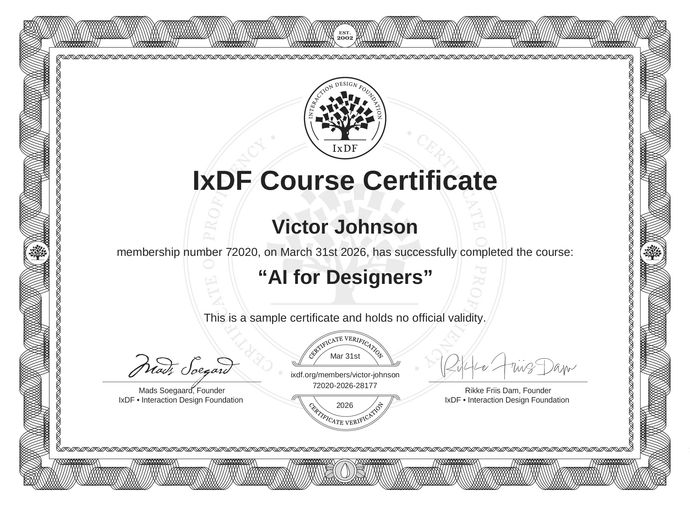
Course Certificate Example

Be in distinguished company, alongside industry leaders who train their teams with the IxDF and trust IxDF Course Certificates.

Our clients: IBM, HP, Adobe, GE, Accenture, Allianz, Phillips, Deezer, Capgemin, Mcafee, SAP, Telenor, Cigna, British Parliament, State of New York

All Free IxDF Articles on Lateral Thinking

Read full article
Understand the Elements and Thinking Modes that Create Fruitful Ideation Sessions - Article hero image
Interaction Design Foundation logo

Understand the Elements and Thinking Modes that Create Fruitful Ideation Sessions

Facilitating ideation sessions involves an understanding of human thinking and mental modes as well as a whole range of factors like creating the right environment and goals, which we’ll introduce you to here.“Ideation is the mode of the design process in which you concentrate on idea generation. Me

Social shares
809
Published
Read Article
Read full article
Learn How to Use the Worst Possible Idea Method - Article hero image
Interaction Design Foundation logo

Learn How to Use the Worst Possible Idea Method

We all know what it is like when someone calls for new ideas. At first, no one wants to say anything; most people tend to wait to hear what others have to say, and—if they feel that their ideas are not as great—they may bottle up what they're thinking. Worst Possible Idea is a highly effective metho

Social shares
871
Published
Read Article

Understand the Elements and Thinking Modes that Create Fruitful Ideation Sessions

Understand the Elements and Thinking Modes that Create Fruitful Ideation Sessions

Facilitating ideation sessions involves an understanding of human thinking and mental modes as well as a whole range of factors like creating the right environment and goals, which we’ll introduce you to here.

“Ideation is the mode of the design process in which you concentrate on idea generation. Mentally it represents a process of ‘going wide’ in terms of concepts and outcomes. Ideation provides both the fuel and also the source material for building prototypes and getting innovative solutions into the hands of your users.”
– d.school, An Introduction to Design Thinking PROCESS GUIDE

Elements that Influence Ideation Sessions

  • Mental or Thinking Modes: Understand and purposely adopt the mental modes required to successfully generate the right kind of ideas.

  • People dynamics: Understand and manage the people dynamics and maintain group cohesion in order to leverage the collective cognitive power of the team and avoid people-related stumbling blocks.

  • Clear Goals: Know the objectives and understand the goals, users, needs, wants, and associated problems. You should articulate these as a problem statement (also known as a Point Of View) before you start ideating.

  • Tools and Methods: Make use of the appropriate ideation methods and associated tools and artifacts, to facilitate the process and navigate the challenges of ideation.

  • Constraints: Know how to apply and make use of the right kind of constraints in order to generate ideas that match the team’s objectives.

  • Stimulus: Gather and appropriately use stimuli which, in combination with the right mental modes, can overcome idea generation inhibitors.

  • Environment: Set up and maintain a physical and social space that provides openness, freedom of expression, and creative energy.

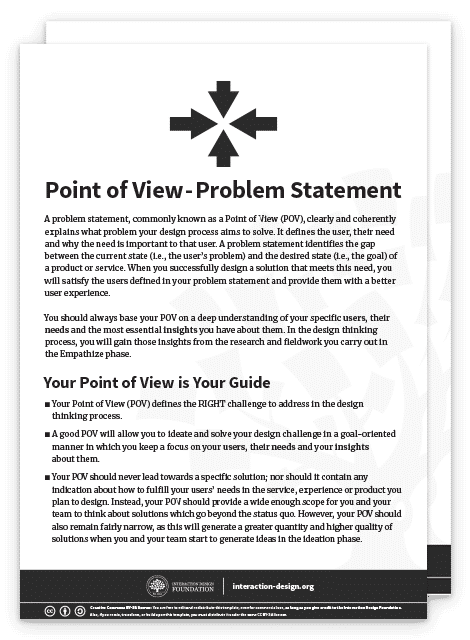
Here, you can download our template to help you crystallise your problem statement:

Advance Your Career With This Free Template for “Point of View - Problem Statement”
Point of View - Problem Statement
We respect your privacy
Get 1 powerful email each week: Design a life you love!

Mental or Thinking Modes

Ideation relies on the interplay between a range of cognitive processes and mental modes or mindsets. Achieving the best results requires that you purposefully select only the relevant modes and apply them, switch between them and mix them to produce unconventional recipes from the same set of inputs.

Vertical Thinking – Linear Thinking

Vertical Thinking is the type of thinking within which problem solving in traditional organisational settings and academia generally falls. It is based on pure logic, past data and existing solutions, possibly with some form of reductionism or streamlining of what exists. It is best to use vertical thinking after the initial divergent stages (please see below) of ideation and towards the end, where you need to choose one or more specific ideas to flesh them out in more detail and streamline them.

Binary Thinking

Binary thinking serves to see the world through a yes/no right/wrong lens. In other words: black or white. There is no room for exploration, gradation, or ambiguity. This is the antithesis of innovation or human-centred problem solving. With so much complexity to consider, solutions need to span across a spectrum of needs, which requires broader, more holistic cognitive processes to consider fully.

Lateral Thinking – Horizontal thinking

Horizontal thinking, unlike vertical thinking, is used to investigate wider not deeper. The opposite of lateral thinking is vertical/linear thinking, which is about being analytical, careful and precise and finding logical solutions. Lateral thinking involves solving problems through an indirect and creative approach. It’s all about using reasoning that is not immediately obvious and involving ideas that may not be obtainable by using only traditional step-by-step logic.

World-renowned thinking guru, Edward De Bono, coined the term, Lateral Thinking, in 1967 in his book New Think: The Use of Lateral Thinking. De Bono is also the inventor of the famous Six Thinking Hats technique and a host of other creative thinking techniques and methods. Edward de Bono is a major force in British creative thinking and he has doctorates from both Oxford and Cambridge University.

The purpose of lateral thinking is to break out of rigid thought patterns and to generate unpredictable ideas. Achieving this requires the purposeful application of a range of techniques, which depends on the area of focus. Lateral thinking seeks to arrive at unknown solutions, as opposed to vertical thinking, which operates directly on perceivable data and analysis.

Lateral thinking is very much about standing back, looking at the big picture, and understanding concepts. It also requires that you focus on the parts that have perhaps been overlooked, challenging assumptions, and seeking alternatives.

Edward De Bono believes creative thinking is not so much a talent but a learnable skill. We can all learn to apply specific techniques to help our mind break out of unproductive patterns of thinking. A good way to learn it is through examples and provocation techniques.

Provocations in Lateral Thinking

Lateral thinking techniques include the following provocations in order to stimulate unconventional ways of looking at things. In simplest terms, a provocation can be thought of as an idea which you consider too radical and unrealistic for a regular brainstorming session.

The purpose of the provocation is to force your mind to move out of your comfortable mental patterns and instead allow you to come up with potentially radical solutions to the problem at hand:

  • Randomisation

  • Contradiction

  • Reversal

  • Distortion

  • Exaggeration

  • Insight or Theme Mining

  • Analogies

  • Questioning the Norms

  • Wishing and Dreaming

  • Escapism

  • Breaking Assumptions

Two thinking techniques that are quite effective at structuring lateral thinking and broadening the scope of input being used to stimulate ideas, are De Bono's 6 “Thinking Hats technique” and the SCAMPER method. Both of these techniques categorise thinking styles into set patterns and allow for the purposeful choice of each style at any given time to stoke alternative cognitive approaches to the challenge. This disrupts the patterns of thinking and allows reflection that is more intentioned. Implementing these techniques, however, requires a good level of awareness from the participants or the ideation facilitator, to know when to call for a pause and redirect the group's thinking or even apply a new thinking trigger to the process.

Author/Copyright holder: Teo Yu Siang and Interaction Design Foundation. Copyright terms and licence: CC BY-NC-SA 3.0

Do you want to learn how you can get started using Edward De Bono's 6 Thinking Hats technique for your next design project and ideation session? Then you can download and print this template:

Advance Your Career With This Free Template for “6 Thinking Hats”
6 Thinking Hats
We respect your privacy
Get 1 powerful email each week: Design a life you love!

Disruptive Thinking

One of the most successful approaches to problem solving, idea generation and innovation is the concept of disruption, which involves looking at an existing paradigm and turning it on its head. The aim of disruption involves considering existing assumptions and overturning them to make what seemed impossible, possible. It requires the application of lateral thinking processes to arrive at paradigm shifts. In stories, these may represent the twist in the tale.

Three modes of thinking in Ideation Sessions

1. Divergent Thinking

Early stage divergent thinking takes the form of generative cognitive activity, where the quantity of ideas is more important than quality. Visually, you may imagine two lines opening up from a single point like a less than sign ( < ). This indicates that the thinking starts at a single point of focus and expands further and further adding more novel combinations as time progresses.

2. Emergent Thinking

This is an in-between thinking style, which leverages ideas generated in the early divergent stage as stimuli to allow the generation of additional ideas. It is a building upon phase, in which new connections, mix-ups and ideas are sparked from the pile of ideas generated during early phases. Usually what emerges out of these later thinking sessions would not have been possible without the early, more chaotic divergent sessions, providing a wide enough range of stimuli. Many ideation methods rely on trigger stimuli to provide a platform out of which new ideas can emerge.

3. Convergent Thinking

Convergent thinking is at the opposite end of ideation sessions, and involves closing off these sessions by sifting through ideas, grouping them into themes, picking out common threads and ultimately deciding upon winners and losers. Ideation and Design Thinking is not a wild frenzy of chaos. Impractical or impossible solutions do need to be weeded out, or at least the overly ambitious ones need to be shelved for later consideration in certain cases. This is where you make decisions through the lenses of desirable, viable and feasible. It doesn't end with these decisions though, as this is merely the first phase of pruning to prepare a few of the best ideas for prototyping and field validation. Convergent thinking relies on a more vertical, rational style of thinking, though it still needs to maintain a good enough degree of creativity so that ideas with merit are not rejected merely because they do not follow logical norms.

Clear Goals and Problem Statement

Whether or not your team has the greatest minds on the planet, including expert facilitation at hand, without a clear enough map, they could easily get lost in ideation twilight zone. Ideation can go in so many different directions that the possibilities are almost infinite. Understanding the challenge at hand, the goals and objectives, the user, the needs and wants of the targeted market and a range of other constraints help put much more focus into ideation sessions. A random constraint-less ideation session could invigorate the team and be lots of fun, while wasting time and producing nothing of value. It’s only when you frame the challenge/problem statement/Point Of View clearly that you can steer the ship in the right direction.

Stimulus

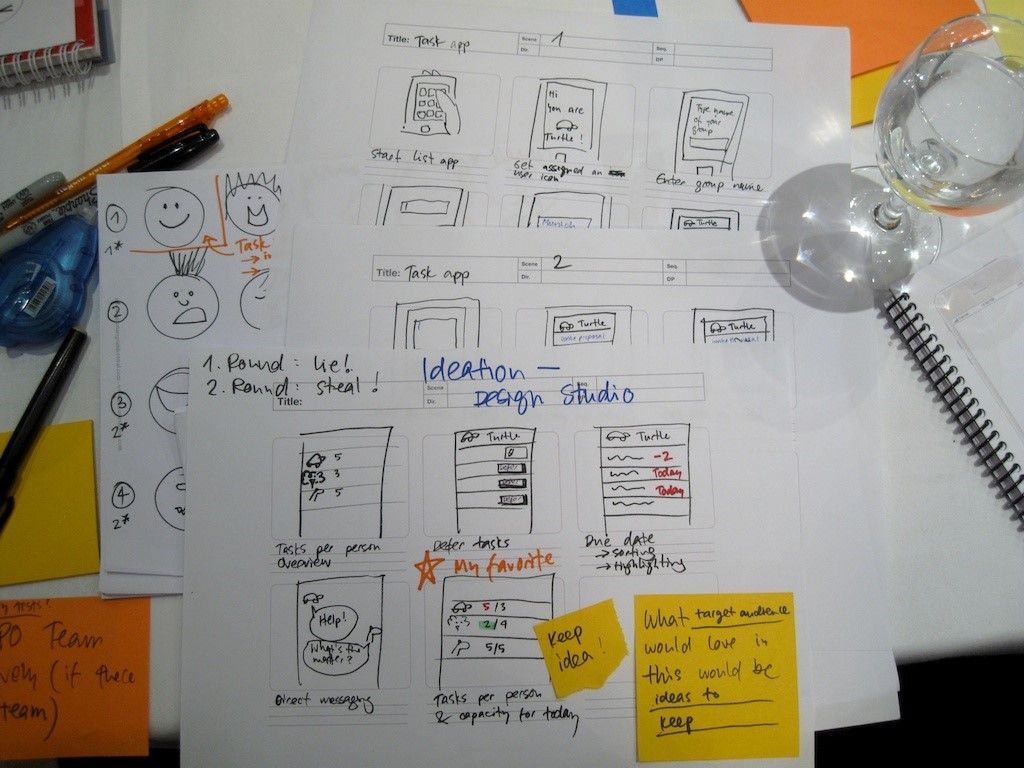
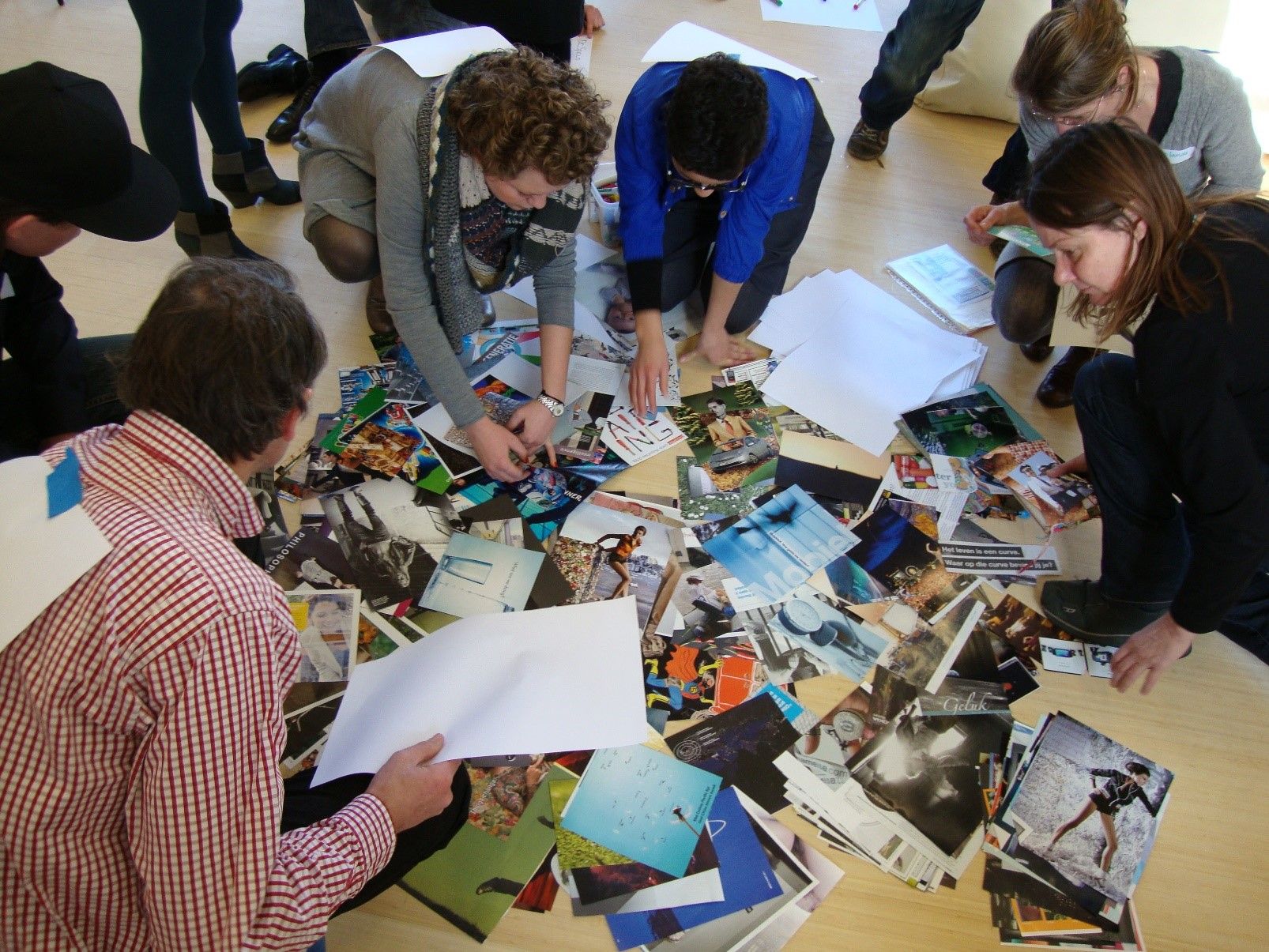
Having information, artifacts, idea stoking material, or stimulus help provide levers for lifting the collective cognitive load. Stimulus sparks new connections and thinking pathways, which can help lead to unexpected and unconventional ideas. The stimulus applied depends on the needs of the group, whether it is some input in the form of personas, affinity diagrams, imagery, analogies, key words, quotes, stories, or even video collages to get the collective neurons firing. Understanding the type of stimulus needed at any given time is the role of the facilitator.
Author/Copyright holder: Kennisland. Copyright terms and licence: CC BY-SA 2.0

Stimulus such as images of the users and quotes from them help sparks new connections and thinking pathways, which can help lead the designers to unexpected and unconventional ideas.

Team Leadership and Human Psychology

As we find when exploring the nitty gritty of innovation teamwork, we know diversity rules. Bringing together a multi-disciplinary team that incorporates a wide range of thinking styles helps provide that much needed diversity. Add to that openness, mutual respect, and a bar on egos at the door, and you're much closer to the type of radical collaboration on which Design Thinking thrives. Ideation facilitation requires experience and expertise in a range of people dynamics, not to mention an understanding of the principles and methods to be implemented. Investing in external skills or internal facilitation and creative leadership training is important for any organisation that has a continuous need for creative solutions. The book Rise of the DEO by Maria Giudice and Christopher Ireland is full of characteristics required of creative leadership, including empathy, social intelligence, ambiguity, risk taking, being hands on, being a change agent and applying intuition.

Ideation facilitators and creative leaders need to be acutely aware of those they are leading, their mental modes, their cognitive and creative aptitudes, and how best to leverage these to produce innovative results.

Environment

When you plan an ideation session or a design thinking session, it’s important that you choose or create the right location as it will have a significant impact on the outcome. The importance of appropriate space cannot be underestimated in the ideation process, as the effects of space on people's attitudes, thinking and collaboration will directly impact on the quality of output from ideation sessions.

The ideation space should ideally be located away from the normal work environments, which can stifle creativity or remind participants of stressful activities and time pressure. Participants should be cut off from interference from other co-workers or continuing work activities that may distract them. Distractions of this nature will prevent them from fully focussing on the task at hand, due to their minds wandering to other tasks that need to be completed across the hall.

The Take Away

Facilitating ideation sessions involves an understanding of human thinking and mental modes. Ideation relies on the interplay between a range of cognitive processes and mental modes or mindsets. To achieve the best results requires that you purposefully select only the relevant modes and apply them, switch between them and mix them to produce unconventional recipes from the same set of inputs.

Vertical Thinking/Linear Thinking is based on pure logic, past data and existing solutions, possibly with some form of reductionism or streamlining of what exists. It is best to use vertical thinking after the initial divergent stages of ideation and towards the end, where you need to choose one or more specific ideas to flesh them out in more detail and streamline them. Binary thinking serves to see the world through a yes/no right/wrong lens. In other words: black or white. Lateral Thinking/Horizontal thinking is to investigate wider not deeper. Lateral thinking involves solving problems using an indirect and creative approach.

  1. Divergent thinking: Early stage divergent thinking takes the form of generative cognitive activity, where the quantity of ideas is more important than quality.

  2. Emergent thinking: This is an in-between thinking style, which leverages ideas generated in the early divergent stage as stimuli to allow the generation of additional ideas. It is a building upon phase, in which new connections, mix-ups and ideas are sparked from the pile of ideas generated in early phases.

  3. Convergent thinking: Convergent thinking closes off the ideation sessions by sifting through ideas, grouping them into themes, picking out common threads and ultimately deciding upon winners and losers. This is where you make decisions through the lenses of desirable, viable and feasible. Convergent thinking relies on a more vertical, rational style of thinking, though it still needs a good enough degree of creativity so that ideas with merit are not rejected merely because they do not follow logical norms.

References & Where to Learn More

Edward de Bono, New think: The use of lateral thinking in the generation of new ideas, 1967

The de Bono Group. Six Thinking Hats.

Ella Miron-Spektor, Miriam Erez, and Eitan Naveh. To Drive Creativity, Add Some Conformity. Harvard Business Review, March 2012.

Bob Riley. The Provocation Creative Technique. ThoughtEgg.com.

Maria Giudice and Christopher Ireland, Rise of the DEO - Leadership by Design.

Hero Image: Author/Copyright holder: visualpun.ch. Copyright terms and licence: CC BY-SA 2.0
Feel Stuck?
Want Better Job Options?

AI is replacing jobs everywhere, yet design jobs are booming with a projected 45% job growth. With design skills, you can create products and services people love. More love means more impact and greater salary potential.

At IxDF, we help you from your first course to your next job, all in one place.

See How Design Skills Turn Into Job Options
Privacy Settings
By using this site, you accept our Cookie Policy and Terms of Use.
Customize
Accept all

Be the One Who Inspires

People remember who shares great ideas.

Share on:

Academic Credibility — On Autopilot

Don't waste time googling citation formats. Just copy, paste and look legit in seconds.