Picture of man riding a bycicle which is tied up to a plane by a cord.

Learn How to Use the Worst Possible Idea Method

by Rikke Friis Dam and Yu Siang Teo • 8 min read

871 Shares

We all know what it is like when someone calls for new ideas. At first, no one wants to say anything; most people tend to wait to hear what others have to say, and—if they feel that their ideas are not as great—they may bottle up what they're thinking. Worst Possible Idea is a highly effective method that you can use to get the creative juices flowing and help those not so confident in expressing themselves by flipping the brainstorm on its head. And it’s a lot of fun, too.

Instead of going for good ideas and putting the pressure on, call for the worst and, yes, the worst possible ideas your team can come up with. Doing this relieves the anxiety and self-confidence issues and allows people to be more playful and adventurous, as they know their ideas are most certainly not going to be scrutinized for missing the mark. It's way easier to say “Hey no that's not bad enough.” than the opposite. Better still, it helps ensure that mental constipation is never responsible for keeping a breakthrough idea from getting out into the open.

In Idea Stormers, the author and innovation guru to Fortune 500 companies, Bryan Mattimore, recalls a scenario where he was trying to get a group of bankers to come up with innovative ideas. They had gone through hours of ideation sessions and had come up with nothing worth considering. Mattimore introduced the Worst Possible Idea method as a last resort. As soon as the first of the bankers had thrown out a terrible suggestion, the rest of the group quickly joined in and finally had some fun as well, opening up the way for positive ideation sessions later.

The Worst Possible Idea or Worst Idea technique is not purely an icebreaker-style technique, though, as insights that may stem from really bad ideas may even be useful in generating really great ideas. On that note, it doubles as a—really fun—process of elimination.

“To invent, you need a good imagination and a pile of junk.”

– Thomas Edison, American inventor who developed the phonograph, the motion picture camera and the electric light bulb. As quoted in Behavior-Based Robotics (1998) by Ronald C. Arkin. p. 8

Photo of a sign with an image of a brain with wings and the words

The Worst Possible Idea method is a fun and effective ideation icebreaker technique. However, your team may also very likely be able to extract and come up with amazing ideas from really bad ideas.

© Daniel Lobo, CC BY 2.0.

Best Practice: How

The technique is simple:

  1. The facilitator briefs the ideation session participants about the problem statement (also called Point Of View), the overall goals and important user insights.

  2. Then the facilitator asks the participants to come up with the worst possible ideas they can think of. There should be permission given to revel in unusable, impractical, stupid or foolish ideas; ones that are nonsensical, ridiculous, incorrect, mismatched, and against known best-practices, laws or guidelines. The intention is not necessarily to descend into toxic or gratuitously offensive concepts (the facilitator will need to use their judgement to keep the ideation session happy and healthy) but to escape constraints by opening the mind. You can do this as a collective brainstorm session, or you can ask all participants to write down their worst ideas individually—this method is called Braindumping. You could also use the Brainwriting method, where each participant fills out idea cards/papers with their worst possible ideas for 3–5 minutes and then passes on the idea card to another participant, who elaborates on their worst possible ideas, and so forth.

  3. As the facilitator, be sure to push your group to generate extremely bad ideas! This will help get participants laughing and re-engaged. As a facilitator of ideation sessions, it’s your job to help participants open their minds and hearts, and the Worst Idea method can help you do just that—especially if you combine it with the collective Brainstorm method.

  4. The technique includes generating as many terrible ideas as possible.

  5. It includes listing the attributes of the worst ideas.

  6. Investigate which attributes of the ideas make them really bad.

  7. Once the participants have generated a list of their worst ideas, you as the facilitator should challenge the group to turn those horrible ideas into good ones. They can either consider the ideas’ opposites or look for aspects within the terrible ideas that might inspire a good one. Or, you can consider simply removing the worst attribute and replacing it with something else. Mix and match different bad ideas, and see what comes out.

Why

A closed mind will not be able to build on external stimuli. We've all witnessed this in some way or another—a person who is convinced that their own ideas are better than anyone else's becomes oblivious to the value of the contributions others have made. Group ideation functions best when all ideas can be expressed equally and then later mixed up in unconventional ways. This approach by the Worst Possible Idea produces novel combinations or completely new ideas. With ideas, one leads to another; bad ideas lead to good ones, sometimes in ways we could never have imagined. At times, the best idea stems from its exact opposite—the worst. This is why the Worst Possible Idea is actually an ideation method, one which you can use to provide disruptive insight within the ideation process.

This is a lateral thinking technique which seeks to solve problems through an indirect and creative approach. It’s all about using reasoning that is not immediately obvious and involving ideas that may not be obtainable by using only traditional step-by-step logic. The purpose of lateral thinking is to help us break out of rigid thought patterns and to generate unpredictable and innovative ideas. Lateral thinking seeks to arrive at unknown solutions, as opposed to vertical thinking, which operates directly on perceivable data and analysis. Not for nothing are the horizons—and, by association, the possibilities—broader with lateral thinking.

Do you want to learn how you can get started using the Worst Possible Idea methods to break the ice and help open up participants’ minds? Then download and print our Worst Possible Idea template:
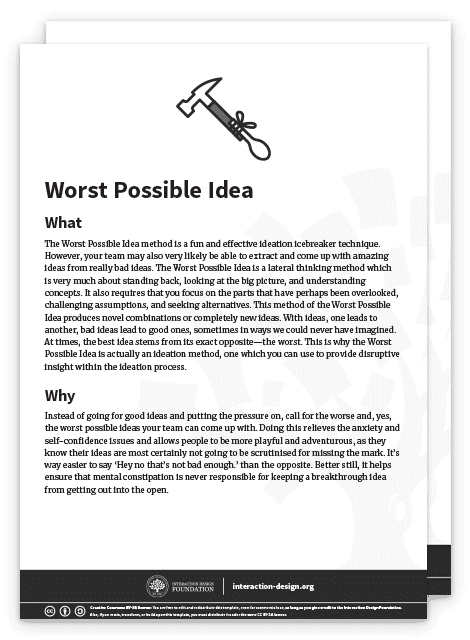
Advance Your Career With This Free Template for “Worst Possible Idea”
Worst Possible Idea
We respect your privacy
Get 1 powerful email each week: Design a life you love!

The Take Away

The Worst Possible Idea method is a fun and effective ideation icebreaker technique. However, your team may also very likely be able to extract and come up with amazing ideas from really bad ideas. The Worst Possible Idea is a lateral thinking method which is very much about standing back, looking at the big picture and understanding concepts. It also requires that you focus on the parts that have perhaps been overlooked, challenging assumptions and seeking alternatives. It’s a great way of zeroing in on what will work by exposing what won’t, but then working out or working back elements from these “dud ideas” that may have a bearing on the true solution to the problem at hand.

References & Where to Learn More

Bryan Mattimore, Idea Stormers: How to Lead and Inspire Creative Breakthroughs, 2012.

Edward de Bono, New think: The use of lateral thinking in the generation of new ideas, 1967

Edward de Bono, Lateral thinking: Creativity Step by Step, 1970

Edward De Bono, De Bono Thinking.

The de Bono Group. Six Thinking Hats: http://www.debonogroup.com/six_thinking_hats.php

PDAgroup Blog. Design Thinking: The Ideal Design Space, 2013.

Ella Miron-Spektor, Miriam Erez, and Eitan Naveh, To Drive Creativity, Add Some Conformity, Harvard Business Review, March 2012.

Bob Riley, The Provocation Creative Technique, ThoughtEgg.com.

Maria Giudice and Christopher Ireland, Rise of the DEO - Leadership by Design.

Images

Hero Image: © Richard Masoner / Cyclelicious, CC BY-SA 2.0.

Learn More in This Course:

AI for Designers

12 days
13 % booked
View Course

What You Should Read Next

  • Read full article
    What is Design Thinking and Why Is It So Popular? - Article hero image
    Interaction Design Foundation logo

    What is Design Thinking and Why Is It So Popular?

    Design Thinking is not an exclusive property of designers—all great innovators in literature, art, music, science, engineering, and business have practiced it. So, why call it Design Thinking? What’s special about Design Thinking is that designers’ work processes can help us systematically extract,

    Social shares
    1.6k
    Published
    Read Article
  • Read full article
    Personas – A Simple Introduction - Article hero image
    Interaction Design Foundation logo

    Personas – A Simple Introduction

    Personas are fictional characters, which you create based upon your research to represent the different user types that might use your service, product, site, or brand in a similar way. Creating personas will help you understand your users’ needs, experiences, behaviors and goals. Creating personas

    Social shares
    1.6k
    Published
    Read Article
  • Read full article
    Stage 2 in the Design Thinking Process: Define the Problem and Interpret the Results - Article hero image
    Interaction Design Foundation logo

    Stage 2 in the Design Thinking Process: Define the Problem and Interpret the Results

    An integral part of the Design Thinking process is the definition of a meaningful and actionable problem statement, which the design thinker will focus on solving. This is perhaps the most challenging part of the Design Thinking process, as the definition of a problem (also called a design challenge

    Social shares
    1.4k
    Published
    Read Article
  • Read full article
    What is Ideation – and How to Prepare for Ideation Sessions - Article hero image
    Interaction Design Foundation logo

    What is Ideation – and How to Prepare for Ideation Sessions

    Ideation is the process where you generate ideas and solutions through sessions such as Sketching, Prototyping, Brainstorming, Cheatstorming, Brainwriting, Worst Possible Idea, and a wealth of other ideation techniques. Ideation is also the third stage in the Design Thinking process. Although many p

    Social shares
    1.4k
    Published
    Read Article
  • Read full article
    Empathy Map – Why and How to Use It - Article hero image
    Interaction Design Foundation logo

    Empathy Map – Why and How to Use It

    Here’s an interesting fact you may—or may not—know: users are more likely to choose, buy, and use products that meet their needs than products that just meet their wants. And an Empathy map will help you understand your user’s needs while you develop a deeper understanding of the persons you’re desi

    Social shares
    1.4k
    Published
    Read Article
  • Read full article
    Affinity Diagrams: How to Cluster Your Ideas and Reveal Insights - Article hero image
    Interaction Design Foundation logo

    Affinity Diagrams: How to Cluster Your Ideas and Reveal Insights

    Affinity diagrams are a great method to use when you want to make sense of a large volume of mixed information and data—facts, ethnographic research, ideas from brainstorms, user opinions, user needs, insights and design issues, just to name a few! Affinity diagrams require you to cluster informatio

    Social shares
    1.3k
    Published
    Read Article
  • Read full article
    Stage 4 in the Design Thinking Process: Prototype - Article hero image
    Interaction Design Foundation logo

    Stage 4 in the Design Thinking Process: Prototype

    One of the best ways to gain insights in a Design Thinking process is to carry out some form of prototyping. This method involves producing an early, inexpensive, and scaled down version of the product in order to reveal any problems with the current design. Prototyping offers designers the opportun

    Social shares
    1.3k
    Published
    Read Article
  • Read full article
    The History of Design Thinking - Article hero image
    Interaction Design Foundation logo

    The History of Design Thinking

    We need to appreciate the roots and origins of a concept to truly understand it—we need to know how it came to be. Let’s take a look at how design thinking emerged from an exploration of theory and practice to become one of the most effective ways to address the human, technological and strategic in

    Social shares
    1.3k
    Published
    Read Article
  • Read full article
    Stage 1 in the Design Thinking Process: Empathise with Your Users - Article hero image
    Interaction Design Foundation logo

    Stage 1 in the Design Thinking Process: Empathise with Your Users

    Design Thinking cannot begin without a deeper understanding of the people you are designing for. In order to gain those insights, it is important for you as a design thinker to empathize with the people you’re designing for so that you can understand their needs, thoughts, emotions and motivations.

    Social shares
    1.3k
    Published
    Read Article
  • Read full article
    Stage 3 in the Design Thinking Process: Ideate - Article hero image
    Interaction Design Foundation logo

    Stage 3 in the Design Thinking Process: Ideate

    In the Ideation stage, design thinkers spark off ideas — in the form of questions and solutions — through creative and curious activities such as Brainstorms and Worst Possible Idea. In this article, we’ll introduce you to some of the best Ideation methods and guidelines that help facilitate success

    Social shares
    1.3k
    Published
    Read Article

Top Articles

Top Topic Definitions

Feel Stuck?
Want Better Job Options?

AI is replacing jobs everywhere, yet design jobs are booming with a projected 45% job growth. With design skills, you can create products and services people love. More love means more impact and greater salary potential.

At IxDF, we help you from your first course to your next job, all in one place.

See How Design Skills Turn Into Job Options
Privacy Settings
By using this site, you accept our Cookie Policy and Terms of Use.
Customize
Accept all

Be the One Who Inspires

People remember who shares great ideas.

Share on:

Academic Credibility — On Autopilot

Don't waste time googling citation formats. Just copy, paste and look legit in seconds.

Feel Stuck? Want Freedom?

Join 326,013+ designers who get one powerful email each week. Learn to design a life you love.

Next email in
1
day
17
hrs
24
mins
38
secs

Free forever. No spam. Unsubscribe anytime.