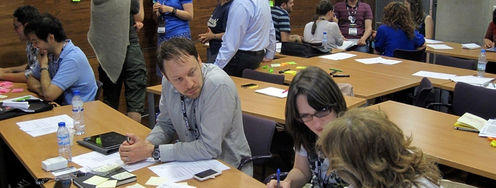
Braindumping

Your constantly-updated definition of Braindumping and collection of videos and articles.
Be a conversation starter: Share this page and inspire others!

296 Shares

What is Braindumping?

Braindumping is the process of unloading a cascade of thoughts, ideas, assumptions, questions, or impressions onto paper or sticky notes, so you free mental space and create raw material you can refine later. Use it to capture what’s floating around in your mind, including research notes, early ideas, pain-points, and messy sketches. Braindumps help you pause the noise, sift through what matters, and more clearly define the problems and opportunities you want to focus on.

In this video, William Hudson: User Experience Strategist and Founder of Syntagm Ltd., explains how judgment-free brainstorming sessions spark bold ideas.

Transcript

Why Braindumping Matters in UX Design

At first glance, the term “braindump” might seem random or even crude. However, this masks the immense value it can bring to ideation sessions and beyond. Braindumping is an ideation technique that comes from the broader family of methods which design teams use when ideating, or in the ideation phase of design thinking. It’s closely related to, but distinct from, classic brainstorming (a group-based idea generation approach) and other sibling methods such as brainwriting and brainwalking.

In this video, William Hudson shows you how the design thinking process helps you and your team understand users, redefine problems, and generate creative solutions that balance desirability, feasibility, and viability.

Transcript

Braindumping improves outcomes because it aligns several factors: it taps into individual creativity and lays the groundwork for group ideation. That makes it one side of a potentially valuable “coin,” since individual ideation sessions (like braindumping) combined with group sessions produce more diverse and original ideas than group ideating alone. More specifically, the benefits of braindumping include how it:

Frees Cognitive Load

Holding many thoughts, observations, assumptions, and partial ideas in your mind consumes mental energy. With all that mental bandwidth taken up, it limits creativity, and what can make that worse is that you might not even realize how much is clogging up your mind. One of the best ways to reach more advanced thinking is to remove internal clutter first. It’s a little like drain cleaner, but instead of dissolving the material, it prompts it to come out. And with cognitive unloading, you’ll stop trying to hold thoughts in your head and start working with them externally.

Levels the Playing Field

A significant risk in any group ideation exercise lies in the nature of the group itself. Sometimes, the fruitfulness of a session is only as good as the moderating skills of the facilitator. Louder voices and larger personalities can dominate the proceedings, or senior team members might “pull rank” by making statements which other team members might not want to debate (for fear of reprisal later). The result? Introverts and quieter participants can feel silenced. Happily, braindumping offers an “antidote” to such a potentially toxic environment in how it encourages everyone to externalize ideas individually before group dynamics take over.

Maximizes Idea Quantity

Because your team postpones evaluation and the focus is on capture, you’ll harvest a broad set of raw ideas. User-centered work often involves messy inputs like research findings, competitor scans, stakeholder assumptions, user quotes, and more. Without capturing them properly, you and your design team may overlook or misremember important insights. Braindumping helps ensure nothing falls off the radar and, instead, ideas form a richer foundation for further ideation.

Feeds Later Ideation

The output becomes raw, tangible artifacts that feed brainstorming, clustering, concept-generation, and prototyping. That’s why it’s wise to do braindumping before more structured sessions, as the team can go on to organize, combine, challenge, and refine individual members’ thoughts to great effect. And that can lead to more grounded, user-relevant, and innovative solutions.

Braindumping can act as a bridge between early-phase research or problem definition and the generation of truly innovative ideas. It helps designers move from a state of fuzzy thinking to a clearer set of possibilities, and it proves that teamwork can be so much more than the sum of its parts.

When to Use Braindumping in the UX Design Process

Braindumping works best at certain moments in the UX workflow, most notably:

  • After research but before ideation: Once you’ve completed user interviews, competitive audits, or an analytics review, run a braindump to surface lingering observations, assumptions, and curiosities before you and your team narrow things down into concepts.

  • At the start of a new phase: When you switch from one major stage to another, such as going from discovery to ideation, braindumping helps clear the mind of leftover issues and opens creative space.

  • When the team feels stuck: If you’re finding your idea generation is slow, or parts of the design feel blocked, do a quick braindump as it can unlock hidden thoughts and refresh momentum.

  • Before documentation or handoff: When you’re preparing project artifacts, such as case studies, handoffs, or retrospectives, braindumping lets you surface everything you learned. That includes even the less-polished bits, so you don’t leave anything on the table.

How to Do Braindumping, A Step-by-Step Guide

Here’s a step-by-step flow for how UX designers commonly adopt a braindumping session:

1. Set Context

Begin by reaffirming the design problem or opportunity. Frame a “How Might We” question, or similar point-of-view statement, so that participants know what domain to focus on. While braindumping is freer than structured ideation, you’ll still benefit from a clear prompt.

In this video, William Hudson tells you how to turn design problems into actionable “How might we” questions that inspire creative solutions.

Transcript

2. Time‐Box The Activity

Allocate a short, fixed time, typically 3 to 10 minutes for individuals or 5 to 15 minutes for teams; in that time, participants write down everything that comes to mind (from the prompt). This timebox preserves energy and prevents overthinking or premature refinement of ideas (which might wreck an otherwise-superb thought or kernel of a potentially great idea).

3. Work on Individual, Silent Generation

Everybody participating works alone and writes or sketches as many thoughts as they have, be it on sticky notes, paper, or digital boards. Ideas may include research insights, user quotes, interface frustrations, wild concepts, and even contradictions or unknowns. The key is quantity and unfiltered capture, hence the “dump,” with the limit being only that the prompt triggers them (and that people don’t come out with “I need to collect the kids from school this afternoon.” or the like.)

4. Share and Cluster

Once the time is up, participants place their notes on a wall or board and briefly present or read out their ideas; critically, here, there’s to be no debate or judgment. Then, the team groups similar ideas, discards duplicates, and highlights themes for further exploration.

5. Refine and Move Forward

From the clustered ideas, the team selects promising threads to explore more deeply, and will do this via brainstorming, sketching, mind-mapping, prototyping, or user-testing. The braindump output becomes the input for more structured processes.

In this video, Alan Dix: Author of the bestselling book “Human-Computer Interaction” and Director of the Computational Foundry at Swansea University, explains how starting from well-informed design ideas, and then iteratively prototyping and testing with users, helps you refine solutions intelligently.

Transcript

Best Practices and Tips for Better Braindumping

Try these practical tips to apply braindumping effectively in UX design:

  • Use one idea per note: Whether they’re sticky notes or digital cards, keep one thought per unit, as it helps with grouping and combination later.

  • Set the timer and enforce it: Keeping it short ensures focus and avoids overthinking, and that’s where good facilitation comes in handy.

  • Encourage freewriting and wild ideas: Remind participants that even exotic, “odd,” and “out there” concepts might trigger richer thinking later. Indeed, braindumping may generate many low-quality ideas because of unfiltered capture, and, sure, some ideas will be irrelevant or unfeasible. Still, that’s no reason to hold back from just “going for it,” hence why you’ll allocate time later to refine.

  • Avoid discussion during generation: Reserve critique and discussion for after the sharing phase; again, effective facilitation will help here.

  • Cluster quickly: As soon as the dump is done, group notes into themes. This helps transition into design activity.

  • Document the output: Photograph or digitize the grouped results so the team can revisit and link into the design record.

  • Follow through with an ideation technique: Use brainstorming, brainwriting, mind-mapping, or other techniques to refine and evolve the braindump results. Don’t let the latter languish as a pile of sticky notes that don’t lead to action; it would become a dump of wasted effort, moldering away while maybe harboring some gems of design ideas.

  • Use braindumping as a recurring tool: Don’t treat it as a one-time only activity. Designers often use it multiple times during a project when new information surfaces or momentum stalls.

What a Braindump Looks like – an Example Scenario

Imagine a UX team who are working on improving a food-delivery app. They conduct user interviews and an analytics review, and then they gather for a braindumping session. The facilitator sets a prompt of: “How might we improve the experience of ordering a special-diet meal under time constraints?”

Each designer silently writes everything they recall, with researched observations such as “users avoid the filters because they’re buried,” frustrations like “I forgot which meal I chose,” ideas like “pre-select favorites for repeat users,” and questions like “what if meals expired early?”

After five minutes, everyone places their notes on the wall. The team then clusters into themes: filter usability, repeat-user shortcuts, meal-visibility, and time-pressure flows. From there, they move into a 20-minute brainstorming session using the clusters to spark creative concepts. Because they did the braindump first, their brainstorming is rich and grounded in real user insight rather than starting from a blank page.

Overall, braindumping in UX design is a powerful, low-cost method for tapping into individual ideas, clearing mental noise, and generating a rich set of inputs that fuel stronger ideation and design work. It’s like an extra cylinder in your design team’s “ideation engine,” and it can boost your group brainstorming while it helps your team work more effectively by starting from a broader and better-surfaced foundation.

The trick is to use it deliberately, setting clear prompts, timeboxing the exercise, capturing ideas individually, and then clustering them. Catch a team at the right time with this technique and you’ll find it can unlock hidden passageways to more creative, more inclusive, and more user-centered digital products and other design solutions.

Questions About Braindumping?
We've Got Answers!

How is braindumping different from brainstorming?

Braindumping focuses on capturing every idea in your head without judgment or structure, while brainstorming involves group collaboration and idea generation around a specific topic. In a braindump, you empty your thoughts to clear mental clutter and uncover raw insights around a prompt. Brainstorming, meanwhile, typically follows a more interactive and goal-oriented path for a group.

Braindumps work best as a solo activity to explore thoughts, especially at the start of a UX project, before moving into a “group zone.” Brainstorming shines when teams build on each other’s ideas. You might use braindumping to discover what you already know deep down and then switch to brainstorming to explore new angles with others. Both methods serve creativity but in different ways.

Get more from your creative design sessions with our article What is Ideation – and How to Prepare for Ideation Sessions.

How do I start a braindump session for UX work?

To start a braindump session for UX design work, set a timer for 10–15 minutes and focus on a specific area, which could be user needs, interface challenges, or design goals, for example. Write everything that comes to mind without stopping to edit or organize any of it. Use pen and paper, a digital note app, or voice-to-text if you prefer speaking.

The key is speed and volume; get your ideas out before self-censorship kicks in. This will help surface unconscious knowledge, early assumptions, and hidden insights. Many UX designers find value in starting sessions right after user interviews, as this captures raw impressions before memory fades. Create a distraction-free environment and let your thoughts flow freely; they may lead to exciting and effective solutions.

Speaking of assumptions, discover a treasure trove of insights into another effective approach in our article Learn How to Use the Challenge Assumptions Method.  

How do I organize my thoughts after a braindump?

After a braindump, review your notes and group related ideas into themes or categories. Use color-coding, bullet points, or digital tools to create visual clusters. Prioritize by relevance to your UX goals, such as user pain points, design ideas, or research questions. Label each group clearly to keep the insights actionable and effective.

Highlight duplicated or overlapping thoughts, as these often signal patterns worth exploring. Discard anything that feels off-topic or irrelevant. The important thing is to get everything out first and then continue with your braindump this way. That’s how you can transform raw, messy input into a structured foundation for ideation, research planning, or design sprints. You want to turn mental clutter into clarity and direction.

Explore further avenues and techniques in creativity for additional insights and ways to give you and your UX design team an extra edge in ideation sessions.

What kinds of prompts help start a useful braindump?

Effective braindump prompts should target your design goals or user problems, so try prompts like these ones: “What do I already know about this user?” or “What could frustrate someone using this app?” or “What questions remain unanswered after research?”

Use open-ended questions to unlock deeper thinking, such as “What if the user had no technical skills?” or “What would a radically simple version of this feature look like?” Good prompts help steer your mind without limiting creativity or locking you into too narrow an area to explore meaningfully. Tailor them to your project’s stage: early prompts should explore unknowns; later ones can refine ideas. Strong prompts turn vague thoughts into sharp insights, and so they can guide UX decisions with purpose.

Discover more avenues of productive design creativity, with our article Introduction to the Essential Ideation Techniques which are the Heart of Design Thinking.

Should I filter or edit ideas while braindumping?

No, don’t filter or edit during a braindump, as the point is to capture raw, unfiltered thoughts before your inner critic steps in. Editing interrupts flow and can stifle original ideas. Even ideas that seem irrelevant or silly might lead to breakthroughs later. Keep the momentum going by writing continuously and avoiding judgment. Filtering comes afterwards, during the review and organization parts.

This process preserves spontaneity, surfaces subconscious insights, and reduces cognitive load. Designers often miss great ideas by self-censoring too early, and it can happen without your even realizing it. So, let everything out first, and then refine. The messiness of a braindump is its strength; it mirrors how the brain naturally connects ideas, so go with it.

Explore other potential “hazards” to creativity in our article 14 Barriers to Ideation and How to Overcome Them for important insights and tips.

How do I deal with “bad” or off-topic ideas during a braindump?

Capture all ideas, including the “bad” or off-topic ones; you’ll evaluate them later. Label questionable thoughts as “wild,” “unsure,” or “off-road” instead of deleting them. These ideas may trigger better ones or highlight assumptions worth testing, or they might well contain hidden gems or germs of ideas.

During the braindump, avoid judging ideas altogether. It’s afterwards where categorization and trimming irrelevant items happens. If an idea consistently feels out of place, archive it instead of discarding it; it might fit another project, and so save you valuable time too.

Off-topic ideas often reveal new perspectives or forgotten user needs, and unexpected ideas sometimes spark innovation in UX design. So, keep the door open for serendipity during the dump, and then guide your insights with clarity during analysis.

Gain some inspiration from the bad ideas approach to ideation (feel better, too, from how “good” something “bad” can be).

How does braindumping help in creating user personas?

Braindumping can help you form user personas (research-based, synthetic representations of real users) by pulling together what you already know (consciously and unconsciously) about your users. Before you create personas, braindump everything you remember from user research, interviews, and observations.

Include pain points, goals, behaviors, and emotional triggers. This unstructured approach can uncover overlooked details and biases you need to check. Once the ideas are out in the open, sort them into patterns that represent distinct user types. Then, build personas around those clusters. You may find richer, more empathetic personas grounded in your raw impressions. What’s more, braindumping helps ensure your personas don’t just reflect surface-level data but capture deeper user realities too.

Discover more about personas to appreciate why you’ll want to design with them.

How can I braindump ideas after user research?

Right after finishing user research, set aside time for a solo braindump session. Write down everything you can recall, which could include user quotes, surprising reactions, repeated complaints, or emotional moments. Include both facts and feelings.

Don’t worry about structure; just capture impressions quickly before they fade. Use sticky notes, a whiteboard, or voice memos: whatever helps. Doing this can surface insights that structured analysis might miss. After the dump, review your notes to spot patterns and themes, and then validate those with your actual research data. Braindumping serves as a neat bridge to span the gap between raw data and design direction, and it helps you capture the emotional nuance and context behind the numbers.

Firm up a stronger grasp of user research and start building a solid foundation on which to help move forwards with effective ideation.

How do I prioritize ideas that came from a braindump?

To prioritize ideas after a braindump, first sort them into themes: like user needs, technical constraints, or design opportunities. Then, apply frameworks like the MoSCoW method (Must-have, Should-have, Could-have, Won’t-have) or an impact-effort matrix.

Ask questions like these: “Which idea solves a core user pain point?” or “Which idea can we implement quickly with high impact?” Get rid of duplicates and defer low-value items. Some digital tools can help you visualize priorities clearly. Above all, turn top ideas into action steps for your design process. Prioritization transforms your UX design braindump from a chaotic list into a focused, strategic roadmap.

Discover how to make the most of a helpful prioritization tool, with our article Making Your UX Life Easier with the MoSCoW.

How do I guide a team braindump session effectively?

To guide a team braindump, set a clear topic and time limit: usually 10–15 minutes. Ask everyone to write ideas silently at first to prevent groupthink. Be sure to encourage quantity over quality. Ask everyone to use sticky notes, shared documents, or digital whiteboards: whatever works to gather input. Remind participants not to judge ideas yet.

After the dump, group similar items and discuss patterns together. Vitally, create an inclusive space where all voices are heard and none drown out others. Capture wild ideas; “outrageous” as they might seem, they often lead to innovation in some way. Use a facilitator to keep focus and momentum, or be the one to do it. Effective team braindumps foster psychological safety and creative confidence, and they can produce a goldmine of insights for your UX process, team, brand, and (ultimately) your product’s users.

Get a better idea of where to take the fruit of your team’s creative efforts in our article How to Select the Best Idea by the End of an Ideation Session.

What are some recent or highly cited articles and respected books about braindumping?

Ryder, C. (2022). Ideation methods – Brain dumping [Class assignment]. Principles of User Experience, Spring 2022.

This class assignment by Cheyanne Ryder, completed for a UX design course in Spring 2022, documents personal experimentation with ideation methods including brain dumping, analogies, and SCAMPER. “Brain dumping” is described as getting all mental ideas onto paper to clear cognitive space for further ideation. Ryder applied the method across multiple UX case studies (apps like Headspace, Finch, and Dailyio), showing how brain dumping aided problem framing and idea development. Although not peer-reviewed, it directly uses and defines the term brain dumping in a design ideation context, offering real-use examples of its application in UX problem-solving.

Steckler, S. (n.d.). The Daily Productivity & Brain Dump Book. Sarah Steckler.

Sarah Steckler’s Daily Productivity & Brain Dump Book is a 205-page softcover planner designed to help users declutter their minds, reduce decision fatigue, and enhance focus through structured brain dumps. It includes 90 daily brain dump pages, 90 productivity planning pages, an index, and extra list pages for task organization. Steckler, a certified wellness coach and mindfulness practitioner, developed this tool to promote clarity and emotional well-being by helping individuals externalize mental clutter. The planner is printed in the U.S. and sized at 8x10 inches, providing a practical, psychology-informed approach to everyday productivity enhancement.

Earn a Gift Earn a Gift, Answer a Short Quiz!

1
2
3
4
1
2
3
4
Question 1
Question 2
Question 3
Get Your Gift
Interaction Design Foundation logo

Question 1

What best describes the braindump technique in ideation

1 point towards your gift

  • A group brainstorming session where participants build on each other’s ideas verbally.
  • An individual, silent ideation session where each person writes down ideas on their own.
  • A discussion-based workshop focused on analyzing existing ideas rather than generating new ones.
Interaction Design Foundation logo

Question 2

According to the source, when does it make sense to use braindumping in a design process?

1 point towards your gift

  • As the only technique in ideation, replacing group brainstorming entirely.
  • Before and/or after a group brainstorming session as a way to complement group ideation.
  • Only at the very end of the project, after prototyping.
Interaction Design Foundation logo

Question 3

What is a key benefit of using braindumping compared to a group brainstorming session?

1 point towards your gift

  • It ensures only the loudest voices are heard.
  • It helps quiet or less assertive participants contribute ideas without social pressure.
  • It immediately filters out weak ideas before sharing with the group.

Learn More About Braindumping

Make learning as easy as watching Netflix: Learn more about Braindumping by taking the online IxDF Course Design Thinking: The Ultimate Guide.

Why? Because design skills make you valuable. In any job. Any industry.

In This Course, You'll

  • Get excited when you discover that you don't need to start from scratch to use the secret recipes that empower companies like Apple and Google to shape the future. You just need a structure and proven methods to optimize what you already do. As AI becomes part of your day-to-day workflows, your ability to guide it with timeless human-centered skills such as strategic thinking, creativity, and empathy for real users is what turns AI into your superpower and delivers meaningful results.

  • Build on your existing creativity, problem-solving, and people skills to learn the powerful 5-stage method called Design Thinking. It's one of the key drivers behind Apple and Google's continuous innovation and provides a clear, structured way to solve real-world problems. You've already got the instincts, so it's easy to learn the method. 

  • Make yourself invaluable with hands-on skills in Design Thinking. Design Thinking can help you break into User Experience Design, product design, and tech. It's widely applicable, impactful, and fun! Use your skills to improve customer support processes, create new products, and even tackle big challenges like climate change. This human-centered approach is a key driver of business success because it guides you to systematically understand and address what your users really need and want. That's why Design Thinking skills can help you increase sales, keep customers loyal, and turn them into powerful advocates for your company.

  • Gain confidence and credibility as you effortlessly apply methods from all five stages of the Design Thinking process. You'll be guided to build empathy and gather insights into people's habits through user interviews. 

  • Use our downloadable templates to create affinity diagrams, empathy maps, and actionable "How Might We" questions. Develop solutions as you apply ideation and innovation methods. Create a paper prototype early and fast, then test and optimize your prototype to ensure that your users love it. More love, more impact, greater salary potential. 

  • Apply your new skills in an optional project where you'll design and test a user-centered experience that's perfect for your portfolio and career growth. Master Design Thinking to amplify your uniquely human strengths like empathy, intuition, and creativity, and confidently stay in demand as AI reshapes how teams work.

It's Easy to Fast-Track Your Career with the World's Best Experts

Master complex skills effortlessly with proven best practices and toolkits directly from the world's top design experts. Meet your experts for this course:

  • Don Norman: Father of User Experience (UX) Design, author of the legendary book “The Design of Everyday Things,” and co-founder of the Nielsen Norman Group.

  • Alan Dix: Author of the bestselling book “Human-Computer Interaction” and Director of the Computational Foundry at Swansea University.

  • Mike Rohde: Experience and Interface Designer, author of the bestselling “The Sketchnote Handbook.”

Get an Industry-Recognized IxDF Course Certificate

Increase your credibility, salary potential and job opportunities by showing credible evidence of your skills.

IxDF Course Certificates set the industry gold standard. Add them to your LinkedIn profile, resumé, and job applications.

Course Certificate Example

Be in distinguished company, alongside industry leaders who train their teams with the IxDF and trust IxDF Course Certificates.

Our clients: IBM, HP, Adobe, GE, Accenture, Allianz, Phillips, Deezer, Capgemin, Mcafee, SAP, Telenor, Cigna, British Parliament, State of New York

All Free IxDF Articles on Braindumping

Read full article
Introduction to the Essential Ideation Techniques which are the Heart of Design Thinking - Article hero image
Interaction Design Foundation logo

Introduction to the Essential Ideation Techniques which are the Heart of Design Thinking

Ideation is at the heart of the Design Thinking process. There are literally hundreds of ideation techniques, for example brainstorming, sketching, SCAMPER, and prototyping. Some techniques are merely renamed or slightly adapted versions of more foundational techniques. Here you’ll get an overview o

Social shares
1.2k
Published
Read Article
Read full article
Learn How to Use the Best Ideation Methods: Brainstorming, Braindumping, Brainwriting, and Brainwalking - Article hero image
Interaction Design Foundation logo

Learn How to Use the Best Ideation Methods: Brainstorming, Braindumping, Brainwriting, and Brainwalking

Brainstorming is the most frequently practiced form of ideation. We recommend that you use it along with Brainwriting, Brainwalking, and Braindumping. Here, you’ll learn the best practices from the very best experts from d-school and IDEO as well of the father of the Brainstorming technique, Alex Os

Social shares
1.3k
Published
Read Article
Read full article
Start Your UX Journey: Essential Insights for Success - Article hero image
Interaction Design Foundation logo

Start Your UX Journey: Essential Insights for Success

One in three consumers (32%) will abandon a brand they love after a single poor experience—yes, all it takes is just one bad experience. It’s a statistic that drives home the point that designers can’t afford to gamble against user feedback. What users think is a reality that’s total for you as a de

Social shares
464
Published
Read Article

Introduction to the Essential Ideation Techniques which are the Heart of Design Thinking

Introduction to the Essential Ideation Techniques which are the Heart of Design Thinking

Ideation is at the heart of the Design Thinking process. There are literally hundreds of ideation techniques, for example brainstorming, sketching, SCAMPER, and prototyping. Some techniques are merely renamed or slightly adapted versions of more foundational techniques. Here you’ll get an overview of the best techniques as well as when and why to use them.

“Ideation is the mode of the design process in which you concentrate on idea generation. Mentally it represents a process of “going wide” in terms of concepts and outcomes. Ideation provides both the fuel and also the source material for building prototypes and getting innovative solutions into the hands of your users.”
– d.school, An Introduction to Design Thinking PROCESS GUIDE

How to Ideate

You ideate by combining your conscious and unconscious mind. You combine your rational thoughts with your imagination. The following techniques are the most essential techniques, which can help you and your team ideate:

The Most Essential Ideation Techniques: Which Ideation Techniques Should You Choose?

Due to the nature of ideation, it is extremely important to make use of techniques that match the type of ideas you're trying to generate. The techniques you choose will also need to match the needs of the ideation team, their states of creative productivity and their experience in ideation sessions.Here is an overview of the most essential ideation techniques:

Brainstorm

During a Brainstorm session, you leverage the synergy of the group to reach new ideas by building on others’ ideas. Ideas are blended to create one good idea as indicated by the slogan “1+1=3”. Participants should be able to discuss their ideas freely without fear of criticism. You should create an environment where all participants embrace wild ideas and misunderstanding, and which will allow you to reach further than you could by simply thinking logically about a problem.

Braindump

Braindump is very similar to Brainstorm, however it’s done individually. The participants write down their ideas on post-it notes and share their ideas later with the group.

Brainwrite

Brainwriting is also very similar to a Brainstorm session. However, the participants write down their ideas on paper and, after a few minutes, they pass on their own piece of paper to another participant who’ll then elaborate on the first person’s ideas and so forth. Another few minutes later, the individual participants will again pass their papers on to someone else and so the process continues. After about 15 minutes, you will collect the papers and post them for instant discussion.

Author/Copyright holder: Marco Arment. Copyright terms and licence: CC BY 2.0

Brainwriting is very similar to a Brainstorm session. However, the participants write down their ideas and then after a few minutes they pass on their own paper to another participant who’ll then elaborate on the first person’s ideas and so forth.

Brainwalk

Brainwalk is similar to Brainwriting. However, instead of passing around the paper, the participants walk around in the room and continuously find new “ideation stations” where they can elaborate on other participants’ ideas.

Worst Possible Idea

Worst Possible Idea is a highly effective method that you can use to get the creative juices flowing and help those who are not so confident in expressing themselves by flipping the brainstorm on its head. It’s a lot of fun too. Instead of going for good ideas and putting the pressure on, call for the worst possible ideas your team can come up with. Doing this relieves any anxiety and self-confidence issues and allows people to be more playful and adventurous, as they know their ideas are most certainly not going to be scrutinised for missing the mark. It's way easier to say, “hey, no that's not bad enough” than the opposite. A great variation of this called the bad ideas method encourages you to generate a large quantity of bad ideas.

Challenge Assumptions

Take a step back from the challenge you're tackling and ask some important questions about the assumptions you have about the product, service, or situation where you're trying to innovate. It is particularly effective to challenge assumptions when you are stuck in current thinking paradigms or have run out of ideas. Therefore, it is good for re-booting a flagging session. Are the characteristics we take for granted about these things really crucial aspects, or are they just so because we've all become accustomed to them?

Mindmap

Mindmapping is a graphical technique in which participants build a web of relationships. To get started with the simplest form of mindmapping, the participants write a problem statement or key phrase in the middle of the page. Then, they write solutions and ideas that comes to their mind on the very same page. After that, participants connect their solutions and ideas by curves or lines to its minor or major (previous or following) fact or idea.

Sketch or Sketchstorm

Throughout ideation sessions, a valuable exercise is to express ideas and potential solutions in the form of diagrams and rough sketches instead of merely in words. Visuals have a way of provoking further ideas and providing a wider lens of thinking. The idea with sketching out ideas is not to develop beautiful drawings worthy of framing and mounting on the wall. The sketches should be as simple and rough as possible with just enough detail to convey meaning. This also helps preventing people from becoming attached to their little works of art.

You can rely on sketching, a proven design tool, to help you explore your design space more fully, and avoid the pitfalls of focusing on suboptimal design choices ahead of time. More particularly, sketches can assist you in the design process by helping you to think more openly and creatively about your ideas. They can help you create abundant ideas without worrying about their quality. Sketches will help you invent and explore concepts by being able to record ideas quickly. Sketches will make it easier for you to discuss, critique, and share your ideas with others. That’s why sketches are a great tool to help you and your team to choose which ideas are worth pursuing.

Author/Copyright holder: Jen Gallardo. Copyright terms and licence: CC BY-NC-ND 2.0
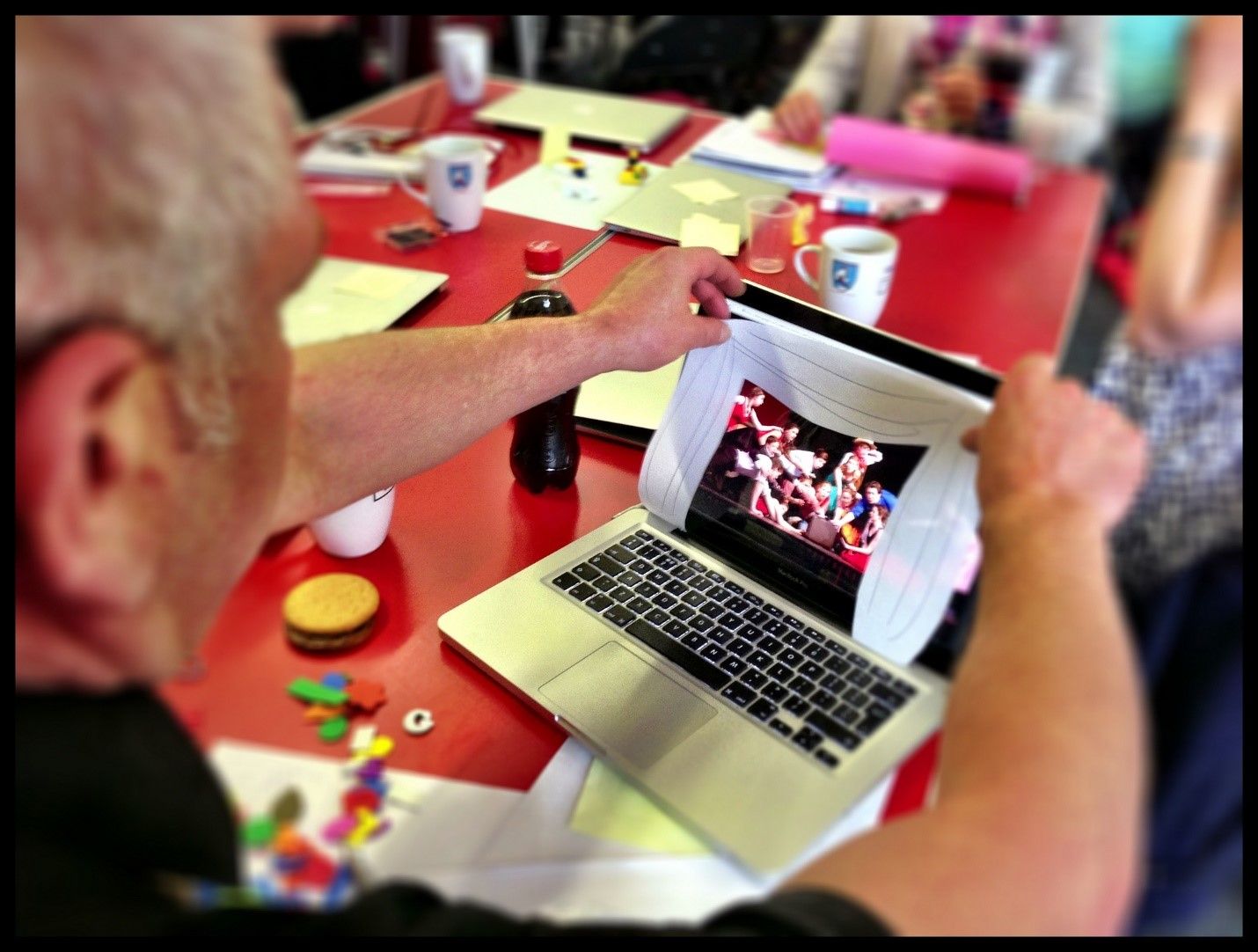
Sketches should be as simple and rough as possible with just enough detail to convey meaning.

Storyboard

Stories are a key medium for communication, learning, and exploring. Storyboarding is all about developing a visual story relating to the problem, design, or solution which you want to explain or explore. Storyboarding can help you bring a situation to life, it can show what happens over time, and explore the dynamics of a situation. You can use storyboarding after having empathised with people in order to better understand their lives. You can draw out their stories. Storyboards can help you represent information you gain during research. Create scenarios consisting of pictures and quotes from users. If you are developing ideas, you may then seek to play with different scenarios to see where they go. Develop a coherent storyline with actors and a plot. Try to build tension and include unexpected surprises in your story. Evoke emotions and show struggle and by the end learning and solving the tensions and leaving the user satisfied.

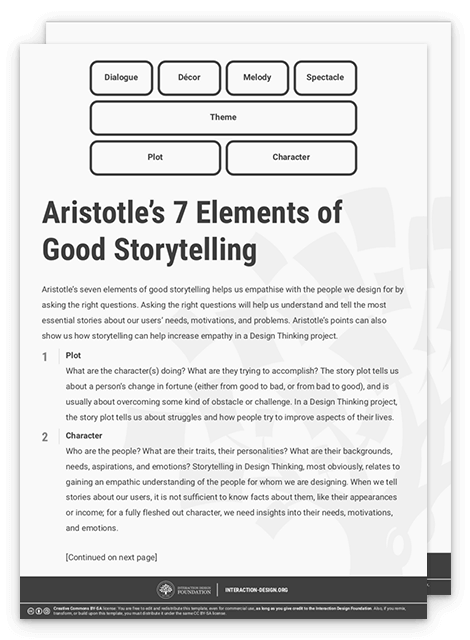
When you’re creating your storyboard you can seek inspiration in the method called “Aristotle’s seven elements of good storytelling” which you can download, print and use as your guide.

Advance Your Career With This Free Template for “Aristotle's 7 Elements of Good Storytelling”
Aristotle's 7 Elements of Good Storytelling
We respect your privacy
Get 1 powerful email each week: Design a life you love!

Bodystorm

Bodystorming is a technique in which participants physically act out situations they are trying to innovate within. It may involve expressing solutions to ideas through physical activity, or enacting some of the problem scenarios that we are attempting to solve. Physically acting out processes, scenarios and events helps get the ideation team physically involved instead of theorising about the problems. It combines aspects of empathy, brainstorming, and prototyping into one exercise with increased energy and movement, which helps stimulate higher energy and more meaningful experiences.

Bodystorming may include setting up the entire ideation space with props and artifacts, to recreate some semblance of the real environment in order to test out various scenarios and see how this may change the situation. The process may also include setting up various steps in a customer's journey.

Analogies

Storytellers, journalists, artists, leaders and all kinds of other creative professions have relied on creating analogies as a powerful tool for communicating and sparking ideas. An analogy is a comparison between two things for instance a comparison of a heart and a pump. We communicate using analogies all the time as they allow us to express our idea or to explain complex matters in an understandable and motivating way.

Provocation

Provocation is a lateral thinking technique, which challenges the status quo and allows you to explore new realities to extreme degrees. Lateral thinking distances itself from the classic method for problem solving where we work out the solution step-by-step from the given data.

Creativity is all about journeying through stimuli with a possibly abstract or unseen destination in mind. The route of the journey is unknown and most often requires you to explore multiple paths in order to arrive at the unknown destination. Provocations provide this mechanism for injecting the unconventional into the thinking patterns and exploration process. Provocations do not themselves lead directly to a final solution in most cases, although they do provide the material from which the new idea may be formed.

SCAMPER

SCAMPER is a lateral ideation technique that utilises action verbs as stimuli. It helps us ask seven kinds of questions to come up with ideas either for improvements of existing products or for making a new product.

Movement

The movement technique will also help you if you’re blocked in your idea generation. You can use this technique to step around the roadblocks in your thinking. As the Provocation technique Movement will help you force your team to question the status quo, shock yourself and your team into a new reality. This is the perfect “what if?” tool. Lateral thinking techniques do not always immediately result in concrete or usable ideas, but create a wide array of thinking stimuli, which you can leverage for piecing together practical ideas. To make use of the stimuli generated, it requires movement, or what some refer to as insight or principle mining. This tool will help you spot themes, principles, useful attributes or trends in your thinking, which you can use to build up a more viable and realistic ideas.

Gamestorming

Gamestorming is a set of ideation and problem-solving methods that are purposely gamified in order to dramatically increase levels of engagement, energy, and collaboration during group sessions. It involves some of the methods we've already mentioned, while adding gamification.

A few examples of gamified ideation sessions include:

  • Fishbowl: An ideation session in which participants sit in two circles, one smaller and one larger surrounding the smaller one. Participants in the inner circle discuss their ideas and brainstorm while participants in the outer circle listen, observe, and document the ideas and conversation points without saying anything. This forces some to listen and others to engage in brainstorming.

  • The Anti-Problem: The idea is based on flipping the problem. In the Anti-Problem is the opposite of the real problem that needs to be solved. In this session you seek to solve the anti-problem. This may provide inspiration that you could not have gotten access to by focusing purely on the real challenge, though it may generate ideas which are still related to the problem space. The ideas you generate can then be re-flipped to bring them back into the realm of the real problem.

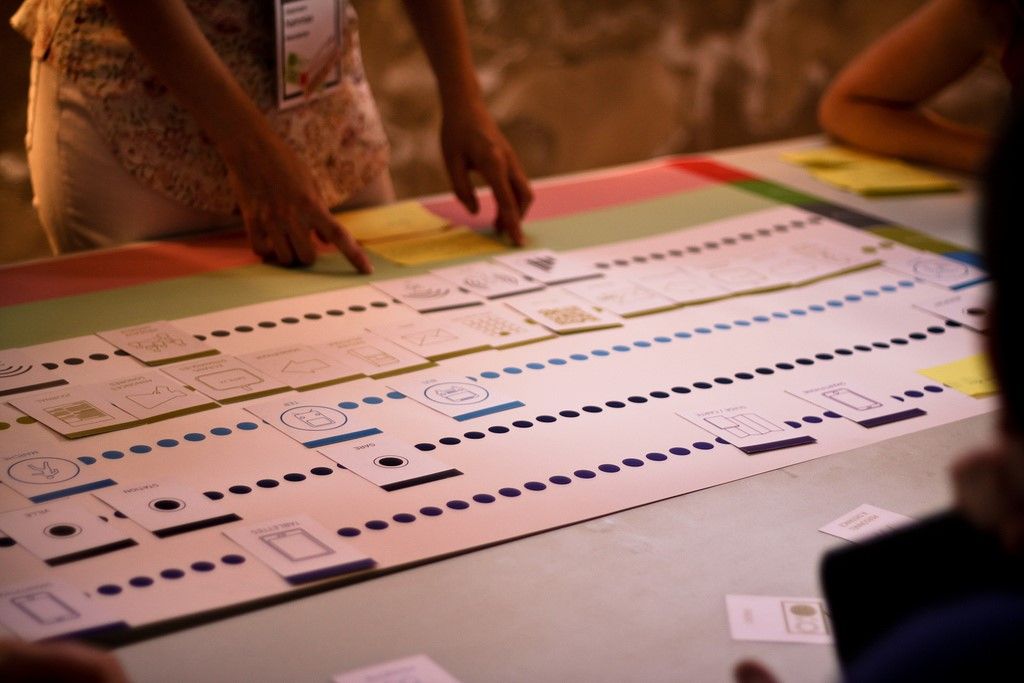
  • Cover Story: This involves using a template that forces participants to create a cover story, including main image, headline, quotes, and sidebars with associated facts etc. It is a good method for vision generation sessions and helps create a cohesive picture of a broad subject area using the primary characteristics.

Author/Copyright holder: Ewan McIntosh. Copyright terms and licence: CC BY-NC 2.0
Cheatstorm

Cheatstorming is less about coming up with new ideas and more of an early ideation technique for taking existing pools of ideas and leveraging them as input or stimulus. Unlike other ideation methods where the bulk of ideas generated are discarded, cheatstorming is a bit like cognitive sustainability, reusing and not wasting previously ideated material.

Crowdstorm

Another storm to consider involves the target audience to generate or comment and approve generated ideas. Customer or user feedback is important at every stage of the process and involving them to pick and evaluate ideas can lead to identifying possible winners or losers, which the team might have missed due to blind spots. Social media, customer surveys, focus groups and co-design workshops are all methods of getting the crowd to share their thoughts on the generated ideas. This process may not provide an ultimate winner but it will reveal valuable insights that can assist in the daunting decision relating to which ideas to proceed with.

Co-Creation Workshops

Author/Copyright holder: Swanny Mouton. Copyright terms and licence: CC BY-NC 2.0

There are times when combining customer or user empathy research, ideation, and prototyping might prove useful when rapidly combined.

There are times when combining customer or user empathy research, ideation and prototyping might prove useful when rapidly combined. Co-creation or Co-design workshops combine a number of Design Thinking methods over the course of a few hours to days or even weeks. They can be condensed into full day workshops and conducted a number of times at different locations in order to expedite findings and ideas from the target community. These sessions, if used as one-off workshops, usually follow a sequence that includes:

  • Introductions and Icebreakers

  • Vision and Values Exercises

  • Empathy Exercises

  • Insight Mining

  • Challenge Framing

  • Ideation

  • Prototyping

Prototype

Prototyping itself can be an ideation technique. When you create a physical object you need to make decisions and this encourages the generation of new ideas. You build to think.

Creative Pause

An important step in any ideation process or session is what Edward De Bono refers to in his book, Serious Creativity as the creative pause. When our neurons are firing away against a seemingly impenetrable brick wall challenge, we can easily get stuck into unconstructive thinking patterns. We become anchored to an early idea or stream of thought, or get caught up in negative thoughts surrounding the process. A creative pause gives us time to take a step back, reflect, extract ourselves from the traps we've cognitively set for ourselves, and re-approach the challenge with renewed freshness of the mind. We want proactive thinking to lead the way – not reactive thinking, which often has a negative orientated spin to it.

Author/Copyright holder: tsaiproject. Copyright terms and licence: CC BY 2.0

Creative pauses help us to not get anchored to an early idea or stream of thought or get caught up in negative thoughts surrounding the process. A creative pause gives us time to take a step back, reflect, extract ourselves from the traps we've cognitively set for ourselves, and re-approach the challenge with renewed freshness of the mind.

The Take Away

Ideation is at the heart of the Design Thinking process. There are literally hundreds of ideation techniques. Here we’ve provided you with an overview of the best techniques as well as when and why to use them. Due to the nature of ideation, it is extremely important to make use of techniques that match the type of ideas you're trying to generate. The techniques you choose will also need to match those of the ideation team members, their states of creative productivity, and their experience with ideation sessions.

References and Where to Learn More

Hero Image: Author/Copyright holder: Braden Kowitz. Copyright terms and licence: CC BY-SA 2.0

Edward De Bono. Serious Creativity: Using the Power of Lateral Thinking to Create New Ideas, 1993

Gabriela Goldschmidt. Chapter 9 Visual Analogy- a Strategy for Design Reasoning and Learning

Dave Gray. Gamestorming: A Playbook for Innovators, Rulebreakers, and Changemakers, 2010

Feel Stuck?
Want Better Job Options?

AI is replacing jobs everywhere, yet design jobs are booming with a projected 45% job growth. With design skills, you can create products and services people love. More love means more impact and greater salary potential.

At IxDF, we help you from your first course to your next job, all in one place.

See How Design Skills Turn Into Job Options
Privacy Settings
By using this site, you accept our Cookie Policy and Terms of Use.
Customize
Accept all

Be the One Who Inspires

People remember who shares great ideas.

Share on:

Academic Credibility — On Autopilot

Don't waste time googling citation formats. Just copy, paste and look legit in seconds.