Making Your UX Life Easier with the MoSCoW

• 8 min read

824 Shares

If you’re stuck trying to move a project forward because it seems like there are too many things to concentrate on then the MoSCoW method may help you get unstuck. It’s a prioritization technique which is easy to learn and simple to apply. It can also help you decide what’s really valuable for your UX projects before you get started on them.

There are many different prioritization techniques that can be employed on design projects but one of the simplest to use is the MoSCoW method. It’s used across all business disciplines to enable project teams to work with stakeholders to define requirements. It can also be used as a personal prioritization technique.

What Does MoSCoW Stand For?

MoSCoW is an (almost) acronym designed to reflect the four categories used by the technique to determine priorities; Must have, Should have, Could have and Would like but won’t get. The lower case “o’s” are added simply to give the acronym a pronounceable form. Occasionally, you may also see the whole phrase in block capitals MOSCOW to distinguish it from the name of the city but MoSCoW is more common.

What is the MoSCoW Method?
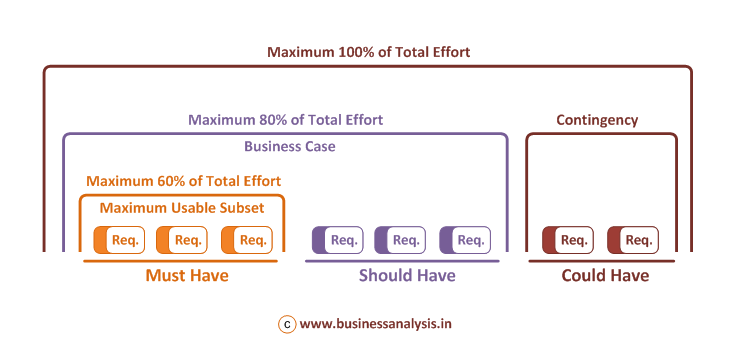

Author/Copyright holder: Busy BA. Copyright terms and licence: All rights reserved Img Src

Experts Dai Clegg and Richard Barker proposed the method in their paper “Case Method Fast-Track: A RAD Approach” and while it was initially intended to be used with the Dynamic Systems Development Method (DSDM) it has long since been adopted throughout many areas of business. In recent times it has become very popular in the Agile and RAD (rapid application development) communities.

The MoSCoW method is most effective when it comes to prioritizing requirements in projects with either fixed or tight deadlines. It works by understanding the idea that all project requirements can be considered important but that they should be prioritized to give the biggest benefits in the fastest possible time frame.

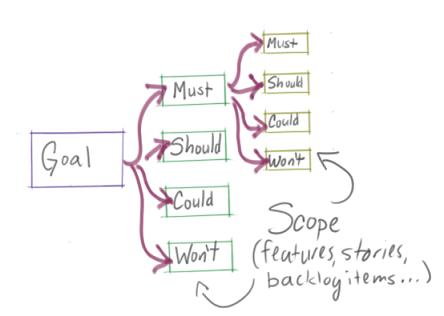
It breaks down the requirements into four categories:

Must have

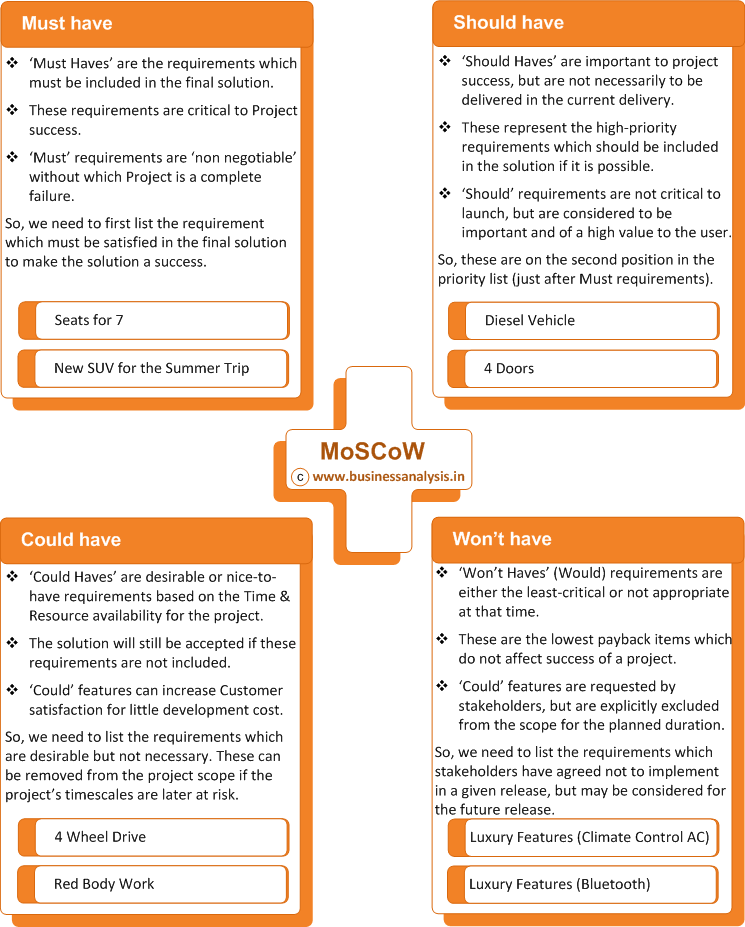
These are the requirements without which a project will fail. They MUST be delivered within the timeframe in order for anyone involved with the project to move on. In essence they make up the MVP (Minimum Viable Product) though it can be argued that MUST could stand for Minimum Usable SubseT too.

Should have

Should have requirements aren’t 100% necessary for delivering the project successfully but they are the “most nice to have” out of the list. They may be less time critical than “must have” or might be better held for a future release.

Could have

Author/Copyright holder: Busy BA. Copyright terms and licence: All rights reserved Img src

Could have requirements are just “nice to have” they are desirable to provide a nice user experience or customer experience but they’re not that important to the delivery of the project. They will be delivered only if there’s enough time and resources to spare to devote to them. Otherwise, they’re likely to be tabled for future releases and re-reviewed to see if they have become higher or lower priority in the interim.

Won’t Have

These are the requirements that everyone agrees aren’t going to happen. It might be because they cost too much to implement or provide too little ROI (Return on Investment) for the efforts required to implement them. These are simply left to one side until they are either removed from the requirements list or become a higher priority.

Overall

The MoSCoW method provides a simple way of clarifying the priorities involved on a project. It’s most useful in time bound situations and it can be used to prioritize your own workload (usually with the buy in from a supervisor or manager if you work for someone else) as easily as it can be used for project work.

Implementing MoSCoW – A Practical Process
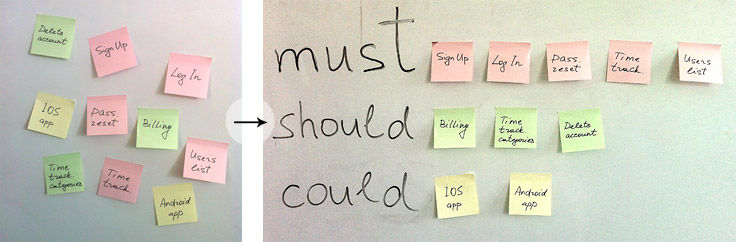

Author/Copyright holder: Railsware Blog. Copyright terms and licence: All rights reserved Img src

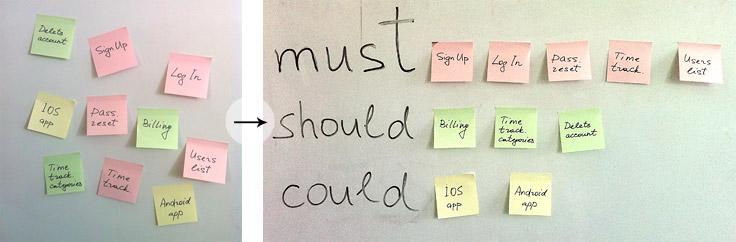
The easiest way to use MoSCoW is to bring together all the relevant stakeholders to the project and then:

  • List the requirements (on a flip chart or on a screen)

  • Vote on which category each requirement falls into (bearing in mind any hierarchical issues within the company itself – the CEOs vote may count for more than the votes of everyone else in the room)

  • Then collate the information and ensure that each requirement is presented against the relevant category in written form so that it can be used for reference by the project team

You can repeat this exercise whenever you feel it is necessary. Priorities may change mid-project or between releases. It’s important for everyone to understand what the implications of changing priorities in the middle of a project may be in terms of costs, resources, and time.

Issues with MoSCoW

It’s important to know that the MoSCoW method isn’t without its detractors. The main flaw in the method, as identified by authors Kark Weigers and Joy Beatty in their book Software Requirements, is that the method offers no means for comparing one requirement to another. This can make it difficult for those tasked with prioritizing requirements to know which category to place them in.

The Take Away

The MoSCoW method offers a simple process for prioritizing within project delivery. It can also be used to prioritize your work load. It should be used with some caution in that it may be too simple – particularly for complex projects – but it makes for a good starting point. One of the big advantages to its simplicity is that it should be easy to get buy in from other stakeholders to put it into practice.

References

Check out this useful study into how the MoSCoW method is used by business analysts.

You can read about the MoSCoW method as it was originally designed in: Clegg, Dai; Barker, Richard (2004-11-09). Case Method Fast-Track: A RAD Approach. Addison-Wesley. ISBN 978-0-201-62432-8.

You can read Weigers and Beatty’s criticism and their suggestion for a more complex method in: Wiegers, Karl; Beatty, Joy (2013). Software Requirements. Washington, USA: Microsoft Press. pp. 320–321. ISBN 978-0-7356-7966-5.

Hero Image: Author/Copyright holder: Agile Connection. Copyright terms and licence: All rights reserved. Img


Learn More in This Course:

AI for Designers

12 days
13 % booked
View Course

What You Should Read Next

  • Read full article
    What is Interaction Design? - Article hero image
    Interaction Design Foundation logo

    What is Interaction Design?

    Interaction design is an important component within the giant umbrella of user experience (UX) design. In this article, we’ll explain what interaction design is, some useful models of interaction design, as well as briefly describe what an interaction designer usually does.A simple and useful unders

    Social shares
    1.5k
    Published
    Read Article
  • Read full article
    Apple’s Product Development Process – Inside the World’s Greatest Design Organization - Article hero image
    Interaction Design Foundation logo

    Apple’s Product Development Process – Inside the World’s Greatest Design Organization

    Apple’s Product Development Process may be one of the most successful design processes ever implemented. With a valuation that exceeds $2 trillion, there’s a lot that designers can learn from Apple and introduce into their own design environments.Apple is a notoriously secretive business. In Steve J

    Social shares
    1.4k
    Published
    Read Article
  • Read full article
    Shneiderman’s Eight Golden Rules Will Help You Design Better Interfaces - Article hero image
    Interaction Design Foundation logo

    Shneiderman’s Eight Golden Rules Will Help You Design Better Interfaces

    Follow Ben Shneiderman’s 'Eight Golden Rules of Interface Design' if you want to design great, productive and frustration-free user interfaces. Apple, Google and Microsoft are among some of the highly successful companies whose well-designed products reflect Shneiderman’s rules. The characteristics

    Social shares
    1.4k
    Published
    Read Article
  • Read full article
    How to Change Your Career from Graphic Design to UX Design - Article hero image
    Interaction Design Foundation logo

    How to Change Your Career from Graphic Design to UX Design

    If there’s an occupation that is 100% linked with the public’s idea of what design is all about, it’s graphic design. From the familiar golden arches of the McDonald’s brand to the typography and colors of movie posters, graphic designers create some of the most iconic and ubiquitous designs around

    Social shares
    1.4k
    Published
    Read Article
  • Read full article
    The Grid System: Building a Solid Design Layout - Article hero image
    Interaction Design Foundation logo

    The Grid System: Building a Solid Design Layout

    Now that we’ve seen some grids at work in the Rule of Thirds article, let’s examine them a little more deeply. As a concept that deals so fundamentally with the fabric and background of our work as designers, it’s easy to overlook the power of grids and think more about the elements we want to creat

    Social shares
    1.4k
    Published
    Read Article
  • Read full article
    The Principles of Service Design Thinking - Building Better Services - Article hero image
    Interaction Design Foundation logo

    The Principles of Service Design Thinking - Building Better Services

    Service design is all about taking a service and making it meet the user’s and customer’s needs for that service. It can be used to improve an existing service or to create a new service from scratch. In order to adapt to service design, a UX designer will need to understand the basic principles of

    Social shares
    1.4k
    Published
    Read Article
  • Read full article
    A Simple Introduction to Lean UX - Article hero image
    Interaction Design Foundation logo

    A Simple Introduction to Lean UX

    Lean UX is an incredibly useful technique when working on projects where the Agile development method is used. Traditional UX techniques often don’t work when development is conducted in rapid bursts – there’s not enough time to deliver UX in the same way. Fundamentally Lean UX and other forms of UX

    Social shares
    1.3k
    Published
    Read Article
  • Read full article
    Dieter Rams: 10 Timeless Commandments for Good Design - Article hero image
    Interaction Design Foundation logo

    Dieter Rams: 10 Timeless Commandments for Good Design

    Let’s pay a virtual visit to a famous industrial designer’s workshop. By examining the principles of his winning approach, we can incorporate vital elements into our designs in the “less is more” age.As user experience practitioners, most of us have worked with Nielsen and Molich’s 10 heuristics or

    Social shares
    1.3k
    Published
    Read Article
  • Read full article
    The 7 Factors that Influence User Experience - Article hero image
    Interaction Design Foundation logo

    The 7 Factors that Influence User Experience

    User Experience (UX) is critical to the success or failure of a product in the market but what do we mean by UX? All too often UX is confused with usability which describes to some extent how easy a product is to use and it is true that UX as a discipline began with usability – however, UX has grown

    Social shares
    1.3k
    Published
    Read Article
  • Read full article
    10 Free-to-Use Wireframing Tools for UX Designers in 2026 - Article hero image
    Interaction Design Foundation logo

    10 Free-to-Use Wireframing Tools for UX Designers in 2026

    Wireframes help you quickly ideate and test your ideas. While paper wireframes are the fastest to create, digital wireframes look more polished and presentable. If you are looking for a pocket-friendly wireframing tool, look no further.Whether you prefer browser-based apps or offline desktop tools,

    Social shares
    1.3k
    Published
    Read Article

Top Articles

Top Topic Definitions

Feel Stuck?
Want Better Job Options?

AI is replacing jobs everywhere, yet design jobs are booming with a projected 45% job growth. With design skills, you can create products and services people love. More love means more impact and greater salary potential.

At IxDF, we help you from your first course to your next job, all in one place.

See How Design Skills Turn Into Job Options
Privacy Settings
By using this site, you accept our Cookie Policy and Terms of Use.
Customize
Accept all

Be the One Who Inspires

People remember who shares great ideas.

Share on:

Academic Credibility — On Autopilot

Don't waste time googling citation formats. Just copy, paste and look legit in seconds.

Feel Stuck? Want Freedom?

Join 326,029+ designers who get one powerful email each week. Learn to design a life you love.

Next email in
1
day
13
hrs
51
mins
18
secs

Free forever. No spam. Unsubscribe anytime.