One of the biggest challenges facing designers is how to begin and how to further their design education. Do you go for the university degree or book-learning or e-learning or pay for classroom learning? While we all have some natural preference for one (or more) of these learning methods, one thing we really need to consider is the return on investment for the path we choose.
Return on investment is the amount of money that we expect to earn over and above the costs of the learning experience. The higher the return on investment, the better the learning opportunity is for us.
About Return on Investment
The formula for Return on Investment (ROI) is as follows:
ROI = Profit/Investment * 100
Let’s take a look at each of those terms:
Profit
When we talk about profit in terms of learning for ourselves, we’re not talking about company profits. We’re looking instead at personal profit, and that is measured by how much extra money we will earn based on either promotion or a salary raise or a job change (to a job the pays more than our original salary).
This isn’t quite as simple as taking say a $2,000 raise and multiplying it by the expected length of our careers. Why? Because $2,000 in 20 years’ time is going to be worth much less than $2,000 today. So when we calculate the “profit” from learning we also need to adjust the calculation so that we examine how much all that extra money would be worth today (which is when we’re paying for the learning).
To do this we use a calculation that is very standard for calculating present value, which you can find here on our website.
Profits are calculated as the money you make, subtracted with the investment you made. So if you make $20,000 and you spend $10,000 to do so, your profit is $10,000.
Profit = Return – Original Investment
Investment
Investment is more than just the direct cost of the learning experience. It is also the cost of the missed opportunities that form part of the learning. So, for example, if you want to go to study a degree at university, you’re not just paying the course fees, living costs, etc., but you’re also giving up the chance to work a full-time job for the 3-4 years of the course. The 3-4 years’ salary you lose is known as an “opportunity cost”. Opportunity costs can often outweigh the costs of the learning experience and it’s very important to take them into account.
Investment = Direct Costs + Opportunity Costs
ROI
ROI itself is expressed as a percentage. That’s why we multiply by 100 at the end of the formula. The formula can produce a negative ROI (when the investment results in a loss rather than a profit). As a general rule, you want to achieve the highest possible positive ROI for your investment.
Calculating ROI for Design Learning Experiences
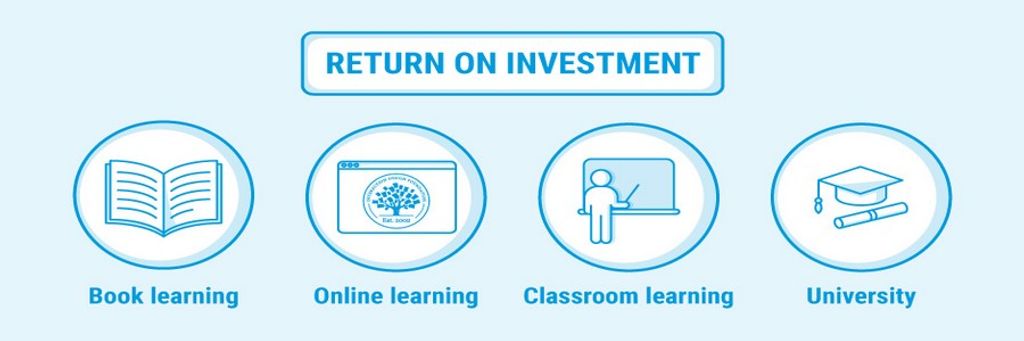
There are many types of learning experience and it’s not possible for us to cover them all. However, it is important that we work through a number of learning experiences, so that you understand how this calculation works. So for this exercise we’re going to look at the four most common learning experiences and try to provide some insight into each:
Book learning
Online learning
Classroom training
University
Book Learning and ROI
Yes, there are still people who learn from books. We’re big believers in book learning. It’s a very cheap and effective way to learn about something. You can do it in your own time and at your own pace.
The only downside of book learning is that it can be hard to persuade an employer of the value of a learning experience without some sort of certificate to “prove you know your stuff”.
A typical educational book costs around $50 (though some can cost more and some can cost less). That’s not a huge amount of money. There’s no opportunity cost to book learning in most cases as it’s something we do in our spare time. (Though there is an opportunity cost in “having fun” as you can’t play cricket or go for a walk in the woods while you read a book, there’s no financial cost to this opportunity).
In a lot of cases the “profit” on book learning, however, will be minimal. Most books that we read just help us get a bit better at our jobs. That means this kind of learning tends not to lead to promotions but rather modest annual pay rises when we show that we’ve learned a bit more than our peers. We’re going to put an arbitrary figure on that now and say that it’s worth $500 a year in pay rises. We’re also going to assume in all these examples that the value is paid out over 20 years.
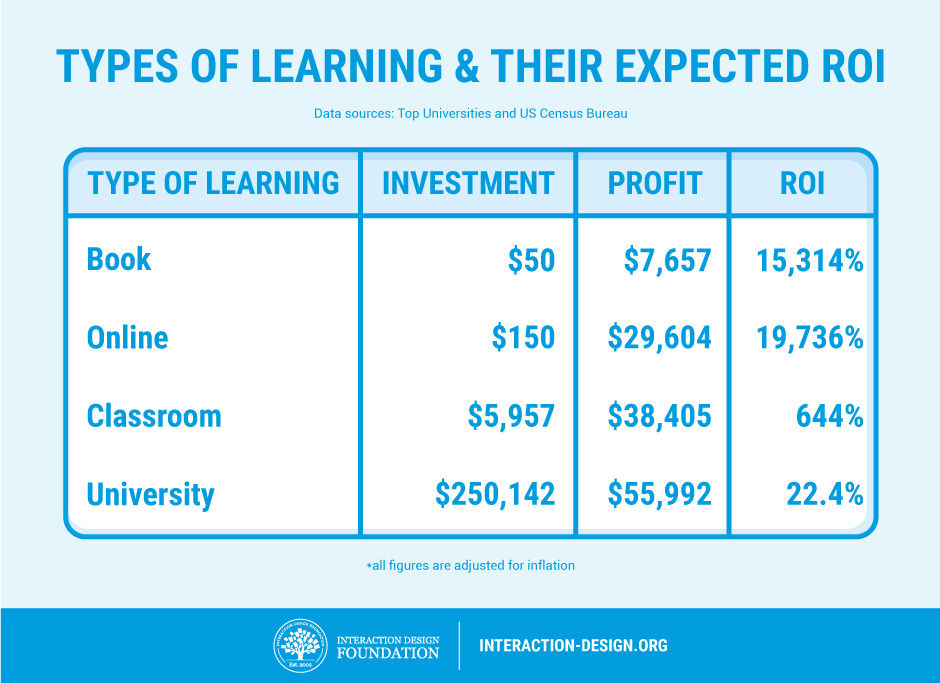
When we account for what $500 a year for 20 years is worth today, assuming a 3% decrease in value annually (roughly the rate of inflation), we find that the return on our $50 book is $7,707 in today’s terms. That’s a profit of $7,707 - $50, which is $7,657.
So let’s put that into our ROI formula:
ROI = Profit/Investment * 100
ROI = ($7,707 - $50)/$50 * 100 = 15,314%
That’s an incredible ROI of more than 15,000%! That book might not bring about a huge increase in salary but that little bit of extra money we got as a raise? It turns out reading that book was very profitable for us indeed.
Online Learning and ROI
There are a lot of online learning providers for designers. However, as the Interaction Design Foundation (IDF) has the world’s largest design specialist learning community, we’re going to use our own figures for the next ROI calculation.
You can do more with an IxDF membership than just study a single course or read a single book. We estimate that if somebody puts in just 15 minutes of their time a day, they could complete between 6 and 8 courses or read between 6 and 8 books in the course of a year. That’s for the princely sum of about $150 a year (it varies slightly depending on the currency you use to pay for it).
There are no real opportunity costs with online learning; if you’re doing 15 minutes a day over a year then you can probably squeeze that in while waiting for meetings at work.
IDF courses do come with certificates of completion and those certificates can be used to demonstrate learning and growth to employers unlike with straight book learning. We’d like to think that a year’s study of 15 minutes a day would give someone the leverage either to get their first design job or to secure a healthy pay rise or even a promotion. Certainly, feedback from our members tells us that this is a fairly normal occurrence. So let’s put a value on that at $2,000 a year. It’s more than reading a book but not a stratospheric amount of money either.
We do our profit calculation over 20 years with a 3% annual discount and find that the return is $29,754; the profit (the return less our $150 membership) thus comes out at $29,604.
So let’s put that into our ROI formula:
ROI = Profit/Investment * 100
ROI = $29,604/$150 *100 = 19,736%
That’s also an incredible ROI of more than 19,000% Someone spending 15 minutes a day on our e-learning programs can make a very healthy return on their membership fees.
Classroom Learning and ROI
A lot of classroom learning is learning that is mandated by an employer. It’s used to fill a skill/knowledge gap quickly. However, there are courses that help you learn skills which you might sign up for to improve your job prospects.
The Nielsen Norman Group is one of the world’s most renowned UX consultancies and they offer a series of one-day courses to help you transition into the world of UX. Their 7-day program for this costs $4,957.
If you intend to attend a week’s training in a classroom, you’ll have to take a week off work to do so. So there’s an opportunity cost associated with attending a classroom course of 1 week’s wages. To make this easy to calculate we’re going to assume that you earn exactly $52,000 a year. That makes 1 week’s wages worth $1,000.
Your total investment is then $4,957 + $1,000 to give a total of $5,957 (though if you have to travel to the course or stay somewhere while it’s on, this cost would go up).
Just like our courses, these courses come with certifications at the end which will help you persuade employers of their value. This should translate into more money in your pay packet; we’re going to be generous and say that because of Nielsen Norman Group’s reputation in the industry it’s going to give you a higher rise than if you’d done your learning online. (Though we should note—this is probably not true, as employers generally care about skills more than where you got them from). So we’ll say you earn $3,000 more a year because of the classroom training with them.
Once again we do our profit calculation over 20 years and find that your return is a healthy $44,362 and your profit is $38,405.
So let’s put that into our ROI formula:
ROI = Profit/Investment * 100
ROI = $38,405/$5,957 * 100 = 644%
That’s not too shabby either, a more than 600% return on your investment over 20 years. Classroom training may not offer quite such dramatic returns as plain old book learning or online learning but it’s healthy enough to be worth considering if you have $5,957 to spend.
University Degrees and ROI
The cost of university varies from country-to-country. So for our example we’re going to use figures based on the American (USA) system. According to HSBC’s figures, as reported by Top Universities(2), the average cost of a US university course per year is $36,564. That includes tuition, rent, and other living expenses. The average American degree lasts for 4 years, and taking inflation into account, that’s a total cost of $135,912.
There is also an opportunity cost associated with a degree. If you study full-time for 4 years, you can’t work full-time. The average high school leaver in the United States earns $30,731 a year according to the US Census Bureau (3). That’s a total opportunity cost over 4 years of $114,230 after considering inflation.
That gives us a present value of the total investment in a university degree of $250,142.
The US Census Bureau also reported that the average graduate earns $20,577 a year more than the high school leaver. We’re going to use that figure as the amount of money you’ll be earning more as a result of your 4-year university course. That’s $306,134 over 20 years based on the present value of that premium, giving us a profit of $55,992.
So let’s put that into our ROI formula:
ROI = Profit/Investment * 100
ROI = $55,992/$250,142 = 22.4%
That’s a much lower ROI than any other form of learning, at just over 22%. However, it is also worth noting that $55,992 is still more of profit than we attribute to the other forms of learning too.
A Little Bit More on ROI
Our ROI calculation is a bit different from other ROI calculations done, to try and stretch the value of different learning experiences across a career. We’ve used low estimates for the value of the 3 non-university forms of learning because there isn’t an easy-to-find number on these things.
We’ve also only calculated ROI over 20 years rather than 40 or even 50 as many companies and universities like to do. Why? Because we don’t believe that the impact of a 40-year-old learning event is anything at all on your bottom line. We’re not even sure that it will have an impact in 20 years, but our use of present value (rather than future value as in most calculations) means that we’ve diminished the impact of learning over time rather than keeping it at its maximum. We think it’s a fair number.
We’ve also taken into account the opportunity costs of learning; that’s something that we find institutions selling degrees, in particular, neglecting to mention. For the first three forms of learning we examine, the opportunity costs are pretty low, but when you realize that they make up more than $111,000 in the case of a 4-year degree, they become pretty substantial.
However, the most important thing for you to realize is that the ROI given here is an average. While the average college graduate, for example, may make more than the average high school leaver, there are a ton of college graduates who don’t.
It’s entirely possible that when you invest in learning that it might not achieve the outcomes you hoped that it would. That’s why when you evaluate your ROI calculations, you also want to look at the risk vs. the overall return. When you buy a book to improve your career prospects, you’re risking $50 on the hopes of making $7,657. When you sign up to the IxDF, you risk $150 on the hopes of making $29,604. When you take a Nielsen Norman Group course, you risk $5,957 on the hopes of making $38,405. All of which are pretty good risk vs reward outcomes.
However, when you sign up for a degree, you are betting a whopping $250,142 that you will make $55,992 more in the future. That’s not a very solid risk-to-reward ratio.
In fact, Forbes magazine shows that many college degrees have a poor ROI and some will lose you a ton of money.
It’s also worth noting that university degrees from top institutions with incredible reputations in their field can product startlingly higher rates of ROI than those listed above. If you can get into MIT, Harvard, Oxford, Cambridge, etc. then there’s a very good chance of a degree delivering better results than our calculations show.
We’d also like to point out that degrees aren’t mandatory in business, no matter how much it may seem like that when you’re 18. In particular, technical professions (such as development and UX design) will often prefer experience gained in the real world to any amount of paper.
Break-Even Point Calculations
The break-even point is when your investment in your education returns exactly what you spent on that education and nothing more (i.e. when the ROI is 0%). It’s another way to examine the risks involved in your investment. So we’ve taken each form of learning and worked out what you’d need to add to your salary (each year for 20 years) to break-even on that form of learning, and as always we’ve accounted for present vs. future value:
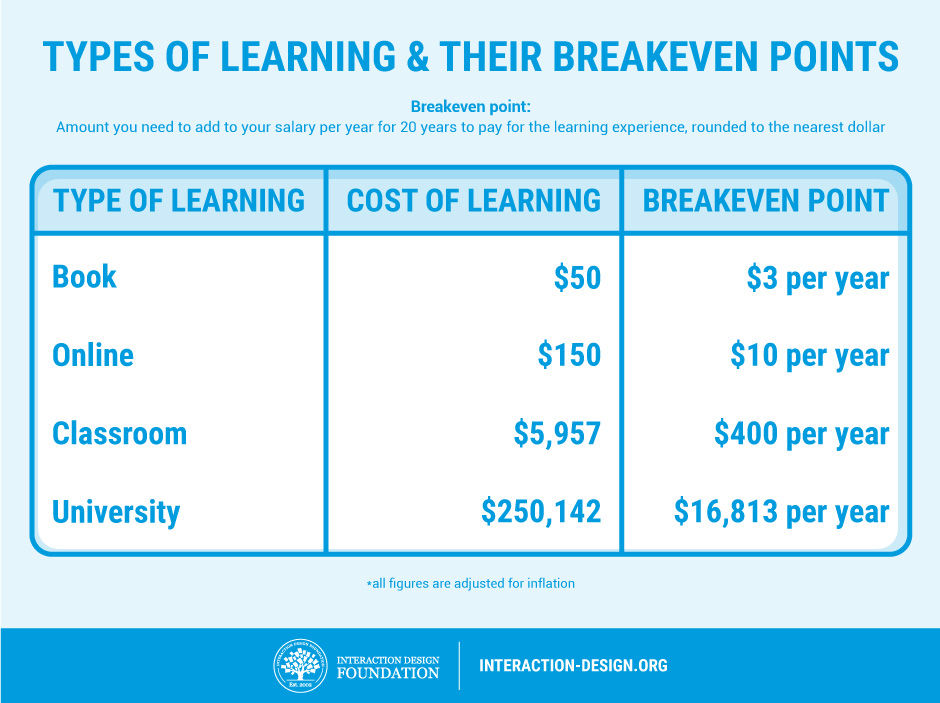
As you can see, it takes a very substantial boost to your salary to make university education pay for itself; you don’t need anywhere near as much of a boost to pay for other forms of learning. In fact, in most Western countries a single great pay review, attributable to the learning experience, would pay for book, online or classroom learning in its entirety.
The Take Away
Calculating return on investment for learning is a useful thing to do. It helps you understand the potential payoffs and the potential risks of any form of learning. Of course, ROI isn’t the only measure of value in education. There’s a lot to be said for learning for learning’s sake. However, when you’re trying to invest in your future career ROI is a vital measure of the value you will get for your investment. The break-even point can be very useful to help you see exactly what a learning experience must provide to pay for itself.
Reference & Where to Learn More
How to calculate the present and future value to determine value over time.
How much does it cost to study in the US?
Earnings by education: US Bureau Of Labor Statistics.
The 25 colleges with the worst return on investment.