Design management is a large and complex field with many sub-types of management involved. Many UX designers will want to pursue design management either directly or indirectly within the scope of their careers. By introducing yourself to the concept of design management you can begin to understand what aspects appeal to you as an individual most and then begin to steer your career in the appropriate direction.
Design Management
Your constantly-updated definition of Design Management and collection of videos and articles.
Be a conversation starter: Share this page and inspire others!
Get 1 Powerful Email Each Week
Join 313,382 subscribers.
What is Design Management?
Learn More About Design Management
Make learning as easy as watching Netflix: Learn more about Design Management by taking the online IxDF Course UX Management: Strategy and Tactics.
Why? Because design skills make you valuable. In any job. Any industry.
Earn Industry-Recognized Certificates
Industry giants trust our courses to train their teams, and prestigious universities integrate our content into their curricula. Add your certificates to your LinkedIn profile, résumé, and job applications.


All Free IxDF Articles on Design Management


Design Management (An Introduction) - Taking Charge of Processes and People
Design management is a complex field; it doesn’t relate to a single design discipline and the exact responsibilities attached to a design manager will depend on the organization they work for, the size of that organization (and the tier in the hierarchy at which the manager operates), the industry t
- Social shares
- 1k
- Published
Read Article
Stand on the shoulders of giants and follow international standards
Design can be very subjective. This leads UX practitioners facing criticism and a lack of credibility when dealing with other more scientific disciplines. Fortunately, you can rely on international standards to refer to and easily bridge the gap. The ISO 9241 Standard for the Ergonomics of Human-Sy
- Social shares
- 698
- Published
Read Article
The Tipping Point in UX Design
The Tipping Point was postulated by the best-selling author Malcolm Gladwell. He wanted to examine change in society and he concluded that extreme changes happen both quickly and unexpectedly.He came to the conclusion that new ideas can spread virally; in the same way that diseases can spread in epi
- Social shares
- 616
- Published
Read Article
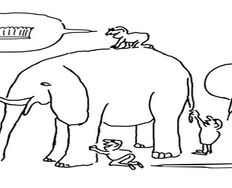
6 Blind Men Walk Into a Bar… The UX Punchline
The blind men of our tale begin their day in a bar. They are drinking together when a man runs in and says; “I have a problem! I have found this amazing creature but I don’t know what it is!”Unfortunately, for our befuddled zoo keeper – there are no customers in the bar except the blind guys. Howeve
- Social shares
- 592
- Published
Read Article
Design Management (An Introduction) - Taking Charge of Processes and People

Design management is a complex field; it doesn’t relate to a single design discipline and the exact responsibilities attached to a design manager will depend on the organization they work for, the size of that organization (and the tier in the hierarchy at which the manager operates), the industry they work in, the current market position and to a large extent the perceived importance of design to the business.
That means that defining “design management” becomes a near impossible task. However, it is fair to say that design management in general works to support design within a business, the business and its objectives and the business’s interface with the market it operates in. This leads to three general roles that design managers will fulfill:
Ensuring that design strategy and activities are in keeping with the larger business strategy
Ensuring the quality of the outcomes of design activities within their remit
Ensuring that user experience is prioritized and ensuring that it is user needs that create new products and differentiation from the competition
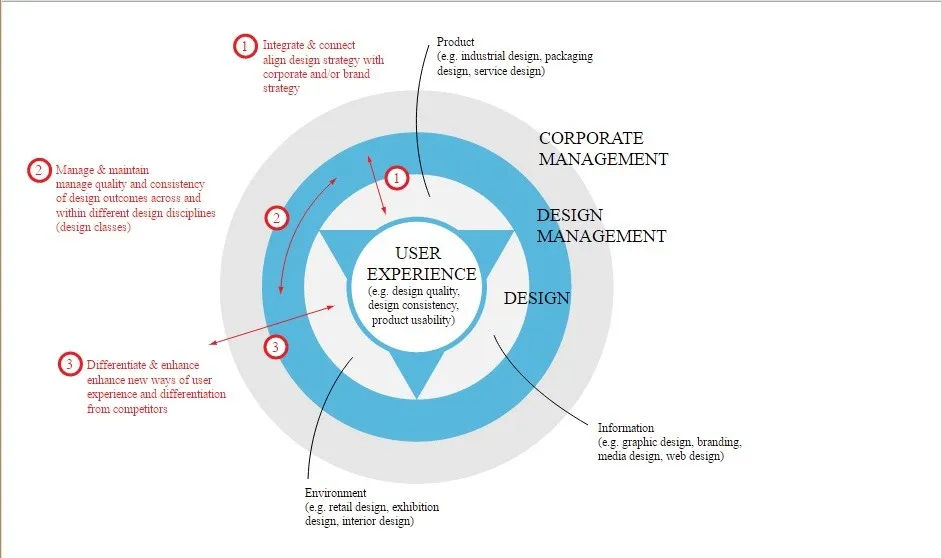
An example of how design management might be incorporated in a UX design working environment.
© Wiki4de, Fair Use
Design and Management
We take design at its most simple definition that of a practical approach to problem solving. This remains true from industrial design to service design – designers build products and/or services to solve user and customer problems.
Management, in any business activity, is the act of working with people and processes to reach organization objectives in the most efficient manner possible. It can include planning, organizing, controlling, staffing and directing people and processes.
What it does not include is leadership. While some managers are leaders many are not and leadership is effectively bestowed upon a person by those who follow a leader and cannot be dictated by corporate position. Leadership is a proactive pursuit and leadership may change within a group dynamic depending on the situation currently being faced – management on the other hand is constant and more reactive. As Peter Drucker, the world renowned management consultant says; “Management is doing things right; leadership is doing the right things.”
The Evolution of Design Management
Design management has only been formalized as an individual discipline quite recently (in the latter half of the 20th century) however; the tasks of design management have been taking place since the earliest corporations began to invest in design.
Before the 1960s design management was mainly concerned with managing the aesthetic components of design in terms of products and the corporate brand.
In the 1960s and 1970s design management became concerned with systemizing the design function so that output became more reliable – checklists and tools for quality control became more widely used.
Then in the 1980s and 1990s design managers became more high profile as their contributions to a business’s success became better understood and the focus of design management became more strategic with the objective being to secure design as a strategic asset. Design began to work alongside production and marketing at the highest levels of organizations.
In the 2000s (and until now) the focus shifted again. Design started to become a proactive strategic tool and managing design was now all about ensuring the ability to innovate and lead markets rather than to respond to market needs.
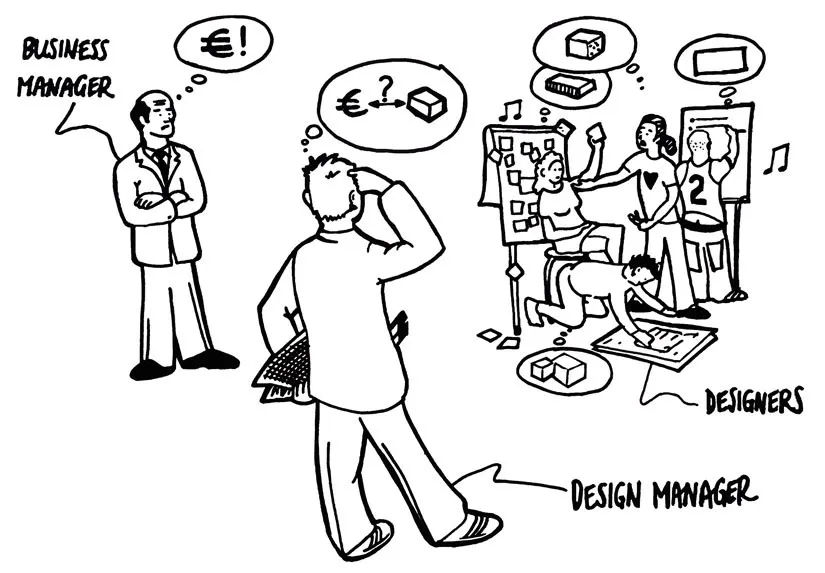
Design managers aren’t just involved with the needs of design – they’re also involved with the larger needs of the business as this cartoon shows.
© Wiki4des, CC BY-SA 3.0
Areas of Design Management
As we said at the start of this piece; design falls into a large number of disciplines and thus so too does design management. Some of the more common areas in which design management can be found include:
Product design. The manager here will be looking at managing all functions related to product development and release and securing relationships with other business units to facilitate this. A user-centered (or UX centered) approach is commonly the guiding force for this work.
Brand design. Responsibilities here are for brand experience, developing touch points, and creating reliable, trustworthy perspectives that are strongly recognizable to clients.
Service design. The flip side to product design and something that is becoming increasingly importance with the rise of the product-service hybrid. Service design takes a customer experience (CV) or customer-centered approach.
Business design. Business design is an emerging concept – it’s the understanding that businesses can be designed from within to operate more efficiently and at higher levels of effectiveness. Typically, a business design manager will need to be very effective at persuading others of the utility of their designs.
Engineering design. Engineering design is more concerned with technological outputs than other disciplines of design – be it a technological process (such as manufacturing) or technological artifacts (such as a system).
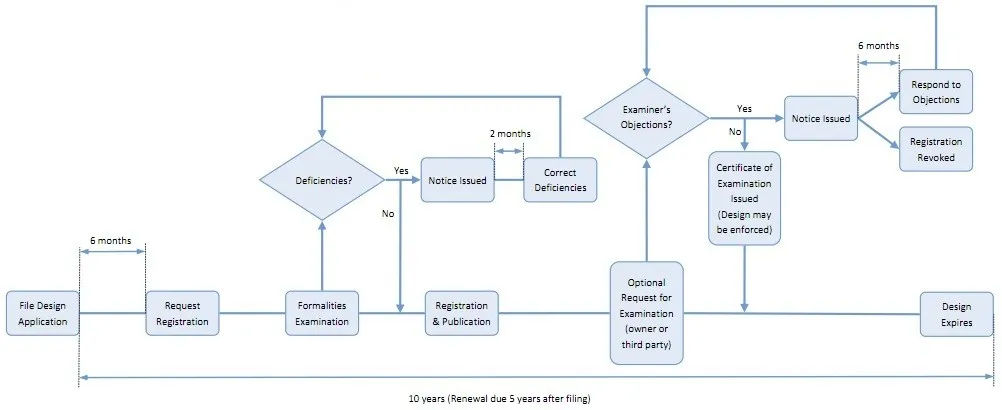
Where design management is best employed often depends on the processes of the business. Like this industrial engineering process – there’s design management throughout the process if you look carefully.
© Chris Baxter, CC BY-SA 3.0
Why Does Design Management Matter?
Design management matters because, for the vast majority of companies not engaged in simple reselling, design offers the only opportunity for a company to innovate and differentiate itself from competitors.
Design management allows companies to better control their design process and enhance:
Their internal business processes – cutting out waste and inefficiency in processes may not be visible to the company’s clients but it will be clearly beneficial to the company in terms of reduced costs.
Their learning and growth curve – design knowledge can be applied to learning and development too, thus focus is brought to strategic integration and the quality of employees on the ground.
Customer and brand relationships – design as applied to brand ensures strategic positioning and market differentiation in customer’s eyes.
Finances – design efforts should either increase sales or reduce costs to demonstrate strategic value and measurable value for the business.
Where Does Design Management Fall Within Businesses?
Design managers will find themselves operating in businesses with one of these strategic orientations:
Product-driven companies. In this instance it’s likely that the majority of design will fall within the company’s research and development function.
Market-driven companies. In these businesses design is likely to belong within the marketing department.
Brand-driven companies. These companies will often place design within the corporate communications department.
There are also three levels of corporate hierarchy that design managers operate from within:
Operational. This is the “doing” of design and is concerned with managing projects and teams that deliver on the business strategy. Good managers will be able to measure performance in terms of outcomes. Common job titles for design managers here include: operations design manager, design team lead, senior designer, etc.
Tactical. This is the “structuring” of design within a business – determining how projects are coordinated to achieve higher objectives, managing the skill and competency frameworks for design in a business, creating high-level systems for cooperation or support of design, etc. Common job titles at this level include: brand design manager, tactical design manager, design director, etc.
Strategic. This is the “direction” of design within a business – the determination of how design will meet corporate strategy and the development of the individual design strategy. Common job titles at this level include: design director, vice-president for design, chief design officer, etc.
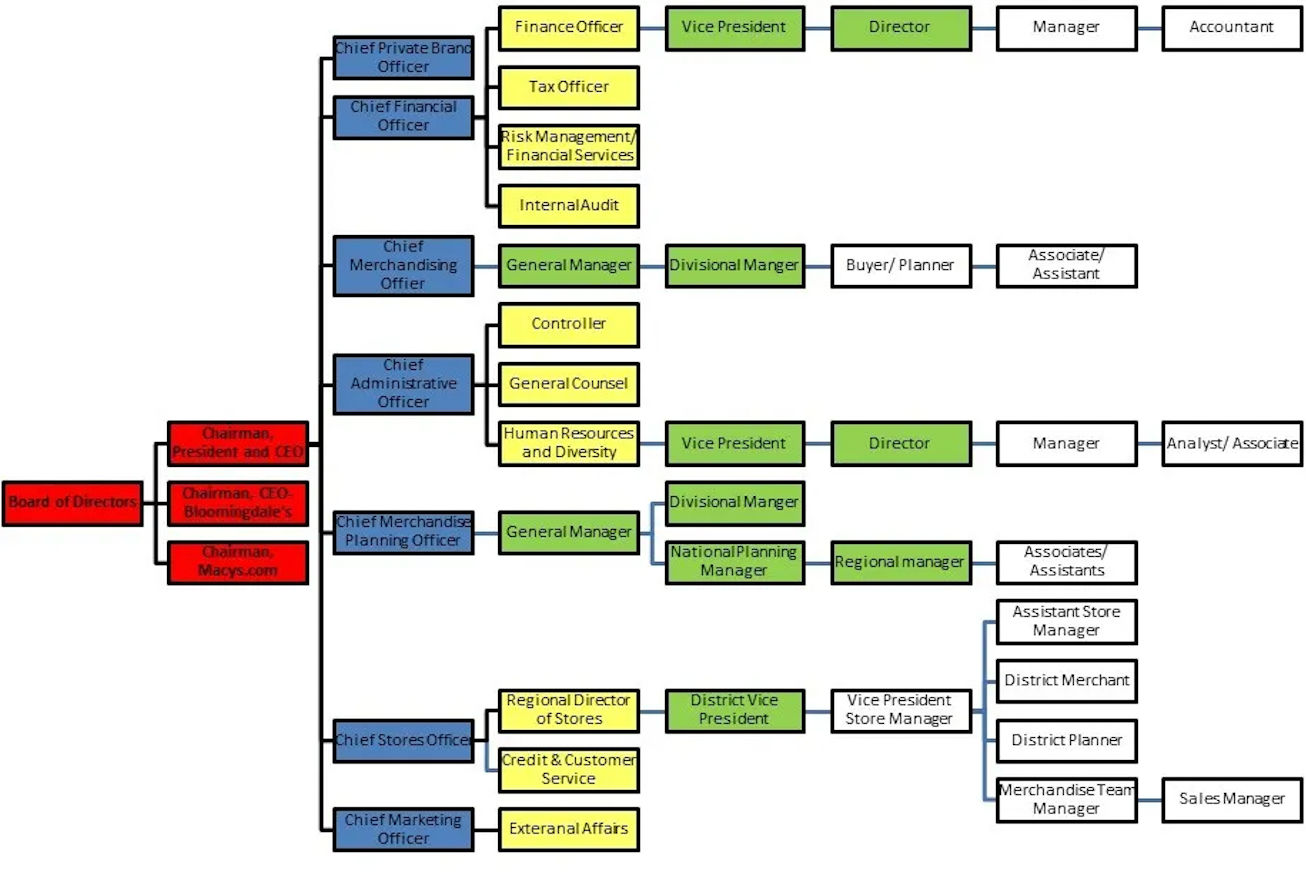
Management structures can vary significantly from one company to another (this is a snapshot of Macy’s the American brand’s hierarchy) and thus it’s hard to say with certainty where design management will be in any given company.
© Aevans75, CC BY-SA 3.0
The Take Away
Design management is both necessary and complex. Designers who want to enter design management will need to think about their objectives and where they want to direct their career long-term. It is not always easy to move from one type of management to another (whether sideways or up the ladder) and it’s better to position yourself early to be where you want to be. However, that doesn’t mean that a manager stuck in a role that they no longer enjoy should not pursue a change even if there are obstacles to achieving that change.
Resources & Where to Learn More
Check out our “UX Management: Strategy and Tactics” course.
Read The Design Management Institute’s definition of design management
Image
Hero Image: ©Jason Goodman, Unsplash License