Cheatstorming is an ideation technique that primarily uses existing ideas from previous brainstorming sessions as input, rather than new ones. Unlike other ideation methods that discard most generated ideas, cheatstorming practices cognitive sustainability through reuse—to not waste previously ideated material.
Cheatstorming vs. Brainstorming: What’s the Difference?
Brainstorming and cheatstorming are two techniques used to generate ideas, but they differ significantly in their approach and objectives; however, both help overcome the initial barriers to creativity especially when used together.
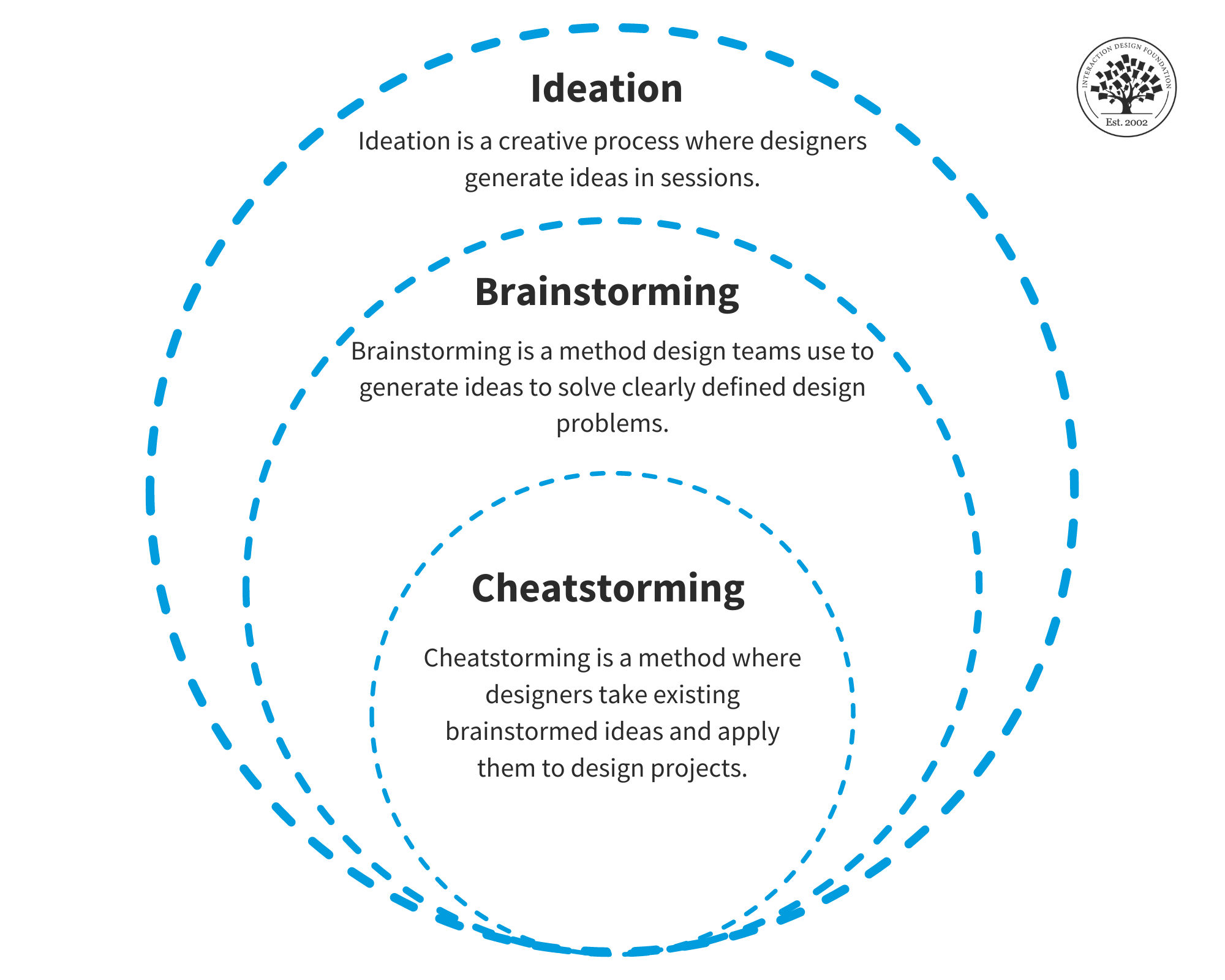
Cheatstorming is another ideation method that falls under the umbrella of brainstorming, without starting from zero.
© Interaction Design Foundation, CC BY-SA 4.0
Brainstorming opens the problem space with a breadth of new ideas, while cheatstorming provides a shortcut to innovation by adapting existing ideas to new contexts.
Furthermore, brainstorming is a widely recognized idea generation technique where participants generate a large quantity of ideas in a group setting to encourage a free flow of thoughts and creativity without immediate criticism or judgment. This method operates on the principle that the more ideas generated, the higher the chance of producing a truly innovative solution. Brainstorming emphasizes quantity over quality, with the belief that volume leads to diversity and eventually to the identification of viable and innovative solutions.
Cheatstorming, on the other hand, is a less conventional approach. Designers that use cheatstorming look at existing solutions in similar or different domains and think about how to adapt or “cheat” those solutions to solve their current problem. It's a pragmatic technique that leverages the idea that not all problems require “reinventing the wheel.” Instead, the method borrows and adapts ideas that have proven successful elsewhere to create new, resourceful solutions efficiently and sustainably.
How to Implement Cheatstorming
Designers can effectively implement cheatstorming via a structured approach. The fundamental steps for cheatstorming involve:
Access previous brainstorming ideas: Ensure the ideas generated in past brainstorming sessions are easily accessible.
Prepare for a new session: As your team gears up to brainstorm on a fresh topic, select a random assortment of ideas from previous brainstorming sessions.
Identify relevant ideas: Sift through these ideas to find those that align closely with the current topic of discussion.
“...Ideation need not require the generation of new ideas…its value has less to do with the generation of novel ideas than the cultural influence exerted by unconventional ideas on the ideating team…it involves the sharing and interpretation of concepts in unintended and (ideally) unanticipated ways.”
— From Carnegie Mellon’s Abstract on Brainstorm, Chainstorm, Cheatstorm, Tweetstorm: New Ideation Strategies for Distributed HCI Design
Thus, cheatstorming doesn't create new ideas; it cleverly repurposes existing ones to tackle new brainstorming challenges. This method underscores the value of building on what's already been thought of, promoting a culture of sustainability and innovation through adaptation.
How to Conduct a Cheatstorming Session
For a fresh and productive cheatstorming session, follow these key strategies:
Set Clear Objectives
Designers need a clear understanding of the problem or prompt they want to solve. Set specific goals to provide an overview and align all participants. Also, set a time limit to help focus the cheatstorming session. Time constraints support creativity and guarantee the discussion stays on track, leading to productive outcomes.
Gather Participants
For a cheatstorming session, assemble a diverse group of participants. Diversity refers not only to professional background and expertise but also to the varying perspectives different cultures, ages and experiences undoubtedly bring.
The greater variety of people, the deeper the pool for new ideas because participants from different walks of life can offer unique solutions that others might not consider. In a company setting, encourage the inclusion of members from various departments, such as design, marketing, engineering and customer experience, to bring a well-rounded view to the problem at hand. This diversity ensures a wide range of ideas and approaches, making the session more productive and dynamic.
Access Previous Brainstorming Ideas
Before the session, compile a comprehensive database or repository of ideas and outcomes from previous brainstorming activities or even responses from artificial intelligence (AI) chatbots, for example. This collection can include sketches, notes, mind maps or any form of idea documentation.
During the cheatstorming session, present these ideas to the participants so they have a wealth of resources to draw from. When designers revisit past ideas, participants can reevaluate, combine or expand upon them, leading to apt solutions that may not have been apparent in their original context.
Select Ideas
Dive into the pool of existing ideas. Randomly select a sample or choose ideas that seem tangentially related to the current challenge. The randomness can lead to unexpected connections and spark creativity. Encourage the team to look beyond the surface and explore how each selected idea could apply to the problem in new and unconventional ways.
Discuss the Ideas
Allow participants to adapt the selected ideas to the new challenge. This step is crucial and requires creativity and open-mindedness. Discuss how these ideas, with modifications, could solve the current design or research problem.
Document Everything
As with any ideation session, keep a detailed record of all ideas and discussions. Pictures like sketches, graphs or charts can help follow the development of ideas and make sure teams don’t forget essential insights.
Evaluation
Critically evaluate the adapted ideas. Consider their feasibility, potential impact and how they address the problem. This step may involve voting on ideas, discussing their merits and drawbacks or further refining them.
Through traditional elements of brainstorming and the strategic incorporation of existing ideas, designers apply a unique approach to innovation during a cheatstorming session. With clear objectives, diverse participants and past brainstorming efforts, designers can create an environment ripe for unexpected connections and novel solutions.
It's essential to approach the session with openness, document every step of the process and critically evaluate the outcomes so the ideas not only are creative but also practical and directly address the defined challenges. While the method is unconventional, it can lead to breakthroughs that might not emerge from standard brainstorming and provide fresh solutions to complex design problems.
Cheatstorming: Case Study
Cheatstorming, as demonstrated in Carnegie Mellon's "Study 2" in the academic article “Brainstorm, Chainstorm, Cheatstorm, Tweetstorm: New Ideation Strategies for Distributed HCI Design,” offers a rapid and enjoyable approach to generate creative ideas by repurposing a wide array of existing concepts. The experiment consisted of a cheatstorming session using over 50 ideas from diverse brainstorming sessions and aimed to explore the adaptability and effectiveness of these ideas in various new contexts, such as the creation of intuitive browsing experiences and the design of aesthetically pleasing narrative products and services.
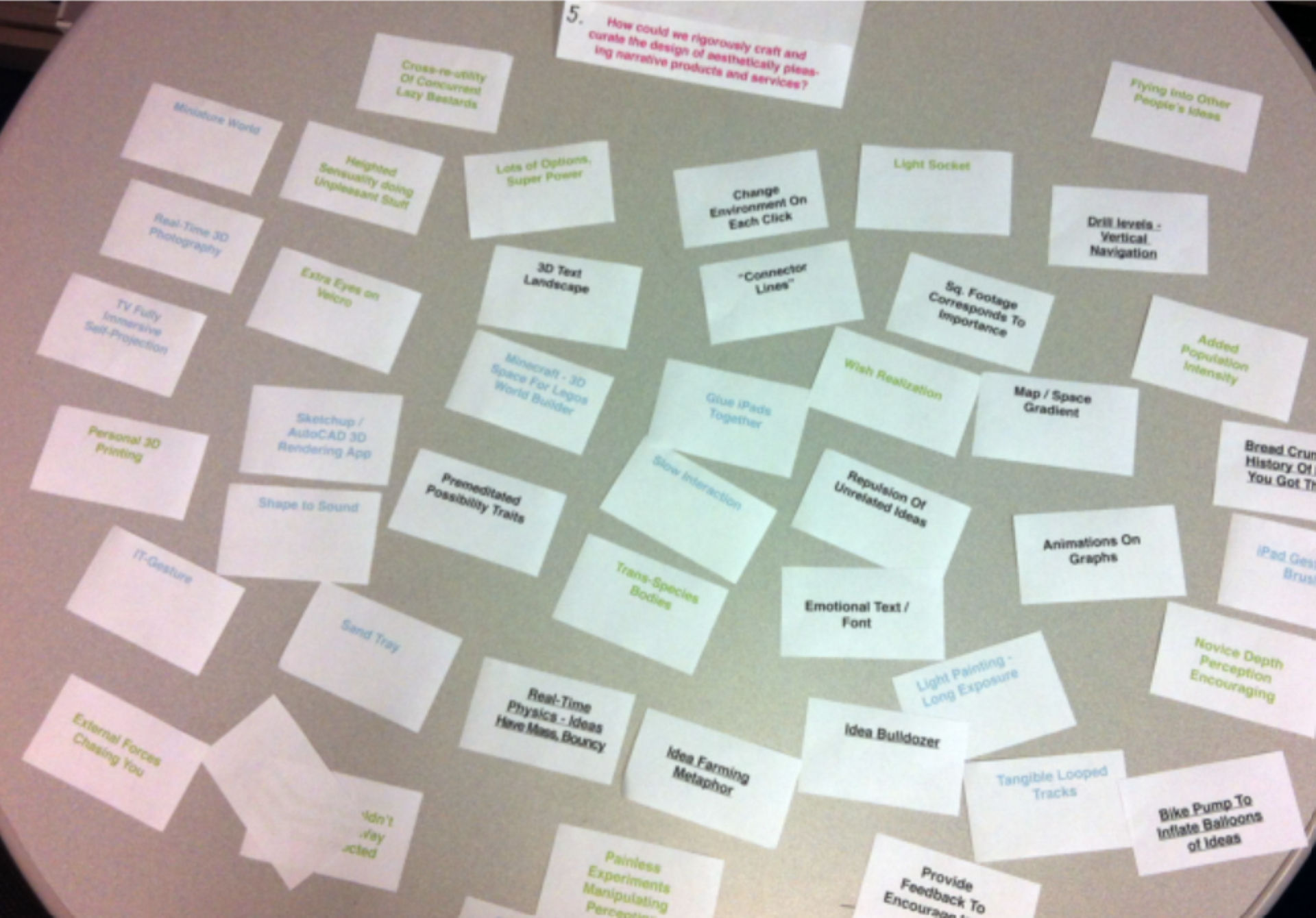
Notecards with possible ideas during the "Study 2" cheatstorming session.
© Brainstorm, Chainstorm, Cheatstorm, Tweetstorm: New Ideation Strategies for Distributed HCI Design. Fair use.
The research revealed that while cheatstorming facilitates quick and creative ideation, it also presents challenges, such as the need for forced connections between ideas and the benefits of implementing time constraints to facilitate quicker and more spontaneous idea selection. Moreover, it highlighted ideas that combine elements from different sources tended to yield the most innovative solutions, despite biases and the reduced excitement over repeated ideas in subsequent iterations.
The study showed the potential of cheatstorming to not only generate solutions relevant to specific prompts but also to capture the original spirit of brainstorming sessions. This suggests that the incorporation of a diverse mix of somewhat related ideas can significantly broaden the scope of ideation for design projects, making cheatstorming a valuable strategy in creative problem-solving.
“The natural reaction of the cheatstormer—indeed, their only real option—is to force an inventive connection between ideation and prompt.”
— From Carnegie Mellon’s Abstract on Brainstorm, Chainstorm, Cheatstorm, Tweetstorm: New Ideation Strategies for Distributed HCI Design
Cheatstorming’s Limitations
Professor Alan Dix discusses how to think creatively, avoid biases and break out of fixation—just a few limitations that can appear in a cheatstorming session.
While cheatstorming offers a unique approach to leverage previously brainstormed solutions, it comes with challenges designers should consider:
Risk of inhibited creativity: When designers rely too heavily on existing ideas, it can sometimes limit their thinking within established parameters, which can potentially stifle groundbreaking innovation.
Intellectual property concerns: There's a fine line between inspiration and infringement. Cheatstorming requires careful navigation to ensure that new designs do not infringe on existing copyrights, patents or trademarks, which can lead to serious legal complications. The ideation method’s only form of “cheating” should stay within its name.
Hyper-focus on adaptation: Designers who focus on adaptation and improvement of existing ideas or concepts might overlook the opportunity to address problems from an entirely new angle or to innovate in areas where there are no precedents.
Echo chamber effect: Teams that draw inspiration primarily from solutions within a specific domain or industry can lead to an echo chamber—where existing ideas don’t encounter opposition, which could lead to bias. Designs become iterative rather than inventive, and teams potentially miss out on cross-industry innovations.
Quality of source material: The effectiveness of cheatstorming depends on the quality and diversity of the existing solutions analyzed. Poor or limited source material can lead to suboptimal or even biased outcomes.
Groupthink risk: When teams engage in cheatstorming, they risk converging too quickly around a particular idea or solution, especially if it comes from a highly respected source, team member or stakeholder. This can stifle individual creativity and lead to less ingenious results.
Dependency on existing solutions: Though it’s the primary point of cheatstorming, a potential downside is its dependency on existing ideas, designs or solutions. This can limit a designer's ability to think and problem-solve independently from the norm.
Despite these limitations, cheatstorming, when used judiciously and combined with other ideation techniques, is a powerful tool in the designer's toolkit. It's vital for designers to be aware of these challenges and to strive for a balance between using old ideas and inventing new ones.
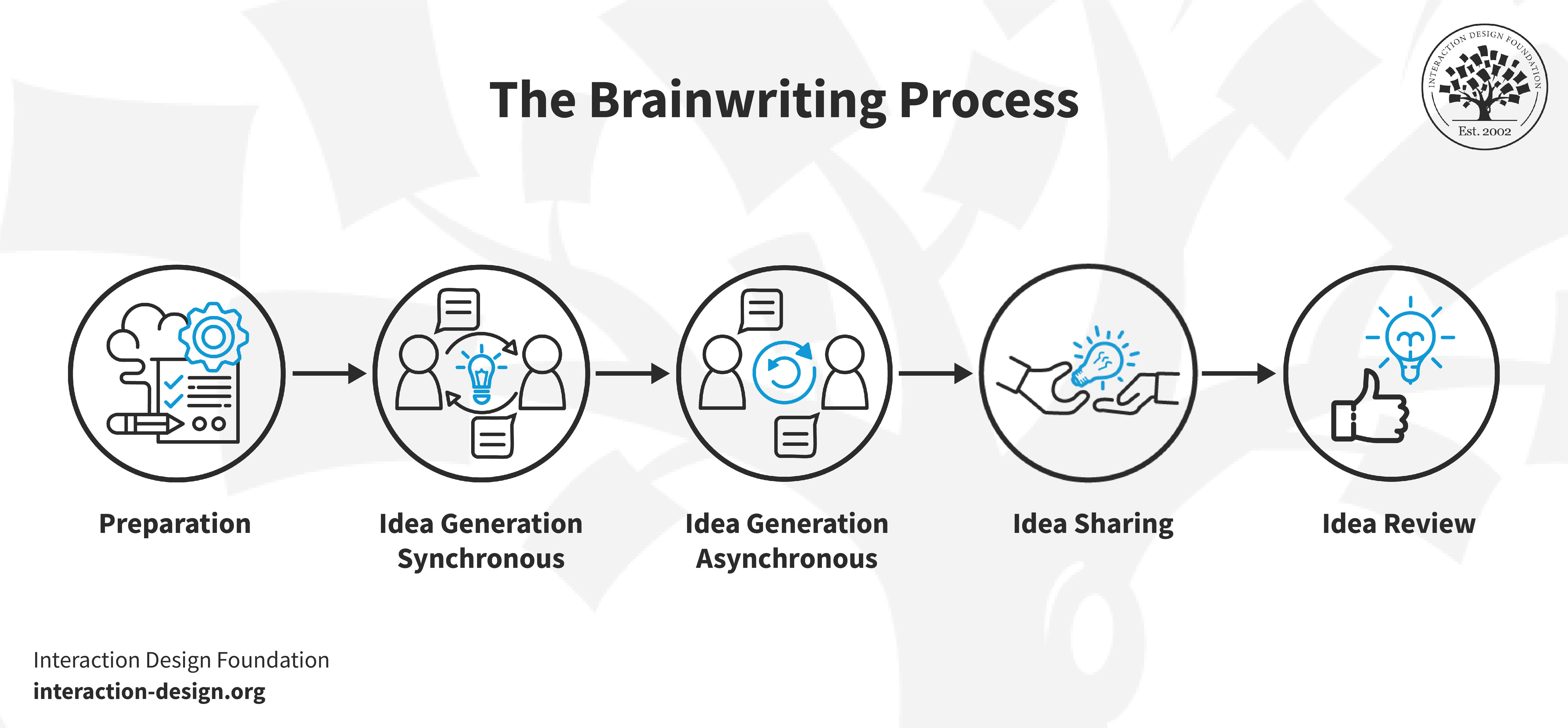 While several variations exist in the brainwriting process, we’ve outlined a general approach above.
 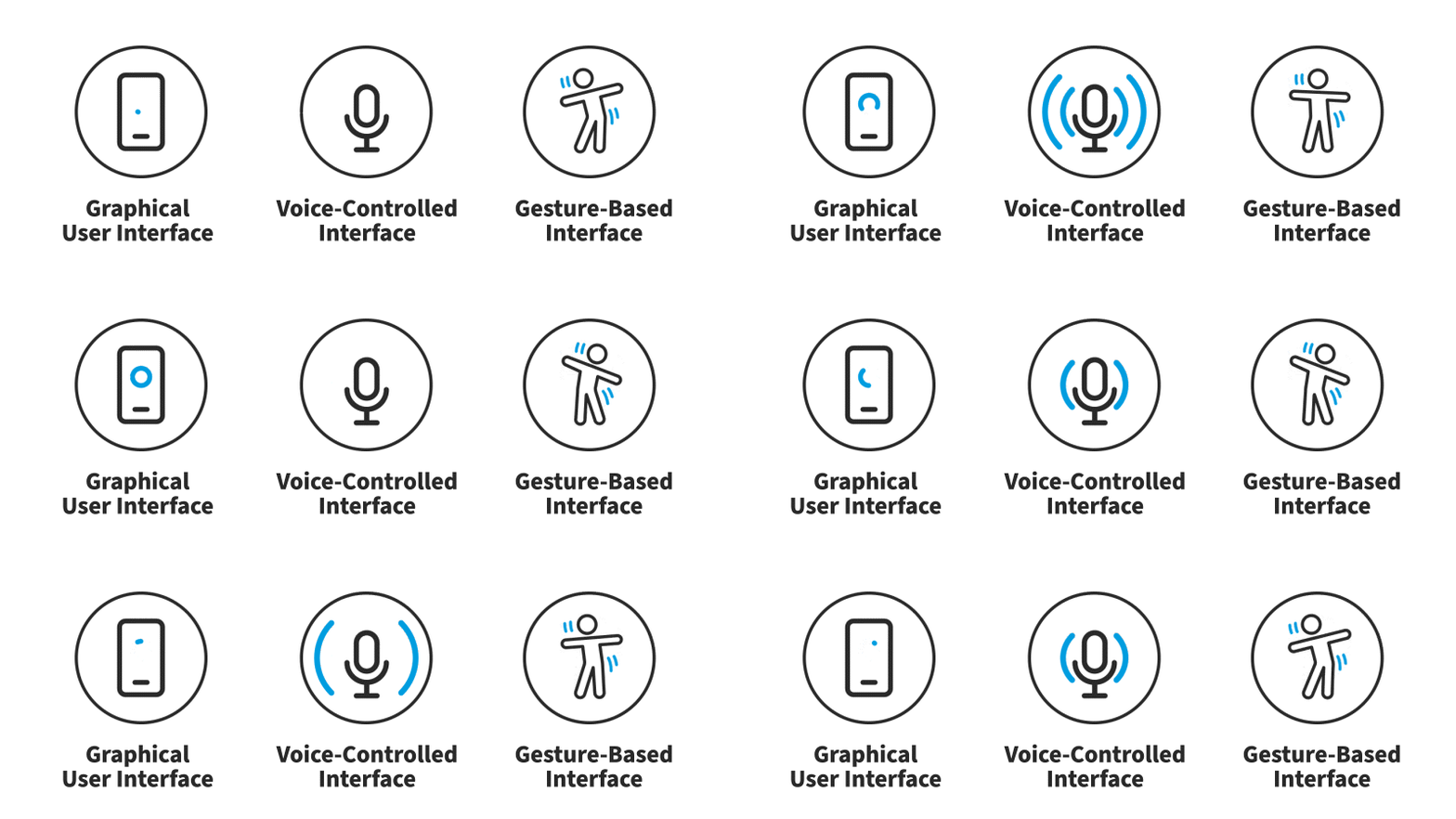 User interfaces are the access points where users interact with designs. They come in three formats highlighted in the GIF.











 Author/Copyright holder: Marco Arment. Copyright terms and licence: CC BY 2.0
 Author/Copyright holder: Jen Gallardo. Copyright terms and licence: CC BY-NC-ND 2.0
 Author/Copyright holder: Ewan McIntosh. Copyright terms and licence: CC BY-NC 2.0
 Author/Copyright holder: Swanny Mouton. Copyright terms and licence: CC BY-NC 2.0
 Author/Copyright holder: tsaiproject. Copyright terms and licence: CC BY 2.0