Brainstorming

Your constantly-updated definition of Brainstorming and collection of videos and articles.
Be a conversation starter: Share this page and inspire others!

887 Shares

What is Brainstorming?

Brainstorming is a method design teams use to generate ideas to solve clearly defined design problems. In controlled conditions and a free-thinking environment, teams approach a problem by such means as “How Might We” questions. They produce a vast array of ideas and draw links between them to find potential solutions.

Transcript

How To Use Brainstorming Best

Brainstorming is part of design thinking. You use it in the ideation phase. It’s extremely popular for design teams because they can expand in all directions. Although teams have rules and a facilitator to keep them on track, they are free to use out-of-the-box and lateral thinking to seek the most effective solutions to any design problem. By brainstorming, they can take a vast number of approaches—the more, the better—instead of just exploring conventional means and running into the associated obstacles. When teams work in a judgment-free atmosphere to find the real dimensions of a problem, they’re more likely to produce rough answers which they’ll refine into possible solutions later. Marketing CEO Alex Osborn, brainstorming’s “inventor”, captured the refined elements of creative problem-solving in his 1953 book, Applied Imagination. In brainstorming, we aim squarely at a design problem and produce an arsenal of potential solutions. By not only harvesting our own ideas but also considering and building on colleagues’, we cover the problem from every angle imaginable.

“It is easier to tone down a wild idea than to think up a new one.”

— Alex Osborn

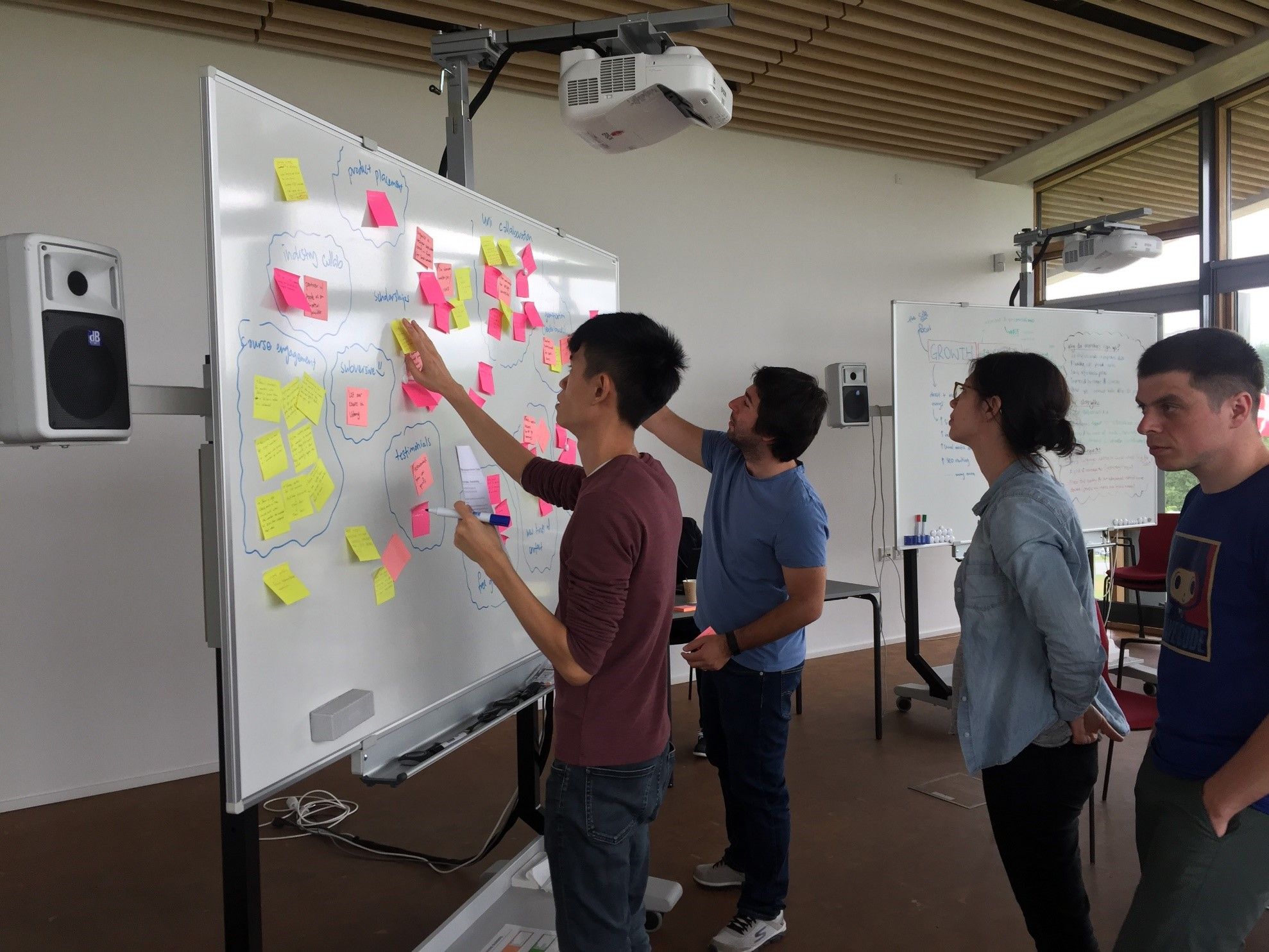
Everyone in a design team should have a clear definition of the target problem. They typically gather for a brainstorming session in a room with a large board/wall for pictures/Post-Its. A good mix of participants will expand the experience pool and therefore broaden the idea space.

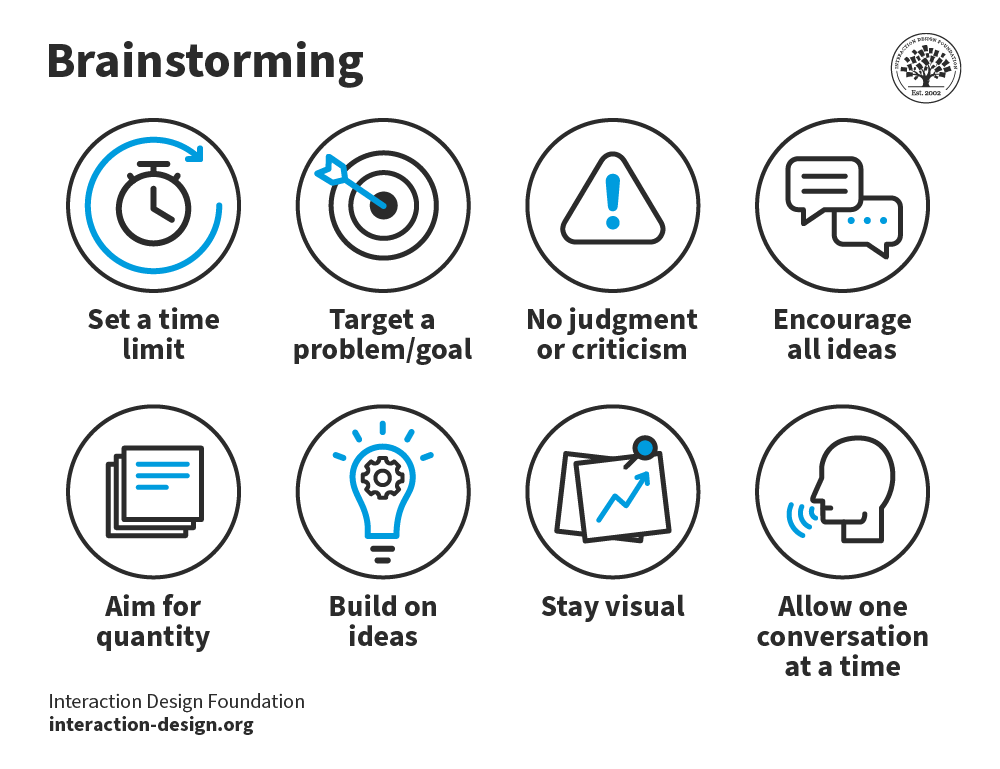
Brainstorming may seem to lack constraints, but everyone must observe eight house rules and have someone acting as facilitator.

  1. Set a time limit – Depending on the problem’s complexity, 15–60 minutes is normal.

  2. Begin with a target problem/brief – Members should approach this sharply defined question, plan or goal and stay on topic.

  3. Refrain from judgment/criticism – No-one should be negative (including via body language) about any idea.

  4. Encourage weird and wacky ideas – Further to the ban on killer phrases like “too expensive”, keep the floodgates open so everyone feels free to blurt out ideas (provided they’re on topic).

  5. Aim for quantity – Remember, “quantity breeds quality”. The sifting-and-sorting process comes later.

  6. Build on others’ ideas – It’s a process of association where members expand on others’ notions and reach new insights, allowing these ideas to trigger their own. Say “and”—rather than discourage with “but”—to get ideas closer to the problem.

  7. Stay visual – Diagrams and Post-Its help bring ideas to life and help others see things in different ways.

  8. Allow one conversation at a time – To arrive at concrete results, it’s essential to keep on track this way and show respect for everyone’s ideas.

To capture everyone’s ideas in a brainstorming session, someone must play “scribe” and mark every idea on the board. Alternatively, write down your own ideas as they come, and share these with the group. Often, design problems demand mixed tactics: brainstorming and its sibling approaches – braindumping (for individuals), and brainwriting and brainwalking (for group-and-individual mixes).

Take Care with Brainstorming

Brainstorming involves harnessing synergy – we leverage our collective thinking towards a variety of potential solutions. However, it’s challenging to have boundless freedom. In groups, introverts may stay quiet while extroverts dominate. Whoever’s leading the session must “police” the team to ensure a healthy, solution-focused atmosphere where even the shiest participants will speak up. A warm-up activity can cure brainstorming “constipation” – e.g., ask participants to list ways the world would be different if metal were like rubber.

Another risk is to let the team stray off topic and/or address other problems. As we may use brainstorming in any part of our design process—including areas related to a project’s main scope—it’s vital that participants stick to the problem relevant to that part (what Osborn called the “Point of View”). Similarly, by framing problems with “How Might We” questions, we remember brainstorming is organic and free of boundaries. Overall, your team should stay fluid in the search for ways you might resolve an issue – not chase a “holy grail” solution someone has developed elsewhere. The idea is to mine idea “ore” and refine “golden” solutions from it later.

How to Supercharge Brainstorming with AI

Transcript

Questions About Brainstorming?
We've Got Answers!

How is brainstorming different from other ideation techniques?

Brainstorming stands out from other ideation techniques because it focuses on speed, quantity, and free-flowing creativity, without criticism. Classic brainstorming asks participants to rapidly share any and all ideas, regardless of how wild they might be. The objective isn’t depth or analysis at first; it’s momentum and spontaneity.

This open style helps teams bypass fear of failure or judgment, which often blocks creativity. Other techniques may use step-by-step prompts or visual structures to guide thinking. Instead, brainstorming thrives on collaboration and builds ideas by bouncing thoughts around the room. When participants feel psychologically safe, the number of ideas they generate increases.

Watch our video about brainstorming.

Transcript

Take our course Design Thinking: The Ultimate Guide.

What are the key rules for running a good brainstorming session?

To run a successful brainstorming session, here are four key rules:

  1. Defer judgment: Don’t criticize or evaluate ideas during the session. This keeps the environment safe and encourages wild thinking. Analysis comes later.

  2. Encourage wild ideas: Even seemingly crazy ideas can spark brilliant solutions or lead to practical breakthroughs; sometimes the “badder,” the better.

  3. Go for quantity: A large pool increases the chances of finding gold.

  4. Build on others’ ideas: Use others’ thoughts as springboards. Collaboration fuels creativity.

Watch our video about brainstorming.

Transcript

Take our course Design Thinking: The Ultimate Guide.

How do I prepare for a brainstorming session?

To prepare for a brainstorming session, define a clear goal or problem to solve. Ensure everyone understands the challenge before the session begins. Next, choose a diverse group of participants; different perspectives spark better ideas. Set a time limit and create a relaxed, judgment-free space where creativity can flow and everyone feels safe to contribute.

Before the session, gather inspiration: research the topic, review user feedback, or explore competitor solutions. Bring prompts or thought-starters to help break mental blocks. Also, prepare tools like sticky notes, whiteboards, or digital collaboration platforms to capture ideas fast. It might be a good idea, especially if team members don’t know each other, to warm up with creative games to loosen up thinking and get everyone in the right mindset.

Watch our video about brainstorming.

Transcript

Take our course Design Thinking: The Ultimate Guide.

How many people should join a brainstorming session?

The ideal size for a brainstorming session is between four and seven people. This range balances diversity of thought with the ability to stay focused and collaborative. Fewer than four may limit idea variety. More than seven can make it harder to manage the conversation and ensure everyone contributes.

Smaller groups foster trust, encourage participation, and allow ideas to build more naturally. Larger sessions, if needed, work best when the main group splits into smaller breakout groups. Each group can brainstorm independently and then share highlights with the larger team. Size matters, but quality and chemistry matter more.

Watch our video about brainstorming.

Transcript

Take our course Design Thinking: The Ultimate Guide.

How long should a brainstorming session last?

A good brainstorming session typically lasts 30 to 60 minutes. This window keeps energy high and minds sharp without leading to fatigue or distractions. Shorter sessions help participants stay focused. However, they shouldn’t be so short that perceived time pressure creates performance anxiety and creative blocks. On the other hand, if a session runs too long, there’s a risk of repetition or loss of momentum.

Start with a brief warm-up or description of the challenge, and then dive straight into idea generation. Time-box each activity—like silent brainstorming or group sharing—to maintain a fast pace. If the team hits a creative flow, you can extend slightly and explore what may be valuable insights. However, avoid dragging it out. The purpose is to discover insights and angles of a problem you wouldn’t find otherwise; make the most of the opportunity.

Watch our video about brainstorming.

Transcript

Take our course Design Thinking: The Ultimate Guide.

How do I choose the right problem or topic to brainstorm?

To choose the right problem or topic to brainstorm, start with one that’s specific, relevant, and challenging—but not too broad. A focused question sparks better ideas than a vague or general one. Ask yourself: What’s the exact outcome you want? Who are you designing for? What roadblocks are you facing?

Effective brainstorming topics usually aim to solve user pain points, improve existing products, or explore new opportunities. Make sure the problem matters to your team or users, and that it’s something you can take action on. If it feels too big, break it down.

A helpful tip is to frame the challenge as a “How might we…” question. For example, “How might we help new users feel confident during onboarding?”

Watch our video about brainstorming.

Transcript

Take our course Design Thinking: The Ultimate Guide.

Designers often use a mix of brainstorming techniques to spark creativity and solve tough problems. Some of the most popular ones include:

  • Classic brainstorming: A fast-paced idea dump where team members come up with as many ideas as possible without judgment.

  • Crazy 8s: Each person sketches 8 ideas in 8 minutes, forcing rapid, visual thinking.

  • Brainwalking: Participants move around the room, adding ideas to posters or sheets placed at different stations. This technique energizes the group and encourages fresh thinking through movement and collaboration.

  • Brainwriting: Everyone writes ideas silently, then passes them along for others to build on—great for introverts or remote teams.

Watch our video about brainstorming.

Transcript

Take our course Design Thinking: The Ultimate Guide.

How do I make sure everyone gets a chance to speak during brainstorming?

To make sure everyone gets a chance to speak during brainstorming, set clear ground rules before you start. Let the group know that all voices matter and you want to hear from everyone. Use structured techniques like round-robin sharing, where each person takes a turn, or brainwriting, which lets people write down ideas silently before discussing.

The facilitator should actively invite quieter team members to share if needed. Ask open questions like, “What do you think?” or “Any thoughts from your side?” Avoid letting louder voices dominate—gently redirect if needed. Also, create a safe space where people feel respected and not judged. Judgment is the enemy of creativity. When people feel heard, they’re more likely to contribute and build on others’ thoughts.

Watch our video about brainstorming.

Transcript

Take our course Design Thinking: The Ultimate Guide.

What should I do after the brainstorming session ends?

After a brainstorming session ends, don’t let the ideas sit—organize and act on them. Start by reviewing all the input. Group similar ideas into themes, then prioritize based on feasibility, impact, and alignment with your goal. Use methods like dot voting or an impact-effort matrix to identify the top concepts.

Next, document everything. Share a summary with your team so nothing gets lost. Be clear about next steps: who will explore what, and when you’ll regroup. If any ideas need research or prototyping, assign those tasks straight away.

Overall, without follow-up, great ideas often go nowhere. So, turn momentum into action quickly—while the energy is still fresh.

Watch our video about brainstorming.

Transcript

Take our course Design Thinking: The Ultimate Guide.

What are some recent or highly cited scientific articles about brainstorming?

Bonnardel, N., & Didier, J. (2020). Brainstorming variants to favor creative design. Applied Ergonomics, 83, 102987.

In this paper, Nathalie Bonnardel and John Didier examine how two modified forms of brainstorming can enhance creativity in ergonomic design contexts. One variant emphasizes idea evocation (like traditional brainstorming), while the other focuses on constraint evocation—encouraging participants to reflect on limitations inherent in design problems. Through three empirical studies involving future designers and educators, they assess how these variants influence ideation quality based on the participants' backgrounds and task complexity. The findings identify conditions that best support creativity depending on user profiles. This study is especially valuable for UX and design professionals aiming to tailor ideation techniques to user characteristics and improve creative outputs.

Knight, J., Fitton, D., Phillips, C., & Price, D. (2019). Design thinking for innovation: Stress testing human factors in ideation sessions. The Design Journal, 22(sup1), 1929–1939.

In this paper, Knight and colleagues explore how various human factors influence ideation success during design thinking workshops. Through a series of structured experiments, they manipulate four key variables: participant stimulation prior to sessions, the presence or absence of facilitators, the application of design thinking methods, and the participants' professional backgrounds (designers vs. non-designers). Surprisingly, the findings suggest that participant background and pre-session stimulation had greater effects on the quality and quantity of ideas generated than the structured methods themselves. This study is critical for UX professionals and facilitators aiming to refine collaborative ideation processes, emphasizing the nuanced roles of motivation, facilitation, and participant diversity.

Osborn, A. F. (1953). Applied Imagination: Principles and Procedures of Creative Problem Solving. Charles Scribner’s Sons.

Alex F. Osborn’s Applied Imagination is a seminal work that introduced the concept of “brainstorming” to the world. Drawing from his experience as an advertising executive and co-founder of BBDO, Osborn presents a structured approach to creative problem-solving. The book outlines techniques to foster creativity, emphasizing the importance of deferring judgment and encouraging idea generation in group settings. Osborn’s methodologies have profoundly influenced fields such as design thinking, UX design, and organizational innovation. Despite its publication year (1953), the principles laid out in this book remain relevant, offering valuable insights into harnessing collective creativity to tackle complex challenges.

Wilson, C. (2013). Brainstorming and Beyond: A User-Centered Design Method. Morgan Kaufmann.

Chauncey Wilson's Brainstorming and Beyond is a practical guide tailored for UX professionals exploring creative ideation techniques. It introduces and contrasts three core methods: traditional brainstorming, brainwriting, and braindrawing. Each method is explored through a user-centered design lens, offering actionable advice on when and how to apply them effectively. Wilson explains the psychological and social dynamics that influence group ideation and provides strategies for overcoming common pitfalls. The book is essential for UX designers looking to refine their brainstorming practices and generate innovative, user-focused ideas, especially in environments with time constraints or cultural limitations on vocal participation. It stands out for its clarity and focus on usability outcomes.

What’s the main goal of a brainstorming session?

The main goal of a brainstorming session is to generate a wide range of ideas quickly and without judgment or evaluation. It helps individuals or teams break out of fixed thinking patterns and explore creative solutions to a specific challenge or question. Alex Osborn, who coined the term “brainstorming” in the 1940s, believed people could double their creative output with the right group setting, hence why selecting the right people to ideate with is critical.

In design, brainstorming unlocks innovation. Designers often use it to uncover user needs, improve user flows, or invent entirely new products. A great session fuels collaboration, builds on each team member's ideas, and taps into diverse perspectives. By encouraging quantity over quality in the early stages, brainstorming opens up unexpected possibilities that designers and design teams can refine later.

Watch our video about brainstorming.

Transcript

Take our course Design Thinking: The Ultimate Guide.

Earn a Gift Earn a Gift, Answer a Short Quiz!

1
2
3
4
1
2
3
4
Question 1
Question 2
Question 3
Get Your Gift
Interaction Design Foundation logo

Question 1

What is the primary goal of brainstorming?

1 point towards your gift

  • To generate a large quantity of ideas without judgment
  • To critique and evaluate ideas immediately
  • To finalize a solution during the session
Interaction Design Foundation logo

Question 2

Why is it important to avoid judging ideas during a brainstorming session?

1 point towards your gift

  • It slows down the process.
  • It allows participants to freely propose wild and creative ideas.
  • It helps prioritize the best ideas immediately.
Interaction Design Foundation logo

Question 3

Why do brainstorming sessions prioritize generating a large number of ideas?

1 point towards your gift

  • It increases the chance of finding innovative solutions.
  • It allows the team to reach a consensus faster.
  • It ensures that only simple ideas are considered.

Learn More About Brainstorming

Make learning as easy as watching Netflix: Learn more about Brainstorming by taking the online IxDF Course Design Thinking: The Ultimate Guide.

Why? Because design skills make you valuable. In any job. Any industry.

In This Course, You'll

  • Get excited when you discover that you don't need to start from scratch to use the secret recipes that empower companies like Apple and Google to shape the future. You just need a structure and proven methods to optimize what you already do. As AI becomes part of your day-to-day workflows, your ability to guide it with timeless human-centered skills such as strategic thinking, creativity, and empathy for real users is what turns AI into your superpower and delivers meaningful results.

  • Build on your existing creativity, problem-solving, and people skills to learn the powerful 5-stage method called Design Thinking. It's one of the key drivers behind Apple and Google's continuous innovation and provides a clear, structured way to solve real-world problems. You've already got the instincts, so it's easy to learn the method. 

  • Make yourself invaluable with hands-on skills in Design Thinking. Design Thinking can help you break into User Experience Design, product design, and tech. It's widely applicable, impactful, and fun! Use your skills to improve customer support processes, create new products, and even tackle big challenges like climate change. This human-centered approach is a key driver of business success because it guides you to systematically understand and address what your users really need and want. That's why Design Thinking skills can help you increase sales, keep customers loyal, and turn them into powerful advocates for your company.

  • Gain confidence and credibility as you effortlessly apply methods from all five stages of the Design Thinking process. You'll be guided to build empathy and gather insights into people's habits through user interviews. 

  • Use our downloadable templates to create affinity diagrams, empathy maps, and actionable "How Might We" questions. Develop solutions as you apply ideation and innovation methods. Create a paper prototype early and fast, then test and optimize your prototype to ensure that your users love it. More love, more impact, greater salary potential. 

  • Apply your new skills in an optional project where you'll design and test a user-centered experience that's perfect for your portfolio and career growth. Master Design Thinking to amplify your uniquely human strengths like empathy, intuition, and creativity, and confidently stay in demand as AI reshapes how teams work.

It's Easy to Fast-Track Your Career with the World's Best Experts

Master complex skills effortlessly with proven best practices and toolkits directly from the world's top design experts. Meet your experts for this course:

  • Don Norman: Father of User Experience (UX) Design, author of the legendary book “The Design of Everyday Things,” and co-founder of the Nielsen Norman Group.

  • Alan Dix: Author of the bestselling book “Human-Computer Interaction” and Director of the Computational Foundry at Swansea University.

  • Mike Rohde: Experience and Interface Designer, author of the bestselling “The Sketchnote Handbook.”

Get an Industry-Recognized IxDF Course Certificate

Increase your credibility, salary potential and job opportunities by showing credible evidence of your skills.

IxDF Course Certificates set the industry gold standard. Add them to your LinkedIn profile, resumé, and job applications.

Course Certificate Example

Be in distinguished company, alongside industry leaders who train their teams with the IxDF and trust IxDF Course Certificates.

Our clients: IBM, HP, Adobe, GE, Accenture, Allianz, Phillips, Deezer, Capgemin, Mcafee, SAP, Telenor, Cigna, British Parliament, State of New York

All Free IxDF Articles on Brainstorming

Read full article
Ideation for Design  - Preparing for the Design Race - Article hero image
Interaction Design Foundation logo

Ideation for Design - Preparing for the Design Race

Ideation is easy to define. It’s the process by which you generate, develop and then communicate new ideas. Ideas can take many forms such as verbal, visual, concrete or abstract. The principle is simple to create a process by which you can innovate, develop and actualize new products. Ideation is c

Social shares
869
Published
Read Article
Read full article
Stage 3 in the Design Thinking Process: Ideate - Article hero image
Interaction Design Foundation logo

Stage 3 in the Design Thinking Process: Ideate

In the Ideation stage, design thinkers spark off ideas — in the form of questions and solutions — through creative and curious activities such as Brainstorms and Worst Possible Idea. In this article, we’ll introduce you to some of the best Ideation methods and guidelines that help facilitate success

Social shares
1.3k
Published
Read Article
Read full article
Introduction to the Essential Ideation Techniques which are the Heart of Design Thinking - Article hero image
Interaction Design Foundation logo

Introduction to the Essential Ideation Techniques which are the Heart of Design Thinking

Ideation is at the heart of the Design Thinking process. There are literally hundreds of ideation techniques, for example brainstorming, sketching, SCAMPER, and prototyping. Some techniques are merely renamed or slightly adapted versions of more foundational techniques. Here you’ll get an overview o

Social shares
1.2k
Published
Read Article
Read full article
Learn How to Use the Best Ideation Methods: Brainstorming, Braindumping, Brainwriting, and Brainwalking - Article hero image
Interaction Design Foundation logo

Learn How to Use the Best Ideation Methods: Brainstorming, Braindumping, Brainwriting, and Brainwalking

Brainstorming is the most frequently practiced form of ideation. We recommend that you use it along with Brainwriting, Brainwalking, and Braindumping. Here, you’ll learn the best practices from the very best experts from d-school and IDEO as well of the father of the Brainstorming technique, Alex Os

Social shares
1.3k
Published
Read Article
Read full article
Three Ideation Methods to Enhance Your Innovative Thinking - Article hero image
Interaction Design Foundation logo

Three Ideation Methods to Enhance Your Innovative Thinking

“In a world where business is more interested in ‘best practice’ rather than different practice, is it any wonder that products and services, companies and organizations are all beginning to look the same?” the three authors rhetorically ask in ?What If!'s classic book on creativity and innovation,

Social shares
906
Published
Read Article
Read full article
14 UX Deliverables: What will I be making as a UX designer? - Article hero image
Interaction Design Foundation logo

14 UX Deliverables: What will I be making as a UX designer?

What does a UX designer actually produce? Here, we will explore the concept of UX deliverables, a term that describes the outputs of a UX design process during its various stages. The deliverables produced by UX designers vary according to their role in the design team and also depending on the meth

Social shares
1.2k
Published
Read Article

Learn How to Use the Best Ideation Methods: Brainstorming, Braindumping, Brainwriting, and Brainwalking

Learn How to Use the Best Ideation Methods: Brainstorming, Braindumping, Brainwriting, and Brainwalking

Brainstorming is the most frequently practiced form of ideation. We recommend that you use it along with Brainwriting, Brainwalking, and Braindumping. Here, you’ll learn the best practices from the very best experts from d-school and IDEO as well of the father of the Brainstorming technique, Alex Osborn.

Brainstorming is a great way to generate a lot of ideas that you would not be able to generate by just sitting down with a pen and paper. The intention of brainstorming is to leverage the collective thinking of the group, by engaging with each other, listening, and building on other ideas. Conducting a brainstorm also creates a distinct segment of time when you intentionally turn up the generative part of your brain and turn down the evaluative part. You can use brainstorming throughout any design or work process, of course, to generate ideas for design solutions, but also any time you are trying to generate ideas, such as planning where to do empathy work, or thinking about product and services related to your project.

Learn the Best Practices from the Experts Themselves

Here, you’ll learn the best practices from the very best experts from d-school and IDEO as well of the father of the Brainstorming technique, Alex Osborn. IDEO is a hugely successful international design and consulting firm, which uses the Design Thinking methodology to advance innovative design in products, services, environments, and digital experiences. The d.school celebrates Design Thinking, and it’s one of the most – if not the most – celebrated and recognised sources on Design Thinking and ideation techniques. d.school is a design school based in Stanford University in cooperation with the German Hasso Plattner Institute of the University of Potsdam.

Brainstorming (or just ‘brainstorm’, for short) has remained the cornerstone of the creative industry for decades and has evolved over the years as experience and learning developed from its variety of applications. Brainstorming essentially relies on a group of people coming together with their prior knowledge and research in order to gather ideas for solving the stated problem. It evokes images of exploration, experimental thinking, and wild ideas. However, all too often it takes the form of controlled sessions where dominant figures assert themselves over others and creativity ends up getting stifled. Or, in other cases, the facilitator does not succeed in helping the team steer towards the goal by keeping the user, the user’s need and the team’s insights about them in a problem statement – also called Point of View – at the front of the team’s minds.

In the following, we’ll let you in on some amazing brainstorm rules which will help keep you from falling into these traps, and instead facilitate innovative and effective brainstorming sessions.

Best Practice Rules for Effective Brainstorming
Author/Copyright holder: Teo Yu Siang and Interaction Design Foundation. Copyright terms and licence: CC BY-NC-SA 3.0

Idea generation, or Ideation, is an art form, which is dependent on appointing an experienced facilitator and having an experienced team. However, we’re all here to learn, and here is how you can start learning to become a successful facilitator of brainstorming sessions. Brainstorming is about setting a safe, creative space for people to feel like they can say anything and be wild—and know that they will not be judged for doing so—so that new ideas can be born. The following are some rules, principles, and suggestions so you can make brainstorming sessions much more user-oriented, effective, innovative – and fun.

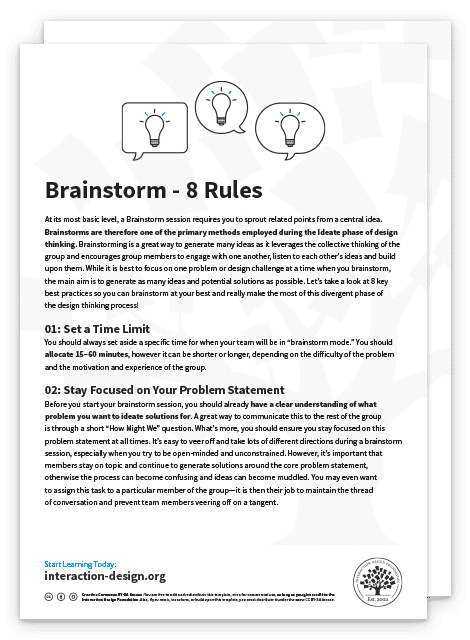
1. Set a time limit

d-school emphasises that the facilitator has to be intentional about setting aside a period when your team will be in “brainstorm mode”. In this time frame, it’s the sole goal to come up with as many ideas as possible, and during this period judgements of those ideas are prohibited. Typically, a Brainstorm will take around 15-60 minutes. It can be shorter or longer, depending on the difficulty of the problem and the motivation and experience of the group.

Best practice tip:

“Invest energy into a short period of time, such as 15 or 30 minutes of high engagement. Get in front of a whiteboard or around a table, but take an active posture of standing or sitting upright. Get close together.”
– dschool, Bootcamp Bootleg

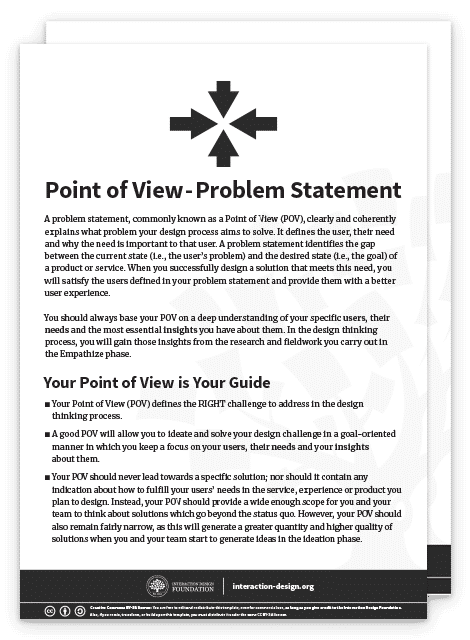
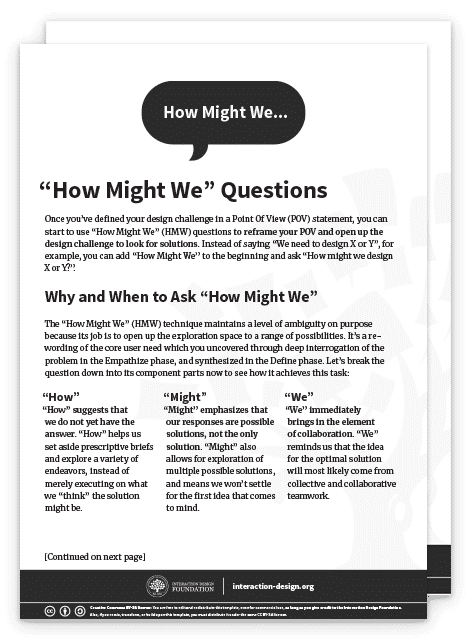
2. Start with a problem statement, Point of View, How Might We questions, a plan or a goal – and stay focused on the topic

Alex Osborn, the father of the Brainstorming technique, emphasises that brainstorming sessions should always address a specific question or problem statement (also called a Point of View) as sessions addressing multiple questions are inefficient. Begin with a good problem statement or question. Design Thinkers and other ideation specialists have further developed this approach into the art of framing problem statements via methods. Specifically, these are “How Might We” questions.

You can read and download the full guides below about how you can define your problem statement by using the Design Thinking method called Point Of View and how you can start ideating by asking “How Might We” questions:

Advance Your Career With This Free Template for “Point of View - Problem Statement”
Point of View - Problem Statement
We respect your privacy
Get 1 powerful email each week: Design a life you love!

Advance Your Career With This Free Template for “How Might We Questions”
How Might We Questions
We respect your privacy
Get 1 powerful email each week: Design a life you love!

Best practice tip:

“Write down clearly what you are brainstorming. Using a ‘How Might We’ (HMW) question is a great way to frame a brainstorm (e.g. HMW give each shopper a personal checkout experience?).”
– dschool, Bootcamp Bootleg

3. Defer judgement or criticism, including non-verbal

The facilitator should always set a positive, unthreatening tone and tell participants to reserve criticism for a later critical stage in the ideation process. A Brainstorming session is not the time and the place to evaluate ideas, and you should avoid executional details. It’s crucial that participants are feeling confident by being in a safe environment so they have no fear of being judged by others when they put forward wild ideas. You should create equal opportunities for all participants. The best ideas often come from practitioners, students, and people who dare to think differently – and not necessarily only from the highly skilled and experienced managers.

“Have playful rules: Critiquing or debating ideas can quickly sap the energy of a session. Many IDEO conference rooms have brainstorming rules stenciled in 6-inch-high letters on the walls; for example, ‘Go for quantity,’ ‘Encourage wild ideas,’ ‘Defer judgment,’ or ‘One conversation at a time.’”
– IDEO, The IDEO Difference

Best practice tip: The facilitator should suspend judgement. This way, participants will feel free to generate unusual ideas. As a facilitator, you will find that it can even be a great idea to prohibit the word “no”. You’ll be surprised to see how effective this tool is and how it helps open up minds and creates a collaborative, curious, and friendly ideation environment. And you’ll find that it’s pretty fun too when team members have to initially say “yes” to even the weirdest ideas. Giving out half-thought-out ideas or strange suggestions is normally not socially accepted, is socially frowned on and leads to people holding back in normal situations. Brainstorming deliberately gives permission to be “stupid” and “child-like”.

“Creative spaces don't judge. They let the ideas flow, so that people can build on each other and foster great ideas. You never know where a good idea is going to come from, the key is make everyone feel like they can say the idea on their mind and allow others to build on it.”
– OpenIDEO, 7 Tips on Better Brainstorming

4. Encourage weird, wacky, and wild ideas

These new ways of thinking might give you better solutions.

"It is easier to tone down a wild idea than to think up a new one.”
– Alex Osborn, the father of the Brainstorming technique

“Wild ideas can often give rise to creative leaps. In thinking about ideas that are wacky or out there we tend to think about what we really want without the constraints of technology or materials. We can then take those magical possibilities and perhaps invent new technologies to deliver them.”
– OpenIDEO, 7 Tips on Better Brainstorming

5.Aim for quantity

Aim for as many new ideas as possible. The assumption is that the greater the number of ideas you generate, the bigger your chance is of producing a radical and effective solution. Brainstorming celebrates the maxim “quantity breeds quality”.

6.Build on each others' ideas

As suggested by the slogan "1+1=3", Brainstorming stimulates the building of ideas by a process of association. Embrace the most out-of-the-box notions and build, build, build. Be positive and build on the ideas of others. Brainstorming works well when participants use each other's ideas to trigger their own thinking. Our minds are highly associative. One thought easily triggers another. When we use the thoughts of others, then these will stop us getting trapped by our own thinking structures.

Best practice tip: Try to say and encourage others to say “and” instead of “but”. It takes practice, but this little trick works surprisingly well.

7. Be visual

Best practice tip: At IDEO, they encourage you to use coloured markers to write on Post-its and put them on the wall—or sketch your idea. Nothing gets an idea across faster than drawing it. It doesn’t matter how terrible of a sketcher you are! It's all about the idea behind your sketch. And d.school has two great ideas for you:

“There are at least two ways to capture the ideas of a brainstorming:
1. Scribe: the scribe legibly and visually captures on the board ideas that team members call out. It is very important to capture every idea, regardless of your own feelings about each idea.
2. All-in: Each person will write down each of his or her ideas as they come, and verbally share it with the group. It is great to do this with post-it notes, so you can write your idea and then stick it on the board.”
– dschool, Bootcamp Bootleg

8. One conversation at a time

Listen to each other and elaborate on each other’s ideas. Don’t get obsessed with your own ideas. You’re here to ideate together.

You can download and print our template with the 8 rules for effective Brainstorming and use it as your and your team’s guide:

Advance Your Career With This Free Template for “Brainstorm - 8 Rules”
Brainstorm - 8 Rules
We respect your privacy
Get 1 powerful email each week: Design a life you love!

Should you Forget Brainstorming?

Brainstorm, as great as it can be, has some obvious weaknesses, most of them human factors. Whenever a group of people gets together to work collectively on anything, we inevitably find some members dominating over others. Introverts take a back seat and prefer working away in a quieter self-reflective manner, while extroverts, especially egoistical ones, put a stake in the ground and try to own the show. Research published in the Administrative Science Quarterly in 1958, Does Group Participation When Using Brainstorming Facilitate or Inhibit Creative Thinking?, seeks to understand whether individual brainstorming or group brainstorming sessions produce better results. A storm of debate ensued in 2010 when News Week posted an article referencing this research and making a call to "Forget Brainstorming "with others rebuffing this claim and affirming "Don't Forget: Brainstorming Works". Though the results of the study were based on limited parameters, they do indicate that if group-brainstorming conditions are not properly met, they can fail more easily.

We agree that poorly facilitated face-to-face brainstorms do stifle creativity. We agree that, even when brainstorming is done right, people could sometimes still generate ideas faster when they work alone. However, if you want creativity, it’s a major mistake to keep your team members in solitary confinement where they can’t “waste time” listening to and building on the ideas of others.

Here’s the problem: Most pieces of research on brainstorming are rigorous but irrelevant to the challenge of managing creative work. For starters, comparing whether creativity happens best in groups or alone is pretty silly when you look at how creative work is actually done. At creative companies like IDEO, people switch between both modes so seamlessly that it is hard to notice where individual work ends and group work starts.

Should Your Team Brainstorm as a Group or as Individuals?

Best practice: Switching between the two modes of individual and collective ideation sessions can be seamless—and highly productive. Alex Osborn’s 1950s classic Applied Imagination gave advice that is still relevant: Creativity comes from a blend of individual and collective ideation.

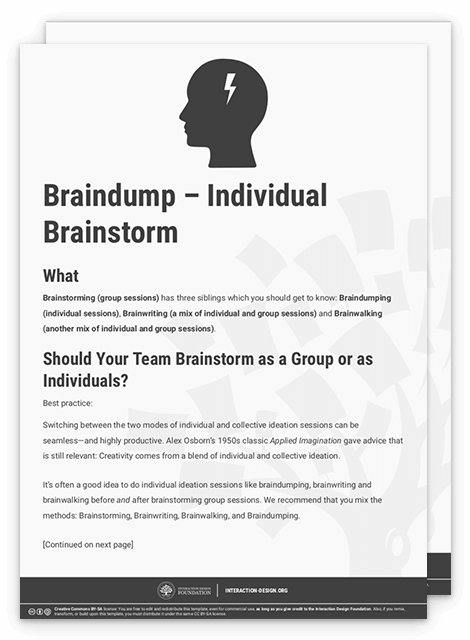
Brainstorming (group sessions) has three siblings which you should get to know: Braindumping (individual sessions), Brainwriting (a mix of individual and group sessions) and Brainwalking (another mix of individual and group sessions).

It’s often a good idea to do individual ideation sessions like braindumping, brainwriting and brainwalking before and after brainstorming group sessions.

Braindump – Individual Brainstorm

Author/Copyright holder: Teo Yu Siang and Interaction Design Foundation. Copyright terms and licence: CC BY-NC-SA 3.0

One of the best ways to progress to more advanced levels of ideation is to start by getting everything that's currently clogging the neural pathways out in the open and freeing up some cognitive space for other synapses, connections, and mixtures to get through. David Allen, author of the world famous “Getting Things Done” methodology, swears by the braindump as a means to free up mental energy and allow freethinking. Holding onto your own thoughts, unfinished tasks, or unexplored ideas creates mental blockages and prevents freethinking. Furthermore, Braindump is an amazing technique to help quiet employees get a voice.

Best practice

  • If you were the facilitator, you’d brief ideation participants upfront on the problem statement, goals and important insights from previous research and findings.

  • Then ask all participants to write down their ideas as they come.

  • It’s important that each participant does this individually – and silently.

  • Provide participants with sheets of paper, idea cards or traditional Post-it notes. Sticky notes are great, because they allow people to write their ideas down individually – one idea per note.

  • Give participants between 3 and 10 minutes to get ideas they have been thinking of off their chests.

  • After reaching the time limit of approximately 3-10 minutes, each participant will say a few words about his or her ideas and stick them on a board or wall. You should avoid initial discussions about notes when team members are presenting them. Ideas that come out of early braindump sessions should be shared verbally with the entire team in order to spark new streams of thinking or combinations of ideas.

  • While sticking the ideas up and presenting them, the group will also group duplicates together.

  • When all team members have presented their ideas, you can select the best ideas, which you can continue to build and elaborate on in other ideation sessions. There are various methods you can use such as “Post-it Voting”, “Four Categories”, “Bingo Selection”, “Six Thinking Hats”, and “Now Wow How Matrix”.

You can download and print the template where we’ve summarised how to create a successful Braindump session:

Advance Your Career With This Free Template for “Braindump”

Braindump
We respect your privacy
Get 1 powerful email each week: Design a life you love!

Author/Copyright holder: Victor Roa. Copyright terms and licence: CC BY 2.0

Sticky notes are great for braindump sessions, because they allow people to write their ideas down individually – one idea per note. After reaching the time limit of approximately 3-10 minutes, each participant will say a few words about his or her ideas and stick them on a board or wall.

Brainwriting

Author/Copyright holder: Teo Yu Siang and Interaction Design Foundation. Copyright terms and licence: CC BY-NC-SA 3.0

Brainwriting is a technique where participants write ideas onto cards and then pass their idea cards on to the next person, moving those cards around the group in a circle as participants build on the ideas of others. Participants perform this technique in complete silence—and they are forced to build on, instead of criticise, other participants' ideas. The cycle can be repeated multiple times and can be applied to chunks of the problem being addressed, depending on the need. The beauty of brainwriting is that it levels the playing field immediately, and it removes many of the obstacles of group brainstorming. With traditional verbal brainstorming, the number of ideas which can be expressed at once is limited, and the time it takes to get through a number of ideas is much longer, which results in many participants forgetting or becoming confused while others shout out ideas. This is especially so for those who are shy or introverted or who may be at a disadvantage due to being less senior or unfamiliar with the specialisations being discussed.

Brainwriting is an excellent starting point for ideation sessions, and can serve as a means to maximise the initial braindump, or as a way to refocus if other ideation methods go haywire. Before the chaos of group ideation muddles people's thinking, help them get their initial thoughts out in the open with an introductory brainwriting session and use the results later to build on further with other techniques.

Best Practice

  • If you were the facilitator, you’d brief ideation participants upfront on the problem statement, goals and important user insights from previous research and findings.

  • Encourage participants to jot down ideas on their idea cards for 3-5 minutes before passing on their ideas when you make the call.

  • Ideally, participants pass on idea cards 3-10 times depending on the problem statement and goals.

  • This all happens silently and without any interference or communication.

  • Encourage participants to push themselves for more ideas at least a couple of times, in the few minutes they have, in order to maximize the output and variation.

  • You should stoke the session with encouragement and provide questions or statements which push participants to think outside of their comfort zones.

  • The cycle can be repeated multiple times and can be applied to chunks of the problem being addressed, depending on the need.

  • After ending the cycle, each participant will briefly verbally present the thoughts on the idea card he/she ends up with by the end of the cycle to the rest of the team—in order to spark new streams of thinking or combinations of ideas. If you were the facilitator, you would often be taking notes on a white board.

  • When all team members have presented their idea cards, you can select the best ideas which you can continue to build and elaborate on in other ideation sessions. There are various methods you can use such as “Post-it Voting”, “Four Categories”, “Bingo Selection”and “Now Wow How Matrix”.

You can download and print the template where we’ve summarised how to create a successful Brainwriting session:

Advance Your Career With This Free Template for “Brainwrite”
Brainwrite
We respect your privacy
Get 1 powerful email each week: Design a life you love!

Brainwalking

Author/Copyright holder: Teo Yu Siang and Interaction Design Foundation. Copyright terms and licence: CC BY-NC-SA 3.0

Yes, you read it correctly—don’t worry, though; it doesn’t involve soles touching souls. Brainwalking is very similar to brainwriting with one small but highly impactful difference. Instead of passing idea cards or notes from one participant to another, participants have to get up from their seats and move to another spot around the brainstorming table or even to another table altogether. Bryan Mattimore came up with this technique; he’s a specialist in the art of ideation and facilitation. Mattimore has many years and thousands of sessions of experience conducting ideation sessions. In his book Idea Stormers, he describes brainwalking as the: 'single best technique to use to begin an ideation session'.

Brainwalking gets people out of their seats, gets them moving, keeps energy levels up and mixes things up enough so that the group as a whole does not get stuck delving too long down the same one-way street, without a quick exit or U turn available. Brainwalking works best when it is easy to flip or to start from scratch.

You can download and print the template where we’ve described the best practice for creating a Brainwalking session:

Advance Your Career With This Free Template for “Brainwalk”
Brainwalk
We respect your privacy
Get 1 powerful email each week: Design a life you love!

As we can see, one ideation method leads to another, and another… and the methods themselves are areas open to creative interpretation and disruption.

Know Your History

Alex Osborn was an advertising executive who created the technique we know today as brainstorming. He invented the technique as a response to the stifling environment of executive meetings and with the goal of freeing up creative thinking in order to facilitate ideas to flow more easily. Alex Osborn presented the brainstorming technique in his book, How To Think Up. Alex Osborn authored several books on group creative thinking, including Your Creative Power, How to Organize a Squad to Create Ideas and Applied Imagination, and he was a pioneer in the field, laying the ground for what we call ideation today.

Alex Osborn developed a system that still applies to our modern ideation methods and includes such principles as deferring judgement or criticism and aiming for a larger quantity of ideas as opposed to a focus on quality. He also impresses the importance of an experienced facilitator and on combining group brainstorming with separate individual ideation sessions. As much as the modern understanding of brainstorming may conjure up ideas of randomised chaos with an untrained, poorly facilitated group just shouting out whatever comes to mind, the technique Osborn developed has many rules and principles, which need to be respected in order to achieve success.

“Creativity is more than mere imagination. It is imagination inseparably coupled with both intent and effort.”
– Alex Osborn

The Take Away

Brainstorming is the most frequently practiced form of ideation. We recommend that you mix it with Brainwriting, Brainwalking and Braindumping and other ideation methods. Idea generation is an art form, which is dependent on appointing an experienced facilitator and having an experienced team. However, we’re all here to learn, and here is how you can start learning to become a successful facilitator of ideation sessions. Ideation sessions are about setting a safe, creative space for people to feel like they can say anything, be wild, and not be judged – so that new relevant ideas can be born. The following are the rules, principles and suggestions to help you make brainstorming and other initial ideation sessions much more effective:

  1. Set a time limit.

  2. Start with a question, a plan or a goal – and stay focused on the topic.

  3. Defer judgement or criticism, including non-verbal.

  4. Encourage weird, wacky and wild ideas.

  5. Aim for quantity.

  6. Build on each others' ideas.

  7. Be visual.

  8. Allow one conversation at a time.

References & Where to Learn More

Hero Image: Author/Copyright holder: visualpun.ch. Copyright terms and licence: CC BY-SA 2.0

IDEO, The IDEO Difference, by Catherine Fredman, 2002.

Alex Osborn, How To Think Up, 1942

Alex Osborn, Applied Imagination, 1953

d.school, Bootcamp Bootleg.

Donald W. Taylor, Paul C. Berry and Clifford H. Block, Does Group Participation When Using Brainstorming Facilitate or Inhibit Creative Thinking? In Administrative Science Quarterly Vol. 3, No. 1, Page 23-47, 1958.

Po Bronson and Ashley Merryman. Forget Brainstorming, 7/12/2010.

Jonathan Vehar. Don't forget: Brainstorming works!, 2010.

David Allen, Five Simple Steps that Apply Order to Chaos.

Dave Gray. Brainwriting. Gamestorming A toolkit for innovators, rule-breakers and changemakers, 2010.

Bryan W. Mattimore, Idea Stormers: How to Lead and Inspire Creative Breakthroughs, 2012

Tim Brown, CEO of IDEO, Change by Design, 2009
Feel Stuck?
Want Better Job Options?

AI is replacing jobs everywhere, yet design jobs are booming with a projected 45% job growth. With design skills, you can create products and services people love. More love means more impact and greater salary potential.

At IxDF, we help you from your first course to your next job, all in one place.

See How Design Skills Turn Into Job Options
Privacy Settings
By using this site, you accept our Cookie Policy and Terms of Use.
Customize
Accept all

Be the One Who Inspires

People remember who shares great ideas.

Share on:

Academic Credibility — On Autopilot

Don't waste time googling citation formats. Just copy, paste and look legit in seconds.