How Might We (HMW)

Your constantly-updated definition of How Might We (HMW) and collection of videos and articles.
Be a conversation starter: Share this page and inspire others!

394 Shares

What is How Might We (HMW)?

How Might We (HMW) is a design thinking method that allows designers to reframe and open up their problem statements for efficient, targeted and innovative ideation sessions to help solve design challenges. HMW is the bridge between the Define and Ideate stages of the design thinking process.

“The ‘how’ part assumes there are solutions out there — it provides creative confidence…‘Might’ says we can put ideas out there that might work or might not — either way, it’s OK. And the ‘we’ part says we’re going to do it together and build on each other’s ideas.”

– Tim Brown, IDEO Chairman and former CEO

Transcript

How Might We Create the Most Effective HMW Questions?

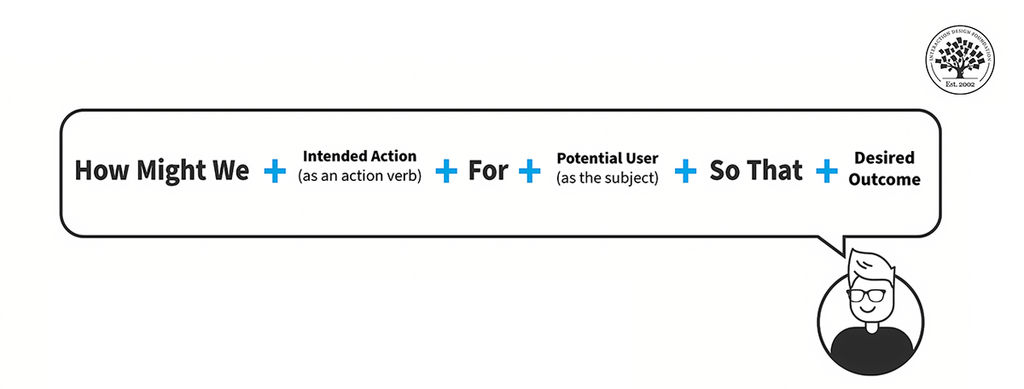
Write effective How Might We questions with a structured approach. Use the formula below and follow the steps to create effective HMW questions.

HMW Formula
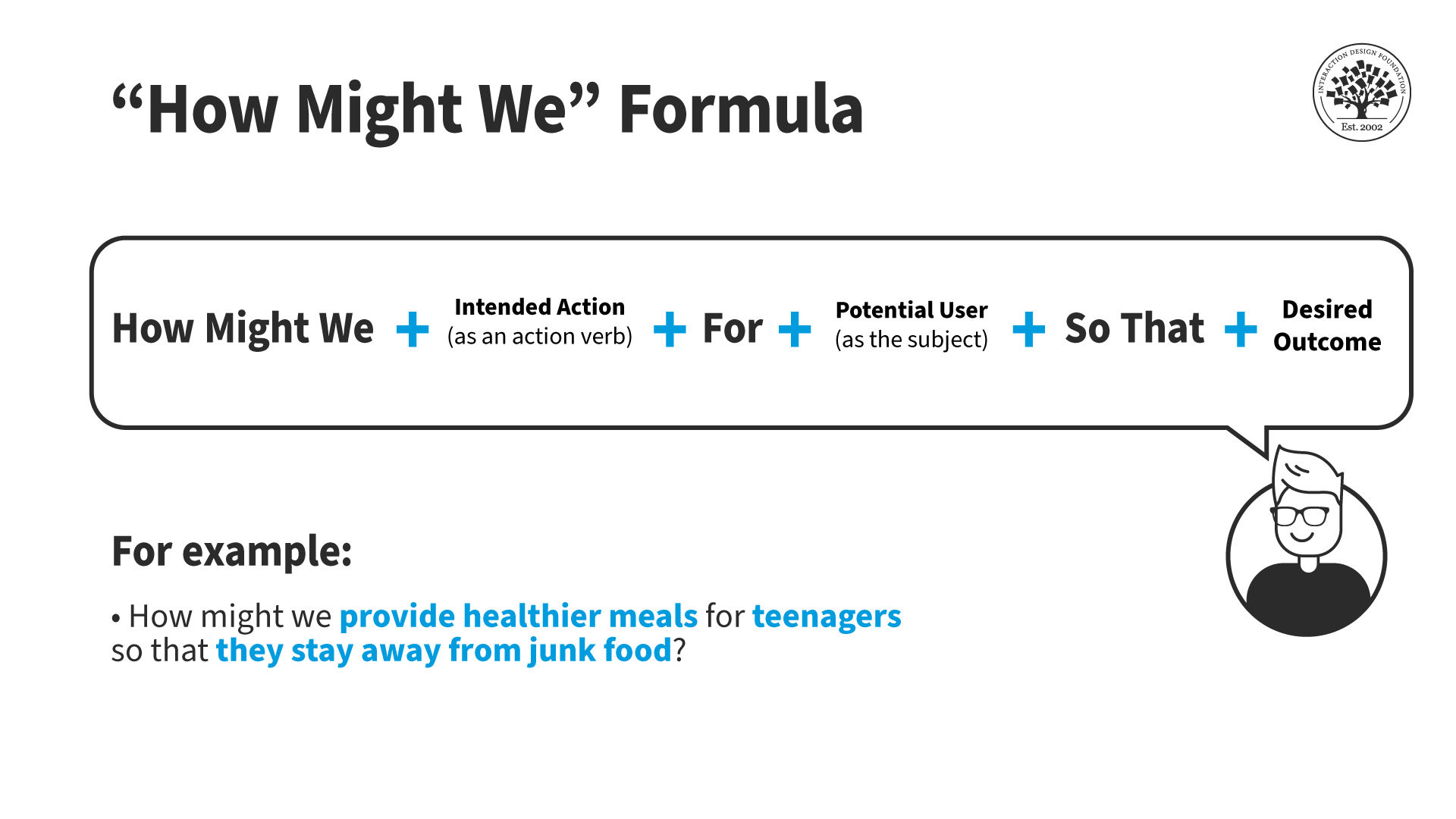
Follow this helpful HMW formula to get started in your ideation session: “How might we” + Intended Action (as an action verb) + “for” + Potential User (as the subject) + “so that” + Desired Outcome. For example, “How might we provide healthier meals (intended action) for teenagers (potential users) so that they stay away from junk food (desired outcome).

© Interaction Design Foundation, CC BY-SA 4.0

For example, here is a hypothetical problem statement

“University students need to save as much money as possible when buying their textbooks for their courses because it’s a big expense for them each academic year and they don’t have a lot of disposable income.” 

HMW questions could include: 

“How might we help students connect with each other so that they can buy and sell their textbooks from each other at discounted prices?”

Or 

“How might we collaborate with local bookstores to facilitate the purchase and sale of low-cost university textbooks on and off campus?”

Steps to Create HMW Questions

Step 1: Clearly define the problem or challenge with a concise problem statement to capture the core of the problem. This sets the foundation for HMW questions.

Step 2: Break down the problem statement into its key components.

Step 3: Choose an action verb that prompts action and exploration.

Step 4: Insert the subject relevant to the challenge or problem.

Step 5: Add a provocative element to encourage creative and fresh thinking.

Step 6: Generate several HMW questions by varying the action verbs, subjects, and provocative elements.

Step 7: Review and prioritize the HMW questions based on their relevance and potential impact. Refine the language for clarity.

Step 8: Test HMW questions within the design team or with stakeholders. Iterate based on feedback and insights—explore variations of HMW questions, such as "In what ways might we..." or other creative prompts.

Step 9: Develop follow-up questions to deepen understanding and guide the ideation process.

Step 10: Creating effective HMW questions is an iterative process. Repeat the steps as needed. Refine and edit the HMWs based on insights gained during the process.

The goal is to prompt innovative thinking and inspire a range of potential solutions. Adjust the formula and steps based on the specific context and nature of the design challenge.

How to Create HMW Statements: Example

In the context of sustainable practices: A rural community struggles with the environmental impact of single-use plastic, and there’s a need to find sustainable alternatives.

Problem statement: A village community needs to decrease their use of single-use plastics and find better alternatives because it negatively impacts their environment. 

HMW questions:

  • How might we encourage community members to adopt reusable alternatives for everyday items like bags and containers?

  • How might we collaborate with local businesses to reduce the use of single-use plastic in packaging?

  • How might we make sustainable alternatives more accessible and affordable for a diverse range of community members?

Variations of HMW questions:

  • What's stopping us from implementing a community-wide education campaign on the environmental consequences of single-use plastic?

  • What would happen if we introduced incentives for businesses and individuals to actively participate in plastic recycling initiatives?

  • In what ways might community members be motivated to participate in a neighborhood clean-up event focused on plastic waste?

  • What has changed in consumer behavior that allows us to explore new, eco-friendly packaging solutions for local products?

  • Who needs to be involved in creating and implementing local policies to encourage the reduction of single-use plastic?

  • When should we launch awareness campaigns to coincide with significant community events and maximize impact?

These HMW questions address various aspects of the community's relationship with single-use plastic and explore education, incentives, collaboration, policy and the broader context of sustainability. They guide initiatives that contribute to the reduction of plastic waste and foster a more environmentally friendly community.

Beyond How Might We Questions

“When you let your mind wander across the blank page of possibilities, all constraints and preconceptions disappear, leaving only the trace of a barely glimpsed dream, the merest hint of a sketch of an idea.”

– Marty Neumeier's second rule of genius from The 46 Rules of Genius: An innovator’s guide to creativity

To better understand the concept of HMWs and expand on the approach, refer to Marty Neumeier's second Rule of Genius for inspiration. The rule refines the HMW generation process and helps designers express desires for potential users. Use alternative HMW question formulations like:

  •     "In what ways might we…?" (Allow for multiple solutions.)

  •     "What's stopping us from...?"

  •     "What would happen if...?"

After, ask follow-up questions such as:

  •     "Why would we...?"

  •     "What has changed to enable us to...?"

  •     "Who would need to...?"

  •     "When should we...?"

Additionally, it is useful to incorporate a "Why wouldn’t we…?" question to uncover potential adverse consequences of specific design decisions, but designers can complete this at a later stage in the process.

HMW: Best Practices
Speech bubble with

Design teams formulate HMWs from clear problem statements, then dig deeper by splitting the problem into smaller, actionable HMW questions. It’s an iterative process, resulting in multiple possible solutions.

© Interaction Design Foundation, CC BY-SA 4.0

The guide below consists of key points to follow to craft effective HMW questions. At the end of this section, download a convenient IxDF template to help create optimal HMW questions based on the recommended practices:

  1. Ensure a Clear and Concise Problem Statement: To make "How Might We" questions meaningful, it is imperative to have a clearly defined problem statement. Within the problem statement, frame a clear vision or goal that strikes the right balance—neither too narrow nor overly broad.

  2. Always Start with the Problem Statement: Incorporate the problem statement into the HMW questions so the HMWs directly relate to the problem at hand. For example, rewrite the problem statement with “How might we…” at the beginning, and iterate as needed.

  3. Split the Problem Statement into Multiple HMWs: Explore the design challenge further by breaking it down into smaller, relevant questions. Five to ten HMW questions for one problem statement serve as a solid foundation.

  4. Prioritize HMW Questions Before Solutions: Brainstorm HMWs before solutions. This logical sequence of events often proves more impactful in ideation sessions.

  5. Assess the HMWs: Review HMW questions to allow for a diverse range of solutions. If they don’t, then broaden the questions to generate multiple possible answers and form a robust platform for ideation sessions. On the other hand, if the HMW questions are too broad, narrow them down. Aim for a scope to launch any ideation sessions while offering enough room to explore unconventional ideas.
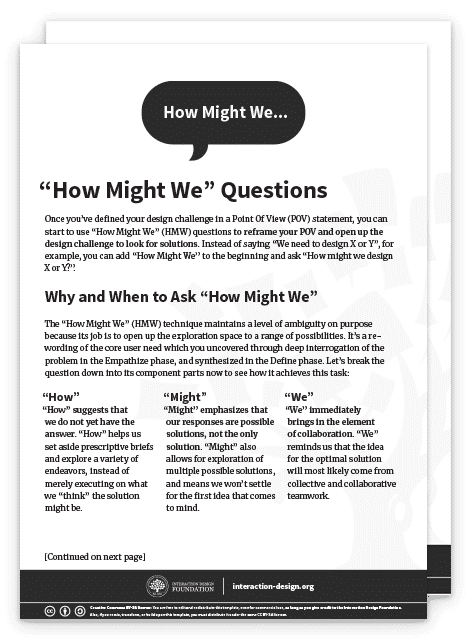
Advance Your Career With This Free Template for “How Might We Questions”
How Might We Questions
We respect your privacy
Get 1 powerful email each week: Design a life you love!

A Real-life Example of HMW

Consider the real-world example from David and Tom Kelley's book, Creative Confidence, to follow the story of the Embrace Warmer. It was a design challenge undertaken by Stanford graduate students to help mitigate neonatal hypothermia, which takes the lives of thousands of infants in developing countries every year. 

The students conducted user research to better understand the challenges faced by individuals dealing with the issue of expensive hospital incubators, particularly those living in rural settings with limited physical access to hospitals. This empathetic thinking led them to the "How Might We" statement:

"How Might We create a baby warming device that helps parents in remote villages give their dying infants a chance to survive?"

The Embrace Warmer sleeping bag device, designed in response to the HMW question, delivers the necessary warmth to babies in rural villages at a fraction of the cost of traditional hospital incubators and can be safely stored at home or in a local clinic.

A sky blue and orange Embrace Warmer that looks like a small sleeping bag with a hood and plastic window on the front.

The Embrace Warmer is the product of clever design thinking and the HMW method which allowed the Stanford students to empathize with the villagers to make a positive impact and save precious lives.

© Embrace Innovations. Fair Use.

Although a conventional strategy might have focused on technological efforts to lower incubator costs, the students’ empathetic research uncovered a fundamental issue: mothers were unable or unwilling to leave their villages or their newborns for extended hospital stays. This realization led to a shift in perspective and transformed the incubator into a warming device.

Who Should Create HMW Questions?
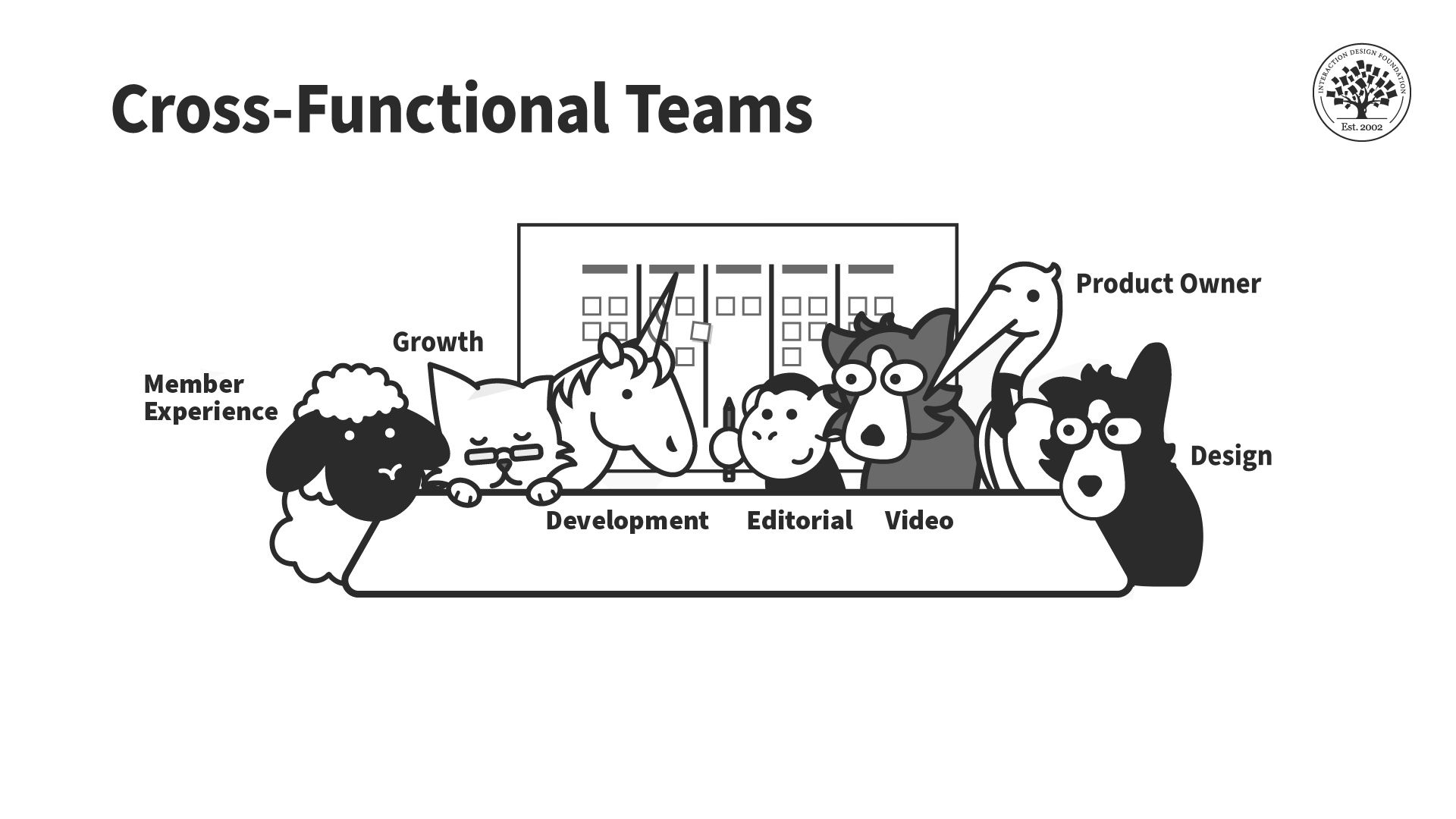
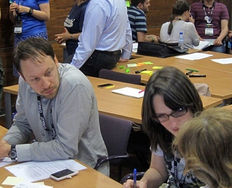
The “How Might We” method is a collaborative process. With key players involved, design teams can initiate the ideation process to empathize with potential users and create multiple ideas for viable design solutions.

© Interaction Design Foundation, CC BY-SA 4.0

When teams involve a diverse group of stakeholders in the HMW process, it allows for key collaboration. With a mix of participants, teams can create comprehensive, user-centered HMW questions reflective of the problem and solution space. This diversity in participation helps discover unique insights and fosters a more holistic approach to problem-solving in the design process.

Key participants should include:

Designers and Researchers: As the primary facilitators of the design process, designers bring expertise in problem-solving, creativity, and user-centered design methodologies. They usually act as facilitators of the HMW process. 

Users or User Representatives: Actual users or their representatives make sure HMW questions are grounded in real user needs and experiences.

Cross-Functional Team Members: Members from different teams, such as marketing, development, product management, customer service, etc. provide different perspectives and ideas and a better understanding of the problem.

Subject Matter Experts: Depending on the project, it’s beneficial to include experts in specific fields related to the product or service being designed. These could be technical experts, industry specialists or behavioral scientists, for example. 

Stakeholders: Key stakeholders who have an interest in the outcome of the design process, like senior management, investors, or partner organizations.

What Are the Limitations of HMW in the Design Process?

The limitations of the HMW method in the design process stem from its simplicity and open-ended nature. While HMW is a powerful tool to generate creative ideas and solutions, it can sometimes lack focus and direction. The open-ended questions provide a wide array of ideas, but not all of them may be relevant or doable. This can lead to time wasted on the exploration of ideas that are not good options for the project's overall goals.

Another limitation is that HMW questions can sometimes be too broad, which makes it difficult for designers to find a starting point for ideation. Without specific guidelines or constraints, designers might struggle to come up with ideas that are practical and aligned with the project's objectives.

Furthermore, HMW doesn't inherently prioritize ideas or solutions. Design teams can develop multiple ideas, but without a way to evaluate and prioritize them, deciding which ideas to spend more time on becomes a challenge.

Lastly, HMW questions may not always consider the users’ needs or the context in which a product will be used. This can lead to original outcomes but may not solve the users’ problems or fit well within their environment.
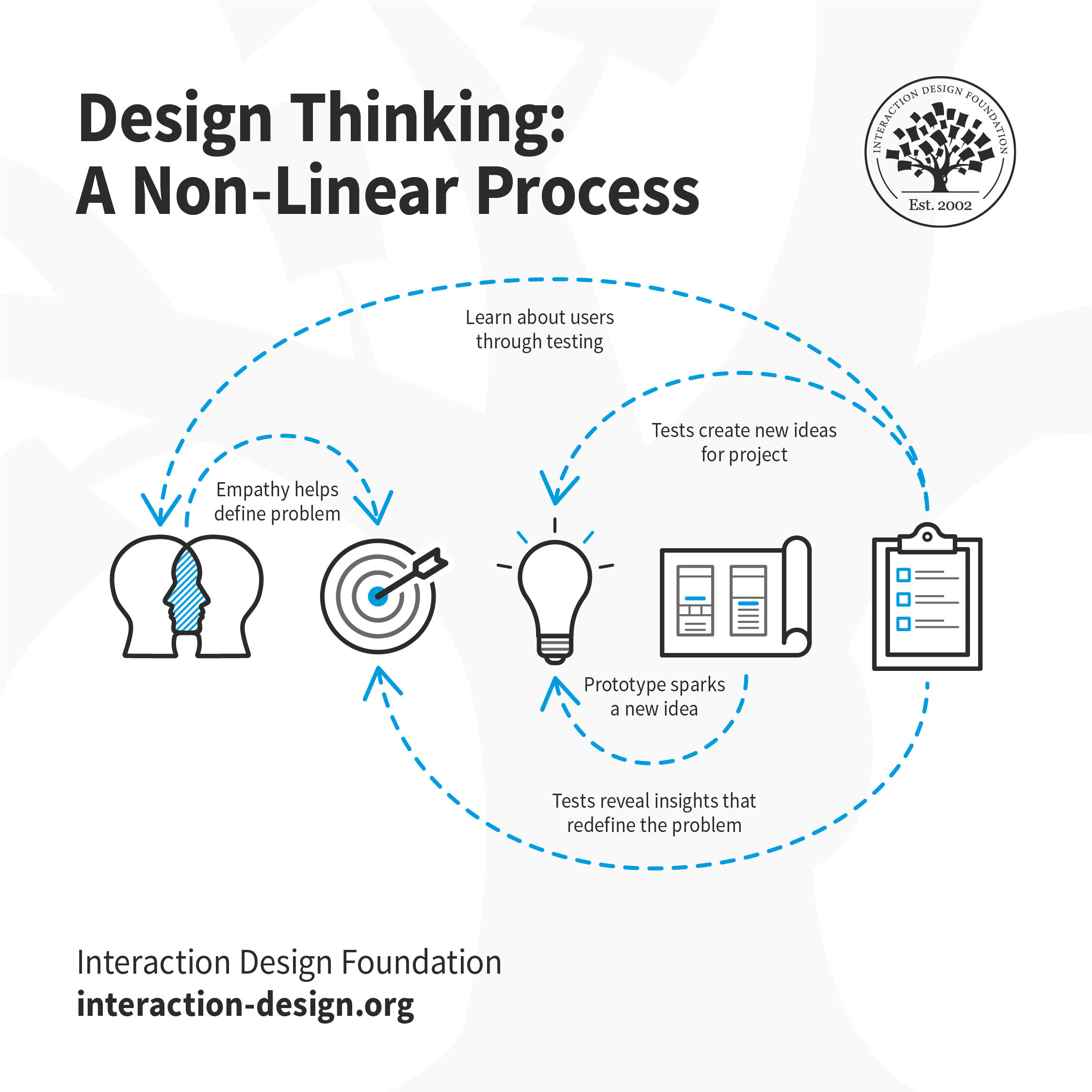
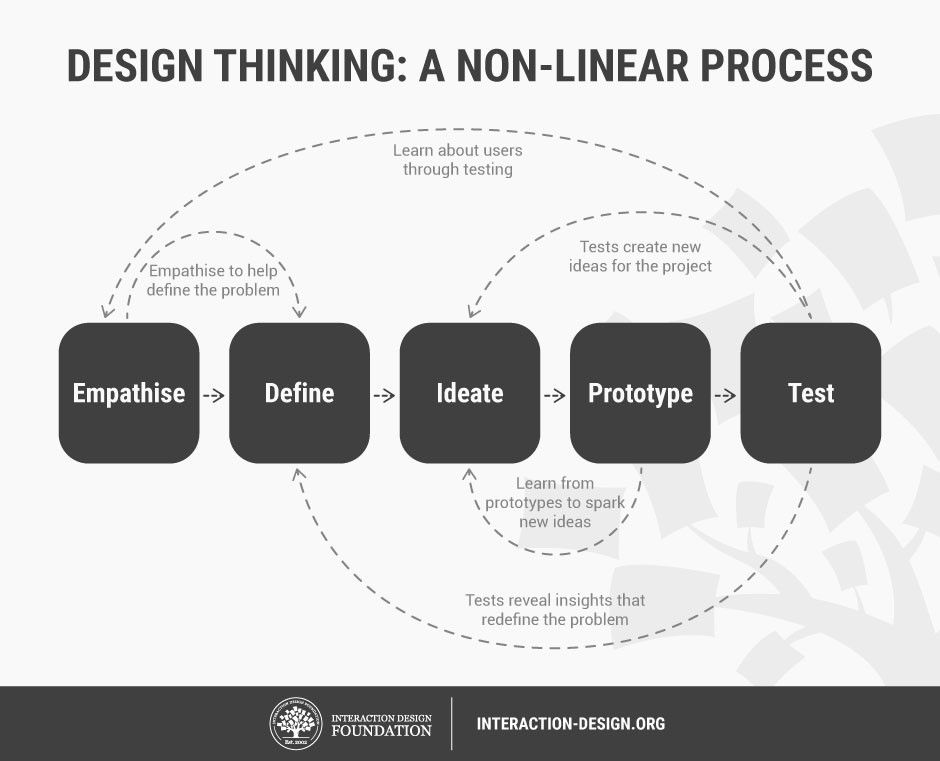
Remember, HMWs are an iterative process, like the overall design thinking process captured above that includes the phases: Empathize, Define, Ideate, Prototype and Test. Although HMWs are a link between the Define and Ideate stages, that does not mean teams can’t revisit or use them in later stages. Similarly, teams must not rely solely on How Might We statements and use other user research methods in harmony with them.

© Interaction Design Foundation, CC BY-SA 4.0

To overcome these limitations, designers should use HMW questions with other tools and methods, such as user research, to guarantee a user-centered approach and focused idea selection for feasible and relevant solutions.
Questions About How Might We (HMW)?
We've Got Answers!

How do HMW questions facilitate user-centered design?

HMW questions are a great tool in user-centered design as they explore solutions from the users’ perspectives. Stated as open-ended questions, they encourage designers to think creatively about how to meet user needs and solve real-world problems. They are inherently open and flexible as well, so the solutions designers present explore unconventional ideas beyond the obvious.

HMW questions help shift the focus from the designer's assumptions to the users’ needs. By asking creative questions like, "How might we improve our users’ experience with our product?" instead of "What do we think is cool?", designers prioritize the users’ wants and needs in the design process so the developed solutions are the most relevant and valuable to the end user.

HMWs also foster empathy. They require designers and researchers to step into the users' shoes and consider their challenges, needs, and desires. This empathetic approach leads to a better understanding of the user, which is important to genuinely address their problems and create actionable resolutions. 

Moreover, the method encourages a collaborative approach to problem-solving. Teams typically use HMWs in brainstorming sessions where team members build on each other's ideas. This agile teamwork can lead to more innovative and user-focused answers, as it combines diverse perspectives and expertise.

Overall, HMWs focus on the user to promote empathy, facilitate team cooperation and support creative problem-solving, all of which are essential to design products which truly meet the needs of the users.

Learn how to think creatively and apply techniques, like HMWs and their variations, to get reasonable creative ideas when we need them. 

Copyright
Transcript

In the course Harness Your Creativity To Design Better Products, HCI expert, Professor Alan Dix walks you through several ideation methods―both for generating new ideas and for developing your ideas further.

Some books that cover the “How Might We” and other design thinking methods include: 

How Might We Champion Design Thinking in Your Organization?: A PRAKTIKEL Guide by Dan Buchner from FriesenPress, 2021. 

The guide serves as a rich source of practical ideas meant to motivate, instill confidence, and help others recognize the value of design thinking. The author includes ideas from years of hands-on experience involving trial and error and collaboration with individuals across diverse organizations. The book is a friendly guide which shares stories, observations, aha moments, and HMWs.

The Art of Innovation: Lessons in Creativity from IDEO, America's Leading Design Firm by Tom Kelley with John Littman by Currency, 2001.

This book offers a peek into the practices and strategies of IDEO, which is renowned for its innovative use of design thinking methodologies, including HMW.

Change by Design: How Design Thinking Transforms Organizations and Inspires Innovation by Tim Brown, Chairman and former CEO of IDEO, by HarperBusiness, 2009. 

In the book, Tim Brown provides a comprehensive overview of design thinking, a process in which HMW questions play a crucial role.

What are some highly cited research on the How Might We method?

Some interesting research surrounding HMW and other user research methods includes: 

Fabri, M. 2015. Thinking with a New Purpose: Lessons Learned from Teaching Design Thinking Skills to Creative Technology Students. In Design, User Experience, and Usability: Design Discourse, edited by A. Marcus, 9186: Lecture Notes in Computer Science. Cham: Springer. 

Siemon, Dominik, Felix Becker, and Susanne Robra-Bissantz. 2018. How Might We? From Design Challenges to Business Innovation. 4: 96–110.

Uebernickel, Falk, Matthias Herterich, and Jennifer Hehn. 2018. Design Thinking Methods for Service Innovation - A Delphi Study.

How can teams avoid bias in HMW questions?

Teams can significantly reduce the risk of bias in HMW questions with these strategies:

  • Diverse Team: Include individuals with different backgrounds, experiences, and perspectives on the team. This diversity helps to challenge assumptions and bring a variety of viewpoints to the table, reducing the risk of a singular, biased perspective.

  • User Research: Ground HMW questions in thorough user research. Understanding users’ needs, behaviors, and contexts through methods like interviews, surveys, and observation helps base questions on real-world data rather than personal assumptions.

  • Assess HMWs: Regularly review, refine, and iterate HMW questions. Encourage team members to identify and question any implicit biases within the questions. 

  • External Feedback: Seek feedback on HMW questions from people outside of the design team, especially those who represent the end users. This external perspective can highlight unseen biases and assumptions.

  • Bias Training: Educate the team and relevant stakeholders about common cognitive biases (such as confirmation bias, anchoring, or groupthink) to increase awareness and foster a more critical approach to formulating HMW questions.

  • Structured Brainstorming: Use structured brainstorming methods to give each team member an equal opportunity to contribute. Techniques like brainwriting can prevent dominant voices from overshadowing others for a more balanced set of perspectives.

Can HMW questions be combined with other brainstorming techniques?

We can use HMWs with various brainstorming techniques to progress creativity and idea generation in design processes. The combination results in diverse and comprehensive solutions. 

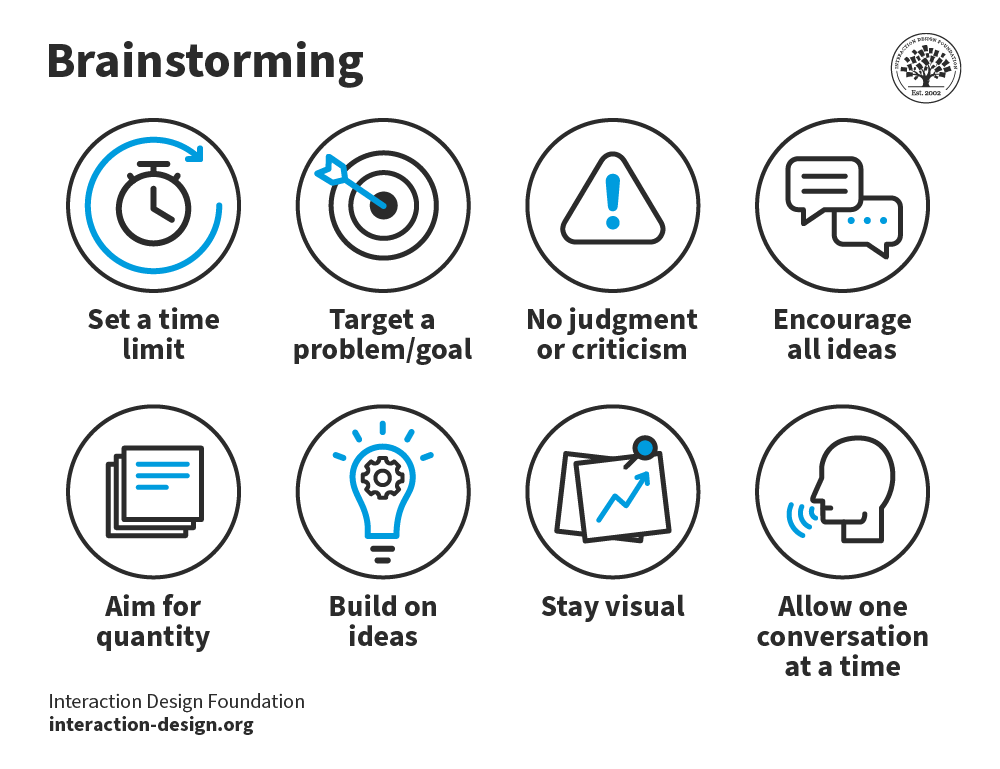
You can apply the brainstorming guidelines pictured above to any ideation session, including HMWs.
© Interaction Design Foundation, CC BY-SA 4.0

For example, brainwriting begins with HMW questions to pinpoint focus areas, followed by team members individually writing down ideas. This benefits those who prefer writing over speaking. Additionally, mind mapping with HMW questions visually explores problem aspects and interconnections for holistic solutions. 

The SCAMPER technique (Substitute, Combine, Adapt, Modify, Put to another use, Eliminate, Reverse) pairs with HMW questions, prompting teams to rethink existing products or processes. Furthermore, the Six Thinking Hats method by Edward de Bono, representing different perspectives, integrates with HMW questions for a multifaceted exploration. As does Starbursting, a technique that generates questions instead of answers and works alongside HMW questions to deeply understand problems.

Finally, HMW questions also assist in crafting storyboards and visualizing user journeys, thereby centering the ideation session on human experiences. The combination of HMW questions with these brainstorming methods enables teams to take advantage of each technique for more innovative, well-rounded and human-centered design solutions.

Can HMW questions be used in remote or virtual team settings?

Yes, teams can effectively use HMW questions in remote or virtual team settings. The adaptability of HMW questions makes them perfect for digital collaboration. Explore some helpful strategies for a remote context:

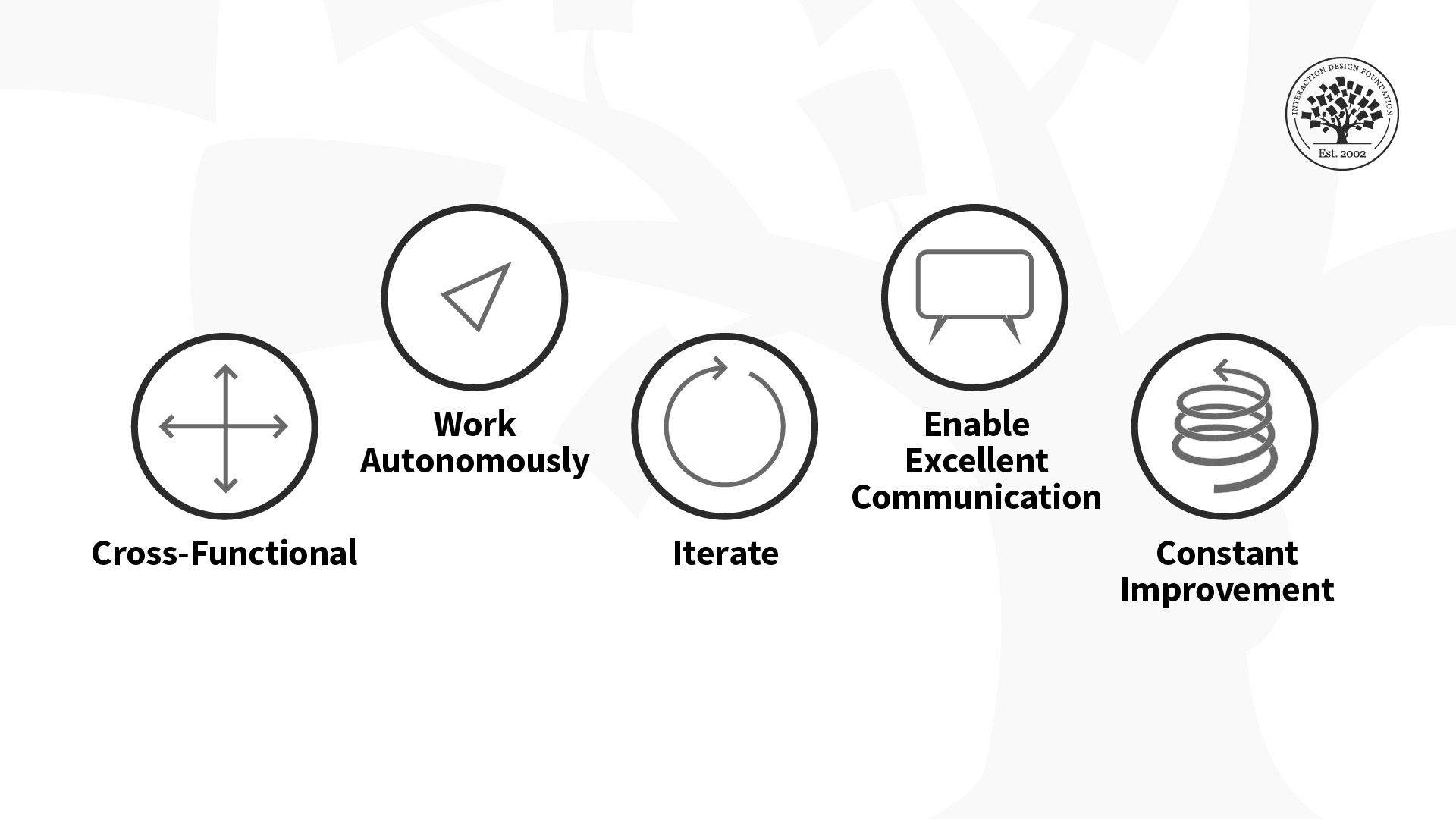
Alt: icons representing the common patterns found in agile teams: Cross-Functional, Work Autonomously, Iterate, Enable Excellent Communication, Constant Improvement.Follow the strategies to incorporate the HMW technique in a virtual environment. Strive for agile teamwork across teams with clear communication, and don’t forget to iterate!

© Interaction Design Foundation, CC BY-SA 4.0

  • Digital Collaboration Tools: Use digital tools such as online whiteboards (e.g., Miro, Figma) and collaborative document platforms (e.g., Google Docs) to brainstorm and document HMW questions. These tools enable real-time collaboration and idea sharing.

  • Structured Virtual Meetings with Breakout Sessions: Organize structured virtual meetings or workshops dedicated to HMW brainstorming. Clearly outline the agenda and objectives beforehand and ensure everyone understands the HMW process. In larger teams, use breakout sessions to facilitate smaller group discussions, to make sure all team members participate to be able to generate more diverse ideas.

  • Asynchronous Brainstorming and Communication: Recognize the potential for asynchronous brainstorming, allowing team members in different time zones to contribute HMW questions and ideas at their convenience. Do this by maintaining clear and regular communication so everyone is aligned on the goals and context of the HMW questions. Use channels like Slack, Teams, or email for updates and ongoing discussions, leading to more thoughtful and considered contributions. 

  • Facilitation and Moderation: Have a dedicated facilitator to guide the HMW sessions. It’s important the conversation stays on track and all voices are heard, especially in a virtual setting where it’s easy for some participants to become passive.

  • Feedback and Iteration: Encourage and incorporate feedback on the HMW questions and iterate on them as necessary. Do this via follow-up meetings or shared digital platforms.

How does HMW integrate with other design thinking tools?

HMW questions smoothly integrate with various design thinking tools, boosting their effectiveness. 

Empathy maps capture users' thoughts, feelings, experiences, needs, etc., and they inform HMW questions to address specific user needs. 

After the development of user personas, designers tailor HMW questions to meet their distinct needs, goals and pain points, enhancing question relevance. 

Alongside user journey maps, HMW questions focus on particular journey stages and aid in pinpointing and resolving additional pain points while improving the user experience throughout. 

During prototype development and testing, HMW questions concentrate on user-specific needs or problems and assist in hypothesis formulation about user behavior and preferences.

Integrating HMW questions with these design thinking tools ensures a consistent human-centered approach, leading to more targeted, creative and efficient resolutions that align closely with user needs.

Learn more about the tools designers need in their UX toolbox to optimize the design thinking process with Susan Weinschenk and Guthrie Weinschenk. 

Watch the Master Class, How to Build Your UX Toolbox, today!

How can HMW be adapted for specific industries or projects?

Adapt HMWs to specific industries or projects by tailoring them to unique challenges and contexts:

  1. Research industry challenges, terminologies, regulatory environments and user behaviors to create relevant HMW questions.

  2. Develop user personas for the industry’s target audience and use them to direct HMW questions to their specific needs and wants.

  3. Integrate constraints like regulatory compliance and technical limitations into HMW questions.

  4. Aim to align HMW questions with project objectives, particularly for innovative solutions within the industry context.

  5. Involve industry experts for depth and accuracy to ground HMWs in real-world knowledge.

  6. Include technical specifics in HMW questions for technically complex industries to improve actionable solutions.

  7. Continually adapt and refine HMW questions as the project evolves and new insights are gained.

By customizing HMW questions, they more effectively elicit targeted, interesting and workable solutions in a creative process relevant to industry realities and project goals.

How do HMW questions evolve for advanced or complex design projects?

For advanced or complex design projects, HMW questions evolve to meet greater complexity:

  • Increased Specificity: HMW questions become more specific, focusing on particular challenges and delving into nuanced design areas.

  • Integration of Technical and Business Constraints: These questions incorporate technical and business considerations, like scalability and alignment with business strategies.

  • User-Centric but Holistic: HMW maintains a user-centric approach but also considers the entire ecosystem, including supply chains and environmental impact.

  • Iterative Refinement: HMW questions undergo iterative refinement to adjust to new information as the project progresses.

  • Cross-Disciplinary Input: They draw on diverse fields such as technology, business and psychology for various perspectives.

  • Emphasis on Feasibility and Viability: HMW questions balance creative ideation with realistic implementation and sustainability considerations.

  • Risk and Future-Proofing: HMWs include risk management and future-proofing to assess how design decisions might play out in future scenarios.

In summary, as design projects and their goals grow in complexity, HMW questions adapt to become more targeted, integrated, iterative and forward-looking.

Can HMW questions be used in agile design methodologies?

HMWs seamlessly integrate into agile design methodologies and complement their flexible and user-centered nature.

During sprint planning sessions, teams use HMW questions to define goals and focus. These questions pose challenges and objectives, foster creative problem-solving and center users’ needs. They also aid the development of user stories by summarizing those needs and problems, which are then later put to use in designs that focus on real user requirements.

In daily standups and iterative reviews, HMW questions enable teams to reassess their approaches based on new findings and feedback—demonstrating the agile principle of “embrace change.” They also act as catalysts in cooperative brainstorming sessions, which often spark user-centric and novel ideas.

At the end of each sprint, teams use HMW questions in retrospectives to reflect on learned lessons and identify areas for process and outcome improvements. This practice supports the agile methodology’s goal of “continuous improvement.”

When teams incorporate HMW questions into various stages of the agile design process, a sustained focus on user needs, creativity and adaptive responses to new insights and changes emerges and embodies the core principles of agile methodologies.

Enroll in the IxDF course, Agile Methods for UX Design, with author and agile expert Laura Klein. 

Transcript

Earn a Gift Earn a Gift, Answer a Short Quiz!

1
2
3
4
1
2
3
4
Question 1
Question 2
Question 3
Get Your Gift
Interaction Design Foundation logo

Question 1

What is the primary purpose of "How Might We" questions in design thinking?

1 point towards your gift

  • To create detailed project plans and timelines
  • To evaluate the financial viability of a project
  • To open up problem statements for innovative ideation
Interaction Design Foundation logo

Question 2

Who should create "How Might We" questions?

1 point towards your gift

  • A diverse group of stakeholders, including users and cross-functional team members
  • Only senior designers and high-level stakeholders
  • The marketing team alone
Interaction Design Foundation logo

Question 3

What components make up a well-structured "How Might We" question?

1 point towards your gift

  • Action verb, potential user and desired outcome
  • Financial goals, timeline and project scope
  • Technology requirements, user demographics and budget constraints

Learn More About How Might We (HMW)

Make learning as easy as watching Netflix: Learn more about How Might We (HMW) by taking the online IxDF Course Design Thinking: The Ultimate Guide.

Why? Because design skills make you valuable. In any job. Any industry.

In This Course, You'll

  • Get excited when you discover that you don't need to start from scratch to use the secret recipes that empower companies like Apple and Google to shape the future. You just need a structure and proven methods to optimize what you already do. As AI becomes part of your day-to-day workflows, your ability to guide it with timeless human-centered skills such as strategic thinking, creativity, and empathy for real users is what turns AI into your superpower and delivers meaningful results.

  • Build on your existing creativity, problem-solving, and people skills to learn the powerful 5-stage method called Design Thinking. It's one of the key drivers behind Apple and Google's continuous innovation and provides a clear, structured way to solve real-world problems. You've already got the instincts, so it's easy to learn the method. 

  • Make yourself invaluable with hands-on skills in Design Thinking. Design Thinking can help you break into User Experience Design, product design, and tech. It's widely applicable, impactful, and fun! Use your skills to improve customer support processes, create new products, and even tackle big challenges like climate change. This human-centered approach is a key driver of business success because it guides you to systematically understand and address what your users really need and want. That's why Design Thinking skills can help you increase sales, keep customers loyal, and turn them into powerful advocates for your company.

  • Gain confidence and credibility as you effortlessly apply methods from all five stages of the Design Thinking process. You'll be guided to build empathy and gather insights into people's habits through user interviews. 

  • Use our downloadable templates to create affinity diagrams, empathy maps, and actionable "How Might We" questions. Develop solutions as you apply ideation and innovation methods. Create a paper prototype early and fast, then test and optimize your prototype to ensure that your users love it. More love, more impact, greater salary potential. 

  • Apply your new skills in an optional project where you'll design and test a user-centered experience that's perfect for your portfolio and career growth. Master Design Thinking to amplify your uniquely human strengths like empathy, intuition, and creativity, and confidently stay in demand as AI reshapes how teams work.

It's Easy to Fast-Track Your Career with the World's Best Experts

Master complex skills effortlessly with proven best practices and toolkits directly from the world's top design experts. Meet your experts for this course:

  • Don Norman: Father of User Experience (UX) Design, author of the legendary book “The Design of Everyday Things,” and co-founder of the Nielsen Norman Group.

  • Alan Dix: Author of the bestselling book “Human-Computer Interaction” and Director of the Computational Foundry at Swansea University.

  • Mike Rohde: Experience and Interface Designer, author of the bestselling “The Sketchnote Handbook.”

Get an Industry-Recognized IxDF Course Certificate

Increase your credibility, salary potential and job opportunities by showing credible evidence of your skills.

IxDF Course Certificates set the industry gold standard. Add them to your LinkedIn profile, resumé, and job applications.

Course Certificate Example

Be in distinguished company, alongside industry leaders who train their teams with the IxDF and trust IxDF Course Certificates.

Our clients: IBM, HP, Adobe, GE, Accenture, Allianz, Phillips, Deezer, Capgemin, Mcafee, SAP, Telenor, Cigna, British Parliament, State of New York

All Free IxDF Articles on How Might We (HMW)

Read full article
Define and Frame Your Design Challenge by Creating Your Point Of View and Ask “How Might We” - Article hero image
Interaction Design Foundation logo

Define and Frame Your Design Challenge by Creating Your Point Of View and Ask “How Might We”

Defining your design challenge is probably one of the most important steps in the Design Thinking process, as it sets the tone and guides all of the activities that follow. In the Define mode, you should end up creating an actionable problem statement which is commonly known as the Point of View (PO

Social shares
1.2k
Published
Read Article
Read full article
What is Ideation – and How to Prepare for Ideation Sessions - Article hero image
Interaction Design Foundation logo

What is Ideation – and How to Prepare for Ideation Sessions

Ideation is the process where you generate ideas and solutions through sessions such as Sketching, Prototyping, Brainstorming, Cheatstorming, Brainwriting, Worst Possible Idea, and a wealth of other ideation techniques. Ideation is also the third stage in the Design Thinking process. Although many p

Social shares
1.4k
Published
Read Article
Read full article
Learn How to Use the Best Ideation Methods: Brainstorming, Braindumping, Brainwriting, and Brainwalking - Article hero image
Interaction Design Foundation logo

Learn How to Use the Best Ideation Methods: Brainstorming, Braindumping, Brainwriting, and Brainwalking

Brainstorming is the most frequently practiced form of ideation. We recommend that you use it along with Brainwriting, Brainwalking, and Braindumping. Here, you’ll learn the best practices from the very best experts from d-school and IDEO as well of the father of the Brainstorming technique, Alex Os

Social shares
1.3k
Published
Read Article
Read full article
Transform Your Creative Process with Design Thinking - Article hero image
Interaction Design Foundation logo

Transform Your Creative Process with Design Thinking

Think about a new user experience (UX) design project at work that your team needs fresh ideas for—you want to create a winning digital product for your users, one that’s desirable, economically viable, and technologically feasible. To start with, you try to understand market trends and consumer beh

Social shares
521
Published
Read Article

Define and Frame Your Design Challenge by Creating Your Point Of View and Ask “How Might We”

Define and Frame Your Design Challenge by Creating Your Point Of View and Ask “How Might We”

Defining your design challenge is probably one of the most important steps in the Design Thinking process, as it sets the tone and guides all of the activities that follow. In the Define mode, you should end up creating an actionable problem statement which is commonly known as the Point of View (POV) in Design Thinking. You should always base your Point Of View on a deeper understanding of your specific users, their needs and your most essential insights about them. In the Design Thinking process, you will gain those insights from your research and fieldwork in the Empathise mode. Your POV should never contain any specific solution, nor should it contain any indication as to how to fulfill your users’ needs in the service, experience, or product you’re designing. Instead, your POV should provide a wide enough scope for you and your team to start thinking about solutions which go beyond status quo. Here, you’ll also learn to frame and open up your Point Of View, which is the axis that Design Thinking revolves around – a challenge well-framed is half solved.

"Your point of view should be a guiding statement that focuses on specific users, and insights and needs that you uncovered during the empathize mode.

More than simply defining the problem to work on, your point of view is your unique design vision that you crafted based on your discoveries during your empathy work. Understanding the meaningful challenge to address and the insights that you can leverage in your design work is fundamental to creating a successful solution.”
– d.school, Bootcamp Bootleg

Your POV is Your Guide

Your Point of View (POV) defines the RIGHT challenge to address in the following mode in the Design Thinking process, which is the Ideation mode. A good POV will allow you to ideate and solve your design challenge in a goal-oriented manner in which you keep a focus on your users, their needs and your insights about them.

You should construct a narrowly-focused problem statement or POV as this will generate a greater quantity and higher quality solutions when you and your team start generating ideas during later Brainstorm, Brainwriting, SCAMPER and other ideation sessions. In the ideation process, POV will be your guiding statement that focuses on insights and needs of a particular user, or composite character. It’s easy to get lost in the ideations sessions if you don’t have a meaningful and actionable problem statement to help keep your focus on the core essence of your research results from your previous work. A great POV keeps you on track. It helps you design for your users and their needs. If you neglect to define your POV, you may end up getting lost in the ideation processes and in your prototyping process. It’s all too easy to end up focusing on you and your company’s own needs, trying to fulfill your and your company’s own dreams, not to mention the risk of getting lost in creating amazing buttons in the beautiful colours. It’s time to find out how you define your POV.

Author/Copyright holder: Teo Yu Siang and Interaction Design Foundation. Copyright terms and licence: CC BY-NC-SA 3.0
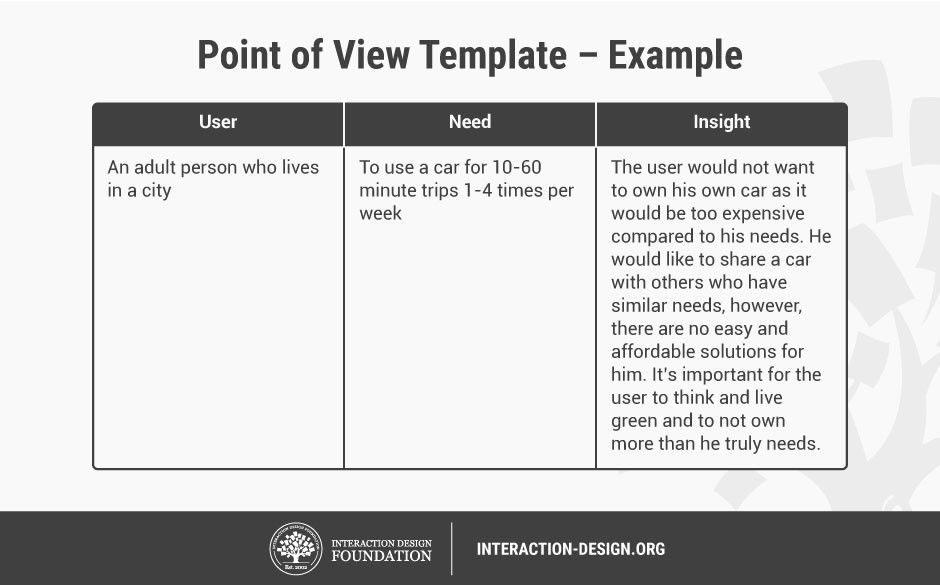
How do you Define your Point Of View?

Step 1

  • Define the type of person you are designing for – your user. For example, you could define the user by developing one or more personas, by using affinity diagrams, empathy maps and other methods, which help you to understand and crystallise your research results – observations, interviews, fieldwork, etc.

  • Select the most essential needs, which are the most important to fulfill. Again, extract and synthesise the needs you’ve found in your observations, research, fieldwork, and interviews. Remember that needs should be verbs.

  • Work to express the insights developed through the synthesis of your gathered information. The insight should typically not be a reason for the need, but rather a synthesised statement that you can leverage in your designing solution.

Step 2

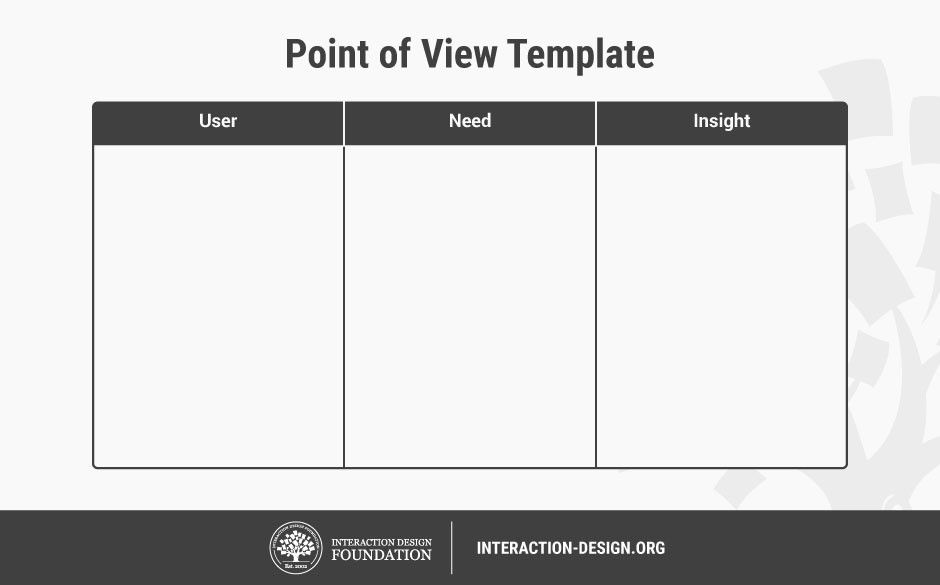
Write your definitions into a Point Of View template like this one:

Author/Copyright holder: Teo Yu Siang and Interaction Design Foundation. Copyright terms and licence: CC BY-NC-SA 3.0

Your Point Of View template:

Author/Copyright holder: Teo Yu Siang and Interaction Design Foundation. Copyright terms and license: CC BY-NC-SA 3.0
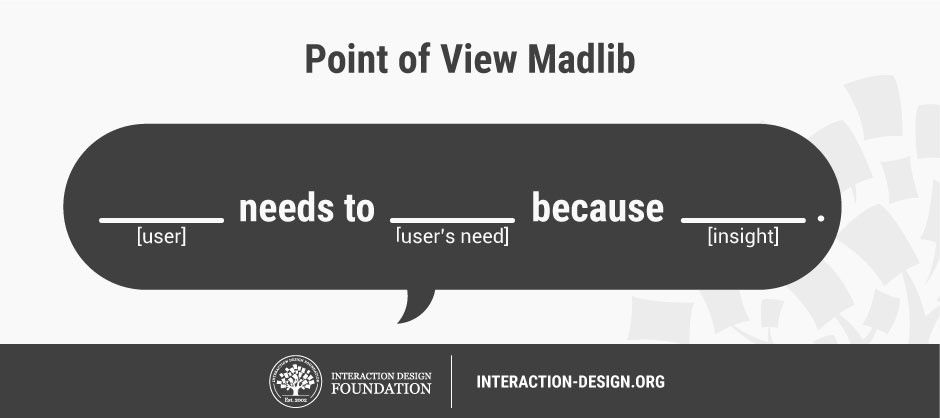
Step 3 – POV Madlib

You can articulate a POV by combining these three elements – user, need, and insight – as an actionable problem statement that will drive the rest of your design work. It’s surprisingly easy when you insert your findings in the POV Madlib below. You can articulate your POV by inserting your information about your user, the needs and your insights in the following sentence:

[User . . . (descriptive)] needs [Need . . . (verb)] because [Insight . . . (compelling)]

Author/Copyright holder: Teo Yu Siang and Interaction Design Foundation. Copyright terms and license: CC BY-NC-SA 3.0

Condense your Point Of View by using this POV Madlib.

Example: An adult person who lives in the city… needs access to a shared car 1-4 times for 10-60 minutes per week … because he would rather share a car with more people as this is cheaper, more environmentally friendly, however, it should still be easy for more people to share.

Author/Copyright holder: Sam Churchill. Copyright terms and license: CC BY 2.0

You articulate a POV by combining these three elements – user, need, and insight – as an actionable problem statement that will drive the rest of your design work. An example could be: “A person who lives in the city… needs access to a shared car 1-4 times for 10-60 minutes per week … he would rather share a car with more people as this is cheaper, more environmentally friendly, and it should still be easy for more people to share.” Here you see one of Google’s driverless cars – a driverless electric car could be a part of the solution to this design challenge. However, at this stage of the design process, we’re not ready to look for solutions just yet.

Step 4 – Make Sure That Your Point Of View is One That:

  • Provides a narrow focus.

  • Frames the problem as a problem statement.

  • Inspires your team.

  • Guides your innovation efforts.

  • Informs criteria for evaluating competing ideas.

  • Is sexy and captures people’s attention.

  • Is valid, insightful, actionable, unique, narrow, meaningful, and exciting.

Yay! You’re now well-equipped to create a POV and it’s time to understand how to start using your POV which crystallizes all of your previous work in the Empathise mode.

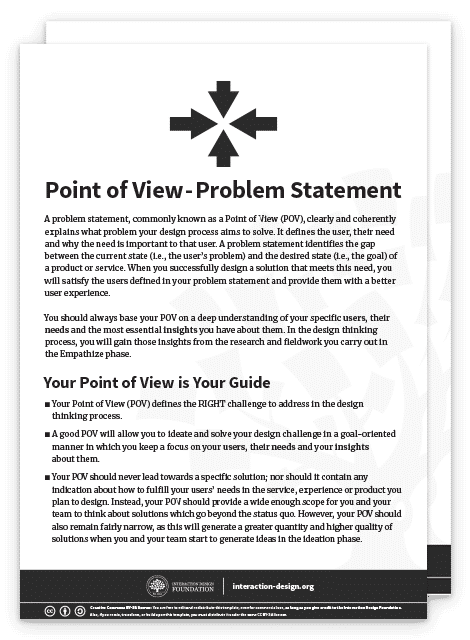
You can download and print the Point Of View template here:

Advance Your Career With This Free Template for “Point of View - Problem Statement”
Point of View - Problem Statement
We respect your privacy
Get 1 powerful email each week: Design a life you love!

“How Might We” Questions Frame and Open Up Your Design Challenge

You start using your POV by reframing the POV into a question: Instead of saying, we need to design X or Y, Design Thinking explores new ideas and solutions to a specific design challenge. It’s time to start using the Design Thinking Method where you ask, “How Might We…?”

Author/Copyright holder: Teo Yu Siang and Interaction Design Foundation. Copyright terms and license: CC BY-NC-SA 3.0

When you’ve defined your design challenge in a POV, you can start opening up for ideas to solve your design challenge. You can start using your POV by asking a specific question starting with, “How-Might-We?” or “in-what-ways-might-we?”. For example: How might we… design a driverless car, which is environmentally friendly, cheap and easy for more people to share?

How Might We (HMW) questions are the best way to open up Brainstorm and other Ideation sessions. HMW opens up to Ideation sessions where you explore ideas that can help you solve your design challenge. By framing your challenge as a How Might We question, you’ll prepare yourself for an innovative solution in the third Design Thinking phase, the Ideation phase. The How Might We method is constructed in such a way that it opens the field for new ideas, admits that we do not currently know the answer, and encourages a collaborative approach to solving it.

For example, if your POV is:

“Teenage girls need… to eat nutritious food… in order to thrive and grow in a healthy way.“

The HMW question may go as follows:

  • How Might We make healthy eating appealing to young females?

  • How Might We inspire teenage girls towards healthier eating options?

  • How Might We make healthy eating something, which teenage girls aspire towards?

  • How Might We make nutritious food more affordable?

These are simple examples, all with their own subtle nuances that may influence slightly different approaches in the ideation phases. Your HMW questions will ensure that your upcoming creative ideation and design activities are informed with one or more HMW questions, which spark your imagination and aligns well with the core insights and user needs that you’ve uncovered.

“We use the How Might We format because it suggests that a solution is possible and because they offer you the chance to answer them in a variety of ways. A properly framed How Might We doesn’t suggest a particular solution, but gives you the perfect frame for innovative thinking.”
– Ideo.org

How Might We?

The How Might We question purposely maintains a level of ambiguity, and opens up the exploration space to a range of possibilities. It's a re-wording of the core need, which you have uncovered through a deeper interrogation of the problem in your research phase, the Empathise mode in Design Thinking – and synthesized in the Define mode in Design Thinking.

  • "How" suggests that we do not yet have the answer. “How” helps us set aside prescriptive briefs. “How” helps us explore a variety of endeavors instead of merely executing on what we “think” the solution should be.

  • "Might" emphasizes that our responses may only be possible solutions, not the only solution. “Might” also allows for the exploration of multiple possible solutions, not settling for the first that comes to mind.

  • "We" immediately brings in the element of a collaborative effort. “We” suggests that the idea for the solution lies in our collective teamwork.

Without a statement of a clear vision or goal, “How Might We” is obviously meaningless. The words require a well-framed objective, a POV, which is neither too narrow so as to make it overly restrictive, nor too broad so as to leave you wandering forever in infinite possibilities.

An Inspiring HMW example

David and Tom Kelley's book Creative Confidence has the story of the Embrace Warmer, a design challenge undertaken by Stanford Graduate Students aimed at solving the problem of neonatal hypothermia, which costs the lives of thousands of infants in developing countries every year. Faced with the situation where hospital incubators were too expensive as well as physically inaccessible to villagers who lived in rural settings, a team of students engaged in some Empathy research, which led them to formulate the HMW statement:

"How Might We create a baby warming device that helps parents in remote villages give their dying infants a chance to survive?"

This HMW question inspired the design of the Embrace Warmer sleeping bag device, which provides the warmth premature babies in rural villages need, and which they are able to access at a fraction of the cost of traditional hospital incubators.

Whilst a traditional approach may have resulted in technological attempts to reduce the cost of the incubator, empathic research revealed that one of the core issues was the inability or unwillingness of mothers to leave their villages or leave their babies at hospitals for extended periods. This resulted in the reframing of an incubator to a warming device.

Author/Copyright holder: Embrace Innovations. Copyright terms and license: Fair Use.
Expand on Your How Might We Questions

Marty Neumeier's Second Rule of Geniusis all about framing and opening up your Point Of View by helping us dream of wishing for what we want. To start wishing, ask yourself the kinds of questions that begin with:

  • How might we...? (This is the commonly structured framing phrase used to express the essence of the challenge at hand.)

  • In What Ways Might We…. (Expand on HMW to add the possibility of multiple ways.)

  • What's stopping us from...?

  • In what ways could we...?

  • What would happen if...?

From there, you can ask follow-up questions such as:

  • Why would we...?

  • What has changed to allow us to...?

  • Who would need to...?

  • When should we...?

“When you let your mind wander across the blank page of possibilities, all constraints and preconceptions disappear, leaving only the trace of a barely glimpsed dream, the merest hint of a sketch of an idea.”
– Marty Neumeier's Second Rule of Genius

Best Practice Guide to Asking How Might We

  1. Begin with your Point of View (POV) or problem statement. Start by rephrasing and framing your Point Of View as several questions by adding “How might we” at the beginning.

  2. Break that larger POV challenge up into smaller actionable and meaningful questions. Five to ten How Might We questions for one POV is a good starting point.

  3. It is often helpful to brainstorm the HMW questions before the solutions brainstorm.

  4. Look at your How Might We questions and ask yourself if they allow for a variety of solutions. If they don’t, broaden them. Your How Might We questions should generate a number of possible answers and will become a launchpad for your Ideation Sessions, such as Brainstorms.

  5. If your How Might We questions are too broad, narrow them down. You should aim for a narrow enough frame to let you know where to start your Brainstorm, but at the same time, you should also aim for enough breadth to give you room to explore wild ideas.

You can download and print out our How Might We template which you and your team can use as a guide:

Advance Your Career With This Free Template for “How Might We Questions”
How Might We Questions
We respect your privacy
Get 1 powerful email each week: Design a life you love!

A Good POV will Make Your Problem Statement Human-Centred

Creating your POV will help you to define the problem as a problem statement in a human-centered manner. A human-centered problem statement is important in a Design Thinking project because it guides you and your team, and focuses on the uncovered specific needs. It also creates a sense of possibility and optimism in that it encourages team members to generate ideas during the Ideation stage, the third and next stage in the Design Thinking process. A good problem statement should thus have the following traits. It should be:

  • Human-centred. This means you frame your problem statement according to specific users, their needs and the insights that your team has gained during the Empathise phase. Rather than focus on technology, monetary returns or product specifications, the problem statement should be about the people the team is trying to help.

  • Broad enough for creative freedom. This means the problem statement should not focus too narrowly on a specific method regarding the implementation of the solution. Neither should the problem statement list technical requirements, as these would unnecessarily restrict the team and prevent them from exploring areas that might bring unexpected value and insight to the project.

  • Narrow enough to make it manageable. On the other hand, a problem statement such as “Improve the human condition” is too broad and will likely cause team members to feel easily daunted. Problem statements should have sufficient constraints to make them manageable.

Linear Problem Solving vs. the Non-Linear Nature of Design Thinking

This design challenge framing is in stark contrast to the business models for linear problem solving, which rationally attempt to define everything upfront, and then etch away at achieving the set solution systematically. Design Thinking is also very systematic, but its approach is more about uncovering the problem rather than etching away at a set solution. Idris Mootee mentions in his book, Design Thinking for Strategic Innovation, that more than 80% of management tools, systems, and techniques are for value capture, but that the role of Design Thinking is for value creation.

Well-framed Challenges

A well-framed challenge has just enough constraints, with space to explore. You might have encountered the following linear problem-solving approach by your manager telling you: "Design a poster which increases sign-ups to our next event."—or—"Redesign the packaging so our product is more noticeable on the shelf." These kinds of briefs quite often attempt to solve the problem of target markets not responding well enough to what's on offer, and are attempts to put a patch on things. Design Thinking digs deeper and helps us understand the users, their needs and our insights about them before we decide upon which course of action to take. As such, Design Thinking will instead help us ask and research: “Why are people not signing up for the event?” and “What is it about our product that causes people to ignore it?”

Design Thinking helps us focus on what kind of userswe’re dealing with, their needs we're trying to address in our design challenge, and then understand whether we're actually addressing those needs well enough.

Define and re-define – The Non-Linear Nature of Design Thinking

Author/Copyright holder: Teo Yu Siang and Interaction Design Foundation. Copyright terms and licence: CC BY-NC-SA 3.0

The five stages of Design Thinking are not sequential steps, but different “modes” you can put yourself in, to iterate on your problem definition, ideas, or prototype, or to learn more about your users at any point during the project. It is important to be aware from the outset that the initial definition of your challenge is based upon your initial set of constraints or understandings, and that you should revisit and re-frame your definition often as you uncover new insights indicating a problem in the framing as you work in the other four Design Thinking modes.

Know Your History

One of the most commonly structured framing phrases which we use to express the essence of the challenge at hand is: How Might We? (HMW). The Phrase is rumoured to have been popularized by Min Basadur at Proctor and Gamble, then on to IDEO, next at Google and later at Facebook in a viral breakout, that has since revolutionised how companies frame their innovation challenges. GK Van Platter of Humantific references a much earlier example in an article entitled, Origins of How Might We? (2012). The reframing technique has its roots all the way back in the mid-sixties, with a work by Sidney J. Parnes Ph.D "Creative Behavior Guidebook", which touches on the concept of "Invitation Stems" or "How Mights" .

The Take Away

Spend enough time to carefully consider the format and composition of your POV and HMW questions to ensure that your upcoming creative ideation and design activities are informed with one of more HMW questions, which spark your imagination and align well with the core insights and user needs that you’ve uncovered. Creating your POV helps you define your problem statement in a human-centred manner.

“If I had an hour to solve a problem I'd spend 55 minutes thinking about the problem and 5 minutes thinking about solutions.”
– Albert Einstein

References & Where to Learn More

Idris Mootee, Design Thinking for Strategic Innovation: What They Can't Teach You at Business or Design School, 2013

Ideo.org, How Might We.

Marty Neumeier, The Rules of Genius #2, Wish for what you want, 2014.

Sarah Soule: How Design Thinking Can Help Social Entrepreneurs, 2013.

Warren Berger, The Secret Phrase Top Innovators Use, 2012.

Hero Image: Author/Copyright holder: Simon Powell. Copyright terms and licence: CC BY 2.0

Feel Stuck?
Want Better Job Options?

AI is replacing jobs everywhere, yet design jobs are booming with a projected 45% job growth. With design skills, you can create products and services people love. More love means more impact and greater salary potential.

At IxDF, we help you from your first course to your next job, all in one place.

See How Design Skills Turn Into Job Options
Privacy Settings
By using this site, you accept our Cookie Policy and Terms of Use.
Customize
Accept all

Be the One Who Inspires

People remember who shares great ideas.

Share on:

Academic Credibility — On Autopilot

Don't waste time googling citation formats. Just copy, paste and look legit in seconds.