A cross-functional team includes members with different skills, expertise, and levels working towards a common goal. The team's diverse backgrounds contribute to a comprehensive understanding of problems, which enhances the likelihood of reaching optimal solutions.
Laura Klein, author of Build Better Products and UX for Lean Startups, explains how cross-functional teams work and how they differ from functional teams in this video:
How Do Cross-Functional Teams Differ from Traditional Team Structures?
Traditional team structures are usually functional, where team members share similar skills and expertise and perform similar functions. For example, a company might have a design team, an engineering team, a customer service team, etc.
A functional team has a manager who has a similar background and understands the team members’ roles and responsibilities.
Functional teams have a clear leadership structure. In large functional organizations, managers might assign team members to different projects, depending on their expertise and availability. Even if assigned to different projects, team members report to the departmental manager. This approach, however, can lead to a siloed organization where teams don’t interact with each other.
Cross-functional teams seek to break these silos and foster greater collaboration between teams. When people across different departments come together, the group gains multiple perspectives.
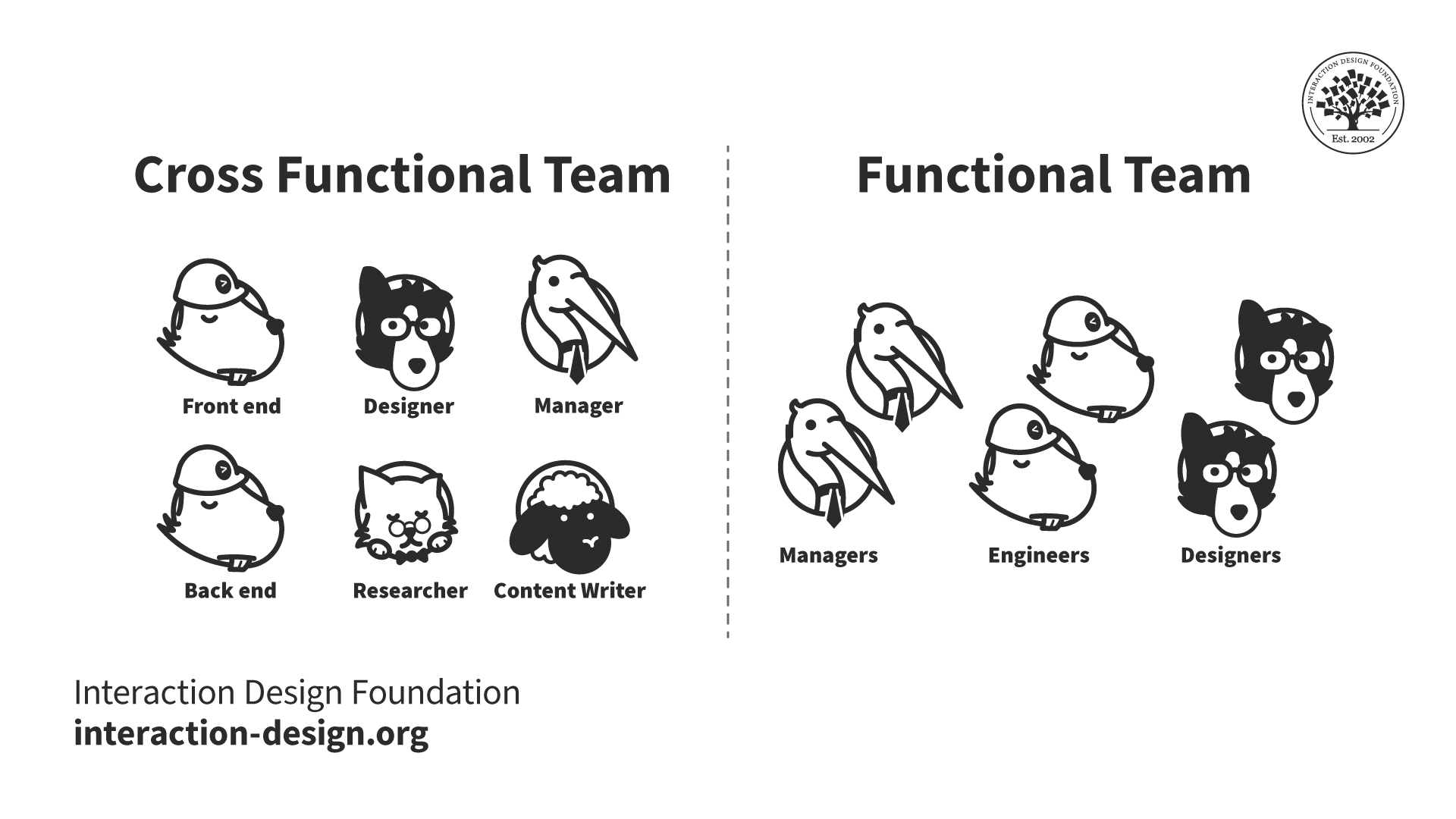
© Interaction Design Foundation, CC BY-SA 4.0
Functional and cross-functional teams have advantages and drawbacks that suit different organizations and projects. Here is a comparison between the two types of teams.
Functional Teams | Cross-Functional Teams | |
Composition | Team members share similar skills and expertise and perform similar functions. | Team members have different skills and expertise and perform different functions. |
Alignment | Teams align themselves to the goals of the function or department. | Teams align themselves to the goals of a project. |
Management | The manager usually shares similar skills as the team members. Teams have a clear leadership hierarchy, and members report to a single manager. | The team has a project manager who might be from a different department than most team members. The reporting structure is unclear, as team members might need to report to their departmental managers and the project manager. |
Collaboration with Other Departments | The organization can become siloed, where one team doesn’t know what the others are doing. | Fosters deeper collaboration between people of different functions. |
Communication | Since team members have a similar knowledge base, they share similar jargon and can communicate within the team easily. | Team members have different skills and expertise, use different terms, and have different work styles or approaches to problem-solving, which may cause friction and conflicts. |
Scope of Work | Work within their domain or department and usually have a more specialized and narrow scope. | Work on projects or initiatives that span across multiple functions. Their scope is often broader and more strategic. |
Flexibility and Innovation | Teams are focused and efficient in their specific area but might be rigid, thus reducing innovative thinking outside their field. | Often more adaptable and innovative. Team members’ diverse perspectives and expertise make such teams suitable for tasks that require creativity and interdisciplinary knowledge. |
Duration | Often permanent and focuses on ongoing tasks and objectives within their functional area. | Frequently assembled for a specific project or initiative and may be temporary, disbanding once the project is complete. |
Advantages of Cross-Functional Teams in Design
In this video, Frank Spillers, CEO of Experience Dynamics, dives into the importance of co-creation, especially in service design. He highlights how collaboration among cross-functional teams can drive innovation and success.
Diverse expertise: Cross-functional teams bring together members with a wide range of skills and knowledge from different functional areas of the organization. This diversity of expertise enables the team to tackle complex problems and challenges that require a multidisciplinary approach.
Beginner’s mindset: Each team member has expertise in their domain, which might lead to blind spots and assumptions. When people from different backgrounds come together, they offer a fresh perspective and approach each other’s domains from a beginner’s point of view, thus challenging beliefs and assumptions.
Fewer handoffs: In traditional teams, resources (such as a designer or researcher) might work on a project temporarily and then move to the next one. To help the next designer, the outgoing team member creates a handover, usually a document. These handovers sometimes can cause misunderstandings and confusion. A cross-functional team comes together for a specific project, which reduces the need for handoffs and potential confusion.
Innovation and creativity: The design thinking methodology advocates for cross-functional teams. The combination of diverse perspectives fosters innovation and creativity. Team members can brainstorm ideas, challenge conventional thinking, and develop novel solutions that might not be possible in teams with a more limited focus.
Aligned with business goals: Unlike siloed departments, where teams might lose sight of the larger picture or move in different directions, cross-functional teams share a common vision.
Comprehensive problem-solving: Cross-functional teams can consider all aspects of a problem, from technical and operational to marketing and customer-related concerns. This comprehensive approach often leads to more effective solutions.
User-centric focus: When people from different teams come together, everyone can see how each department influences the customer journey and experience. This holistic approach leads to better products, services, and user experience.
© Interaction Design Foundation, CC BY-SA 4.0
Faster decision-making: Cross-functional teams can make decisions faster than traditional hierarchical structures. With all relevant expertise in one unit, there’s no need to wait for approvals or information from different departments. This is particularly relevant for agile teams.
Flexibility and adaptability: Functional teams will likely have their priorities and may not be available at the same time for urgent scenarios. On the other hand, cross-functional teams don’t depend on multiple departments—they have all the required expertise within the team. Hence, they can adapt quickly to changing circumstances or market conditions. They can pivot their strategies and tactics more easily than siloed teams.
Enhanced learning and development: Team members from different backgrounds can learn from each other, which leads to professional growth, skill development, and a broader understanding of the organization.
Increased accountability: Team members are often more accountable for their contributions in cross-functional teams because their work is visible to the entire organization. This accountability can lead to higher-quality outcomes.
Higher employee engagement: Working in cross-functional teams can enhance job satisfaction and engagement, as employees have a sense of ownership and impact on the outcomes of their collaborative efforts.
Challenges of Cross-Functional Teams
While cross-functional teams offer many advantages, they are not without their disadvantages. Organizations need to be aware of these potential drawbacks and address them effectively to ensure the success of such teams. Here are some disadvantages of cross-functional teams:
Conflict and tension: Diverse perspectives, expertise, opinions, goals and working styles can sometimes lead to conflicts and tension within the team.
Coordination and communication challenges: Coordinating activities and aligning goals across different functions can be complex. Effective communication can be difficult in cross-functional teams, especially if team members come from different backgrounds or have varying levels of technical expertise. Project managers may need more time and effort to ensure everyone is on the same page.
Ownership issues: Team members might need help understanding who is responsible for what within a cross-functional team. Without clear roles and responsibilities, tasks may fall through the cracks, and accountability can be unclear.
Resource allocation: The management of resources across functions can take time and effort. Cross-functional team members often belong to individual department heads as well. Department managers might want to assign other tasks. Team members might struggle to prioritize work, and managers might clash over resource allocation.
Resistance to change: Employees from different functional areas might feel uncomfortable leaving traditional working styles. This resistance can hinder the team’s progress and success.
Lack of domain expertise: Cross-functional teams may lack deep domain expertise in a specific area, making it difficult to effectively address highly specialized or technical issues.
Time-consuming meetings: Collaboration and consensus-building can require frequent meetings and discussions, which may consume a significant amount of team members’ time and potentially lead to “meeting fatigue.”
Decision-making delays: Achieving consensus among diverse team members may take longer than in more specialized teams and lead to delays.

Groupthink: While diversity of thought is valuable, it can also lead to groupthink. In an effort to reach consensus, team members may conform to the dominant viewpoint and suppress other opinions.
Difficulty in team formation: Project managers can struggle to identify the right mix of skills and personalities to build a high-performing cross-functional team.
Training and development needs: Team members may require additional training or development to bridge gaps in knowledge or skills, which can add to the overall cost.
Inconsistent performance: Cross-functional teams may find it difficult to perform consistently. Managers may also struggle to assess individual performance.
Many of these challenges stem from the team members’ diverse backgrounds. Cross-functional teams can invest in orientation programs, create clear communication channels and effective team management to ease many of these issues. If an organization promotes a culture of collaboration, then such challenges will ease out with every successive project.
How to Implement Cross-Functional Teams Effectively
In this video, Don Norman: Father of User Experience design, author of the legendary book The Design of Everyday Things, co-founder of the Nielsen Norman Group, and former VP of the Advanced Technology Group at Apple, emphasizes the need for cross-functional collaboration and urges designers to learn how to work with people from different disciplines.
A single person or department isn’t enough to solve complex problems. Here’s how you can implement cross-functional teams effectively.
Identify the right projects or initiatives: Choose projects or initiatives that benefit from a cross-functional approach. Not every project needs a cross-functional team. Ensure that the benefits of cross-functional teams outweigh the costs. Cross-functional teams are more suitable for complex challenges, strategic initiatives, or tasks that require diverse expertise.
Define objectives and goals: Clearly articulate the objectives and goals you want to achieve through cross-functional teams. What specific problems or opportunities will these teams address? What are the expected outcomes? Define key performance indicators (KPIs) and metrics to measure the success of cross-functional teams. These should align with the project’s goals and objectives.
Select the right team members: Identify individuals from different functional areas with the relevant project skills and knowledge. Consider a mix of backgrounds, experiences, and perspectives to ensure diversity within the team.
Establish team roles and responsibilities: Clearly define the roles and responsibilities of each team member. Ensure everyone understands their contribution to the project’s success and how their role fits within the team.
Provide training and support: Offer training or resources to team members to help bridge any knowledge or skill gaps. Clearly outline the benefits of the approach and provide cross-training sessions, workshops, or relevant tools and materials to ensure everyone is onboard.

Designate a project manager: Appoint a project manager to guide the team’s activities, ensure that workshops have healthy discussions and help resolve conflicts or obstacles.
Promote a collaborative culture: Foster a culture of collaboration and open communication within the organization. Encourage employees to share ideas, provide feedback, and work together across departments.
Empower the team: Give the cross-functional team the autonomy to make decisions and take ownership of their work. Avoid micromanaging, but provide support and resources when necessary.
Celebrate successes and learn from failures: Acknowledge and celebrate the team’s achievements and milestones. Encourage a culture where the team sees failures as learning opportunities and applies lessons to future projects.
Evaluate and iterate: At the end of the project, conduct a thorough evaluation to assess what worked well and how the team can improve. Share best practices and lessons learned across teams and use these insights to refine future efforts.
When Not to Implement Cross-Functional Teams
Cross-functional teams are best suited to address complex problems or projects that benefit from diverse expertise and perspectives, for example, new product development and sustainability initiatives.
While cross-functional teams can be highly effective, there are certain types of problems for which a traditional team approach might work best.
Here are some example scenarios:
Routine or Simple Tasks: Individual specialists or small, specialized teams can often handle such tasks more efficiently than cross-functional teams.
Urgent or Time-Sensitive Issues: Cross-functional teams may take time to form, and their collaborative nature can slow down decision-making. A hierarchical or specialized team approach may be more appropriate when quick decisions and immediate action are necessary.
Confidential or Sensitive Matters: Problems or projects that involve highly confidential or sensitive information may not suit cross-functional teams; sharing sensitive data across multiple functions can increase security risks.
Small-Scale Projects: For small-scale projects or initiatives, assembling a cross-functional team may be resource-intensive and unnecessary. A single department or a small group of specialists may be more suitable.
Well-Defined and Narrowly Focused Tasks: If a problem or project has a well-defined scope and requires a narrow focus, a specialized team or individual experts within a single department may be more efficient and cost-effective.
Low-Complexity Issues: Cross-functional teams are best suited for complex, multifaceted challenges. Problems with straightforward solutions may not require the diversity of expertise and perspectives that cross-functional teams offer.
Highly Technical or Specialized Problems: Cross-functional teams may not be efficient to solve problems that require deep technical or specialized knowledge in a single domain. Rely on subject-matter experts within that specific field instead.
Budget Constraints: In cases of tight budgets, other approaches may be more cost-effective.
Learn More about Cross-Functional Teams
The design thinking and agile methodologies emphasize the importance of interdisciplinary collaboration. To learn more about these methodologies, sign up for the following courses: