Groupthink in UX/UI Design

Your constantly-updated definition of Groupthink in UX/UI Design and collection of videos and articles.
Be a conversation starter: Share this page and inspire others!

296 Shares

What is Groupthink in UX/UI Design?

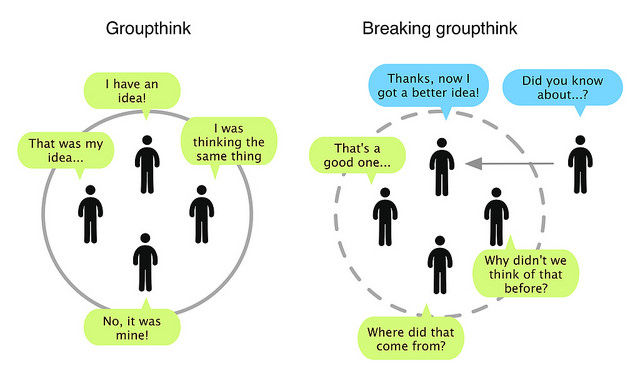
Groupthink is a psychological phenomenon that is very likely to occur in an organizational setting, or any situation where there are many people together, where individual differences are lost in favor of group harmony and cohesion.

Controversial topics or any form of dissent and challenging opinions are avoided. Therefore, groupthink often leads to the loss of the individual’s creativity and opinion. Instead of having many ideas and challenging each other, personal beliefs are lost or overshadowed by the groups’s identity. A classic signature of groupthink is bandwagon bias, a cognitive bias arising from the comparative ease of going along with popular beliefs.

Groupthink affects many organizational settings and that is why many businesses make errors in their strategies or decisions.

Learn More About Groupthink in UX/UI Design

Make learning as easy as watching Netflix: Learn more about Groupthink by taking the online IxDF Course Creativity: Methods to Design Better Products and Services.

Why? Because design skills make you valuable. In any job. Any industry.

In This Course, You'll

  • Get excited as you learn to innovate and get creative, even when you feel blocked! Did you know that creative thinking is the second most important skill hiring managers look for, across all jobs and industries? This course will give you the skills to design innovative solutions and products that stand out. It's easier than you think! No matter your background, you can effortlessly learn to tap into creativity. You'll apply proven methods to break out of habitual thinking, spark new ideas anytime, and capture them before they disappear!

  • Make yourself invaluable with divergent and convergent ideation techniques that have real business impact. In a world where AI can generate endless ideas, you stay in demand when you know which ideas to explore, which to combine, and which to move forward. Timeless human-centered design skills help you focus creativity on real needs, and that’s how you can turn AI from a tool into your new creative superpower. Companies that prioritize creativity achieve 67% more organic revenue growth. Creativity is just as valuable in finance, engineering, and healthcare as it is in creative professions. Every industry thrives on innovative ideas. In this course, you'll use ideation methods like multiple classifications and three-way comparisons to see opportunities others miss and bring bold ideas to life.  

  • Gain confidence and credibility with 15+ downloadable templates to fast-track your creativity! You'll learn how to use busywork to enable your creativity in daily planning and foster a creative team environment. You'll apply step-by-step strategies to beat procrastination, bias, and fixation, and ensure your creative process remains productive—even under pressure. You'll get hands-on experience and walk away with a polished case study for your portfolio if you choose to complete the optional ideation project. If you want to solve big problems, improve lives, and build a better world with innovative solutions people love, then this course is the perfect place to start.

It's Easy to Fast-Track Your Career with the World's Best Experts

Master complex skills effortlessly with proven best practices and toolkits directly from the world's top design experts. Meet your experts for this course:

  • Alan Dix: Author of the bestselling book “Human-Computer Interaction” and Director of the Computational Foundry at Swansea University.

  • Don Norman: Father of User Experience (UX) Design, author of the legendary book “The Design of Everyday Things,” and co-founder of the Nielsen Norman Group.

Get an Industry-Recognized IxDF Course Certificate

Increase your credibility, salary potential and job opportunities by showing credible evidence of your skills.

IxDF Course Certificates set the industry gold standard. Add them to your LinkedIn profile, resumé, and job applications.

Course Certificate Example

Be in distinguished company, alongside industry leaders who train their teams with the IxDF and trust IxDF Course Certificates.

Our clients: IBM, HP, Adobe, GE, Accenture, Allianz, Phillips, Deezer, Capgemin, Mcafee, SAP, Telenor, Cigna, British Parliament, State of New York

All Free IxDF Articles on Groupthink in UX/UI Design

Read full article
The Bandwagon Bias – The Dangers of Groupthink - Article hero image
Interaction Design Foundation logo

The Bandwagon Bias – The Dangers of Groupthink

Groupthink is dangerous to our objectivity. It prevents us from thinking for ourselves and making the best decisions. Designers need to be cautious about falling into the bandwagon bias trap but also be aware of how it can be exploited in their designs to improve user experiences and get users to ma

Social shares
817
Published
Read Article
Read full article
Obstacles to Problem Solving and Innovation in Design Thinking - Article hero image
Interaction Design Foundation logo

Obstacles to Problem Solving and Innovation in Design Thinking

Understanding the obstacles that prevent teams from reaching innovative solutions that solve underlying problems is a very important aspect of the Design Thinking process. When we ignore a major influencing factor while trying to develop a solution, we are setting ourselves up for a potentially

Social shares
832
Published
Read Article
Read full article
14 Barriers to Ideation and How to Overcome Them - Article hero image
Interaction Design Foundation logo

14 Barriers to Ideation and How to Overcome Them

Would you like to facilitate successful ideation sessions? Or would you like to learn how to contribute to ideation processes in your team more effectively? In either case, you should know the ideation traps and how you can prevent yourself and your team from falling into them. You should give the f

Social shares
920
Published
Read Article

The Bandwagon Bias – The Dangers of Groupthink

The Bandwagon Bias – The Dangers of Groupthink

Groupthink is dangerous to our objectivity. It prevents us from thinking for ourselves and making the best decisions. Designers need to be cautious about falling into the bandwagon bias trap but also be aware of how it can be exploited in their designs to improve user experiences and get users to make the decisions the designer wants them to make.

We, human beings, are social creatures. The urge to belong and to conform is strong within us – it helps us form relationships and brings meaning to our lives. It also has a downside; it can make us conform to the wrong beliefs or take the wrong actions because well… “everyone knows…”. For example, nowadays, social media have an enormous effect on groupthink.

Author/Copyright holder: Keoni Cabral. Copyright terms and licence: CC BY 2.0

The science fiction author, Robert Heinlein, had this to say about this urge; “If everybody knows such and such, then it ain’t so, by at least ten thousand to one.” Of course, that statement might be a little strong – everybody knows that if you eat enough cyanide you’re going to die but there’s a great element of truth to the idea too. Back in the 1950s people believed smoking was good for you and it wasn’t. Today, many people believe that sugar in your diet is bad for you; it’s not but it is in excess. And so on.

Bandwagon bias is a form of groupthink. It’s a cognitive bias that makes us believe something because other people believe it. It can make us think something that is achievable is impossible because others have tried and failed before us. It can make us think that there’s only way to tackle a problem because; “that’s the way it’s always been done.”

Tackling our own bandwagon biases is important because it frees us up to be creative and to think for ourselves. It allows us to rise to meet challenges rather than falling at the first hurdle.

However, on the flip side, we can also tap into the bandwagon bias in our designs. The most obvious way to do so is by the use of “social proof”. This is why reviews and star ratings have become such an intrinsic part of online marketing – people are more likely to buy a product or service when they can see that many other people did so and were happy with that decision.

A History of the Bandwagon Bias

Author/Copyright holder: khrawlings . Copyright terms and licence: CC BY 2.0)

The term “bandwagon” in this context became popular in the mid-19th century as a form of derision in American political relationships. It was drawn from a chap called Dan Rice. Dan was a circus clown who performed across the USA. He was incredibly popular and when he came to a place to promote his show – local folks would, literally, “jump on the bandwagon” to participate in his promotions.

It’s not like a politician to miss a trick and when they got wind of Dan’s popular displays – they decide to emulate his work. They added music and bandwagons of their own to their campaigns, to encourage their supporters to “jump on the bandwagon”.

However, the public was as cynical about politics back then as it is today and soon “jumping on the bandwagon” was a phrase that held negative connotations. By the start of the 20th century the phrase was used to mock the person who followed the herd without engaging their brain.

The Bandwagon Bias and You

Like all cognitive biases most of us suffer from the bandwagon bias at some point or other. It might be simply expressed for example; a preference for Apple computers because “everyone knows they’re the best computers for designers”. This is at best a subjective judgement and at worst completely untrue. The reality is that the right tool for design is one you can afford and one which does what you need it to do. Most modern-PCs are as capable as an Apple computer of conducting design related work.

Or it might be a little more complex; “We do it like this at XYZ company because my boss did it like this before me and his boss before him.” None of that means that there isn’t a better way to do things, does it?
Author/Copyright holder: Oscar Berg. Copyright terms and licence: CC BY 2.0

It’s difficult to recognize our biases and the bandwagon bias is no different. We can start by asking ourselves why we believe what we believe and then probing the reasoning until we reach a strong understanding. Then we can ask; “Is that rational?” If the answer is “no” and it might take a bit of soul searching to come to that – then we must tackle the bias.

It can be much easier to tackle biases through the use of a coach or someone that can work with you in a “verbal sparring”. They can help draw out your biases and ask the questions to help you examine them more clearly.

The Take Away

The bandwagon bias is not always incorrect. However, when it is wrong – it limits our ability to carry out work effectively. It’s worth challenging our biases and examining them in context so that we can make informed decisions and generate better work.

Don’t forget that user experience designers can tap into the bandwagon bias via social proof – to improve the experience and customer journey of their products. Though don’t overdo it; people are beginning to distrust social proof due to its overuse and unreliability.

References & Where to Learn More:

Check out our Design League program if you’d like to tackle your own cognitive biases with expert guidance.

More on how to leverage the mechanisms of social computing.

NetMind examines the bandwagon bias and other cognitive biases.

How can social biases affect writers? Read all about it! -

Hero image: Author/Copyright holder: Jeff Warren. Copyright terms and licence: CC BY-SA 2.0

Feel Stuck?
Want Better Job Options?

AI is replacing jobs everywhere, yet design jobs are booming with a projected 45% job growth. With design skills, you can create products and services people love. More love means more impact and greater salary potential.

At IxDF, we help you from your first course to your next job, all in one place.

See How Design Skills Turn Into Job Options
Privacy Settings
By using this site, you accept our Cookie Policy and Terms of Use.
Customize
Accept all

Be the One Who Inspires

People remember who shares great ideas.

Share on:

Academic Credibility — On Autopilot

Don't waste time googling citation formats. Just copy, paste and look legit in seconds.