Understanding the obstacles that prevent teams from reaching innovative solutions that solve underlying problems is a very important aspect of the Design Thinking process. When we ignore a major influencing factor while trying to develop a solution, we are setting ourselves up for a potentially negative result, or may even be creating an even more problematic situation than the one we are trying to resolve. To ensure your team has the optimum working environment for problem solving, let us look at the most common obstacles to problem solving and innovation — as well as a few simple steps you can take to prevent them.
Obstacles to Problem Solving
The following list of factors, though not exhaustive, represents some of the obstacles to achieving innovative solutions to the challenges we face. The more obstacles we encounter within a problem space, the more difficult the path to innovation. Our goal should always be to create a space where obstacles are understood and removed or neutralised while exploring solutions.
- Individual people
- Egos
- Knowledge
- Perception
- Mindsets
- Beliefs
- Impulsive reactions
- Groupthink
- Education
- Language
- Skills
- Man with a hammer syndrome
- Team construction
- Power structures
- Organisational constraints and power structures
- Culture
- Location
- Environment
- Economics
- Politics
- Trends
- Technology
- Sustainability
- Law
- Time
- Money
If the list above seems long and broad, that’s the whole point. Hundreds of factors can influence how conducive a team can be when solving problems, so it is extremely important to be cognizant of how small and seemingly unimportant factors can adversely affect your team’s progress. While it is not efficient to consider and analyse each and every factor in full, you should nevertheless put them at the back of your mind when working on a project.
Let us elaborate further on the most common obstacles teams face when trying to solve a problem.
Impulsive Reactions
When confronted with a challenging situation, we tend to want to be spontaneous in our reactions. The instinctive mentality is that we should strike, and strike fast, if we want to solve a challenging problem. We tend to pinpoint obvious superficial factors and attack them directly, without reviewing subtle and perhaps more influential factors. We might individually attack symptoms of problems, when the more appropriate solution would be to understand the situation as a group before attempting to apply a solution. Similarly, any one problem may comprise a tangled complex of sub-problems; striking at one of these may ‘seem’ to solve it, but doing so may have deep-reaching effects that can complicate tangent sub-problems and make the whole thing even more problematic. This impulsive urge to jump into a problem and quickly solve it can be a stumbling block in your project, because a truly useful and impactful solution requires a deep, empathic understanding of the problem. Consequently, it takes insight and restraint to overcome this impulse. While it feels good to be doing something about a problem, remember that “doing something” doesn’t have to mean taking a potentially brash action. The danger here is to mistake careful analysis for wasting time, as it seems to be far less proactive-looking and lacks the glory of a good, quick strike back that shows the problem solver can think on his feet.
Indeed, the very first reaction is rarely the most appropriate in problem solving, unless the problem is so familiar and frequent that one has become an expert in patching it quickly. Its reoccurrence may, however, indicate that the root has not been addressed — but that is another issue. Regarding being impulsive and diving in too soon, it prevents us from taking a bigger-picture view, from gaining deeper insight and from understanding how others view and experience the same problem.
Best practice: In order to solve a complex, wicked problem, you and your team need to resist the urge to react impulsively — whether it’s to solve the obvious, superficial factors quickly, or to develop the very first idea into a full product directly — and learn to dive deep and develop a holistic understanding of the problem, before starting to ideate the possible solutions to it.
 Author/Copyright holder: Chris Lott. Copyright terms and licence: CC BY 2.0
In order to solve a complex, wicked problem, you and your team need to resist the urge to react impulsively and learn to dive deep and develop a holistic understanding of the problem, before starting to ideate the possible solutions to it.
Egos Get in the Way
At times, we can be our own worst enemies when it comes to working in teams trying to solve problems. If we're focused on ourselves, showing off, on egos and asserting ourselves over others, we will most likely run into issues. Not only will there almost definitely be conflicts within the team, we will also tend to fall in love with our own ideas and refuse to accept it when tests indicate that the solution is not working with the target users.
Solving problems with others requires a sincere desire to achieve the objectives together. It requires a degree of humility and excellent people skills as well. When individuals are more interested in asserting themselves over others, flexing their authority, experience or creative muscles and proving a personal point, the group will suffer and the solutions or ideas that are being forced through may not be the most appropriate. Someone’s vanity will therefore dilute the team’s effectiveness.
Best practice: The most successful problem-solving spaces provide room for each player or actor to present his/her views, thoughts, feelings and experiences, thereby allowing a more holistic approach to solving the problem. There should be no room for egos in an innovative design project.
As you may have noticed, the word “holistic” has popped up quite a few times already — and will likely appear many more times in any Design Thinking article you read. That’s because it’s one of the core aspects of the Design Thinking mindset. It's one of the words you should definitely stick up on the wall close to your thinking and working space if you want to apply Design Thinking. HOLISTIC!
Groupthink
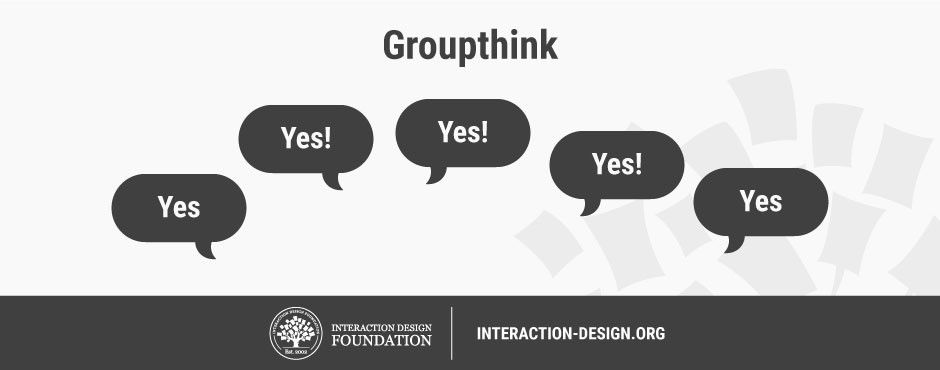 Author/Copyright holder: Teo Yu Siang and Interaction Design Foundation. Copyright terms and licence: CC BY-NC-SA 3.0
We all agree, so it must be right... right? Wrong!
Groupthink is a phenomenon that occurs when the desire for harmony or conformity in the group results in a dysfunctional or irrational decision-making outcome. When working in groups, we find in many cases that people will agree with group decisions due to self-confidence issues, a kind of group peer pressure, or fear of having an opposing view rejected. But groupthink does not only occur due to negative reasoning. It may result from the desire towards a more cohesive group dynamic by avoiding conflict or controversy. Individuals consider expressing loyalty to the group to require avoiding views which may be out of sync with what the group has achieved consensus on.
Groupthink is especially dangerous when it comes to a Design Thinking project, where the team is focused on creating an innovative solution to combat a tricky problem. In Design Thinking, it is crucial to iterate and to base your decisions on user testing and understanding; with groupthink, your team might suppress dissenting viewpoints and be less critical when evaluating ideas.
Best practice: In order to avoid this scenario, team managers need to create a safe and playful space for individuals to express themselves, throw ideas out there, and not feel targeted. No-one must be allowed to dominate while ideas are being brainstormed. The right mentality must be adopted at the beginning of the project, where critiques of ideas are never made personal (and should never feel personal). Of course, during later stages where ideas are evaluated and chosen for their appropriateness, a more critical approach should be taken rather than adopting a conforming mindset.
Man with a Hammer Syndrome
As the saying goes, “to the man with a hammer, every problem looks like a nail.”
We approach problems based on the toolset which we feel most comfortable with and most skilled at. Engineers, doctors, teachers, developers, and politicians may all have tendencies to want to exercise their core skills or experience within their own field. This may not be the correct approach to solve a specific problem, and it may not be a means to achieve the desired objective, especially when the problem has multiple influencing factors which require, wait for it, Holistic thinking. At times, we need to look outside of our core tendencies, skills and experiences and approach the problem on its own level of need.
We tend to try to solve problems which appear similar to previously solved problems, using the same methods even though simpler or more optimal solutions may exist. It's part of how the human brain works in following familiar patterns, thereby reducing cognitive load. But when embarking on a Design Thinking project, it is important to abandon our tendencies to follow patterns, because the way the brain tries to help us reduce cognitive load is the very same one in which it inhibits our ability to think outside of the box!
Best practice: Creating cross-disciplinary teams will help solve this issue, as there will be many men with different kinds of hammers looking for different kinds of nails. It’s of course crucial that the team leader illuminates to all team members that all skills and mindsets are equally important so as to avoid power struggles. In this context the manager’s skills and ideas are as important as the newly employed designer’s are. Likewise, the web designer’s, architect’s, and developer’s skills and ideas are equally important in a Design Thinking process.
 Author/Copyright holder: Christine und Hagen Graf. Copyright terms and licence: CC BY 2.0
As the saying goes, “to the man with a hammer, every problem looks like a nail.” We tend to try to solve problems which appear similar to previously solved problems, using the same methods even though simpler or more optimal solutions may exist. It's part of how the human brain works in following familiar patterns, thereby reducing cognitive load. 'Hammering Man' (1994) is a sculpture which is located in various cities.
It's a Bird; it's a Plane – Misdiagnosing Problems
We need to be sure we are diagnosing problems correctly, as treating symptoms may — as in the case of illnesses — not result in a cure but only temporary relief. In some cases, prescribing the incorrect medication to tackle a symptom may even cause a deepening of the root illness. As part of any human-centred design approach, digging deep into human experience uncovers more about the problems we face than if we only scrutinised things on a superficial level.
Best practice: It is when we immerse ourselves in all the factors that influence a situation that we gain a deeper understanding of the way forward. We need to be vigilant, fully focused and aware of the obstacles which could derail our progress while keeping our focus squarely on the destination.
The Take Away
Before we take on a Design Thinking project, it is important, firstly, to take note of the various obstacles that can prevent us from reaching a solution that really works. From our impulsive tendencies to react to problems quickly and solve them just as fast, to the threat of egos and groupthink, there are many potential pitfalls that teams should learn to avoid. Developing a holistic understanding of the problems that the target users face is a key element of Design Thinking, which is typically adopted to solve complex, wicked problems where multiple spheres and fields collide.