Would you like to facilitate successful ideation sessions? Or would you like to learn how to contribute to ideation processes in your team more effectively? In either case, you should know the ideation traps and how you can prevent yourself and your team from falling into them. You should give the following 14 important barriers to ideation your full attention in order to avoid any of their negative effects. Let’s get started.
Ideation is the capability for generating, developing, actualizing and communicating ideas. Ideation is an essential part of the design process, both in education and practice—and it’s at the heart of the Design Thinking process. Design Thinking is all about breaking down barriers and removing the obstacles which typically block innovation. It is highly scientific, just not the kind of science they teach in chemistry labs or in graduate business schools. Let’s take a closer look at the 14 barriers you should tear down when you want to run or participate in successful ideation sessions.
1. Inexperienced Facilitation
Ideation, as fun and crazy as it may seem, is serious business and requires experience and a firm grasp of the rules in order to be effective. If you have no experience with ideation, you should start with getting a better grasp of the fundamentals before diving in. Start practicing by facilitating smaller groups. It is not the same as a group of friends sitting on the sofa, thinking about how they may someday change the world. Ideation requires focus on the user and problem statement, keen awareness of group dynamics and purposeful steering. It is like a large boat in stormy waters. If the captain is unable to control the crew—their direction may be seriously affected, potentially leading to mutiny in the ranks. Team managers should always focus on developing facilitation capabilities within their team, regardless of their focus, as group facilitation and problem solving are essential parts of any team environment.
2. Uninitiated Team
Ideation brings with it its own form of chaos and ambiguity, which, to the trained team, is exactly how it should be. To a newcomer, this is unsettling—and it could adversely affect the results of the ideation activities. To avoid fear and anxiousness, the facilitator should always prepare inexperienced teams for ideation. We recommend that you use ideation warm-up exercises such as Worst Possible Idea and Brainwalking as icebreakers. It’s important that your exercises help illustrate how the creative processes work in both fun and meaningful ways so as to make people more comfortable and eager to get started. Ideation has to make sense to participants—all of them, each one with his or her unique way of seeing the world. As a facilitator, you have to show team members that it pays off to participate in and create this organized chaos which ideation is. Uninitiated teams could very well result in frustration, negative team dynamics, conflict and dented team confidence.
3. Unfriendly Space

Each to his or her own—this is a cubby or cubicle environment, perfect if you’re mono-tasking on something like data entry all day long. For our purposes in Design Thinking, though, it’s far from ideal.
© 松林 L, CC BY 2.0.
Spatial configuration seriously affects how people perceive and interact with each other and with their team leaders or seniors. It’s essential to create an open, equal and non-threatening environment which facilitates freedom of expression and flexibility, both mentally and physically. Doing ideation sessions in cubicle offices is a no-no. Ideation sessions may need to switch from large group interaction to team spaces very quickly, ideally requiring a space which could be easily reconfigured. Keep ideation spaces hierarchy free. Be explicit about this. Say it aloud at the beginning of any ideation sessions so all team members feel comfortable by contributing. Keep ideation spaces well lit, ventilated and free from external distraction or interference. You may have heard the expression “Tidy place = tidy mind”? Well, let’s carry that over a notch and say, “Ideation-session-conducive space = ideation-session-conducive mind”!
4. Unclear Goals
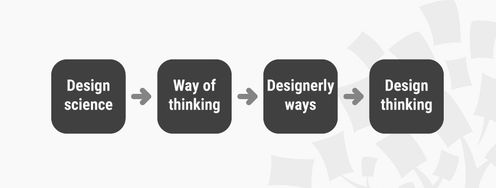
A huge no-no is diving into ideation without a clear idea of the objectives. Don’t ever send a diverse group of people into an ideation session without one or more clear goals and a problem statement (also known as a Point Of View). Goal finding or quest storming is the focus of the first two Design Thinking phases, which are the Empathize phase and the Define phase. The following phases are Ideate, Prototype and—finally—Test. Familiarizing yourself with these first two phases will help you set the objectives well enough to make ideation more focused and meaningful. When setting goals for the ideation, you need to remember that people naturally incline towards issues that are within their direct line of vision and influence.
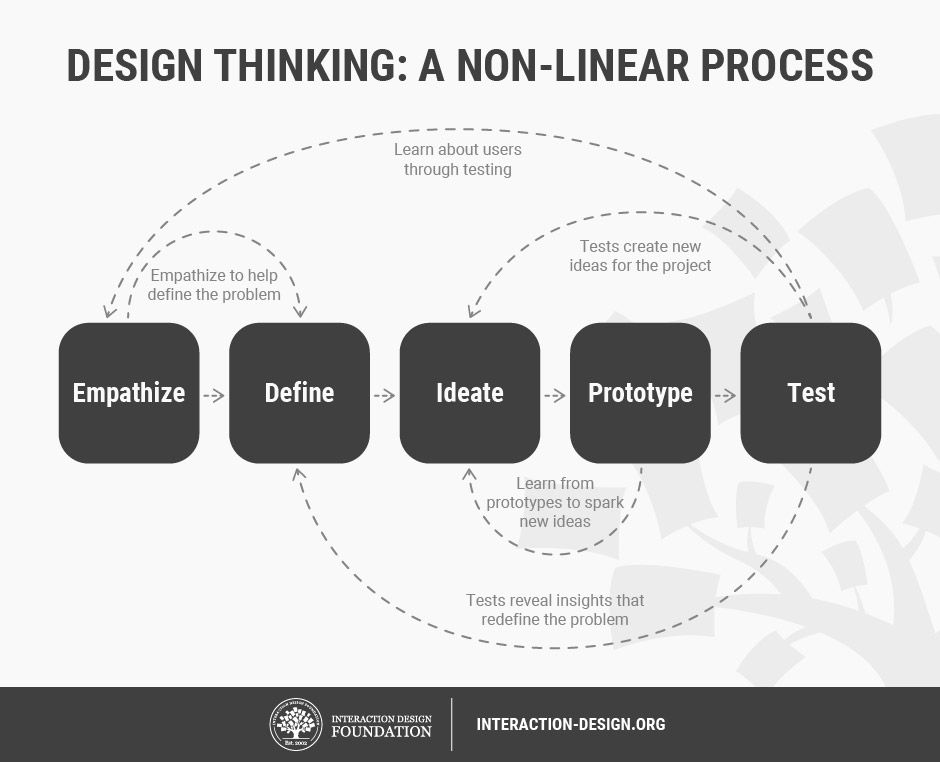
The five stages of Design Thinking are not sequential steps, but different “modes” you can put yourself in, to iterate on your problem statement, ideas or prototype, or to learn more about your users at any point during the project.
© Teo Yu Siang and the Interaction Design Foundation, CC BY-NC-SA 3.0.
5. Egos and Hierarchy
Look up any set of rules for conducting ideation and you're sure to find hierarchies and egos as some of the primary obstacles. Flattening the organizational structure—even just momentarily—is necessary for creative channels to open up sufficiently. Good ideas rarely come from people who are stifled by others' personalities or rank. Nor do good ideas come from asserting oneself over others, regardless of the reason. Team creativity works best when everyone is considered equal and everyone can express all ideas freely. Many ideation methods, such as Brainwalking and Brainwriting, have built-in mechanisms to prevent ego and hierarchy from overshadowing the process.
6. Closed-Mindedness
A closed mind will not be able to build on external stimuli. We've all witnessed this in some way or another—a person who is convinced that their own ideas are better than anyone else's becomes oblivious to the value of the contributions made by others. Group ideation functions best when all ideas can be expressed equally and then later mixed up in unconventional ways. This produces novel combinations or completely new ideas.
With ideas, one leads to another; bad ideas lead to good ones, sometimes in ways we could never have imagined. At times, the best idea stems from its exact opposite, the worst. This is why the “Worst Possible Idea” method is actually an ideation method which you can use to provide disruptive insight within the process. The technique is simple: To solve the problem statement, ask the participants to create a list of unusable, impractical, stupid or foolish ideas — ones that are nonsensical, ridiculous, incorrect, mismatched, and against known best-practices, laws or guidelines.
Once the participants have generated a list of their worst ideas, you should challenge the group to turn those horrible ideas into good ones. They can either consider the opposite of each one or look for aspects within the terrible ideas that can be used to inspire a good one. As the facilitator, be sure to push your group to generate extremely bad ideas! This will help get participants laughing and re-engaged. As a facilitator of ideation sessions, it’s your job to help participants open their minds and hearts, and the “Worst Possible Idea” method can help you do just that. In fact, the method should act like a crowbar that even the most closed-minded person will eventually lift up and use on their mind!
“To invent, you need a good imagination and a pile of junk.”
– Thomas Edison, American inventor who developed the phonograph, the motion picture camera and the electric light bulb. As quoted in Behavior-Based Robotics (1998) by Ronald C. Arkin. p. 8.
7. Limiting Ideas

Free-forming ideas with Sticky notes is a great way to get the creative juices flowing—and to show notions to others, who can show you theirs, too. Not for nothing is it such an invaluable part of Design Thinking.
© artfulblogger, CC BY-NC-ND 2.0
There may be a natural tendency for teams to cut their ideation sessions as soon as they have a few (superficially) “good enough” ideas. Perhaps the manager is unwilling to spend the extra time delving into the unknown and merely sees the clock ticking. Limiting ideas to only the very first seemingly effective-looking ones will render any group ideation session irrelevant. If time is indeed very limited, you will not want to initiate ideation sessions at all—as they will just be a waste of the team’s time if you do not have time to elaborate on, investigate and develop the best ideas fully, anyway. So, if time is a luxury you and your team can ill afford, don’t start an ideation process. One of the foundational principles of idea generation is to aim for quantity, as you can only evaluate a diverse range of ideas for patterns and attributes from which you could piece together something amazing.
"The best way to have a good idea is to have lots of ideas."
– Linus Pauling, US Chemist and Peace Activist as quoted by Francis Crick in his presentation The Impact of Linus Pauling on Molecular Biology (1995)
8. Early Judgment and Devil's Advocate
Another foundational principle in ideation, at least in the earlier stages of ideation, is deferring judgment. This means ideas should be allowed to be expressed as is, without criticism, censure or requests for detail unless the ways they are expressed are simply not understood. The “devil's advocate” is essentially banned from entering the room, as this personality takes criticism or judgment to an extreme and can virtually destroy any progress in ideation sessions based on hypercritical negative thinking.
In the first parts of ideation sessions, you will find that it can even be a great idea to prohibit the word “no”. You’ll be surprised to see how effective this tool is and how it helps open up minds in creating a collaborative, curious and friendly ideation environment. And you’ll find that it’s pretty fun too when team members have to say “yes”—at least initially—to even the weirdest ideas.
9. Lack of Imagination or Being too Serious/Boring
"I think there is a world market for maybe five computers."
– Thomas Watson, chairman of IBM, 1943
Different from genuine creative blocks, another problem lurks in the shadows. Some organizational environments are so entrenched in statistical data, logic and rationality that people end up losing their ability to think out of the box. Expressing unconventional, unfavored or—at times—downright silly ideas may not be within the comfort zone of certain fields of specialization. Getting people in these fields to be curious, explorative and experimental about the way they think can be tough and may require more than a simple icebreaker. This is really the territory of highly experienced ideation facilitators.
10. Old Pattern Thinking
When we become too familiar and comfortable with the way things are and have been for some time, complacency sets in and can cloud our vision of what the future could look like. Innovation is an absolute must across the majority of sectors these days. With the increase in competition, higher demands and rapidly changing economic, technological and environmental factors, we cannot become comfortable with how things are for too long. Old pattern thinking or resistance to change is what left Kodak, an icon of the photographic industry, out in the cold when digital photography invaded our lives. “Innovate or die” is not only a motto of the radical entrepreneur but also a common reality whether you're just one person or a global conglomerate.

Old pattern thinking or resistance to change is what left Kodak, an icon of the photographic industry, out in the cold when digital photography invaded our lives. Analogue film may still be around, but the revolution was decisive, and it didn’t happen overnight.
© Vincenzo Reina, CC BY-SA 2.0.
11. “Man-with-a-Hammer” Syndrome
As you may have heard before, "to the man with a hammer every problem looks like a nail". People have a natural tendency to address problems using their core skills and specializations. Additionally, there is a tendency to apply a solution that may have worked previously to a related problem even if the relation is not that close. These thinking and decision-making patterns prevent venturing into the unknown where the most innovative solutions likely exist. Ideation processes and methods should encourage individuals to break out of their preconceived job titles and specializations in an attempt to adopt unconventional thinking.
12. Groupthink
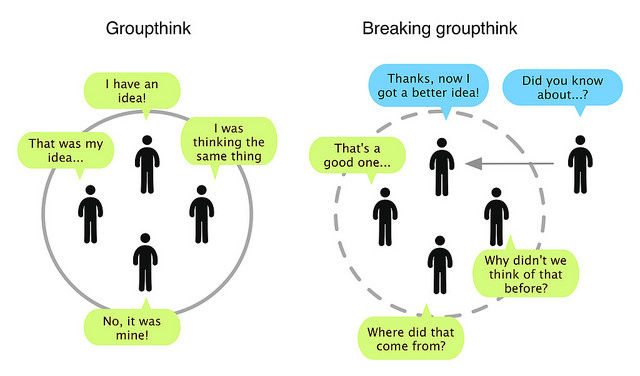
As you can see, thinking “within” and thinking “without” each provides very different outcomes.
© Oscar Berg, CC BY 2.0.
We humans have the tendency to adopt the norms of those people we spend time with. Within group settings, we tend not to want to act, think or express differently from what is perceived to be acceptable within the group. This may lead to a type of collective closed-mindedness, something which can kill innovative thinking and prevent new ideas from flowing. A lack of self-confidence, the desire to fit in and not rock the boat, and the avoidance of controversy are all human factors contributing towards groupthink. Resolving this requires purposefully setting up the ideation process and making use of techniques and methods such as “Brainwriting” which get around these issues and allow expression free of group influence.
Brainwriting is an alternative or a complement to face-to-face brainstorming. You’ll find that it often yields more ideas in less time than traditional group brainstorming. Brainwriting is very straightforward. Instead of asking participants to say their ideas aloud, you ask them to spend a few minutes writing down their ideas about a particular question or problem on sheets of paper. Then, you ask each participant to pass their ideas on to someone else in the group, who reads the ideas and adds their own new ideas. After a few minutes, you ask the participants to pass their papers to others and the process repeats. After approximately 15 minutes, you collect the sheets and discuss what’s on them in the group. You can use this method at appropriate times within the ideation process.
13. Cognitive Bias
Negative cognitive biases are factors which negatively affect how we humans think. Negative cognitive biases are a matter of concern for a wide range of organizations who’re currently grappling with how to navigate the complexities of human interactions. The challenge involves how to prevent cognitive bias from negatively affecting organizational development and decision making. Ideation is not immune and suffers from these negative biases like any other organizational decision-making activity. Cognitive biases are like generalizations, which individuals develop based on their experiences and according to their preferences, and become automatic reactions that people apply within certain situations.
As a facilitator of ideation sessions, you should explicitly encourage open-mindedness and acceptance of others' ideas and help the group collectively build on an individual’s ideas as you move through what each participant has contributed. This can help overcome these biases to a certain extent. Each individual's level of self-awareness will also impact his or her ability to overcome these cognitive biases.
14. Idea Killers
This list of idea killers by Igor Byttebier and Ramon Vullings provides an extensive overview of excuses we've all heard for why innovative thinking is rejected. As a facilitator, it’s your job to ban these idea killers at all costs during ideation:
Yes, but...
It already exists!
Our customers won't like that!
We don't have time.
NO!
It's not possible.
It's too expensive!
Let's be realistic.
That's not logical.
We need to do more research.
There’s no budget.
I'm not creative.
We don't want to make mistakes.
The management won't agree.
Get real.
It's not my responsibility.
It's too difficult to master.
That’s too big a chance.
The market is not ready yet.
Let's keep it under consideration.
It is just like ______.
The older generation will not use it.
We are too small for that.
It might work in other places but not here.
Since when are you the expert?
That's for the future.
There are no staff members available.
It is not suitable for our clients.
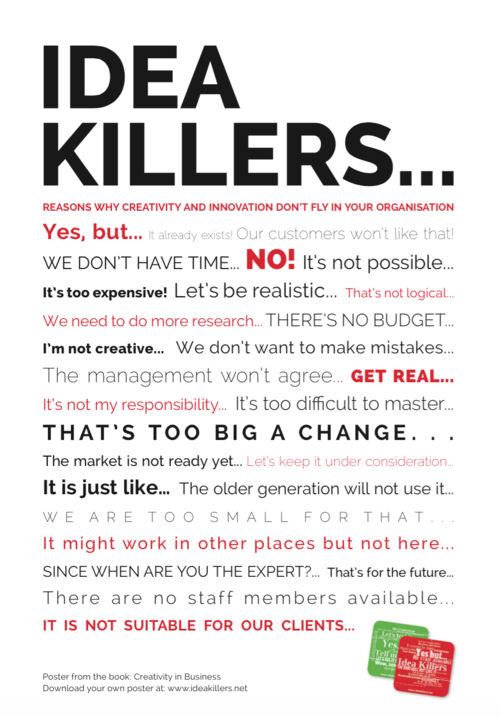
As a facilitator, it’s your job to ban these idea killers at all costs during the ideation process.
© Ramon Vullings & Igor Byttebier, Fair use.
The Take Away
Once you’re aware of the 14 traps, you can start practicing them (as in, your continued awareness of and avoidance of them!) in your daily work life and start improving your facilitation skills and your skills as an ideation session participant. In order to run highly successful ideation sessions, you have to practice—a lot. Successful ideation sessions depend on an experienced facilitator and ideation team, who are trained in techniques for purposely navigating around the barriers, the thinking traps and the idea killers. There is only one way to become an expert and take the helm so as to help put even the most ungainly or stubborn-looking organization on the correct course to success in these ever-changing times. Why not get started right away?
References & Where to Learn More
Tom Kelly and Jonathan Littman, The Ten Faces of Innovation: IDEO's Strategies for Defeating the Devil's Advocate and Driving Creativity Throughout Your Organization, 2005
Tom Kelly and Jonathan Littman, The Art of Innovation: Lessons in Creativity from IDEO, America's Leading Design Firm, 2001
Linus Pauling, US Chemist and Peace Activist, as quoted by Francis Crick in his presentation, The Impact of Linus Pauling on Molecular Biology, 1995.
Rolf Dobelli, The Art of Thinking Clearly: Better Thinking, Better Decisions, 2013
Chauncey Wilson, Using Brainwriting For Rapid Idea Generation, 2013:
Igor Byttebier and Ramon Vullings, Creativity Today, 2007
Ramon Vullings and Igor Byttebier, Creativity in Business - The Basic Guide for Generating and Selecting Ideas, 2015
Images
Hero Image: © Oriol Pascual, CC BY-SA 2.0.