Brainwriting

Your constantly-updated definition of Brainwriting and collection of videos and articles.
Be a conversation starter: Share this page and inspire others!

295 Shares

What is Brainwriting?

Brainwriting is an ideation technique in which participants write their ideas in silence instead of speaking aloud. Participants then share their ideas and build upon them. Brainwriting levels the field and encourages introverts and junior team members to participate more equally in ideation sessions.

When a team begins its journey of idea generation and problem-solving, brainwriting becomes a powerful technique to guide them. This is not the usual chatter-filled brainstorming session. Instead of speaking, team members write down their thoughts; no interruptions and no fear of criticism. 

Brainwriting creates a safe space for all ideas. This quick yet effective activity, which you can complete in 15 minutes, often leads to an impressive array of ideas.

The benefits of this technique surpass traditional brainstorming. With it, you can reduce noise, promote equality, and foster an inclusive environment. Unlike oral exchanges, brainwriting does not favor outspoken individuals. It nurtures quiet voices and invites them into the conversation.

Brainwriting Vs. Brainstorming

Brainwriting

Brainstorming

6 people in a room come up with 3 ideas each. Once through, they pass on their sheet to the person on their right for new ideas.

Sitting in a room with a whiteboard to record things on, participants start jotting random ideas on it.

Produce more number of ideas in less time.

Consumes more time to come up with a single concrete idea.

No verbal discussion is required as people write their ideas on a sheet of paper.

Ideas are shared anonymously, reducing the chances of bias.

Ideas are shared anonymously, reducing the chances of bias.

Ideas are shared out loud, increasing the chance of bias, counter comments, and negative feedback.


Here at the Interaction Design Foundation (IxDF), we have seen the benefits of brainwriting firsthand. Our experience leading effective brainwriting sessions has given us a wealth of ideas to enhance our design thinking process.

Comparison table for differences between brainwriting and brainstorming.

© Interaction Design Foundation, CC BY-SA 4.0

Brainwriting allows us to navigate the wide ocean of creativity. We follow a robust brainwriting process that encourages every participant to bring forth their most creative solutions.

The Brainwriting Process

A brainwriting session is a simple process that can yield a wealth of creative methods and ideas. While several variations exist in the brainwriting process, we’ll outline a general approach below.
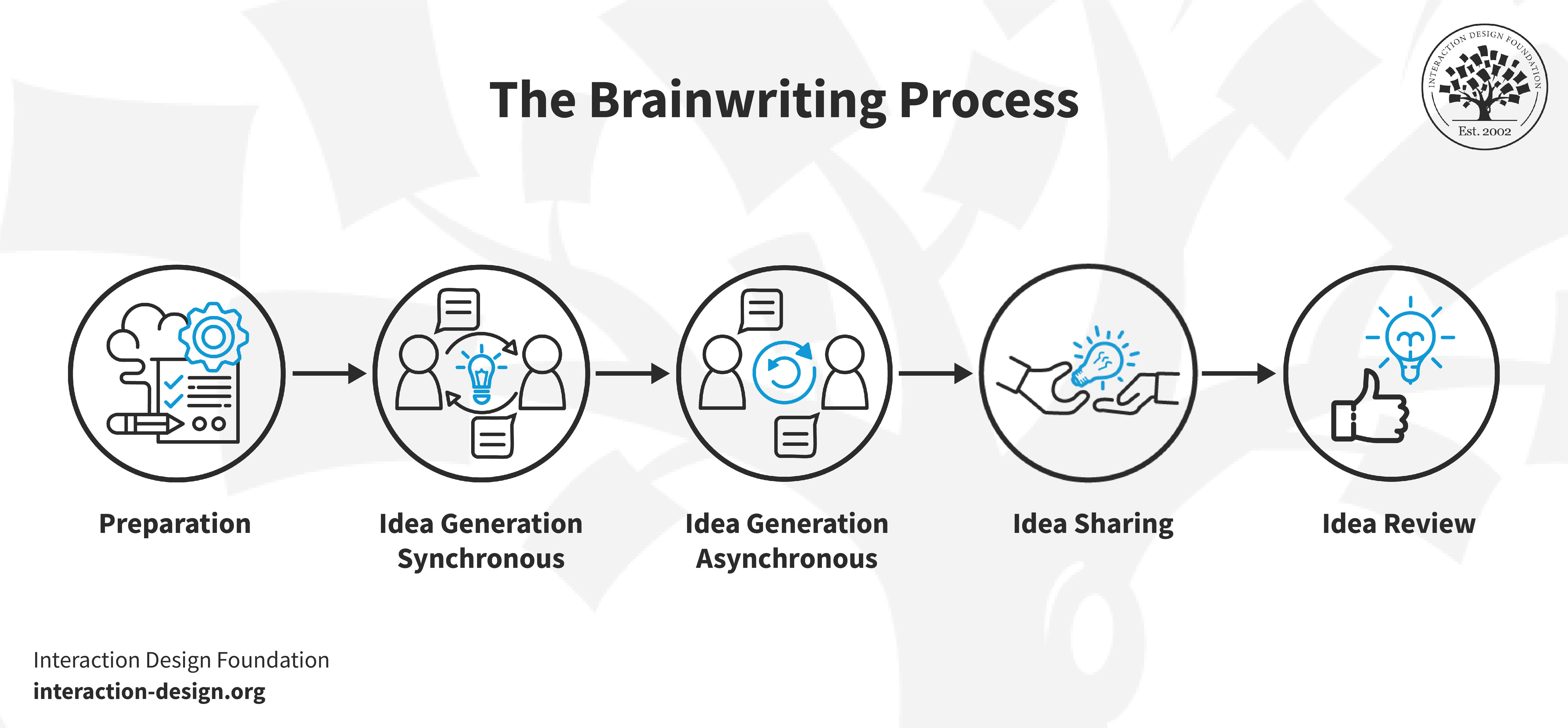
Step-by-step visual representation of the brainwriting process.

© Interaction Design Foundation, CC BY-SA 4.0

Preparation

Gather your team members and ensure they understand the brainwriting concept and process. Then, define the problem or topic for which ideas are needed. If it's a remote session, every participant should have paper, a pen, or a digital equivalent. Remote teams face no disadvantages.

Idea Generation - Synchronous

Every participant starts writing down their ideas about the defined problem or topic. They can jot these down on sticky notes or a sheet of paper and focus on quantity over quality. This should be a silent exercise that should take about 15 minutes.

Idea Generation - Asynchronous

Some people are better at idea generation on their own or over a longer period. So, you might want to consider an asynchronous idea generation step instead. Participants would be briefed and allowed a day or two to write down ideas. They would bring these to the idea-sharing session.

Idea Sharing

Once all team members have their ideas, they share them with the group. They can post the sticky notes on a board or share them digitally during a remote session. Each participant should read the ideas of others without any interruptions or discussions at this point.

Idea Review

Participants then take time to review the ideas put forward by others. They can add comments or build upon these ideas by writing their thoughts on paper or sticky notes. This process emphasizes the collaborative nature of brainwriting, turning it into a quiet, intellectual conversation.

Guidelines and Rules for Effective Brainwriting
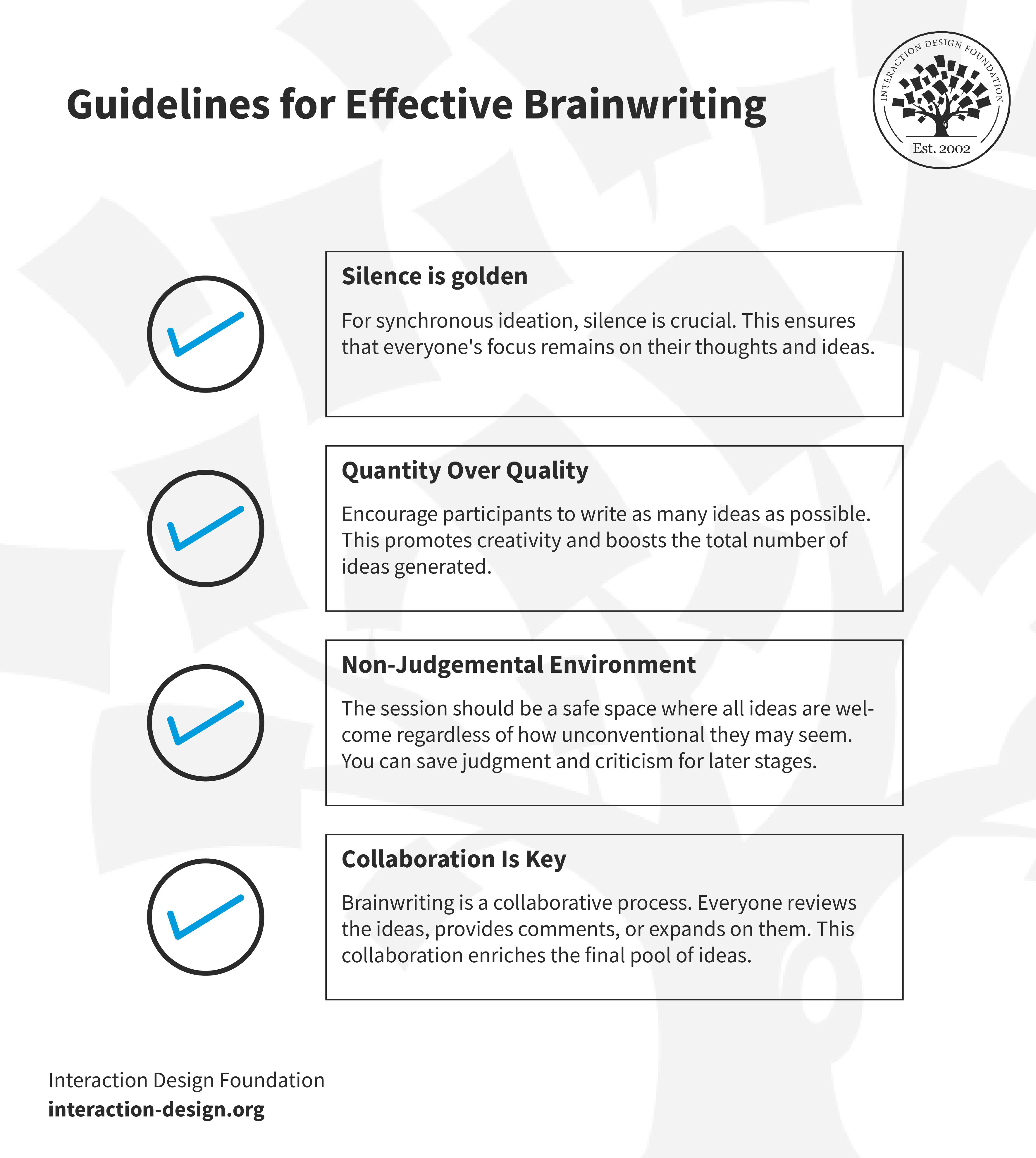
 A checklist for guidelines for effective brainwriting.

© Interaction Design Foundation, CC BY-SA 4.0

Follow these guidelines to ensure your brainwriting session is effective:

  • Silence is golden: For synchronous ideation, silence is crucial. This ensures that everyone's focus remains on their thoughts and ideas.

  • Quantity over quality: Encourage participants to write as many ideas as possible. This promotes creativity and boosts the total number of ideas generated.

  • Non-judgmental environment: The session should be a safe space where all ideas are welcome, regardless of how unconventional they may seem. You can save judgment and criticism for later stages.

  • Collaboration is key: Brainwriting is a collaborative process. Everyone reviews the ideas, provides comments, or expands on them. This collaboration enriches the final pool of ideas.

The brainwriting process brings together the power of collective minds. It creates a collaborative space where the loudest voice does not necessarily command the room. Instead, it promotes equality. Each thought is seen, each idea is heard, and each participant plays an integral role in the creativity game. 

The output is a treasure of diverse ideas that might have remained unvoiced in traditional brainstorming sessions. 

Download the Brainwriting template and start using this technique with your team!
Advance Your Career With This Free Template for “Brainwrite”
Brainwrite
We respect your privacy
Get 1 powerful email each week: Design a life you love!

Variations of Brainwriting Techniques

While brainwriting is an effective tool for idea generation, it’s not a one-size-fits-all solution. It has several variations that accommodate different team sizes, dynamics, and objectives, each having unique features and benefits. Let’s look at two notable variations. 

The 6-3-5 Brainwriting Method
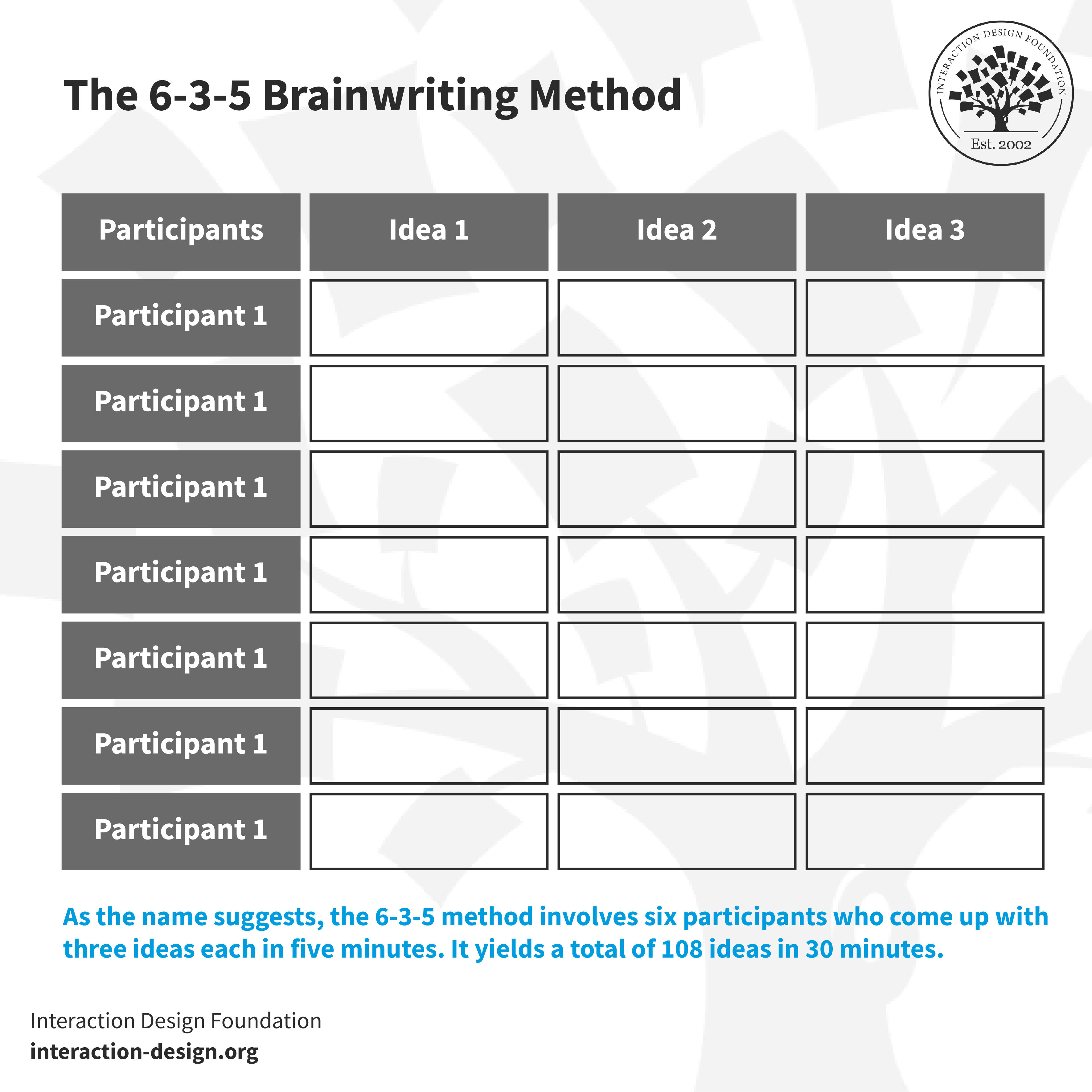
 The 6-3-5 brainwriting technique.

© Interaction Design Foundation, CC BY-SA 4.0

As the name suggests, the 6-3-5 method involves six participants who come up with three ideas each in five minutes. It yields a total of 108 ideas in 30 minutes.

The process starts with each participant writing down three ideas on paper. These are in response to the problem statement the group is addressing. After a five-minute interval, each participant passes their sheet to the next person. The recipient then reads the ideas on the sheet and adds three new ones using the existing ideas for inspiration. This continues until everyone has contributed to each sheet.

The beauty of the 6-3-5 method lies in its structured approach and the momentum it generates. As ideas pass from one participant to another, they spark new thoughts. It leads to a snowball effect of idea generation. This technique encourages building upon others' ideas while creating a sense of collaboration and collective creativity.

The Brainwriting Pool

 Visual representation of the brainwriting pool technique.

© Interaction Design Foundation, CC BY-SA 4.0

The brainwriting pool approach offers more flexibility compared to the 6-3-5 method. In this process, participants write down their ideas on individual sheets of paper. They then place them in the "pool" (a central location).

Other participants can pick any idea from the pool, read it, and use it as inspiration for their own ideas. This allows for a wider range of inspiration and encourages participants to think outside the box. Additionally, the brainwriting pool approach eliminates the pressure of coming up with ideas on the spot. That’s because participants can take their time to browse through the pool and select the ideas that resonate with them.. The process continues for a designated amount of time, and as a result, a diverse set of ideas builds up.

The brainwriting pool is particularly beneficial when a broad range of ideas is needed. It offers more freedom to the participants in choosing the ideas they want to build upon.

Advantages of Brainwriting
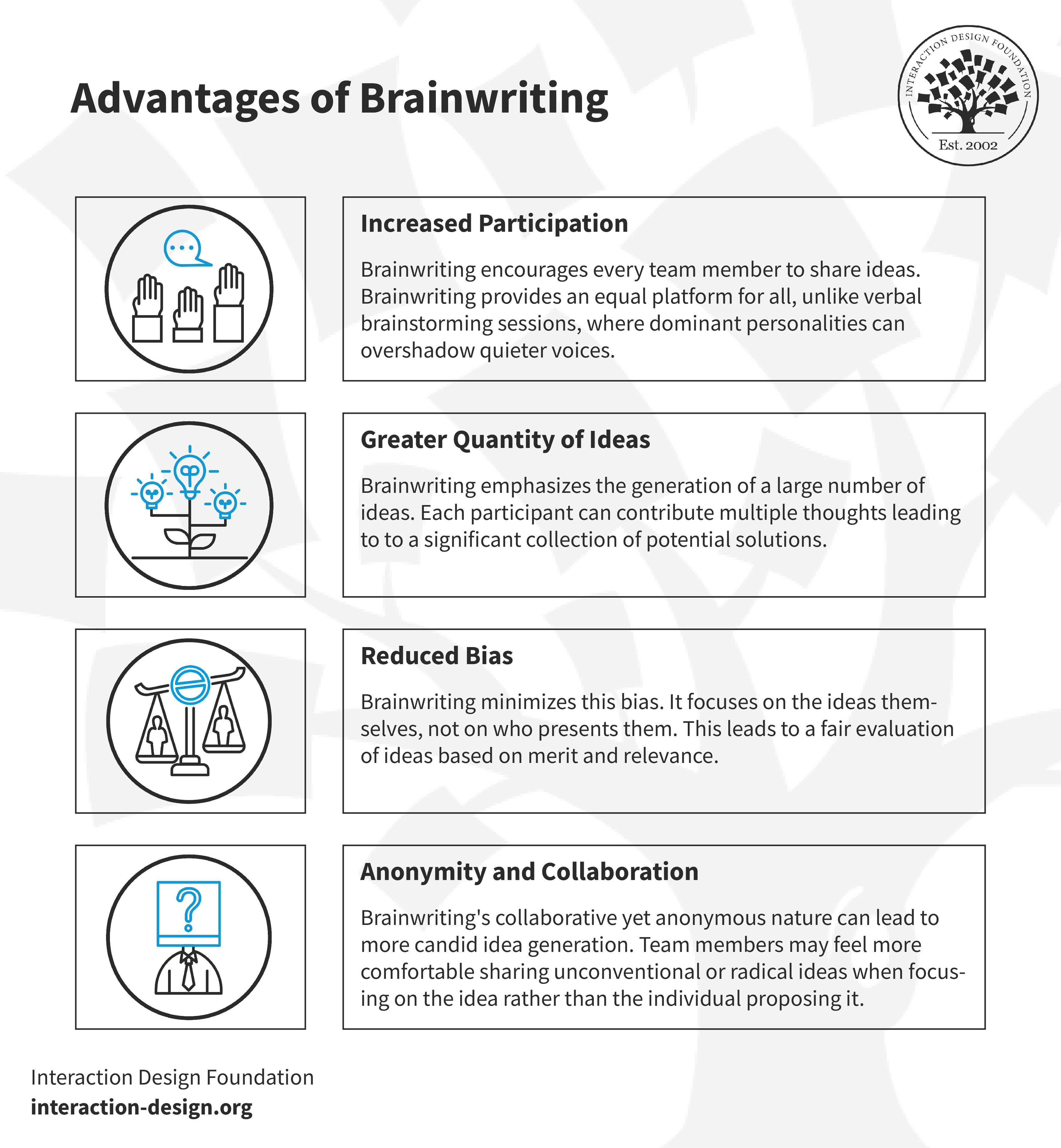
Visual representation of advantages of brainwriting.

© Interaction Design Foundation, CC BY-SA 4.0

Brainwriting offers several notable advantages, making it an effective tool for creativity and problem-solving. Here’s an overview of the advantages that brainwriting offers.

Increased Participation

Brainwriting encourages every team member to share ideas. Brainwriting provides an equal platform for all, unlike verbal brainstorming sessions, where dominant personalities can overshadow quieter voices. Each participant writes down their thoughts, which creates an environment of inclusivity and results in a rich diversity of ideas.

Reduced Bias

In a traditional brainstorming session, the status or personality of the contributors might sway ideas. Brainwriting minimizes this bias. It focuses on the ideas themselves, not on who presents them. This leads to a fair evaluation of ideas based on merit and relevance.

Greater Quantity of Ideas

Brainwriting emphasizes the generation of a large number of ideas. Each participant can contribute multiple thoughts. It often leads to a significant collection of potential solutions.

Collaboration and Anonymity

Brainwriting's collaborative yet anonymous nature can lead to more candid idea generation. Team members may feel more comfortable sharing unconventional or radical ideas when focusing on the idea rather than the individual proposing it.

How to Overcome Challenges in Brainwriting

While brainwriting is a powerful tool, it may pose specific challenges. You can address these challenges through well-considered strategies to ensure a productive and positive ideation session.

Challenge 1: Limited Participation

Sometimes, participants may hesitate to share their thoughts due to fear of judgment or lack of confidence. This could lead to limited participation.

Solution: Foster a non-judgmental and inclusive environment. Remind participants that all ideas are valued, and the goal is to generate many ideas rather than perfect ones. Encourage participants to write freely and assure them that critique and evaluation come later.

Challenge 2: Sticking to Known Ideas

Creating a collaborative atmosphere in a brainwriting session can be challenging in remote settings.

Solution: Encourage divergent thinking. Prompts or themes can be provided to help inspire fresh and unconventional ideas. Stress that you welcome radical, out-of-the-box thinking and actively encourage it.

Challenge 3: Overwhelming Number of Ideas

With every participant generating multiple ideas, the quantity can be overwhelming, and managing them might be challenging.

Solution: Plan for idea organization. Create a system to categorize and prioritize the ideas after they're generated. You can use tools such as affinity diagrams to group related ideas and dot voting to prioritize them.

Challenge 4: Remote Brainwriting

Creating a brainwriting session's collaborative atmosphere can be challenging in remote settings.

Solution: Leverage digital tools. Several online platforms allow for real-time collaboration and idea sharing. These can replicate a physical brainwriting session's dynamic and offer advantages like easy categorization and permanent records.

A positive and inclusive team environment is crucial for overcoming these challenges. It ensures all participants feel valued and heard, which boosts participation and idea generation. With proper strategies, brainwriting can unleash creativity, leading to innovative solutions that enrich the collective goal.

Technology for Remote Brainwriting

In this digital and remote work environment, using technology to facilitate brainwriting has become necessary and advantageous. Digital tools allow for remote participation and offer features that can streamline and enhance the brainwriting process.

Digital Tools for Brainwriting

Several online platforms enable virtual collaboration, making them suitable for remote brainwriting sessions. Here are a few recommended options:

  1. Google Jamboard: This digital whiteboard platform allows team members to create and share real-time sticky notes. It's a simple yet effective tool replicating brainwriting's physical process in a digital environment.

  2. FigJam: FigJam serves as a versatile digital tool designed for team collaboration. It goes beyond mere brainwriting and extends into diagramming meetings, and agile workflows. The tool also integrates with Asana, Jira, and Github, making it easier to turn brainstormed ideas into actionable plans.

  3. Miro: Miro offers a more feature-rich experience, providing an extensive toolkit for brainstorming and ideation sessions. Participants can add sticky notes, draw, create flowcharts, and even vote on ideas. It's an excellent choice for more complex brainwriting sessions.

  4. Microsoft Whiteboard: Similar to Google Jamboard but integrated with the Microsoft ecosystem, this platform offers real-time collaboration. It has features like sticky notes, drawing tools, and image uploads.

Benefits of Remote Brainwriting

Despite the challenges, remote brainwriting offers several benefits in today's digital age:

  1. Flexibility: It allows team members to participate regardless of location. This ensures all voices are heard, even in distributed teams.

  2. Accessibility: Digital tools often come with features that increase accessibility. These include adjustable text sizes, color differentiation, and compatibility with assistive technologies.

  3. Record Keeping: Online platforms automatically save the work and create a permanent session record to revisit later. This eliminates the risk of losing ideas and allows for easy sharing and reviewing after the session.

  4. Efficiency: Digital categorization and voting tools can streamline the review and prioritization process. This way, you can easily manage a large number of ideas.

Integrating technology into brainwriting sessions has never been more relevant. These virtual platforms facilitate innovative, inclusive, and practical ideation sessions as we navigate the evolving digital landscape.

Brainwriting in Different Contexts

Brainwriting's versatility makes it applicable in various contexts, from business and design to education. Its flexibility allows it to be adapted to different problem-solving scenarios, providing a powerful approach to idea generation across domains.

Business

Brainwriting can address countless challenges in the business world, be it strategic planning, marketing innovations, or process improvements. 

For instance, a company might use a brainwriting session to generate ideas for a new product launch. Team members from different departments could contribute diverse perspectives. It can lead to various promotional ideas that combine sales strategies, advertising creativity, and customer engagement tactics.

Design

Brainwriting helps in creating user-centered design through innovative solutions and creative designs in the design field. 

For a quick introduction to user-centered design, see this video by Don Norman, the pioneer of UX design.

Transcript

Every designer has a unique perspective and ideas that they can write. Brainwriting creates a collective pool of creativity that the team can work with. 

For example, a design team could hold a brainwriting session to develop new solutions or introduce features to solve users’ problems  and improve user experience. As the team shares and builds upon these ideas, it can converge on a design that merges the best elements from each concept.

Education

The education industry can benefit significantly from brainwriting. Teachers can use it to generate lesson plan ideas, educational strategies, or methods to increase student engagement. Meanwhile, students can use brainwriting to work on group projects or to generate creative solutions in problem-based learning scenarios. 

For example, during a class project, students could hold a brainwriting session to develop ideas for their project topic, research methods, presentation strategies, and more.

In each of these contexts, the core principle remains the same:

  • Every participant writes down their ideas.

  • Everyone's ideas are valued equally.

  • You leverage the collective creativity of the group.

You can tailor the brainwriting process's specifics to suit the context's unique needs and characteristics.

The versatility of brainwriting lies in its ability to accommodate different problem-solving scenarios across a wide range of fields. It stands as a testament to the adaptability of this ideation technique and its capacity to promote innovation in diverse settings. Therefore, brainwriting isn't just a tool; it's a flexible strategy to unleash creativity and encourage collaborative problem-solving.

The Future of Trends in Brainwriting: AI-Assisted Digital Tools

Brainwriting is a dynamic evolving process. The technological advancements and innovative ideation techniques point towards exciting future trends in brainwriting methodologies.

Remote Brainwriting and AI-Assisted Digital Tools

The digital era has unlocked the potential for remote brainwriting, making this collaborative process more accessible and efficient. Even tools like Google Spreadsheets can be harnessed for brainwriting. The immediacy of idea sharing on these digital platforms enables participants to draw inspiration from others' thoughts in real time. 

As technology advances, we can expect even more sophisticated tools to enhance the brainwriting process. These may offer features like instant categorization, advanced collaborative capabilities, and AI-assisted idea generation.

Studies suggest that digital brainwriting can significantly improve idea generation. This highlights the potential for further advancements in brainwriting tools and platforms. As technology evolves, we can see smarter platforms that offer features designed specifically for brainwriting. For example, these could be AI-based idea categorization or automatic transcription for verbal brainwriting.

The future of brainwriting is indeed exciting, with technology paving the way for enhanced collaboration, innovation, and efficiency. As we adapt and evolve these methodologies, brainwriting proves to be a valuable and highly cost-effective idea-generating technique. It promises to remain a potent tool in our creativity arsenal for collaborative idea generation. 

Questions About Brainwriting?
We've Got Answers!

How is brainwriting different from brainstorming?

Brainwriting differs from brainstorming in how ideas are shared. In brainstorming, people speak their ideas out loud in real time, which can lead to louder voices dominating and quieter ones holding back. Brainwriting flips that script in that everyone writes down ideas silently and simultaneously, usually on paper or digitally.

This method gives every team member equal space to contribute, without interruption or judgment. It also prevents group thinking because people don’t get influenced by others’ ideas right away. After a set time, the group shares and builds on the written ideas together.

Brainwriting also works well in remote teams or when time is tight. It’s focused, fast, and inclusive, making it a good option when you quickly want diverse ideas.

Watch our video about brainstorming:

Transcript

Take our course Creativity: Methods to Design Better Products and Services.

What are the steps in a brainwriting session?

To start, clearly define the problem or challenge. Ensure everyone understands what they’re brainwriting. Next, give each participant a sheet of paper—or digital document—and ask them to write down three ideas in a few minutes. Then, everyone passes their sheet to the person next to them. The new person reads and builds on the ideas or adds several new ones. Keep the process moving in rounds until each sheet returns to its original owner or the group runs out of time.

After the writing rounds, collect and review the ideas. Group similar ones and discuss the most promising solutions together.

Watch our video about brainstorming:

Transcript

Take our course Creativity: Methods to Design Better Products and Services.

What’s the best number of people for brainwriting?

The sweet spot for a brainwriting session is six to eight people. This size strikes the right balance—enough idea variety without overwhelming the process. Too few people risk not generating enough diverse input, while too many can make tracking and building on ideas chaotic and slow things down.

Ideas circulate smoothly in a group of six, seven, or eight; each participant gets a good mix of perspectives, and everyone has time to contribute meaningfully. This range also helps maintain energy and focus throughout the session.

If you’re working remotely, use digital tools to manage documents or boards, especially with larger groups. However, keep the core team small whenever possible to get the best results.

Watch our video about brainstorming:

Transcript

Take our course Creativity: Methods to Design Better Products and Services.

How do I stop people from copying each other’s ideas in brainwriting?

To avoid idea copying in brainwriting, use silent and anonymous writing rounds. Make sure participants can’t see who wrote what. In a physical session, fold or hide previous entries. In a digital setup, use anonymous documents or tools where names stay hidden.

Set clear rules at the start so everyone tries to generate original ideas or build meaningfully on existing ones, not just repeat them. Time each round tightly to keep the flow going and prevent overthinking or mimicry.

Rotate the sheets or documents randomly, too. This keeps patterns unpredictable and encourages independent thought. A little structure can go a long way in protecting the creative process and promoting fresh, authentic, diverse ideas.

Watch our video about brainstorming:

Transcript

Take our course Creativity: Methods to Design Better Products and Services.

What are good design challenges for brainwriting?

Great brainwriting challenges are specific, user-centered, and open-ended. Ask questions like: “How can we make onboarding smoother for first-time users?” or “What features would help remote teams collaborate better?” These types of prompts spark targeted yet diverse ideas.

Focus on real pain points or unmet needs. Keep the challenge narrow enough to guide thinking but broad enough to allow creative freedom.

You can also reframe problems using “How might we…” questions—for example, “How might we reduce decision fatigue in our app’s UI?” This framing encourages possibility-driven thinking and keeps the tone constructive.

Tailor the challenge to your product stage—early ideation, refining features, or solving usability issues—and you’ll likely get insights that can be effective for the problem at hand.

Watch our video about brainstorming:

Transcript

Take our course Creativity: Methods to Design Better Products and Services.

How can I get better ideas while brainwriting?

Start with a well-crafted challenge. Frame it as a “How might we…” question to focus thinking while remaining open-ended, like “How might we simplify user onboarding?” Specific prompts unlock sharper, more relevant ideas.

Time the rounds tightly to maintain energy and avoid overthinking. Use silent writing to help everyone focus, and rotate ideas quickly to spark fresh input. Encourage building on others’ ideas—not just creating new ones. Iteration often leads to breakthroughs.

Mix up your team, too. Bring in people with different roles or backgrounds to widen perspectives—diverse input often produces more original and useful solutions.

Note—if the energy dips, pause and reframe the challenge. A small shift in wording can breathe new life into the session.

Watch our video about brainstorming:

Transcript

Take our course Creativity: Methods to Design Better Products and Services.

What should I avoid during brainwriting?

Avoid group discussion during the writing rounds—talking breaks the focus and can influence ideas. Keep the room silent so everyone can think independently and write their thoughts. Then, don’t allow dominant voices to steer the session. Brainwriting works best when everyone contributes equally.

Skip vague or overly broad prompts. The challenge needs to be clear, or people will either get stuck or go off-topic. Likewise, don’t rush the process. Allow enough time for each round—typically 3 to 5 minutes—to let ideas take shape without dragging on.

Avoid tracking names or tying ideas to individuals. Anonymity helps remove bias and encourages honest, uninhibited input. And never judge or filter ideas during the session; the evaluation comes later. That way, creativity flows authentically and without fear of criticism.

Watch our video about brainstorming:

Transcript

Take our course Creativity: Methods to Design Better Products and Services.

What do I do with all the ideas we collect?

After a brainwriting session, group similar ideas to spot patterns and themes. Use color coding or tags to cluster related suggestions. This step makes it easier to see what resonates across the team.

Next, filter out duplicates and unfeasible options. Then prioritize the remaining ideas using criteria like impact, effort, or alignment with user needs. A simple matrix or voting system can help the team decide what to pursue.

Once you've narrowed the list, turn the strongest ideas into sketches, prototypes, or user stories. Then test these with users to validate their value early. Don’t let ideas sit in a document—tap their potential and turn them into action.

Watch our video about brainstorming:

Transcript

Enjoy our Master Class Harness Your Creativity to Design Better Products with Alan Dix, Professor, Author and Creativity Expert.

What are some recent scientific articles about brainwriting?

Shaer, O., Cooper, A., Mokryn, O., Kun, A. L., & Ben Shoshan, H. (2024). AI-augmented brainwriting: Investigating the use of LLMs in group ideation. arXiv.

This study explores how large language models (LLMs) can enhance the traditional brainwriting process, particularly within group ideation. The authors designed a collaborative framework integrating LLMs for both idea generation (divergence) and evaluation (convergence). Conducted with university students, the study demonstrated that LLM support improved both the quantity and depth of ideas. An LLM-based evaluation engine also reliably assessed idea quality compared to human judges. This research is significant as it bridges human creativity with AI capabilities, proposing novel directions for HCI education and design practice. It marks a foundational step in incorporating AI in structured co-creation activities like brainwriting.

Langham, J., & Paulsen, N. (2021). Simulating the cognitive leap using brainwriting. Design Management Journal, 16(1), 85–101.

This study examines the effectiveness of digital brainwriting in enhancing idea generation during remote collaboration. The authors conducted an online experiment with participants from a Massive Open Online Course (MOOC), utilizing a structured brainwriting process to simulate creative ideation. Findings revealed that approximately 53% of the ideas generated were novel and more sophisticated compared to those from a pre-session control activity. The research highlights the potential of digital brainwriting to improve both the quality and quantity of ideas in remote settings, offering valuable insights for organizations seeking innovative solutions in virtual environments.

Mattimore, B. W. (2012). Idea Stormers: How to Lead and Inspire Creative Breakthroughs. Jossey-Bass.

Bryan W. Mattimore’s Idea Stormers offers a structured, real-world approach to ideation in organizations, making it a cornerstone resource for innovation leaders. Drawing on his facilitation experience with over 300 companies, Mattimore demystifies group creativity by introducing methods like brainwriting, brainwalking, and wishful thinking. These tools are designed to produce not just more ideas, but better and more actionable ones. The book emphasizes that ideation is both an art and a science—one that thrives on structure and skilled facilitation. It is particularly important for UX teams, product designers, and business strategists aiming to tackle complex challenges with breakthrough solutions.

Neubauer, B. (2005). The Write-Brain Workbook: 366 Exercises to Liberate Your Writing. Writer’s Digest Books.

Bonnie Neubauer’s The Write-Brain Workbook is a comprehensive guide designed to stimulate creativity through daily writing exercises. With 366 prompts, it encourages writers to overcome blocks, explore various genres, and develop a consistent writing practice. The workbook’s playful approach makes it accessible to both novice and experienced writers, fostering a habit of daily writing and self-expression. By providing diverse and imaginative exercises, Neubauer helps writers discover their unique voice and enhance their storytelling skills. This resource is invaluable for anyone looking to cultivate creativity and maintain a regular writing routine.​

Earn a Gift Earn a Gift, Answer a Short Quiz!

1
2
3
4
1
2
3
4
Question 1
Question 2
Question 3
Get Your Gift
Interaction Design Foundation logo

Question 1

What is the main benefit of brainwriting over traditional brainstorming?

1 point towards your gift

  • It focuses on verbal communication and body language.
  • It generates only a few high-quality ideas.
  • It reduces bias and promotes equal participation.
Interaction Design Foundation logo

Question 2

What is the first step in a brainwriting session?

1 point towards your gift

  • Evaluate the ideas
  • Share ideas verbally
  • Write down ideas silently
Interaction Design Foundation logo

Question 3

What is the 6-3-5 method in brainwriting?

1 point towards your gift

  • Five participants write six ideas in three minutes.
  • Six participants write three ideas in five minutes.
  • Three participants write six ideas in five minutes.

Learn More About Brainwriting

Make learning as easy as watching Netflix: Learn more about Brainwriting by taking the online IxDF Course Creativity: Methods to Design Better Products and Services.

Why? Because design skills make you valuable. In any job. Any industry.

In This Course, You'll

  • Get excited as you learn to innovate and get creative, even when you feel blocked! Did you know that creative thinking is the second most important skill hiring managers look for, across all jobs and industries? This course will give you the skills to design innovative solutions and products that stand out. It's easier than you think! No matter your background, you can effortlessly learn to tap into creativity. You'll apply proven methods to break out of habitual thinking, spark new ideas anytime, and capture them before they disappear!

  • Make yourself invaluable with divergent and convergent ideation techniques that have real business impact. In a world where AI can generate endless ideas, you stay in demand when you know which ideas to explore, which to combine, and which to move forward. Timeless human-centered design skills help you focus creativity on real needs, and that’s how you can turn AI from a tool into your new creative superpower. Companies that prioritize creativity achieve 67% more organic revenue growth. Creativity is just as valuable in finance, engineering, and healthcare as it is in creative professions. Every industry thrives on innovative ideas. In this course, you'll use ideation methods like multiple classifications and three-way comparisons to see opportunities others miss and bring bold ideas to life.  

  • Gain confidence and credibility with 15+ downloadable templates to fast-track your creativity! You'll learn how to use busywork to enable your creativity in daily planning and foster a creative team environment. You'll apply step-by-step strategies to beat procrastination, bias, and fixation, and ensure your creative process remains productive—even under pressure. You'll get hands-on experience and walk away with a polished case study for your portfolio if you choose to complete the optional ideation project. If you want to solve big problems, improve lives, and build a better world with innovative solutions people love, then this course is the perfect place to start.

It's Easy to Fast-Track Your Career with the World's Best Experts

Master complex skills effortlessly with proven best practices and toolkits directly from the world's top design experts. Meet your experts for this course:

  • Alan Dix: Author of the bestselling book “Human-Computer Interaction” and Director of the Computational Foundry at Swansea University.

  • Don Norman: Father of User Experience (UX) Design, author of the legendary book “The Design of Everyday Things,” and co-founder of the Nielsen Norman Group.

Get an Industry-Recognized IxDF Course Certificate

Increase your credibility, salary potential and job opportunities by showing credible evidence of your skills.

IxDF Course Certificates set the industry gold standard. Add them to your LinkedIn profile, resumé, and job applications.

Course Certificate Example

Be in distinguished company, alongside industry leaders who train their teams with the IxDF and trust IxDF Course Certificates.

Our clients: IBM, HP, Adobe, GE, Accenture, Allianz, Phillips, Deezer, Capgemin, Mcafee, SAP, Telenor, Cigna, British Parliament, State of New York

All Free IxDF Articles on Brainwriting

Read full article
Introduction to the Essential Ideation Techniques which are the Heart of Design Thinking - Article hero image
Interaction Design Foundation logo

Introduction to the Essential Ideation Techniques which are the Heart of Design Thinking

Ideation is at the heart of the Design Thinking process. There are literally hundreds of ideation techniques, for example brainstorming, sketching, SCAMPER, and prototyping. Some techniques are merely renamed or slightly adapted versions of more foundational techniques. Here you’ll get an overview o

Social shares
1.2k
Published
Read Article
Read full article
Learn How to Use the Best Ideation Methods: Brainstorming, Braindumping, Brainwriting, and Brainwalking - Article hero image
Interaction Design Foundation logo

Learn How to Use the Best Ideation Methods: Brainstorming, Braindumping, Brainwriting, and Brainwalking

Brainstorming is the most frequently practiced form of ideation. We recommend that you use it along with Brainwriting, Brainwalking, and Braindumping. Here, you’ll learn the best practices from the very best experts from d-school and IDEO as well of the father of the Brainstorming technique, Alex Os

Social shares
1.3k
Published
Read Article
Read full article
Start Your UX Journey: Essential Insights for Success - Article hero image
Interaction Design Foundation logo

Start Your UX Journey: Essential Insights for Success

One in three consumers (32%) will abandon a brand they love after a single poor experience—yes, all it takes is just one bad experience. It’s a statistic that drives home the point that designers can’t afford to gamble against user feedback. What users think is a reality that’s total for you as a de

Social shares
464
Published
Read Article

Learn How to Use the Best Ideation Methods: Brainstorming, Braindumping, Brainwriting, and Brainwalking

Learn How to Use the Best Ideation Methods: Brainstorming, Braindumping, Brainwriting, and Brainwalking

Brainstorming is the most frequently practiced form of ideation. We recommend that you use it along with Brainwriting, Brainwalking, and Braindumping. Here, you’ll learn the best practices from the very best experts from d-school and IDEO as well of the father of the Brainstorming technique, Alex Osborn.

Brainstorming is a great way to generate a lot of ideas that you would not be able to generate by just sitting down with a pen and paper. The intention of brainstorming is to leverage the collective thinking of the group, by engaging with each other, listening, and building on other ideas. Conducting a brainstorm also creates a distinct segment of time when you intentionally turn up the generative part of your brain and turn down the evaluative part. You can use brainstorming throughout any design or work process, of course, to generate ideas for design solutions, but also any time you are trying to generate ideas, such as planning where to do empathy work, or thinking about product and services related to your project.

Learn the Best Practices from the Experts Themselves

Here, you’ll learn the best practices from the very best experts from d-school and IDEO as well of the father of the Brainstorming technique, Alex Osborn. IDEO is a hugely successful international design and consulting firm, which uses the Design Thinking methodology to advance innovative design in products, services, environments, and digital experiences. The d.school celebrates Design Thinking, and it’s one of the most – if not the most – celebrated and recognised sources on Design Thinking and ideation techniques. d.school is a design school based in Stanford University in cooperation with the German Hasso Plattner Institute of the University of Potsdam.

Brainstorming (or just ‘brainstorm’, for short) has remained the cornerstone of the creative industry for decades and has evolved over the years as experience and learning developed from its variety of applications. Brainstorming essentially relies on a group of people coming together with their prior knowledge and research in order to gather ideas for solving the stated problem. It evokes images of exploration, experimental thinking, and wild ideas. However, all too often it takes the form of controlled sessions where dominant figures assert themselves over others and creativity ends up getting stifled. Or, in other cases, the facilitator does not succeed in helping the team steer towards the goal by keeping the user, the user’s need and the team’s insights about them in a problem statement – also called Point of View – at the front of the team’s minds.

In the following, we’ll let you in on some amazing brainstorm rules which will help keep you from falling into these traps, and instead facilitate innovative and effective brainstorming sessions.

Best Practice Rules for Effective Brainstorming

Author/Copyright holder: Teo Yu Siang and Interaction Design Foundation. Copyright terms and licence: CC BY-NC-SA 3.0
Idea generation, or Ideation, is an art form, which is dependent on appointing an experienced facilitator and having an experienced team. However, we’re all here to learn, and here is how you can start learning to become a successful facilitator of brainstorming sessions. Brainstorming is about setting a safe, creative space for people to feel like they can say anything and be wild—and know that they will not be judged for doing so—so that new ideas can be born. The following are some rules, principles, and suggestions so you can make brainstorming sessions much more user-oriented, effective, innovative – and fun.

1. Set a time limit

d-school emphasises that the facilitator has to be intentional about setting aside a period when your team will be in “brainstorm mode”. In this time frame, it’s the sole goal to come up with as many ideas as possible, and during this period judgements of those ideas are prohibited. Typically, a Brainstorm will take around 15-60 minutes. It can be shorter or longer, depending on the difficulty of the problem and the motivation and experience of the group.

Best practice tip:

“Invest energy into a short period of time, such as 15 or 30 minutes of high engagement. Get in front of a whiteboard or around a table, but take an active posture of standing or sitting upright. Get close together.”
– dschool, Bootcamp Bootleg

2. Start with a problem statement, Point of View, How Might We questions, a plan or a goal – and stay focused on the topic

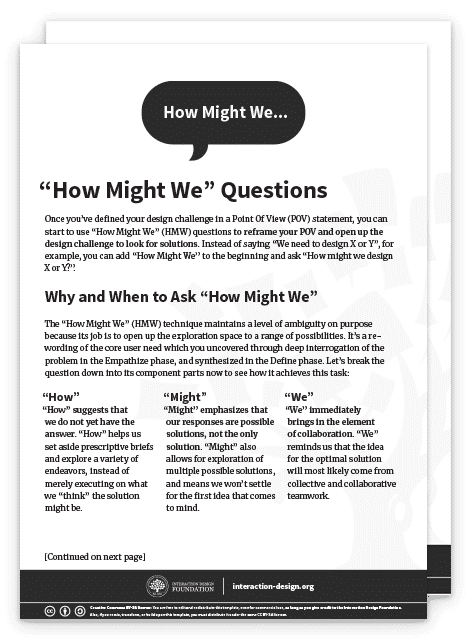
Alex Osborn, the father of the Brainstorming technique, emphasises that brainstorming sessions should always address a specific question or problem statement (also called a Point of View) as sessions addressing multiple questions are inefficient. Begin with a good problem statement or question. Design Thinkers and other ideation specialists have further developed this approach into the art of framing problem statements via methods. Specifically, these are “How Might We” questions.

You can read and download the full guides below about how you can define your problem statement by using the Design Thinking method called Point Of View and how you can start ideating by asking “How Might We” questions:

Advance Your Career With This Free Template for “Point of View - Problem Statement”
Point of View - Problem Statement
We respect your privacy
Get 1 powerful email each week: Design a life you love!

Advance Your Career With This Free Template for “How Might We Questions”
How Might We Questions
We respect your privacy
Get 1 powerful email each week: Design a life you love!

Best practice tip:

“Write down clearly what you are brainstorming. Using a ‘How Might We’ (HMW) question is a great way to frame a brainstorm (e.g. HMW give each shopper a personal checkout experience?).”
– dschool, Bootcamp Bootleg

3. Defer judgement or criticism, including non-verbal

The facilitator should always set a positive, unthreatening tone and tell participants to reserve criticism for a later critical stage in the ideation process. A Brainstorming session is not the time and the place to evaluate ideas, and you should avoid executional details. It’s crucial that participants are feeling confident by being in a safe environment so they have no fear of being judged by others when they put forward wild ideas. You should create equal opportunities for all participants. The best ideas often come from practitioners, students, and people who dare to think differently – and not necessarily only from the highly skilled and experienced managers.

“Have playful rules: Critiquing or debating ideas can quickly sap the energy of a session. Many IDEO conference rooms have brainstorming rules stenciled in 6-inch-high letters on the walls; for example, ‘Go for quantity,’ ‘Encourage wild ideas,’ ‘Defer judgment,’ or ‘One conversation at a time.’”
– IDEO, The IDEO Difference

Best practice tip: The facilitator should suspend judgement. This way, participants will feel free to generate unusual ideas. As a facilitator, you will find that it can even be a great idea to prohibit the word “no”. You’ll be surprised to see how effective this tool is and how it helps open up minds and creates a collaborative, curious, and friendly ideation environment. And you’ll find that it’s pretty fun too when team members have to initially say “yes” to even the weirdest ideas. Giving out half-thought-out ideas or strange suggestions is normally not socially accepted, is socially frowned on and leads to people holding back in normal situations. Brainstorming deliberately gives permission to be “stupid” and “child-like”.

“Creative spaces don't judge. They let the ideas flow, so that people can build on each other and foster great ideas. You never know where a good idea is going to come from, the key is make everyone feel like they can say the idea on their mind and allow others to build on it.”
– OpenIDEO, 7 Tips on Better Brainstorming

4. Encourage weird, wacky, and wild ideas

These new ways of thinking might give you better solutions.

"It is easier to tone down a wild idea than to think up a new one.”
– Alex Osborn, the father of the Brainstorming technique

“Wild ideas can often give rise to creative leaps. In thinking about ideas that are wacky or out there we tend to think about what we really want without the constraints of technology or materials. We can then take those magical possibilities and perhaps invent new technologies to deliver them.”
– OpenIDEO, 7 Tips on Better Brainstorming

5.Aim for quantity

Aim for as many new ideas as possible. The assumption is that the greater the number of ideas you generate, the bigger your chance is of producing a radical and effective solution. Brainstorming celebrates the maxim “quantity breeds quality”.

6.Build on each others' ideas

As suggested by the slogan "1+1=3", Brainstorming stimulates the building of ideas by a process of association. Embrace the most out-of-the-box notions and build, build, build. Be positive and build on the ideas of others. Brainstorming works well when participants use each other's ideas to trigger their own thinking. Our minds are highly associative. One thought easily triggers another. When we use the thoughts of others, then these will stop us getting trapped by our own thinking structures.

Best practice tip: Try to say and encourage others to say “and” instead of “but”. It takes practice, but this little trick works surprisingly well.

7. Be visual

Best practice tip: At IDEO, they encourage you to use coloured markers to write on Post-its and put them on the wall—or sketch your idea. Nothing gets an idea across faster than drawing it. It doesn’t matter how terrible of a sketcher you are! It's all about the idea behind your sketch. And d.school has two great ideas for you:

“There are at least two ways to capture the ideas of a brainstorming:
1. Scribe: the scribe legibly and visually captures on the board ideas that team members call out. It is very important to capture every idea, regardless of your own feelings about each idea.
2. All-in: Each person will write down each of his or her ideas as they come, and verbally share it with the group. It is great to do this with post-it notes, so you can write your idea and then stick it on the board.”
– dschool, Bootcamp Bootleg

8. One conversation at a time

Listen to each other and elaborate on each other’s ideas. Don’t get obsessed with your own ideas. You’re here to ideate together.

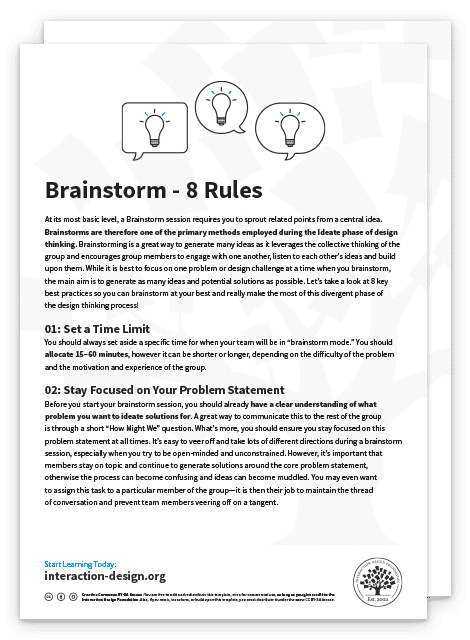
You can download and print our template with the 8 rules for effective Brainstorming and use it as your and your team’s guide:

Advance Your Career With This Free Template for “Brainstorm - 8 Rules”
Brainstorm - 8 Rules
We respect your privacy
Get 1 powerful email each week: Design a life you love!

Should you Forget Brainstorming?

Brainstorm, as great as it can be, has some obvious weaknesses, most of them human factors. Whenever a group of people gets together to work collectively on anything, we inevitably find some members dominating over others. Introverts take a back seat and prefer working away in a quieter self-reflective manner, while extroverts, especially egoistical ones, put a stake in the ground and try to own the show. Research published in the Administrative Science Quarterly in 1958, Does Group Participation When Using Brainstorming Facilitate or Inhibit Creative Thinking?, seeks to understand whether individual brainstorming or group brainstorming sessions produce better results. A storm of debate ensued in 2010 when News Week posted an article referencing this research and making a call to "Forget Brainstorming "with others rebuffing this claim and affirming "Don't Forget: Brainstorming Works". Though the results of the study were based on limited parameters, they do indicate that if group-brainstorming conditions are not properly met, they can fail more easily.

We agree that poorly facilitated face-to-face brainstorms do stifle creativity. We agree that, even when brainstorming is done right, people could sometimes still generate ideas faster when they work alone. However, if you want creativity, it’s a major mistake to keep your team members in solitary confinement where they can’t “waste time” listening to and building on the ideas of others.

Here’s the problem: Most pieces of research on brainstorming are rigorous but irrelevant to the challenge of managing creative work. For starters, comparing whether creativity happens best in groups or alone is pretty silly when you look at how creative work is actually done. At creative companies like IDEO, people switch between both modes so seamlessly that it is hard to notice where individual work ends and group work starts.

Should Your Team Brainstorm as a Group or as Individuals?

Best practice: Switching between the two modes of individual and collective ideation sessions can be seamless—and highly productive. Alex Osborn’s 1950s classic Applied Imagination gave advice that is still relevant: Creativity comes from a blend of individual and collective ideation.

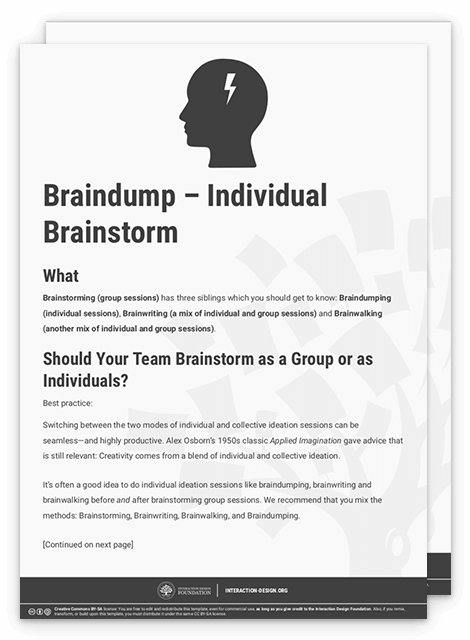
Brainstorming (group sessions) has three siblings which you should get to know: Braindumping (individual sessions), Brainwriting (a mix of individual and group sessions) and Brainwalking (another mix of individual and group sessions).

It’s often a good idea to do individual ideation sessions like braindumping, brainwriting and brainwalking before and after brainstorming group sessions.

Braindump – Individual Brainstorm

Author/Copyright holder: Teo Yu Siang and Interaction Design Foundation. Copyright terms and licence: CC BY-NC-SA 3.0
One of the best ways to progress to more advanced levels of ideation is to start by getting everything that's currently clogging the neural pathways out in the open and freeing up some cognitive space for other synapses, connections, and mixtures to get through. David Allen, author of the world famous “Getting Things Done” methodology, swears by the braindump as a means to free up mental energy and allow freethinking. Holding onto your own thoughts, unfinished tasks, or unexplored ideas creates mental blockages and prevents freethinking. Furthermore, Braindump is an amazing technique to help quiet employees get a voice.

Best practice

  • If you were the facilitator, you’d brief ideation participants upfront on the problem statement, goals and important insights from previous research and findings.

  • Then ask all participants to write down their ideas as they come.

  • It’s important that each participant does this individually – and silently.

  • Provide participants with sheets of paper, idea cards or traditional Post-it notes. Sticky notes are great, because they allow people to write their ideas down individually – one idea per note.

  • Give participants between 3 and 10 minutes to get ideas they have been thinking of off their chests.

  • After reaching the time limit of approximately 3-10 minutes, each participant will say a few words about his or her ideas and stick them on a board or wall. You should avoid initial discussions about notes when team members are presenting them. Ideas that come out of early braindump sessions should be shared verbally with the entire team in order to spark new streams of thinking or combinations of ideas.

  • While sticking the ideas up and presenting them, the group will also group duplicates together.

  • When all team members have presented their ideas, you can select the best ideas, which you can continue to build and elaborate on in other ideation sessions. There are various methods you can use such as “Post-it Voting”, “Four Categories”, “Bingo Selection”, “Six Thinking Hats”, and “Now Wow How Matrix”.

You can download and print the template where we’ve summarised how to create a successful Braindump session:

Advance Your Career With This Free Template for “Braindump”
Braindump
We respect your privacy
Get 1 powerful email each week: Design a life you love!

Author/Copyright holder: Victor Roa. Copyright terms and licence: CC BY 2.0

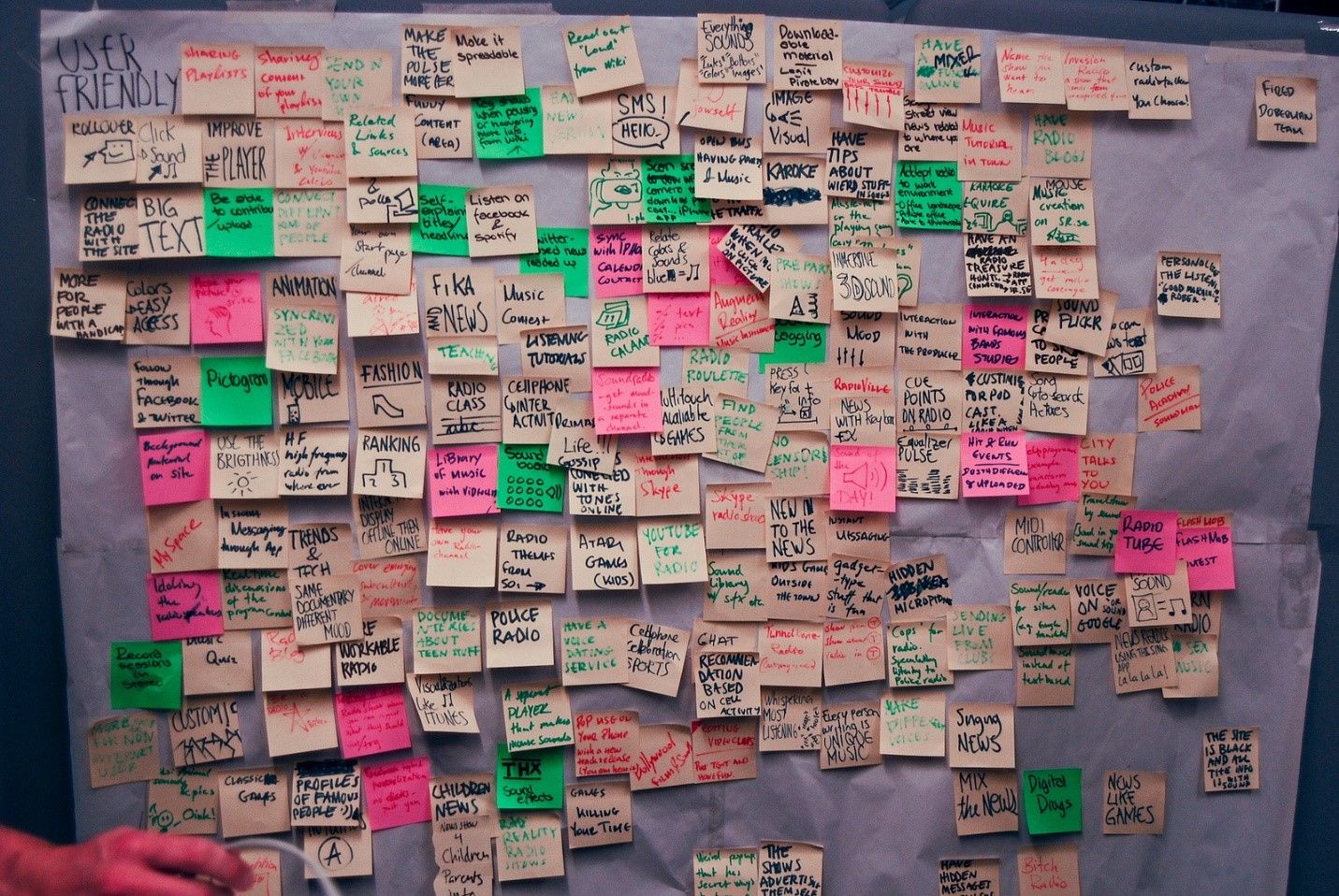
Sticky notes are great for braindump sessions, because they allow people to write their ideas down individually – one idea per note. After reaching the time limit of approximately 3-10 minutes, each participant will say a few words about his or her ideas and stick them on a board or wall.

Brainwriting

Author/Copyright holder: Teo Yu Siang and Interaction Design Foundation. Copyright terms and licence: CC BY-NC-SA 3.0
Brainwriting is a technique where participants write ideas onto cards and then pass their idea cards on to the next person, moving those cards around the group in a circle as participants build on the ideas of others. Participants perform this technique in complete silence—and they are forced to build on, instead of criticise, other participants' ideas. The cycle can be repeated multiple times and can be applied to chunks of the problem being addressed, depending on the need. The beauty of brainwriting is that it levels the playing field immediately, and it removes many of the obstacles of group brainstorming. With traditional verbal brainstorming, the number of ideas which can be expressed at once is limited, and the time it takes to get through a number of ideas is much longer, which results in many participants forgetting or becoming confused while others shout out ideas. This is especially so for those who are shy or introverted or who may be at a disadvantage due to being less senior or unfamiliar with the specialisations being discussed.

Brainwriting is an excellent starting point for ideation sessions, and can serve as a means to maximise the initial braindump, or as a way to refocus if other ideation methods go haywire. Before the chaos of group ideation muddles people's thinking, help them get their initial thoughts out in the open with an introductory brainwriting session and use the results later to build on further with other techniques.

Best Practice

  • If you were the facilitator, you’d brief ideation participants upfront on the problem statement, goals and important user insights from previous research and findings.

  • Encourage participants to jot down ideas on their idea cards for 3-5 minutes before passing on their ideas when you make the call.

  • Ideally, participants pass on idea cards 3-10 times depending on the problem statement and goals.

  • This all happens silently and without any interference or communication.

  • Encourage participants to push themselves for more ideas at least a couple of times, in the few minutes they have, in order to maximize the output and variation.

  • You should stoke the session with encouragement and provide questions or statements which push participants to think outside of their comfort zones.

  • The cycle can be repeated multiple times and can be applied to chunks of the problem being addressed, depending on the need.

  • After ending the cycle, each participant will briefly verbally present the thoughts on the idea card he/she ends up with by the end of the cycle to the rest of the team—in order to spark new streams of thinking or combinations of ideas. If you were the facilitator, you would often be taking notes on a white board.

  • When all team members have presented their idea cards, you can select the best ideas which you can continue to build and elaborate on in other ideation sessions. There are various methods you can use such as “Post-it Voting”, “Four Categories”, “Bingo Selection”and “Now Wow How Matrix”.

You can download and print the template where we’ve summarised how to create a successful Brainwriting session:

Advance Your Career With This Free Template for “Brainwrite”
Brainwrite
We respect your privacy
Get 1 powerful email each week: Design a life you love!

Brainwalking

Author/Copyright holder: Teo Yu Siang and Interaction Design Foundation. Copyright terms and licence: CC BY-NC-SA 3.0

Yes, you read it correctly—don’t worry, though; it doesn’t involve soles touching souls. Brainwalking is very similar to brainwriting with one small but highly impactful difference. Instead of passing idea cards or notes from one participant to another, participants have to get up from their seats and move to another spot around the brainstorming table or even to another table altogether. Bryan Mattimore came up with this technique; he’s a specialist in the art of ideation and facilitation. Mattimore has many years and thousands of sessions of experience conducting ideation sessions. In his book Idea Stormers, he describes brainwalking as the: 'single best technique to use to begin an ideation session'.

Brainwalking gets people out of their seats, gets them moving, keeps energy levels up and mixes things up enough so that the group as a whole does not get stuck delving too long down the same one-way street, without a quick exit or U turn available. Brainwalking works best when it is easy to flip or to start from scratch.

You can download and print the template where we’ve described the best practice for creating a Brainwalking session:

Advance Your Career With This Free Template for “Brainwalk”
Brainwalk
We respect your privacy
Get 1 powerful email each week: Design a life you love!

As we can see, one ideation method leads to another, and another… and the methods themselves are areas open to creative interpretation and disruption.

Know Your History

Alex Osborn was an advertising executive who created the technique we know today as brainstorming. He invented the technique as a response to the stifling environment of executive meetings and with the goal of freeing up creative thinking in order to facilitate ideas to flow more easily. Alex Osborn presented the brainstorming technique in his book, How To Think Up. Alex Osborn authored several books on group creative thinking, including Your Creative Power, How to Organize a Squad to Create Ideas and Applied Imagination, and he was a pioneer in the field, laying the ground for what we call ideation today.

Alex Osborn developed a system that still applies to our modern ideation methods and includes such principles as deferring judgement or criticism and aiming for a larger quantity of ideas as opposed to a focus on quality. He also impresses the importance of an experienced facilitator and on combining group brainstorming with separate individual ideation sessions. As much as the modern understanding of brainstorming may conjure up ideas of randomised chaos with an untrained, poorly facilitated group just shouting out whatever comes to mind, the technique Osborn developed has many rules and principles, which need to be respected in order to achieve success.

“Creativity is more than mere imagination. It is imagination inseparably coupled with both intent and effort.”
– Alex Osborn

The Take Away

Brainstorming is the most frequently practiced form of ideation. We recommend that you mix it with Brainwriting, Brainwalking and Braindumping and other ideation methods. Idea generation is an art form, which is dependent on appointing an experienced facilitator and having an experienced team. However, we’re all here to learn, and here is how you can start learning to become a successful facilitator of ideation sessions. Ideation sessions are about setting a safe, creative space for people to feel like they can say anything, be wild, and not be judged – so that new relevant ideas can be born. The following are the rules, principles and suggestions to help you make brainstorming and other initial ideation sessions much more effective:

  1. Set a time limit.

  2. Start with a question, a plan or a goal – and stay focused on the topic.

  3. Defer judgement or criticism, including non-verbal.

  4. Encourage weird, wacky and wild ideas.

  5. Aim for quantity.

  6. Build on each others' ideas.

  7. Be visual.

  8. Allow one conversation at a time.

References & Where to Learn More

Hero Image: Author/Copyright holder: visualpun.ch. Copyright terms and licence: CC BY-SA 2.0

IDEO, The IDEO Difference, by Catherine Fredman, 2002.

Alex Osborn, How To Think Up, 1942

Alex Osborn, Applied Imagination, 1953

d.school, Bootcamp Bootleg.

Donald W. Taylor, Paul C. Berry and Clifford H. Block, Does Group Participation When Using Brainstorming Facilitate or Inhibit Creative Thinking? In Administrative Science Quarterly Vol. 3, No. 1, Page 23-47, 1958.

Po Bronson and Ashley Merryman. Forget Brainstorming, 7/12/2010.

Jonathan Vehar. Don't forget: Brainstorming works!, 2010.

David Allen, Five Simple Steps that Apply Order to Chaos.

Dave Gray. Brainwriting. Gamestorming A toolkit for innovators, rule-breakers and changemakers, 2010.

Bryan W. Mattimore, Idea Stormers: How to Lead and Inspire Creative Breakthroughs, 2012

Tim Brown, CEO of IDEO, Change by Design, 2009

Feel Stuck?
Want Better Job Options?

AI is replacing jobs everywhere, yet design jobs are booming with a projected 45% job growth. With design skills, you can create products and services people love. More love means more impact and greater salary potential.

At IxDF, we help you from your first course to your next job, all in one place.

See How Design Skills Turn Into Job Options
Privacy Settings
By using this site, you accept our Cookie Policy and Terms of Use.
Customize
Accept all

Be the One Who Inspires

People remember who shares great ideas.

Share on:

Academic Credibility — On Autopilot

Don't waste time googling citation formats. Just copy, paste and look legit in seconds.