Motivation in UX/UI Design

Your constantly-updated definition of Motivation in UX/UI Design and collection of videos and articles.
Be a conversation starter: Share this page and inspire others!

197 Shares

What is Motivation in UX/UI Design?

Motivation is the mechanism behind many of our decisions and actions. Its most basic form is described by a layered model devised by Abraham Maslow, referred to as the hierarchy of needs. In this model, motivation is the driving force to satisfy the needs of each layer.

But we can also consider motivation in more specific terms. How can we motivate ourselves to achieve individual goals once the basic needs of the model are attained? Motivation in this sense can be considered from two perspectives, external and internal.

External motivation, or “extrinsic motivation” in psychology, refers to an outside force that moves a person to do something they might not normally do. This could be a reward, praise or punishment. Internal, or intrinsic, motivation is the self-generated force that drives you towards a goal. The reward is purely internal but leads toward positive feelings in the individual.

UX Designers often use extrinsic rewards to encourage certain behaviors from users when interacting with a product or service. However, it is generally more effective to learn people's intrinsic motivations to support them in what they already want to do. Otherwise, you waste time and energy convincing them to do something they don’t wish to, potentially turning them off your product. UX researchers focus on their users' motivations during the early stages of development to better appeal to users' intrinsic motivations.

How Do Designers Motivate Users?

Transcript

Video games use different kinds of motivation to serve other purposes. Often extrinsic motivation rewards players in the short term. Intrinsic motivating factors keep players engaging with the product in a meaningful and enjoyable way. These primary motivators are:

  • Autonomy (feeling agency, acting by one's goals and values)

  • Competence (feeling able and effective)

  • Relatedness (feeling connected to others, a sense of belonging)

Gamification is a common method of inspiring motivation derived from game theory and video game development, even for products that aren’t games. They do this by introducing “game-like” elements, such as points and scoring, or adding nonessential but satisfying tasks that trigger a sense of accomplishment and achievement.

Gamified experiences that are not games can risk turning off users who want a more traditional experience, which is why UX research and usability testing are essential to get the balance right.

Extrinsic Motivation vs. Intrinsic Motivation

External rewards are standard in many interfaces. These are usually virtual rewards used in digital products but can also be real-world rewards like gift cards. Most of the time, external rewards won’t motivate your users for long. Designers need to tap into an internal motivation users already have, like a desire to achieve or a social connection.

For example, an award in a video game might be motivating. An award people can share with friends is more motivating because it taps into sociability and achievement drives.

However, providing extrinsic rewards will eventually result in diminishing returns. Games and gamified products require constant rewards to keep players engaged. Otherwise, players will stop playing.

The book Drive by Daniel Pink describes a study that suggested that extrinsic rewards will demotivate people in the long run.
The experiment divided preschool children into three groups before being allowed to draw. Each group had different rewards for drawing.

The groups were:

  • Expected award – each child was shown and promised a "Good Player" certificate before drawing.

  • Unexpected award – children in this group were shown nothing but received the "Good Player" certificate.

  • No award – these children were neither shown nor received the certificate.

Two weeks later, they brought the same children back to draw, but this time with no rewards for any group. The children not promised awards the first time were just as enthusiastic and drew the same amount of time. However, those previously in the expected award group showed less interest and spent less time drawing. Researchers found that extrinsic rewards made the children less motivated to draw unless rewarded, so without one, they lost interest.

The same is true with adults. Simply put, offering a reward in advance turns play into work. Intrinsic motivation is enough to sustain us when we perform activities of our own free will, with no compensation. With a promised reward, the task becomes a chore we do for a reward, not for its own sake.

This doesn’t necessarily mean that you should never use external rewards. Surveys often offer gift cards for completing them, mainly because it is not a sustained user experience. However, external rewards will not lead to prolonged customer engagement for interfaces that should be used over time.

Deceptive Patterns

It is essential to encourage certain behaviors from users. But designers can go too far. They can make something deliberately addictive or coerce or deceive users into something they don't want to do.

These are generally known as “dark patterns” or “deceptive patterns.” These are interfaces that deliberately misguide users to force certain behaviors.

For example, an app might make users feel like they are missing out on a chance to try something. That thing is always available, but the deception of a limited opportunity makes users more likely to engage. Another example is a task the user cannot easily back out of without closing the app, so they will be encouraged to complete it to save their progress.

Use intrinsic motivation as often as possible and avoid coercing users into behaviors they aren't comfortable with. Otherwise, you risk losing trust and possibly promoting unhealthy behaviors in your users. Using deceptive patterns or exploiting motivation may be profitable in the short term. However, it undercuts the long-term goal of a product that users value and enjoy.

Questions About Motivation?
We've Got Answers!

How can interaction designers measure the impact of intrinsic and extrinsic motivation on user engagement?

Designers can use a combination of quantitative metrics (like usage statistics, completion rates, and achievement unlocks) and qualitative feedback (user interviews, surveys) to understand how motivation affects engagement.

What are some examples of extrinsic motivators in interaction design?

Extrinsic motivators can include points, badges, leaderboards, financial incentives, or social recognition features within a product.

Can extrinsic rewards in interaction design lead to long-term user engagement?

While extrinsic rewards can initially attract users, long-term engagement is more likely sustained by intrinsic factors. It's important to gradually shift the focus from extrinsic rewards to intrinsic values of the interaction.

How can interaction design effectively use extrinsic motivators without undermining intrinsic motivation?

Designers can balance extrinsic motivators, like rewards or social recognition, with elements that support intrinsic motivation, ensuring that extrinsic rewards do not overshadow the inherent value of the experience.

What is extrinsic motivation in interaction design?

Extrinsic motivation involves using or interacting with a design due to external rewards or pressures, rather than the enjoyment or satisfaction derived from the activity itself.

How can feedback mechanisms in interaction design boost intrinsic motivation?

Positive and constructive feedback mechanisms can boost intrinsic motivation by affirming users' competence and encouraging them to explore and interact further.

What role does user autonomy play in intrinsic motivation within interaction design?

User autonomy is crucial for intrinsic motivation; allowing users to make choices and control their interaction can increase their interest and engagement with the product.

Can gamification elements enhance intrinsic motivation in interactive products?

Yes, gamification elements like achievements, progress tracking, and personal challenges can enhance intrinsic motivation by making the interaction more engaging and rewarding in itself.

How can interaction design foster intrinsic motivation in users?

Designs can foster intrinsic motivation by creating engaging and satisfying experiences that align with the users' interests, challenges, and the joy of discovery.

What is intrinsic motivation in interaction design?

Intrinsic motivation refers to the drive to use or interact with a design because of an inherent interest or pleasure in the activity itself rather than for some separable outcome.

How can interaction designers balance intrinsic and extrinsic motivation?

Balancing intrinsic and extrinsic motivation involves creating designs that reward users externally and resonate with them on a personal level. This can be achieved by aligning the design’s goals with the users' internal values and interests, offering choices that empower users, and providing challenges that match users' skill levels to promote a sense of achievement and progress.

What strategies can be employed in interaction design to improve user motivation?

To improve user motivation, interaction designers can employ various strategies, such as incorporating gamification elements to make the experience more engaging, personalizing the user experience to better meet individual needs and preferences, providing clear and meaningful feedback to encourage progress and achievement, and ensuring the usability and accessibility of the design to reduce barriers to engagement.

How does motivation affect user engagement in interaction design?

Motivation, both intrinsic and extrinsic, plays a crucial role in user engagement. Intrinsically motivated users engage with a product because they find it inherently enjoyable or fulfilling, while extrinsically motivated users might be driven by external rewards or recognition. Understanding and designing for these motivational factors can significantly enhance user engagement and satisfaction.

Earn a Gift Earn a Gift, Answer a Short Quiz!

1
2
3
4
1
2
3
4
Question 1
Question 2
Question 3
Get Your Gift
Interaction Design Foundation logo

Question 1

What is intrinsic motivation?

1 point towards your gift

  • Motivation driven by external rewards or pressures.
  • Motivation driven by financial incentives.
  • Motivation driven by internal satisfaction or enjoyment.
Interaction Design Foundation logo

Question 2

Why should UX designers focus on users' intrinsic motivations?

1 point towards your gift

  • To decrease development costs
  • To make sure users engage with the product meaningfully
  • To provide frequent external rewards
Interaction Design Foundation logo

Question 3

What is a potential drawback when designers solely rely on extrinsic motivation for user engagement?

1 point towards your gift

  • It always increases user satisfaction.
  • It guarantees short-term user loyalty immediately.
  • It may lead to diminishing returns over time.

Learn More About Motivation in UX/UI Design

Make learning as easy as watching Netflix: Learn more about Motivation by taking the online IxDF Course Design for Thought and Emotion.

Why? Because design skills make you valuable. In any job. Any industry.

In This Course, You'll

  • Get excited as you create products and experiences that go beyond functionality to connect deeply with people. You'll discover how people think, act, and feel, and learn to design products and services they don't just use, but love. More love, more impact, greater salary potential. The principles of thought and emotion in design are not industry-specific, they're about people. Whether you work in healthcare, gaming, education, or finance, skills in human-centered design empower you to create products, services, and experiences people trust and are eager to share. As AI accelerates how fast we build and iterate, your timeless human-centered skills become even more powerful. You'll direct AI with deep human insight, and ensure outcomes remain meaningful, ethical, and genuinely resonate with people. This is how you stay in demand: Human-centered design skills transform AI from a tool into your new superpower.

  • Make yourself invaluable by mastering the psychology of thought and emotion to design experiences that make a real impact and convert. Studies show that companies that increased their human-centered design spending saw a lower cost of acquisition (74%), increased retention (79%), and increased market share (95%). You'll bring down high bounce and drop-off rates once you understand how people think and feel. You'll design intuitive experiences and products people care about and want to come back to. You'll know what drives people's decisions and turn frustrating interactions into joyful ones. Stand out as someone who creates measurable business success with solutions people love and advocate for. 

  • Gain confidence and credibility as you build a portfolio that impresses employers, clients, and hiring managers. Apply your new skills immediately with downloadable templates like the Hierarchy of User Experience Needs, which empower you to transform existing technology or services into solutions that deliver a peak emotional experience. It's easier than you think! Even if you're new to design, you can effortlessly master Design for Thought and Emotion. If you complete the optional hands-on exercises, you'll walk away with polished, portfolio-ready case studies that showcase your new skills. You'll analyze enjoyable and frustrating interfaces, conduct casual user research, and create niche personas. You'll become familiar with thought-to-action pathways and design intuitive, effortless systems people love.

It's Easy to Fast-Track Your Career with the World's Best Experts

Master complex skills effortlessly with proven best practices and toolkits directly from the world's top design experts. Meet your expert for this course:

  • Alan Dix: Author of the bestselling book “Human-Computer Interaction” and Director of the Computational Foundry at Swansea University.

Get an Industry-Recognized IxDF Course Certificate

Increase your credibility, salary potential and job opportunities by showing credible evidence of your skills.

IxDF Course Certificates set the industry gold standard. Add them to your LinkedIn profile, resumé, and job applications.

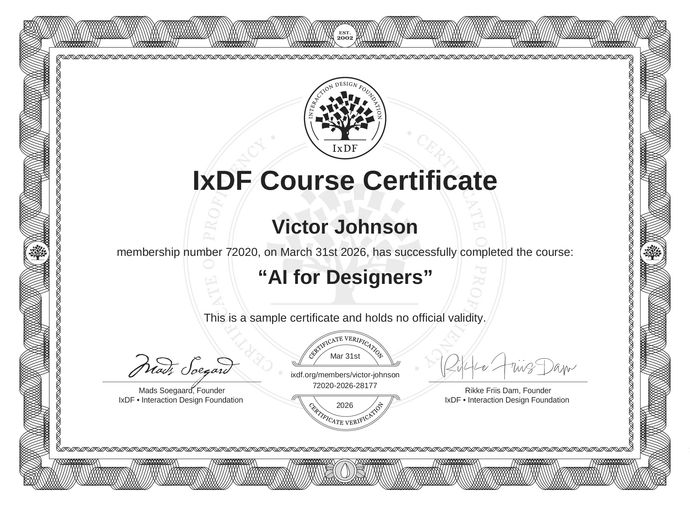
Course Certificate Example

Be in distinguished company, alongside industry leaders who train their teams with the IxDF and trust IxDF Course Certificates.

Our clients: IBM, HP, Adobe, GE, Accenture, Allianz, Phillips, Deezer, Capgemin, Mcafee, SAP, Telenor, Cigna, British Parliament, State of New York

All Free IxDF Articles on Motivation in UX/UI Design

Read full article
Safety: Maslow's Hierarchy of Needs - Article hero image
Interaction Design Foundation logo

Safety: Maslow's Hierarchy of Needs

Safety is one of our basic, evolutionary needs. Most of our decisions and actions are based on sustaining or improving our circumstances. While we may not be in constant danger like early man, we are no less driven by the need for safety for us and our loved ones. This drive is carried over into use

Social shares
1.1k
Published
Read Article

Feel Stuck?
Want Better Job Options?

AI is replacing jobs everywhere, yet design jobs are booming with a projected 45% job growth. With design skills, you can create products and services people love. More love means more impact and greater salary potential.

At IxDF, we help you from your first course to your next job, all in one place.

See How Design Skills Turn Into Job Options
Privacy Settings
By using this site, you accept our Cookie Policy and Terms of Use.
Customize
Accept all

Be the One Who Inspires

People remember who shares great ideas.

Share on:

Academic Credibility — On Autopilot

Don't waste time googling citation formats. Just copy, paste and look legit in seconds.