The Bandwagon Bias – The Dangers of Groupthink

• 8 min read

817 Shares

Groupthink is dangerous to our objectivity. It prevents us from thinking for ourselves and making the best decisions. Designers need to be cautious about falling into the bandwagon bias trap but also be aware of how it can be exploited in their designs to improve user experiences and get users to make the decisions the designer wants them to make.

We, human beings, are social creatures. The urge to belong and to conform is strong within us – it helps us form relationships and brings meaning to our lives. It also has a downside; it can make us conform to the wrong beliefs or take the wrong actions because well… “everyone knows…”. For example, nowadays, social media have an enormous effect on groupthink.

Author/Copyright holder: Keoni Cabral. Copyright terms and licence: CC BY 2.0

The science fiction author, Robert Heinlein, had this to say about this urge; “If everybody knows such and such, then it ain’t so, by at least ten thousand to one.” Of course, that statement might be a little strong – everybody knows that if you eat enough cyanide you’re going to die but there’s a great element of truth to the idea too. Back in the 1950s people believed smoking was good for you and it wasn’t. Today, many people believe that sugar in your diet is bad for you; it’s not but it is in excess. And so on.

Bandwagon bias is a form of groupthink. It’s a cognitive bias that makes us believe something because other people believe it. It can make us think something that is achievable is impossible because others have tried and failed before us. It can make us think that there’s only way to tackle a problem because; “that’s the way it’s always been done.”

Tackling our own bandwagon biases is important because it frees us up to be creative and to think for ourselves. It allows us to rise to meet challenges rather than falling at the first hurdle.

However, on the flip side, we can also tap into the bandwagon bias in our designs. The most obvious way to do so is by the use of “social proof”. This is why reviews and star ratings have become such an intrinsic part of online marketing – people are more likely to buy a product or service when they can see that many other people did so and were happy with that decision.

A History of the Bandwagon Bias

Author/Copyright holder: khrawlings . Copyright terms and licence: CC BY 2.0)

The term “bandwagon” in this context became popular in the mid-19th century as a form of derision in American political relationships. It was drawn from a chap called Dan Rice. Dan was a circus clown who performed across the USA. He was incredibly popular and when he came to a place to promote his show – local folks would, literally, “jump on the bandwagon” to participate in his promotions.

It’s not like a politician to miss a trick and when they got wind of Dan’s popular displays – they decide to emulate his work. They added music and bandwagons of their own to their campaigns, to encourage their supporters to “jump on the bandwagon”.

However, the public was as cynical about politics back then as it is today and soon “jumping on the bandwagon” was a phrase that held negative connotations. By the start of the 20th century the phrase was used to mock the person who followed the herd without engaging their brain.

The Bandwagon Bias and You

Like all cognitive biases most of us suffer from the bandwagon bias at some point or other. It might be simply expressed for example; a preference for Apple computers because “everyone knows they’re the best computers for designers”. This is at best a subjective judgement and at worst completely untrue. The reality is that the right tool for design is one you can afford and one which does what you need it to do. Most modern-PCs are as capable as an Apple computer of conducting design related work.

Or it might be a little more complex; “We do it like this at XYZ company because my boss did it like this before me and his boss before him.” None of that means that there isn’t a better way to do things, does it?
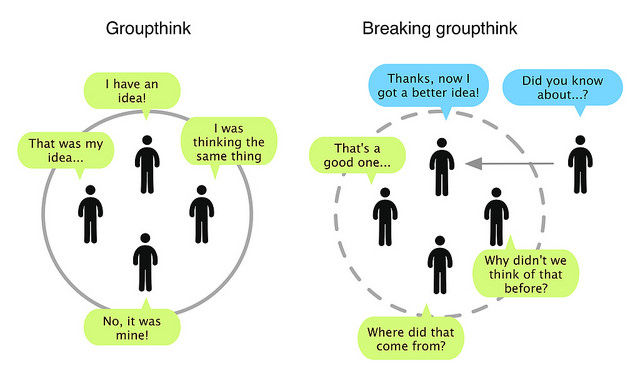
Author/Copyright holder: Oscar Berg. Copyright terms and licence: CC BY 2.0

It’s difficult to recognize our biases and the bandwagon bias is no different. We can start by asking ourselves why we believe what we believe and then probing the reasoning until we reach a strong understanding. Then we can ask; “Is that rational?” If the answer is “no” and it might take a bit of soul searching to come to that – then we must tackle the bias.

It can be much easier to tackle biases through the use of a coach or someone that can work with you in a “verbal sparring”. They can help draw out your biases and ask the questions to help you examine them more clearly.

The Take Away

The bandwagon bias is not always incorrect. However, when it is wrong – it limits our ability to carry out work effectively. It’s worth challenging our biases and examining them in context so that we can make informed decisions and generate better work.

Don’t forget that user experience designers can tap into the bandwagon bias via social proof – to improve the experience and customer journey of their products. Though don’t overdo it; people are beginning to distrust social proof due to its overuse and unreliability.

References & Where to Learn More:

Check out our Design League program if you’d like to tackle your own cognitive biases with expert guidance.

More on how to leverage the mechanisms of social computing.

NetMind examines the bandwagon bias and other cognitive biases.

How can social biases affect writers? Read all about it! -

Hero image: Author/Copyright holder: Jeff Warren. Copyright terms and licence: CC BY-SA 2.0

Learn More in This Course:

AI for Designers

10 days
16 % booked
View Course

What You Should Read Next

  • Read full article
    7 Tips to Improve Your UX Design Practice - Article hero image
    Interaction Design Foundation logo

    7 Tips to Improve Your UX Design Practice

    Hey! But my UX design practice is perfect! Thankfully, we don’t hear that very much but the truth is – the longer we’re in a job, the better we consider ourselves to be at that job. Sometimes, it’s worth remembering that even the best professionals still have learning to be done. It’s also worth rem

    Social shares
    967
    Published
    Read Article
  • Read full article
    Do I Need a Degree to Work In User Experience? - Article hero image
    Interaction Design Foundation logo

    Do I Need a Degree to Work In User Experience?

    This is a question that, in slightly different forms, gets asked a lot by those considering a UX design career. The question is a simple one but the answer..? Well, that’s a bit more complicated. A lot depends on you and your approach to life and your career. So let’s take a look at the benefits of

    Social shares
    952
    Published
    Read Article
  • Read full article
    How to Build a UX/UI Design PDF Portfolio That Hiring Managers Will Love (Includes Examples) - Article hero image
    Interaction Design Foundation logo

    How to Build a UX/UI Design PDF Portfolio That Hiring Managers Will Love (Includes Examples)

    If you already have an online UX/UI design portfolio, do you need a PDF version? The answer is – yes; it is better to be safe than sorry! Some hiring managers like to see a more detailed PDF portfolio after reviewing your online portfolio, while some job applications may request an upload instead of

    Social shares
    943
    Published
    Read Article
  • Read full article
    14 Barriers to Ideation and How to Overcome Them - Article hero image
    Interaction Design Foundation logo

    14 Barriers to Ideation and How to Overcome Them

    Would you like to facilitate successful ideation sessions? Or would you like to learn how to contribute to ideation processes in your team more effectively? In either case, you should know the ideation traps and how you can prevent yourself and your team from falling into them. You should give the f

    Social shares
    920
    Published
    Read Article
  • Read full article
    Obstacles to Problem Solving and Innovation in Design Thinking - Article hero image
    Interaction Design Foundation logo

    Obstacles to Problem Solving and Innovation in Design Thinking

    Understanding the obstacles that prevent teams from reaching innovative solutions that solve underlying problems is a very important aspect of the Design Thinking process. When we ignore a major influencing factor while trying to develop a solution, we are setting ourselves up for a potentially

    Social shares
    832
    Published
    Read Article
  • Read full article
    What Tech Job is Right for Me? A Comprehensive Guide to Navigating Your Career Path - Article hero image
    Interaction Design Foundation logo

    What Tech Job is Right for Me? A Comprehensive Guide to Navigating Your Career Path

    Think about which tech career is right for you and you may well find that choosing a career is about getting work that offers fulfilling employment, personal growth opportunities, and—of course—good remuneration. If you’re finding yourself contemplating a change or exploring alternative paths on you

    Social shares
    817
    Published
    Read Article
  • Read full article
    The GROW model: Similarities between Coaching and UX - Article hero image
    Interaction Design Foundation logo

    The GROW model: Similarities between Coaching and UX

    The GROW model is used by coaches to enable individuals to reach their objectives. As you will see while reading about this model, there’s a large overlap with the skills already used by UX designers. As a designer, it can be helpful for you to see the parallels between the two professions – as it a

    Social shares
    752
    Published
    Read Article
  • Read full article
    The Illusion of Control – You Are Your Worst Enemy - Article hero image
    Interaction Design Foundation logo

    The Illusion of Control – You Are Your Worst Enemy

    Not everything in life is within our control. Believing that it is can be a serious handicap to getting things done in design work and most of life. Learning how to handle the illusion of control will make it much easier to accept things that aren’t within your control and focus your efforts on area

    Social shares
    751
    Published
    Read Article
  • Read full article
    The Bias Blind Spot and Unconscious Bias in Design - Article hero image
    Interaction Design Foundation logo

    The Bias Blind Spot and Unconscious Bias in Design

    It’s useful for designers to understand bias both so that they combat their own biases when they work and so that they can tap into the biases of their users to provide better user experiences. But what happens when we can’t acknowledge our own biases? That’s when we need to understand the bias blin

    Social shares
    742
    Published
    Read Article
  • Read full article
    How to Create the Perfect UX Resume and Cover Letter - Article hero image
    Interaction Design Foundation logo

    How to Create the Perfect UX Resume and Cover Letter

    Your cover letter helps sell you as a good fit for the company and serves to introduce your resume and portfolio. The cover letter plays a major role because this is your first chance to help the recruiter know that you’re the perfect fit for the company and job role. You need your UX design portfol

    Social shares
    725
    Published
    Read Article

Top Articles

Top Topic Definitions

Feel Stuck?
Want Better Job Options?

AI is replacing jobs everywhere, yet design jobs are booming with a projected 45% job growth. With design skills, you can create products and services people love. More love means more impact and greater salary potential.

At IxDF, we help you from your first course to your next job, all in one place.

See How Design Skills Turn Into Job Options
Privacy Settings
By using this site, you accept our Cookie Policy and Terms of Use.
Customize
Accept all

Be the One Who Inspires

People remember who shares great ideas.

Share on:

Academic Credibility — On Autopilot

Don't waste time googling citation formats. Just copy, paste and look legit in seconds.

Feel Stuck? Want Freedom?

Join 326,378+ designers who get one powerful email each week. Learn to design a life you love.

Next email in
7
days
6
hrs
59
mins
53
secs

Free forever. No spam. Unsubscribe anytime.