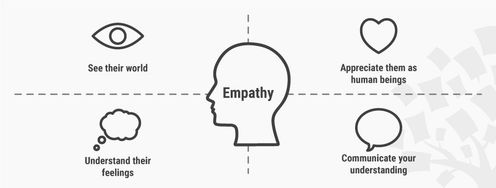
The design thinking process takes you into unknown and sometimes uncomfortable territory. Members of a design thinking team need to be open minded, curious, collaborative and willing to have their assumptions challenged. They also need to prepare themselves for change and take on an accepting, adaptable mindset. You may feel like that asks a lot of the people involved; however, it’s totally worth the effort. Design thinking not only leads to increased innovation and improved end products, it also creates a great team spirit, boosts work ethic and bolsters individuals’ confidence in their creative abilities.
"The greatest fear in life is not of death, but unsolicited change.”
- Raheel Farooq
Everyone thinks, feels and experiences things differently. Differences are what we need—especially in the world of design thinking. These differences also mean certain activities in design thinking projects will not come naturally to the people involved. Newcomers, in particular, may feel intimidated, confused or disoriented by the seemingly chaotic approach of the design thinking process. You can, however, conduct a few short exercises to break through this negative tension, loosen things up and make people feel positive and excited about the project. And we’re going to take you through three steps to help you do exactly that.
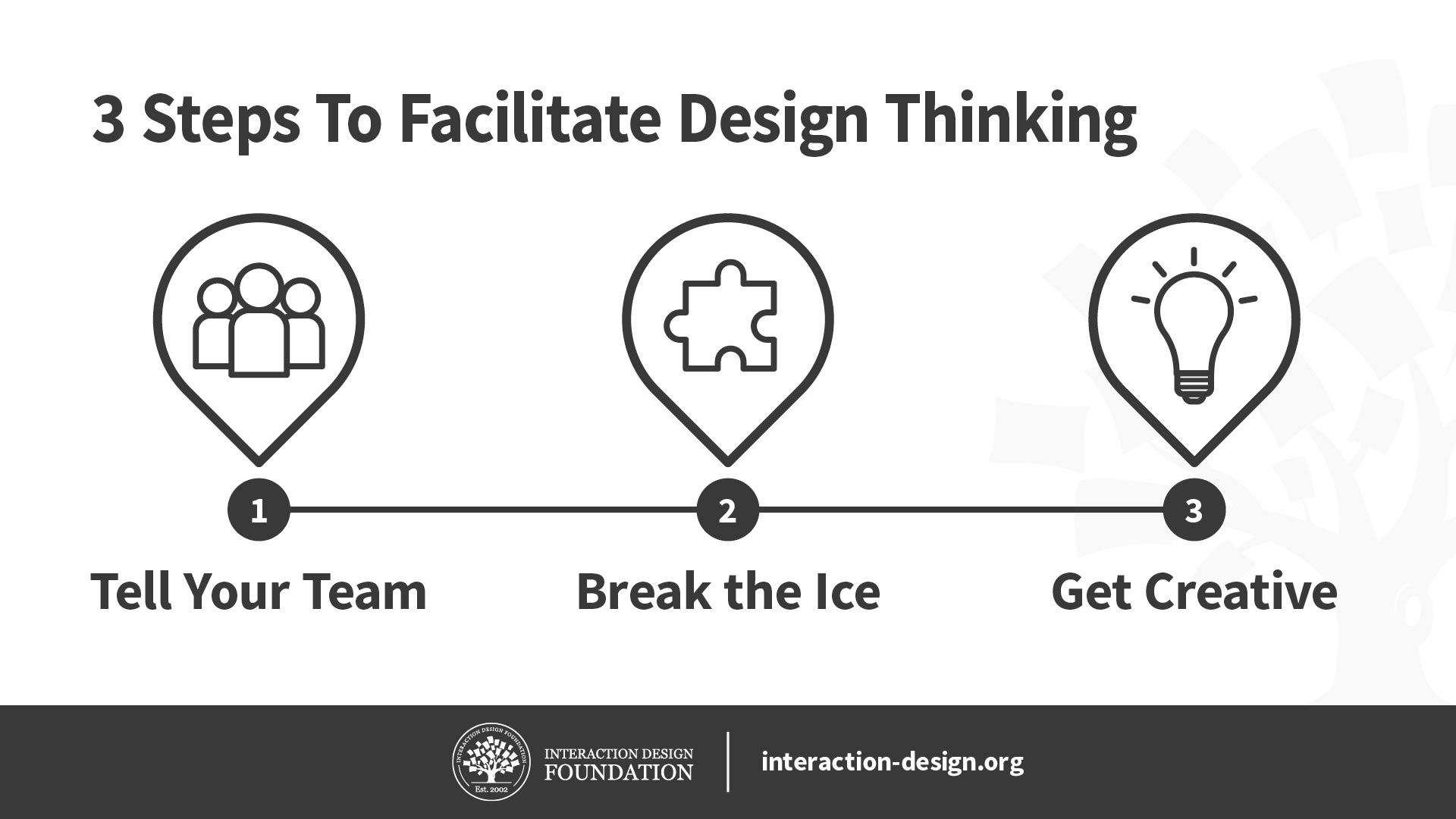
© Daniel Skrok and the Interaction Design Foundation, CC BY-NC-SA 3.0.
Step 1: Tell Your Team Members About the Process of Design Thinking
First things first, you need to explain the design thinking process to your team members. You can achieve this with the following steps.
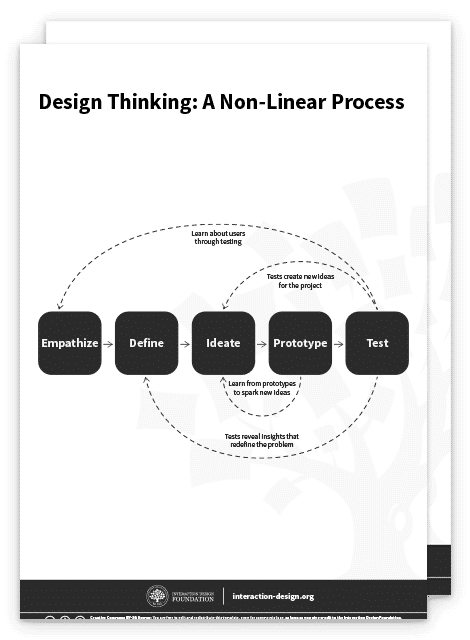
Print out the 'Design Thinking: A Non-linear Process' PDF download shown above and hand a copy to each member of your team. This will help them understand and recognize the different stages of the process before the project begins, and will highlight the iterative and non-linear nature of design thinking.
Run through a definition of each of the five stages:
Empathize—research your users' needs.
Define—state your users' needs and problems.
Ideate—challenge assumptions and create ideas.
Prototype—start to create solutions.
Test—try your solutions out.
Explain that the five stages of design thinking are not sequential steps, but are there to serve as a guide. You should encourage your team to see the stages as different modes to put themselves in—to iterate on your problem definition, ideas or prototype. The various stages also enable you to learn more about your users at any point in the project.
Tell your team that the iterative, non-linear nature of design thinking means you can carry these stages out in parallel, repeat them and even circle back to previous stages at any point in the design thinking process.
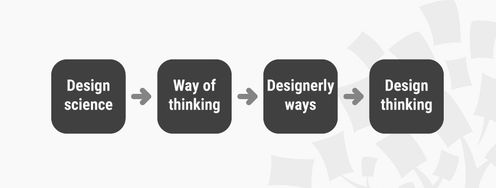
Discuss how design thinking creates a third way to approach problem-solving. It combines the analytical and information-driven approach of science with the holistic, empathic and creative ways of thinking in ethnography and design.
Highlight that you’ll apply lots of proven methods and techniques throughout the process—user interviews, brainstorm sessions, affinity clustering, sketching, user testing, etc.
Your team members will feel safer when they know the background and underlying structure of design thinking. They will better understand there is method to the madness, and that chaos is not the goal—even though the process may feel chaotic from time to time. You could round up the introduction and use the quote below to remind your team members that innovation demands both courage and an open mind as you progress towards the goal:
“One must still have chaos in oneself to be able to give birth to a dancing star.”
– Friedrich Nietzsche
Step 2: Break the Ice
Icebreakers are important techniques to utilize when you want to overcome the barriers which form when team members start to work on something new, or when they work with people they don't yet know or trust.
Each design thinking setting is unique, and the ice that needs to be broken will be different depending on the situation. You may just need to give people enough time to make a proper introduction, and follow that up with an explanation of the process they are about to engage in. Other situations may require more intervention, however, and the tips below will help you choose the most suitable icebreaker technique for your particular context.
A few icebreaker tips:
Map out and consider the barriers that may exist in the team, and design your icebreakers based on these.
Ensure the icebreakers don't alienate anyone or create further obstacles to collaboration.
Carry out the icebreakers in a way which will build confidence in each and every team member, make them feel comfortable to move forward with the process and avoid any feelings of embarrassment.
Use the icebreakers to level the playing field. There should be no winners or losers per se, and more senior members of staff should not necessarily get more say or input.
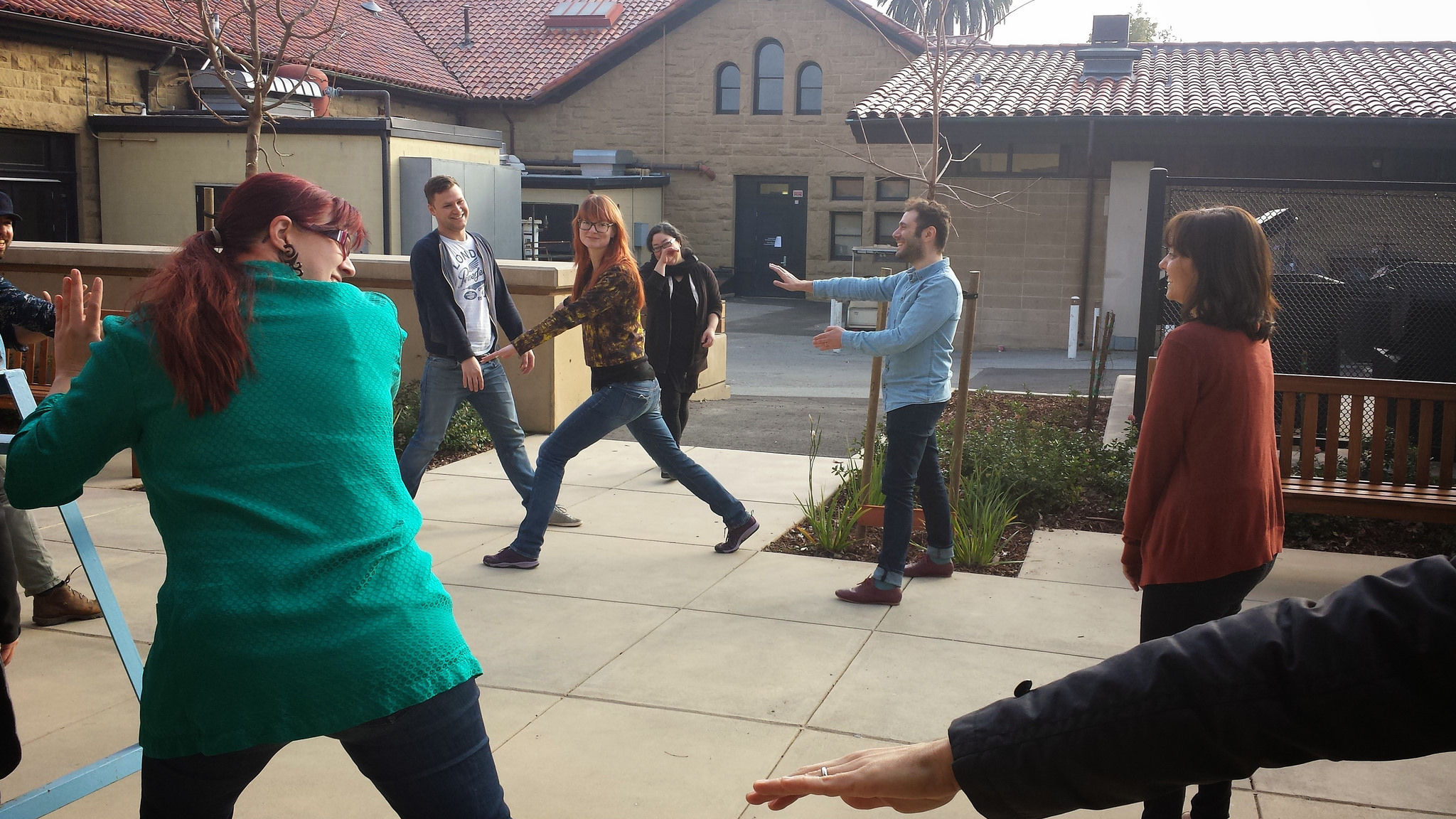
Choose icebreaker activities which are best suited to the group of design thinking participants. You should also take the setting into consideration. This team has chosen a fun, ninja icebreaker game where the goal is to be the last ninja standing!
© Josh & Karen Tanenbaum, CC BY-NC-SA 2.0
Step 3: Get People in the Mood for Creativity
“Creativity is contagious, pass it on.”
—Albert Einstein
You don’t need the surname “Picasso” to be considered creative. Creativity, like intelligence, can be thought of as a trait everyone possesses in some capacity. Many people, however, do not consider themselves as creative due to their upbringing, or because they have a natural affinity towards the more scientific side of things. It is your job to encourage the creative side to emerge from each team member’s personality when you facilitate a design thinking session. The following techniques are ways you can do exactly that!
1. Co-Create a Story
Group storytelling is a great way to get your design thinking team members to relax and enjoy the creative process.
Choose a topic for the story—it could be a completely unrelated story, something familiar to the team or something related to the challenge at hand.
Briefly outline the task and encourage team members to make the story as crazy as possible.
As the facilitator, start the story off with a brief intro.
Take it in turns to move the story around the team in a circle, with each team member adding a sentence or two.
End the story on your second turn, and repeat the game with a different story topic if you feel it appropriate.
A set of story aids like Rory's Story Cubes may help even further, especially with people who are too shy to suggest unconventional storylines or plot twists. The story cubes come with a range of objects, actions and themes which can be mixed and matched to encourage randomized storytelling. It's also an excellent tool to get people in the mood for brainstorming.
2. Visual telephone
The visual telephone is another activity which encourages visualization rather than spoken stories. It’s also a great energizer to get everyone engaged in a conversation about creativity, communication and interpretation.
Give everyone a small piece of paper and a pen.
Ask the first player to draw a simple picture in secret, and then pass it on to the person beside them without anyone else seeing the picture.
The second player takes a look at the image (without showing the rest of the team) and writes down their interpretation of what the image shows.
The next person takes the written explanation (again, without showing anyone) and draws an image to represent the words.
Repeat this method until all team members have either drawn a picture or written an interpretation.
The entire team will then review the end results to find out how each person interpreted the message they received.

The visual telephone (or broken picture telephone) game is a great activity to start conversations around creativity, communication and interpretation. In this example, you can see the characters get completely misidentified by the third player—this is sure to generate some laughs within a team, even if they don’t know each other that well.
© Alishah Novin, Public Domain
Your Team Will Soon Start to See the Benefits of Design Thinking
The structure of design thinking sets the scene to unleash specific, and maybe even previously unknown, qualities within a team. It also enables you to overcome the obstacles innovation teams typically face.
Obstacles to innovation
Fear of failure
Intimidation
Low self-esteem
Hierarchy
Blind spots
Specialization bias
Once you follow the steps outlined here and start to incorporate design thinking into your workflow, you and your team will soon start to see huge benefits, including these:
Greater inclusiveness
Better team cohesion
Higher levels of collaboration and interaction
Increased confidence in creative abilities
The Take Away
You can’t assume all of your team members will naturally fall into the working patterns involved in design thinking. However, you can take steps to help people settle in:
Explain the process of design thinking.
Use icebreaker activities to break any negative tension.
Encourage team members to explore their creative side.
Once you have carried out these steps, your team will start to become more inclusive, cohesive, confident and collaborative—and you’ll be well on your way to the creation of more innovative products and services.
References & Where to Learn more
Mind Tools Content Team, Ice Breakers: Easing Group Contribution, 2016.
Susan M. Heathfield, The 10 Best Icebreaker Activities for Any Work Event, 2018.
Art Markman, Happy People are Creative People, According to Science, 2017.
Dave Gray, Sunni Brown, James Macanufo, Gamestorming: A Playbook for Innovators, Rulebreakers, and Changemakers, 2010.
XPLANE, Gamestorming, 2011.
Images
Hero Image: © holder: LEGO:Public License.