Ethnographic Research

Your constantly-updated definition of Ethnographic Research and collection of videos and articles.
Be a conversation starter: Share this page and inspire others!

492 Shares

What is Ethnographic Research?

Ethnography is a research method that involves immersing oneself in the natural context of individuals to collect qualitative insights into their behavior and culture. This method emphasizes observation, engagement, and analysis of human experiences in real-world settings.

Ethnographic research is widely used in UX design since it provides detailed data about users' preferences and behaviors. This data is used to create products and services that meet the needs of diverse user groups. It also ensures user-centered and culturally sensitive design. Research of this type helps designers comprehend how users interact with technology in a range of settings. It also reveals areas that have the potential for growth.

While ethnographic research has several advantages, there are also some potential drawbacks to consider, even more so when conducting ethnographic research in cross-cultural contexts. It's important for researchers to be aware of their own biases and to approach the culture being studied with respect and sensitivity

Benefits and Limitations of Ethnographic Research

Thanks to its immersive nature, ethnographic research offers several advantages over other qualitative research methods, for example:

  • It enables researchers to understand the cultural context in which their subjects live, work, and interact.

  • It offers crucial insights into the factors that influence how individuals make decisions, act, and perceive their environment.

  • It allows for flexibility in data collection since researchers can adapt their methods as they go along and explore new areas of interest that may emerge during the study.

While ethnography can provide an understanding of human behavior and culture, researchers must be aware of its limitations and possible ethical concerns. Some of the most common challenges associated with ethnographic research include its time-consuming and expensive nature, the difficulty of addressing certain research questions or populations effectively, the potential language barriers, and the challenges to accessing the culture to study.

Still, this method reveals how different cultures operate and interact. For example, a study of workplace culture in Japan might show differences in communication styles or decision-making processes compared to a similar study conducted in the United States.

Ethnographic Research Methods

Ethnographic research is a qualitative research method to study human behavior and societies and culture.

The most common methods of ethnographic research are participant observation and interviews.

Participant Observation: The researcher immerses themselves in the natural environment of the people they study. They observe their behavior firsthand and may even participate in activities alongside them.

Interviews: The researcher conducts interviews with individuals from the culture of interest to understand how they perceive and experience their culture. These interviews can be structured (with a predefined or standardized set of questions) or unstructured (less formal conversations that allow the researcher to explore topics as they arise) and may be conducted one-on-one or in a group setting.

Ann Blandford, expert in qualitative user studies and professor of Human-Computer Interaction at University College London, explains the characteristics of a semi-structured interview:

Transcript

Examples of Ethnographic Research in Various Fields

Ethnographer with workers in a field.

© CIFOR, CC BY-NC-ND 2.0

Ethnographic research has been employed in several fields to understand human behavior and culture better. Here are some examples:

  • Anthropology: Anthropologists have long used ethnographic research to study different cultures worldwide. Margaret Mead is a well-known example of an ethnographic researcher who studied the people of Samoa, revealing important information about their social and cultural practices.

  • Sociology: Sociologists also use ethnographic research to understand social phenomena. For example, Erving Goffman's classic work The Presentation of Self in Everyday Life used participant observation to explore how individuals present themselves to others in everyday interactions.

  • Marketing: Ethnographic research is increasingly being used in marketing to gain insights into consumer behavior. For example, a company may conduct ethnographic research by observing consumers in a natural setting (such as a grocery store) to understand their purchasing decisions and what factors influence those decisions.

  • UX Design: Ethnographic research allows designers to understand their users' habits, mental models and behaviors deeply. For instance, a UX designer working on a travel booking platform might use ethnographic research to investigate how travelers plan and book their trips.

Ethical Considerations in Ethnographic Research

Ethnographic research involves observing individuals in their natural environment, which can raise ethical concerns. It's important for researchers to carefully weigh the risks and benefits of their studies and obtain informed consent from participants.

One fundamental consideration in ethnographic research is privacy. Researchers must take steps to protect the privacy of their subjects.

  • Obtain permission before taking photographs or recording conversations.

  • Be careful not to reveal personal information about subjects that could lead to their identification. 

It’s also important to obtain informed consent from subjects before conducting any study activities. This means that people understand the study's purpose, what will be involved, and any potential risks or benefits. Ensure that any study does not cause harm or distress to subjects, either physically or emotionally. This may involve avoiding sensitive topics or situations that could trigger trauma.

The Role of Technology in Ethnographic Research

Technology has become an increasingly important tool for ethnographic research. Here are a few ways in which researchers use technology in ethnographic research:

  • Digital Recording: One of the most basic ways to use technology in ethnographic research is through digital recording. Researchers can use audio or video recording devices to capture conversations, interactions, and other observations.

  • Online Platforms: Social media is making it easier for researchers to observe and interact with people from all over the world, which can be especially useful when studying cultures that are difficult to access due to geography or political barriers.

  • Mobile Apps: Mobile apps can also be helpful tools for ethnographic research. For example, a researcher could develop an app that allows participants to record their daily activities and thoughts, offering unique perspectives on their behavior and experiences.

  • Virtual Reality: Virtual reality (VR) is another emerging technology with potential ethnographic research applications. VR allows researchers to create immersive environments that simulate real-world situations, allowing participants to interact with simulated objects and people as if they were actually there.

While technology can provide many benefits for ethnographic research, it's important for researchers also to consider its limitations. For example, relying too heavily on digital recordings may prevent researchers from noticing important nonverbal cues or context that may be lost when not observed directly in person. Additionally, some cultures may need more access or knowledge about specific technologies, making it difficult to use them in certain contexts.

Questions About Ethnographic Research?
We've Got Answers!

How does ethnographic research help UX designers understand users?

Ethnographic research helps UX (user experience) designers deeply understand users by observing them in their natural environments. Instead of relying on what users say in interviews, designers watch what they do—how they interact with products, what frustrates them, and what workarounds they invent. This real-world context reveals insights that surveys or usability tests often miss.

For example, a banking app might seem perfect in a lab, but ethnographic research could uncover that users often multitask during their commute. Such insights would highlight the need for simpler navigation and larger touch targets.

Contextual inquiry, a core method in ethnographic research, often uncovers usability problems that structured tests don’t reveal. Designers can use this data to build more intuitive interfaces, prioritize features that solve actual pain points, and connect more genuinely with users’ daily lives.

Watch as CEO of Experience Dynamics, Frank Spillers gives tips about ethnographic research:

Transcript

Take our course, Personas and User Research: Design Products and Services People Need and Want.

How is ethnographic research different from user interviews or surveys?

Ethnographic research differs from user interviews or surveys because it captures what users do, not just what they say. In interviews and surveys, users often describe their behaviors, needs, or frustrations. However, these self-reports can be incomplete or inaccurate. Ethnography avoids this problem by placing designers in the user’s real-world environment to observe behaviors directly.

For example, a user might say they never have trouble using a fitness app. However, ethnographic research might reveal they regularly switch between apps to track workouts, suggesting real usability issues they didn’t articulate.

According to UX researchers, ethnographic methods uncover insights users themselves might not even be aware of, making such methods ideal for early-stage discovery and innovation.

Designers should use interviews and surveys for breadth, but turn to ethnography when they need depth and context.

Watch as CEO of Experience Dynamics, Frank Spillers gives tips about ethnographic research:

Transcript

Take our course, Personas and User Research: Design Products and Services People Need and Want.

What are the key methods used in ethnographic research for UX design?

Ethnographic research in UX uses several key methods to uncover real user behaviors and contexts. The most common is contextual inquiry, where designers observe users while they perform tasks in their natural environment, be it at home, at work, or on the go. Unlike usability testing, this method captures unfiltered behavior and reveals hidden needs.

Grounded theory research, a qualitative method, helps uncover patterns and insights from real user data. Researchers don’t start with assumptions but instead collect and analyze data step by step. They let findings emerge naturally to build a deep and unbiased understanding of user behaviors and needs.

Participant observation is another powerful tool, where researchers embed themselves in users’ routines. An example could be a designer shadowing a nurse during a hospital shift to see how digital tools fit into their workflow.

Field notes, diaries, and photo documentation also play a significant role. These help capture subtle moments that users may forget to mention or find too routine to notice.

Ethnographic research methods tend to reveal issues which interviews alone cannot capture. Users are often too close to what’s going on in their lives that it takes an attentive observer to spot key insights.

Watch as CEO of Experience Dynamics, Frank Spillers gives tips about ethnographic research:

Transcript

Take our course, Personas and User Research: Design Products and Services People Need and Want.

How do I plan and conduct an ethnographic field study?

To plan and conduct an ethnographic field study, start by clearly defining your research goals. Know what you want to learn—such as how users interact with a product in a specific setting. Then choose participants who represent your target users and arrange to observe them in their natural environment, like their home or workplace.

Next, prepare a flexible discussion guide. Focus less on scripted questions and more on key themes to explore. While in the field, use contextual inquiry—watch users perform tasks and ask occasional questions to clarify their actions.

Capture observations with field notes, photos (with consent), and voice memos. Afterwards, analyze the data by identifying patterns, pain points, and workarounds.

Always build trust with participants. They’ll behave more naturally if they feel respected and comfortable, and their authentic behavior can reveal valuable insights.

Watch as Frank Spillers gives tips about ethnographic research:

Transcript

Take our course, Personas and User Research: Design Products and Services People Need and Want.

How do I mix ethnographic research with other UX design methods like usability testing?

Mixing ethnographic research with other UX methods like usability testing gives you both deep context and measurable results. Start with ethnography early in the process. Observe users in their natural environment to discover hidden needs, routines, and pain points. These insights help shape personas, journeys, and design directions.

Once you have a prototype or product, switch to usability testing to evaluate how well your designs solve the real problems ethnography uncovered. Usability testing shows whether users can complete tasks efficiently, while ethnographic research reveals whether those tasks truly matter.

You can also loop back—use insights from testing to revisit the field and see how users adapt over time. Combining both methods ensures your design is not only functional but also fully relevant to real-world use.

Watch as Frank Spillers gives tips about ethnographic research:

Transcript

Take our course, Personas and User Research: Design Products and Services People Need and Want.

How long does ethnographic research usually take?

Ethnographic research usually can take anywhere from a few days to several weeks, depending on the depth of insight you need. Short studies—often called “rapid ethnography”—can last two to five days and still uncover valuable patterns, especially when focusing on specific tasks or environments. These are common in fast-paced product teams.

More traditional ethnographic studies span multiple weeks, allowing researchers to observe behaviors over time. This is ideal for complex systems or when context plays a significant role, like studying how nurses use medical software during an entire shift.

Time also varies based on logistics: recruiting users, gaining access to real environments, and analyzing rich, qualitative data add to the timeline. However, the depth of understanding you get often outweighs the time invested, a point you should mention to business stakeholders if they appear critical about timelines.

Watch as Frank Spillers gives tips about ethnographic research:

Transcript

Take our course, Personas and User Research: Design Products and Services People Need and Want.

How many users should I observe to get good results?

In ethnographic UX research, observing five to ten users often gives rich, actionable insights. However, context matters, so this is a general number to consider. Unlike surveys or usability tests, ethnography focuses on depth, not volume. Watching just a few users in context—as they perform real tasks in real settings—can reveal major pain points, unmet needs, and design opportunities.

Observe a few people in each key group if your users have significantly different roles or environments. Quality matters more than quantity, so watch deeply, take detailed notes, and analyze for recurring behaviors. In ethnographic research, patterns can emerge quickly when focusing on behavior and context.

Watch as Frank Spillers gives tips about ethnographic research:

Transcript

Take our course, Personas and User Research: Design Products and Services People Need and Want.

How do I handle privacy and ethics during ethnographic studies?

To handle privacy and ethics in ethnographic research, start with obtaining informed consent. Always explain the purpose of your study, what you’ll observe, and how you’ll use the data. Get permission in writing and allow participants to opt out at any time without pressure.

Respect their space. Never film or record without participants’ clear approval, and never push for access to private or sensitive activities. Be transparent: tell users when you’re taking notes and why. If you're observing in a shared or public space, make sure others nearby know what’s happening too.

Anonymize all data in your findings. Use pseudonyms, blur identifiable details, and store notes securely. If in doubt, prioritize the participant’s dignity and comfort over your research needs.

Ethical research builds trust and leads to more honest, meaningful insights. It also safeguards participants from embarrassment and other negative outcomes and helps keep researchers from running into privacy violations.

Watch as Frank Spillers gives tips about ethnographic research:

Transcript

Take our course, Personas and User Research: Design Products and Services People Need and Want.

What are some recent or highly cited scientific articles about ethnographic research?

White, P. J., & Devitt, F. (2021). Creating personas from design ethnography and grounded theory. Journal of Usability Studies, 16(3), 156–178.

This peer-reviewed article by White and Devitt (2021) presents a detailed, systematic methodology for creating user personas from ethnographic data using a grounded theory approach. Addressing the lack of methodological rigor in traditional persona creation, the paper outlines a three-phase process: post-fieldwork data management, coding with grounded theory, and data reduction leading to persona design. Using a case study involving older adults (65+), it demonstrates how qualitative analysis can enhance the depth and reliability of personas. The work is significant for UX professionals seeking a research-based persona development process that bridges ethnographic fieldwork and practical design outputs, despite increased time demands.

Pink, S. and Morgan, J. (2013), Short‐Term Ethnography: Intense Routes to Knowing. Symbolic Interaction, 36: 351-361

Short-term ethnography offers an intense, focused approach to ethnographic research that differs qualitatively from traditional long-term ethnography. Rather than viewing it as merely a "quick and dirty" version of longer fieldwork, the authors propose that short-term ethnography creates unique "ethnographic places" through intense research encounters, a sharp focus on detail, ongoing theoretical dialogue, and the use of audiovisual methods. This approach is particularly suited to contemporary research contexts, especially applied research projects designed to lead to real-world interventions.

The authors emphasize that short-term ethnography isn't defined merely by its temporal constraints but by its distinctive qualities and methodological approaches. They argue that this approach produces alternative ways of knowing about people and environments through more interventional methods, creating contexts that reveal what matters to participants. Their example of a six-week healthcare ethnography demonstrates how digital collaboration between researchers in different locations created an intense, ongoing dialogue between theory and practice, allowing them to identify "quiet safety" practices that might have remained invisible in traditional observational research.

What skills do I need to do ethnographic research in UX design?

To succeed in ethnographic research in UX design, you need sharp observational skills and a strong sense of empathy. You must notice subtle behaviors, environments, and patterns that users may not even recognize themselves. Great researchers don’t just watch; they interpret context and connect small actions to larger design needs.

You also need excellent communication and listening skills. Asking open-ended questions at the right moment can reveal the “why” behind a user’s action. Equally important is your ability to stay silent and let the moment unfold naturally.

Cultural sensitivity is vital too. You’re entering someone’s space, so a respectful, patient, and nonjudgmental approach helps you build trust and capture genuine behaviors.

Last, but not least, analytical thinking helps you turn raw observations into actionable insights and patterns that inform design.

Watch as Frank Spillers gives tips about ethnographic research:

Transcript

Take our course, Personas and User Research: Design Products and Services People Need and Want.

Crabtree, A., Rouncefield, M., & Tolmie, P. (2012). Doing Design Ethnography. Springer.

This book specifically bridges ethnographic methods and design processes, making it highly relevant for UX practitioners. The authors provide practical guidance on how to conduct ethnographic research in design contexts, with a focus on understanding users in their natural environments. They explore how to translate ethnographic insights into design requirements and illustrate their points with case studies from real-world projects. The book covers both traditional and innovative research methods, addressing the challenges of conducting ethnography within the time constraints typical of design projects.

Cranz, G. (2016). Ethnography for DesignersEthnography for Designers. Routledge.

This practical guidebook is specifically tailored for designers who want to incorporate ethnographic methods into their work. Cranz provides clear instructions on observation techniques, interviewing methods, and analysis approaches that can be applied to UX and interactive systems design. The book emphasizes how to uncover the tacit, unspoken aspects of user experience that are difficult to capture through more conventional research methods. It's particularly strong in addressing how to identify patterns of behavior and translate qualitative insights into actionable design recommendations.

Earn a Gift Earn a Gift, Answer a Short Quiz!

1
2
3
4
1
2
3
4
Question 1
Question 2
Question 3
Get Your Gift
Interaction Design Foundation logo

Question 1

What is the main purpose of ethnographic research in UX design?

1 point towards your gift

  • To provide detailed insights into user behavior and cultural context
  • To provide large sets of statistical data for various end products
  • To provide lower costs of product development
Interaction Design Foundation logo

Question 2

Which method do designers commonly use to gather data in ethnographic research?

1 point towards your gift

  • Controlled experiments
  • Participant observation
  • Quantitative surveys
Interaction Design Foundation logo

Question 3

What is a common challenge in ethnographic research?

1 point towards your gift

  • Designers can conduct the research quickly and cheaply.
  • Designers limit it to digital interactions only.
  • It may require significant time and resources.

Learn More About Ethnographic Research

Make learning as easy as watching Netflix: Learn more about Ethnographic Research by taking the online IxDF Course Mobile UX Strategy: How to Build Successful Products.

Why? Because design skills make you valuable. In any job. Any industry.

In This Course, You'll

  • Get excited as you create mobile experiences people love! Feel like you're not reaching your potential? This is your moment to grow, feel confident, and accelerate your career. Did you ever download an app, only to delete it almost immediately because it didn't meet your expectations? You're not alone. Apps lose 77% of their daily active users within the first 3 days of installation. In this course, you'll learn how to design apps that fit effortlessly into people's lives, solve real-world problems, and make a lasting impact. You'll build actionable personas and apply proven best practices. You'll learn how to tap into what people want and create an app that delivers with total confidence.

  • Make yourself invaluable when you create mobile experiences that drive adoption and loyalty in any industry. As AI supports new mobile features, timeless human-centered design skills help you decide how those features fit into real mobile contexts, on small screens, and in moments of distraction. That’s what turns AI from a superficial add-on into a real superpower in your day-to-day work. And it's easier than you think! With step-by-step guidance, you'll apply your new Mobile UX Strategy skills straight away. You'll learn how to conduct mobile user research and make data-driven decisions that increase engagement, boost retention, and drive measurable growth. You'll integrate assistive technology and champion accessibility to improve your app's usability for all and expand your market reach. You'll learn how to optimize your content for shorter attention spans and the on-the-go nature of mobile devices.

  • Gain confidence and credibility with practical exercises and ready-to-use templates like the Accessible Design Cheatsheet and 10-Step Guide to Personas. The optional portfolio project helps you walk away with an impressive portfolio. How? You'll learn to redesign a mobile app, and you'll be able to use your portfolio and IxDF course certificate to fast-track your career. You'll get comfortable with frameworks that help you lead mobile UX design initiatives, influence stakeholders, and turn ideas into successful mobile products.

It's Easy to Fast-Track Your Career with the World's Best Experts

Master complex skills effortlessly with proven best practices and toolkits directly from the world's top design experts. Meet your experts for this course:

  • Frank Spillers: Service Designer and Founder and CEO of Experience Dynamics.

  • Alan Dix: Author of the bestselling book “Human-Computer Interaction” and Director of the Computational Foundry at Swansea University.

  • Torrey Podmajersky: Author of “Strategic Writing for UX” and President of Catbird Content, who has designed and executed content strategies for iconic brands like Google, OfferUp, and Microsoft.

Get an Industry-Recognized IxDF Course Certificate

Increase your credibility, salary potential and job opportunities by showing credible evidence of your skills.

IxDF Course Certificates set the industry gold standard. Add them to your LinkedIn profile, resumé, and job applications.

Course Certificate Example

Be in distinguished company, alongside industry leaders who train their teams with the IxDF and trust IxDF Course Certificates.

Our clients: IBM, HP, Adobe, GE, Accenture, Allianz, Phillips, Deezer, Capgemin, Mcafee, SAP, Telenor, Cigna, British Parliament, State of New York

All Free IxDF Articles on Ethnographic Research

Read full article
7 Simple Ways to Get Better Results From Ethnographic Research - Article hero image
Interaction Design Foundation logo

7 Simple Ways to Get Better Results From Ethnographic Research

The first step in any user experience or design thinking process will involve you getting to know your users. The problem is, when you start a project from scratch or move into a new industry, it’s unlikely you’ll have either relevant experience or a deep understanding of your users!This is where et

Social shares
856
Published
Read Article
Read full article
Personas: What They Are and Why They Matter - Article hero image
Interaction Design Foundation logo

Personas: What They Are and Why They Matter

Why do so many products and services fail to meet users' needs? Do we not have the right tools? Or perhaps our users just aren't smart enough for our designs? All wrong! The truth is, the tools used in traditional software development don't cut it if we want to genuinely understand users and design

Social shares
512
Published
Read Article
Read full article
Grounded Theory: Base Findings on Research, Not Preconceptions - Article hero image
Interaction Design Foundation logo

Grounded Theory: Base Findings on Research, Not Preconceptions

Preconceptions and biases are like a faulty compass. Whether they creep in through researchers, project teams, or your organization, they throw your user research off course. Enter grounded theory: a proven social research method that keeps your compass pointing true north. With grounded theory, you

Social shares
444
Published
Read Article
Read full article
How to Get Started with Affinity Diagrams - Article hero image
Interaction Design Foundation logo

How to Get Started with Affinity Diagrams

Affinity diagramming is almost too good to be true. Write on some sticky notes, arrange them, and…that’s it. But don’t let its simplicity fool you. With affinity diagrams in your toolbox, you’ll have the power to bridge the gap between research and results.Begin with Affinity NotesAffinity diagrams

Social shares
473
Published
Read Article

7 Simple Ways to Get Better Results From Ethnographic Research

7 Simple Ways to Get Better Results From Ethnographic Research

The first step in any user experience or design thinking process will involve you getting to know your users. The problem is, when you start a project from scratch or move into a new industry, it’s unlikely you’ll have either relevant experience or a deep understanding of your users!

This is where ethnographic research, such as user observation and interviews, steps in. This type of research will allow you to discover who your users really are, and the environments in which they live. It will provide great insights into the way your users will interact with your product, and therefore allow you to build empathy with their wants and needs. We’ve collected seven simple things you can do to maximize the effectiveness of your ethnographic research—so, whatever research technique you’re about to undertake, make sure you have a read of this first!

When you carry out research, your purpose is not merely to obtain a certain quantity of research data, but also study what comes out of the data, be it broad or deep. As you gather data, you aim to gather the right amount and quality of information to help you extract insights that will inform your future design process. To achieve this, you can gather two types of research data:

  • Quantitative: This type provides a breadth of data and includes tactics such as statistics, demographics, analytics, product metrics, surveys and customer feedback forms.

  • Qualitative: This type provides depth of insight and includes tactics such as exploratory, focus groups, interviews, observations, photo/video journals and photo/video-based user studies.

Quantitative research involves a scientific and statistical approach. It can provide insights into the choices and behaviors that the majority of people make, but it is unable to verify the exact reasons or motivations behind these decisions. Qualitative research, however, attempts to understand the human and social phenomena much more deeply, and on a case-by-case basis.

You’ll have probably realized by now that ethnographic research doesn’t provide you with neat numbers, graphs, and figures (quantitative data, in other words). When you conduct ethnographic research, such as user observations and interviews, you carry out a qualitative process which produces a great deal of unruly, yet deep, data that is hard to summarize. And here lies the challenge: How can you use this data without letting your own biases or assumptions sneak in?

It may be difficult, but it’s certainly not impossible and, with that in mind, we have seven simple ideas that should help you get more out of your ethnographic insights and turn you into the research rockstar you’ve always wanted to be!

1. Curate a Diverse Research Team

When you build your research team, you should ensure the team represents a variety of diverse backgrounds—pick a team who vary in ethnicity, gender, age and discipline. People with a mix of different backgrounds will possess a wide range of capabilities and modes of thinking, and this is useful when you want to interpret the observations and insights gathered by the team. In fact, Margaret Ann Neale, an Adams Distinguished Professor of Management at the Stanford University, found that when you increase diversity in a team, the team performs better. Furthermore, she found that conflicts in opinions between diverse team members would spark greater innovation than those in homogeneous teams. What’s more, you want input from your client, your fellow designers and developers as well as ethnographers when you conduct your research, so make sure your team reflects that!

Along with team diversity, you should also aim for participant diversity. This is particularly important in countries or societies which have a sizable difference between the expectations and roles of different genders, races, etc. You should also consider whether it would be beneficial to interview your extreme users. For instance, instead of only interviewing people who fit into your target audience, you could also interview fervent fans of your brand as well as people who would never use your product.

People wearing masks to show diversity.

It would be a dull world if we were all the same! Luckily for us, this diversity creates powerful problem-solving abilities when combined in a team.

© George A. Spiva Center for the Arts, CC BY 2.0.

2. Consider The Mindsets of Your Subjects

“People who wonder whether the glass is half empty or half full miss the point. The glass is refillable.”

—Unknown

In life, some people perceive the glass as half empty, while others see the glass as half full. On rare occasions, people drink the contents of the glass and then blame it being empty on someone else! Each type of person will experience things in a different way, yet they will still have many things in common—that is why you need to include them all in your research.

You need to delve into individual mindsets to fully understand your users and gain insights that can contribute to your research and design project in general. Don’t assume all members of your target audience see the world through the same lens. Just because two people share the same DNA, live in the same part of the world and speak the same dialect, it doesn’t mean their mindsets or thought processes will be the same. You need to give each one of your research participants the opportunity to express their inner thoughts, feelings and motivations as individuals—that is the only way you will get truly valuable insights.

3. Show People You Care

Good research begins when you develop a relationship with the subject (your participant or user). You need to develop a level of rapport and show some empathy and understanding towards that person. This will make them feel comfortable, and they will then be much more likely to participate in the process and open up about what they truly think, feel and want in regards to your product or idea.

A good example of this is when the International Development Enterprises (iDE) wanted to learn more about smallholder farmer incomes in Ethiopia. As part of the research process, the design team decided to stay overnight in the farmers’ houses, and this dedicated, caring act had huge effects on the insights they gained. One of the farmers was very guarded while they asked him questions on the first day, and only offered up superficial facts about himself. What the farmer hadn’t realized was the team planned to stay with his fellow farmers overnight, and he was shocked to find them still there the next morning! From that point on, his behavior around the team changed and he started to tell them about his long-term plans to improve his life. The design team’s decision to stay overnight showed the farmers the researchers genuinely cared about them and their livelihood, and were there to help the farmers in the long run, rather than offer them short-term handouts.

Farm hands working in the field on a sunny day.

No matter where or with whom you conduct your ethnographic research, you need to show your participants you care. Researchers gained much deeper insights into their users (Ethiopian farmers) when they stayed with them overnight. It showed the farmers they truly cared about their day-to-day lives and were invested in helping them long-term.

© Kristina Stefanova, Public Domain.

When you conduct your own ethnographic research, you should take the time to introduce yourself, explain what’s going to happen and invite questions from your participants from the start. Try to illustrate throughout the process that what the person says or does is of great importance and value to you. Make it clear you care, in other words!

4. Give People the Chance to Explain

As humans, we have a natural tendency to assume we know how and why things are done or said in a certain way. You will have to battle with and overcome this innate pattern of thought if you want to conduct research in an effective way.

“Know thy user, and you are not thy user.”

—Arnie Lund

You need to steer clear of your own guesswork and assumptions, and instead ask people to explain the reasons behind their behavior for themselves. By all means listen to their answers and try to figure out what is not being said—you can even observe their body language for clues. Whatever you do, just don’t assume!

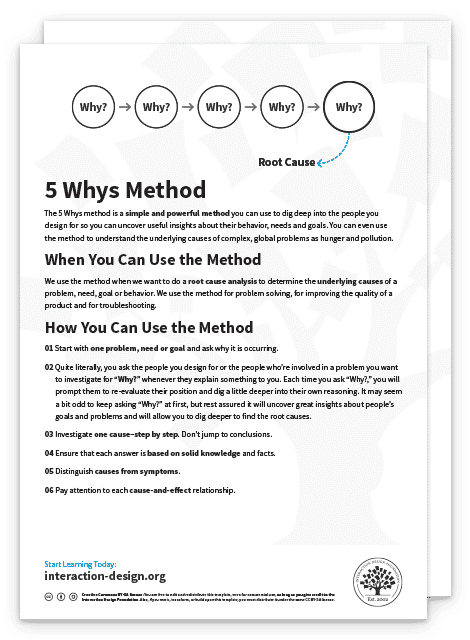
A simple way to let your participants explain for themselves is to use the 5 Whys method. This technique requires you to ask your users “Why?” whenever they explain something to you. Each time you follow up one of their statements with “Why?”, you will prompt them to re-evaluate their position and dig a little deeper into their own reasoning and behavior. Ask your users “Why” even if you think you already know the answer—their reason might surprise you!

Learn more about the 5 Whys method in our template:

Advance Your Career With This Free Template for “5 Whys Method”
5 Whys Method
We respect your privacy
Get 1 powerful email each week: Design a life you love!

The 5 Whys Method requires you to keep asking “Why?” until you get to the root cause of why your users behave in a certain way, or feel a specific emotion. Don’t ever feel like you ask why too many times—as long as you’re still getting answers, keep prompting your users to dig into their reasoning and behaviors!

© Teo Yu Siang and the Interaction Design Foundation, CC BY-NC-SA 3.0.

5. Keep an Eye on the Physical Context

The user experience of a product or service isn’t just about a person’s preferences. It’s also about the environment in which they use the product. What’s around your users as they use the product? Are there obstacles present as they perform their tasks? If your users wear thick rubber gloves for the majority of their working day for example, it should be no surprise when your sophisticated touch-screen interface is not received as well as you’d hoped!

Whenever you conduct ethnographic research, make sure to record the sessions through video, audio or photographs (or all three!). Just make sure to get consent from your participants first! This means you can then go back and look at things such as body language and environmental interactions to help you understand why your participants gave a certain response. When you document your research sessions in this way, you can also return to it time and time again to look for clues about what might affect how people use your product or service.

One woman interviewing another and taking notes.

You should record all your ethnographic research sessions (with your participants’ consent of course). This will provide you with more research material to analyze and digest for contextual clues about how users perceive and make use of your product in their daily lives.

© Wavebreakmedia, Standard License. Source.

6. Don’t Start with Solutions in Mind

You’ll find that bias will creep into your research very easily if you start the design process with solutions in mind. These premature design ideas will guide your research questions, observations and understanding in the direction you want rather than in the direction your users want. And the worst thing is, you may not even realize you’re doing it! As the great Sherlock Holmes (or rather, Sir Arthur Conan Doyle) once quipped:

“It is a capital mistake to theorize before you have all the evidence. It biases the judgment.”

– Sherlock Holmes, A Study in Scarlet (1887)

It is much better to conduct research with a fresh and open mind and only once the research phase is complete, should you start to use the data you’ve obtained to develop solutions. This doesn’t mean you can’t introduce solutions in ethnographic research (user testing is important, after all) but it does mean you should introduce those ideas at an appropriate time—i.e. once you’ve had a chance to observe your users without bias. Always keep in mind the first step in any user experience, human-centered or design thinking process is to get to know your users. Solutions come later!

7. Map Your Insights and Check for Objectivity

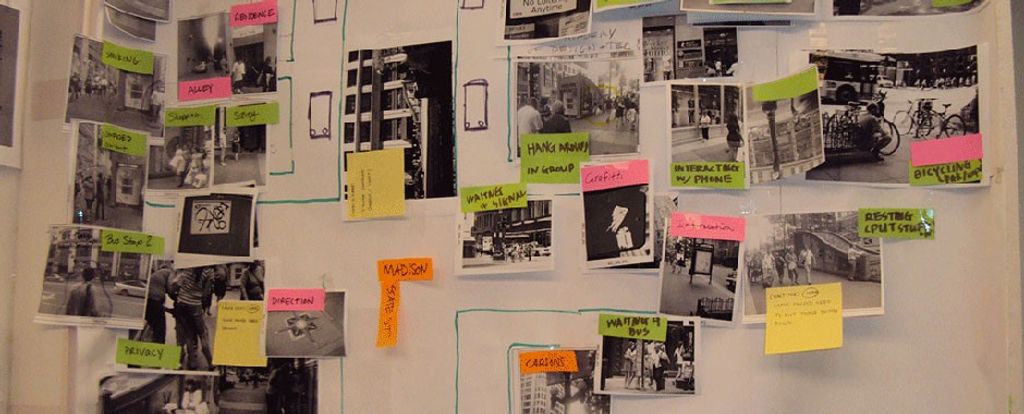
When you analyze your research, it’s a good idea for everyone to generate ideas separately at first. If you write these ideas on Post-It notes, you can then come together, stick all your ideas on a wall and examine them as a team for common ideas.

Affinity diagrams are a great way to make sense of your information when you have a lot of mixed data, such as facts, ethnographic research, ideas from brainstorms, user opinions, user needs, insights and design issues. You can employ this method either as a team or as an individual—whichever way you do it, it will help you define the problem(s) and develop potential ideas for solutions.

You can learn more about the affinity diagrams method in our template:

Advance Your Career With This Free Template for “Affinity Diagrams”
Affinity Diagrams
We respect your privacy
Get 1 powerful email each week: Design a life you love!

You want your solutions to come from this review process, so don’t be afraid to undertake it multiple times, and with different participants. And remember, while all interpretations as to why people behaved the way they did are subjective, they should be based on objective facts and observations. Don’t let your opinions and assumptions get in the way!

Index cards posted to a wall.

Affinity or infinity? Don’t worry if your affinity diagram starts to take up a whole wall in your home or office—as long as you follow the process, you will still come out with actionable insights and design ideas.

© Josh Evnin, CC BY-SA 2.0.

The Take Away

Ethnographic research should be the starting point for any user experience or design thinking process because it makes it human-centered from the outset. It’s important to focus on and empathize with the people you design for, show them how much you care and truly listen to and understand them.

You need to be aware of potential sources of bias and take care to eliminate them, and one way to achieve this is to create as diverse a research team as possible. Keep the seven simple methods discussed in this article in mind and you’ll enhance your ethnographic research, maximize what you learn from your users and gain useful insights that will inspire the rest of the design process.

References & Where to Learn More

Christy Harper, Best practices for ethnographic research, lessons learned in the wild, 2018.


Stanford Graduate School of Business, Diverse Backgrounds and Personalities Can Strengthen Groups, 2006.

Images

Hero Image: © Unknown, Fair-Use.

Feel Stuck?
Want Better Job Options?

AI is replacing jobs everywhere, yet design jobs are booming with a projected 45% job growth. With design skills, you can create products and services people love. More love means more impact and greater salary potential.

At IxDF, we help you from your first course to your next job, all in one place.

See How Design Skills Turn Into Job Options
Privacy Settings
By using this site, you accept our Cookie Policy and Terms of Use.
Customize
Accept all

Be the One Who Inspires

People remember who shares great ideas.

Share on:

Academic Credibility — On Autopilot

Don't waste time googling citation formats. Just copy, paste and look legit in seconds.