The first step in any user experience or design thinking process will involve you getting to know your users. The problem is, when you start a project from scratch or move into a new industry, it’s unlikely you’ll have either relevant experience or a deep understanding of your users!
This is where ethnographic research, such as user observation and interviews, steps in. This type of research will allow you to discover who your users really are, and the environments in which they live. It will provide great insights into the way your users will interact with your product, and therefore allow you to build empathy with their wants and needs. We’ve collected seven simple things you can do to maximize the effectiveness of your ethnographic research—so, whatever research technique you’re about to undertake, make sure you have a read of this first!

When you carry out research, your purpose is not merely to obtain a certain quantity of research data, but also study what comes out of the data, be it broad or deep. As you gather data, you aim to gather the right amount and quality of information to help you extract insights that will inform your future design process. To achieve this, you can gather two types of research data:
Quantitative: This type provides a breadth of data and includes tactics such as statistics, demographics, analytics, product metrics, surveys and customer feedback forms.
Qualitative: This type provides depth of insight and includes tactics such as exploratory, focus groups, interviews, observations, photo/video journals and photo/video-based user studies.
Quantitative research involves a scientific and statistical approach. It can provide insights into the choices and behaviors that the majority of people make, but it is unable to verify the exact reasons or motivations behind these decisions. Qualitative research, however, attempts to understand the human and social phenomena much more deeply, and on a case-by-case basis.
You’ll have probably realized by now that ethnographic research doesn’t provide you with neat numbers, graphs, and figures (quantitative data, in other words). When you conduct ethnographic research, such as user observations and interviews, you carry out a qualitative process which produces a great deal of unruly, yet deep, data that is hard to summarize. And here lies the challenge: How can you use this data without letting your own biases or assumptions sneak in?
It may be difficult, but it’s certainly not impossible and, with that in mind, we have seven simple ideas that should help you get more out of your ethnographic insights and turn you into the research rockstar you’ve always wanted to be!
1. Curate a Diverse Research Team
When you build your research team, you should ensure the team represents a variety of diverse backgrounds—pick a team who vary in ethnicity, gender, age and discipline. People with a mix of different backgrounds will possess a wide range of capabilities and modes of thinking, and this is useful when you want to interpret the observations and insights gathered by the team. In fact, Margaret Ann Neale, an Adams Distinguished Professor of Management at the Stanford University, found that when you increase diversity in a team, the team performs better. Furthermore, she found that conflicts in opinions between diverse team members would spark greater innovation than those in homogeneous teams. What’s more, you want input from your client, your fellow designers and developers as well as ethnographers when you conduct your research, so make sure your team reflects that!
Along with team diversity, you should also aim for participant diversity. This is particularly important in countries or societies which have a sizable difference between the expectations and roles of different genders, races, etc. You should also consider whether it would be beneficial to interview your extreme users. For instance, instead of only interviewing people who fit into your target audience, you could also interview fervent fans of your brand as well as people who would never use your product.

It would be a dull world if we were all the same! Luckily for us, this diversity creates powerful problem-solving abilities when combined in a team.
© George A. Spiva Center for the Arts, CC BY 2.0.
2. Consider The Mindsets of Your Subjects
“People who wonder whether the glass is half empty or half full miss the point. The glass is refillable.”
—Unknown
In life, some people perceive the glass as half empty, while others see the glass as half full. On rare occasions, people drink the contents of the glass and then blame it being empty on someone else! Each type of person will experience things in a different way, yet they will still have many things in common—that is why you need to include them all in your research.
You need to delve into individual mindsets to fully understand your users and gain insights that can contribute to your research and design project in general. Don’t assume all members of your target audience see the world through the same lens. Just because two people share the same DNA, live in the same part of the world and speak the same dialect, it doesn’t mean their mindsets or thought processes will be the same. You need to give each one of your research participants the opportunity to express their inner thoughts, feelings and motivations as individuals—that is the only way you will get truly valuable insights.
3. Show People You Care
Good research begins when you develop a relationship with the subject (your participant or user). You need to develop a level of rapport and show some empathy and understanding towards that person. This will make them feel comfortable, and they will then be much more likely to participate in the process and open up about what they truly think, feel and want in regards to your product or idea.
A good example of this is when the International Development Enterprises (iDE) wanted to learn more about smallholder farmer incomes in Ethiopia. As part of the research process, the design team decided to stay overnight in the farmers’ houses, and this dedicated, caring act had huge effects on the insights they gained. One of the farmers was very guarded while they asked him questions on the first day, and only offered up superficial facts about himself. What the farmer hadn’t realized was the team planned to stay with his fellow farmers overnight, and he was shocked to find them still there the next morning! From that point on, his behavior around the team changed and he started to tell them about his long-term plans to improve his life. The design team’s decision to stay overnight showed the farmers the researchers genuinely cared about them and their livelihood, and were there to help the farmers in the long run, rather than offer them short-term handouts.

No matter where or with whom you conduct your ethnographic research, you need to show your participants you care. Researchers gained much deeper insights into their users (Ethiopian farmers) when they stayed with them overnight. It showed the farmers they truly cared about their day-to-day lives and were invested in helping them long-term.
© Kristina Stefanova, Public Domain.
When you conduct your own ethnographic research, you should take the time to introduce yourself, explain what’s going to happen and invite questions from your participants from the start. Try to illustrate throughout the process that what the person says or does is of great importance and value to you. Make it clear you care, in other words!
4. Give People the Chance to Explain
As humans, we have a natural tendency to assume we know how and why things are done or said in a certain way. You will have to battle with and overcome this innate pattern of thought if you want to conduct research in an effective way.
“Know thy user, and you are not thy user.”
—Arnie Lund
You need to steer clear of your own guesswork and assumptions, and instead ask people to explain the reasons behind their behavior for themselves. By all means listen to their answers and try to figure out what is not being said—you can even observe their body language for clues. Whatever you do, just don’t assume!
A simple way to let your participants explain for themselves is to use the 5 Whys method. This technique requires you to ask your users “Why?” whenever they explain something to you. Each time you follow up one of their statements with “Why?”, you will prompt them to re-evaluate their position and dig a little deeper into their own reasoning and behavior. Ask your users “Why” even if you think you already know the answer—their reason might surprise you!
Learn more about the 5 Whys method in our template:
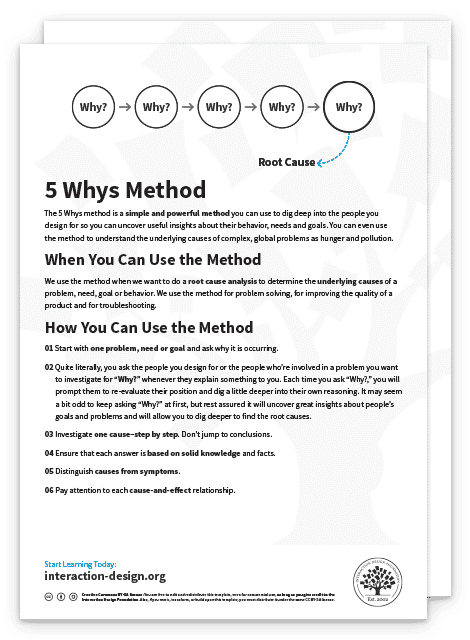
The 5 Whys Method requires you to keep asking “Why?” until you get to the root cause of why your users behave in a certain way, or feel a specific emotion. Don’t ever feel like you ask why too many times—as long as you’re still getting answers, keep prompting your users to dig into their reasoning and behaviors!
© Teo Yu Siang and the Interaction Design Foundation, CC BY-NC-SA 3.0.
5. Keep an Eye on the Physical Context
The user experience of a product or service isn’t just about a person’s preferences. It’s also about the environment in which they use the product. What’s around your users as they use the product? Are there obstacles present as they perform their tasks? If your users wear thick rubber gloves for the majority of their working day for example, it should be no surprise when your sophisticated touch-screen interface is not received as well as you’d hoped!
Whenever you conduct ethnographic research, make sure to record the sessions through video, audio or photographs (or all three!). Just make sure to get consent from your participants first! This means you can then go back and look at things such as body language and environmental interactions to help you understand why your participants gave a certain response. When you document your research sessions in this way, you can also return to it time and time again to look for clues about what might affect how people use your product or service.

You should record all your ethnographic research sessions (with your participants’ consent of course). This will provide you with more research material to analyze and digest for contextual clues about how users perceive and make use of your product in their daily lives.
© Wavebreakmedia, Standard License. Source.
6. Don’t Start with Solutions in Mind
You’ll find that bias will creep into your research very easily if you start the design process with solutions in mind. These premature design ideas will guide your research questions, observations and understanding in the direction you want rather than in the direction your users want. And the worst thing is, you may not even realize you’re doing it! As the great Sherlock Holmes (or rather, Sir Arthur Conan Doyle) once quipped:
“It is a capital mistake to theorize before you have all the evidence. It biases the judgment.”
– Sherlock Holmes, A Study in Scarlet (1887)
It is much better to conduct research with a fresh and open mind and only once the research phase is complete, should you start to use the data you’ve obtained to develop solutions. This doesn’t mean you can’t introduce solutions in ethnographic research (user testing is important, after all) but it does mean you should introduce those ideas at an appropriate time—i.e. once you’ve had a chance to observe your users without bias. Always keep in mind the first step in any user experience, human-centered or design thinking process is to get to know your users. Solutions come later!
7. Map Your Insights and Check for Objectivity
When you analyze your research, it’s a good idea for everyone to generate ideas separately at first. If you write these ideas on Post-It notes, you can then come together, stick all your ideas on a wall and examine them as a team for common ideas.
Affinity diagrams are a great way to make sense of your information when you have a lot of mixed data, such as facts, ethnographic research, ideas from brainstorms, user opinions, user needs, insights and design issues. You can employ this method either as a team or as an individual—whichever way you do it, it will help you define the problem(s) and develop potential ideas for solutions.
You can learn more about the affinity diagrams method in our template:

You want your solutions to come from this review process, so don’t be afraid to undertake it multiple times, and with different participants. And remember, while all interpretations as to why people behaved the way they did are subjective, they should be based on objective facts and observations. Don’t let your opinions and assumptions get in the way!

Affinity or infinity? Don’t worry if your affinity diagram starts to take up a whole wall in your home or office—as long as you follow the process, you will still come out with actionable insights and design ideas.
© Josh Evnin, CC BY-SA 2.0.
The Take Away
Ethnographic research should be the starting point for any user experience or design thinking process because it makes it human-centered from the outset. It’s important to focus on and empathize with the people you design for, show them how much you care and truly listen to and understand them.
You need to be aware of potential sources of bias and take care to eliminate them, and one way to achieve this is to create as diverse a research team as possible. Keep the seven simple methods discussed in this article in mind and you’ll enhance your ethnographic research, maximize what you learn from your users and gain useful insights that will inspire the rest of the design process.
References & Where to Learn More
Christy Harper, Best practices for ethnographic research, lessons learned in the wild, 2018.
Stanford Graduate School of Business, Diverse Backgrounds and Personalities Can Strengthen Groups, 2006.
Images
Hero Image: © Unknown, Fair-Use.