Preconceptions and biases are like a faulty compass. Whether they creep in through researchers, project teams, or your organization, they throw your user research off course. Enter grounded theory: a proven social research method that keeps your compass pointing true north. With grounded theory, you’ll build solutions that address real problems for your users—not those you’ve imagined.
Grounded theory is a qualitative research methodology we use to develop a theory that is "grounded" in the real world. In this video, William Hudson, User Experience Strategist and Founder of Syntagm Ltd, explains grounded theory.
Grounded theory differs from other research methods because it doesn’t start with a fixed hypothesis or framework; instead, insights emerge naturally from observation and participant interviews. Unlike surveys or usability testing, which we use to validate predefined assumptions, grounded theory helps us uncover unexpected patterns and deeper motivations by continuously analyzing and refining data.
Beyond Preconceptions: Use Grounded Theory to Avoid Bias in User Research
Grounded theory not only combats preconceptions—it is an effective tool against bias, which takes many forms and can occur at almost any stage of research.
Many types of bias exist, but these six are particularly relevant in user research:
Availability bias: Research results become skewed because the available participants lack the required background. This can happen when participants exaggerate their experience, especially if the screening questionnaire is poorly designed. Availability bias can also happen when organizations prefer to use their existing customers for research.
Confirmation bias: Researchers accept positive feedback but downplay or ignore negative feedback.
Cultural bias: Results are colored by researchers' cultural beliefs or attitudes.
Framing effect: The wording of a question is not neutral, and responses tend toward an answer suggested in the question. For example, "How difficult do you find the checkout process?" implies that difficulty is expected. "How easy or difficult" would be a neutral wording.
Hawthorne effect: People change their behavior when they know they’re being watched. Participants may provide overly cautious or insincere answers in these scenarios.
Social desirability bias: Respondents' answers will tend towards more socially acceptable norms. This is why, in market research, figures for toothpaste usage usually exceed toothpaste manufactured! Respondents exaggerate the socially desirable habit of cleaning their teeth. For example, respondents may claim, “I know I should brush twice daily,” even if their actual habits differ. The inverse happens with smoking and alcohol consumption.
Fortunately, you can more easily avoid bias when you ask open-ended questions. These typically take the form of “What are…” or “How do you…” Here are some examples:
How do you usually plan your day?
How do you decide what products or services to buy online?
How do you measure progress or success in your work or personal projects?
How do you cope with stress or frustration?
How do you learn new skills or information?
What are some goals or challenges in your current role or situation?
What are some of the features or benefits that you look for in a product or service?
What are some of the sources or influences that shape your opinions or decisions?
What frustrations or pain points do you encounter when using a product or service?
What are some of the things that motivate or inspire you?
Naturally, it is still possible to introduce bias into questions like these. However, you do not prepare these questions in advance. They form part of a more natural dialogue between the researcher and participants.
How to Get Started with Grounded Theory
The grounded theory approach begins with a research question. In persona development, for example, the research question focuses on key aspects of the problem domain. The question should be:
Broad enough to include the primary user needs, behaviors, and peripheral issues that you may decide to address in your solution.
Not overly broad, as this would require an excessive research effort.
Here’s an example of a well-balanced research question for a fitness app aimed at busy professionals:
"What are the primary health and fitness challenges that busy professionals face balancing exercise with work and personal life?"
This question is broad enough because it allows you to explore:
Key user needs like time management and exercise preferences.
Behaviors, such as workout routines, frequency, and time.
Related issues like diet, stress, or sleep.
At the same time, it remains focused. The question doesn’t require you to research every possible factor about users’ health or professional lives, which would make the research effort too large.
Step-by-Step Guide to the Stages of Grounded Theory
Grounded theory consists of several key stages. However, in many situations—especially when time and budget are limited—you can take a streamlined yet effective approach. This approach alternates between rounds of data collection and data analysis:
In grounded theory, data analysis is an ongoing activity where you categorize your research findings. Grounded theory uses a simple approach called “open coding,” where you categorize findings after each research session.
When further research no longer produces new categories, you have reached "saturation." At this stage, additional research is unlikely to provide new insights as long as you've included participants with a good range of perspectives.
Therefore, an example process looks like this:
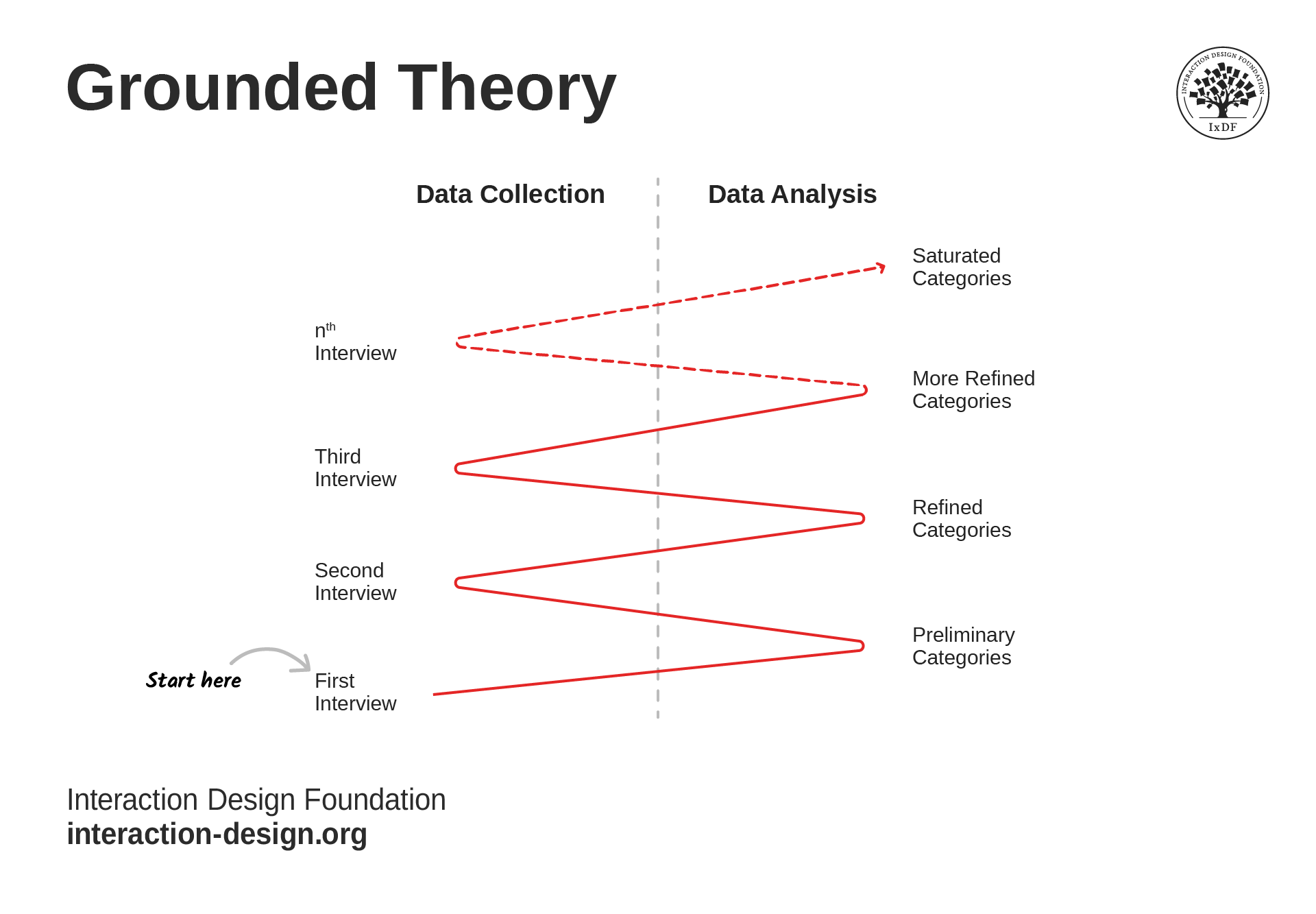
Grounded theory cycles between data collection and analysis to ensure insights shape ongoing research. This iterative approach uncovers patterns, improves our understanding, and adapts the focus of the research accordingly. Grounded theory leads to user-centered solutions based on real behaviors, motivations, and challenges.
© John Creswell (Educational Research), Fair use
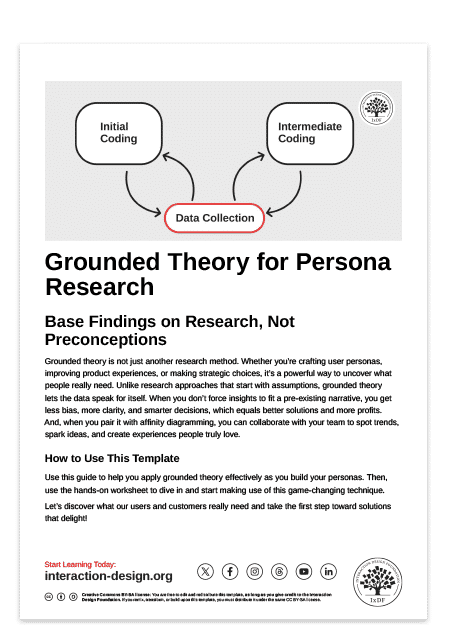
Download this handy template to help you implement grounded theory in your research. It contains more detail on the grounded theory process and a worksheet to plan and keep track of your research.
The Take Away
Grounded theory gives you a structured approach to user research and helps you avoid preconceptions and biases. It helps you design solutions that address the real problems your users have, not those you make up. In grounded theory, you:
Ask general, open-ended questions.
Alternate data collection with analysis and coding.
Use “open coding” to categorize your discoveries and develop a big picture of your users’ needs.
Identify gaps in the big picture where you need more data.
Conclude your research when you reach “saturation” and can identify no further gaps.
If you let your research guide you (rather than the other way around), you'll make more impactful discoveries and gain the deep user understanding you need to create meaningful, delightful solutions.
References and Where to Learn More
Read more about grounded theory in user research in our article, Grounded Theory.
Build a solid foundation in grounded theory with Cathy Urquhart’s easy-to-understand book, Grounded Theory for Qualitative Research: A Practical Guide.
Discover grounded theory from its co-creator, Anselm Strauss, in his book with Juliet Corbin, Basics of Qualitative Research: Grounded Theory Procedures and Techniques.
Get Philip Cleave’s top tips on How to Reduce Social Desirability Bias.
Learn more about the Hawthorne Effect in our article, Light up Your User Research – Understanding the Hawthorne Effect.
Find out how to avoid confirmation bias in our article, Confirmation Bias – It’s Not What We Think We Know That Counts.
Hero image: © Interaction Design Foundation, CC BY-SA 4.0