A woman in the supermarket.

Personas: What They Are and Why They Matter

by William Hudson • 17 min read

512 Shares

Why do so many products and services fail to meet users' needs? Do we not have the right tools? Or perhaps our users just aren't smart enough for our designs? All wrong! The truth is, the tools used in traditional software development don't cut it if we want to genuinely understand users and design for them. The solution lies in personas, and you'll discover why below.

What are Personas?

“Personas represent the needs and behaviors of a subset of users your product aims to delight.”

- William Hudson, User Experience Strategist and Founder of Syntagm Ltd

The optimal design does exist—just not how you might think. We’re all unique individuals with vastly different goals, behaviors, motivations, preferences—the list goes on. If you try to design for everyone, you will create a mediocre solution at best.

Instead, you must focus on a subset of people—of users—and create the optimal design for them. If you can delight these users, then you will succeed. So, how do you focus on them? With personas.

A persona distills a collection of users with similar needs and behaviors into a fictional character whom we consider a real person. It is a research-backed reminder of who you are designing for—it keeps you on track and ensures you take a user-centered approach. When you use personas in your team or organization, you align around a common understanding of your users and make informed decisions throughout the design process.
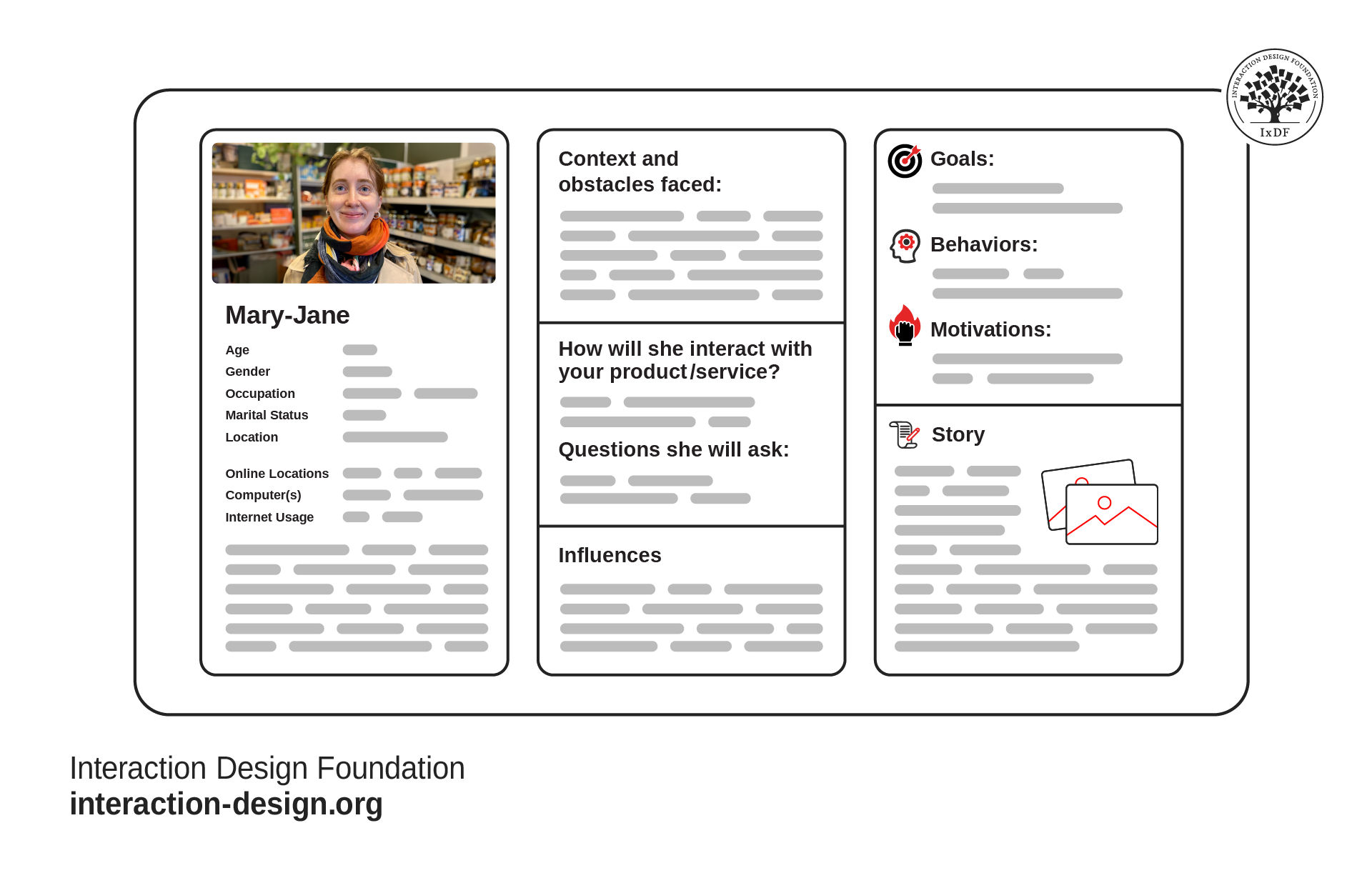
A persona template including demographics, context and obstacles faced, how the personas will interact with the product, questions they will ask, influences, goals, behaviors, motivations, and story.

You will typically represent personas on a one-page document that contains all the information you need to design for them. In addition to their behavioral profile, personas should feel like real people and include a picture, a name, and demographics.

© Interaction Design Foundation, CC BY-SA 4.0

Here’s Why Design Without Personas Falls Short

In this video, William explains why personas are essential for putting users at the center of our processes.

Transcript

Designing without personas is like navigating without a map—you might get somewhere, but it’s unlikely to be where your users need you to go. Personas are more than profiles; they’re the lens through which we understand user motivations, challenges, and goals. When faced with countless interesting features, we use personas to determine which ones best align with user interests and motivations.
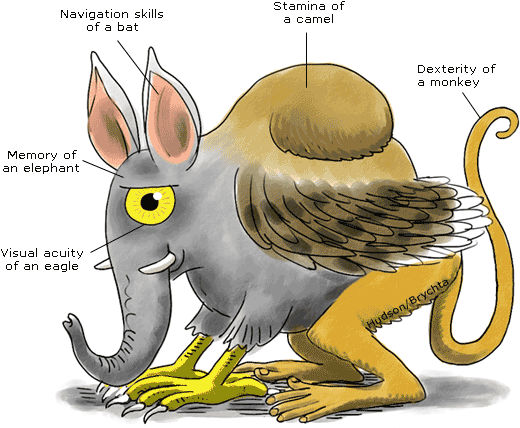
Illustration of an imaginary creature with the visual acuity of an eagle, the memory of an elephant, the navigation skills of a bat, the stamina of a camel, and the dexterity of a monkey.

Some development teams mistakenly believe that users can handle anything they throw at them. This approach results in solutions built for the “Perfect User,” pictured above. This hybrid is a super-user who simply does not exist.

© William Hudson, used with permission

Without Context, User Needs Are Just Assumptions

In this video, William explains why project teams need to understand the whole user journey to build effective solutions for users.

Transcript

Without the big picture, team members approach each small part of a problem with their own understandings and assumptions. If each team member designs for users they assume, rather than truly understand, the final product or service will be disjointed and fail to meet user needs. User research and personas help prevent this issue.
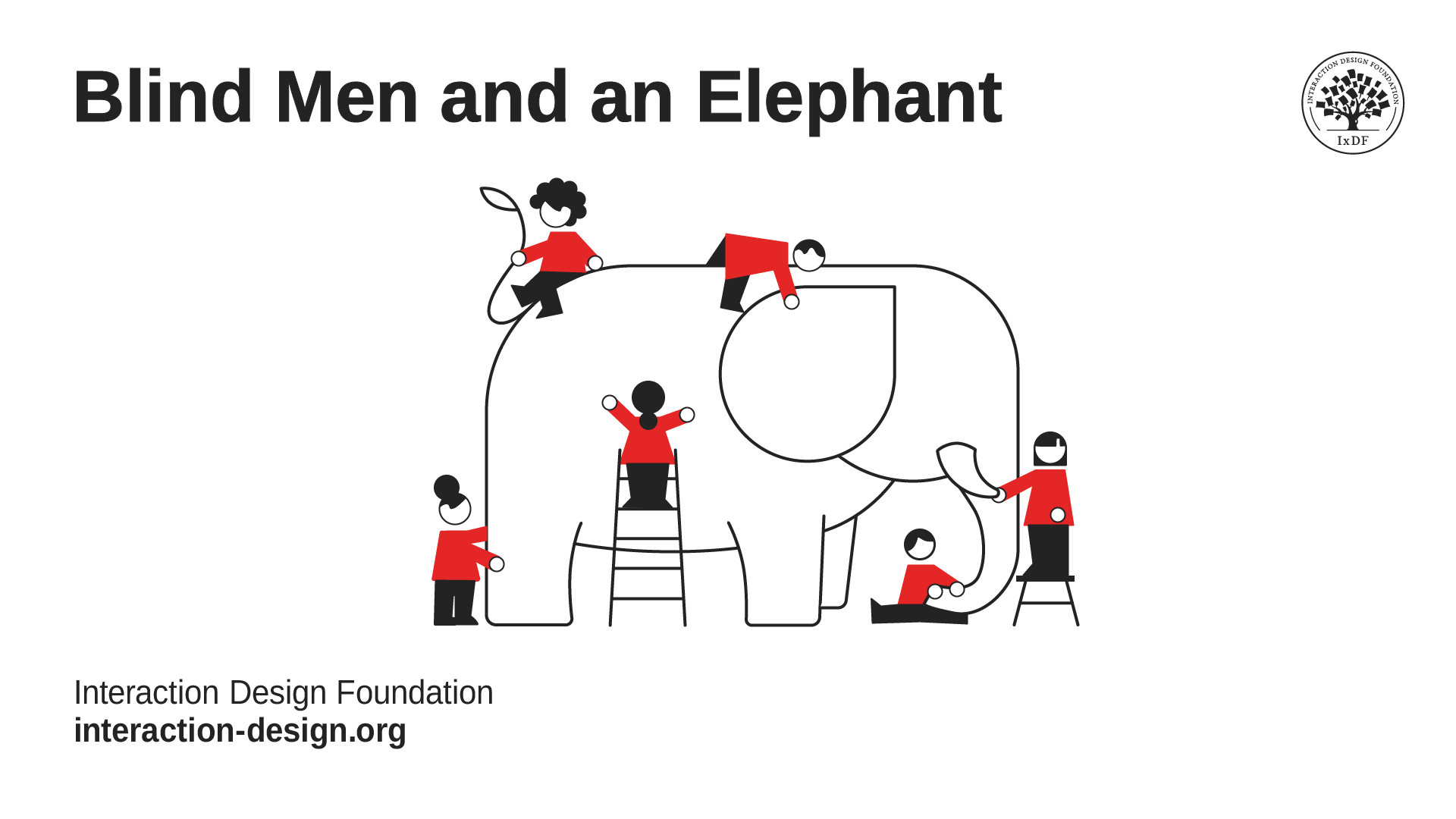
Illustration of six people investigating an elephant. One touching the tusk, one the trunk, one the ear, one the flank, one the tail, and one the lag.

The Indian parable of the Blind Men and the Elephant is a perfect illustration of what happens when a project team lacks sufficient user understanding. In the story, each man investigates an individual part of an elephant. One man believes the elephant's trunk is a snake, while another thinks the leg is a tree.

© Interaction Design Foundation, CC BY-SA 4.0

The Take Away

Personas represent a subset of your users whom you aim to delight. They are the north star that guides you towards user-centered results. When you use personas, you:

  • Get a constant reminder of who you’re designing for and their needs and behaviors.

  • Give focus to the development process, especially in situations where user-centered design is not practiced.

  • Improve the awareness of users within your team and organization.

  • Contextualize your users’ journeys to minimize misunderstandings about them.

This is just the beginning of how personas can transform your design process. If you’ve never used them before, you’ll wish you’d started sooner!

References and Where to Learn More

Read Alan Cooper’s book, The Inmates Are Running the Asylum, to discover why many solutions struggle to meet user needs.

Explore our definitive topic definition of User-Centered Design.

Hero image: © Interaction Design Foundation, CC BY-SA 4.0

Learn More in This Course:

Design for the 21st Century with Don Norman

8 days
35 % booked
View Course

What You Should Read Next

  • Read full article
    A Simple Introduction to Lean UX - Article hero image
    Interaction Design Foundation logo

    A Simple Introduction to Lean UX

    Lean UX is an incredibly useful technique when working on projects where the Agile development method is used. Traditional UX techniques often don’t work when development is conducted in rapid bursts – there’s not enough time to deliver UX in the same way. Fundamentally Lean UX and other forms of UX

    Social shares
    1.3k
    Published
    Read Article
  • Read full article
    How to Do a Thematic Analysis of User Interviews - Article hero image
    Interaction Design Foundation logo

    How to Do a Thematic Analysis of User Interviews

    You have been in the field talking to users and you now find yourself with a massive amount of audio, notes, video, pictures, and interesting impressions. All that information can be overwhelming, and it’s difficult to know where to start to make sense of all the data. Here, we will teach you how to

    Social shares
    1.3k
    Published
    Read Article
  • Read full article
    How to Conduct User Interviews - Article hero image
    Interaction Design Foundation logo

    How to Conduct User Interviews

    You may have noticed in life that few (if any!) people think like you do. So there’s absolutely no reason for you to think your users think like you either! You need to go out and meet your users if you want to properly understand and design for them, and user interviews are a great way to achieve t

    Social shares
    1.3k
    Published
    Read Article
  • Read full article
    14 UX Deliverables: What will I be making as a UX designer? - Article hero image
    Interaction Design Foundation logo

    14 UX Deliverables: What will I be making as a UX designer?

    What does a UX designer actually produce? Here, we will explore the concept of UX deliverables, a term that describes the outputs of a UX design process during its various stages. The deliverables produced by UX designers vary according to their role in the design team and also depending on the meth

    Social shares
    1.2k
    Published
    Read Article
  • Read full article
    Data Analysis: Techniques, Tools, and Processes - Article hero image
    Interaction Design Foundation logo

    Data Analysis: Techniques, Tools, and Processes

    Data analysis is one of those terms that “is what it sounds like,” although there’s more to it than may meet the eye. In any case, it’s a valuable skill for making better decisions—a skill that you can bring to bear on both your professional and personal life, from personal budgeting to analyzing cu

    Social shares
    1.2k
    Published
    Read Article
  • Read full article
    7 Great, Tried and Tested UX Research Techniques - Article hero image
    Interaction Design Foundation logo

    7 Great, Tried and Tested UX Research Techniques

    Thinking about conducting some user research? Wondering which techniques are most likely to provide useful results? Then look no further. We’ve compiled a list of 7 excellent techniques which are tried and tested and have been proven to deliver real value in UX projects. Let’s take a look at each te

    Social shares
    1.2k
    Published
    Read Article
  • Read full article
    UX Roles: The Ultimate Guide – Who Does What and Which One You Should Go For? - Article hero image
    Interaction Design Foundation logo

    UX Roles: The Ultimate Guide – Who Does What and Which One You Should Go For?

    Do you have the ambition and enthusiasm for a career in UX design but don’t know where to start? You’ll be pleased to know there are many paths you can take. Even as a relatively new field, user experience (UX) design has both general and specialist job roles. This variety means there is a role wait

    Social shares
    1.2k
    Published
    Read Article
  • Read full article
    User Research: What It Is and Why You Should Do It - Article hero image
    Interaction Design Foundation logo

    User Research: What It Is and Why You Should Do It

    User research is an essential part of UX design. Unless we understand who we are designing for and why, how can we even know what to create or where to begin? Depending on your project, requirements and constraints, you can choose different types of research methods, from surveys and tests to interv

    Social shares
    1.1k
    Published
    Read Article
  • Read full article
    Minimum Viable Product (MVP) and Design - Balancing Risk to Gain Reward - Article hero image
    Interaction Design Foundation logo

    Minimum Viable Product (MVP) and Design - Balancing Risk to Gain Reward

    The idea of the minimum viable product (MVP) has been around for some time. The term itself was coined by Frank Robinson but was made popular by two influential names in product design – Steve Blank, a serial-entrepreneur and academic, and Eric Ries, the pioneer of the Lean Startup movement.What is

    Social shares
    1.1k
    Published
    Read Article
  • Read full article
    How to Conduct User Observations - Article hero image
    Interaction Design Foundation logo

    How to Conduct User Observations

    Observing users interacting with a product can be a great way to understand the usability of a product and to some extent the overall user experience. Conducting observations is relatively easy as it doesn’t require a huge amount of training and it can be relatively fast – depending on the sample si

    Social shares
    1.1k
    Published
    Read Article

Top Articles

Top Topic Definitions

Feel Stuck?
Want Better Job Options?

AI is replacing jobs everywhere, yet design jobs are booming with a projected 45% job growth. With design skills, you can create products and services people love. More love means more impact and greater salary potential.

At IxDF, we help you from your first course to your next job, all in one place.

See How Design Skills Turn Into Job Options
Privacy Settings
By using this site, you accept our Cookie Policy and Terms of Use.
Customize
Accept all

Be the One Who Inspires

People remember who shares great ideas.

Share on:

Academic Credibility — On Autopilot

Don't waste time googling citation formats. Just copy, paste and look legit in seconds.

Feel Stuck? Want Freedom?

Join 326,020+ designers who get one powerful email each week. Learn to design a life you love.

Next email in
1
day
15
hrs
46
mins
12
secs

Free forever. No spam. Unsubscribe anytime.