Once you’ve outlined the POV and defined the challenge space, you need to gather the troops and start to find a solution. In more complex settings or larger organizations, the first step of this process requires you to draft a stakeholder map and outline everyone who’s either involved in or affected or influenced by the design process—both internally and externally. Let’s dive into what a stakeholder map is and how you can create one to ensure you’ve got everyone in your field of vision during the design process.
If you’re the one who leads the way when it comes to design projects, one of your tasks will be to understand, manage and bring together the various parties affected by your project, both internally and externally. For this, you'll need some kind of plan. One such plan leveraged by many organizations is the stakeholder map. This could start out small—a whiteboard or wall chart with Post-it notes could be enough to get things started, for example. You can then begin to grow your stakeholder map as your scope of research and investigation expands and you gain a clearer idea of the challenge territory. Let’s not get ahead of ourselves, though; let’s take some time to dive deep into the process so you can construct the most relevant and useful stakeholder map, whatever stage you’re at!
What is a Stakeholder Map?
A stakeholder map is a visual or physical representation of the various individuals and groups involved with a particular challenge or system—the stakeholders of your design process in other words. Stakeholder maps come in incredibly handy when you want to:
Identify the core parties you want to collaborate with throughout the rest of the design process.
Understand where the power and influence might come from in regard to design decisions.
Check you’ve considered and included every group of stakeholders.
Learn more about the perspectives of stakeholders and how they are related to the project.
Who are Your Stakeholders?
Stakeholders are people, groups or individuals who have the power either to affect or be affected by the design project you're involved in. They range from the head of your organization to your core group of users, to the man in the street who may just experience a few effects of what you set out to do. Your stakeholders also include people you communicate with throughout the project, report insights to and carry out activities with.
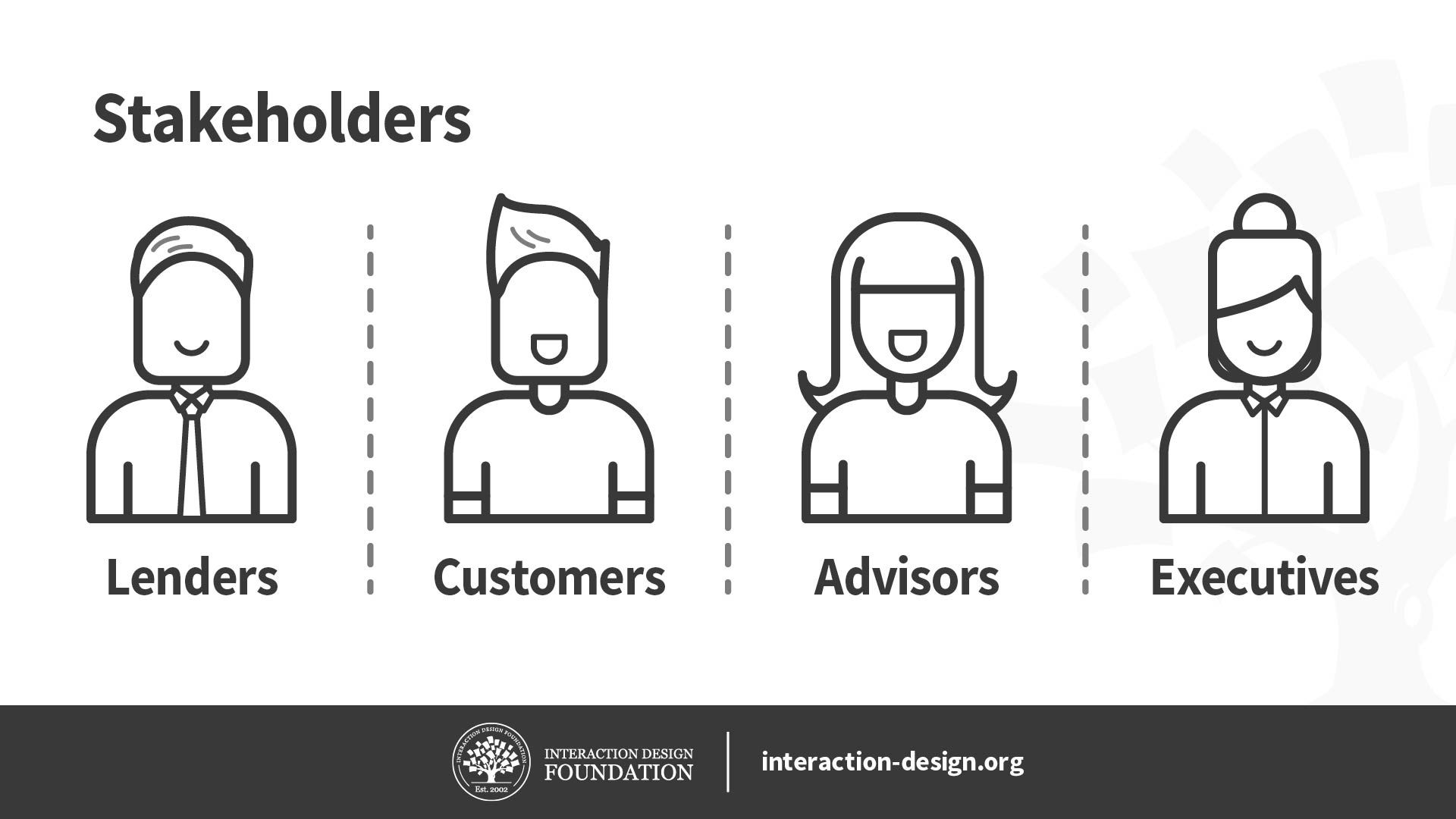
Popular types of stakeholders that you may have to consider when you run or are part of a design process.
© Daniel Skrok and the Interaction Design Foundation, CC BY-NC-SA 3.0.
3 Steps to Create a Stakeholder Map
Stakeholders are affected by and can affect your design project to varying degrees, and you can use the process below to create your very own stakeholder map that clearly outlines as many of these effects as possible.
It’s good to remember that stakeholder maps are best created with a team. If you already have some idea of who the main stakeholders are, try to make them part of it! This will help challenge assumptions, provide different perspectives and ensure participation and involvement from key stakeholders right from the get-go. Once you’ve assembled your team, it’s time to properly get stuck into the process!
Step 1: Brainstorm Who Your Stakeholders Are
All members of your team should brainstorm who they think your stakeholders are—both internally and externally.
Run a 5-minute braindump session where all team members write down stakeholders on different Post-it notes in silence. You can remind the group to think of anyone who will be affected in any way by the design project, either directly or indirectly.
Team members take it in turns to place their Post-its on a whiteboard or table, briefly describing each one.
Each team member should place their Post-its to form groups where necessary—i.e., where one of their stakeholders is the same or similar to that from another team member.
Once all the Post-its have been placed, create a list of all the different types of stakeholders the group has come up with.
Step 2: Prioritize Your List of Stakeholders
Draw an outline of the chart below and, as a group, discuss where to plot each of the stakeholders you highlighted in Step 1 based on their influence over and interest in the design project.
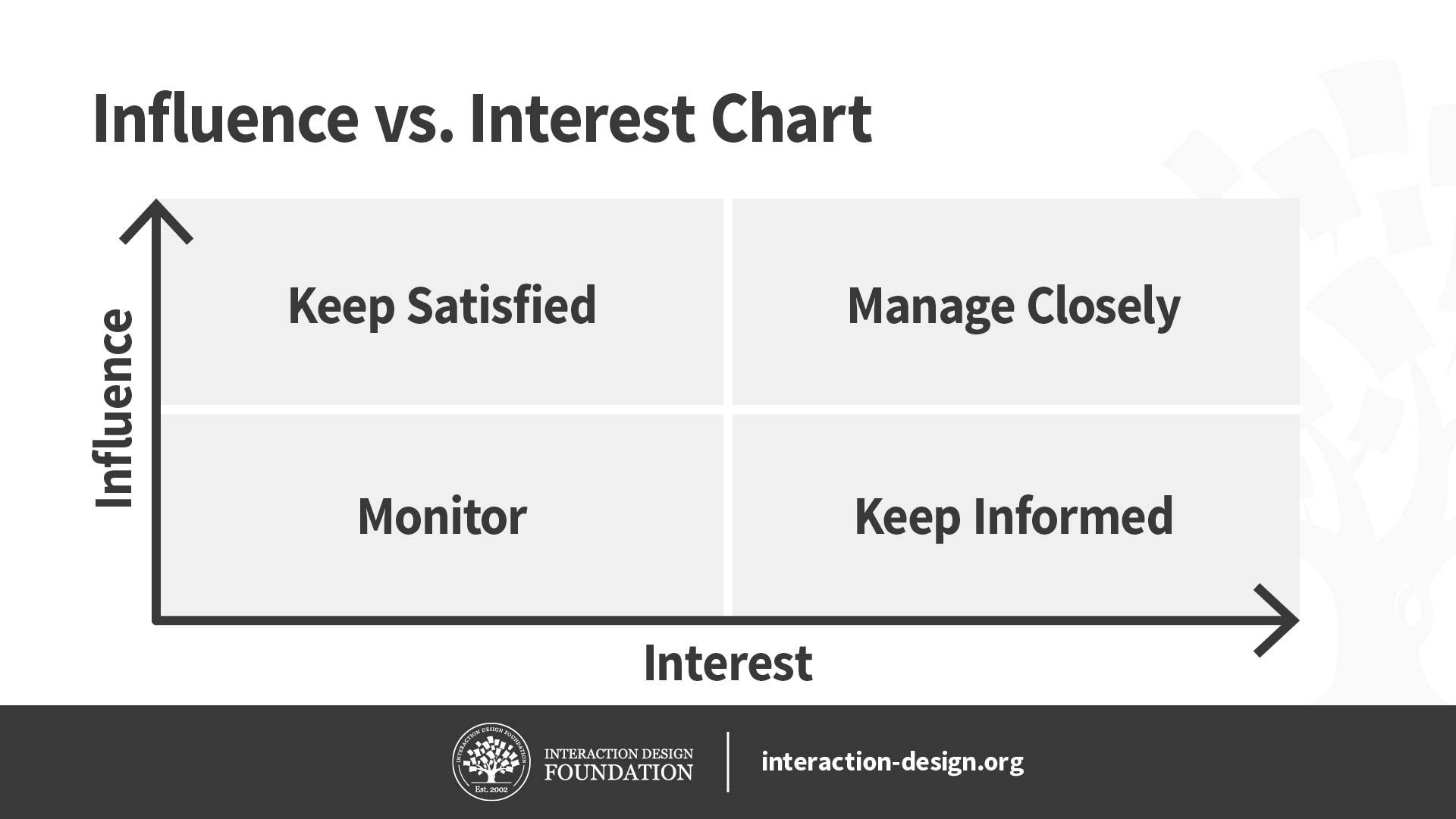
A good way to prioritize your stakeholders is to plot them on an influence vs. interest chart. The actions you take in regard to each stakeholder will depend on which quadrant they fall into.
© Daniel Skrok and Interaction Design Foundation, CC BY-NC-SA 3.0.
You will get a good idea of how to manage the range of stakeholder needs depending on where you plot them on the chart. For example, it’s a good idea to do the following with the stakeholders who sit within each section:
Manage Closely: You should aim to fully engage with these highly influential, highly interested stakeholders, and make the greatest efforts to satisfy them during the design process.
Keep Satisfied: This group of stakeholders are highly influential, yet less interested in your design project. You should put in enough effort that they remain satisfied, yet take care not to overdo it.
Keep Informed: On the other hand, these stakeholders are highly interested but not very influential. These people have the potential to provide great advice during the design process and help you spot and overcome any issues, so make sure you keep them adequately informed of what’s going on.
Monitor: Stakeholders in this section are the least influential as well as the least interested. Keep an eye on these stakeholders but don’t bother them with excessive communication; it’s a waste of your time.
Step 3: Engage and Communicate With Your Stakeholders
Now you’ve identified and ranked your various stakeholders, it’s time to get them engaged in your design process—the best way to do this is through communication. The questions below are good examples of what to ask your stakeholders to help you enhance and make sense of the map even further.
Will you be affected, either financially or emotionally, by the outcome of our project and, if so, how?
What is your main motivation behind your interest in this project?
What information can I provide?
What is the best way to communicate with you?
How do you currently feel about the project?
Who do you think influences you and your opinions, and whom do you influence?

Once you’ve identified and prioritized your stakeholders, it’s a good idea to talk to them to gain a better understanding of how they will affect or be affected by the design project.
© Cade Martin, Dawn Arlotta, USCDCP, CC0
If any stakeholders respond or act negatively towards your design project, you will need to think about and answer the following questions to develop a well-rounded plan:
How can you win over their support?
If that doesn't work, how will you manage their opposition?
Who else might be influenced by their (negative) opinions?
The insights gathered through this round of questioning will help you understand whom to include in your design and development team, and whom you’re likely to come across during the process, both externally and internally. They will also provide you with a good idea of who you should empathize with most in the upcoming phases, when you will explore the human needs and experiences in your challenge space.
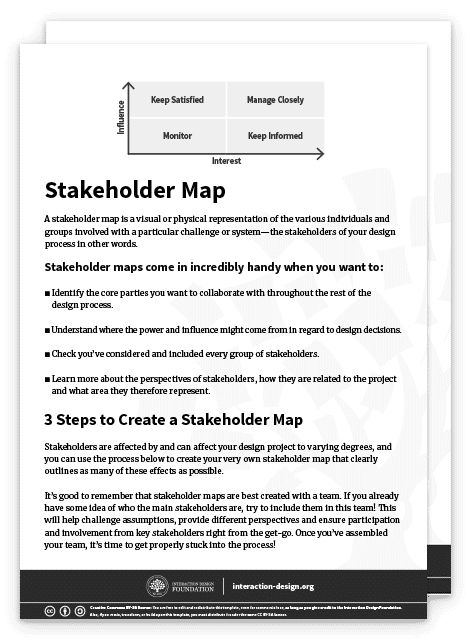
Download our free template on how to create a stakeholder map so you can follow this process with your team!
The Take Away
Stakeholders are people, groups or individuals who have the power to either affect or be affected by the design project you're involved in. Stakeholder maps help you identify and understand both your internal and external stakeholders so you have the best chance to get them on board with your project. Stakeholder maps can be developed in three stages which take you through how to identify, prioritize and understand the various stakeholders related to your design project.
Images
Hero Image: © Kennisland, CC BY-SA 2.0.