Ideation is easy to define. It’s the process by which you generate, develop and then communicate new ideas. Ideas can take many forms such as verbal, visual, concrete or abstract. The principle is simple to create a process by which you can innovate, develop and actualize new products. Ideation is critical to both UX designers and learning experience designers.
As Pablo Picasso, the artist, said about his creations; “I begin with an idea, and then it becomes something else.”
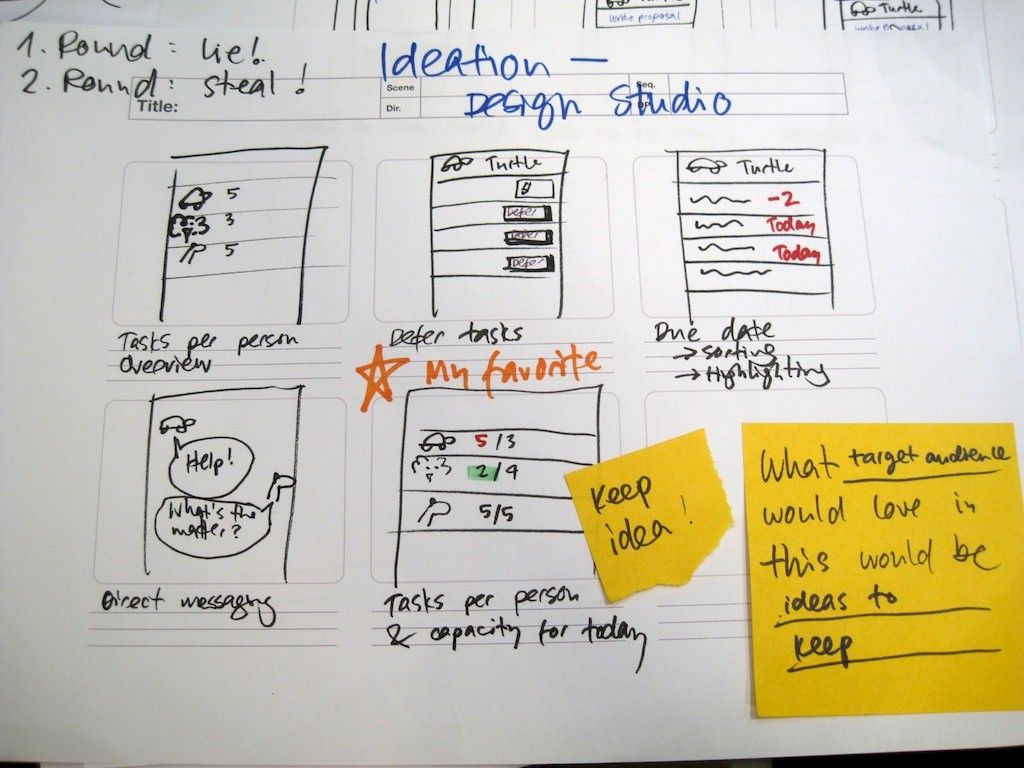
Author/Copyright holder: visualpun.ch. Copyright terms and licence: CC BY-SA 2.0
Ideation does not need to be beautiful to be effective. Creating ideas is the main point rather than graphic design as you can see here.
There are many types of new idea and they are commonly found in the following patterns:
- Problem to solution. Find a problem, find a solution – this is, perhaps, the most common form of ideation.
- Derivation – where you take an existing idea and then change it (hopefully for the better)
- Symbiotic – where you take a group of ideas and combine them to form a single coherent idea
- Revolutionary – where you take an existing principle and smash it and derive a totally new perspective
- Serendipitous discovery (or accidental discovery) – when an idea turns up when you are in pursuit of something else (penicillin would be a good example of serendipitous discovery)
- Targeted innovation – an iterative process where the solution is theorized but the path to it is poorly understood. Repeated attempts are used to create the pathway.
- Artistic innovation – a form of ideation which completely disregards “what is practical” and innovates without constraint
- Computer aided innovation – where computers are used to probe for solutions and to conduct research
All of these processes can be used by the designer in search of ideas for a project. However, in many cases these are not practical (revolutionary ideation, for example, is generally a once or twice in a lifetime Eureka! moment and not a practical process) or out of budget/time constraints (such as targeted innovation or computer aided innovation).
Thus the designer will seek more practical and prosaic approaches when it comes to ideation including brainstorming, mind mapping, etc.
Ideation on Paper
Almost all ideation techniques can be deployed on paper. Brainstorming and mind mapping, for example, are simply the same process but visualized in different ways.
Thus, in this article, we will examine brainstorming as the key tool for ideation but other tools may be considered on projects to bring about similar results.
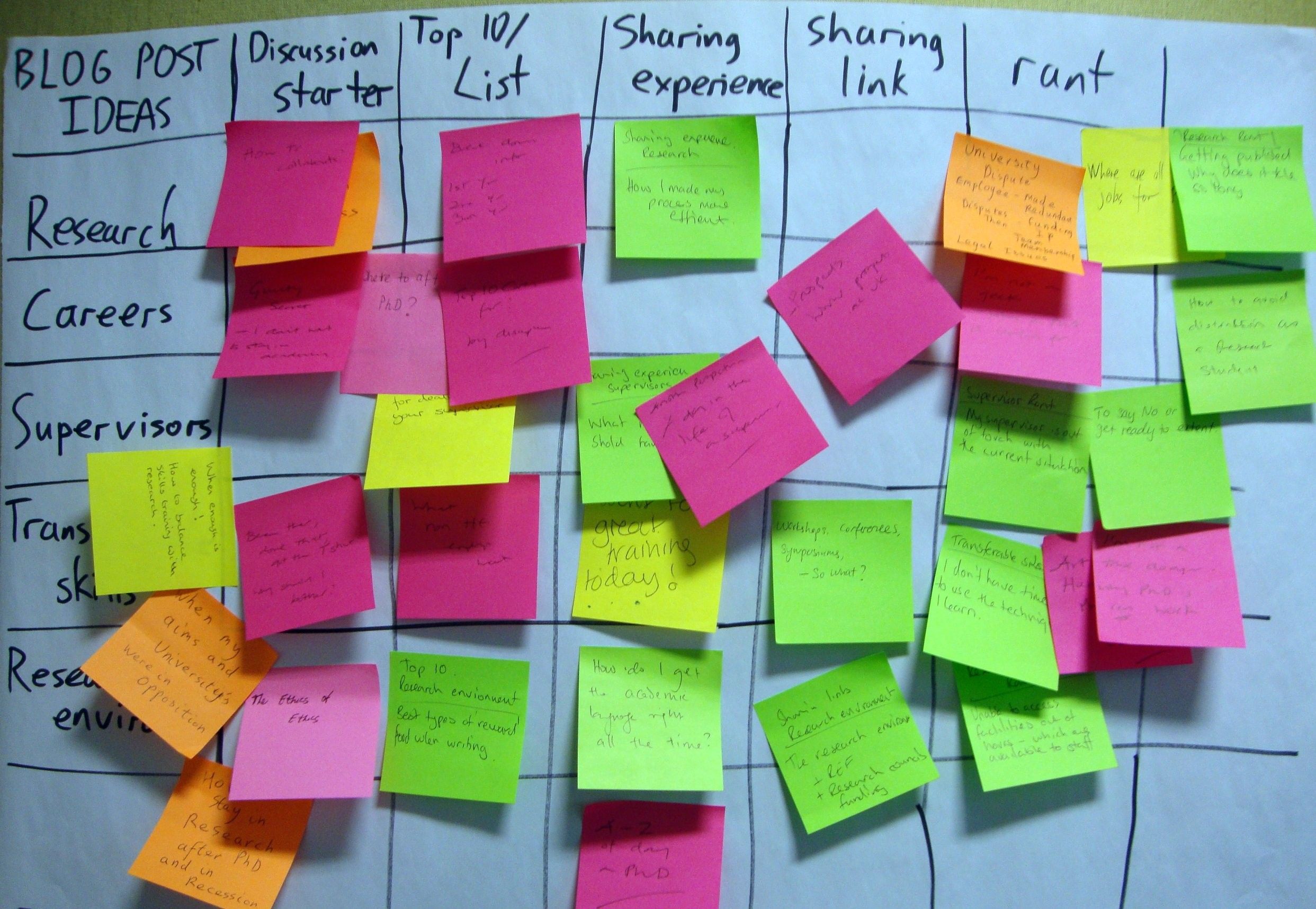
Author/Copyright holder: Dave Gray. Copyright terms and licence: CC BY 2.0
Ideation on paper. This is for a blog’s content but the same principles apply for any kind of ideation. Get it down on sticky notes and then organize ruthlessly.
Rules for Initial Ideation
When you are at the start of the ideation process you want to generate ideas in their multitudes. The idea is to follow a few simple rules, as a team, to deliver lots of ideas. These ideas, once the exercise is complete, can then be examined for practical considerations. The rules are as follows:
- Prepare the space. Put up posters with user personas, the problem in hand, and any design models or processes that will be used on the project. The more context provided, the easier it should be to come up with ideas.
- While initial ideation takes place – there are NO BAD IDEAS – the exercise is to create not judge ideas.
- Unrelated ideas can be parked for another discussion. They should, however, be written down.
- Volume is important don’t waste time examining any particular idea in depth just write it down and move on.
- Don’t be afraid to use lots of space. Write ideas on Sticky-Notes and then plaster them on everything in the room. This can help participants connect seemingly unrelated ideas and enhance them,
- No distractions. Turn off phones, laptops, etc. Lock the door or put a sign outside saying “Do not disturb.” You can’t create ideas when you’re constantly interrupted.
- Where possible be specific. Draw ideas if you can’t articulate them in writing. Make sure you include as much data as possible to make an idea useful.
Once you have the rules understood. Grab your team and get creative. It can help to do a 10 minute warm up on an unrelated topic to get people thinking before you tackle the problem in hand. Don’t take more than 2 hours for initial ideation.
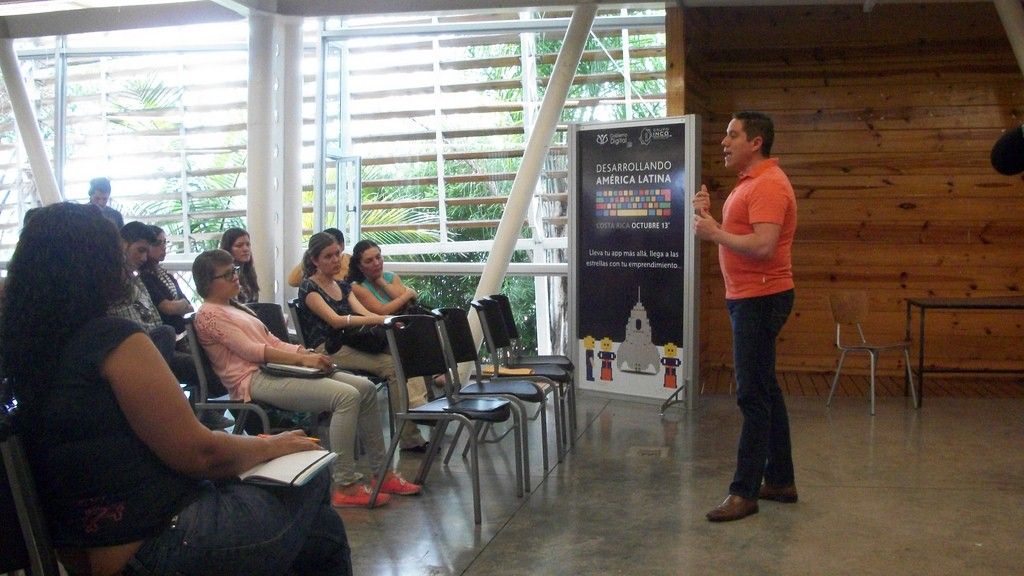
Author/Copyright holder: Desarrollando América Latina. Copyright terms and licence: CC BY 2.0
Laying down rules at the start of an ideation session will help keep things on track throughout. Don’t be afraid to call people’s attention to the rules if they begin to bend or break.
Structuring Your Ideas
Once you’ve got some ideas coming it’s a good idea to group them around specific areas. Some common idea areas include:
- Pain Points
- Opportunities
- Process Steps
- Personas
- Metaphors
When You Get Stuck
There are also some simple techniques to get the creative juices flowing when the ideas process gets stuck.
- Breaking the law. List all the known project constraints and see if you can break them.
- Comparisons. Taking a single phrase that encapsulates the problem and see if you can find real world examples of this.
- Be poetic. Try to turn the problem into a poem or haiku. Thinking about the word structures can deliver new ideas.
- Keep asking “how and why?” - These words make us think and create.
- Use laddering. Move problems from the abstract to the concrete or vice-versa to consider them from another perspective.
- Steal ideas. If you get stuck on a particular concept – look to other industries and see how they’ve handled something similar. Of course, in the end you should be emulating in design not copying.
- Invert the problem. Act like you want to do the exact opposite of what you’ve set out to do – how would you do that instead?
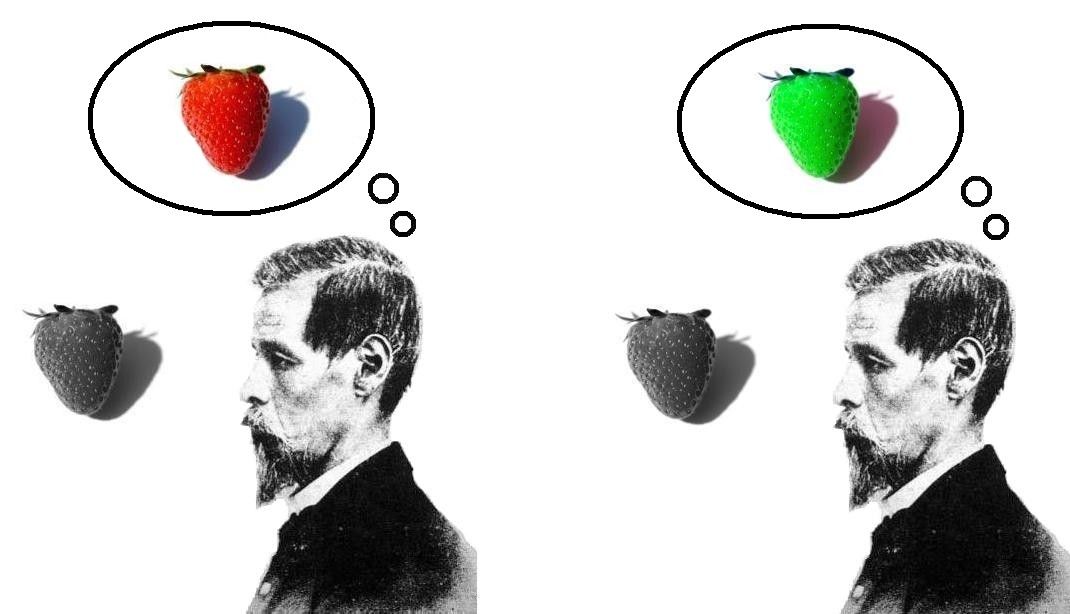
Author/Copyright holder: Was a bee. Copyright terms and licence: CC BY-SA 2.5
Even simple inversions can make us think very differently. Here the inversion of color changes the picture dramatically.
Review and Filter
Once you have a large number of ideas; you then need to review and filter these down to something more manageable. It is at this stage that ideas can be discarded as “bad”, kept as “good” or modified into something more useful. It’s best to carry out this exercise a little while after the initial ideation phase so that people have a chance to reflect on the ideation as well as become less personally attached to the original ideas.
The Take Away
Creating ideas is often best done in groups – though all the techniques above can be carried out by an individual too. The trick is to just create and keep doing so for an extended period of time. You can worry about works and what doesn’t later. Ideation is one of the most fun things a designer can do but it can also be frustrating if you try and do it by yourself sat in front of a piece of paper.
Hero Image: Author/Copyright holder: Martin Hamilton. Copyright terms and licence: CC BY 3.0