The Einstellung Effect

Your constantly-updated definition of the Einstellung Effect and collection of videos and articles.
Be a conversation starter: Share this page and inspire others!

197 Shares

What is the Einstellung Effect?

The Einstellung effect occurs when designers are so used to approaching problems in certain ways that they overlook better ways. It is a cognitive trap arising from a desire to find familiar features in problems and reuse shortcuts. Experience can prime the mind and block creative problem-solving.

“We tend to formulate our problems in such a way as to make it seem that the solutions to those problems demand precisely what we already happen to have at hand. With respect to the conduct of inquiry, and especially in behavioral science, I label this effect “the law of the instrument.” The simplest formulation I know of the law of the instrument runs this way: give a small boy a hammer and it will turn out that everything he encounters needs pounding.”

— Abraham Kaplan, Philosopher and pioneering investigator of the behavioral sciences

See how problematic the Einstellung effect can be.

Transcript

Einstellung (“Attitude” or “Setting” in German) – when Experience is a Curse

Psychologist Abraham Luchins and his wife, Edith, first documented the Einstellung effect in 1942. Test subjects were asked to pour water between different-sized containers to reach exact amounts – and solved several problems with the same solutions. However, one problem had a different solution; they approached it in the same way and failed. As they’d established a set problem-solving path, the participants primed themselves to apply this elsewhere – regardless. Indeed, human minds are cognitive misers; a “shortcut” is appealing even if it involves needless complexity; likewise, it’s easy to rely on experience to color our judgments. And, over time, experience can condition the mind to follow set procedures. This is where expertise and ignorance coexist.

In user experience (UX) design, the effect blocks ideation because design teams can enter the design space without realizing how their own bias can trap them into false views of the users and each problem to address. By injecting distorted insights and ignoring the real dimensions involved, the team can end up with prolonged creative constipation, dwelling on imagined difficulties and/or—worse—ultimately pursuing a mirage of the “best” idea.

In the 21st-century milieu of technologies that have captured the popular imagination, it’s easy for teams to assume similar solutions will work on their own users’ problems. However, innovation demands usefulness and novelty. Design problems are invariably complex and need extensive research before a team can understand what to start looking for in a solution. In the design thinking process, for example, ideation is the third, middle stage. So, if a team declares it has a solution before taking the time to understand the users thoroughly and define the problem accurately, it will have lost its way in the mists of fixation.
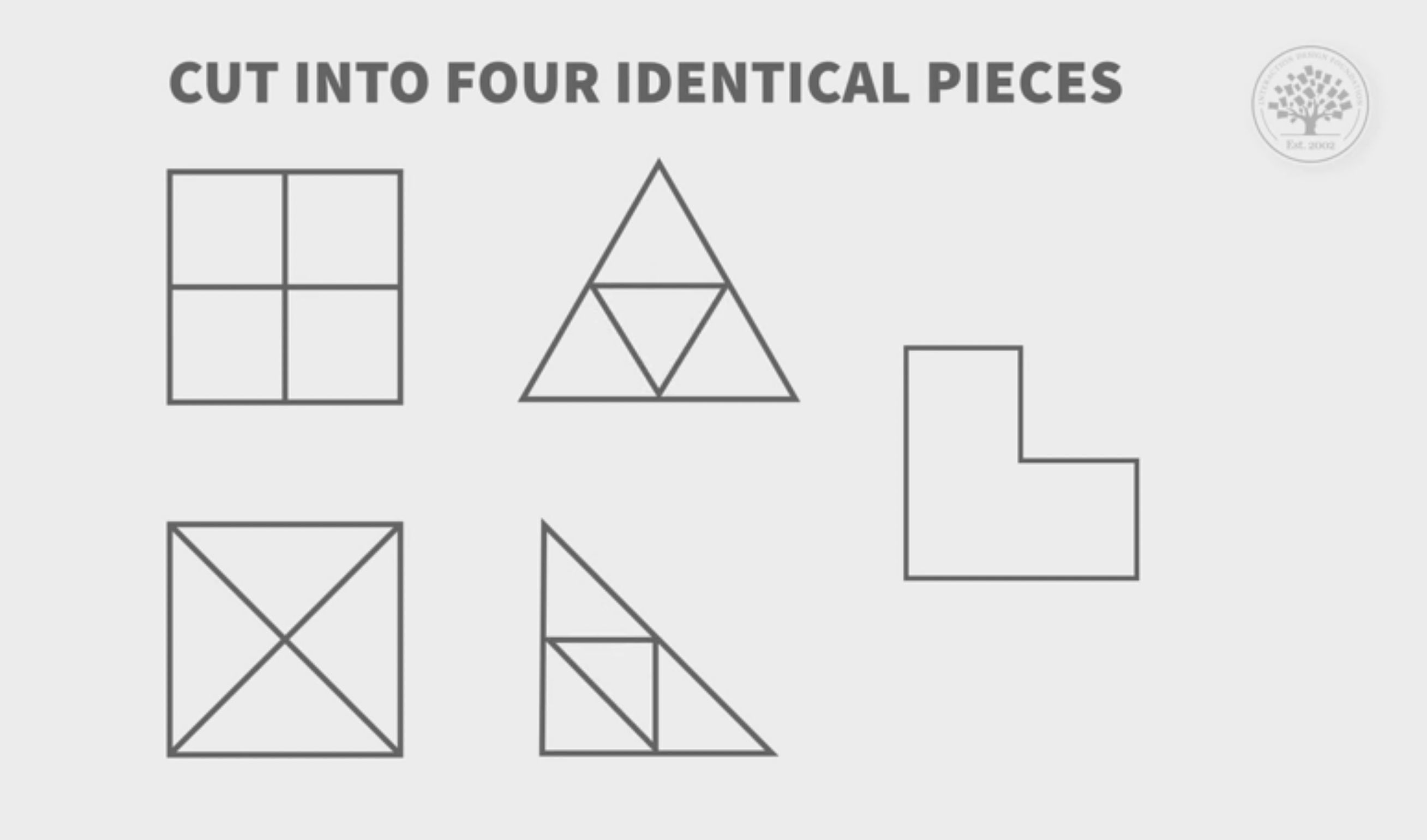
© Yu Siang and Interaction Design Foundation, CC BY-SA 3.0

How to Prevent the Einstellung Effect

Here are vital ways to safeguard your ideation efforts:

  • Stay aware that you may not be aware – Know your enemy, who is the trickster of a mindset that might offer fantastic-looking ideas and trap your ideation efforts inside a tiny “box”. So, if you hear “Hey! What about this…?” consider that someone may have jumped to an Einstellung-framed conclusion.

  • Have a Diverse Group of Team-mates – As expertise can work against creativity, having a range of backgrounds on board can help keep everyone from stumbling down wrong avenues.

  • Don’t overcomplicate the Straightforward; don’t oversimplify the Complex – Of course, design problems are typically intricate, but that doesn’t mean every factor will be. Everything pivots on the wording of the problem statement. One wrong word can result in anchoring and a skewed view of what users might really want from a solution.

  • Use Design Thinking – This process is custom-built for finding solutions that need to be custom-built. From the empathize and define stages, you can craft a solid, fine-tuned and inspiring problem statement, and move on to ideation armed with the criteria for evaluating competing ideas.

  • Complement Divergent Thinking with Convergent Thinking – To flex the creative muscles and then carefully process harvested ideas. For example, methods such as bad ideas help empty the mind of preconceptions and leverage lateral thinking.

  • Believe in the Power of Incubation – After all the dust thrown up in ideation, step back and take a break. Just follow the stages of creativity and get some distance on the problem so you can return with a fresh view.

  • Beware of Fixation in Ideation Sessions – If patterns of approaching a problem start surfacing, team-mates may become stuck in a set way of evaluating other topics that arise. This can be hard to detect, so it helps to keep “Is this the best way of handling this?” in mind.

  • Remember, New Solutions demand New Approaches – And recycling old/popular approaches can happen without your realizing it. So, divergent thinking methods such as oxymorons can help push out beyond what’s already been done.

Overall, remember that although the subconscious mind accounts for a lot, you’re in control of which train of thought you board on the journey to the best solution every time.

© Yu Siang and Interaction Design Foundation, CC BY-SA 3.0

Questions About Einstellung Effect?
We've Got Answers!

What is the Einstellung effect?

The Einstellung effect is when your brain gets stuck using a solution that worked before—even if there’s a better one available now. It’s a mental shortcut that saves time, but it can also block creative thinking. The term “Einstellung” comes from German and means “setting” or “attitude.”

For example, if a designer solves a problem using a certain layout, they might keep reusing that layout—even when a new project needs a different approach. Their past success creates a kind of mental tunnel vision.

This effect happens in many fields, from design to chess to medicine. It shows how experience can help—but also sometimes hurt—our ability to think flexibly.

It’s important to be aware of the effect, but also to appreciate that in user experience (UX) design, users tend to prefer familiarity and efficiency. Try looking at problems with fresh eyes, get input from others, or question your go-to methods regularly, to keep your thinking flexible and open.

Watch as Author and Human-Computer Interaction (HCI) Expert, Professor Alan Dix explains the Einstellung effect:

Transcript

Take our course Creativity: Methods to Design Better Products and Services.

How does the Einstellung effect limit creative thinking?

The Einstellung effect limits creative thinking by trapping designers—and other problem-solvers—in familiar problem-solving patterns. When they face a new challenge, their brains tend to default to past solutions—even when they don’t fit. This mental shortcut feels efficient, but it blocks them from seeing better or more innovative options.

For example, psychologists observed this in chess players who repeated old strategies despite obviously better moves. The effect happens because our brains love efficiency and familiarity, which work well in routine tasks but hinder creativity when a fresh perspective is needed.

To overcome this, step back and question your assumptions. Try looking at the problem from different angles or use brainstorming techniques like SCAMPER or mind mapping. Even simple actions like changing your environment or working with someone from another field can help break the mental loop.

Watch as Author and Human-Computer Interaction (HCI) Expert, Professor Alan Dix explains the Einstellung effect:

Transcript

Take our course Creativity: Methods to Design Better Products and Services.

How does the Einstellung effect appear in UX or product design work?

The Einstellung effect shows up in UX (user experience) and product design when designers rely too much on past design patterns or familiar solutions, even when those don’t serve the user’s current needs. For example, a designer might stick to a layout or navigation flow that worked in a past project, assuming it will work again, without fully exploring possible better alternatives for the new context.

This can lead to uninspired interfaces, poor usability, or features that feel out of place. It’s important to note that familiar solutions and past design solutions are great for UX as long as they are appropriate. In that respect, novel solutions are best avoided.

To avoid this trap, approach each design problem with curiosity. Ask fresh questions. Involve diverse stakeholders. Test unexpected ideas early. Even reviewing user data with a “beginner’s mind” can help you break out of fixed patterns and get a better grasp of the reality of the problem at hand.

Watch as Author and Human-Computer Interaction (HCI) Expert, Professor Alan Dix explains the Einstellung effect:

Transcript

Take our course Creativity: Methods to Design Better Products and Services.

What are some examples of the Einstellung effect in design?

Real examples of the Einstellung effect in design often show up when teams stick to familiar solutions instead of exploring better ones. One classic case is when mobile apps mimic desktop layouts—essentially shrinking the desktop layout without appreciating the intricacies of mobile UX design and mobile users’ needs. Early mobile banking apps, for instance, copied full desktop dashboards. Designers assumed this was the “right” structure, even though mobile users needed faster, simpler navigation.

Another example is e-commerce sites that bury filters in dropdown menus because “that’s how it’s always been done.” Sticking to old ways blocks innovation and is a mindset that can be perilous. That’s especially so in a field as dynamic as UX design and the ever-evolving technology—as well as changing expectations and needs of users—it must cater to.

The Einstellung effect also appears in form design. Designers often include unnecessary fields just because older forms had them—like asking for a fax number in 2025.

To break free, revisit user needs often, challenge assumptions, and test new ideas with real users.

Watch as Author and Human-Computer Interaction (HCI) Expert, Professor Alan Dix explains the Einstellung effect:

Transcript

Take our course Creativity: Methods to Design Better Products and Services.

How can I tell if I’m stuck in the Einstellung effect?

You might be stuck in the Einstellung effect if you solve problems using the same patterns, even when they don’t fit the situation. Design patterns are valuable tools, but it takes good judgment and a creative mindset to make them fresh and relevant to your brand and users. Familiarity is good for users, and chosen solutions must be appropriate. If you often jump to a familiar solution without exploring other options—or feel uncomfortable breaking from “how it’s always been done”—that’s a clear sign of the Einstellung effect. You may also notice that your designs start to feel repetitive or that user feedback points to usability issues you hadn’t considered.

Another clue is if you resist new tools, approaches, or feedback because your go-to method “has always worked.” This mindset can limit innovation and keep your work from evolving with user needs. Again, however, note that familiarity is good for users and they need appropriate solutions.

To break out, step back and ask why you’re making each design choice. Research extensively and brainstorm possible alternatives, even if the current solution seems “good enough.” Collaborate with people who can offer fresh perspectives—cross-functional collaboration with team members from other departments, such as development or marketing, can reveal angles on a problem you mightn’t notice otherwise.

Watch as Author and Human-Computer Interaction (HCI) Expert, Professor Alan Dix explains the Einstellung effect:

Transcript

Take our course Creativity: Methods to Design Better Products and Services.

Can experienced designers be more affected by the Einstellung effect?

Yes, the Einstellung effect can affect experienced designers even more. The greater your expertise, the more likely you’ll be to rely on patterns and past solutions that worked before. This deep knowledge can make it harder to see alternatives or question assumptions, because you’ve been “right” many times. The resulting “tunnel vision” can take you and your design team down the wrong road—or, rather, tunnel.

Experts often jump to conclusions quickly, thinking they’ve seen this problem before. However, even slight differences in context can make old solutions ineffective or even harmful. Intelligence and experience increase confidence, which can block fresh thinking if you’re not careful. Also, the phenomenon of déformation professionnelle—when your expertise in your field or career can constrain your view of a problem—ties in closely with the Einstellung effect. Sometimes the best solution is “ridiculously” simple because it’s “beneath” the scope that an expert is used to applying to a problem. Nevertheless, it is still the best solution to the problem, no matter which professional or career “lens” might try to see it as less so.

To avoid this trap, treat every problem as unique. Slow down, invite input from less experienced teammates, and actively seek out different viewpoints. Staying curious is the smartest thing you can do, and soon you may find the solution is on a completely different “path” from the one where you thought it would be.

Watch as Author and Human-Computer Interaction (HCI) Expert, Professor Alan Dix explains the Einstellung effect:

Transcript

Take our course Creativity: Methods to Design Better Products and Services.

Can design thinking methods help break the Einstellung effect?

Yes, design thinking methods can help break the Einstellung effect. They encourage exploration, empathy, and experimentation. Unlike traditional problem-solving approaches, design thinking pushes you to step back, question assumptions, deeply understand the user’s needs and feel out the edges of the problem before jumping to solutions.

The process—empathize, define, ideate, prototype, and test—forces you out of mental ruts. For example, during ideation, you and your team generate a wide range of ideas, even wild or “bad” ones (the idea being to find why they’re bad ideas so you can get a fresh view of the true problem at hand and what might then be a “good” way to handle it). This reduces the grip of “tried-and-true” solutions. Prototyping and user testing also expose flaws in familiar approaches and open the door to unexpected insights.

Perhaps best of all is how design thinking creates a culture where questioning the obvious is valued. It invites diverse input, reframes challenges, and supports a mindset of continual learning. That makes design thinking one of the most effective ways to overcome the Einstellung effect, so it’s not just an “idea engine” but also a kind of “safety net” to keep your team from falling into the Einstellung trap.

Watch our video about the five phases of design thinking for valuable insights into this design process:

Copyright
Transcript

Enjoy our Master Class Harness Your Creativity to Design Better Products with Alan Dix, Professor, Author and Creativity Expert.

Can design systems or templates cause the Einstellung Effect?

Yes—design systems and templates can trigger the Einstellung effect. While they speed up work and create consistency, they can also lock teams into familiar patterns. When designers rely too heavily on predefined components, they may stop questioning if those solutions actually fit the user’s problem.

This mental shortcut can block creativity and limit exploration. To avoid it, treat the design system as a starting point—not the final answer. Regularly revisit users’ needs, challenge default choices, and explore custom solutions when needed.

Encourage your team to sketch ideas from scratch before reaching for components. This habit keeps critical thinking alive and helps balance efficiency with innovation.

Watch our video about the five phases of design thinking for valuable insights into this design process:

Copyright
Transcript

Enjoy our Master Class Harness Your Creativity to Design Better Products with Alan Dix, Professor, Author and Creativity Expert.

Why do we overlook simpler solutions?

Humans—including professionals at work—often overlook simpler solutions and go with sub-optimal ones due to factors like code reuse or just meeting a deadline. Users prefer familiarity and efficiency, so familiar solutions are the best as long as they are appropriate.

It’s also easy to confuse complexity with value, leading teams to over-engineer solutions instead of looking for elegant, minimal alternatives.

To counter this, build time for exploration into your process. Question assumptions and stretch to find the real edges of a problem—they may be easier to locate than you might think. Perspective plays a vital part. Prototype and test multiple ideas—even the “too simple” ones. Often, the best answer hides in plain sight; and remember that appropriate familiar solutions are the best.

Watch as Author and Human-Computer Interaction (HCI) Expert, Professor Alan Dix explains the Einstellung effect:

Transcript

Take our course Creativity: Methods to Design Better Products and Services.

What are some highly cited scientific articles about the Einstellung Effect or related to it?

Purcell, A. T., & Gero, J. S. (1996). Design and other types of fixation. Design Studies, 17(4), 363–383.

This seminal paper investigates the phenomenon of design fixation, where exposure to existing solutions impedes the generation of novel ideas. Through a series of experiments involving novice and experienced designers, the authors examine how different types of stimuli—such as pictorial examples—can lead to fixation. The study reveals that fixation is influenced by factors like the designer's level of expertise and the nature of the example provided. These findings have significant implications for design education and practice, emphasizing the need to develop strategies that mitigate fixation and promote creativity. The research contributes to a deeper understanding of cognitive processes in design, informing methods to enhance innovative thinking.

Bilalić, M., McLeod, P., & Gobet, F. (2010). The mechanism of the Einstellung (set) effect: A pervasive source of cognitive bias. Current Directions in Psychological Science, 19(2), 111-115.

This publication has been highly influential in the field of cognitive psychology, particularly in understanding the Einstellung effect. The authors provide a comprehensive overview of the Einstellung effect, explaining how it operates as a pervasive source of cognitive bias across various domains of expertise. The paper is significant because it synthesizes previous research on the topic and proposes a theoretical framework for understanding the cognitive mechanisms underlying the effect.

The authors argue that the Einstellung effect is not limited to novices but can affect experts as well, demonstrating its widespread impact on problem-solving and decision-making processes. They present evidence from chess studies using eye-tracking technology, which reveals how the effect influences visual attention and information processing. This research has important implications for understanding expert performance and the potential limitations of expertise.

Furthermore, the paper discusses the broader implications of the Einstellung effect in real-world scenarios, such as medical diagnosis and scientific research. By highlighting the pervasive nature of this cognitive bias, the authors emphasize the need for strategies to mitigate its effects in various professional and academic contexts. This work has been instrumental in raising awareness about the Einstellung effect and inspiring further research into cognitive biases and their impact on human performance.

Earn a Gift Earn a Gift, Answer a Short Quiz!

1
2
3
4
1
2
3
4
Question 1
Question 2
Question 3
Get Your Gift
Interaction Design Foundation logo

Question 1

Why can the Einstellung effect stop effective problem-solving?

1 point towards your gift

  • It always leads to the most efficient solution and the best design.
  • It causes individuals to rely on familiar solutions, which potentially overlooks better options.
  • It promotes innovative thinking with new approaches.
Interaction Design Foundation logo

Question 2

Who first documented the Einstellung effect?

1 point towards your gift

  • Abraham Luchins and Edith Luchins
  • Carl Jung and Karen Horney
  • Sigmund Freud and Anna Freud
Interaction Design Foundation logo

Question 3

How does the Einstellung effect affect UX design teams?

1 point towards your gift

  • It guarantees teams design quickly and implement user research from past projects.
  • It helps teams identify user needs accurately.
  • It leads teams to fixate on familiar solutions, and ignore real user needs.

Learn More About the Einstellung Effect

Make learning as easy as watching Netflix: Learn more about Einstellung Effect by taking the online IxDF Course Creativity: Methods to Design Better Products and Services.

Why? Because design skills make you valuable. In any job. Any industry.

In This Course, You'll

  • Get excited as you learn to innovate and get creative, even when you feel blocked! Did you know that creative thinking is the second most important skill hiring managers look for, across all jobs and industries? This course will give you the skills to design innovative solutions and products that stand out. It's easier than you think! No matter your background, you can effortlessly learn to tap into creativity. You'll apply proven methods to break out of habitual thinking, spark new ideas anytime, and capture them before they disappear!

  • Make yourself invaluable with divergent and convergent ideation techniques that have real business impact. In a world where AI can generate endless ideas, you stay in demand when you know which ideas to explore, which to combine, and which to move forward. Timeless human-centered design skills help you focus creativity on real needs, and that’s how you can turn AI from a tool into your new creative superpower. Companies that prioritize creativity achieve 67% more organic revenue growth. Creativity is just as valuable in finance, engineering, and healthcare as it is in creative professions. Every industry thrives on innovative ideas. In this course, you'll use ideation methods like multiple classifications and three-way comparisons to see opportunities others miss and bring bold ideas to life.  

  • Gain confidence and credibility with 15+ downloadable templates to fast-track your creativity! You'll learn how to use busywork to enable your creativity in daily planning and foster a creative team environment. You'll apply step-by-step strategies to beat procrastination, bias, and fixation, and ensure your creative process remains productive—even under pressure. You'll get hands-on experience and walk away with a polished case study for your portfolio if you choose to complete the optional ideation project. If you want to solve big problems, improve lives, and build a better world with innovative solutions people love, then this course is the perfect place to start.

It's Easy to Fast-Track Your Career with the World's Best Experts

Master complex skills effortlessly with proven best practices and toolkits directly from the world's top design experts. Meet your experts for this course:

  • Alan Dix: Author of the bestselling book “Human-Computer Interaction” and Director of the Computational Foundry at Swansea University.

  • Don Norman: Father of User Experience (UX) Design, author of the legendary book “The Design of Everyday Things,” and co-founder of the Nielsen Norman Group.

Get an Industry-Recognized IxDF Course Certificate

Increase your credibility, salary potential and job opportunities by showing credible evidence of your skills.

IxDF Course Certificates set the industry gold standard. Add them to your LinkedIn profile, resumé, and job applications.

Course Certificate Example

Be in distinguished company, alongside industry leaders who train their teams with the IxDF and trust IxDF Course Certificates.

Our clients: IBM, HP, Adobe, GE, Accenture, Allianz, Phillips, Deezer, Capgemin, Mcafee, SAP, Telenor, Cigna, British Parliament, State of New York

All Free IxDF Articles on the Einstellung Effect

Read full article
10 Simple Ideas to Get Your Creative Juices Flowing - Article hero image
Interaction Design Foundation logo

10 Simple Ideas to Get Your Creative Juices Flowing

Writers deal with writer’s block and designer’s often find that they get stuck for ideas too. There’s no shame in it but learning to smash through the block is a necessary professional skill. Time waits for no-one and when there’s a deadline looming… you’ve got to pull something out of the bag. The

Social shares
873
Published
Read Article
Read full article
Ideation for Design  - Preparing for the Design Race - Article hero image
Interaction Design Foundation logo

Ideation for Design - Preparing for the Design Race

Ideation is easy to define. It’s the process by which you generate, develop and then communicate new ideas. Ideas can take many forms such as verbal, visual, concrete or abstract. The principle is simple to create a process by which you can innovate, develop and actualize new products. Ideation is c

Social shares
870
Published
Read Article

Ideation for Design - Preparing for the Design Race

Ideation for Design  - Preparing for the Design Race

Ideation is easy to define. It’s the process by which you generate, develop and then communicate new ideas. Ideas can take many forms such as verbal, visual, concrete or abstract. The principle is simple to create a process by which you can innovate, develop and actualize new products. Ideation is critical to both UX designers and learning experience designers.

As Pablo Picasso, the artist, said about his creations; “I begin with an idea, and then it becomes something else.”


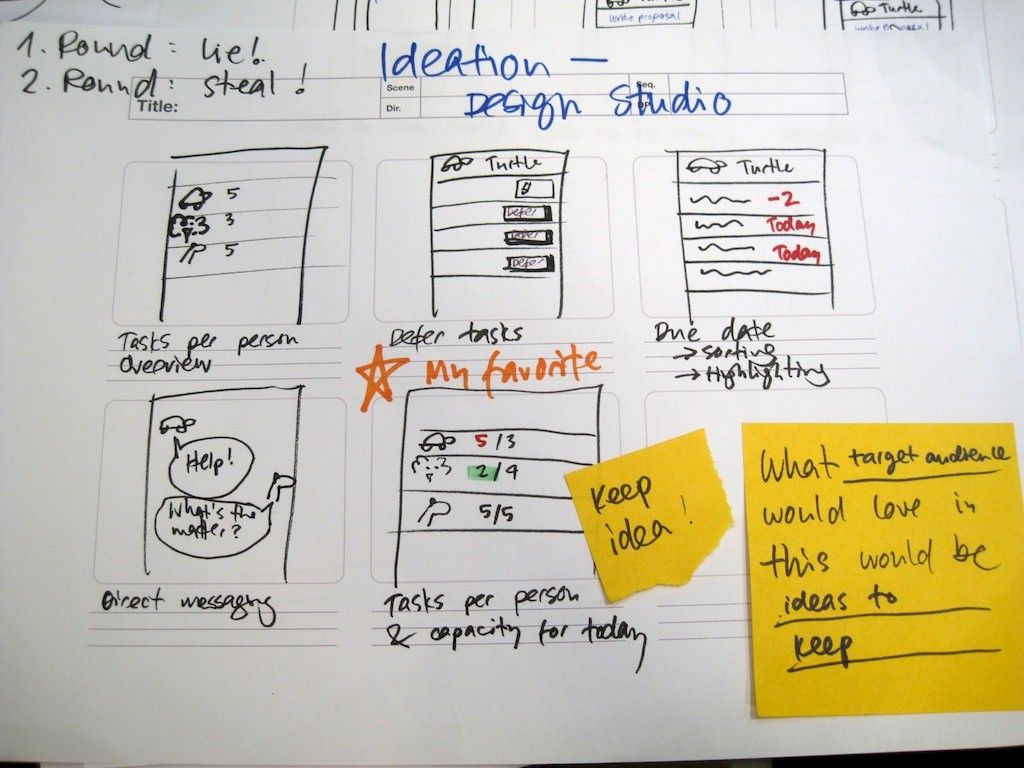
Author/Copyright holder: visualpun.ch. Copyright terms and licence: CC BY-SA 2.0

Ideation does not need to be beautiful to be effective. Creating ideas is the main point rather than graphic design as you can see here.

There are many types of new idea and they are commonly found in the following patterns:

  • Problem to solution. Find a problem, find a solution – this is, perhaps, the most common form of ideation.
  • Derivation – where you take an existing idea and then change it (hopefully for the better)
  • Symbiotic – where you take a group of ideas and combine them to form a single coherent idea
  • Revolutionary – where you take an existing principle and smash it and derive a totally new perspective
  • Serendipitous discovery (or accidental discovery) – when an idea turns up when you are in pursuit of something else (penicillin would be a good example of serendipitous discovery)
  • Targeted innovation – an iterative process where the solution is theorized but the path to it is poorly understood. Repeated attempts are used to create the pathway.
  • Artistic innovation – a form of ideation which completely disregards “what is practical” and innovates without constraint
  • Computer aided innovation – where computers are used to probe for solutions and to conduct research

All of these processes can be used by the designer in search of ideas for a project. However, in many cases these are not practical (revolutionary ideation, for example, is generally a once or twice in a lifetime Eureka! moment and not a practical process) or out of budget/time constraints (such as targeted innovation or computer aided innovation).

Thus the designer will seek more practical and prosaic approaches when it comes to ideation including brainstorming, mind mapping, etc.

Ideation on Paper

Almost all ideation techniques can be deployed on paper. Brainstorming and mind mapping, for example, are simply the same process but visualized in different ways.

Thus, in this article, we will examine brainstorming as the key tool for ideation but other tools may be considered on projects to bring about similar results.


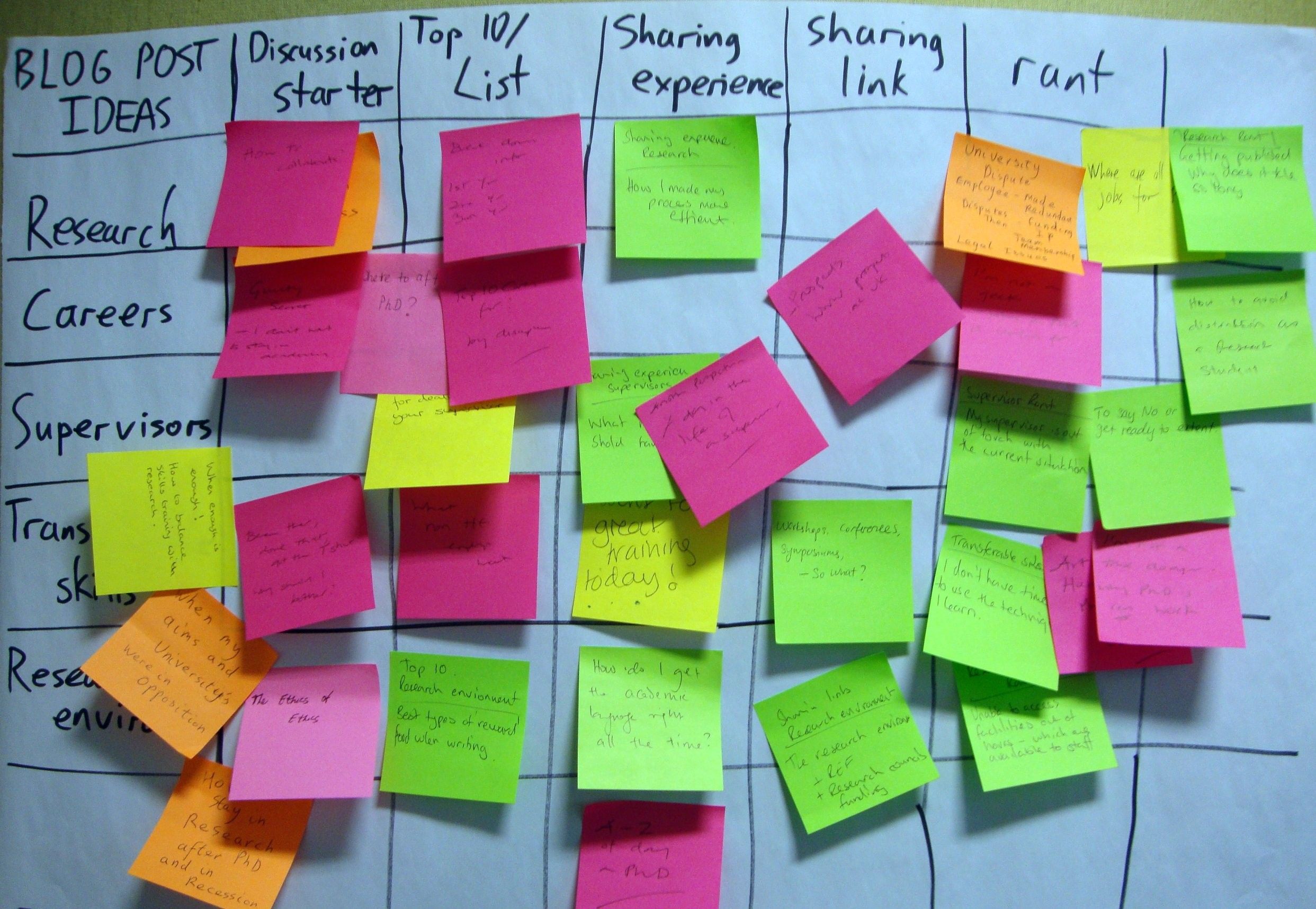
Author/Copyright holder: Dave Gray. Copyright terms and licence: CC BY 2.0

Ideation on paper. This is for a blog’s content but the same principles apply for any kind of ideation. Get it down on sticky notes and then organize ruthlessly.

Rules for Initial Ideation

When you are at the start of the ideation process you want to generate ideas in their multitudes. The idea is to follow a few simple rules, as a team, to deliver lots of ideas. These ideas, once the exercise is complete, can then be examined for practical considerations. The rules are as follows:

  • Prepare the space. Put up posters with user personas, the problem in hand, and any design models or processes that will be used on the project. The more context provided, the easier it should be to come up with ideas.
  • While initial ideation takes place – there are NO BAD IDEAS – the exercise is to create not judge ideas.
  • Unrelated ideas can be parked for another discussion. They should, however, be written down.
  • Volume is important don’t waste time examining any particular idea in depth just write it down and move on.
  • Don’t be afraid to use lots of space. Write ideas on Sticky-Notes and then plaster them on everything in the room. This can help participants connect seemingly unrelated ideas and enhance them,
  • No distractions. Turn off phones, laptops, etc. Lock the door or put a sign outside saying “Do not disturb.” You can’t create ideas when you’re constantly interrupted.
  • Where possible be specific. Draw ideas if you can’t articulate them in writing. Make sure you include as much data as possible to make an idea useful.

Once you have the rules understood. Grab your team and get creative. It can help to do a 10 minute warm up on an unrelated topic to get people thinking before you tackle the problem in hand. Don’t take more than 2 hours for initial ideation.


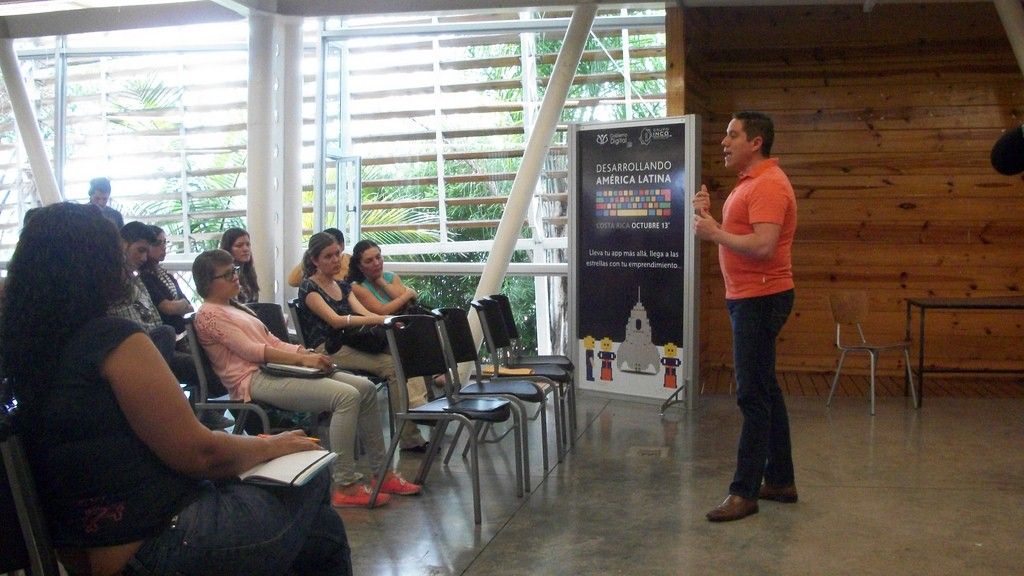
Author/Copyright holder: Desarrollando América Latina. Copyright terms and licence: CC BY 2.0

Laying down rules at the start of an ideation session will help keep things on track throughout. Don’t be afraid to call people’s attention to the rules if they begin to bend or break.

Structuring Your Ideas

Once you’ve got some ideas coming it’s a good idea to group them around specific areas. Some common idea areas include:

  • Pain Points
  • Opportunities
  • Process Steps
  • Personas
  • Metaphors

When You Get Stuck

There are also some simple techniques to get the creative juices flowing when the ideas process gets stuck.

  • Breaking the law. List all the known project constraints and see if you can break them.
  • Comparisons. Taking a single phrase that encapsulates the problem and see if you can find real world examples of this.
  • Be poetic. Try to turn the problem into a poem or haiku. Thinking about the word structures can deliver new ideas.
  • Keep asking “how and why?” - These words make us think and create.
  • Use laddering. Move problems from the abstract to the concrete or vice-versa to consider them from another perspective.
  • Steal ideas. If you get stuck on a particular concept – look to other industries and see how they’ve handled something similar. Of course, in the end you should be emulating in design not copying.
  • Invert the problem. Act like you want to do the exact opposite of what you’ve set out to do – how would you do that instead?


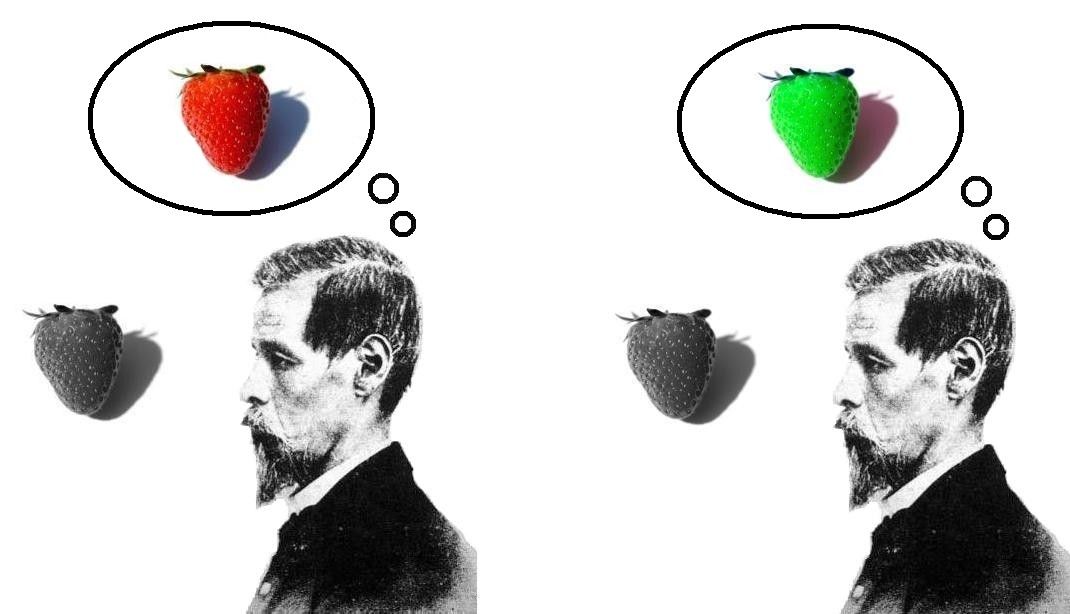
Author/Copyright holder: Was a bee. Copyright terms and licence: CC BY-SA 2.5

Even simple inversions can make us think very differently. Here the inversion of color changes the picture dramatically.

Review and Filter

Once you have a large number of ideas; you then need to review and filter these down to something more manageable. It is at this stage that ideas can be discarded as “bad”, kept as “good” or modified into something more useful. It’s best to carry out this exercise a little while after the initial ideation phase so that people have a chance to reflect on the ideation as well as become less personally attached to the original ideas.

The Take Away

Creating ideas is often best done in groups – though all the techniques above can be carried out by an individual too. The trick is to just create and keep doing so for an extended period of time. You can worry about works and what doesn’t later. Ideation is one of the most fun things a designer can do but it can also be frustrating if you try and do it by yourself sat in front of a piece of paper.

Hero Image: Author/Copyright holder: Martin Hamilton. Copyright terms and licence: CC BY 3.0

Feel Stuck?
Want Better Job Options?

AI is replacing jobs everywhere, yet design jobs are booming with a projected 45% job growth. With design skills, you can create products and services people love. More love means more impact and greater salary potential.

At IxDF, we help you from your first course to your next job, all in one place.

See How Design Skills Turn Into Job Options
Privacy Settings
By using this site, you accept our Cookie Policy and Terms of Use.
Customize
Accept all

Be the One Who Inspires

People remember who shares great ideas.

Share on:

Academic Credibility — On Autopilot

Don't waste time googling citation formats. Just copy, paste and look legit in seconds.