Once an ideation session like brainstorming, brainwriting or cheatstorming has finished, it’s time to collect, categorize, refine and narrow down the best idea, solution or strategy. Here are the best selection methods. They’re Sticky note voting, the Four Categories method, the Bingo Selection method and the Idea Affinity Diagram. The Six Thinking Hats and the Now Wow How Matrix will help you apply the idea criteria, which are right for your current design challenge. Here, you’ll learn how to work in the best way through the pile of ideas which you’ve generated and select the best ones.
Converging
At some point in your ideation session, you’ll have reached a critical mass of ideas, and it will become unproductive to try to keep pushing for more. This is different from the natural creative slumps that teams experience throughout ideation sessions, and means it is a good point to stop and focus on pruning. This is referred to as the “convergent stage”—where ideas are evaluated, compared, ranked, clustered and even ditched in an attempt to pull together a few great ideas to act on. Hang onto those unused ideas, though; they may prove useful in future ideation sessions as stokers or idea triggers. Right now, the aim is spotting potential winners, or combinations of winning attributes, from a number of ideas.
Dot Voting
© Teo Yu Siang and the Interaction Design Foundation, CC BY-NC-SA 3.0.
Best practice:
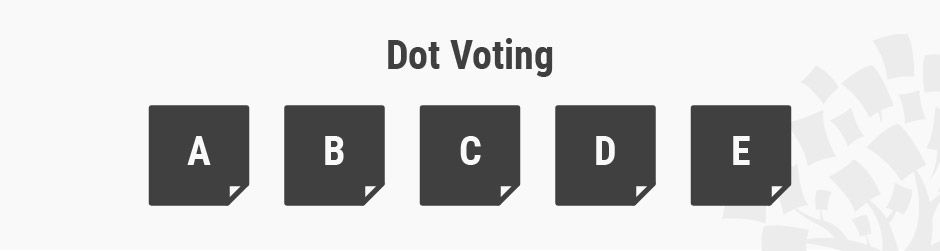
You write all of the ideas which have been generated in the ideation session down on individual sticky notes.
Then you give all participants a number of votes (around 3–4 should do) to choose and write down their personal favorite ideas.
Participants vote by using stickers or simply using a marker to make a dot on the ideas they like.
You can also use variations in color in order to let participants vote on which ideas they like the most or which they dislike the most.
You can invent other voting attributes when it makes sense.
This process allows every member to have an equal say in the shortlisted ideas.
Print and download our sticky note voting template to help you get started using the method:

Four Categories Method
© Teo Yu Siang and the Interaction Design Foundation, CC BY-NC-SA 3.0.
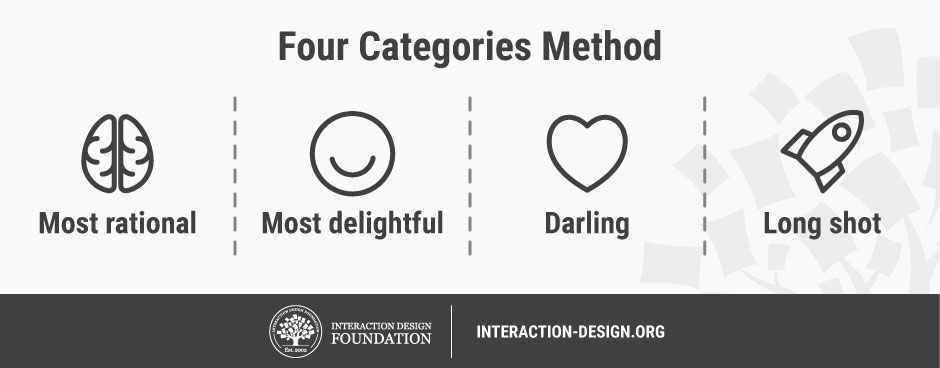
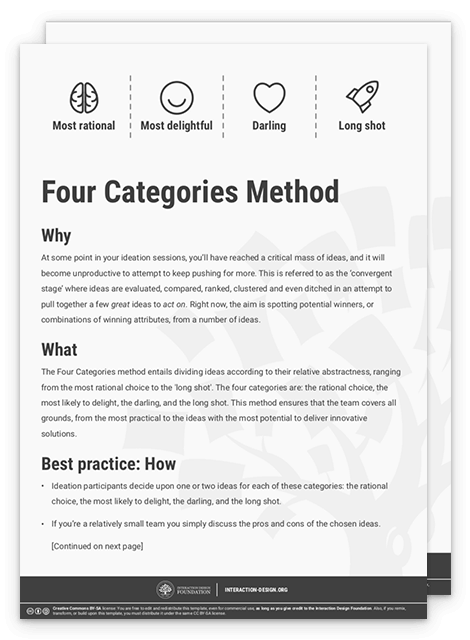
The Four Categories method entails dividing ideas according to their relative abstractness, ranging from the most rational choice to the “long shot”. The four categories are: the rational choice, the most likely to delight, the darling and the long shot.
Best practice: Ideation participants decide upon one or two ideas for each of these categories. This method ensures that the team covers all grounds, from the most practical to the ideas with the most potential to deliver innovative solutions.
Do you want to learn how you can get started using the Four Categories method? Then download and print our template:
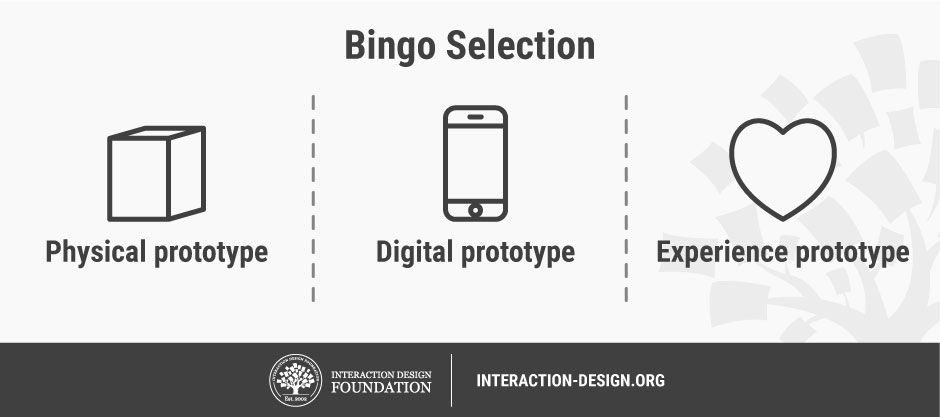
Bingo Selection
© Teo Yu Siang and the Interaction Design Foundation, CC BY-NC-SA 3.0.
Best practice: Similarly, the Bingo Selection method inspires participants to divide ideas. However, in this method, the facilitator should encourage the participants to split ideas according to a variety of form factors, such as their potential applications in a physical prototype, a digital prototype and an experience prototype.
Print and download our Bingo Selection template to help you get started using the method:
Idea Affinity Diagrams
© Teo Yu Siang and the Interaction Design Foundation, CC BY-NC-SA 3.0.
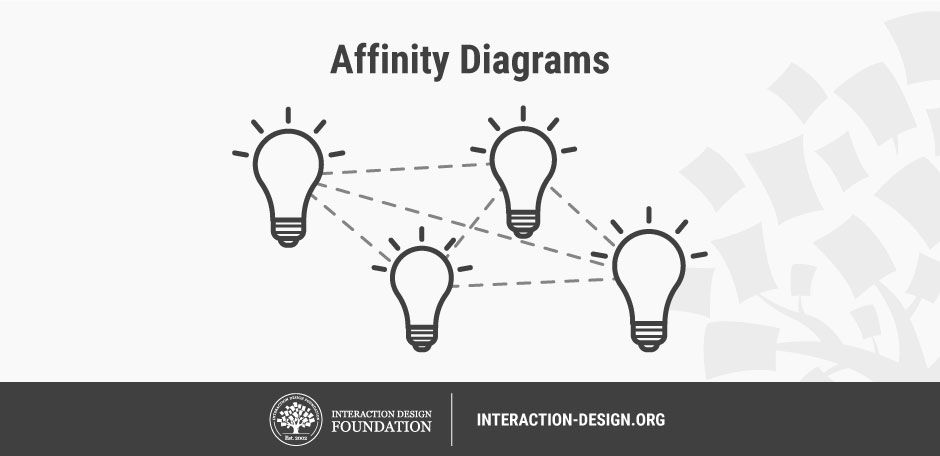
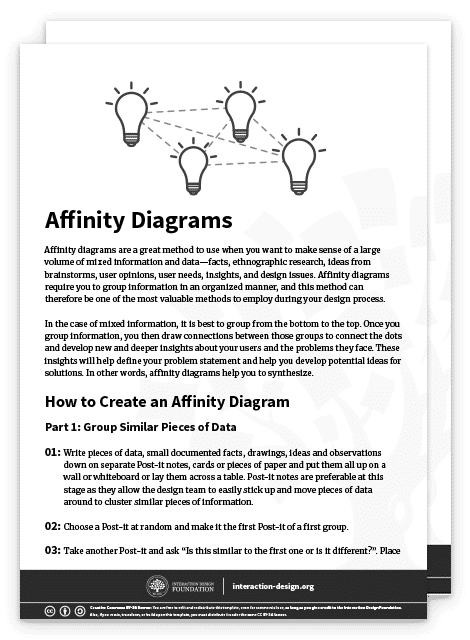
Use affinity diagrams or similar activities to cluster similar ideas together and make connections between them that will help you uncover patterns or themes that may be promising.
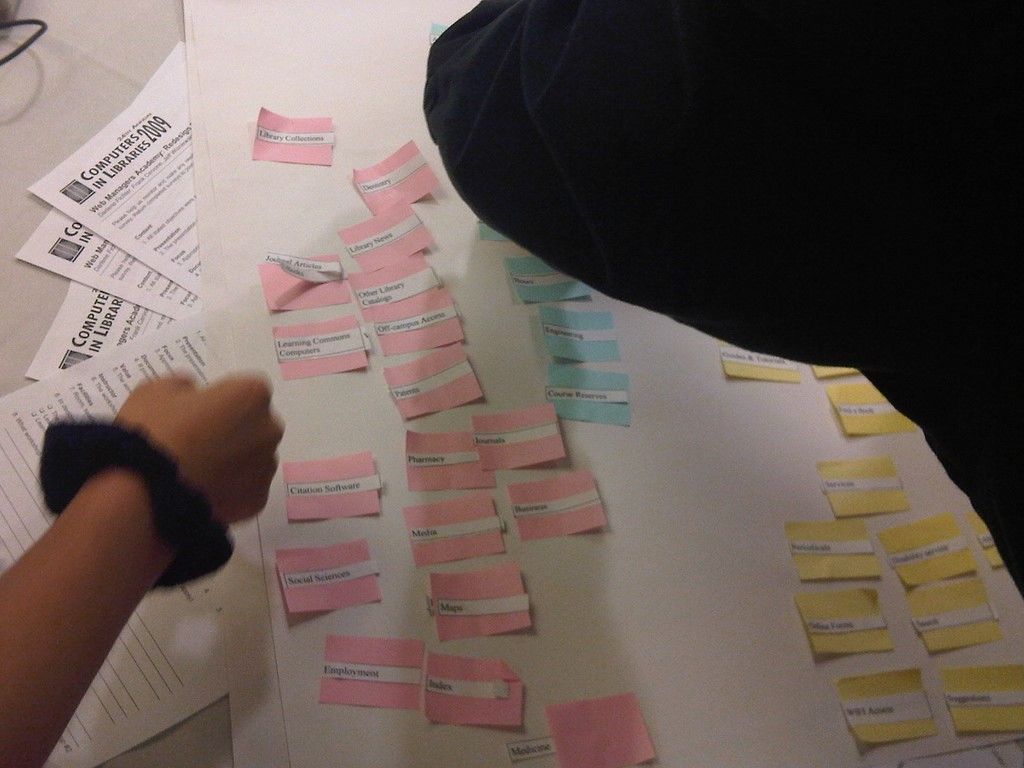
Best practice: Paste up all the ideas which you’ve collected in your ideation sessions—and then, as a group, make sense of these by clustering ideas which share attributes, eliminating duplicates and forming idea themes or concept themes. This will help you in the process of selecting the best ideas or idea themes.
© normad826000, CC BY 2.0.
Print and download our Affinity Diagram template to help you get started using the method—which you can see in action in the above picture:
Idea Selection Criteria
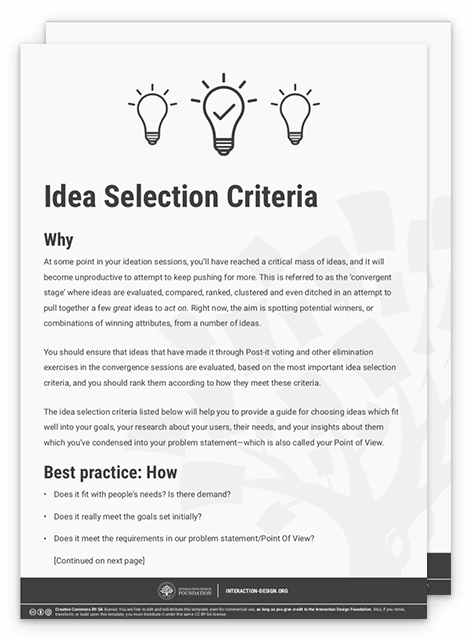
You should ensure that ideas that have made it through sticky note voting and other elimination exercises in the convergence sessions (just described above) are evaluated, based on these selection criteria, and you should rank them according to how they meet these criteria. These idea selection criteria will help you at this stage to provide a guide for choosing ideas which fit well into your goals, your research about your users and their needs and your insights about them which you’ve condensed into your problem statement—which is also called your Point of View.
Does it fit with people's needs? Is there demand?
Does it really meet the goals set initially?
Does it meet the requirements in our problem statement/Point Of View?
Does it answer our “How Might We” questions in a satisfying way?
Is it different enough from what exists to add additional value?
Do we have access to the budget—enough to implement even partially?
Is the technology available?
Will we be able to roll it out with the available resources?
Can we get approval from decision makers?
Print and download our Idea Selection Criteria template to help you get started considering the most important criteria when you select your best ideas.
Now Wow How
© Teo Yu Siang and the Interaction Design Foundation, CC BY-NC-SA 3.0.
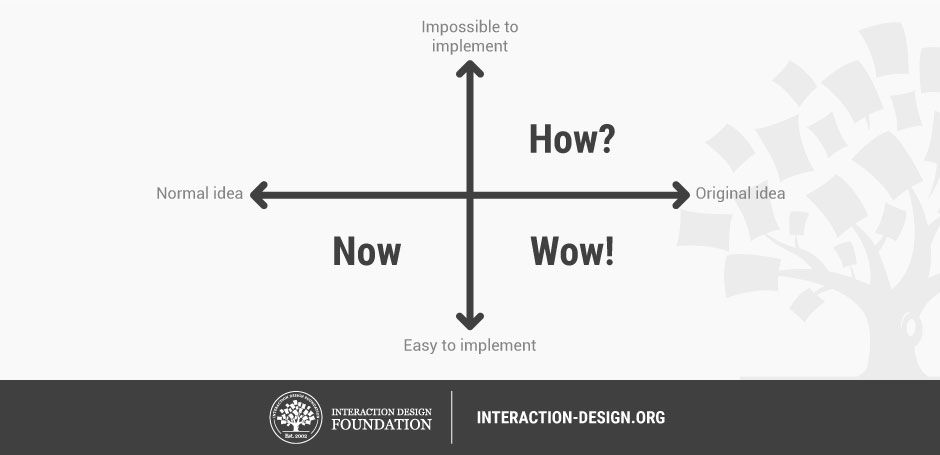
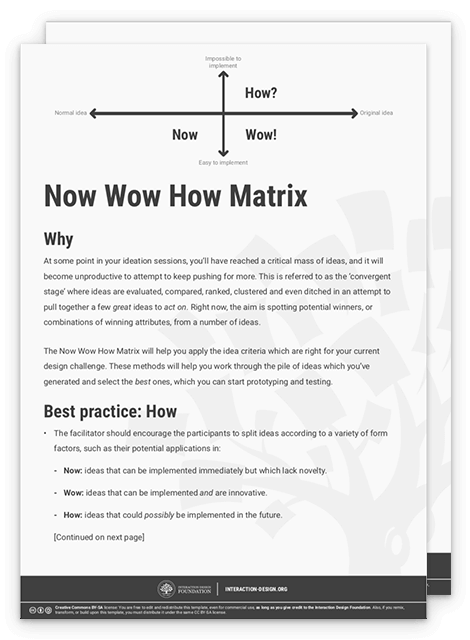
The Now Wow How Matrix provides a mechanism for evaluating ideas on a scale of:
Now: ideas that can be implemented immediately but which lack novelty.
Wow: ideas that can be implemented and are innovative.
How: ideas that could possibly be implemented in the future.
The Now Wow How Matrix should contain two axes, with the vertical representing difficulty of implementation and the horizontal axis representing the degree of innovation. On the 2 x 2 grid formed, the three categories are located at the bottom left (now), bottom right (wow) and top right (how), with the top-left block left blank to represent ideas which are impossible to implement. It provides an easy-to-follow formula for evaluating the viability of ideas as well as their innovativeness. Provide participants with colored dot stickers, each representing one of the categories, allowing group participants to vote on where they think ideas should be pitched on the scale. You can also develop custom graphs with finer levels of gradation for a broader scale assessment of the many ideas.
Print and download our Now Wow How template to help you get started using the method:
Idea Selection – Apply Edward De Bono's Six Thinking Hats

© Teo Yu Siang and the Interaction Design Foundation, CC BY-NC-SA 3.0.
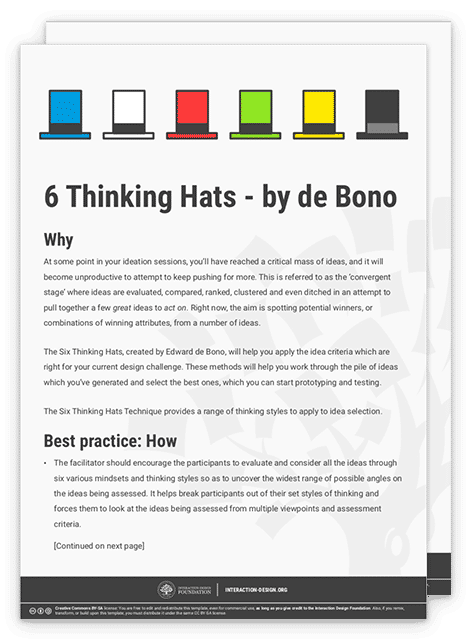
The Six Thinking Hats technique provides a range of thinking styles to apply to idea selection. It involves purposely evaluating and considering ideas through various mindsets so as to uncover the widest range of possible angles on the ideas being assessed. It helps break participants out of their set styles of thinking and forces them to look at the ideas being assessed from multiple viewpoints and assessment criteria.
White Hat: The White Hat calls for information which is known or needed. It’s all about this: “The facts, and nothing but the facts.”
Yellow Hat: The Yellow Hat symbolizes optimism, confidence and brightness. Under this hat, you explore the positives and probe for value and benefit.
Black Hat: The Black Hat is all about judgment. When you put on this hat, you’re the devil's advocate where you try to figure out what or why something may not work. It’s now your job to spot the difficulties and dangers and ask where things might go wrong. This is probably the most powerful and useful of the hats, but it’s a problem if you overuse it.
Red Hat: The Red Hat calls for feelings, hunches and intuition. When you use this hat, you should focus on expressing emotions and feelings and share fears, likes, dislikes, loves and hates.
Green Hat: The Green Hat focuses on creativity: the possibilities, alternatives and new ideas. It's your opportunity to express new concepts and new insights.
Blue Hat: The Blue Hat is used to manage the thinking process. It's your control mechanism that ensures the Six Thinking Hats guidelines are observed.
Print and download our Six Thinking Hats template to help you get started using the method:
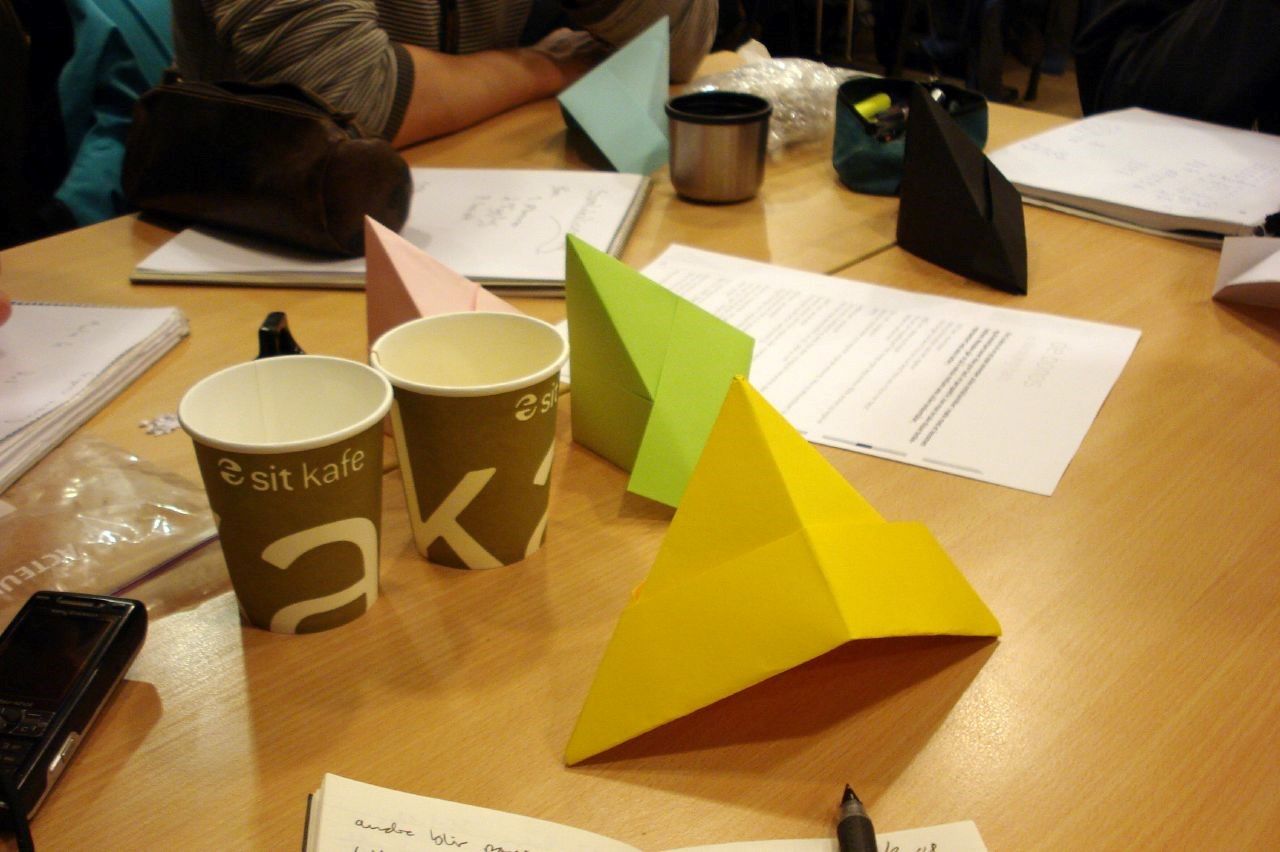
When assessing ideas, we can use the Six Thinking Hats to evaluate them from a range of angles in order to avoid cognitive bias in decision making and to evaluate ideas fairly, based on a holistic outlook.
© Lars Kristian Flem, CC BY-NC 2.0
Lean Startup Machine Idea Validation Board
Lean methodologies—with their roots in Toyota's production system—are making their way into every sector due to their light footprint and potential to speed up decision-making and project cycles dramatically. The crux of the methodology centers on testing assumptions as early as possible in order to avoid venturing too far down the wrong paths. The Lean Startup Machine is a three-day intensive series of workshops by Trevor Owens, which emerged out of the movement instigated by Eric Ries' book Lean Startup. The Lean Startup Machine Validation Board is a tool which enables the validation of ideas based on the lean startup methodology.
The premise of this approach is starting off with a set of related hypotheses:
Customer Hypothesis
Problem Hypothesis
Solution Hypothesis
We interrogate and test these three related hypotheses. If we cannot validate them, we pivot on them so as to move towards a more valid set of hypotheses that will help build an innovation foundation, one which is viable and addresses a real need.
Project Cycle Example
Google Ventures 5-day design sprints series details their process of rapidly assessing new opportunity areas, generating ideas, selecting those ideas and then testing them. Their Day 2: Diverge and Day 3: Decide serve as illustrations of how ideation’s divergent and convergent phases play themselves out in a technology startup environment.
What to Do With the Winning Ideas?
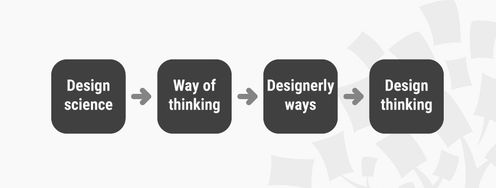
With a series of ideas (the third stage in the Design Thinking process) ready to be prototyped (the fourth stage in Design Thinking) for further testing (the fifth stage) and validation, you're ready to move on to these next stages of the Design Thinking journey. Make sure you have significantly different ideas that make it to the last few so that you can test and explore a few different routes to a winner. Ideas that are very similar can be batch prototyped, with some variation in prototype iterations.
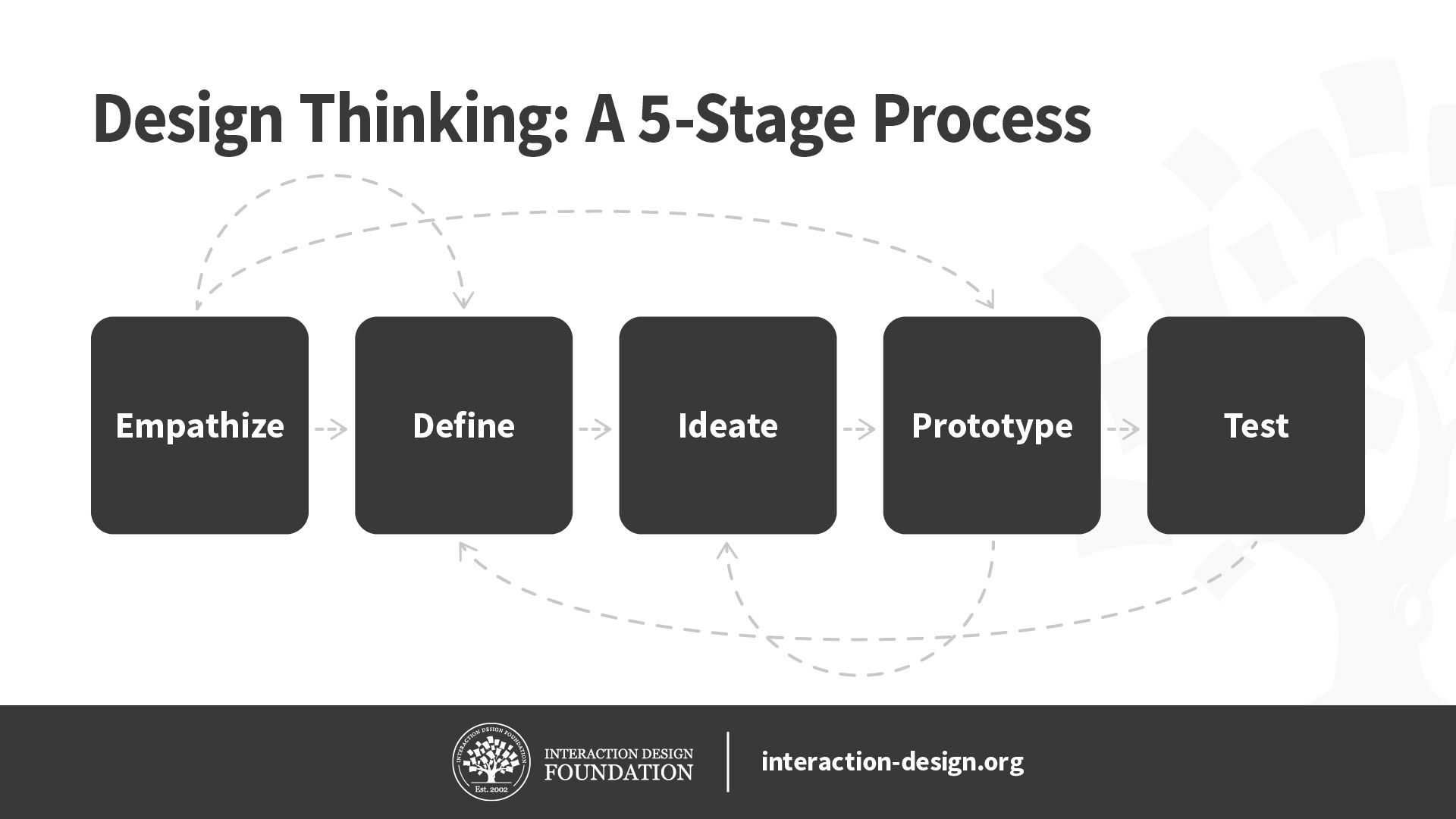
The five stages of Design Thinking are not sequential steps, but different “modes” you can put yourself in, to iterate on your problem definition, ideas or prototype, or to learn more about your users at any point during the project.
© Teo Yu Siang and Interaction Design Foundation, CC BY-NC-SA 3.0.
The Take Away
Once an ideation session has finished, it’s time to collect, categorize, refine and narrow down the best idea, solution or strategy. Here, we’ve explained how to use the best selection methods: Dot voting, the Four Categories method, the Bingo Selection method and the Idea Affinity Diagram. The Six Thinking Hats and the Now Wow How Matrix will help you apply the idea criteria which are right for your current design challenge. These methods will help you work through the pile of ideas which you’ve generated and select the best ones, which you can start prototyping and testing.
References & Where to Learn More
Haakon Faste, Chainstorming! Cheatstorming! 2013.
Dave Gray, Dot Voting, 2010.
Dave Gray, How-Now-Wow Matrix.
Edward De Bono, Six Thinking Hats.
Eric Ries, The Lean Startup Book, Movement, Methodology.
Jake Knapp, John Zeratsky and Braden Kowitz: Sprint: How to Solve Big Problems and Test New Ideas in Just Five Days, 2016
Jake Knapp, The product design sprint: diverge (day 2), Google Ventures, 2012.
Jake Knapp, The product design sprint: decide (day 3), Google Ventures, 2012.
Lean Enterprise Institute, What is Lean?.
IDEA HCD CONNECT, Participatory Co-Design, The HCD Toolkit.
Images
Hero Image: © amnestystudent, CC BY 2.0.