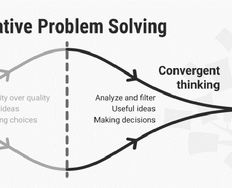
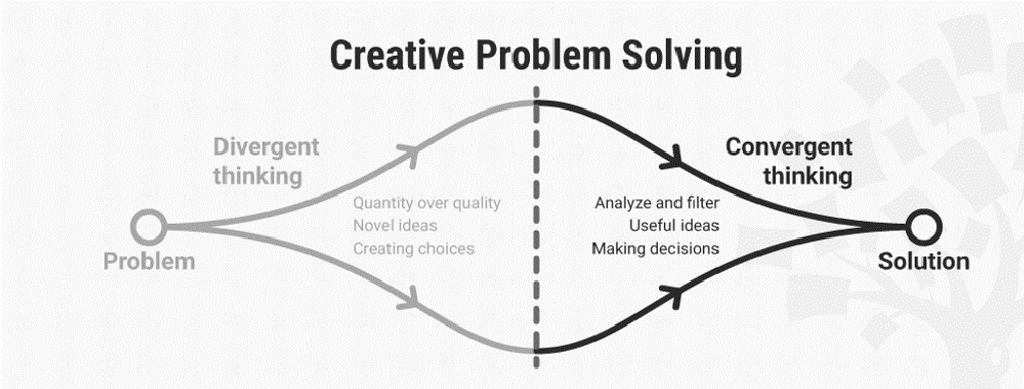
Convergent thinking is an ideation mode which designers use to analyze, filter, evaluate, clarify and modify ideas they have generated in divergent thinking. They use analytical, vertical and linear thinking to find novel and useful ideas, understand the design space possibilities and get closer to potential solutions.
“The best way to have good ideas is to have lots of ideas and throw away the bad ones.”
— Linus Pauling, Nobel Prize-winning chemist, biochemist, chemical engineer, peace activist, author and educator
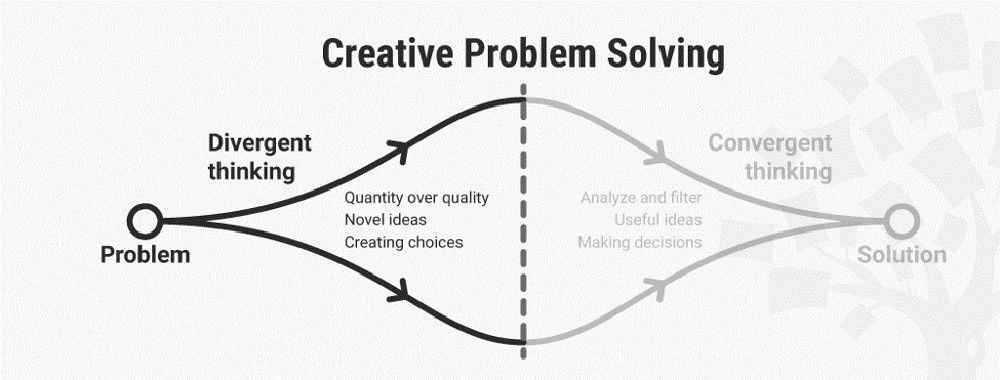
Convergent and divergent thinking
Convergent Thinking – the Other Side of the Ideation “Coin”
After design teams generate as many ideas as possible in the divergent thinking part of ideation sessions, convergent thinking helps them systematically see whether their ideas might work as real-world solutions. The structure is to:
Sift through ideas.
Group them into themes.
Find common threads.
Decide on winners and losers.
Convergent thinking helps tighten your focus when evaluating each idea. For example, if your design problem concerns users with errands, one idea might be an app for users to control their cars remotely to send/collect goods. You’d then examine it through three lenses:
Desirability – “Would users want this?” (Or would they fear accidents, hacking, theft, etc.?)
Viability – “Could a brand mass-produce and support it?” (Or would it be unsustainable/too expensive?)
Feasibility – “Is it doable?” (Or would security, sensory and emergency-backup features take years/decades to perfect?)
Then, considering state-of-the-art technology and other factors, you might abandon this idea as impracticable or shelve it for future consideration.
See Ideas in a New Light with Convergent Thinking
Convergent thinking isn’t a clinical process that automatically results in optimal solutions. Rather, you need a careful, creative mindset to:
Look past logical norms (which we use in everyday critical thinking);
See how an idea stands in relation to the problem; and
Understand the reality/dimensions of that problem.
As you work more insightfully, you can begin to understand the idea in the context of what’s going on in the problem domain. And only with an accurate understanding of the problem can you determine the best criteria to judge an idea with. Otherwise, it’s easy to overlook the problem domain’s complexity and apply just your existing knowledge (e.g., “It looks like something that a mega menu could help with.”). Some dimensions of it may be unlike anything you’ll recognize. By studying problems and ideas on their own terms, though, you can avoid misidentifying them with assumptions.
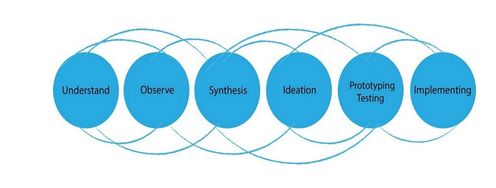
Thinking convergently helps overcome many obstacles, even if alternative ideas can also cause problems. Sometimes, a clearer understanding might show you the best solution straightaway. Or you might use that understanding to generate new ideas and newer understandings. Whether you’re fine-tuning novel ideas through thought-provokingly fresh lenses or suddenly finding yourself inspired to work on a prototype to test, convergent thinking helps advance your creative process. That’s why it’s vital in a design process such as design thinking.
© Teo Yu Siang and Interaction Design Foundation, CC BY-NC-SA 3.0
How to Use Convergent Thinking to Find Novel and Useful Ideas
Some techniques to help you focus creatively are:
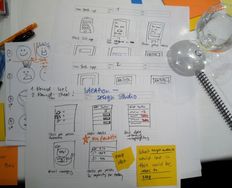
Externalization – You sketch ideas to make all the tacit knowledge and underlying assumptions about your project visible and then identify that knowledge (including its limits) to help understand the problem domain.
Three-Way Comparisons – You compare three similar products to see how each differs from the other two.
More Specific and More General – You place some temporary constraints on your project to get a more specific overview to help you generate ideas, and you stand back to get a more abstract overview.
Embrace Opposites – You find overlaps between different categories or opposites to spot new design opportunities.
Multiple Classifications – You compare aspects of items using a matrix to widen your inspiration, spot market gaps, analyze trends and rules and examine related qualities.
Teasing Apart, Piecing Together (TAPT) – You break down an experience into its elements, reconstruct it with a better understanding of what’s involved and re-imagine it in a new context.