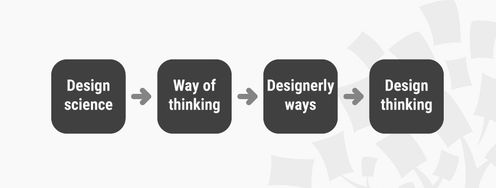
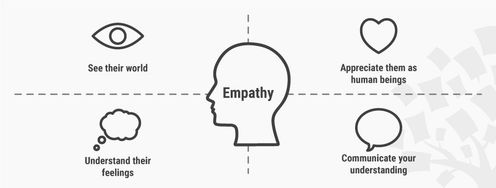
The term “Design Thinking” dates back to the 1987 book by Peter Rowe; “Design Thinking.” In that book he describes the way that architects and urban planners would approach design problems. However, the idea that there was a specific pattern of problem solving in “design thought” came much earlier in Herbert A Simon’s book, “The Science of the Artificial” which was published in 1969. The concept was popularized in the early 1990s by Richard Buchanan in his article “Wicked Problems in Design Thinking”.
Ralph Caplan, the design consultant, sums up the need for design thinking with; “Thinking about design is hard, but not thinking about it can be disastrous.”
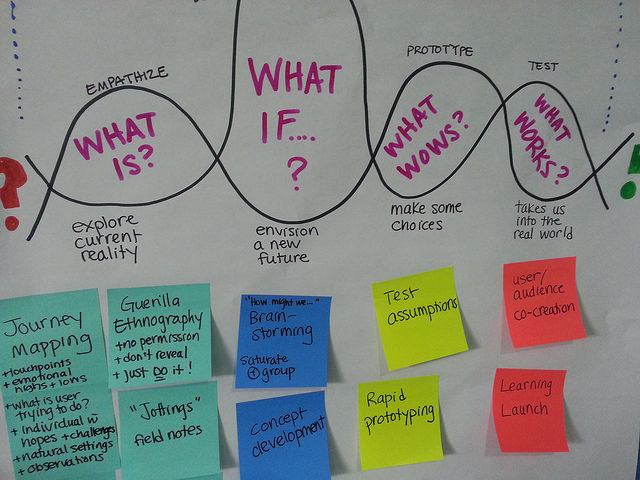
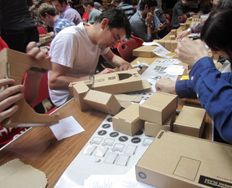
Author/Copyright holder: Christine Prefontaine. Copyright terms and licence: CC BY-SA 2.0
A simple overview of design thinking as a problem solving process.
Problem-Solving and Two Schools of Thought
Design thinking is concerned with solving problems through design. The idea being that the future output of the process will provide a better answer than the one already available or if nothing is available – something entirely new.
It is an unconstrained methodology where it is possible that the designer (or design team) will work on many possible solutions at once. It enables designers to consider the problem in many different ways and speculate on both the past and future of the problem too.
This is in contrast to the scientific method of problem solving which requires a highly-defined problem which focuses on delivering a single solution.
This difference was first noted by Brian Lawson, a psychologist, in 1972. He conducted an experiment in which scientists and architects were asked to build a structure from colored blocks. He provided some basic rules for the project and observed how they approached it. The scientists looked to move through a simple series of solutions based on the outcome and entire rule set. The architects, in contrast, simply focused on the desired end-state and then tested to see if the solution they had found met the rules.
This led to the idea that scientists solve problems by a process of analysis, whilst designers solve problems by synthesis. However, later evidence suggests that designers apply both forms of problem solving to attain “design thinking”.
They do this via a process of divergent thinking. A designer will examine as many possible solutions at the beginning of a process as they can think of – then they will apply the scientific side (convergent thinking) to narrow these solutions down to the best output.
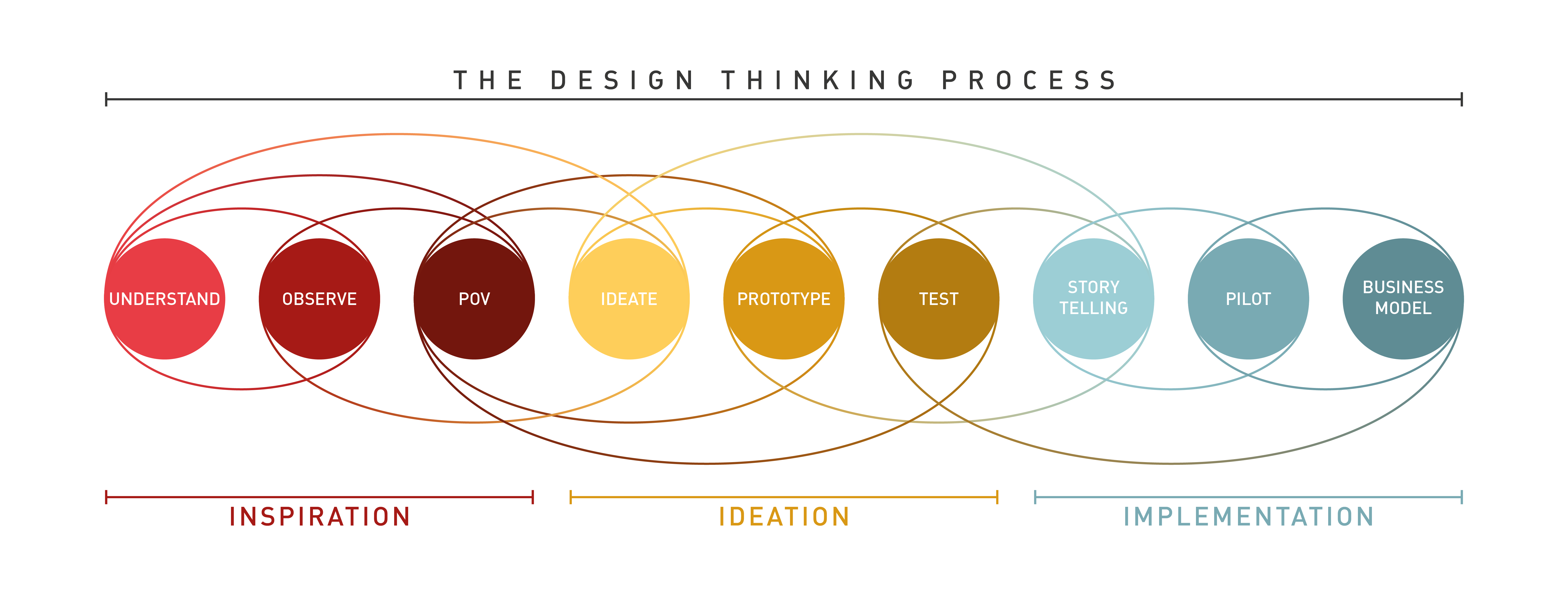
Author/Copyright holder: Paris-Est d.school at Ecole des Ponts . Copyright terms and licence: CC BY-SA 4.0
Design thinking can be as simple or as complex as the business and users require. This IDEO process can be seen as a 3 part process or a 9 part process.
The Design Thinking Process
Design thinking is essentially a process which moves from problem to solution via some clear intermediate points. The classic approach, as proposed by Herbert A Simon, is offered here:
- Definition – where the problem is defined as best as possible prior to solving it
- Research – where the designers examine as much data as they feel necessary to be able to fully contribute to the problem solving process
- Ideation – where the designer commences creating possible solutions without examining their practicality until a large number of solutions has been proposed. Once this is done, impractical solutions are eliminated or played with until they become practical.
- Prototyping – where the best ideas are simulated in some means so that their value can be explored with users
- Choosing – where the best idea is selected from the multiple prototypes
- Implementing – where that idea is built and delivered as a product
- Testing – where the product is tested with the user in order to ensure that it solves the original problem in an effective manner
There are many other design thinking processes outlined in literature – most of which are a truncated version of the above process combining or skipping stages.
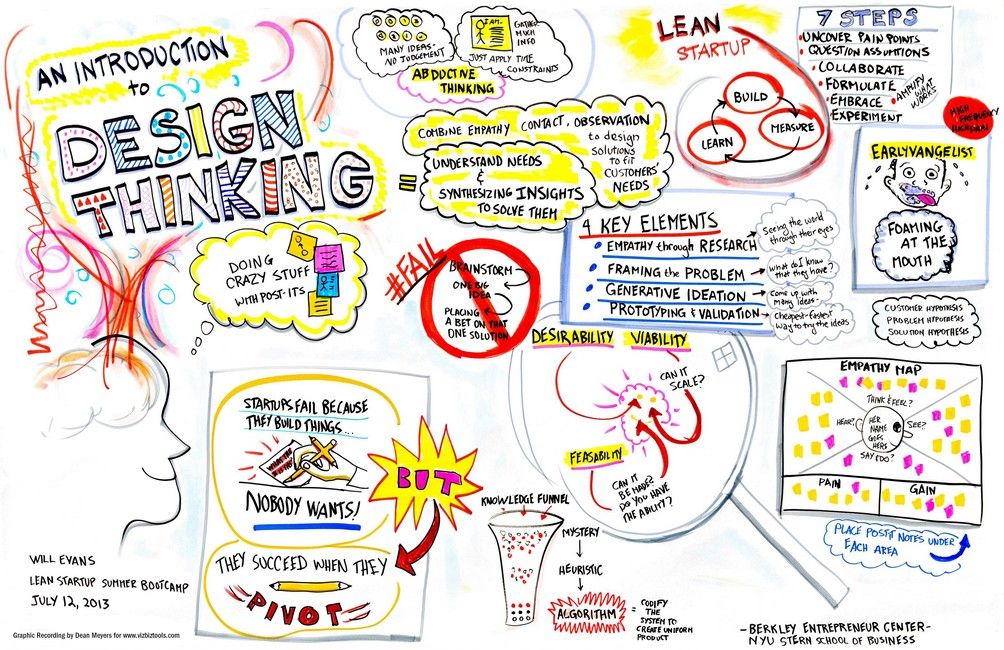
Author/Copyright holder: Dean Meyers . Copyright terms and licence: CC BY-ND 2.0
Here we see a more complex interpretation of the design thinking process and how it fits into the larger business sphere.
The Principles of Design Thinking
In the book, Design thinking: Understand, Improve Apply, Plattner and Meinel offer four underlying principles for design thinking:
- Human – all design is of a social nature
- Ambiguity – design thinking preserves and embraces ambiguity
- Re-design – all design processes are in fact re-design of existing processes
- Tangibility – the design process to make something tangible will facilitate communication of that design
It is also worth noting that design thinking functions independently of the design methods employed in any given design process. Design methods are the tools employed (such as interviews, user research, prototypes, etc.) and the assumption is that there are many paths that may be used (e.g. different sets of methods applied) to reach the same “best” result.
Visuals and Design Thinking
Firstly, it is important to acknowledge that design thinking is not about graphic design per se. However, designers are often used to communicating their thinking visually and drawings, sketches, prototypes, etc. are often used to convey the ideas created within a design thinking process.
In fact, ideas which are hard to express easily in words are often given shape in the form of visual metaphors. Design thinking thus easily incorporates abstract thought processes – something that scientific thinking may find more challenging to accommodate.
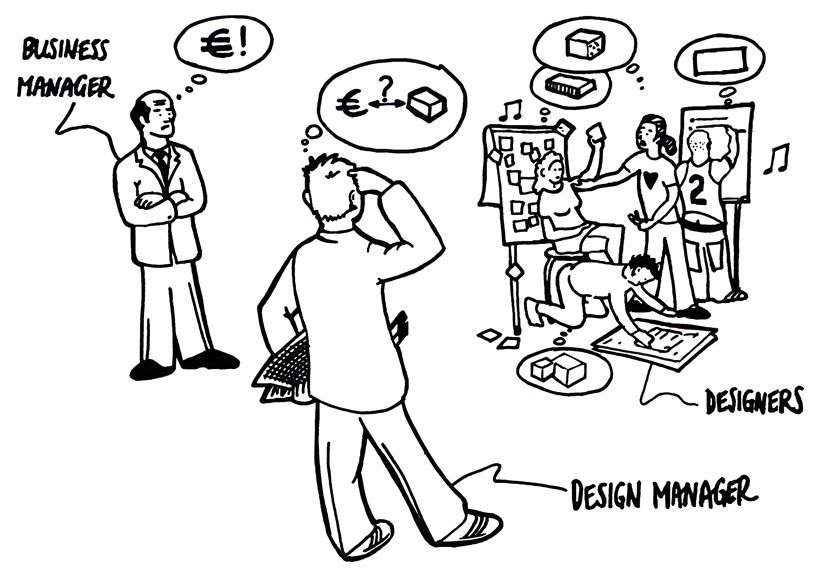
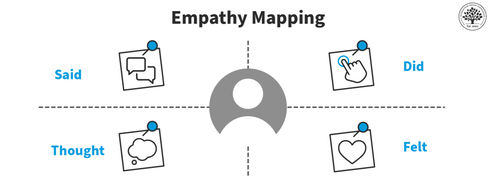
Author/Copyright holder: Wiki4des . Copyright terms and licence: CC BY-SA 3.0
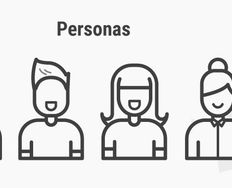
Visual representations of how those involved in the design process might be thinking about a problem.
The Take Away
Design thinking is a process by which designers approach problem solving. It incorporates analytical, synthetic, divergent and convergent thinking to create a wide number of potential solutions and then narrow these down to a “best fit” solution. There are many ways to use a design thinking process to incorporate different methodologies to still reach the same end point. Designers must solve problems in order to add value through design.
Resources
Richard Buchanan’s original article "Wicked Problems in Design Thinking," was published in Design Issues, vol. 8, no. 2, Spring 1992.
Peter Rowe’s book from 1987 Design Thinking was published byCambridge: The MIT Press. ISBN 978-0-262-68067-7.
Herbert A Simon’s book from 1969 The Sciences of the Artificial. Was published by Cambridge: MIT Press.
Plattner, Hasso; Meinel, Christoph; Leifer, Larry J., eds. (2011). Design thinking: understand, improve, apply. Understanding innovation. Berlin; Heidelberg: Springer-Verlag. pp. xiv–xvi.doi:10.1007/978-3-642-13757-0. ISBN 3642137563.
This fascinating case study looks at how IBM plans to bring design thinking to large scale businesses - http://www.wired.com/2016/01/ibms-got-a-plan-to-bring-design-thinking-to-big-business/
See how Pepsi’s CEO, Indra Nooyi, implemented design thinking in her organization - https://hbr.org/2015/09/how-indra-nooyi-turned-design-thinking-into-strategy
Harvard Business Review examines design thinking and how it translates into action here - https://hbr.org/2015/09/design-for-action
Hero Image: Author/Copyright holder: Wikimedia Deutschland e. V. Copyright terms and licence: CC BY-SA 4.0