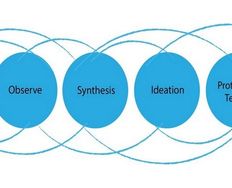
Facilitating ideation sessions involves an understanding of human thinking and mental modes as well as a whole range of factors like creating the right environment and goals, which we’ll introduce you to here.
“Ideation is the mode of the design process in which you concentrate on idea generation. Mentally it represents a process of ‘going wide’ in terms of concepts and outcomes. Ideation provides both the fuel and also the source material for building prototypes and getting innovative solutions into the hands of your users.”
– d.school, An Introduction to Design Thinking PROCESS GUIDE
Elements that Influence Ideation Sessions
Mental or Thinking Modes: Understand and purposely adopt the mental modes required to successfully generate the right kind of ideas.
People dynamics: Understand and manage the people dynamics and maintain group cohesion in order to leverage the collective cognitive power of the team and avoid people-related stumbling blocks.
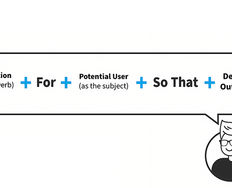
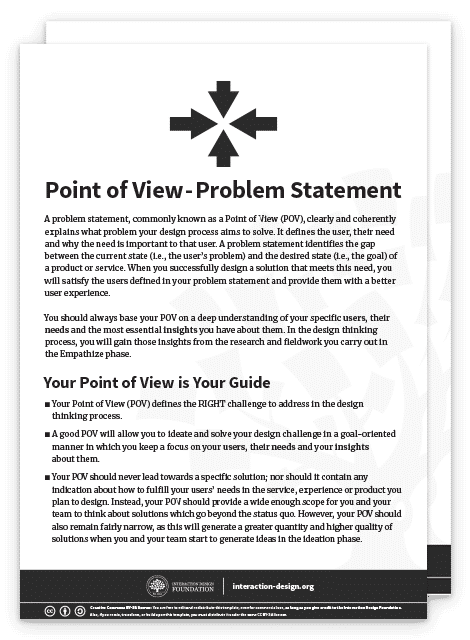
Clear Goals: Know the objectives and understand the goals, users, needs, wants, and associated problems. You should articulate these as a problem statement (also known as a Point Of View) before you start ideating.
Tools and Methods: Make use of the appropriate ideation methods and associated tools and artifacts, to facilitate the process and navigate the challenges of ideation.
Constraints: Know how to apply and make use of the right kind of constraints in order to generate ideas that match the team’s objectives.
Stimulus: Gather and appropriately use stimuli which, in combination with the right mental modes, can overcome idea generation inhibitors.
Environment: Set up and maintain a physical and social space that provides openness, freedom of expression, and creative energy.
Here, you can download our template to help you crystallise your problem statement:
Mental or Thinking Modes
Ideation relies on the interplay between a range of cognitive processes and mental modes or mindsets. Achieving the best results requires that you purposefully select only the relevant modes and apply them, switch between them and mix them to produce unconventional recipes from the same set of inputs.
Vertical Thinking – Linear Thinking
Vertical Thinking is the type of thinking within which problem solving in traditional organisational settings and academia generally falls. It is based on pure logic, past data and existing solutions, possibly with some form of reductionism or streamlining of what exists. It is best to use vertical thinking after the initial divergent stages (please see below) of ideation and towards the end, where you need to choose one or more specific ideas to flesh them out in more detail and streamline them.
Binary Thinking
Binary thinking serves to see the world through a yes/no right/wrong lens. In other words: black or white. There is no room for exploration, gradation, or ambiguity. This is the antithesis of innovation or human-centred problem solving. With so much complexity to consider, solutions need to span across a spectrum of needs, which requires broader, more holistic cognitive processes to consider fully.
Lateral Thinking – Horizontal thinking
Horizontal thinking, unlike vertical thinking, is used to investigate wider not deeper. The opposite of lateral thinking is vertical/linear thinking, which is about being analytical, careful and precise and finding logical solutions. Lateral thinking involves solving problems through an indirect and creative approach. It’s all about using reasoning that is not immediately obvious and involving ideas that may not be obtainable by using only traditional step-by-step logic.
World-renowned thinking guru, Edward De Bono, coined the term, Lateral Thinking, in 1967 in his book New Think: The Use of Lateral Thinking. De Bono is also the inventor of the famous Six Thinking Hats technique and a host of other creative thinking techniques and methods. Edward de Bono is a major force in British creative thinking and he has doctorates from both Oxford and Cambridge University.
The purpose of lateral thinking is to break out of rigid thought patterns and to generate unpredictable ideas. Achieving this requires the purposeful application of a range of techniques, which depends on the area of focus. Lateral thinking seeks to arrive at unknown solutions, as opposed to vertical thinking, which operates directly on perceivable data and analysis.
Lateral thinking is very much about standing back, looking at the big picture, and understanding concepts. It also requires that you focus on the parts that have perhaps been overlooked, challenging assumptions, and seeking alternatives.
Edward De Bono believes creative thinking is not so much a talent but a learnable skill. We can all learn to apply specific techniques to help our mind break out of unproductive patterns of thinking. A good way to learn it is through examples and provocation techniques.
Provocations in Lateral Thinking
Lateral thinking techniques include the following provocations in order to stimulate unconventional ways of looking at things. In simplest terms, a provocation can be thought of as an idea which you consider too radical and unrealistic for a regular brainstorming session.
The purpose of the provocation is to force your mind to move out of your comfortable mental patterns and instead allow you to come up with potentially radical solutions to the problem at hand:
Randomisation
Contradiction
Reversal
Distortion
Exaggeration
Insight or Theme Mining
Analogies
Questioning the Norms
Wishing and Dreaming
Escapism
Breaking Assumptions
Two thinking techniques that are quite effective at structuring lateral thinking and broadening the scope of input being used to stimulate ideas, are De Bono's 6 “Thinking Hats technique” and the SCAMPER method. Both of these techniques categorise thinking styles into set patterns and allow for the purposeful choice of each style at any given time to stoke alternative cognitive approaches to the challenge. This disrupts the patterns of thinking and allows reflection that is more intentioned. Implementing these techniques, however, requires a good level of awareness from the participants or the ideation facilitator, to know when to call for a pause and redirect the group's thinking or even apply a new thinking trigger to the process.
 Author/Copyright holder: Teo Yu Siang and Interaction Design Foundation. Copyright terms and licence: CC BY-NC-SA 3.0
Do you want to learn how you can get started using Edward De Bono's 6 Thinking Hats technique for your next design project and ideation session? Then you can download and print this template:
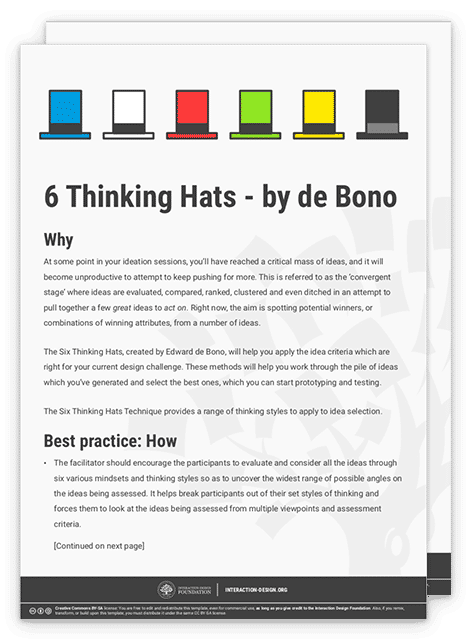
Disruptive Thinking
One of the most successful approaches to problem solving, idea generation and innovation is the concept of disruption, which involves looking at an existing paradigm and turning it on its head. The aim of disruption involves considering existing assumptions and overturning them to make what seemed impossible, possible. It requires the application of lateral thinking processes to arrive at paradigm shifts. In stories, these may represent the twist in the tale.
Three modes of thinking in Ideation Sessions
1. Divergent Thinking
Early stage divergent thinking takes the form of generative cognitive activity, where the quantity of ideas is more important than quality. Visually, you may imagine two lines opening up from a single point like a less than sign ( < ). This indicates that the thinking starts at a single point of focus and expands further and further adding more novel combinations as time progresses.
2. Emergent Thinking
This is an in-between thinking style, which leverages ideas generated in the early divergent stage as stimuli to allow the generation of additional ideas. It is a building upon phase, in which new connections, mix-ups and ideas are sparked from the pile of ideas generated during early phases. Usually what emerges out of these later thinking sessions would not have been possible without the early, more chaotic divergent sessions, providing a wide enough range of stimuli. Many ideation methods rely on trigger stimuli to provide a platform out of which new ideas can emerge.
3. Convergent Thinking
Convergent thinking is at the opposite end of ideation sessions, and involves closing off these sessions by sifting through ideas, grouping them into themes, picking out common threads and ultimately deciding upon winners and losers. Ideation and Design Thinking is not a wild frenzy of chaos. Impractical or impossible solutions do need to be weeded out, or at least the overly ambitious ones need to be shelved for later consideration in certain cases. This is where you make decisions through the lenses of desirable, viable and feasible. It doesn't end with these decisions though, as this is merely the first phase of pruning to prepare a few of the best ideas for prototyping and field validation. Convergent thinking relies on a more vertical, rational style of thinking, though it still needs to maintain a good enough degree of creativity so that ideas with merit are not rejected merely because they do not follow logical norms.
Clear Goals and Problem Statement
Whether or not your team has the greatest minds on the planet, including expert facilitation at hand, without a clear enough map, they could easily get lost in ideation twilight zone. Ideation can go in so many different directions that the possibilities are almost infinite. Understanding the challenge at hand, the goals and objectives, the user, the needs and wants of the targeted market and a range of other constraints help put much more focus into ideation sessions. A random constraint-less ideation session could invigorate the team and be lots of fun, while wasting time and producing nothing of value. It’s only when you frame the challenge/problem statement/Point Of View clearly that you can steer the ship in the right direction.
Stimulus
Having information, artifacts, idea stoking material, or stimulus help provide levers for lifting the collective cognitive load. Stimulus sparks new connections and thinking pathways, which can help lead to unexpected and unconventional ideas. The stimulus applied depends on the needs of the group, whether it is some input in the form of personas, affinity diagrams, imagery, analogies, key words, quotes, stories, or even video collages to get the collective neurons firing. Understanding the type of stimulus needed at any given time is the role of the facilitator.
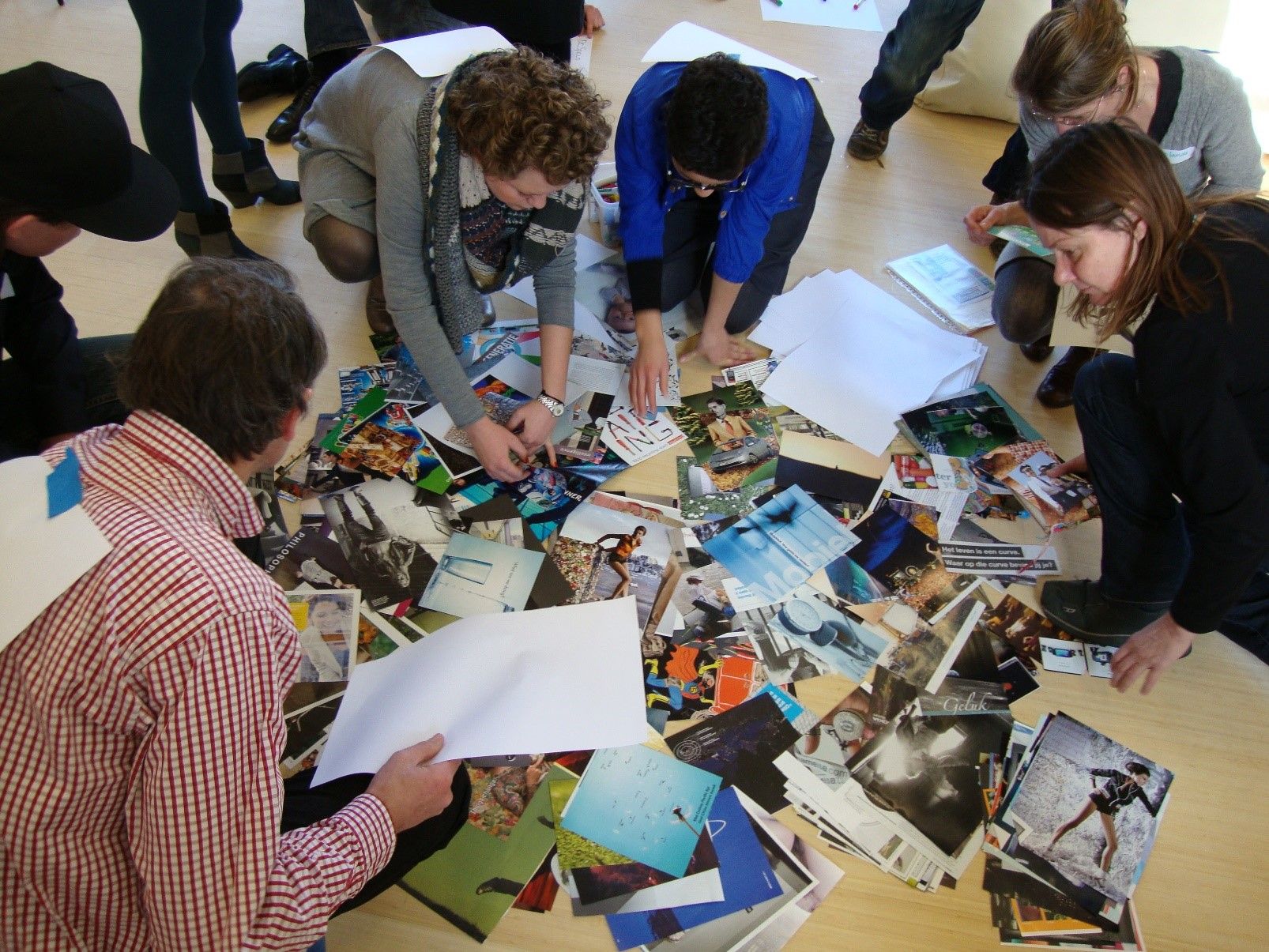 Author/Copyright holder: Kennisland. Copyright terms and licence: CC BY-SA 2.0
Stimulus such as images of the users and quotes from them help sparks new connections and thinking pathways, which can help lead the designers to unexpected and unconventional ideas.
Team Leadership and Human Psychology
As we find when exploring the nitty gritty of innovation teamwork, we know diversity rules. Bringing together a multi-disciplinary team that incorporates a wide range of thinking styles helps provide that much needed diversity. Add to that openness, mutual respect, and a bar on egos at the door, and you're much closer to the type of radical collaboration on which Design Thinking thrives. Ideation facilitation requires experience and expertise in a range of people dynamics, not to mention an understanding of the principles and methods to be implemented. Investing in external skills or internal facilitation and creative leadership training is important for any organisation that has a continuous need for creative solutions. The book Rise of the DEO by Maria Giudice and Christopher Ireland is full of characteristics required of creative leadership, including empathy, social intelligence, ambiguity, risk taking, being hands on, being a change agent and applying intuition.
Ideation facilitators and creative leaders need to be acutely aware of those they are leading, their mental modes, their cognitive and creative aptitudes, and how best to leverage these to produce innovative results.
Environment
When you plan an ideation session or a design thinking session, it’s important that you choose or create the right location as it will have a significant impact on the outcome. The importance of appropriate space cannot be underestimated in the ideation process, as the effects of space on people's attitudes, thinking and collaboration will directly impact on the quality of output from ideation sessions.
The ideation space should ideally be located away from the normal work environments, which can stifle creativity or remind participants of stressful activities and time pressure. Participants should be cut off from interference from other co-workers or continuing work activities that may distract them. Distractions of this nature will prevent them from fully focussing on the task at hand, due to their minds wandering to other tasks that need to be completed across the hall.
The Take Away
Facilitating ideation sessions involves an understanding of human thinking and mental modes. Ideation relies on the interplay between a range of cognitive processes and mental modes or mindsets. To achieve the best results requires that you purposefully select only the relevant modes and apply them, switch between them and mix them to produce unconventional recipes from the same set of inputs.
Vertical Thinking/Linear Thinking is based on pure logic, past data and existing solutions, possibly with some form of reductionism or streamlining of what exists. It is best to use vertical thinking after the initial divergent stages of ideation and towards the end, where you need to choose one or more specific ideas to flesh them out in more detail and streamline them. Binary thinking serves to see the world through a yes/no right/wrong lens. In other words: black or white. Lateral Thinking/Horizontal thinking is to investigate wider not deeper. Lateral thinking involves solving problems using an indirect and creative approach.
Divergent thinking: Early stage divergent thinking takes the form of generative cognitive activity, where the quantity of ideas is more important than quality.
Emergent thinking: This is an in-between thinking style, which leverages ideas generated in the early divergent stage as stimuli to allow the generation of additional ideas. It is a building upon phase, in which new connections, mix-ups and ideas are sparked from the pile of ideas generated in early phases.
Convergent thinking: Convergent thinking closes off the ideation sessions by sifting through ideas, grouping them into themes, picking out common threads and ultimately deciding upon winners and losers. This is where you make decisions through the lenses of desirable, viable and feasible. Convergent thinking relies on a more vertical, rational style of thinking, though it still needs a good enough degree of creativity so that ideas with merit are not rejected merely because they do not follow logical norms.
References & Where to Learn More
Edward de Bono, New think: The use of lateral thinking in the generation of new ideas, 1967
The de Bono Group. Six Thinking Hats.
Ella Miron-Spektor, Miriam Erez, and Eitan Naveh. To Drive Creativity, Add Some Conformity. Harvard Business Review, March 2012.
Bob Riley. The Provocation Creative Technique. ThoughtEgg.com.
Maria Giudice and Christopher Ireland, Rise of the DEO - Leadership by Design.
Hero Image: Author/Copyright holder: visualpun.ch. Copyright terms and licence: CC BY-SA 2.0