Deformation Professionnelle and the Dunning-Kruger Effect – When Expertise Isn’t So Great

• 7 min read

630 Shares

There can be quite a bit of confusion when you think about what the word “expertise” means. We all like to believe we have areas of expertise. However, sometimes, this leads to an over-estimation of our capacities. We fail to see our limits and how they might affect our results. A similar fairly painful outcome might happen when we only see the world from our professional lenses. Deformation Professionelle and the Dunning-Kruger Effect are cognitive biases related to expertise assessment that we have to be aware of and take action to prevent them from interfering with our work.

Let’s see how to do it!

Expertise is a matter of professional and personal pride. We need to demonstrate expertise to differentiate ourselves from other people who offer similar services and work that we do. It’s expertise that brings higher salaries than those who lack such expertise.

Sadly, there are times when expertise can obfuscate the way we see the world too. When that happens we can fail to think creatively or logically and we lower our levels of performance. Worse, this can impact on the user experience, the product and our clients too.

What is Deformation Professionelle?

Deformation professionelle (other than being a French term) is a cognitive bias. It stops us from seeing the world the way that most people see it. What it is, is a tendency to view the world through the eyes of our own profession. We stop seeing things as they are and see them only as a designer would view them.

This isn’t always a bad thing but it can be very limiting too. It’s a warning sign that we’ve become over-specialized in our approach. Not everything in life needs “design theory” applying to it and in fact, there are times when “design theory” is plain wrong in light of the facts.

There are situations when it’s better to take an intuitive or common approach to an idea or a problem or to tackle that problem from the perspective of an alternative profession.

When expertise runs wild; it can severely limit the way we solve problems and handle new ideas.
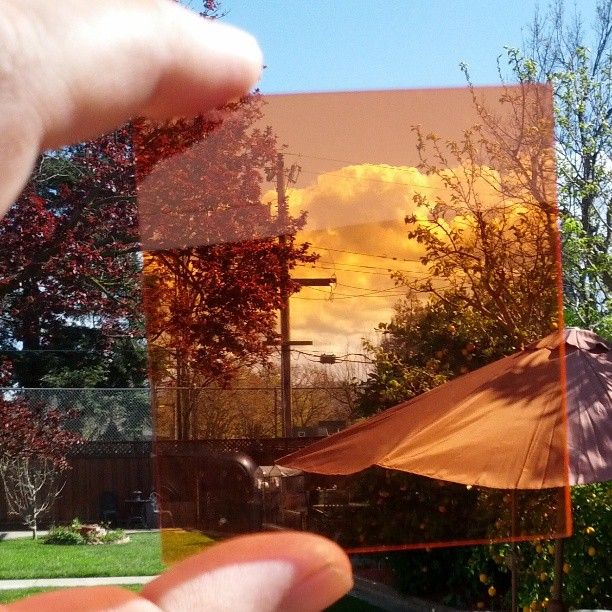

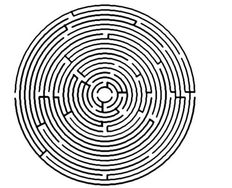
Author/Copyright holder: Kevin Marks. Copyright terms and licence: CC BY 2.0

What’s the Dunning-Kruger Effect?

The Dunning-Kruger effect appears at the other end of the expertise scale. It’s when we suffer from an illusion of expertise when in reality we’re not really all that skilled at something. In its worst form, it’s a belief that we’re good at everything because we’re good at something.

When people suffer from this bias – they have a tendency to massively over-estimate what their competence is in things that they’re not very good at.
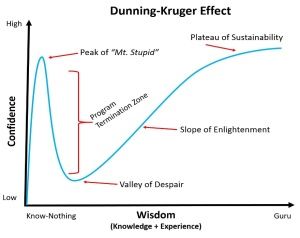

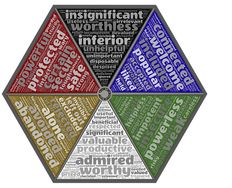
Author/Copyright holder: The YPS Group. Copyright terms and licence: All rights reserved Img source

The bias can also manifest when highly-skilled individuals (or experts as we call them) believe that because they have expertise and thus a task is easy to them; everyone has that expertise and thus the same task should be easier for others than it actually is.

How Do We Tackle These Biases?

If you find yourself prefacing your thoughts with; “Well design theory says…” or “It’s well known in design that…” you might want to take a step back and ask; “How would someone with no expertise see this?”


Author/Copyright holder: KoeppiK. Copyright terms and licence: CC BY-SA 3.0

You may then find yourself falling into the same trap as you progress through the process. Keep taking a step back and make sure you’re examining the problem through fresh eyes.

It can be harder to spot the Dunning-Kruger effect at play. You need to be able to ask yourself; “What do I really know about this situation?” and see if you’re over-estimating your ability to cope with a challenge and whether it needs a little more thought.

If you find that people around you are under-performing in your eyes; you might also want to ask “am I being fair?” Does the person actually have the expertise or should you be giving them more time to develop it?

As with all cognitive biases – tackling them by yourself can be incredibly challenging. That’s because we’re programmed (naturally) to not recognize our biases. You might want to consider enlisting the aid of a coach if you really want to rid yourself of these biases and become more effective.

The Take Away

Expertise can be extremely useful in our work; however, we shouldn’t become over-reliant on expertise – there are advantages to seeing the world with a fresh “non-design” pair of eyes at times. It can help us be more creative and get different perspectives on our work.

It’s also important not to become over-reliant on our image of ourselves as an expert. We cannot be experts at everything, and we cannot expect others always to share our expertise either. Knowing when to differentiate these circumstances can make us better at what we do and make it easier for others to work with us.

References & Where to Learn More:

A brutal but funny look at the Dunning-Kruger effect: Here’s Why Stupid People Don’t Realize They’re Stupid.

A slightly healthier perspective on the Dunning-Kruger effect: We are All Confident Idiots.

A case study in the destructiveness of Deformation Professionnelle.

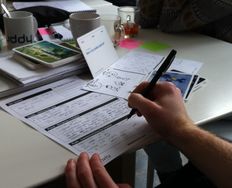
Hero Image: Author/Copyright holder: Stueckelberger.ch. Copyright terms and licence: All rights reserved. Img


Learn More in This Course:

AI for Designers

12 days
13 % booked
View Course

What You Should Read Next

  • Read full article
    User Research: What It Is and Why You Should Do It - Article hero image
    Interaction Design Foundation logo

    User Research: What It Is and Why You Should Do It

    User research is an essential part of UX design. Unless we understand who we are designing for and why, how can we even know what to create or where to begin? Depending on your project, requirements and constraints, you can choose different types of research methods, from surveys and tests to interv

    Social shares
    1.1k
    Published
    Read Article
  • Read full article
    14 Barriers to Ideation and How to Overcome Them - Article hero image
    Interaction Design Foundation logo

    14 Barriers to Ideation and How to Overcome Them

    Would you like to facilitate successful ideation sessions? Or would you like to learn how to contribute to ideation processes in your team more effectively? In either case, you should know the ideation traps and how you can prevent yourself and your team from falling into them. You should give the f

    Social shares
    920
    Published
    Read Article
  • Read full article
    The Bandwagon Bias – The Dangers of Groupthink - Article hero image
    Interaction Design Foundation logo

    The Bandwagon Bias – The Dangers of Groupthink

    Groupthink is dangerous to our objectivity. It prevents us from thinking for ourselves and making the best decisions. Designers need to be cautious about falling into the bandwagon bias trap but also be aware of how it can be exploited in their designs to improve user experiences and get users to ma

    Social shares
    817
    Published
    Read Article
  • Read full article
    The Illusion of Control – You Are Your Worst Enemy - Article hero image
    Interaction Design Foundation logo

    The Illusion of Control – You Are Your Worst Enemy

    Not everything in life is within our control. Believing that it is can be a serious handicap to getting things done in design work and most of life. Learning how to handle the illusion of control will make it much easier to accept things that aren’t within your control and focus your efforts on area

    Social shares
    751
    Published
    Read Article
  • Read full article
    The Bias Blind Spot and Unconscious Bias in Design - Article hero image
    Interaction Design Foundation logo

    The Bias Blind Spot and Unconscious Bias in Design

    It’s useful for designers to understand bias both so that they combat their own biases when they work and so that they can tap into the biases of their users to provide better user experiences. But what happens when we can’t acknowledge our own biases? That’s when we need to understand the bias blin

    Social shares
    742
    Published
    Read Article
  • Read full article
    Outcome Bias – Not All Outcomes are Created Equal - Article hero image
    Interaction Design Foundation logo

    Outcome Bias – Not All Outcomes are Created Equal

    Evaluating the outcomes of our actions makes sense. However, there is a cognitive bias where we place too much weight on the outcome and aren’t critical enough of the process by which we reached that outcome. Learning to avoid the outcome bias can help improve the quality of our decision making proc

    Social shares
    716
    Published
    Read Article
  • Read full article
    Confirmation Bias – It’s Not What We Think We Know That Counts - Article hero image
    Interaction Design Foundation logo

    Confirmation Bias – It’s Not What We Think We Know That Counts

    Confirmation bias is a pernicious form of bias that can cause real problems in both UX research and our own lives. Learning to recognize and eliminate confirmation bias leads to better decision making, better research and ultimately better products and user experiences.One of the most famous, and fl

    Social shares
    654
    Published
    Read Article
  • Read full article
    Extreme Aversion Bias – Sometimes the Risk is Worth the Reward - Article hero image
    Interaction Design Foundation logo

    Extreme Aversion Bias – Sometimes the Risk is Worth the Reward

    Playing it safe is a good strategy for much of the time. Yet, the biggest rewards often come with an element of risk. If we want our designs and our careers to take off – we need to overcome our aversion to taking an extreme option at times. That doesn’t mean becoming an inveterate gambler but rathe

    Social shares
    606
    Published
    Read Article
  • Read full article
    The Focusing Effect – Don’t Look Back With Too Much Optimism - Article hero image
    Interaction Design Foundation logo

    The Focusing Effect – Don’t Look Back With Too Much Optimism

    There’s a good reason that financial advisers tell us “past performance is no guarantee of future returns”. The focusing effect is a cognitive bias that causes us to attribute too much weight to events of the past and translate them into future expectations. Knowing how to handle the focusing effect

    Social shares
    602
    Published
    Read Article
  • Read full article
    Loss Aversion – Really, What’s the Worst that Can Happen? - Article hero image
    Interaction Design Foundation logo

    Loss Aversion – Really, What’s the Worst that Can Happen?

    There’s a cognitive bias that makes us sadder to lose something than it makes us happy to gain it. This causes us to be afraid of loss – even when that fear is illogical. It prevents us from taking small risks to make big gains, for example. Overcoming loss aversion can help you build better product

    Social shares
    563
    Published
    Read Article

Top Articles

Top Topic Definitions

Feel Stuck?
Want Better Job Options?

AI is replacing jobs everywhere, yet design jobs are booming with a projected 45% job growth. With design skills, you can create products and services people love. More love means more impact and greater salary potential.

At IxDF, we help you from your first course to your next job, all in one place.

See How Design Skills Turn Into Job Options
Privacy Settings
By using this site, you accept our Cookie Policy and Terms of Use.
Customize
Accept all

Be the One Who Inspires

People remember who shares great ideas.

Share on:

Academic Credibility — On Autopilot

Don't waste time googling citation formats. Just copy, paste and look legit in seconds.

Feel Stuck? Want Freedom?

Join 326,029+ designers who get one powerful email each week. Learn to design a life you love.

Next email in
1
day
13
hrs
53
mins
17
secs

Free forever. No spam. Unsubscribe anytime.