The Dunning-Kruger effect is a cognitive bias that impacts individuals' perception of their own abilities. For designers and clients, this bias can have significant implications for the overall quality of the user experience. If designers recognize the risks associated with the Dunning-Kruger effect and implement strategies to minimize its impact, they can create more effective and user-centered designs.
CEO of Experience Dynamics, Frank Spillers explains how designers need to be aware of bias:
The Dunning-Kruger Effect: When One Feels Falsely Capable
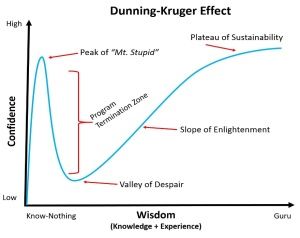
The Dunning-Kruger effect comes from the research of psychologists David Dunning and Justin Kruger. It refers to the phenomenon where individuals with low ability in a particular domain overestimate their competence. Meanwhile, individuals with high ability tend to underestimate their competence. The overarching risk is that those who lack knowledge or skill in a specific area often have an inflated sense of their own expertise. They can’t recognize the complexity of the issue at hand. Nor can they see that they are ill-equipped to handle it. They are both unskilled and unaware. As a result, they exhibit a high level of confidence in their abilities despite their actual incompetence.
This effect stems from a lack of metacognitive abilities—the ability to accurately assess one's own knowledge and skills. People who are less competent in a domain are also less likely to recognize their own deficiencies or limitations. As a result, they may exhibit overconfidence and make poor judgments or decisions based on their limited understanding of the subject matter. They can’t understand that they can’t understand the issue at hand in full. Nevertheless, they might insist on making what they believe are the best choices—a potentially hazardous situation in some circumstances.
© Interaction Design Foundation, CC BY-SA 4.0
How Does The Dunning-Kruger Effect Affect Design?
In the context of user experience (UX) design, the Dunning-Kruger effect can have many negative consequences for a product or service. When individuals involved in a design project are unaware of their own limitations, they may fail to recognize the sheer complexity of user needs and preferences. They can’t grasp the many points about the users’ contexts and other vital attributes about these users. This can lead to designs that are not user-friendly or fail to address the core problems that various types of users face.
Additionally, designers and team members who overestimate their abilities may be less receptive to feedback and less likely to seek input from others. This can result in a lack of collaboration and a failure to incorporate diverse perspectives into the design process. Ultimately, the Dunning-Kruger effect can hinder the ability of designers to create effective and user-centric designs for real users in the target audience.
Ultimately, this overestimation of design abilities can lead to poor user experiences and spell trouble for a brand if it doesn’t recognize and check this bias. It highlights the importance of humility, ongoing learning and user-centered design in the field of UX when design teams are creating products and services. Product designers and service designers need to be aware of this human tendency to overestimate abilities—and overlook realities—throughout the UX design process. Anyone with a voice on the design team, including all stakeholders and clients, likewise should keep the limitations and risks associated with the Dunning-Kruger effect top of mind.
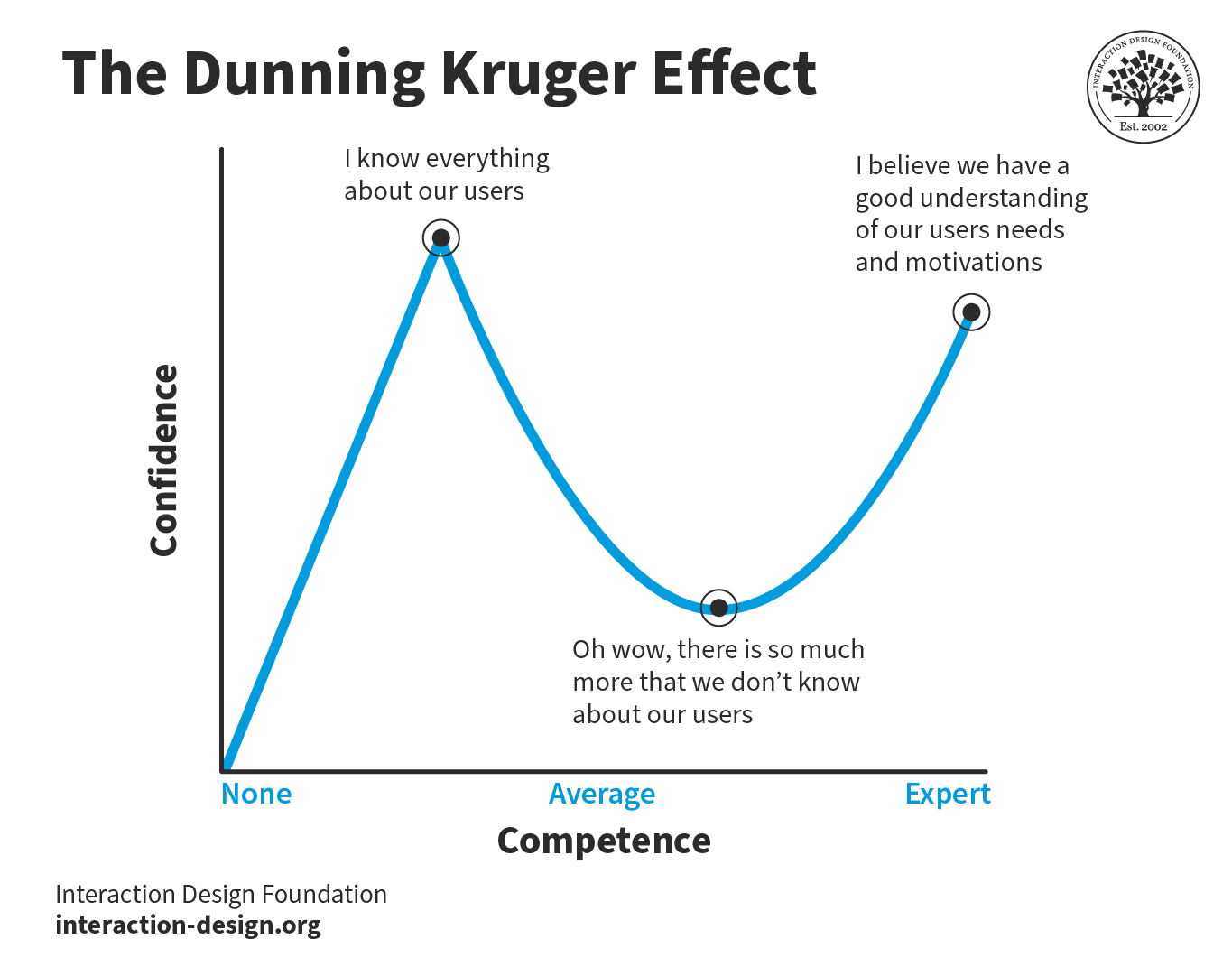
© Interaction Design Foundation, CC BY-SA 4.0
Examples of the Dunning-Kruger Effect in UX Design
The following examples highlight the range of ways in which the Dunning-Kruger effect can manifest in UX design—and the potential negative impact on the user experience:
The Novice Designer
A designer who is new to the field may overestimate their abilities and assume they have a deep understanding of user needs. They may also overlook the importance of proper user research and user testing. Without proper training and experience, they may overlook important design principles and make decisions that negatively impact the user experience.
The Expert Designer
On the other end of the spectrum, an experienced designer may underestimate their abilities and fail to recognize their expertise. They may question their design decisions excessively. This can lead to a lack of confidence and hesitation in the design process.
The Solo Designer
Designers who work in isolation without seeking feedback from users or collaborating with other professionals may fall victim to the Dunning-Kruger effect. Without external perspectives, they may become overly confident in their own design choices and miss opportunities for improvement.
The Dismissive Designer
A designer who dismisses user feedback or fails to consider alternative perspectives due to an inflated sense of their own expertise may alienate users and create designs that do not meet these users’ needs.
It’s also important to recognize how the effect can manifest in stakeholders or clients. They may believe that their limited understanding of UX design is enough to make design decisions. Not only can this jeopardize the success of a design project, but it can also lead to a lack of trust between designers and clients. Many unskilled clients won’t see eye to eye with designers—as they fail to understand that they can’t see eye to eye at such important technical levels. As a result, miscommunication can arise easily, and clients may have a resistance to explore alternative design approaches or incorporate innovative ideas. Here are some examples of the Dunning-Kruger effect on the client side:
Client-Driven Design
A client with limited knowledge of UX design insists on implementing design choices. These choices have no basis in user research or best practices, and can stem from personal preferences or eccentricities. Despite the best advice of the UX designer, the client believes their ideas are superior. However, that’s because of their incomplete understanding of UX principles and user needs. Also, they may have inaccurate grasps of fundamental issues such as visual design. As a result, the final product may not meet user needs. A subpar user experience will follow for a large number of users.
Overconfidence in Design Skills
A stakeholder who has attended a few UX design workshops or read a few articles on the topic may overestimate their design skills. They may believe they have a comprehensive understanding of UX principles. Also, they may dismiss the expertise of the UX designer and impose their own design solutions on the product team. That may cause a lack of user-centricity and potentially undermine the effectiveness of the design.
Failure to Recognize Complexity
A client with limited knowledge of UX design can fail to recognize the complexity and nuances involved when designers create effective user experiences. They may underestimate the importance of conducting user research, usability testing or iterative design processes. That may result in a superficial and ineffective design solution that does not address user needs.
Author, Speaker and Leadership Coach, Todd Zaki Warfel explains how designers need to adjust their communication for other project personnel:
Risks of the Dunning-Kruger Effect
UX designers face several risks when it comes to the Dunning-Kruger effect. Here are significant ones:
The danger of a client or powerful stakeholder overruling valid design decisions: Power and wisdom may sometimes not be in sync. For example, a client may base decisions on personal preferences rather than the necessary user experience design foundations (namely, design principles and user research). Consequently, they might go against the sound advice of the design team and ignore the best guidance from designers, UX researchers and product managers.
The potential for designers to become overconfident in their abilities and overlook important aspects of the user experience: This can lead to designs that are not intuitive, difficult to use or fail to meet user needs.
Impaired decision-making: When designers are overly confident in their own expertise, they may dismiss valuable feedback or fail to consider alternative perspectives. This can result in missed opportunities for improvement and a lack of innovation in the design process.
Hindrance of professional growth and development: If designers are unaware of their own limitations, they may be less motivated to seek further education or skill development. This can limit their ability to adapt to new technologies and design trends. Ultimately, this can hinder their career progression.
Morgane Peng, Design Director at Societe Generale, explains common issues when designers deal with individuals who do not understand design:
Users can also fall victim to the Dunning-Kruger effect. Here are some examples that designers should consider for the overall user experience in a website or app or service:
Inadequate user onboarding: Users who overestimate their understanding of a product may struggle with the onboarding process. This can lead to frustration and a higher likelihood of abandonment. To address the Dunning-Kruger effect, designers should create intuitive onboarding processes that cater to users with varying levels of expertise.
Reduced user engagement: Overconfident users may overlook important features or fail to engage with the product in meaningful ways. This can result in a diminished user experience. If they acknowledge the Dunning-Kruger effect, UX designers can implement strategies to guide users to discover and utilize all relevant features.
Misinterpretation of feedback: Users with limited expertise may provide feedback that stems from misconceptions. This can potentially lead to misguided design decisions if designers do not properly contextualize their input. If UX designers recognize the Dunning-Kruger effect, they can carefully evaluate user feedback and distinguish between valid insights and misunderstandings.
Decreased product adoption: If novice users encounter difficulties because they have overestimated their proficiency, they may be less likely to adopt the product or recommend it to others. For designers to address the Dunning-Kruger effect, they should create an environment that accommodates users across the expertise spectrum, and foster a positive first impression and encourage continued usage for a wide range of target users.
Impaired brand perception: A user's experience with a product can significantly influence their perception of the brand as a whole. Frustrations that come from the Dunning-Kruger effect can lead to negative associations and impact brand loyalty. If designers understand and mitigate the effect, they can help cultivate positive brand experiences for users of all skill levels.
Above all, designers need to keep users on board via empathy with them, as this video explains:
Best Practices To Minimize The Dunning-Kruger Effect
To prevent or minimize the impact of the Dunning-Kruger effect in UX design, designers can implement several strategies:
Practice self-awareness and reflection: Designers should cultivate self-awareness and regularly reflect on their own knowledge and limitations. This requires them to acknowledge areas where they may lack expertise and be open to learning from others.
Demonstrate expertise and value: Designers should strive to demonstrate their expertise and the value they bring to the design process. They can achieve this through effective communication and showcasing past successful projects. Plus, they can provide case studies that highlight the positive impact of user-centered design.
Seek diverse perspectives: Designers should actively seek feedback from users, stakeholders and other professionals. If they embrace diverse perspectives, they can help uncover blind spots. This can lead to more inclusive and user-centered design solutions.
Engage in continuous learning: Designers should prioritize continuous learning and professional development. They should stay up-to-date with industry trends, attend conferences and workshops, and seek out new knowledge. That way, they can help combat the Dunning-Kruger effect and ensure they possess the latest tools and techniques.
Value collaboration and teamwork: It’s essential to create a collaborative environment where designers can openly share ideas, seek input and challenge each other's assumptions. A culture of collaboration and embracing diverse perspectives can foster more innovative and user-centric designs.
Conduct proper user research and testing: This is essential to validate design decisions and ensure they align with user needs and preferences. If designers involve users throughout the design process, they can mitigate the risk of the Dunning-Kruger effect and create designs that truly meet user expectations.
UX Strategist and Consultant William Hudson explains the need for proper user research:
Educate clients and stakeholders: It’s vital to teach clients and stakeholders about the principles and best practices of UX design. Designers should provide these individuals with a deeper understanding of the complexities involved. From there, clients and non-design-oriented stakeholders may become more receptive to the expertise and recommendations of UX designers. When these channels of communication are open, valid input and evidence-based insights and rationale for design decisions will be more likely.
Provide user insights and data: The use of user insights and data can help counteract the Dunning-Kruger effect as they will ground design decisions in empirical evidence. When designers incorporate user research, usability testing and analytics, they can provide objective data to support recommendations. Also, they can illustrate the impact of different design choices on the user experience.
Overall, it’s crucial for designers to continually challenge their own assumptions, seek feedback and remain open to learning and growth. When they understand and navigate the complexities of the Dunning-Kruger effect, they can help create exceptional user experiences that meet the needs and expectations of all users.