Extreme Aversion Bias – Sometimes the Risk is Worth the Reward

• 7 min read

606 Shares

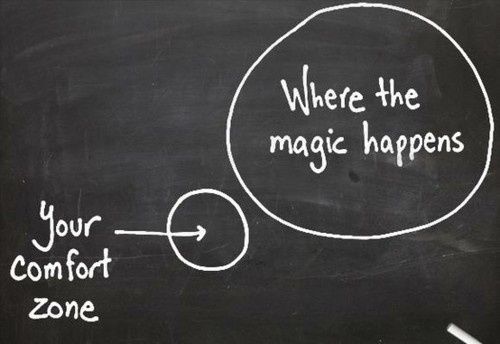
Playing it safe is a good strategy for much of the time. Yet, the biggest rewards often come with an element of risk. If we want our designs and our careers to take off – we need to overcome our aversion to taking an extreme option at times. That doesn’t mean becoming an inveterate gambler but rather learning to weigh up our options and occasionally choosing a riskier decision based on the possible pay off.

The idea of extreme aversion is simple; it’s the idea that people will go to great lengths to avoid choosing an option that lays on the extremes of thinking. In essence people would rather choose the “safe option” and take a middle path than pick something on the edges of possibility.
Author/Copyright holder: oklanica. Copyright terms and licence: CC BY-NC 2.0

This bias is often manipulated by design; for example you can provide a customer with 3 options when making a purchasing decision (cheap, mid-range, expensive) and expect that the majority will choose the mid-range option and thus increase your margins compared to a “cheap” choice. You can also use the same concept to “force” users to take a particularly choice when navigating or using an application.

Extreme aversion comes from the research conducted by Daniel Kahneman et al. in economics. The example given below is based on this research. Kahneman is a psychologist known for his work on the psychology of judgment and decision-making. He was awarded the 2002 Nobel Memorial Prize in Economic Sciences for his research on behavioral economics.

Is Sensible?

Imagine that you could go back in time 50 years. When you arrive you are given $100,000 and you are given the opportunity to invest that money for your future self. Your choices (as they are laid out for you) are to put the money under a mattress (the safest option), to put it in a bank (the mid-range option) or to invest in real estate (a risky option).

You’re unlikely to stick the money in a mattress after all – there’s no reward for doing so. However, you’re probably much more likely to put the money into a bank than into real estate. This is a shame because real estate over the last 50 years has massively outperformed the returns on even the best savings accounts.

An aversion to an extreme option is not always the best choice. You can translate this into other areas of life too, not just investment. For example; you might be faced with the decision as to whether to go freelance in your design career – you might summarize your options as:

A. Keep my job – it’s too risky to freelance

B. Keep my job but do a little freelancing on the side – that way if things don’t work out, I won’t lose anything

C. Quit my job – I’m more likely to be successful as a freelancer if I can give my full attention to it

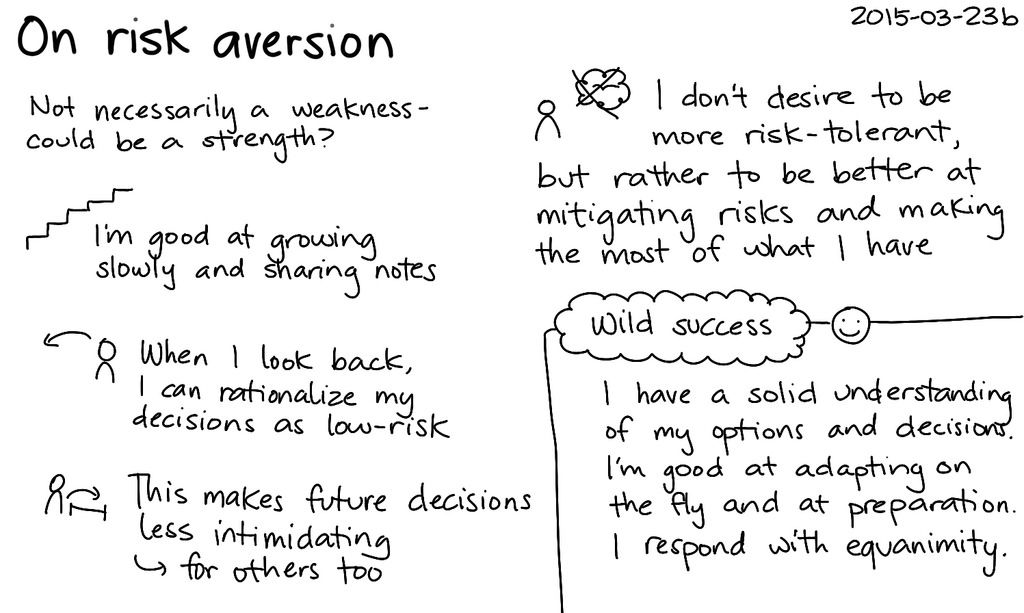
Let’s be fair about this; option B (above) is the safe option. It means there’s little risk to you if things go wrong as a freelancer. However, it’s also not always going to be the best choice.

It’s very difficult to do two jobs at once. We get tired, we underperform. It’s also going to be very challenging to find clients if your current job involves working from 9 to 5 and Monday to Friday.

While, the safe option provides little risk, it also provides little in the way of upside. Most people want to freelance because it gives them the freedom of choosing what projects they work on and working in the way that they want to. If you still have a job… you’re going to be limited as to what projects you can work on and for a lot of the time, you’re going to have no say in what you do.

Author/Copyright holder: Sacha Chua . Copyright terms and licence: CC BY 2.0

While extreme aversion can be very useful for you as a designer when you want to increase sales through a website or to ensure that a customer takes a particular option in an application – it’s not always the best strategy for dealing with life in general.

Dealing With Extreme Aversion

The question you need to ask yourself is; “What am I really hoping to get out of this decision?” followed by; “Which option is most likely to bring about that result?”

This requires a certain level of personal honesty and it can be challenging the first few times you review your decision making process. For some of us, security is the most important thing and choosing not to go freelance in those circumstances is pretty sensible. For others, it’s going to be the freedom that’s most appealing and going freelance is very much the right decision in our example.

If you find that you can’t differentiate these things clearly; you could always try working with a coach. They can help you ask the tough questions and really explore your own motivations so that you can find a way forward. It doesn’t mean that an extreme option is always the right option but opening yourself up to the possibility does mean that you may be able to make the right decisions when it is.

The Take Away

There are times to play it safe and times to take a risk. Learning to overcome extreme aversion means learning when to take a calculated risk. It’s a way of improving your life and getting more from your efforts.

You can also learn to use extreme aversion in your designs and that’s going to make it much easier to show returns on investment.

References & Where to Learn More:

Kahneman and Tversky’s paper “Loss Aversion in Riskless Choice: A Reference-Dependent Model.”

An example of extreme aversion is analyzed at a higher level: “Extremeness Aversion and Attribute-Balance Effects in Choice.”

Hero Image: Author/Copyright holder: Unknown. Copyright terms and licence: Unknown.

Learn More in This Course:

AI for Designers

10 days
12 % booked
View Course

What You Should Read Next

  • Read full article
    What is Interaction Design? - Article hero image
    Interaction Design Foundation logo

    What is Interaction Design?

    Interaction design is an important component within the giant umbrella of user experience (UX) design. In this article, we’ll explain what interaction design is, some useful models of interaction design, as well as briefly describe what an interaction designer usually does.A simple and useful unders

    Social shares
    1.5k
    Published
    Read Article
  • Read full article
    Apple’s Product Development Process – Inside the World’s Greatest Design Organization - Article hero image
    Interaction Design Foundation logo

    Apple’s Product Development Process – Inside the World’s Greatest Design Organization

    Apple’s Product Development Process may be one of the most successful design processes ever implemented. With a valuation that exceeds $2 trillion, there’s a lot that designers can learn from Apple and introduce into their own design environments.Apple is a notoriously secretive business. In Steve J

    Social shares
    1.4k
    Published
    Read Article
  • Read full article
    Shneiderman’s Eight Golden Rules Will Help You Design Better Interfaces - Article hero image
    Interaction Design Foundation logo

    Shneiderman’s Eight Golden Rules Will Help You Design Better Interfaces

    Follow Ben Shneiderman’s 'Eight Golden Rules of Interface Design' if you want to design great, productive and frustration-free user interfaces. Apple, Google and Microsoft are among some of the highly successful companies whose well-designed products reflect Shneiderman’s rules. The characteristics

    Social shares
    1.4k
    Published
    Read Article
  • Read full article
    How to Change Your Career from Graphic Design to UX Design - Article hero image
    Interaction Design Foundation logo

    How to Change Your Career from Graphic Design to UX Design

    If there’s an occupation that is 100% linked with the public’s idea of what design is all about, it’s graphic design. From the familiar golden arches of the McDonald’s brand to the typography and colors of movie posters, graphic designers create some of the most iconic and ubiquitous designs around

    Social shares
    1.4k
    Published
    Read Article
  • Read full article
    The Grid System: Building a Solid Design Layout - Article hero image
    Interaction Design Foundation logo

    The Grid System: Building a Solid Design Layout

    Now that we’ve seen some grids at work in the Rule of Thirds article, let’s examine them a little more deeply. As a concept that deals so fundamentally with the fabric and background of our work as designers, it’s easy to overlook the power of grids and think more about the elements we want to creat

    Social shares
    1.4k
    Published
    Read Article
  • Read full article
    The Principles of Service Design Thinking - Building Better Services - Article hero image
    Interaction Design Foundation logo

    The Principles of Service Design Thinking - Building Better Services

    Service design is all about taking a service and making it meet the user’s and customer’s needs for that service. It can be used to improve an existing service or to create a new service from scratch. In order to adapt to service design, a UX designer will need to understand the basic principles of

    Social shares
    1.4k
    Published
    Read Article
  • Read full article
    A Simple Introduction to Lean UX - Article hero image
    Interaction Design Foundation logo

    A Simple Introduction to Lean UX

    Lean UX is an incredibly useful technique when working on projects where the Agile development method is used. Traditional UX techniques often don’t work when development is conducted in rapid bursts – there’s not enough time to deliver UX in the same way. Fundamentally Lean UX and other forms of UX

    Social shares
    1.3k
    Published
    Read Article
  • Read full article
    Dieter Rams: 10 Timeless Commandments for Good Design - Article hero image
    Interaction Design Foundation logo

    Dieter Rams: 10 Timeless Commandments for Good Design

    Let’s pay a virtual visit to a famous industrial designer’s workshop. By examining the principles of his winning approach, we can incorporate vital elements into our designs in the “less is more” age.As user experience practitioners, most of us have worked with Nielsen and Molich’s 10 heuristics or

    Social shares
    1.3k
    Published
    Read Article
  • Read full article
    The 7 Factors that Influence User Experience - Article hero image
    Interaction Design Foundation logo

    The 7 Factors that Influence User Experience

    User Experience (UX) is critical to the success or failure of a product in the market but what do we mean by UX? All too often UX is confused with usability which describes to some extent how easy a product is to use and it is true that UX as a discipline began with usability – however, UX has grown

    Social shares
    1.3k
    Published
    Read Article
  • Read full article
    10 Free-to-Use Wireframing Tools for UX Designers in 2026 - Article hero image
    Interaction Design Foundation logo

    10 Free-to-Use Wireframing Tools for UX Designers in 2026

    Wireframes help you quickly ideate and test your ideas. While paper wireframes are the fastest to create, digital wireframes look more polished and presentable. If you are looking for a pocket-friendly wireframing tool, look no further.Whether you prefer browser-based apps or offline desktop tools,

    Social shares
    1.3k
    Published
    Read Article

Top Articles

Top Topic Definitions

Feel Stuck?
Want Better Job Options?

AI is replacing jobs everywhere, yet design jobs are booming with a projected 45% job growth. With design skills, you can create products and services people love. More love means more impact and greater salary potential.

At IxDF, we help you from your first course to your next job, all in one place.

See How Design Skills Turn Into Job Options
Privacy Settings
By using this site, you accept our Cookie Policy and Terms of Use.
Customize
Accept all

Be the One Who Inspires

People remember who shares great ideas.

Share on:

Academic Credibility — On Autopilot

Don't waste time googling citation formats. Just copy, paste and look legit in seconds.

Feel Stuck? Want Freedom?

Join 326,432+ designers who get one powerful email each week. Learn to design a life you love.

Next email in
7
days
9
hrs
0
mins
58
secs

Free forever. No spam. Unsubscribe anytime.