Behavioral Economics (BE)

Your constantly-updated definition of Behavioral Economics (BE) and collection of videos and articles.
Be a conversation starter: Share this page and inspire others!

591 Shares

What are Behavioral Economics (BE)?

Behavioral economics is a discipline that examines how emotional, social and other factors affect human decision-making, which is not always rational. As users do not always have stable preferences or act in their best interests, designers can guide their decisions via strategic choice architecture—e.g., pricing structure.

See how a grasp of behavioral economics can help drive effective interventions in the following video by Big Think.

“Choose less and feel better.”

— Barry Schwartz, Psychologist and author

Behavioral Economics and the Power and Shortcomings of Human Choice

Before 20th-century advances in psychology and neuroscience, human thinking was typically deemed a rational process of analyzing situations logically to find optimal solutions. Behavioral economics turns that idea around and proves that humans can’t weigh up pros and cons so clinically. Psychologists Daniel Kahneman and Amos Tversky pioneered the field in the 1970s, isolating “cognitive illusions” that affect judgment and determining the human tendency to make irrational choices in the face of uncertainty. They found the potential value of losses and gains—not rational assessments of outcome—guides decision-making. This school of thought asserts the pain of loss is far more profound than the pleasure of gaining something equally valuable. Human thinking is naturally bounded by limitations in knowledge, processing ability and feedback; thus, designers should consider users’ aversion to thinking too much and frame selected options insightfully.

Fundamental to behavioral economics is that two thought systems are at work in people—one operates with intuitive, experience-based and relatively unconscious processes; the other involves controlled analytical processes and depends on a person’s cognitive ability, in-the-moment bias and influence from society. Using behavioral economics principles, designers present the right information (and right amount) to engage users and guide them towards desired calls to action.

Behavioral Economics in the Challenge of Interaction Design

In user experience design, designers exploit a uniquely human fact—the brain is naturally a cognitive miser. It doesn’t like being flooded with information; so, the power of choice can be a strain. Complex decisions are taxing, even if users can take their time. Regardless of intelligence, they’ll seek simpler solutions and will subconsciously apply heuristics (judgmental shortcuts) to minimize effort. However rational users believe they are, they can be prompted to act in ways they might never expect. A common example is to leverage how people consider an item’s value in relative—not absolute—terms and lead them to buy a high-value product because it seems like a bargain compared with costlier ones.
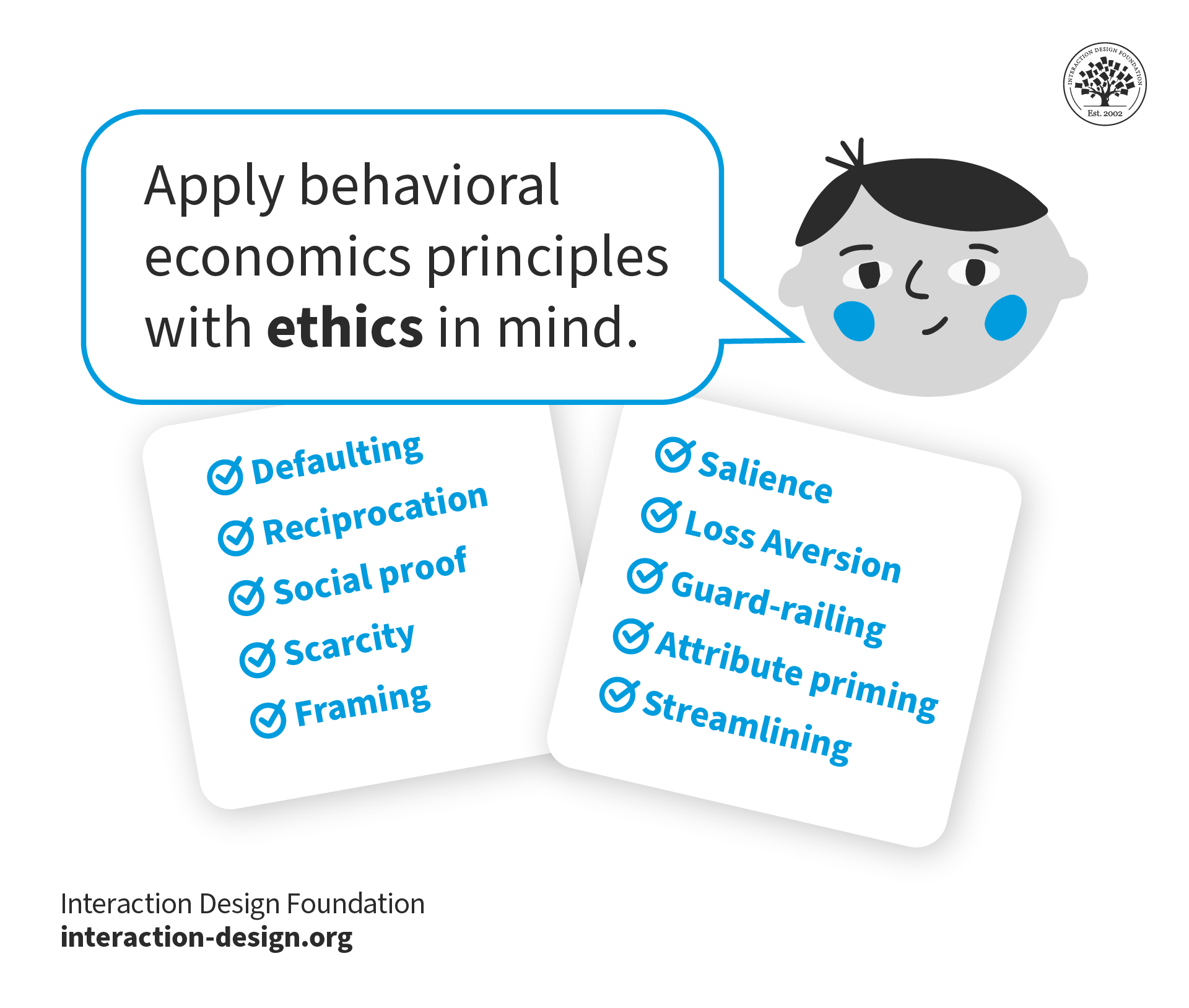
Apply Behavioral Economics Principles with Ethics in Mind

© Interaction Design Foundation, CC BY-SA 4.0

When accessing unfamiliar content such as new interfaces, users will base decisions on value judgments and context. Therefore, to help users make choices that benefit themselves and the business, you should make your designs easier to understand and navigate while carefully considering the ethical dimensions. The best design solutions always work in the users’ and provider’s best interests. A vital distinction is the difference between manipulating users and ethically applying principles of behavioral economics. Reputable e-commerce solutions exemplify the latter, including:

  1. Framing—Drop the right anchor to set a frame of reference. Anchoring is a form of priming where the first number users see serves as a marker for judging other items’ values. As this first piece of information impacts users’ decision-making, you can prompt them to compare other offerings favorably against it by highlighting a more expensive item.

  2. Defaulting—Give users the right defaults to help them decide what to do/buy. Limit choices to only those most appropriate for the step/category; typically, if you show users more than 4 options, they’ll start feeling overwhelmed. Regarding an item’s extra features, users will prefer a higher-priced baseline (to remove options from) over a lower-priced one (to add options to).

  3. Reciprocation/Power of Free—Offer free items; it’s a guaranteed way to put goods in users’ hands, and it fosters obligations (e.g., “If you liked this article, please share it.”).

  4. Streamlining—Remove obstacles from processes (e.g., Amazon’s one-click ordering feature); similarly, insert obstacles to discourage unwanted behavior, but be careful of dark patterns.

  5. Social proofMake users feel they’ll be consumers of a popular item, which also usually bolsters their sense of security, as does the power of authority via expert/celebrity endorsement.

  6. Attribute priming—Strategically guide users’ attention toward specific product features or aspects of an experience that you want to emphasize.

  7. Scarcity—Tap into the fear of loss and raise the value of limited items in users’ minds.

  8. Salience—Make a feature or piece of information more noticeable when users make decisions; when it captures their attention more readily, they’ll tend to give it more weight in their decision-making.

  9. Guard-railing—Keep users on track towards desired actions and make course-correction easy.

  10. Tackling Loss AversionWord incentives to showcase potential gains and downplay negative outcomes (e.g., a 90% success rate sounds more attractive than a 10% failure rate).

You should present features to simplify the user experience and prevent information overload. Above all, frame options ethically to offer meaningful change through user-centered design and appropriate nudging towards desirable actions for all parties concerned.
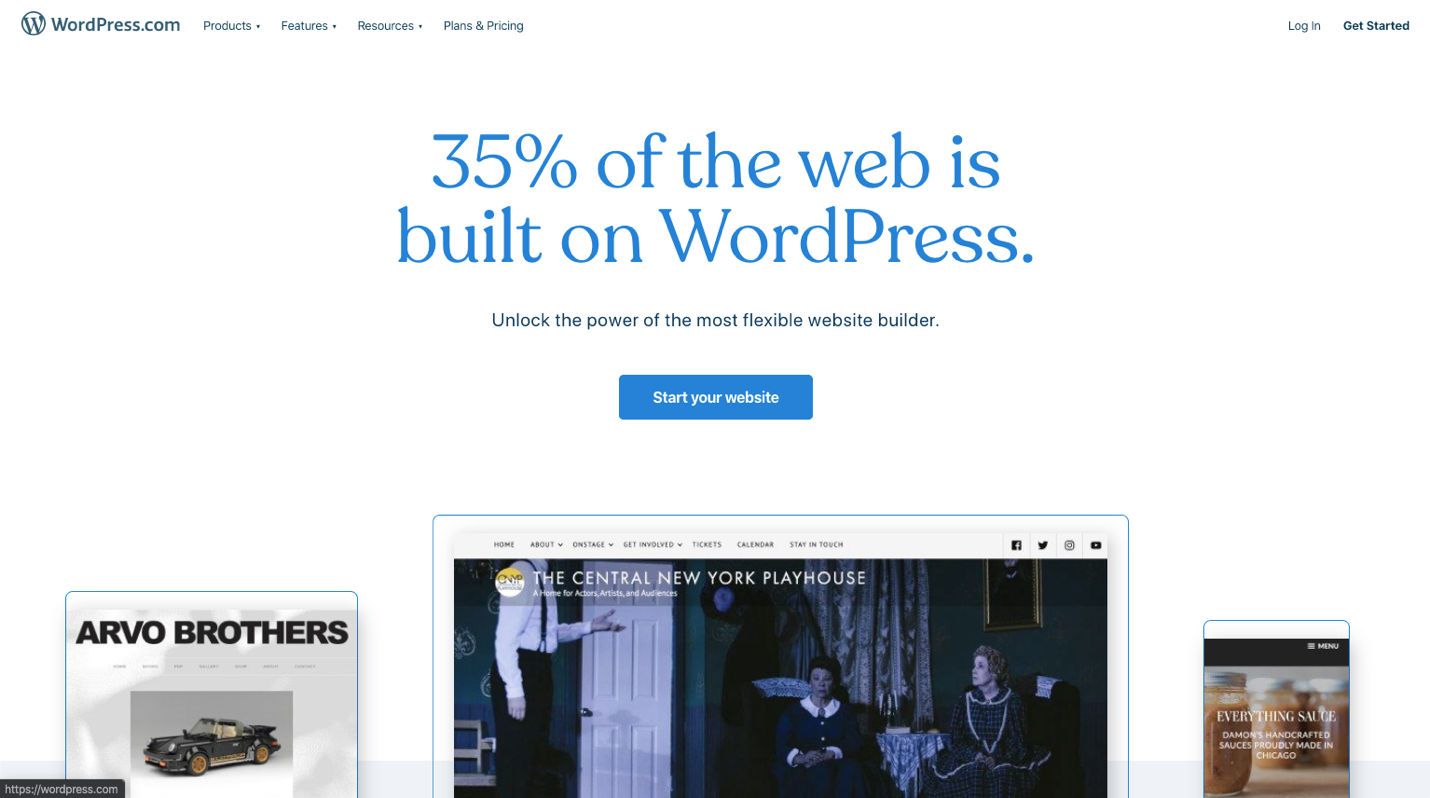
WordPress’s home page uses social proof—by highlighting that a whopping 35% of the Internet is built on WordPress, it makes people trust the platform more.
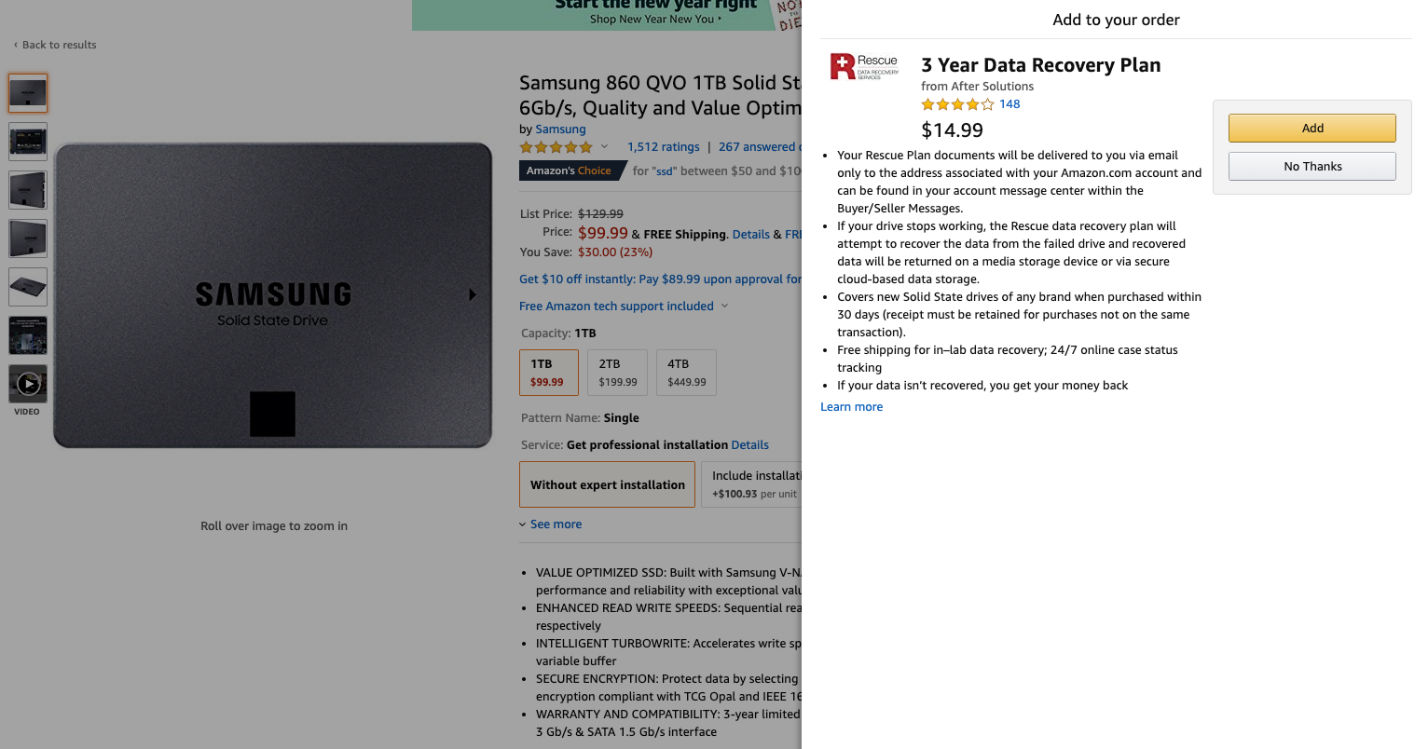
Amazon’s checkout flow uses salience—when you purchase an external hard drive, it presents you with a data recovery add-on before you checkout.

Questions About Behavioral Economics (BE)?
We've Got Answers!

What is behavioral economics in UX design?

Behavioral economics in UX design is the study of how people make decisions—often irrationally—and how designers can use those insights to shape better user experiences. Unlike classical economics, which assumes that individuals act logically, behavioral economics recognizes that users rely on mental shortcuts and biases.

For instance, people tend to avoid losses more than they seek gains—the tendency of loss aversion. The message often becomes more compelling if a UX designer highlights what users lose by not acting (like missing a deadline or deal). Another common effect is the default bias; users tend to stick with preset options, so thoughtful defaults can nudge people toward better or more ethical choices.

Watch our video about behavioral economics:

Transcript

Read our piece, Loss Aversion Theory - The Economics of Design for valuable insights.

How does behavioral economics help designers understand users?

Behavioral economics helps UX designers understand users by revealing how people make decisions—not how we think they should. It highlights that users often rely on mental shortcuts and biases, like defaulting to preset options or avoiding losses more than seeking gains.

For example, the “default effect” shows that users stick with pre-selected choices. You can tap into this by setting eco-friendly or privacy-conscious options as defaults. Another principle, “loss aversion,” suggests users fear losing something they have more than they value gaining something new. This can inform how we frame choices—emphasizing what users might miss out on can be more persuasive than highlighting benefits.

Applying insights like these, designers can create interfaces that guide users toward better decisions without restricting freedom. For example, the right information, and the right amount of it, presented at the right time can help users of a new app achieve what they want and enjoy the product and the brand behind it. It’s not about manipulation; it’s about designing with human behavior in mind and making experiences more intuitive and effective.

Watch our video about behavioral economics:

Transcript

Read our piece, Loss Aversion Theory - The Economics of Design for valuable insights.

What are the most important behavioral economics principles for UX design?

Important behavioral economics principles for UX design include:

  • Loss aversion shows that users feel the pain of loss more than the joy of gain. So, framing messages around what users stand to lose—like missed opportunities or wasted time—can increase engagement.

  • Default bias means users often stick with preset options. That’s why setting smart defaults—like energy-saving modes or privacy-friendly settings—can lead to better outcomes with zero effort from the user.

  • Anchoring is where users rely heavily on the first piece of information they see. Showing a higher “original” price next to a discounted one makes the discount feel more substantial. Anchors can also guide users toward premium plans or preferred choices.

  • The framing effect refers to how the way options appear influences decisions. It’s in the presentation; for example, saying “95% success rate” feels more reassuring than “5% failure rate,” even though they’re logically identical. UX writing and visual layout should frame choices positively or strategically based on context.

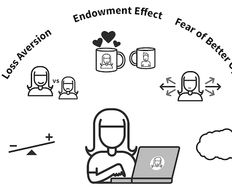
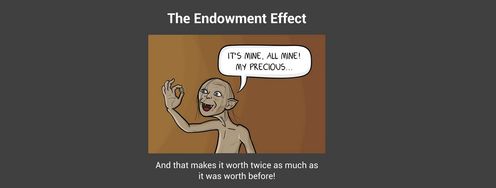
  • The endowment effect, which mirrors aspects of loss aversion, accounts for how people value things more once they feel ownership. Free trials or customization features tap into this bias and make users more likely to commit.

Designers who understand these principles and leverage them ethically can build experiences that feel intuitive, reduce friction, and support users and their brand.

Watch our video about behavioral economics:

Transcript

Take our course, Get Your Product Used: Adoption and Appropriation for valuable insights.

What’s the "nudge theory" and how do I use it in UX?

Nudge theory, from behavioral economics, is the idea that you can influence people’s decisions subtly, without restricting their freedom, by shaping the environment in which they choose. In UX design, a “nudge” gently steers users toward better or more desirable actions while still leaving them in control.

A classic example is the default option. If a newsletter signup box is pre-checked, more users will subscribe, simply because that’s the path of least resistance. However, be mindful of dark patterns, design practices where default settings like prechecked boxes can leave users feeling tricked if the designer isn’t acting in the users’ interest. (Beware that pre-checked boxes violate GDPR in some countries.) Other examples of nudges include progress bars, which can increase task completion by signaling momentum.

Designers use nudges to promote ethical and user-friendly behavior. For example, encouraging energy-saving settings, highlighting socially responsible purchases, or using positive reinforcement (“You’re almost there!”) in onboarding flows.

Used well, nudges improve usability and guide smarter decisions, without manipulation. An ethical approach is always the best one.

Watch our video about behavioral economics:

Transcript

Take our course, Get Your Product Used: Adoption and Appropriation for valuable insights.

How do I apply behavioral economics to improve user engagement?

To apply behavioral economics to improve user engagement, design around how people actually think and make decisions—not how they should. Start with loss aversion: frame actions in terms of what users stand to lose if they don’t engage, like “Don’t miss your free trial ending tomorrow.” This taps into users’ natural fear of missing out.

Use the default effect to simplify choices; auto-enroll users in helpful features with the option to opt out—instead of than forcing them to opt in. To build trust and momentum, you can also apply social proof, like showing how many others have completed a task (e.g., “5,000 designers already downloaded this guide”).

Gamification elements, including progress bars, badges, and streaks, leverage behavioral triggers like completion bias, where people feel driven to finish what they’ve started. Similarly, offering value first (like a free download) taps into reciprocity, a user’s instinct to give something back, like signing up or sharing. They can make engagement feel rewarding and purposeful.

Watch our video about behavioral economics:

Transcript

Take our course, Get Your Product Used: Adoption and Appropriation for valuable insights.

Where’s the line between persuasion and manipulation in design?

The line between persuasion and manipulation in design lies in intent, transparency, and user benefit. Persuasive design respects user autonomy—it uses behavioral insights to guide, not deceive. For example, highlighting a popular plan nudges users toward it, but still leaves clear, honest choices.

Manipulative design—like dark patterns—crosses the line by hiding options, creating false urgency, or tricking users into actions they wouldn’t otherwise choose. If a user feels regret, frustration, or misled afterward, the design likely veered into manipulation.

Ask yourself: Does this interaction align with the user’s goals? Are all options clear and accessible? Is the benefit mutual?

Ethical persuasion builds trust and long-term engagement. Manipulation might drive short-term metrics, but it damages brand credibility and user loyalty. Aside from the moral question, manipulative approaches can be illegal in many jurisdictions.

Watch our video about behavioral economics:

Transcript

Read our article How to Design Ethically: Expert Advice from Guthrie Weinschenk, Behavioral Economist, Attorney and the COO of The Team W, Inc., for important insights.

What user research methods align with behavioral economics?

User research methods that align with behavioral economics focus on what users actually do, not just what they say. So, start with observational research—watch how users interact with your product in real-world settings. This reveals unconscious behaviors and biases that users may not report in interviews.

A/B testing is another key method. It lets you measure how small changes in wording, layout, or defaults affect behavior, helping you validate behavioral nudges like loss framing or social proof in action.

Use field experiments to test decision-making under real conditions. For example, see whether adding a progress bar or changing a call-to-action increases task completion.

Also, conduct usability testing with a behavioral lens—observe hesitations, default selections, or irrational choices to spot where biases influence outcomes.

Watch our video about behavioral economics:

Transcript

Enjoy our Master Class Behavioral Design: Create Engaging Products with Behavioral Science with Susan Weinschenk, Chief Behavioral Scientist and CEO at The Team W, Inc., and Guthrie Weinschenk, Behavioral Economist, Attorney and the COO of The Team W, Inc.

What are some recent or highly cited scientific articles about behavioral economics?

Lee, M. K., Kiesler, S., & Forlizzi, J. (2011). Mining behavioral economics to design persuasive technology for healthy choices. In Proceedings of the SIGCHI Conference on Human Factors in Computing Systems (pp. 325–334). ACM.

In this study, the authors explore how behavioral economics principles can inform the design of persuasive technologies aimed at promoting healthier choices. They apply strategies such as default options, planning prompts, and asymmetric choices in various contexts, including snack selection and health-related decision-making. The research provides empirical evidence on the effectiveness of these strategies in influencing user behavior. This work is significant for UX designers seeking to incorporate behavioral insights into technology that encourages positive user actions.

Benartzi, S., & Bhargava, S. (2020). How digital design drives user behavior. Harvard Business Review.

Benartzi and Bhargava discuss how digital design elements, informed by behavioral economics, can significantly influence user decisions. They highlight how subtle changes in interface design, such as the framing of choices and the use of defaults, can lead to better user outcomes in areas like retirement savings and health plan selection. The article emphasizes the importance of integrating behavioral insights into UX design to facilitate better decision-making. This piece is influential in bridging the gap between behavioral economics theory and practical UX application.

Wendel, S. (2013). Designing for Behavior Change: Applying Psychology and Behavioral Economics. O’Reilly Media.

Stephen Wendel’s Designing for Behavior Change is a hands-on guide for using behavioral science to craft digital products that influence human behavior ethically and effectively. Wendel, a behavioral economist, outlines a structured process to help designers identify target behaviors, apply psychological principles, and test their impact. The book includes practical design patterns, case studies, and tools tailored to product development teams. It bridges theory and application, making it especially valuable for UX professionals who want to create experiences that are not just engaging but behaviorally sound. This work is central to the growing field of behavioral UX, where insights from economics and psychology drive better design outcomes.

Kahneman, D. (2011). Thinking, Fast and Slow. Farrar, Straus and Giroux.

In this landmark book, Nobel laureate Daniel Kahneman explores the dual-process theory of the mind—System 1 (fast, automatic thinking) and System 2 (slow, deliberate reasoning). Thinking, Fast and Slow reveals how biases and heuristics distort judgment and decision-making. For UX designers, the implications are profound: understanding how users process information helps in designing more intuitive, accessible, and cognitively aligned interfaces. The book offers a foundation for anticipating user behavior, avoiding cognitive overload, and crafting user-centered solutions. Kahneman’s work has become a cornerstone in both psychology and UX, offering a rigorous framework for predicting and shaping user actions through design.

Thaler, R. H., & Sunstein, C. R. (2021). Nudge: The Final Edition. Penguin Books.

Nudge: The Final Edition by Richard Thaler and Cass Sunstein expands on their revolutionary concept of “choice architecture”—the idea that small design changes can significantly influence behavior without restricting freedom. This updated version includes fresh insights into digital nudging and real-world policy implementations. For UX designers, Nudge offers practical tools for guiding user decisions in a way that is ethical and user-focused. The authors draw from behavioral economics to demonstrate how people make suboptimal decisions and how better design can help. This book is essential for designers aiming to build experiences that empower users to make smarter, healthier, and more sustainable choices.

Can I use personas or journey maps to apply behavioral insights?

Yes; personas and journey maps are powerful tools for applying behavioral insights in UX. First, you’ll want to enrich your personas with behavioral traits, not just demographics or goals. Include biases like “avoids complex decisions” (choice overload) or “prefers defaults” (default effect). This helps you design nudges that match how users think. Many users will dislike complex decisions, so endow your personas with deeper traits to give them more credible substance.

With journey maps, identify decision points where users hesitate, drop off, or choose irrationally. Then apply behavioral cues—like social proof near checkout, or loss framing in cancellation flows—to guide better choices without pressure.

For example, if a user hesitates during sign-up, show a progress bar (completion bias) or highlight how many others joined today (social proof). These nudges align behavioral science with user context, boosting engagement and satisfaction. In any case, take an ethical approach to envisioning your users' journeys; it will help you leverage behavior economics principles in ways that best serve users and your brand.

Watch as William Hudson, User Experience Strategist and Founder of Syntagm Ltd, explains why design without personas falls short:

Transcript

Enjoy our Master Class Behavioral Design: Create Engaging Products with Behavioral Science with Susan Weinschenk, Chief Behavioral Scientist and CEO at The Team W, Inc., and Guthrie Weinschenk, Behavioral Economist, Attorney and the COO of The Team W, Inc.

Earn a Gift Earn a Gift, Answer a Short Quiz!

1
2
3
4
1
2
3
4
Question 1
Question 2
Question 3
Get Your Gift
Interaction Design Foundation logo

Question 1

What is the main goal of behavioral economics?

1 point towards your gift

  • To analyze purely rational economic models for product pricing
  • To optimize user experience through technical improvements
  • To understand how psychological factors influence economic decisions
Interaction Design Foundation logo

Question 2

What is "loss aversion," according to behavioral economics?

1 point towards your gift

  • A bias that makes individuals less likely to invest in insurance.
  • A cognitive bias where people prefer to avoid losses over the acquisition of equivalent gains.
  • A technique that helps people rationally assess potential losses.
Interaction Design Foundation logo

Question 3

How does the "endowment effect" influence economic behavior?

1 point towards your gift

  • People consistently aim to sell their possessions at a loss.
  • People often value their owned possessions more than their actual market value.
  • People tend to undervalue goods once they purchase them.

Learn More About Behavioral Economics (BE)

Make learning as easy as watching Netflix: Learn more about Behavioral Economics (BE) by taking the online IxDF Course Get Your Product Used: Adoption and Appropriation.

Why? Because design skills make you valuable. In any job. Any industry.

In This Course, You'll

  • Get excited about how you can use design to get more people to use your products repeatedly and enthusiastically! Did you know that 95% of new products fail shortly after launch? Usability and user experience alone won't guarantee success. In this course, you'll discover how to turn prospects into customers and customers into passionate advocates. It's easier than you think, even if you're completely new to design, because you already have transferable skills like strategic thinking, curiosity, and communication. Your skills in adoption and appropriation empower you to create products that people integrate into their lives.

  • Make yourself invaluable with powerful design skills that directly increase adoption, drive business growth, and fast-track your career. Learn how to strategically engage early adopters and achieve critical mass for successful product launches. As AI becomes part of how products are developed, tested, and scaled, you stay in demand when you can design experiences people connect with and choose to return to. These timeless human-centered design skills help you guide AI so faster production still leads to ethical experiences that people can trust and love.

  • Gain confidence and credibility with bite-sized lessons and practical exercises you can immediately apply at work. Master the Path of Use to understand what drives usage and captivates people. You'll use the economics of design, network effects, and social systems to drive product adoption in any industry. Analyze real-world product launch successes and failures, and learn from others' mistakes so you can avoid costly trial and error. This course will give you the hands-on design skills you need to launch products with greater confidence and success.

It's Easy to Fast-Track Your Career with the World's Best Experts

Master complex skills effortlessly with proven best practices and toolkits directly from the world's top design experts. Meet your expert for this course:

  • Alan Dix: Author of the bestselling book “Human-Computer Interaction” and Director of the Computational Foundry at Swansea University.

Get an Industry-Recognized IxDF Course Certificate

Increase your credibility, salary potential and job opportunities by showing credible evidence of your skills.

IxDF Course Certificates set the industry gold standard. Add them to your LinkedIn profile, resumé, and job applications.

Course Certificate Example

Be in distinguished company, alongside industry leaders who train their teams with the IxDF and trust IxDF Course Certificates.

Our clients: IBM, HP, Adobe, GE, Accenture, Allianz, Phillips, Deezer, Capgemin, Mcafee, SAP, Telenor, Cigna, British Parliament, State of New York

All Free IxDF Articles on Behavioral Economics (BE)

Read full article
Loss Aversion Theory - The Economics of Design - Article hero image
Interaction Design Foundation logo

Loss Aversion Theory - The Economics of Design

If people were rational then the feelings invoked by losing something or gaining something (of equal value) ought to be the same. We should feel as pleased that our friend has just given us $100 for our birthdays as we feel bad that we have lost $100 when we forgot to take it from an ATM machine.In

Social shares
738
Published
Read Article
Read full article
Prospect Theory - The Economics of Design - Article hero image
Interaction Design Foundation logo

Prospect Theory - The Economics of Design

Economists once assumed that every actor in an economic system would be rational. That people would calculate the value of what they had and what they could have in the future accurately and that they would make their decisions based on that calculation. Unfortunately, in practice this was rarely th

Social shares
581
Published
Read Article
Read full article
Endowment Effect - The Economics of Design - Article hero image
Interaction Design Foundation logo

Endowment Effect - The Economics of Design

The Endowment Effect is a contradiction of the classical economic idea that people always behave rationally within an economic system. It is the surprising idea that we are prepared to pay more money to retain something that we already own than we would pay for the item if we did not own it. It is o

Social shares
585
Published
Read Article
Read full article
Be Afraid! The Silent Role of Fear in Decision Making - Article hero image
Interaction Design Foundation logo

Be Afraid! The Silent Role of Fear in Decision Making

Fear plays such a dominant role in our lives that several businesses and products have succeeded on the back of this single emotion. Here’s a look at some of the fears that affect our decision making, how businesses and products exploit these tendencies to their advantage, and how, as a designer, yo

Social shares
709
Published
Read Article
Read full article
Positive Friction: How You Can Use It to Create Better Experiences - Article hero image
Interaction Design Foundation logo

Positive Friction: How You Can Use It to Create Better Experiences

While friction in UX is typically something you want to minimize, adding friction can improve the user experience and contribute to good design in many situations. Researchers at UCL define positive friction as friction that “can disrupt mindless automatic interactions, prompting moments of reflecti

Social shares
683
Published
Read Article
Read full article
5 Ways to Use Behavioral Science to Create Better Products - Article hero image
Interaction Design Foundation logo

5 Ways to Use Behavioral Science to Create Better Products

A myriad of fields, skills and insights come together to create the overarching discipline of user experience design. Psychology and behavioral science play a big part in UX design because understanding people, the way their minds work, what they want and don’t want, will help us create better produ

Social shares
634
Published
Read Article

5 Ways to Use Behavioral Science to Create Better Products

5 Ways to Use Behavioral Science to Create Better Products

A myriad of fields, skills and insights come together to create the overarching discipline of user experience design. Psychology and behavioral science play a big part in UX design because understanding people, the way their minds work, what they want and don’t want, will help us create better products and services and, consequently, more successful designs. Let’s explore five behavioral science insights you can use right now to design better products—they’ll be especially useful if you’re a product designer, UX designer, product manager or anyone involved with the product design process.

What is behavioral science and behavioral design? 

First, it’s essential to understand behavioral science and the related discipline of behavioral design. Here’s a quick breakdown:  

Behavioral science studies the cognitive processes of organisms, animals or humans. It uses observation, scientific experimentation and mathematical modeling to draw conclusions on how and why people or animals behave. Behavioral science encompasses psychology, anthropology, psychobiology and more.

 Behavioral design combines design, technology and psychology (behavioral science) and applies it to the design process. To practice behavioral design, we must understand how people think, how and why they make decisions and how to influence them to inform the design of products and services. 

1. Engage the Pre-Attention Area of the Brain to Create Eye-Catching Products

This is the part of the brain that grabs attention—it’s known as the visual cortex. It can be extremely useful in product design, especially if one of your main objectives is to catch a user’s attention. In the Master Class, Behavioral Design: Create Engaging Products with Behavioral Science, Dr Susan Weinschenk (AKA The Brain Lady), we learn that there are four areas of the visual cortex (V1, V2, V3 and V4) and each one has a particular sensitivity.

Color

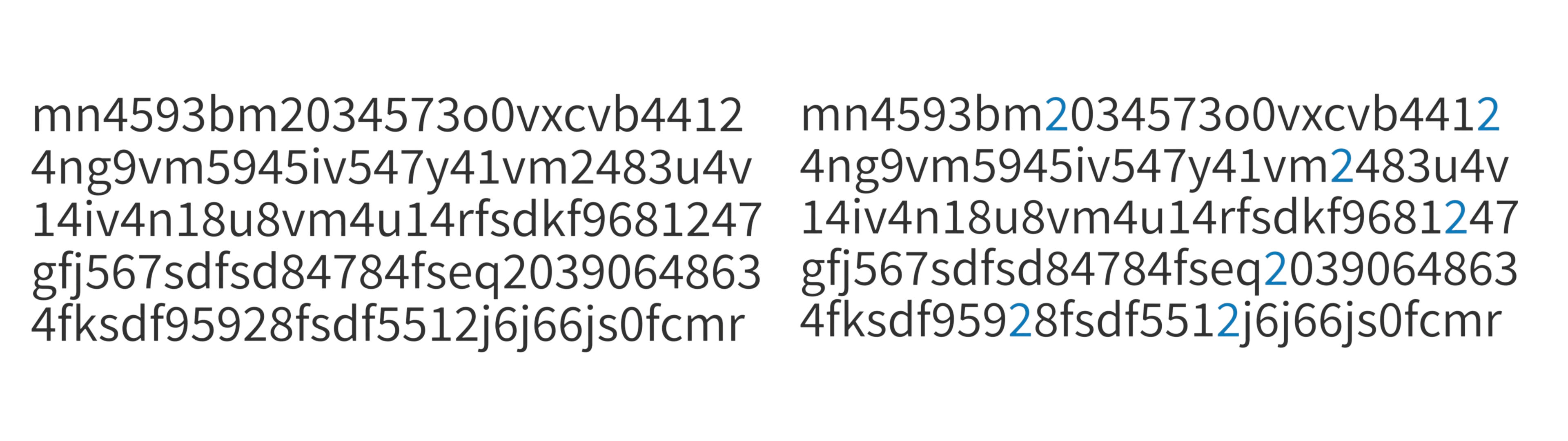
Look at the image below; on which side is it easier to see the number 2? It’s the right-hand side, and that’s because a certain part of the visual cortex is sensitive to color—we can see the 2’s as they’re in a different color from the jumble of letters and numbers.

Side by side image of 5 lines of random letters and numbers. On the left hand side all letters and numbers are black. On the right hand side the number 2's are in blue

© Interaction Design Foundation, CC BY-SA 3.0

Angle

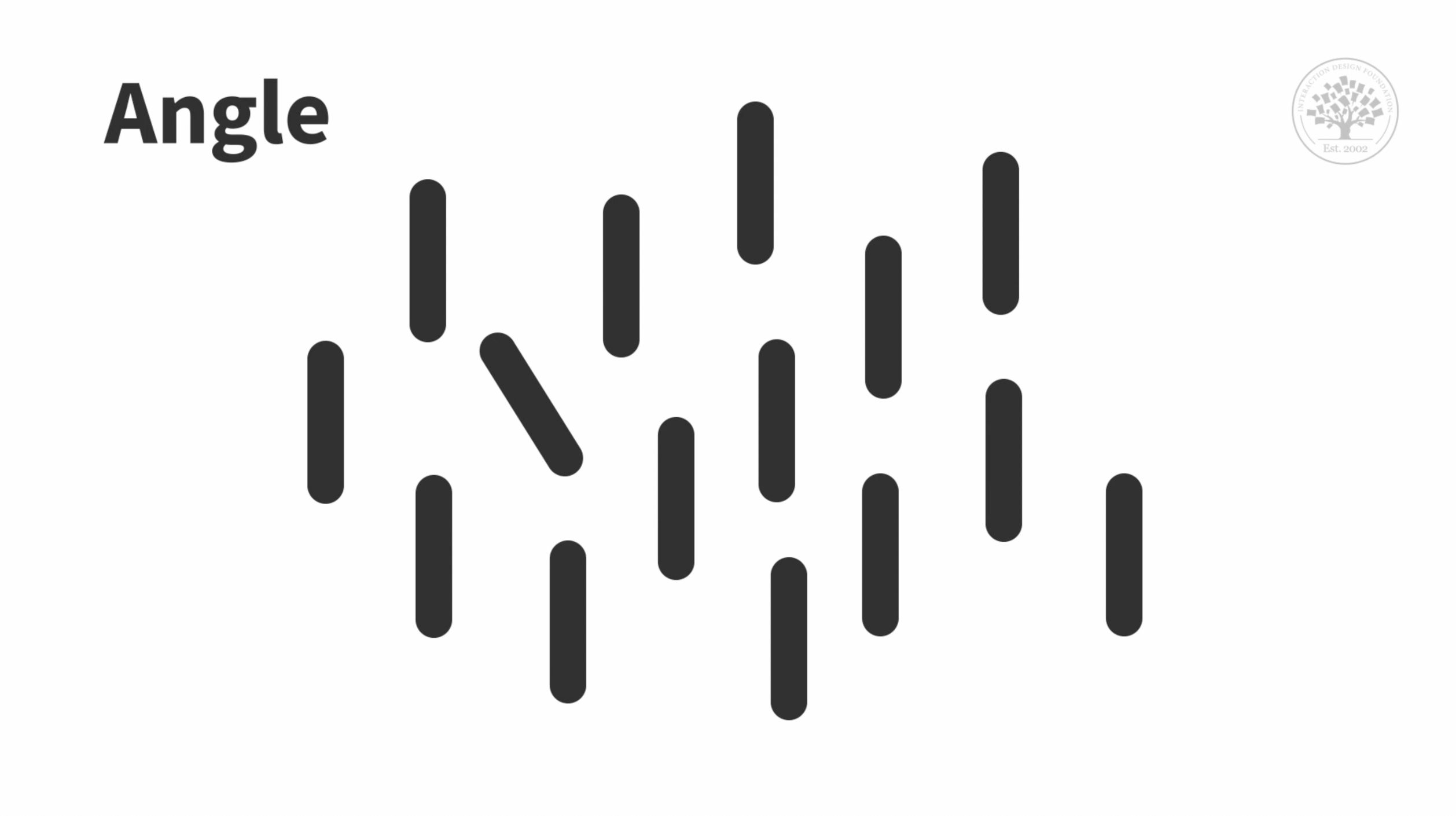
Another part of the visual cortex is sensitive to angle. As illustrated in the image below, we notice one line in particular because it’s slanted, while all the others are vertical.

Illustration of several vertical lines spaced out. One line is at an angle .

© Interaction Design Foundation, CC BY-SA 3.0

Size

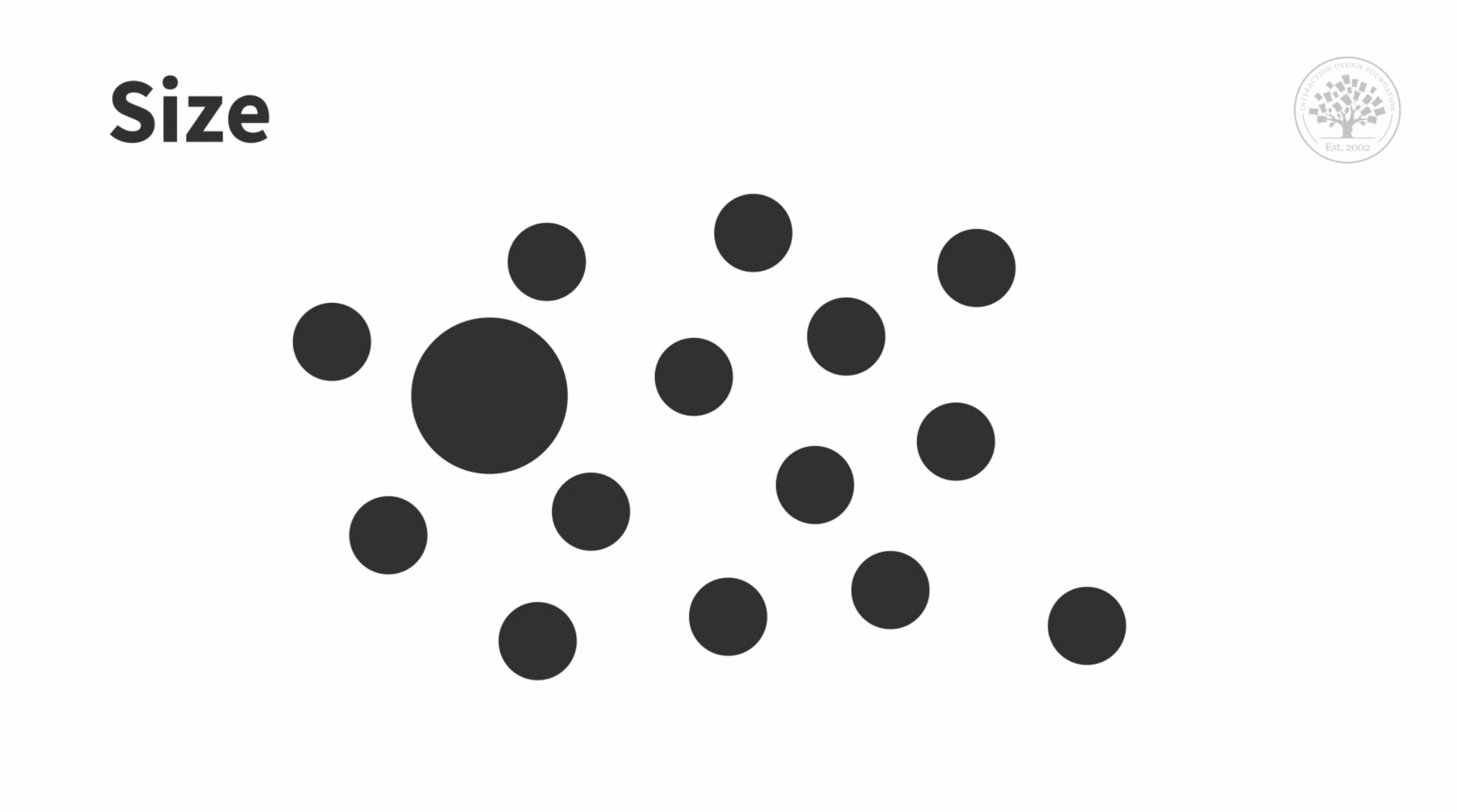
Similarly, when something is a different size from the other objects around it, we notice it. It’s another aspect we can use to catch attention.

Illustration of several dots. One of the dots is bigger than the rest.

© Interaction Design Foundation, CC BY-SA 3.0

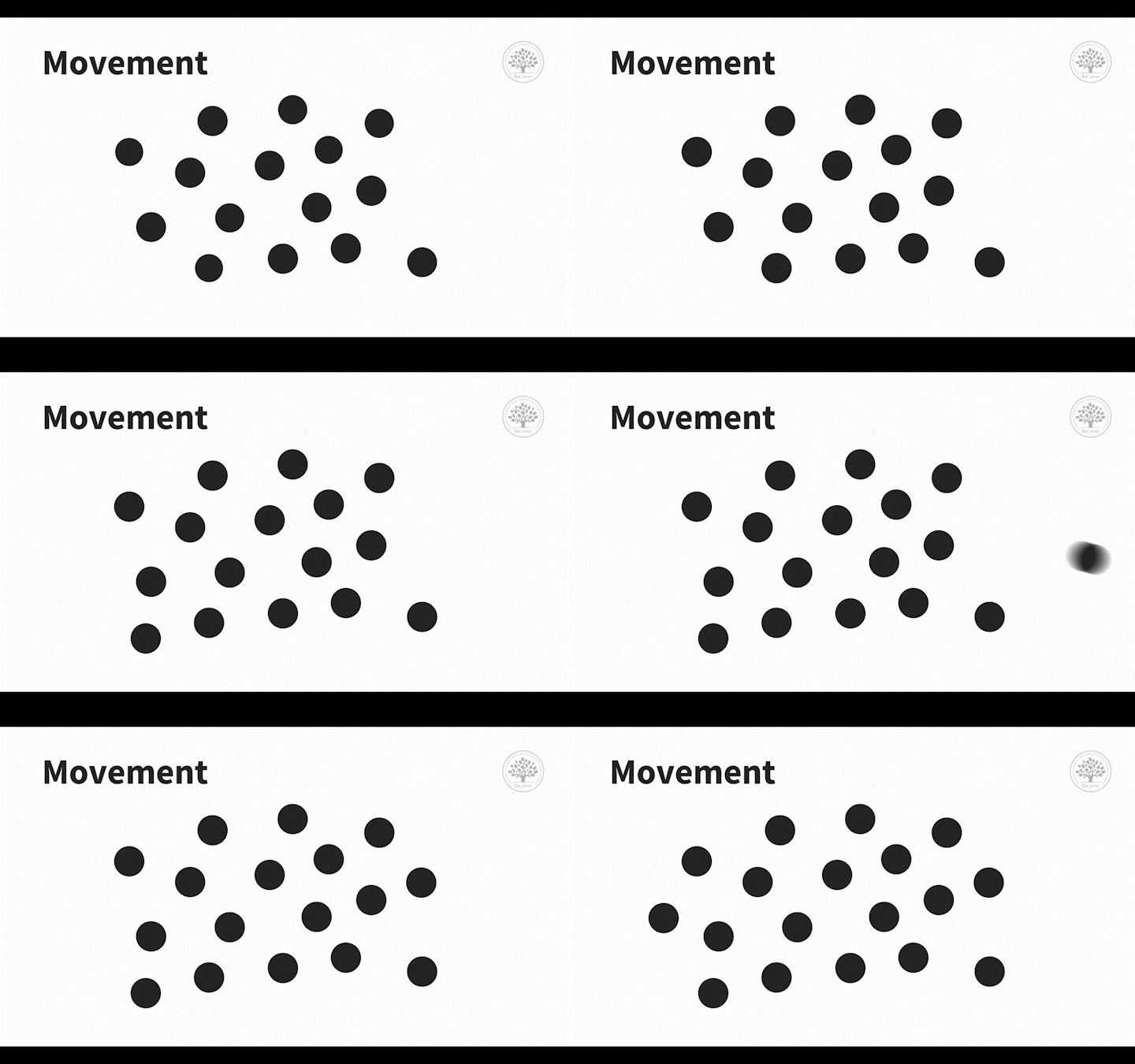
Movement

It may seem obvious, but we automatically detect when there is movement. We don’t often realize it, our attention is fleetingly drawn to small movements throughout the day, whether it’s an insect flying close by or a piece of paper shifting from a brief draught.

A short clip of small dots joining a cluster of dots from somewhere off frame. The clip's purpose is to demonstrate how movement catches our attention

© Interaction Design Foundation, CC BY-SA 3.0

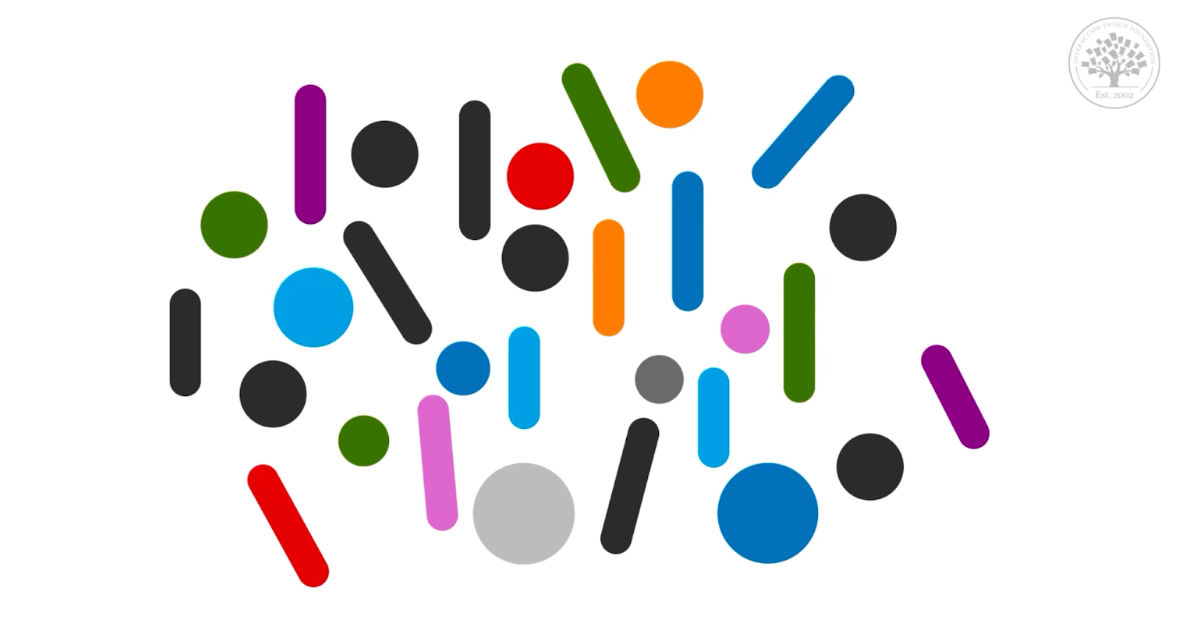
To utilize the pre-attention visual area to its full potential, only use one or two visual attributes simultaneously. If you try to use all of them at once, the pre-attention area goes quiet. 

Illustration of different shapes in different colours at different angles

If you try to engage all pre-attention visual areas simultaneously, that part of the brain goes quiet. Only use one at a time, or just shape and color.

© Interaction Design Foundation, CC BY-SA 3.0

2. Reach Your Target Audience with Mental Models

As we learn something new, we create new neuron connections. However, from childhood through to adulthood our brain prunes some of these connections. It’s a natural process that’s necessary for brain development. But it’s for this reason that learning a language is more difficult later on in life. This same pruning happens when we use and experience different technologies. The technology that we use as a pre-teen or adolescent sets our mental model for the rest of our life. Behavioral Economist, Guthrie Weinschenk, shares his favorite example to illustrate mental models that relate to technology:

Transcript

This means that mental models change from one generation to the next. For instance, have you seen how accustomed young children are with touch screens? They’re far more comfortable with them than someone much older but who’s been exposed to them more. The critical factor here is when they were exposed. 

How does this influence design? If you want to ensure the success of your product, you need to be acutely aware of these mental models. Let the mental model(s) of the generation(s) you’re targeting inform your design. 

3. The Science of Decision-Making Affects the Success of Your Products 

Research shows that decision-making is an unconscious process. Even conscious decisions, where we apply our logic, have an unconscious component. 

Emotions and feelings influence decisions, not just logic and reasoning. Emotions are so important that without them we can’t make any decisions. Susan Weinschenk explains why in this clip: 

Transcript

This means that there are no unemotional decisions. Confidence also influences decision-making. It may seem obvious, but you’re more likely to make a decision when you are confident in it. However, a feeling of confidence is subjective and varies from one person to the next. Susan Weinschenk describes it best:

Transcript

There’s a part of the brain that monitors time, meaning that we will unconsciously make the connection between the length of time it takes to make the decision and a lack of confidence. This unconscious knowledge further prevents us from coming to a resolution. 

Decision-making is more complicated than we realize, it happens unconsciously, it’s emotional and requires confidence. This is where behavioral design comes in, you need to make an emotional connection to trigger action and decision-making. Consider how you can build trust with your desired audience so that their confidence in you grows and consequently, they take action. 

Change Behavior With Partitions and Groupings

Guthrie Weinschenk has a scenario that clearly explains the concept of partitions:

Transcript

What’s the answer? The big bag! You will eat more of a snack when you have a large bag, instead of multiple little bags. The obstacle of opening a new bag is a partition. When we encounter a partition, it prompts us to think about our decision. If we have an enormous bowl of chips on our lap, we’ll instinctively keep grabbing more handfuls. Conversely, if we finish one small bag of chips and we’re in the mood for more, we’ll be more deliberate in our decision to grab another one because of that one small partition—opening the bag. In other words, partitioning gives you a decision point at which you are to evaluate your actions, in this case, to stop or carry on. The decision points shift your decision-making from automatic to deliberative. 

You can use partitioning to frame your product or service in a more favorable way. It can make small numbers seem big and big numbers seem small. For instance, have you ever come across a product framed in this way “Get quality insurance for just $1 a day”? That sounds a lot better than $365 a year. 

To make small numbers seem big, let’s use Guthrie Weinschenk’s example of cigarettes. If you’re trying to convince someone of the damage they’re doing to their lungs by smoking, imagine you could show them how many cigarettes they would smoke in their lifetime. A few cigarettes a day may not seem so bad, but if all the cigarettes were piled up in one place, the full magnitude of smoking can be appreciated. 

Humans can be influenced by the size of partitions and how they are grouped and framed. Use big groups and fewer partitions to keep people in the automatic decision-making mode and make small numbers seem big. On the other end of the spectrum, use small groups and many partitions to encourage behavior change and make big numbers seem small. 

5. Embrace People’s Social Need in Your Designs

We all know that humans are social creatures. And it isn’t just for making us feel good, but is critical for our very survival. Research shows that not having social connections can be fatal.. Here Susan Weinschenk shares research on this topic: 

Transcript

Social interactions are essential, they’re built into our biology and psychology. This knowledge is especially important if you’re designing a product with a social aspect. You need to make it obvious how people can connect socially. Even if your product doesn’t have a social aspect, or you don’t feel it’s important to your design, remember that people will find a way to use any tool or technology socially. Imagine you’ve just bought yourself a new set of gardening tools. You’re so pleased with them you want to show them off and you expect your friends and family to be equally impressed. Initially the garden tools were just for you, but then it becomes a topic of conversation and who knows, you may just convince someone to garden with you! 

The Take Away

Behavioral science provides us with a multitude of insights that we can apply to our design process. When we understand people we can create better, more successful products. Use these five insights to catch your user’s attention, design products best suited for the audience or generation you’re targeting, influence their decision-making and connect with them emotionally and socially. Strive for behavioral design to get the best user experience and the most successful products.

References and Where to Learn More

Watch Susan and Guthrie Weinschenk’s Master Class, Behavioral Design: Create Engaging Products with Behavioral Science

Learn more about behavioral design in this blog post by SUE | Behavioral Design and this Medium article.

Read one of Susan Weinschenk’s Books: 100 Things Every Designer Needs to Know about People, 100 More Things Every Designer Needs to Know about People or How to Get People to Do Stuff: Master the Art and Science of Persuasion and Motivation

Read Guthrie Weinschenk’s book I Love You, Now Read This Book.

Image: © Hal Gatewood, Unsplash License

Feel Stuck?
Want Better Job Options?

AI is replacing jobs everywhere, yet design jobs are booming with a projected 45% job growth. With design skills, you can create products and services people love. More love means more impact and greater salary potential.

At IxDF, we help you from your first course to your next job, all in one place.

See How Design Skills Turn Into Job Options
Privacy Settings
By using this site, you accept our Cookie Policy and Terms of Use.
Customize
Accept all

Be the One Who Inspires

People remember who shares great ideas.

Share on:

Academic Credibility — On Autopilot

Don't waste time googling citation formats. Just copy, paste and look legit in seconds.