Behavioral Design

Your constantly-updated definition of Behavioral Design and collection of videos and articles.
Be a conversation starter: Share this page and inspire others!

197 Shares

What is Behavioral Design?

Behavioral design is a method that applies principles from the fields of behavioral science, psychology, and economics to influence human behavior. This approach is used across various domains, including product design, public policy, health, education, financial services and environmental sustainability, among others.

Behavioral Design in Real-Life

Photo of a urinal. A realistic looking image of a fly is etched close to the drain.

A simple solution to a costly problem: The flies etched onto the urinals at Schiphol Airport reduced spillage by 80 percent.

© Schiphol Airport, Fair Use

The "Fly in the Urinal" at Amsterdam's Schiphol Airport is a classic application of the behavioral design technique known as "nudging." Nudging is a concept in behavioral economics and psychology that involves subtly guiding people's behaviors in a predictable way without restricting their freedom of choice or using direct instructions.

A realistic image of a fly was etched near the drain of each urinal in the men's bathrooms. In this instance, the nudge is the visual cue of the fly itself, which leverages a natural human behavior—the tendency to aim at targets (when urinating or otherwise). This nudge does not mandate users to aim at the fly; instead, it makes the desired behavior (minimizing spillage by aiming more carefully) more likely with the introduction of a small, intriguing target. This behavioral technique exploits automatic cognitive processes, which guide actions without the need for conscious deliberation.

Aad Kieboom, the Schiphol Airport manager at the time, reported that there was a massive 80 percent reduction in spillage after the introduction of the flies. He estimated that this resulted in an 8 percent reduction in total bathroom cleaning costs at the airport. 

The effectiveness of this nudge lies in its simplicity and the insight that small changes in our environment can significantly influence our behavior. 

Behavioral Design vs Traditional Design: What’s the Difference

Behavioral design and traditional design differ in focus, methodology, and application:

  1. Focus: Behavioral design aims to influence user behavior through insights from psychology and behavioral economics, targeting specific actions or changes (like aiming for a target). Traditional design focuses on solving functional problems, to enhance aesthetics, and usability without necessarily aiming to modify behavior. For example, an everyday item like a chair or kettle is designed to be usable, but its aim isn’t to modify its user’s behavior.

  2. Methodology: Behavioral design is data-driven, it relies on empirical research to inform design decisions and test their impact on behavior (like aiming for targets). Traditional design relies on principles of art, aesthetics, and established design practices.

  3. Applications: Behavioral design is applied in fields where behavior change is desired, such as public health, finance, and sustainability. In the Schipol Airport story, the amount of spillage before the introduction of the fly was both detrimental financially and a public health risk. Traditional design spans a wide range of fields like graphic design, industrial design, and web design, its focus more on visual appeal and functionality.

Ultimately, behavioral design uses scientific insights to influence behaviors directly, while traditional design emphasizes aesthetics, functionality, and user experience.

Behavioral Design: Theoretical Foundations 

The key idea behind behavioral design is to create products, environments, systems, or policies that subtly steer people toward making better decisions (to save money rather than spend it or to improve exercise habits) instead of restricting their freedom of choice. It’s a design approach that has various influences, including but not limited to the ones discussed here. 

Cognitive Psychology and Decision Making

At the heart of behavioral design lies cognitive psychology, which studies how people perceive, think, remember and learn. Daniel Kahneman introduced the distinction between fast, intuitive thinking (System 1) and slower, more deliberate thinking (System 2)—a crucial framework to understand human decision-making. Behavioral design uses these insights to shape environments that navigate intuitive choices and support deliberate decision-making when needed.

In this video, Daniel Kahneman explains the concept and framework of thinking fast and slow:

Behavioral Economics

Behavioral design draws heavily on the research findings of behavioral economics, which studies the effects of psychological, cognitive, emotional, cultural and social factors on the economic decisions of individuals and institutions and how those decisions vary from those implied by classical economic theory. By challenging the traditional economic theory that assumes human rationality, behavioral economics introduces the idea of "bounded rationality," where cognitive biases and heuristics limit decision-making. Richard Thaler and Cass Sunstein developed the "nudge" concept—subtle cues or modifications in the choice architecture (the way in which choices are presented to people that influence their decisions without restricting their freedom of choice). This method aims to simplify decision-making that aligns with individuals' long-term goals and interests.

Learn more about what a nudge is in this video:

Social Psychology

Social psychology explores how the presence of others influences an individual's thoughts, feelings and behaviors. Behavioral design incorporates principles like social proof, where people follow others' behaviors to guide their actions and commitment devices. This involves making future commitments publicly to reinforce behavior change. These principles are crucial for creating social environments that foster positive behavior change.

Habit Formation and Change

The study of how habits form and change is vital for designing products and services that encourage positive and lasting behavior modification. Charles Duhigg's exploration of the habit loop (cue, routine, reward) offers a framework to integrate products and services into users' daily lives and influence long-term behavior.

Charles Duhigg explains further in this video: 

Ethical Considerations

The ability of behavioral design to influence behavior raises important ethical questions. It requires a delicate balance between promoting positive behavior change and preserving individual autonomy. Designers and policymakers must ensure that interventions are transparent, voluntary and genuinely serve the best interests of their target audience.

What’s the Impact of Behavioral Design on User Experience (UX)

Behavioral design profoundly influences user experience—the insights gained from behavioral science help to create intuitive, engaging and effective products and services. This approach not only places the user at the center of the design process but also meticulously integrates psychological insights to craft experiences that align with natural human behaviors. Here's how behavioral design reshapes UX across various dimensions:

User-Centered Design and Cognitive Biases

At the core of behavioral design is a commitment to understanding and prioritizing user needs, motivations and behaviors. Designers use empathy to create solutions that are both functional and engaging. With cognitive biases and heuristic insights, such as the tendency to overvalue immediate rewards, designers can anticipate and influence user decisions. For instance, apps that promote saving or healthy habits make the benefits of long-term behaviors feel immediate and tangible and encourage users to adopt more beneficial habits.

The South African Insurance and Financial Institution Discovery has a rewards program, Vitality, which motivates its users to eat healthy, be more active and drive more safely. This promotional video explains in more detail:

https://youtu.be/DBF3mIYDpOI  

Simplification, Clarity and Feedback

A key principle of behavioral design is the emphasis on simplicity and clarity to reduce cognitive load and decision fatigue. Clear, straightforward presentation of choices and the simplification of complex tasks enable users to make better decisions with ease. For example, fitness apps like Fitbit use rewards and progress tracking to provide timely and relevant feedback, which encourages users to maintain their exercise routines by making the feedback loop between action and reward as short as possible. 

Habit Formation and Ethical Considerations

Behavioral design encourages the formation of positive habits with products and services that easily integrate into daily routines. Habit-forming apps, for example, send regular reminders or prompts to encourage consistent usage, leveraging the understanding of triggers, actions and rewards that drive habit formation. Ethical considerations are crucial to ensure these design practices enhance user well-being and trust without manipulating them. Designers must navigate the fine line between influencing behavior for the users' benefit and manipulation to ensure transparency, user consent and respect for autonomy.
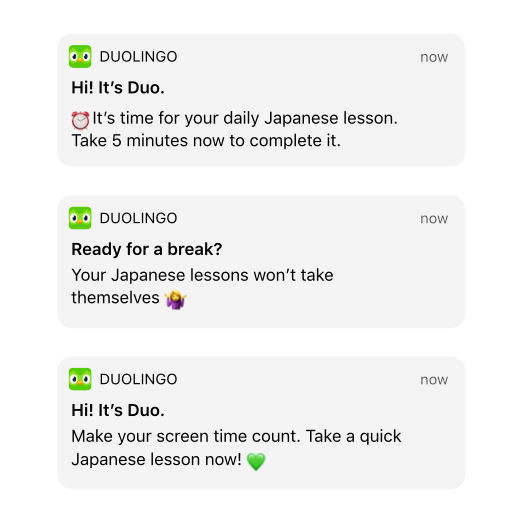
A screenshot of the reminders Duolingo sends as push notifications

The popular language learning app, Duolingo, sends a variety of different reminder notifications to encourage their users to practice the language they’re learning.

© Duolingo, Fair Use

Personalization and Higher Engagement

Personalization and adaptation to individual behaviors, preferences and needs make products and services more relevant and valuable to users. This increased relevance can lead to better outcomes as users receive recommendations and content that match their unique goals and preferences. Techniques such as gamification, personalized content and rewarding systems further increase user engagement by making interactions more enjoyable and meaningful, fostering loyalty and long-term engagement.
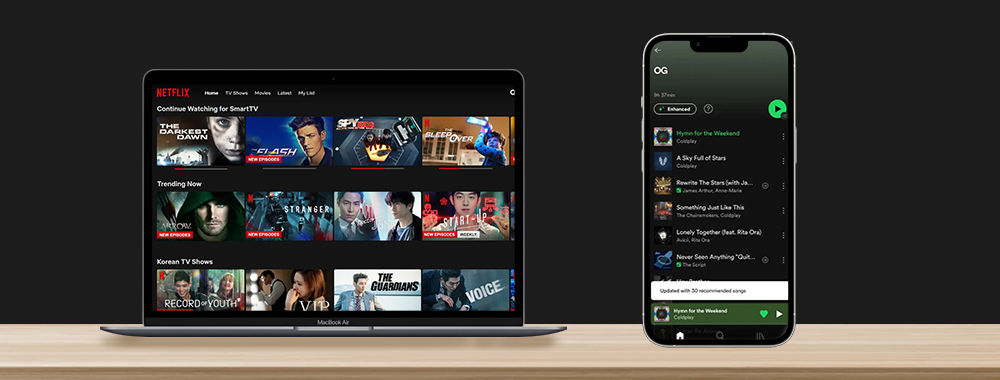
A laptop showing the personalized homescreen of Netflix on one side of the image. On the other side is a mobile phone displaying the personalized homescreen of Spotify.

Applications like Netflix and Spotify personalize their content in accordance with user preferences and behaviors.

© Netlix and Spotify, Fair Use

How to Apply Behavioral Design Techniques to UX

A variety of behavioral design methods can be used to influence user behavior and enhance user experience. Here are some commonly used techniques and how to use them in UX design

1. Nudges

Nudges are subtle design cues or features that encourage users to take certain actions without restricting their freedom of choice. Designers can use nudges to guide users towards beneficial behaviors subtly. This might include placing the most environmentally friendly option as the default choice in a selection menu, or highlighting the most popular plan on a pricing page to guide the user's choice. 

Google Flights is a good example of nudges—it highlights carbon emissions for flights. Users can see the environmental impact of their flight choices and this encourages them to select more eco-friendly options without restricting their choice of flights.
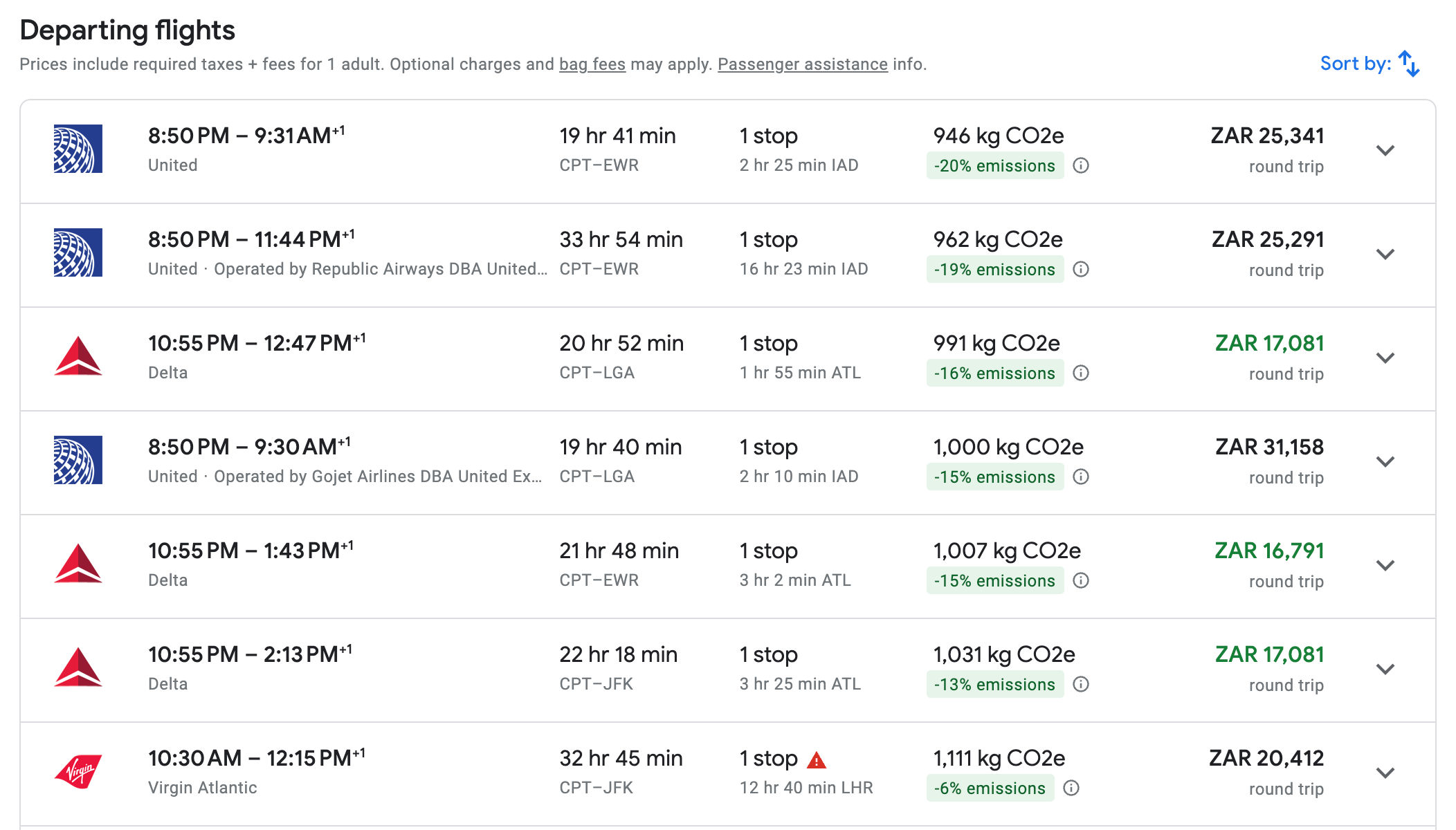
A screenshot of Google Flights showing flights sorted according to carbon emissions.

Google Flights even allows users to sort flights according to emissions.

© Google Flights, Fair Use

2. Choice Architecture

This involves how choices are organized and presented to users to influence their decisions. Designers can make certain choices more appealing or easier for their users to select all by the way they are structured. For example, simplifying the number of choices available can reduce decision fatigue and help users make decisions more easily. 

Spotify uses choice architecture effectively by simplifying its user interface to guide users toward playing music, creating playlists, or exploring new songs with minimal effort. This reduces decision fatigue and enhances the listening experience.

3. Defaults

Defaults are pre-selected options that users are more likely to stick with due to inertia or decision-making fatigue. Setting beneficial defaults can lead to better outcomes for users, such as opting users into paperless billing by default to promote environmental sustainability or setting privacy settings too high by default to protect user data.

Gmail sets up a default setting to show images only from trusted senders which enhances security and user privacy automatically. Users can change this setting, but the default helps protect them from potential phishing attacks or unwanted content.

4. Feedback Loops

Immediate feedback on a user's actions can help reinforce desired behaviors or correct undesired ones. In UX design, feedback loops can be used to encourage progress towards a goal, such as visual indicators of progress in a fitness app or instant feedback when a user enters information in a form incorrectly.

Duolingo provides instant feedback on language exercises, immediately indicating right or wrong answers and suggesting corrections. This reinforces learning and keeps users motivated by showing progress in real-time.
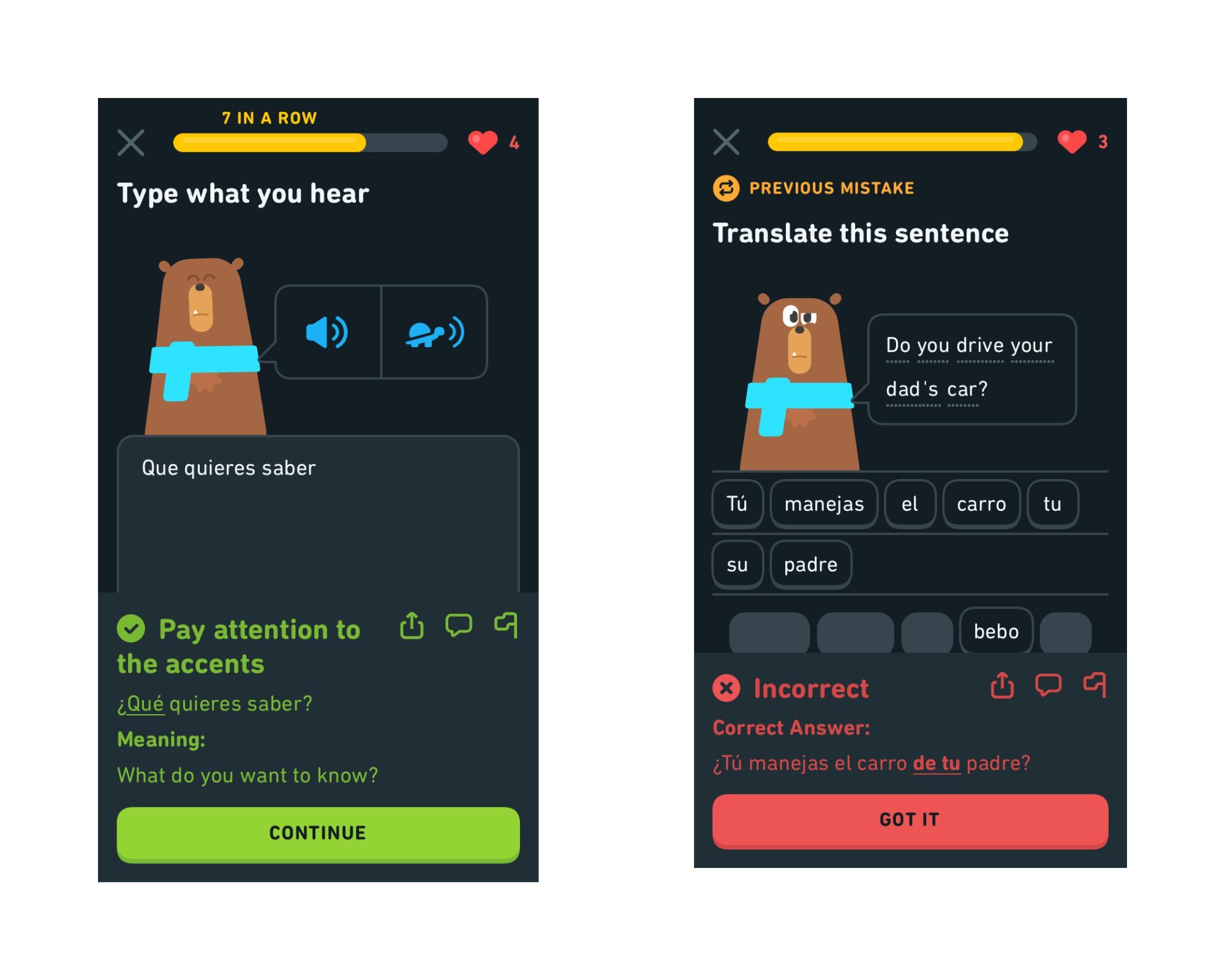
An image with two screenshots from Duolingo. It shows the feedback given to a right and wrong answer.

Duolingo gives instant feedback to their users and uses a progress bar to encourage their users to finish a language lesson and move towards their goal.

© Duolingo, Fair Use

5. Gamification

Gamification applies game-design elements in non-game contexts to motivate and engage users. Techniques such as points, badges, leaderboards and challenges can make the user experience more engaging and encourage continued use of a product or service.

Fitbit incorporates gamification by awarding badges for different milestones (like steps walked or floors climbed) and allows users to compete with friends. This approach makes health tracking more engaging and motivates continued use.

6. Social Proof

Social proof is a psychological phenomenon where people copy the actions of others in an attempt to reflect correct behavior for a given situation. In UX design, this might include showing testimonials, reviews, or the number of users who have taken an action to encourage new users to do the same.

Amazon’s product pages display customer reviews and ratings prominently—this social proof helps potential buyers make informed decisions based on the experiences of others.
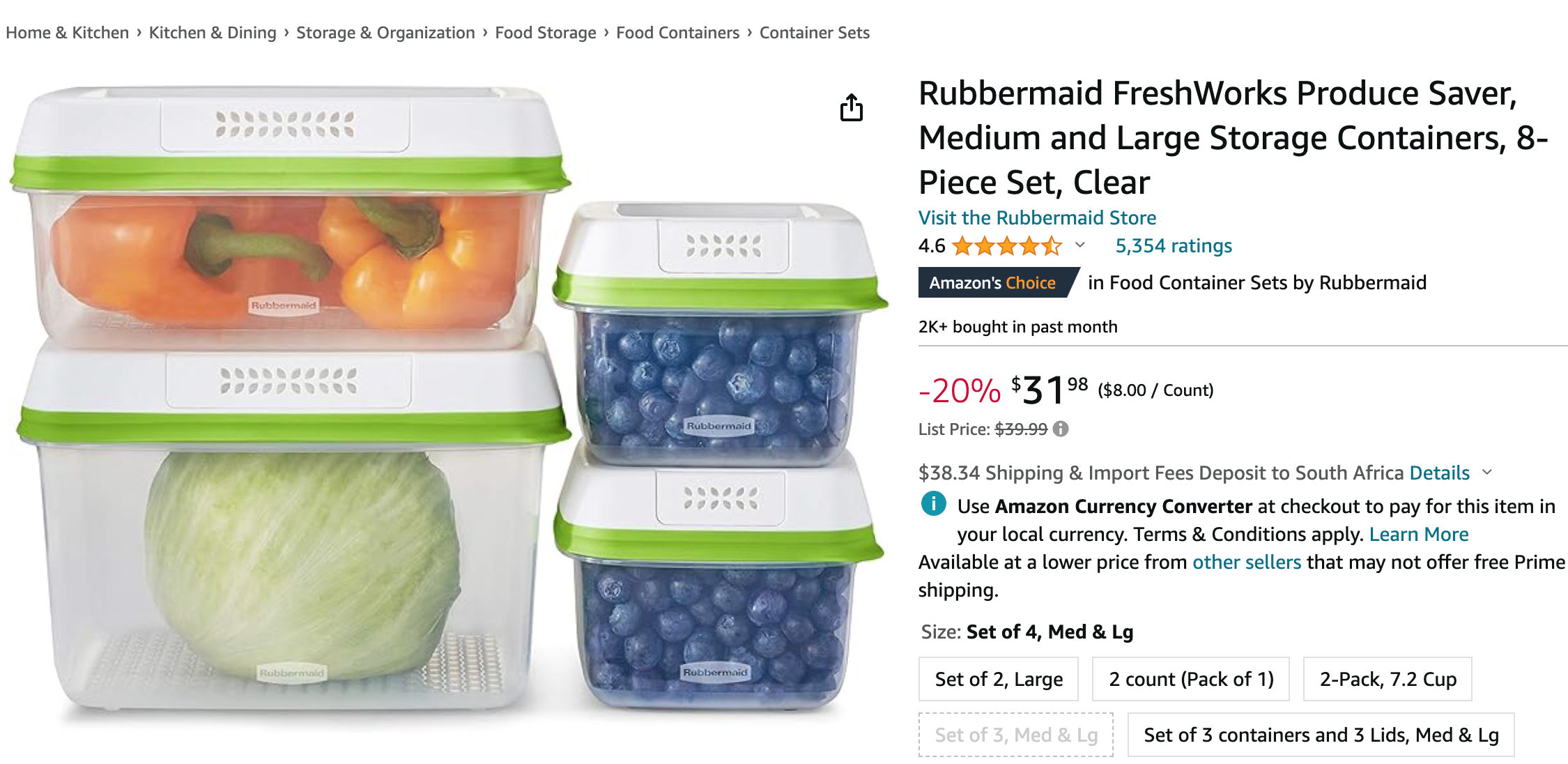
Screenshot of a product page on Amazon.

Amazon’s product page displays a product’s rating before its price and description.

© Amazon, Fair Use

7. Loss Aversion

Loss aversion refers to people's tendency to prefer avoiding losses to acquiring equivalent gains. Designers can use this principle by highlighting what users stand to lose if they don't take a certain action, such as a discount expiring, to encourage prompt decision-making.

Booking.com often displays messages like "Only 2 rooms left at this price" or "Last booked 5 minutes ago" to highlight what users might lose if they don't book quickly, using loss aversion to encourage faster decision-making.

8. Commitment Devices

Commitment devices help users stick to long-term goals by making commitments in the present. In UX design, this could involve allowing users to set personal goals and reminders or to commit to future actions, like scheduling a workout session in a fitness app.

Headspace, a meditation app, allows users to set personal meditation goals and sends reminders to meditate, acting as a commitment device to help users stick to their mindfulness goals.

9. Personalization

Designers can tailor a user experience to individual users' preferences, behaviors and past interactions to make a product more engaging and effective. Personalization can involve customized content, personalized recommendations, or adaptive interfaces that change based on user behavior.

Google News aggregates news stories from various sources and customizes the feed based on the user's past reading behavior, search history and preferences to present the most relevant news articles.
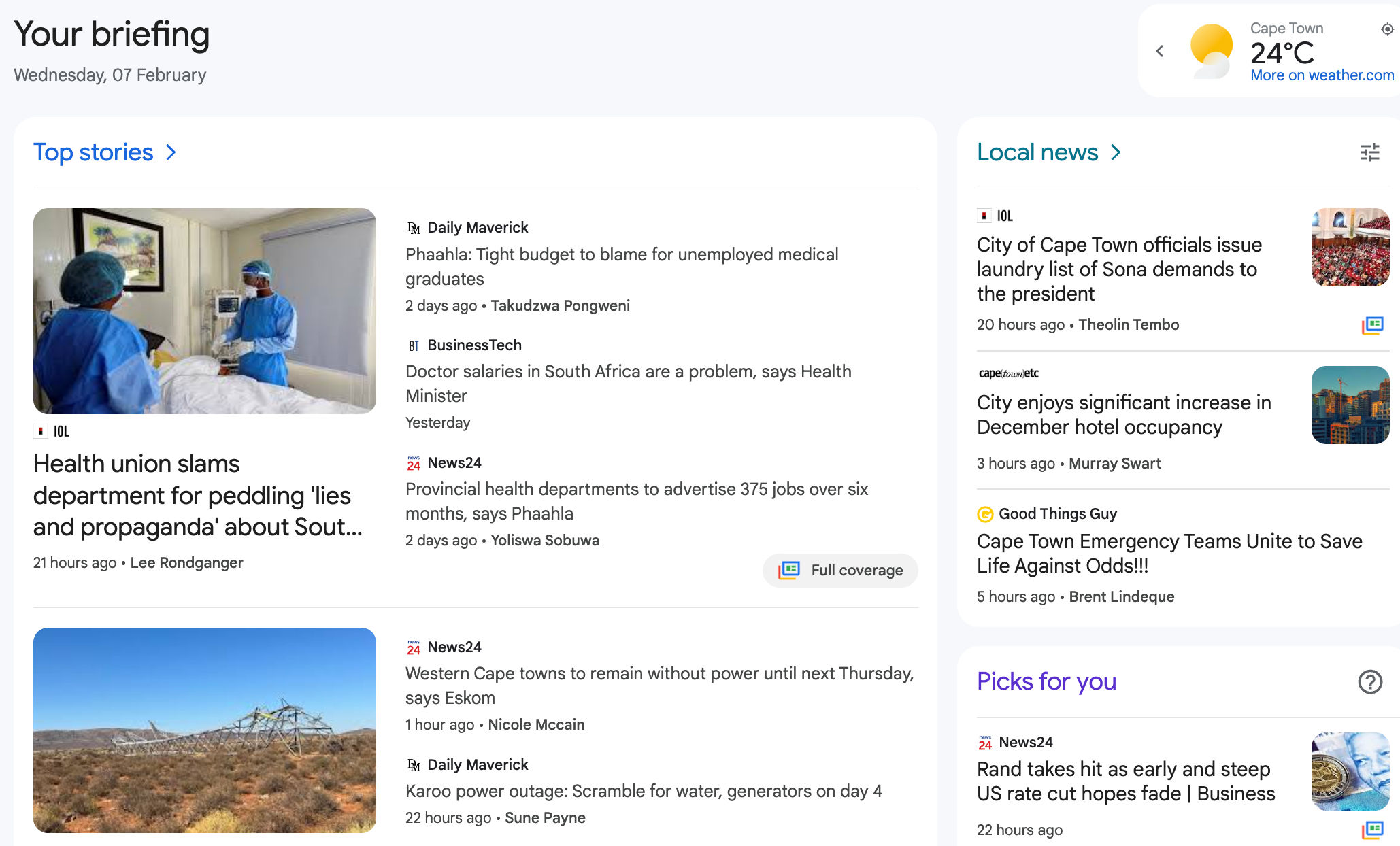
Screenshot of a personalized Google News homepage.

© Google News, Fair Use

10. Scarcity and Urgency

A sense of scarcity (limited availability) or urgency (limited time) can motivate users to take action more quickly. This is often seen in e-commerce UX design, where messages like "Only 3 left in stock" or "Sale ends in 2 hours" encourage users to make purchases more promptly.

eBay uses scarcity and urgency in its auction countdowns—they show time running out on bids to encourage users to act quickly to secure their desired items before they are gone.

11. Accessibility and Inclusivity

Ensure your website is accessible to all users, including those with disabilities or who are neurodiverse. The Web Content Accessibility Guidelines (WCAG) must be followed to ensure a site is usable by people with a wide range of abilities. This not only expands your audience but also demonstrates a commitment to inclusivity.

Apple's website exemplifies a strong commitment to accessibility by providing extensive support for screen readers, keyboard navigation and other assistive technologies to ensure that users with disabilities can navigate their site effectively.

12. Clear and Actionable Calls-to-Action (CTAs)

Designers should create CTAs with clear, compelling language that motivates action. Contrasting colors for CTA buttons and strategic placement on a site will guide users toward desired actions, such as signing up, purchasing, or learning more about a product or service.

Airbnb excels in this area by using prominent, easy-to-find CTAs throughout its site and app. It uses visually distinct and compelling CTAs such as the "Reserve" button or “List your space” CTA.  These CTAs guide users smoothly through the booking process or the steps to list their property, which makes it easy and enticing for users to take the next step.
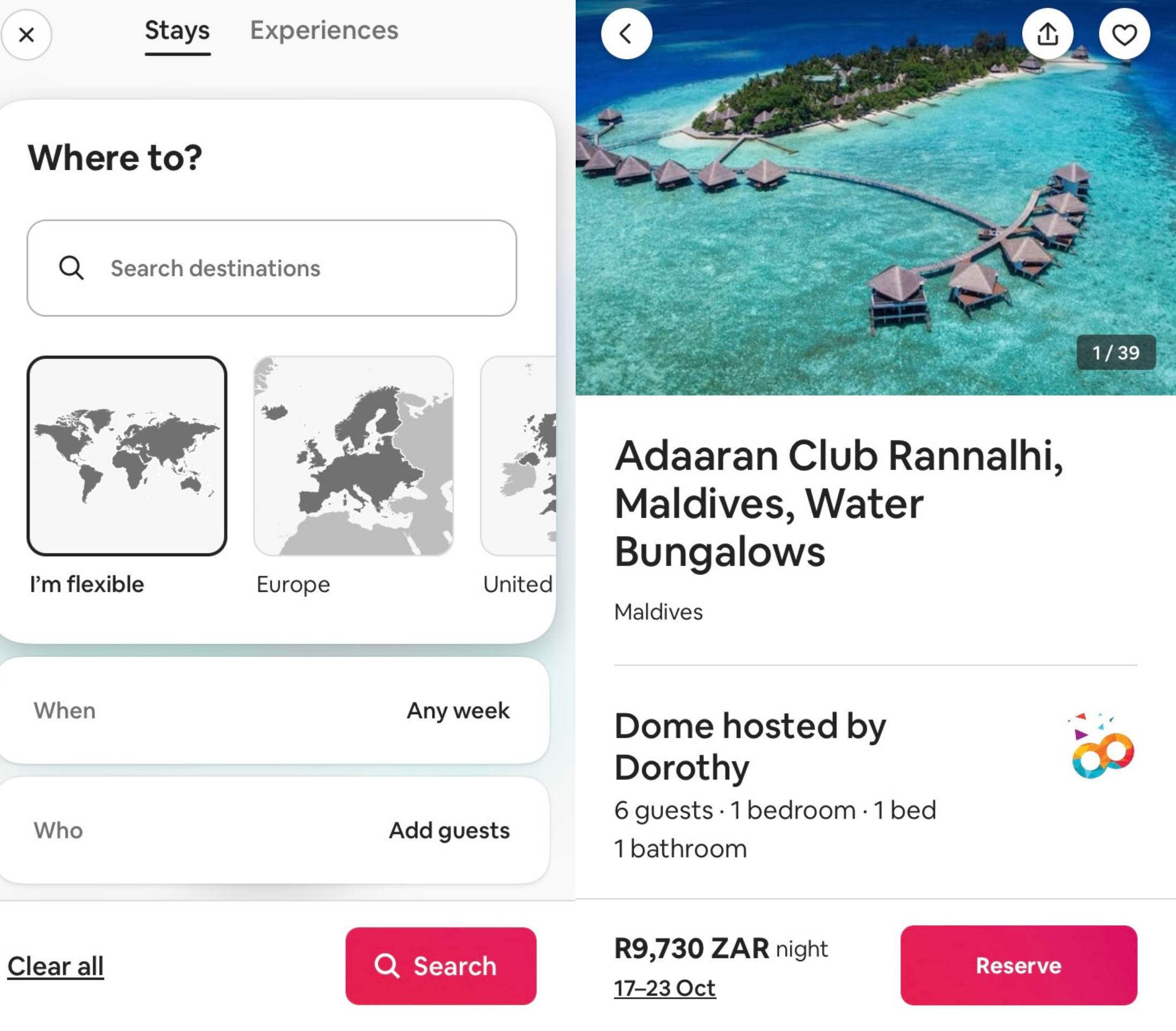
Two screenshots from the Airbnb app

Airbnb’s CTAs are clear, compelling and visually distinct.

© Airbnb, Fair Use

13. Emotional Engagement 

Successful user experiences should aim to be emotionally engaging. Designers can use visuals, stories and content that resonate with their audience. Emotional engagement can increase user retention and brand loyalty. 

Coca-Cola's "Share a Coke" campaign is a prime example. Personalized Coke bottles sparked emotional connections by inviting consumers to share the product with friends and family, which boosted engagement and brand affinity.
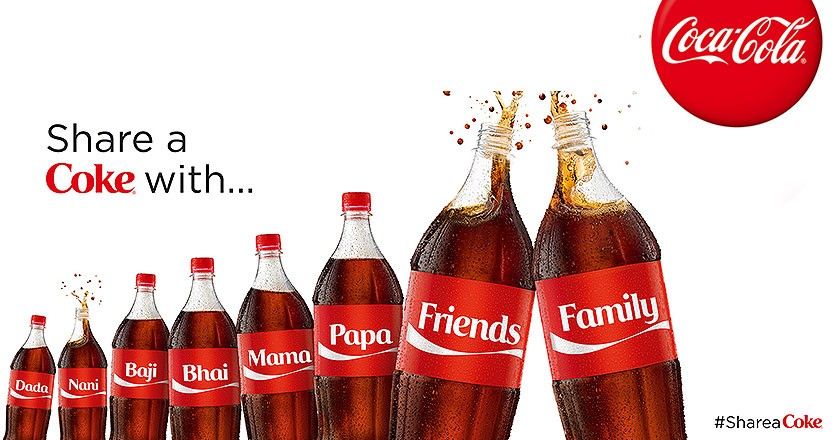
An ad from the Share a Coke campaign

The #ShareACoke campaign launched in Australia and New Zealand in 2011. Coca-Cola reported that over the duration of the campaign, sales increased by 7% in New Zealand and by 4% in Australia.

© Coca-Cola Company, Fair Use

14. Iterative Testing and Improvement

Continuous testing and refinement of a website or product based on real user feedback is crucial to apply behavioral design principles effectively. Designers can use techniques like A/B testing, user interviews and analytics to gather feedback and make data-driven decisions to refine and improve their user experience.

Slack embodies the power of iterative design based on user feedback. This collaboration tool regularly updates its features, interface and functionalities based on direct input from its extensive user base. Through A/B tests on new features and analyzing user interactions and feedback, Slack continuously improves its platform to meet the needs of teams and organizations better.

These behavioral design techniques, when applied ethically and thoughtfully, can significantly enhance user experience. They can make products more intuitive, engaging and effective at helping users achieve their goals.

Questions About Behavioral Design?
We've Got Answers!

Can behavioral design principles be applied to improve website usability?

Yes, behavioral design principles enhance website usability by making sites more intuitive and user-friendly. For example, Amazon uses recommendations based on past behavior to simplify the search process for users which improves overall usability and user experience.

Learn more about behavioral design and website usability in the article Behavioral Design is the Future of UX.

How does behavioral design relate to product design?

Behavioral design is deeply integrated into product design. It focuses on understanding and influencing user behavior to make products more effective and satisfying. For instance, the Nest thermostat learns from user behavior to adjust home temperatures efficiently, a clear application of behavioral design in product development.

Learn more about behavioral design and how it relates to product design in the Master Class, Behavioral Design: Create Engaging Products with Behavioral Science by Susan and Guthrie Weinschenk.

What are the ethical considerations in behavioral design?

Ethical considerations in behavioral design focus on how to respect user autonomy and avoid manipulation. Designers must ensure their work benefits users and does not exploit their psychological vulnerabilities. For example, ethical considerations are paramount to design persuasive technology, like health apps that encourage lifestyle changes without misleading or pressuring users.

Learn more about behavioral design and ethics in the blog, Behavioural Design Ethics.

What are the most highly cited or influential scientific publications in the field of behavioral design?

Here are some of the most highly cited works on behavioral design: 

Voorheis, P., Zhao, A., Kuluski, K., Pham, Q., Scott, T., Sztur, P., Khanna, N., Ibrahim, M., & Petch, J. (2022). Integrating Behavioral Science and Design Thinking to Develop Mobile Health Interventions: Systematic Scoping Review. JMIR mHealth and uHealth, 10(3), e35799. https://doi.org/10.2196/35799

Cash, P. J., Hartlev, C. G., & Durazo, C. B. (2016). Behavioural design: A process for integrating behaviour change and design. Design Studies, 48, 96-128. https://doi.org/10.1016/j.destud.2016.10.001

Khadilkar, P. R., & Cash, P. (2020). Understanding behavioural design: Barriers and enablers. Journal of Engineering Design, 31(10), 508-529. https://doi.org/10.1080/09544828.2020.1836611

Cash, P., Valles Gamundi, X., Echstrøm, I., & Daalhuizen, J. (2022). Method use in behavioural design: What, how, and why? International Journal of Design, 16, 1-21. https://doi.org/10.57698/v16i1.01

How can behavioral design be used to enhance e-commerce platforms?

Behavioral design can significantly enhance e-commerce platforms by personalizing the shopping experience, simplifying decision-making, and encouraging purchases. For example, eBay uses time-limited offers and bid notifications to create a sense of urgency which encourages users to make faster and more frequent purchases.

Learn more about behavioral design in the Master Class, Behavioral Design: Create Engaging Products with Behavioral Science by Susan and Guthrie Weinschenk.

Here are some of the top books on behavioral design:

Wendel, S. (2020). Designing for behavior change (2nd ed.). O'Reilly Media, Inc.

Eyal, N. (2014). Hooked: How to build habit-forming products. Portfolio.

Kahneman, D. (2013). Thinking, fast and slow. Farrar, Straus and Giroux.

Bucher, A. (2020). Engaged: Designing for behavior change. Rosenfeld Media.

Thaler, R. H., & Sunstein, C. R. (2009). Nudge: Improving decisions about health, wealth, and happiness. Penguin Books.

Duhigg, C. (2012). The Power of Habit: Why we do what we do in life and business. Random House.

What role does psychology play in behavioral design?

Psychology is the cornerstone of behavioral design—it provides insights into how users think, feel, and act. This understanding allows designers to craft experiences that effectively influence user behavior. The application of psychological principles, such as the theory of planned behavior, cognitive biases, and emotional triggers, can help designers create products that resonate with users on a deeper level. This approach not only enhances the user experience but also drives desired behaviors, such as increased engagement or conversion rates.

Learn more about behavioral design and psychology in the articles and What is Cognitive Psychology.

How can behavioral design improve user engagement?

Behavioral design can significantly enhance user engagement by creating experiences that are tailored to users' psychological needs and patterns. By leveraging principles like gamification, personalized feedback, and social proof, designers can make products more compelling and rewarding. This approach ensures that users find value and satisfaction in their interactions, leading to increased loyalty and usage. Behavioral design strategies also include designing for habit formation, making the use of a product or service a regular part of the user's routine, thereby boosting engagement over the long term.

Learn more about how behavioral design can enhance user engagement in the article What is Behavioral Economics.

What are the differences between behavioral design and traditional design approaches?

The main difference between behavioral design and traditional design approaches lies in the focus and methodology. Behavioral design centers on understanding and influencing user behavior through psychological principles, aiming to drive specific actions and outcomes. It relies on empirical research into human behavior, using data and insights to shape design decisions. Traditional design approaches, on the other hand, often focus more on aesthetics, usability, and functionality without explicitly targeting behavior change. While traditional design prioritizes the user's experience and interface usability, behavioral design integrates these aspects with a strategic emphasis on shaping user actions and decisions.

Learn more about the differences between behavioral design and traditional design in the article 5 Problems With Traditional User Research And How Behavioural Design Solves Them.

Can behavioral design principles apply to virtual reality environments?

Yes, behavioral design principles can apply to virtual reality (VR) environments. VR offers unique opportunities to influence user behavior in immersive and interactive ways. VR's immersive nature allows for a deeper psychological impact, making behavioral design techniques particularly effective. VR designers can create experiences that not only engage users but also encourage specific actions and reactions by leveraging insights of human behavior.

For instance, using reward systems, realistic simulations, and interactive scenarios, VR can motivate learning, promote behavior change, or enhance training effectiveness. These environments can also utilize psychological principles such as presence, embodiment, and social influence to create powerful, behavior-shaping experiences that are not possible in other mediums. 

Learn more about behavioral design in VR in the Master Class How To Influence Behavior Through Virtual Reality Narratives by Mel Slater.

Earn a Gift Earn a Gift, Answer a Short Quiz!

1
2
3
4
1
2
3
4
Question 1
Question 2
Question 3
Get Your Gift
Interaction Design Foundation logo

Question 1

What is the main focus of behavioral design?

1 point towards your gift

  • To improve visual appeal and aesthetics of each design project
  • To increase the technical functionality of products and improve accessibility
  • To influence human behavior with principles from psychology and behavioral science
Interaction Design Foundation logo

Question 2

What is a "nudge" in the context of behavioral design?

1 point towards your gift

  • A mandatory instruction to users
  • A pop-up that suggests a user should take a certain step in a process
  • A subtle cue that influences behavior without restricting freedom of choice
Interaction Design Foundation logo

Question 3

Why are ethical considerations important in behavioral design?

1 point towards your gift

  • To increase the complexity of design processes to hide user data
  • To make sure designs are visually appealing and accessible
  • To prevent manipulation and respect user autonomy

Learn More About Behavioral Design

Make learning as easy as watching Netflix: Learn more about Behavioral Design by taking the online IxDF Course Emotional Design — How to Make Products People Will Love.

Why? Because design skills make you valuable. In any job. Any industry.

In This Course, You'll

  • Get excited as you discover the secret to creating unforgettable products people love! Studies show that 95% of our purchasing decisions are emotional. Emotional design turns functionality into connection and products people want more of. Your favorite pen probably isn't the smoothest or fanciest, yet you chose it every time. Why? Because it's not just a pen. There's a connection, a feeling, and a story. That's what separates iconic products from mediocre ones. Emotional design uses timeless human-centered skills to create meaning, attachment, and trust, turning one-time users into lifelong advocates. These skills are paramount to turn AI from a tool into your new superpower, no matter how much the tech advances. You don't have to start from scratch. You'll build on your existing human skills like empathy, intuition, and storytelling.

  • Make yourself invaluable with design skills that tap directly into emotional decision-making. People naturally recommend and repeatedly use products that make them feel good. With your new emotional design skills, you'll effortlessly inspire action, build loyalty, and increase engagement, conversions, and retention. Whether you're a designer, marketer, or leader, this course gives you a timeless skill set to amplify your impact in any role.

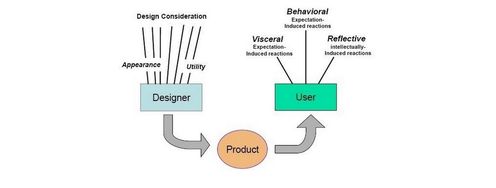
  • Gain confidence and credibility as you master the hidden emotional triggers that make people fall in love with products. It's easier than you think, even if you're completely new to design. Use downloadable templates like the Hierarchy of User Experience (UX) Needs and the 5 Principles of Humanity-Centered Design to fast-track your learning. Directly apply Don Norman's three levels of emotional design—visceral, behavioral, and reflective—to create irresistible products. Leverage tools like Maslow's Hierarchy of Needs and the Triune Brain model to design experiences that win hearts and minds every time. 

It's Easy to Fast-Track Your Career with the World's Best Experts

Master complex skills effortlessly with proven best practices and toolkits directly from the world's top design experts. Meet your expert for this course:

  • Alan Dix: Author of the bestselling book “Human-Computer Interaction” and Director of the Computational Foundry at Swansea University.

Get an Industry-Recognized IxDF Course Certificate

Increase your credibility, salary potential and job opportunities by showing credible evidence of your skills.

IxDF Course Certificates set the industry gold standard. Add them to your LinkedIn profile, resumé, and job applications.

Course Certificate Example

Be in distinguished company, alongside industry leaders who train their teams with the IxDF and trust IxDF Course Certificates.

Our clients: IBM, HP, Adobe, GE, Accenture, Allianz, Phillips, Deezer, Capgemin, Mcafee, SAP, Telenor, Cigna, British Parliament, State of New York

All Free IxDF Articles on Behavioral Design

Read full article
Norman's Three Levels of Design - Article hero image
Interaction Design Foundation logo

Norman's Three Levels of Design

In the human mind there are numerous areas responsible for what we refer to as emotion; collectively, these regions comprise the emotional system. Don Norman proposes the emotional system consists of three different, yet interconnected levels, each of which influences our experience of the world in

Social shares
1.2k
Published
Read Article
Read full article
5 Ways to Use Behavioral Science to Create Better Products - Article hero image
Interaction Design Foundation logo

5 Ways to Use Behavioral Science to Create Better Products

A myriad of fields, skills and insights come together to create the overarching discipline of user experience design. Psychology and behavioral science play a big part in UX design because understanding people, the way their minds work, what they want and don’t want, will help us create better produ

Social shares
634
Published
Read Article

5 Ways to Use Behavioral Science to Create Better Products

5 Ways to Use Behavioral Science to Create Better Products

A myriad of fields, skills and insights come together to create the overarching discipline of user experience design. Psychology and behavioral science play a big part in UX design because understanding people, the way their minds work, what they want and don’t want, will help us create better products and services and, consequently, more successful designs. Let’s explore five behavioral science insights you can use right now to design better products—they’ll be especially useful if you’re a product designer, UX designer, product manager or anyone involved with the product design process.

What is behavioral science and behavioral design? 

First, it’s essential to understand behavioral science and the related discipline of behavioral design. Here’s a quick breakdown:  

Behavioral science studies the cognitive processes of organisms, animals or humans. It uses observation, scientific experimentation and mathematical modeling to draw conclusions on how and why people or animals behave. Behavioral science encompasses psychology, anthropology, psychobiology and more.

 Behavioral design combines design, technology and psychology (behavioral science) and applies it to the design process. To practice behavioral design, we must understand how people think, how and why they make decisions and how to influence them to inform the design of products and services. 

1. Engage the Pre-Attention Area of the Brain to Create Eye-Catching Products

This is the part of the brain that grabs attention—it’s known as the visual cortex. It can be extremely useful in product design, especially if one of your main objectives is to catch a user’s attention. In the Master Class, Behavioral Design: Create Engaging Products with Behavioral Science, Dr Susan Weinschenk (AKA The Brain Lady), we learn that there are four areas of the visual cortex (V1, V2, V3 and V4) and each one has a particular sensitivity.

Color

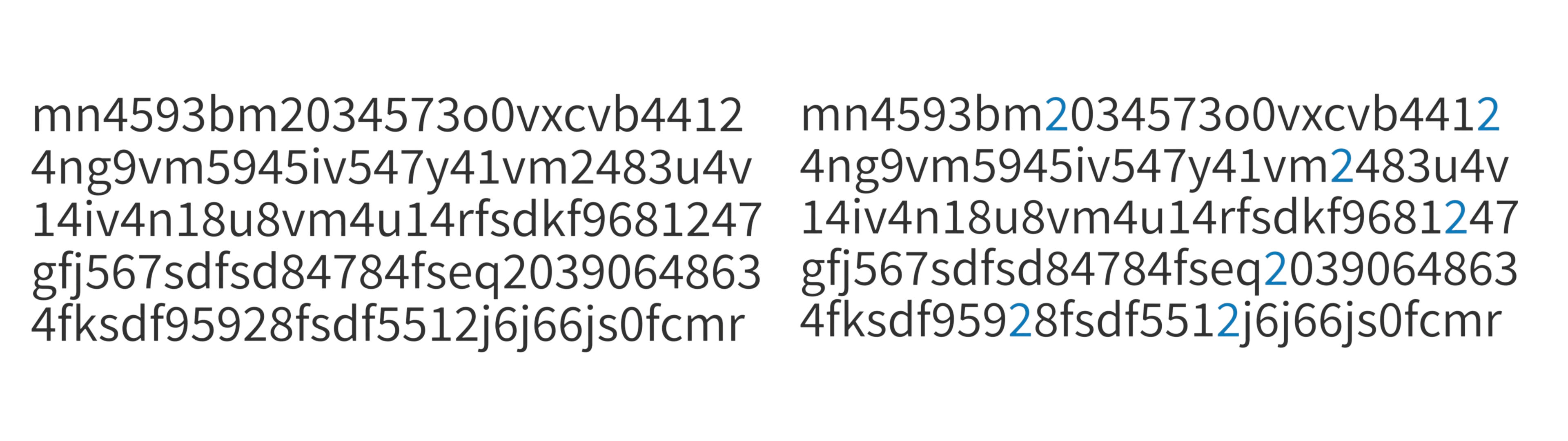
Look at the image below; on which side is it easier to see the number 2? It’s the right-hand side, and that’s because a certain part of the visual cortex is sensitive to color—we can see the 2’s as they’re in a different color from the jumble of letters and numbers.

Side by side image of 5 lines of random letters and numbers. On the left hand side all letters and numbers are black. On the right hand side the number 2's are in blue

© Interaction Design Foundation, CC BY-SA 3.0

Angle

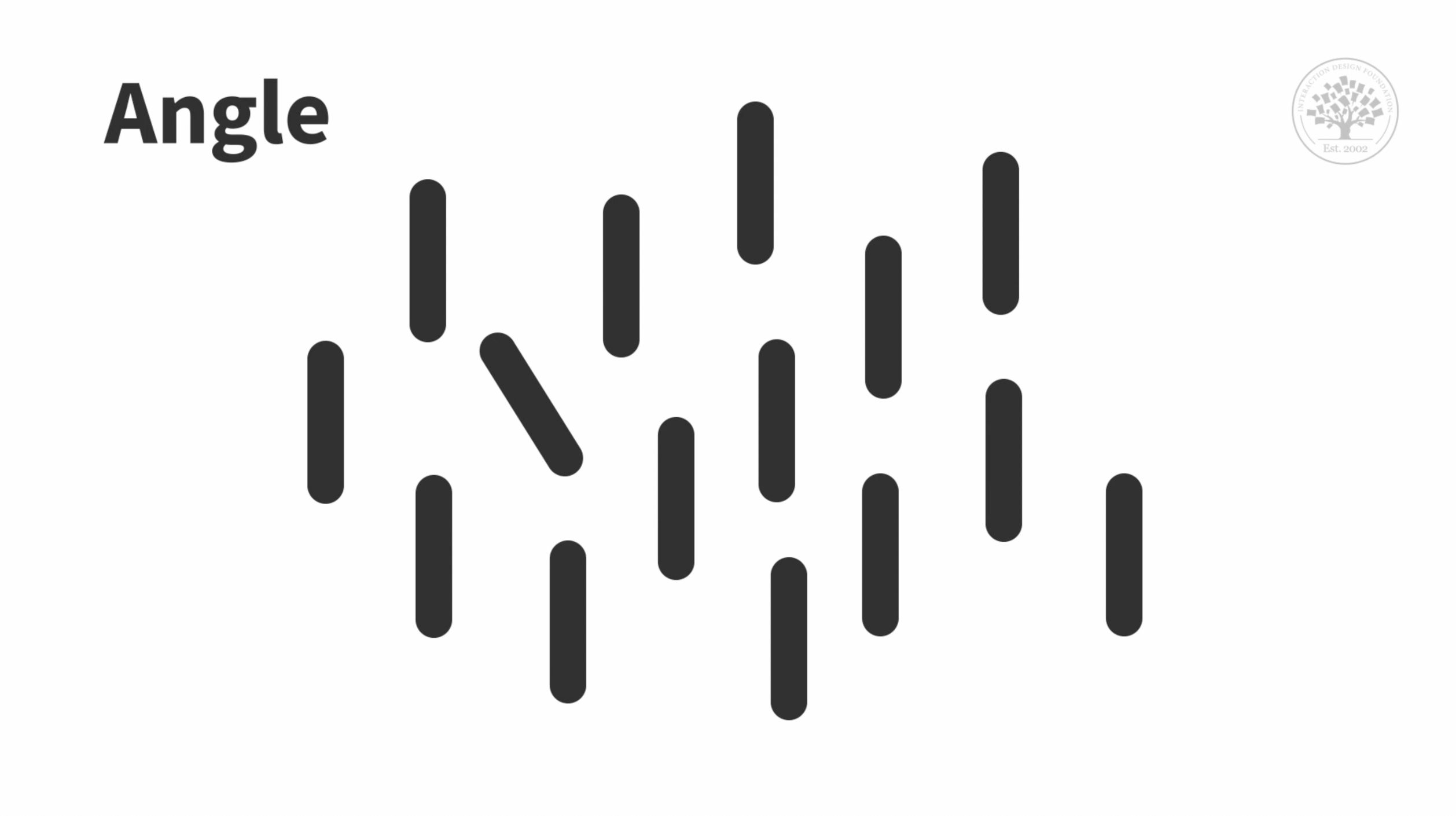
Another part of the visual cortex is sensitive to angle. As illustrated in the image below, we notice one line in particular because it’s slanted, while all the others are vertical.

Illustration of several vertical lines spaced out. One line is at an angle .

© Interaction Design Foundation, CC BY-SA 3.0

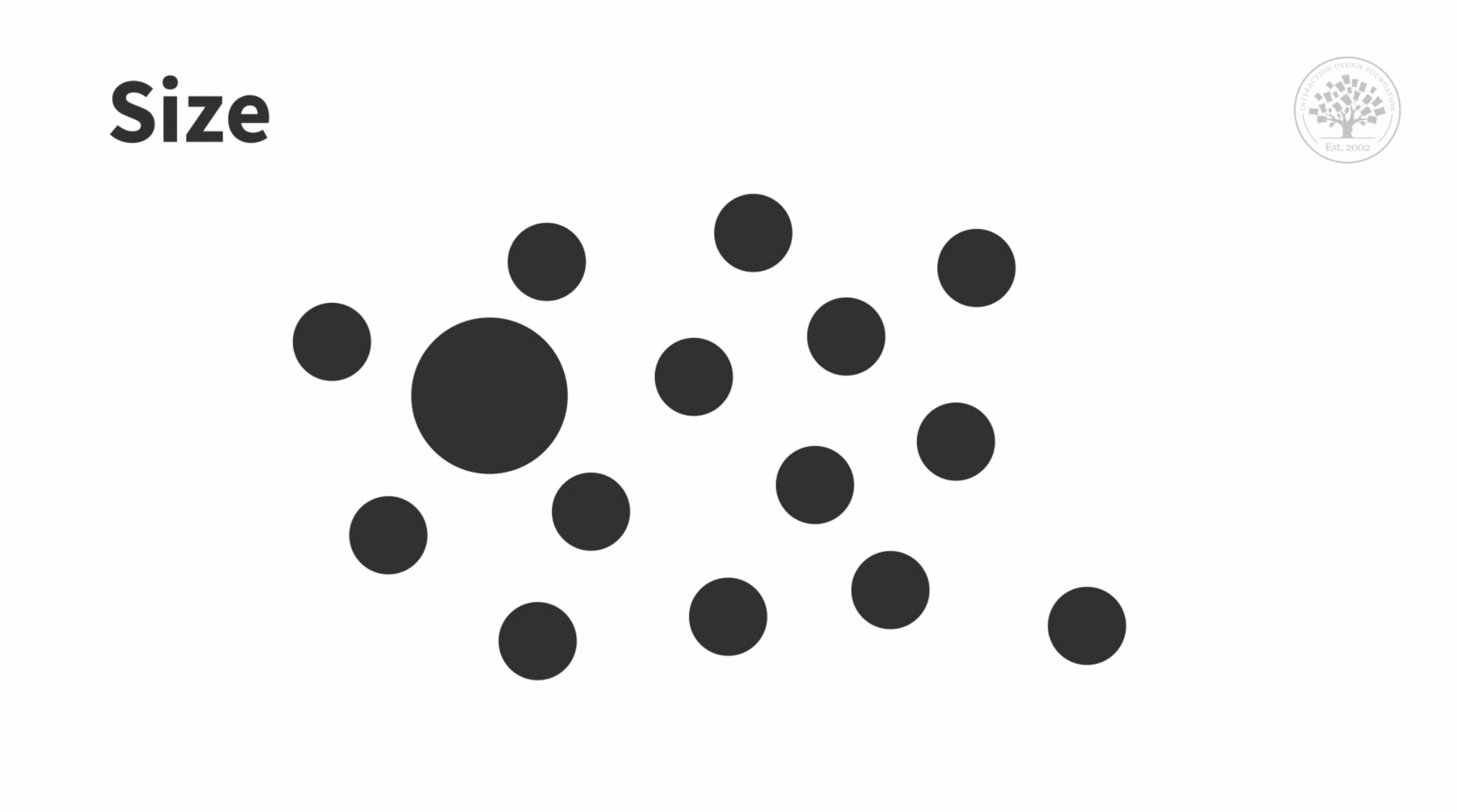
Size

Similarly, when something is a different size from the other objects around it, we notice it. It’s another aspect we can use to catch attention.

Illustration of several dots. One of the dots is bigger than the rest.

© Interaction Design Foundation, CC BY-SA 3.0

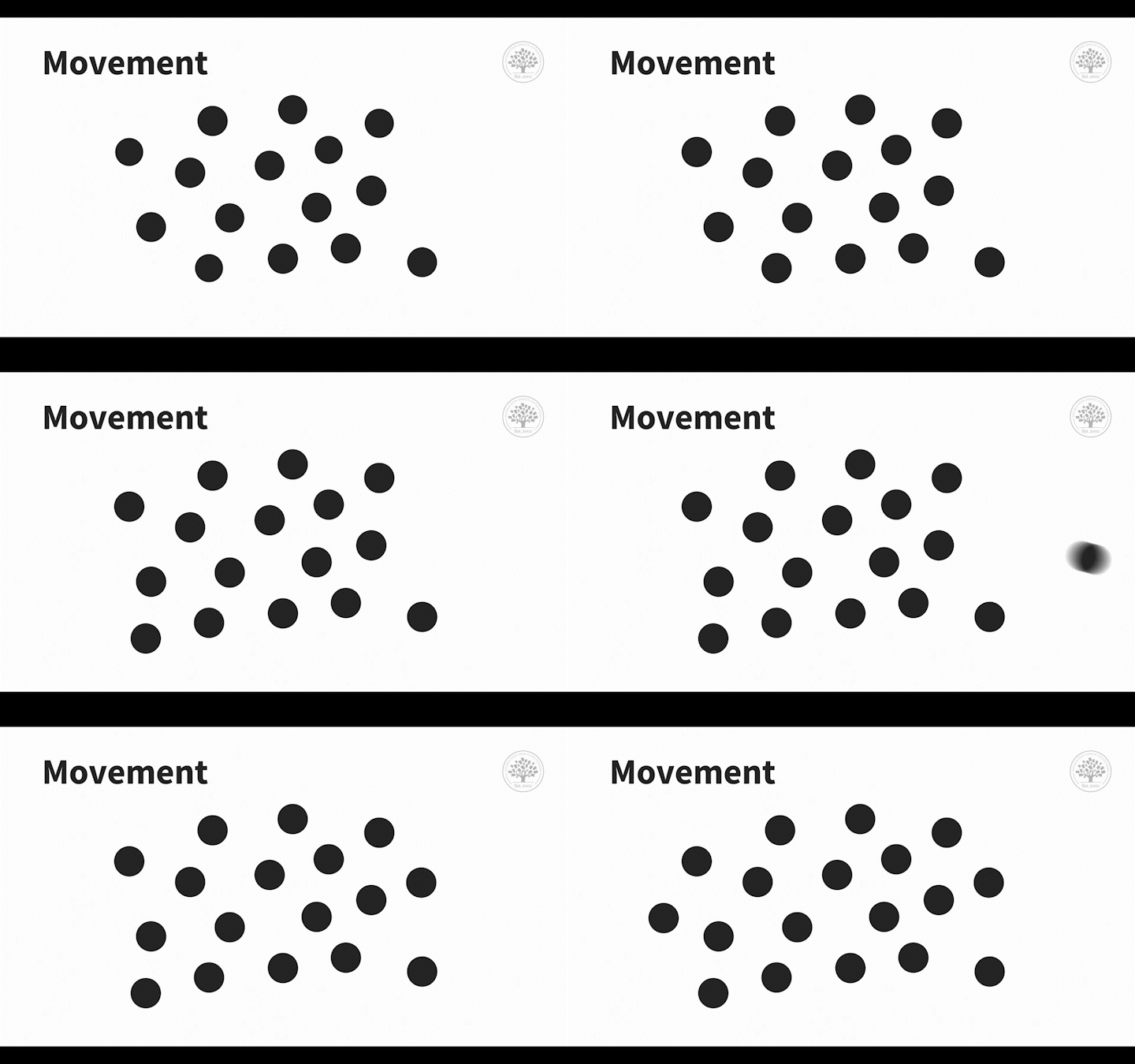
Movement

It may seem obvious, but we automatically detect when there is movement. We don’t often realize it, our attention is fleetingly drawn to small movements throughout the day, whether it’s an insect flying close by or a piece of paper shifting from a brief draught.

A short clip of small dots joining a cluster of dots from somewhere off frame. The clip's purpose is to demonstrate how movement catches our attention

© Interaction Design Foundation, CC BY-SA 3.0

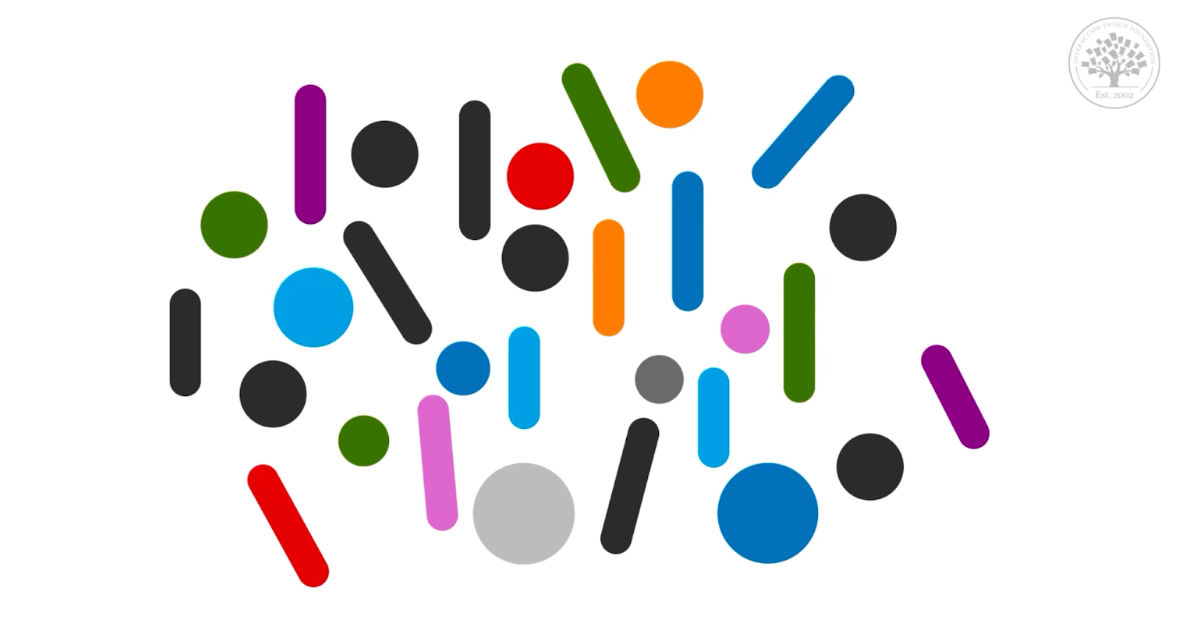
To utilize the pre-attention visual area to its full potential, only use one or two visual attributes simultaneously. If you try to use all of them at once, the pre-attention area goes quiet. 

Illustration of different shapes in different colours at different angles

If you try to engage all pre-attention visual areas simultaneously, that part of the brain goes quiet. Only use one at a time, or just shape and color.

© Interaction Design Foundation, CC BY-SA 3.0

2. Reach Your Target Audience with Mental Models

As we learn something new, we create new neuron connections. However, from childhood through to adulthood our brain prunes some of these connections. It’s a natural process that’s necessary for brain development. But it’s for this reason that learning a language is more difficult later on in life. This same pruning happens when we use and experience different technologies. The technology that we use as a pre-teen or adolescent sets our mental model for the rest of our life. Behavioral Economist, Guthrie Weinschenk, shares his favorite example to illustrate mental models that relate to technology:

Transcript

This means that mental models change from one generation to the next. For instance, have you seen how accustomed young children are with touch screens? They’re far more comfortable with them than someone much older but who’s been exposed to them more. The critical factor here is when they were exposed. 

How does this influence design? If you want to ensure the success of your product, you need to be acutely aware of these mental models. Let the mental model(s) of the generation(s) you’re targeting inform your design. 

3. The Science of Decision-Making Affects the Success of Your Products 

Research shows that decision-making is an unconscious process. Even conscious decisions, where we apply our logic, have an unconscious component. 

Emotions and feelings influence decisions, not just logic and reasoning. Emotions are so important that without them we can’t make any decisions. Susan Weinschenk explains why in this clip: 

Transcript

This means that there are no unemotional decisions. Confidence also influences decision-making. It may seem obvious, but you’re more likely to make a decision when you are confident in it. However, a feeling of confidence is subjective and varies from one person to the next. Susan Weinschenk describes it best:

Transcript

There’s a part of the brain that monitors time, meaning that we will unconsciously make the connection between the length of time it takes to make the decision and a lack of confidence. This unconscious knowledge further prevents us from coming to a resolution. 

Decision-making is more complicated than we realize, it happens unconsciously, it’s emotional and requires confidence. This is where behavioral design comes in, you need to make an emotional connection to trigger action and decision-making. Consider how you can build trust with your desired audience so that their confidence in you grows and consequently, they take action. 

Change Behavior With Partitions and Groupings

Guthrie Weinschenk has a scenario that clearly explains the concept of partitions:

Transcript

What’s the answer? The big bag! You will eat more of a snack when you have a large bag, instead of multiple little bags. The obstacle of opening a new bag is a partition. When we encounter a partition, it prompts us to think about our decision. If we have an enormous bowl of chips on our lap, we’ll instinctively keep grabbing more handfuls. Conversely, if we finish one small bag of chips and we’re in the mood for more, we’ll be more deliberate in our decision to grab another one because of that one small partition—opening the bag. In other words, partitioning gives you a decision point at which you are to evaluate your actions, in this case, to stop or carry on. The decision points shift your decision-making from automatic to deliberative. 

You can use partitioning to frame your product or service in a more favorable way. It can make small numbers seem big and big numbers seem small. For instance, have you ever come across a product framed in this way “Get quality insurance for just $1 a day”? That sounds a lot better than $365 a year. 

To make small numbers seem big, let’s use Guthrie Weinschenk’s example of cigarettes. If you’re trying to convince someone of the damage they’re doing to their lungs by smoking, imagine you could show them how many cigarettes they would smoke in their lifetime. A few cigarettes a day may not seem so bad, but if all the cigarettes were piled up in one place, the full magnitude of smoking can be appreciated. 

Humans can be influenced by the size of partitions and how they are grouped and framed. Use big groups and fewer partitions to keep people in the automatic decision-making mode and make small numbers seem big. On the other end of the spectrum, use small groups and many partitions to encourage behavior change and make big numbers seem small. 

5. Embrace People’s Social Need in Your Designs

We all know that humans are social creatures. And it isn’t just for making us feel good, but is critical for our very survival. Research shows that not having social connections can be fatal.. Here Susan Weinschenk shares research on this topic: 

Transcript

Social interactions are essential, they’re built into our biology and psychology. This knowledge is especially important if you’re designing a product with a social aspect. You need to make it obvious how people can connect socially. Even if your product doesn’t have a social aspect, or you don’t feel it’s important to your design, remember that people will find a way to use any tool or technology socially. Imagine you’ve just bought yourself a new set of gardening tools. You’re so pleased with them you want to show them off and you expect your friends and family to be equally impressed. Initially the garden tools were just for you, but then it becomes a topic of conversation and who knows, you may just convince someone to garden with you! 

The Take Away

Behavioral science provides us with a multitude of insights that we can apply to our design process. When we understand people we can create better, more successful products. Use these five insights to catch your user’s attention, design products best suited for the audience or generation you’re targeting, influence their decision-making and connect with them emotionally and socially. Strive for behavioral design to get the best user experience and the most successful products.

References and Where to Learn More

Watch Susan and Guthrie Weinschenk’s Master Class, Behavioral Design: Create Engaging Products with Behavioral Science

Learn more about behavioral design in this blog post by SUE | Behavioral Design and this Medium article.

Read one of Susan Weinschenk’s Books: 100 Things Every Designer Needs to Know about People, 100 More Things Every Designer Needs to Know about People or How to Get People to Do Stuff: Master the Art and Science of Persuasion and Motivation

Read Guthrie Weinschenk’s book I Love You, Now Read This Book.

Image: © Hal Gatewood, Unsplash License

Feel Stuck?
Want Better Job Options?

AI is replacing jobs everywhere, yet design jobs are booming with a projected 45% job growth. With design skills, you can create products and services people love. More love means more impact and greater salary potential.

At IxDF, we help you from your first course to your next job, all in one place.

See How Design Skills Turn Into Job Options
Privacy Settings
By using this site, you accept our Cookie Policy and Terms of Use.
Customize
Accept all

Be the One Who Inspires

People remember who shares great ideas.

Share on:

Academic Credibility — On Autopilot

Don't waste time googling citation formats. Just copy, paste and look legit in seconds.