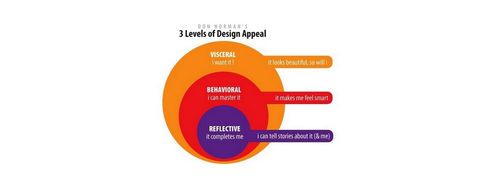
In the human mind there are numerous areas responsible for what we refer to as emotion; collectively, these regions comprise the emotional system. Don Norman proposes the emotional system consists of three different, yet interconnected levels, each of which influences our experience of the world in a particular way. The three levels are visceral, behavioral, and reflective. The visceral level is responsible for the ingrained, automatic and almost animalistic qualities of human emotion, which are almost entirely out of our control. The behavioral level refers to the controlled aspects of human action, where we unconsciously analyze a situation so as to develop goal-directed strategies most likely to prove effective in the shortest time, or with the fewest actions, possible. The reflective level is, as Don Norman states, "...the home of reflection, of conscious thought, of learning of new concepts and generalisations about the world". These three levels, while classified as separate dimensions of the emotional system, are linked and influence one another to create our overall emotional experience of the world.
In Emotional Design: Why we love (or hate) everyday things, Don Norman (a prominent academic in the field of cognitive science, design, and usability engineering) distinguishes between three aspects, or levels, of the emotional system (i.e. the sum of the parts responsible for emotion in the human mind), which are as follows: the visceral, behavioral and reflective levels. Each of these levels or dimensions, while heavily connected and interwoven in the emotional system, influences design in its own specific way. The three corresponding levels of design are outlined below:
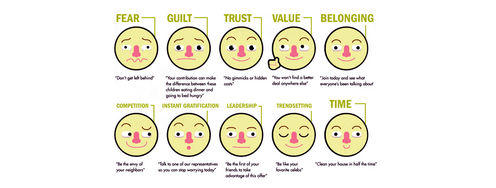
Visceral Design – "Concerns itself with appearances". This level of design refers to the perceptible qualities of the object and how they make the user/observer feel. For example, a grandfather clock offers no more features or time-telling functions than a small, featureless mantelpiece clock, but the visceral (deep-rooted, unconscious, subjective, and automatic feelings) qualities distinguish the two in the eyes of the owner. Much of the time spent on product development is now dedicated to visceral design, as most products within a particular group (e.g., torches/flashlights, kettles, toasters, and lamps) tend to offer the same or a similar set of functions, so the superficial aspects help distinguish a product from its competitors. What we are essentially referring to here is 'branding'—namely, the act of distinguishing one product from another, not by the tangible benefits it offers the user but by tapping into the users’ attitudes, beliefs, feelings, and how they want to feel, so as to elicit such emotional responses. This might be achieved by using pictures of children, animals or cartoon characters to give something the appearance of youthfulness, or by using colors (e.g., red for 'sexy' and black for 'powerful'), shapes (e.g., hard-lined shapes) or even styles (e.g., Art Deco) that are evocative of certain eras. Visceral design aims to get inside the user's/customer's/observer's head and tug at his/her emotions either to improve the user experience (e.g., improving the general visual appeal) or to serve some business interest (e.g., emotionally blackmailing the customer/user/observer to make a purchase, to suit the company's/business's/product owner's objectives).
Behavioral Design – "...has to do with the pleasure and effectiveness of use." Behavioural design is probably more often referred to as usability, but the two terms essentially refer to the practical and functional aspects of a product or anything usable we are capable of using in our environment. Behavioral design (we shall use this term in place of usability from now on) is interested in, for example, how users carry out their activities, how quickly and accurately they can achieve their aims and objectives, how many errors the users make when carrying out certain tasks, and how well the product accommodates both skilled and inexperienced users. Behavioral design is perhaps the easiest to test, as performance levels can be measured once the physical (e.g., handles, buttons, grips, levers, switches, and keys) or usable parts of an object are changed or manipulated in some way. For instance, buttons responsible for two separate operations might be positioned at varying distances from one another so as to test how long it takes the user to carry out the two tasks consecutively. Alternatively, error rates might be measured using the same manipulation(s). Examples of experiences at the behavioral level include the pleasure derived from being able to find a contact and make a call immediately on a mobile phone, the ease of typing on a computer keyboard, the difficulty of typing on a small touchscreen device, such as an iPod Touch, and the enjoyment we feel when using a well-designed computer game controller (such as, in my humble opinion, the N64 control pad). The behavioral level essentially refers to the emotions we feel as a result of either accomplishing or failing to complete our goals. When products/objects enable us to complete our goals with the minimum of difficulty and with little call for conscious effort, the emotions are likely to be positive ones. In contrast, when products restrict us, force us to translate or adjust our goals according to their limitations, or simply make us pay close attention when we are using them, we are more inclined to experience some negative emotion.
Reflective Design – "...considers the rationalization and intellectualization of a product. Can I tell a story about it? Does it appeal to my self-image, to my pride?" This is the highest level of emotional design; representing the conscious thought layer, where we consciously approach a design; weighing up its pros and cons, judging it according to our more nuanced and rational side, and extracting information to determine what it means to us as an individual. Reflective thinking allows us to rationalise environmental information to influence the behavioural level. Take for example smartwatches. On that note, researchers Jaewon Choi and Songcheol Kim at the University of Korea examined users’ intentions to adopt smartwatches under two major factors, namely a user’s perception of the device as a technological innovation and as a luxury fashion product. Users’ view of the smartwatch as a technological innovation relates to their perception of the device’s usefulness and ease of use (the behavioral level). On the other hand, the users’ view of the smartwatch as a luxury fashion product relates to their perception of how much they would enjoy the smartwatch and the levels of self-expressiveness the device will afford to them, i.e. the ability to express themselves and to enhance their image. Both enjoyment and self-expressiveness are influenced by the visceral level ("Does the watch look beautiful?") but also very much by the reflective level ("What will my friends think when they see me wearing this watch? "). The reflective level mediates the effects of the behavioral level – users may well put up with difficulties and shortcomings in the usability of the smartwatch because they believe they will gain other, non-functional benefits from it. Apple’s first version of their smartwatch was riddled with functional problems and usability issues, but that didn’t stop the company from generating the second largest worldwide revenue in the watch industry within the first year of selling it!
The Take Away
Here, we have introduced Don Norman's three levels of design: The visceral, behavioral, and reflective level of design. The visceral level of design refers to the first impression of a design, both in terms of how the user perceives the product and how it makes the user feel. The behavioral level refers to the experience of the product in use. We often think of this level when we think of user experience. The reflective level refers to the user's reflections about the product, both before, during, and after use. The three levels all combine to form the entire product experience.
The perfect follow-up video: The three ways good design makes us happy from Don Norman
References & Where to Learn More
Choi, J., & Kim, S. (2016). “Is the smartwatch an IT product or a fashion product? A study on factors affecting the intention to use smartwatches”. Computers in Human Behavior, 63, 777-786.