Negative Emotions

Your constantly-updated definition of Negative Emotions and collection of videos and articles.
Be a conversation starter: Share this page and inspire others!

317 Shares
Save

Get 1 Powerful Email Each Week

Join 313,076 subscribers.

What are Negative Emotions?

Negative emotion or affect is the experience of feeling negative emotions such as anger, frustration, guilt, nervousness and fear. Inducing negative emotions in your users as they experience your user interface is one of many ways your product could fail. Therefore, it is important to learn how to prevent negative affect in your user experience and induce positive emotions instead.

Learn More About Negative Emotions

Make learning as easy as watching Netflix: Learn more about Negative Emotions by taking the online IxDF Course Emotional Design — How to Make Products People Will Love.

Why? Because design skills make you valuable. In any job. Any industry.

In This Course, You'll

  • Get excited to move past what just works well and looks good as you learn to design products and experiences people love. Every morning your alarm goes off, you shuffle to the kitchen, and you start your daily ritual. Still half-asleep, you boil the kettle, scoop the coffee, and add the milk. And out of every mug you own, you reach for the same one. Every single time. We all have things we choose over and over, sometimes without knowing why. It feels like instinct, but that pull comes from emotional design: It's not just what a product does, but how it makes you feel each time you use it. It's why some things earn a place in our lives while others, even when they're just as functional, get forgotten in a drawer. In this course, design legend and author of the bestselling book "Human-Computer Interaction," Professor Alan Dix, shows you how to use psychology to design for emotion, so that the feelings your product evokes are intentional, not accidental.

  • Make yourself invaluable when you can turn products and experiences that are functional into ones that make people actually feel. In this course you'll learn why people fall in love with some things and abandon others, using Don Norman's three levels of design to make sense of why people respond the way they do. You'll understand the cognitive and affective systems running in every user's head, so you can shape how your work feels before anyone consciously thinks about it. Through Maslow's hierarchy and MacLean's three brains, you'll ground what you build in the instincts, emotions, and reasoning every user carries with them. And with real examples from brands like Apple and Swatch, you'll see how your design choices can earn that connection. AI has made it possible to build more products faster and cheaper than ever, and users are now flooded with endless options. Your timeless, human-centered design skills are what let you look past the screen to the human on the other side, so the people who use what you build feel understood.

  • Gain confidence and credibility because when you design for emotion, you build things that genuinely serve people, earn their trust, and keep them coming back. Emotion is often treated as the soft, unprovable part of design, but according to Gallup, behavioral economists estimate that up to 70% of consumer decisions are driven by emotion rather than logic. In this course, you'll learn to make the business case for emotional design and trade "it just feels better" for a clear explanation of what's working, why it matters, and what you can do about it. You'll also see why a beautiful design isn't just nice to look at: Research shows people perceive attractive things as more usable, even when their actual experience suggests otherwise. And with downloadable templates like the 5 Principles of Humanity-Centered Design, you'll apply your skills immediately.

Learn From Industry Leaders

Master complex skills with proven best practices and toolkits directly from industry leaders. Meet your expert for this course:

  • Alan Dix: Author of the bestselling book “Human-Computer Interaction” and Director of the Computational Foundry at Swansea University.

Earn Industry-Recognized Certificates

Industry giants trust our courses to train their teams, and prestigious universities integrate our content into their curricula. Add your certificates to your LinkedIn profile, résumé, and job applications.

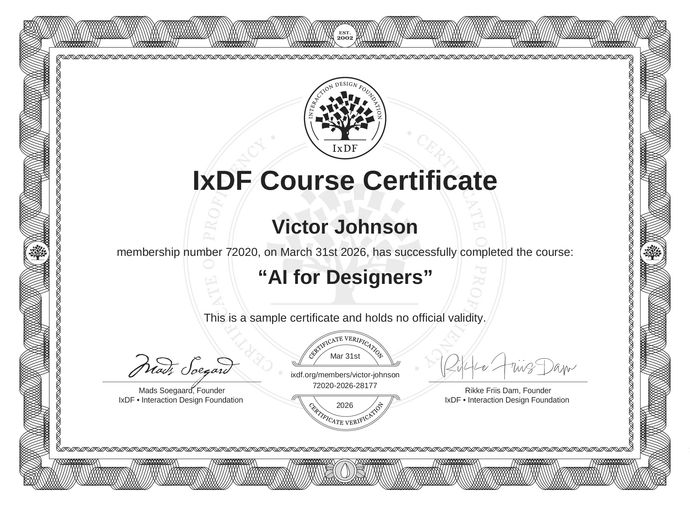
Our clients: IBM, Harvard University, University of Cambridge, NASA, Adobe, Stanford, Massachusetts Institute of Technology, LinkedIn
Course Certificate

All Free IxDF Articles on Negative Emotions
Read full article
How to Prevent Negative Emotions in the User Experience of Your Product - Article hero image

How to Prevent Negative Emotions in the User Experience of Your Product

Learn to prevent negative emotions in the user experience of your product. As a User Experience (UX) designer, you want users to enjoy using your product by eliminating negative experiences and inducing positive emotion in your users. This article will teach you how to prevent anger and frustration

Social shares
902
Published
Read Article
Read full article
Negative Emotional Responses - Article hero image

Negative Emotional Responses

In the developed world, we have the benefit of choice; if a product fails to provide us with a positive emotional experience, we can simply look for an alternative. Consumerism is now more cutthroat than ever; no sooner has one product been released, another, similar product appears in its place on

Social shares
590
Published
Read Article
Read full article
Emotion - Article hero image

Emotion

...emotions, encompassing both positive and negative emotional states, have the potential to benefit us. And not only can emotions have an enduring and positive effect on our psychophysiology, but they provide us with the impetus to choose and pursue different goal paths. This is of particular impor

Social shares
562
Published
Read Article

39% of Today's Skills Will Change by 2030

The World Economic Forum expects 39% of today's skills to be transformed or become outdated by 2030.

The good news is that jobs in UX / UI design and AI are among the fastest-growing professions globally.

Build Skills That Keep You Relevant

Privacy Settings

By using this site, you accept our Cookie Policy and Terms of Use.
Customize
Accept all

Be the One Who Inspires

People remember who shares great ideas.

Share on:

Academic Credibility — On Autopilot

Don't waste time googling citation formats. Just copy, paste and look legit in seconds.