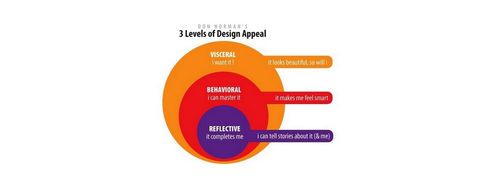
People form emotional connections and associations with the things they use and come across throughout their lives. These connections and associations help guide our behavior and determine how we perceive the world. Designers must grasp how to encourage emotional connections between users and their products. In order to influence emotions, you must have an understanding of general factors that impact all users, regardless of the product, and factors specific to your product.
Our experience of emotion is something we largely take for granted. For the most part, emotions are sensations, feelings, and physiological states that are not under our control. We experience emotion as a direct and immediate result of our involvement and interaction with the world. When someone walks through a door and lets it go in your face, you probably feel angry, and when you hold a door for others but they don’t say thank you, you likely feel the same emotion. Emotions are complicated, context-specific, and affected by our disposition, personality, and other personal factors (e.g., our relation to people), but we all know what is meant by 'Emotion'.
The Power of Emotion
When we talk to one another about how something made us feel, we don't have to explain what we mean by 'angry', 'sad', 'happy', 'anxious', 'excited', or any other word describing an emotional state. These words instantly arouse an understanding and, on occasion, similar physical and psychological sensations, which help us appreciate exactly how the other person feels or felt at some point in time. The human capacity for emotion informs, directs, and, to a large extent, determines our experience of the world, how we navigate it, and our relations with the things – both animate and inanimate – within it.
In the same way, we do not have to experience the exact same conditions as someone else in order to understand how he/she feels/felt, we can judge how our behavior or a particular scenario might make us feel, without actually having to engage in the act or being in that situation. This ability enables us to choose behaviors and make decisions, when interacting with our environment, which are advantageous or, at the very least, have minimal cost to us physically and/or mentally. At the most basic level of human behavior, we can say an action or event is most likely to be carried out or engaged in when there is a significant chance of experiencing a positive emotion, such as happiness, while it becomes increasingly less likely as the emotion becomes progressively more negative.
Emotional Associations and Connections
Emotions become associated with objects, things, places, time periods, and any other element in your life. Once we have formed an emotional association between an object/scenario/thing, etc. and a psychophysiological state, just by simply sensing (i.e. seeing, hearing, tasting, etc.) it again, the same emotion is often evoked. For example, you may have a toy or some other object from your childhood that has sentimental value; once you take it in hand, the same or similar emotions are evoked from your childhood. As a result, we become attached to and feel some emotional connection with the things that have featured in our lives. These emotional connections or associations can be powerful and enduring.
Creating Emotional Experiences
Designers are essentially striving to develop products that encourage the user to form these emotional connections and associations. From the materials, colors, textures, and other aesthetic qualities of a product to the adverts used to attract customers, attempts are being made to make people feel. Designers are not, on the whole, making their products a certain color because it is their own personal favorite or it matches the color of their eyes; it is a conscious decision based on human psychology. Likewise, advertisers are not using images of puppies, kittens, and attractive people for some arbitrary reason; they are trying to tap into the way you think and use things that induce an instant emotional response.
While many of our emotional connections and associations are specific to our world experience, products are designed to induce an emotional response in thousands, if not millions of people. In order to achieve such a feat, they must grasp a whole variety of factors – some general, some specific.
General factors include:
Human cognition
The way we think, learn, solve problems, make decisions, and simply consume information.
Human psychology
We are developing an ever-growing understanding of how things affect our emotions, including colors, sounds, music, shapes, people, faces, and a whole range of other elements. For the most part, human psychology is similar across most of the world's population, so designers can usually be pretty confident that their products will induce a similar emotional response from one person to another.
Culture
Users' cultural experiences influence cognition and psychology, so this is an extremely important factor to consider before developing a product or refining an existing product for a different culture. This could fall into the 'specific' consideration category, but releasing a product to a large potential user base involves generalization. Within each household, there are probably aspects that you might think represent a culture specific to that group of people, but designers would find it impossible to contend with all of these individual 'micro-cultures'. Therefore, designers must research and develop products according to the dominant culture, whilst remaining as sensitive to the specific 'micro-cultures' as possible in the final product.
Specific factors include:
Psychological and physical qualities specific to your particular user base
For example, someone developing products for arthritis sufferers must have an understanding of how this condition impedes mobility and flexibility. If the product demands that the user has to grip some part firmly or there is a specific shape requiring dexterity, this is likely to cause frustration, sadness and the product will probably sink without trace.
Dispositional factors
These refer to how the user is likely to feel at the time of using a particular product. For example, someone using a touchscreen train ticket machine will probably be in a hurry. The design of the machine and its interface needs to reflect the users' desire for speed, ease of use, and clear instructions to help them through the process. To further this example, the machine may also likely be used by tourists. The ability to switch the interface language easily from any state of the interface is crucial (some people simply abandon the process mid-way without returning to the main menu!). Think about the wording in the interface – the machine may be used by people from varied educational backgrounds, so you must avoid any text that includes jargon or complicated terminology. Your users may also span all age groups. You may consider the colors, include helpful animations and pleasant sounds that accompany visual feedback, and provide eye-catching and clear large fonts to ensure that everyone is encouraged to use the machine.
Situational factors (Context of Use)
Where will the product be used? How will the product fit into the user's life? Does the product work in combination or next to other things found in the user's work set-up? If your product will be used in an area with restricted space, making it large, cumbersome or an odd shape will probably infuriate the users and impede their productivity (this also applies to screen space, not just physical space!). When the product is meant to mobilize the user (i.e. it can be used in various environments and places), as the designer you must ensure it is sensitive to the variety of conditions in which it will be used (e.g., different light conditions, public situations where discreetness is required, and the effects of motion on usability).
For each new product, there are usually other factors to consider, but the general and specific factors outlined above are usually certainties. A good example of the application of these factors to designing digital products can be found in the work of Katie Bessiere, a researcher at Carnegie Mellon University and her colleagues (2006). They found that situational and dispositional factors play a major role in the emergence of frustration during work carried out using computers.
The Take Away
People form emotional connections and associations with the things they use and come across throughout their lives. These connections and associations help guide our behavior and determine how we perceive the world. As designers, we must grasp how to encourage emotional connections between users and our products. In order to influence emotions, you must have an understanding of general factors which impact on all users, regardless of the product, and factors specific to your product. It’s the only way to make your designs relevant and catapult them soundly into the context of the users, wherever and whenever they may access them.
References & Where to Learn More
Hero Image: Copyright Holder: Coxblue.com Copyright terms and license: Fair Use.
Bessiere, K., Newhagen, J. E., Robinson, J. P., & Shneiderman, B. (2006). A model for computer frustration: The role of instrumental and dispositional factors on incident, session, and post-session frustration and mood. Computers in human behavior, 22(6), 941-961.