“Clearly there are some products that stand little chance of ever becoming symbolic in people's lives-like Ethernet routers, for instance—no matter how wonderful they look or well they behave. However, when the design of a product or service addresses users' goals and motivations-possibly going beyond the product's primary purpose, yet somehow connected to it via personal or cultural associations-the opportunity for the creation of reflective meaning is greatly enhanced.”
—Robert Reimann (2005) Personas, Goals and Emotional Design
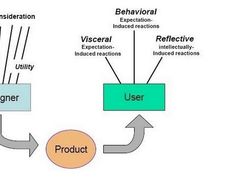
In their work titled “The role of affect and proto-affect in effective functioning” (2004), researchers and prominent usability experts Don Norman, Andrew Ortony, and William Revelle paved the way towards one of the most well-known approaches to emotion and design. Their three-level model of emotional design offers a new perspective when assessing and considering the design process. Norman et al.'s model emphasizes the importance of emotion to the user experience—taking the less well-trodden route of focusing on how the user feels when interacting with a product, as opposed to the usability considerations, which tend to dominate our thinking. Each of the layers of this model refers to a particular type of processing, and for each of these tiers or levels there is a corresponding area of design. Here, we shall concentrate on the highest tier of the emotional design model: reflective processing.
According to Don Norman, reflective processing is the only conscious form of processing. This process involves the active consideration of a product, encompassing how it relates to us personally, its place in our wider environment, and how it reflects upon us to own and use it. Reflective design is, therefore, concerned with how users rationalize and intellectualize a product according to highly personal and subjective factors (Norman, 2004). At this level, people might ask how the product fits in with their current self-image, whether it reflects upon them in a positive or negative way, whether they would be able to tell a personally meaningful story about it, and whether it would enable them to connect with other people.
Know your users
Essentially, if we are to design for the reflective level of the emotional design model, we must focus on what the product means to the intended user base, whether there is an existing set of attitudes towards the product or you are seeking to attach specific, meaningful messages to the product. Regardless of whether there is an established message attached or you are trying to impose meaning to your product, at the heart of reflective design is the user's self-image. The predominant opinion is that we must now influence users or potential customers on some emotional level. When products elicit some positive emotional response, it is assumed that we will feel a connection with the product, which is more likely to influence our behavior with that particular product and the brand.
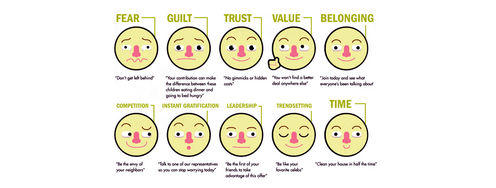
For example, most advertisements in the early 21st century are pretty meaningless as far as the functional or behavioral aspects of the product are concerned. Segments of people dancing around with their Apple products or acting out some scenario where they are supposedly having an amazing time do not show us how we can access our emails, download mp3s or make phone calls. There is very little information about the product itself; instead, we are fed scenes which attempt to associate certain types of people, experiences, and situations with the product. Do you wish you were rich and famous? Well, here is a scene where someone rich and famous is using a particular product; so, maybe this could be...you! But wait; you don't own the product yet, so how could you possibly achieve this lifestyle? Aha!—we can suddenly see what calculus is at work here! “Buy this wonderful new set of hair straighteners/mp3 player/smart phone/computer/game/fashion item, etc., etc. and you too could realize your dreams.”
Tapping into the Reflective Level
Advertising presents one way of tapping into the reflective level, but there are a number of other effective methods, such as branding, packaging, and perhaps most importantly ensuring the product possesses certain properties, qualities, and functions. When making our purchasing decisions, all products will stimulate the reflective level. Many of these decisions are informed by the practical or functional elements. However, we are just as inclined to take other factors into consideration that have much less of a bearing on our behavioral experience. As Rogers, Sharp, and Preece state in Interaction Design: Beyond Human-Computer Interaction:
“...the design of a Swatch watch focuses on reflective aspects, where the aesthetics and the use of cultural images and graphical elements are central. Brilliant colours, wild designs, and art are very much part of the Swatch trademark and are what draw people to buy and wear their watches.”
Below is a list of reflective operations which influence the decisions we make and the emotional attachments we form with the things in our environment:
Analyzing superficial qualities
This might be according to our present likes/dislikes, how we feel at the time, where the product will go, how you intend to use it, and who will see it. For example, we often make decisions based on how others will judge us; you don't see many people walking around with a 'ghetto blaster' on their shoulders anymore (maybe this was just something that happened in films?), but teenagers happily walk around with mobile and smart phones with music playing out (usually much to the annoyance of everyone else around them). Decibel for decibel, the 1985 ghetto blaster may have been able to pack more menace, but the sheer prevalence and easier portability of smart phones means many more of these can infuse joyful tunes/noise pollution into many more locations at the same time.
Reflecting on past experiences
How did we last feel when using a particular product? If a product possesses qualities similar to an object we have used previously, it might evoke some of the emotions and thoughts aroused at the time. Reflective processing takes place when we access things in long-term memory to make value judgments. By reflecting on past experiences and relating these to the products we are using, everyday things are incorporated into our overall experience of the world—and they become as much a part of our memories as what we are doing, who we are with, and where we are. Many products are now even part of the memory-forming experience; cameras, iPhones, computers—all of these things help us mark occasions and collect mementoes, and they provide us with a permanent record of our activities.
Attaching meaning for personal development
When we look at a product, we sometimes project our thoughts, attitudes, hopes, and intentions onto it. For example, millions of people, at the start of every year, seek out and spend millions if not billions of pounds/dollars on exercise equipment. All of these purchases are based on the desire for a new, better 'you', and the products people buy represent this drive. For every piece of exercise equipment people buy, they probably have ten times as many conversations about buying it and how they are going to stick to a particular regime. Products are part of people's lives, and they are now used as symbols of who we are or—perhaps more often—symbols of who we want to be. The challenge for us as designers is to show our products in a way that plays on the desires of our target market. For example, if you want people to buy your trainers, then you are probably going to use someone fit and athletic to showcase them. And if you are selling games, you will show the ‘model player(s)’ having fun. These are very basic examples, but attaching meaning to products as a way of seducing users/customers is a complex task requiring knowledge of your target market, their culture, and some psychology.
The Take Away
Reflective design is the highest level of Norman, Ortony, and Revelle's three-level model of emotion and design. At this level, we use information from both visceral and behavioral processing (i.e. the other layers) in combination with our knowledge and experiences. Unlike the visceral and behavioral levels, reflective processing does not have direct access to sensory information. Instead, sensory information is filtered through the unconscious levels of processing (i.e. visceral and behavioral), which influences our perspective and thoughts as a result. Reflective design presents the biggest challenge to us as designers, as customers and users have different opinions, attitudes, memories, and life experiences which are called upon when we make value judgments during reflective processing. To tap into the reflective level successfully, we must investigate what users want from our products, not just in terms of how they intend to use them but also how they might fit into and enhance their lives.
References & Where to Learn More
Course: Emotional Design — How to Make Products People Will Love
Ortony, A., Norman, D. A., & Revelle, W. (2005). “Affect and proto-affect in effective functioning”. Who needs emotions, 173-202.
Sharp, H., Rogers, Y., & Preece, J. (2015). Interaction design: beyond human-computer interaction (4th edition). Wiley & Sons
Robert Reimann (2005). Persona, Goals, and Emotional Design